MOTION IN A PLANE –PROJECTILE & CIRCULAR MOTION
TOPICS COVERED
Position and Displacement Vectors
Velocity
Rectangular Components of Velocity
Acceleration
Rectangular Components of Acceleration
Displacement equations of Motion in a Plane with constant acceleration
Relative Velocity
Magnitude and direction of Relative Velocity
Projectile Motion
Displacement and Velocity Equations of Projectile Motion
Trajectory of Projectile
Time of Flight of Projectile
Maximum Height of Projectile
Range of Projectile
Uniform Circular Motion
Relation between linear velocity and angular velocity.
Centripetal Acceleration
Position and Displacement Vectors
X
Y
O
r
i
x
j
y
P
The position vector r of a particle P located in a
plane with reference to the origin of an x-y
reference frame is given by
i
= x
r j
+ y
O
Y
X
r
P′
r′
P
Δr
Δy
Δx
Direction of vav
Let the particle move through the curve
from P at time t to P′ at time t′. Then
Displacement vector is r
r′-
Δr =
It is directed from P to P′.
or Δr = (x′i j
+ y′ ) - i
(x j
+ y )
i
= Δx j
+ Δy
where Δx = x′ - x and Δy = y′ - y
where x and y are components of r
along x- and y- axes.
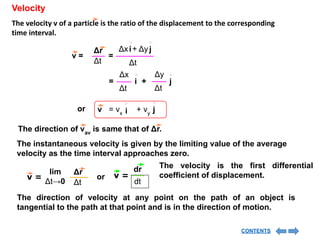
Velocity
The velocity v of a particle is the ratio of the displacement to the corresponding
time interval.
v =
Δt
Δr
=
i
Δx j
+ Δy
Δt
= i
Δx
Δt
j
+
Δy
Δt
or
The direction of vav
is same that of Δr.
The instantaneous velocity is given by the limiting value of the average
velocity as the time interval approaches zero.
v =
Δr
Δt
lim
Δt→0
dr
dt
v =
or
The direction of velocity at any point on the path of an object is
tangential to the path at that point and is in the direction of motion.
i
= vx
v j
+ vy
The velocity is the first differential
coefficient of displacement.
CONTENTS
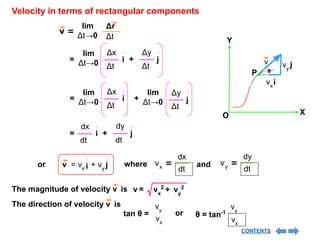
Velocity in terms of rectangular components
v =
Δr
Δt
lim
Δt→0
= i
Δx
Δt
j
+
Δy
Δt
lim
Δt→0
= i
Δx
Δt
+
lim
Δt→0 j
Δy
Δt
lim
Δt→0
= i
dx
dt
j
+
dy
dt
or
dx
dt
vx
=
dy
dt
vy
=
where and
i
= vx
v j
+ vy
The direction of velocity v is
tan θ =
vy
vx
or θ = tan-1
vy
vx
The magnitude of velocity v is v = vx
2
+ vy
2
X
Y
O
i
vx
j
vy
v
P θ
CONTENTS
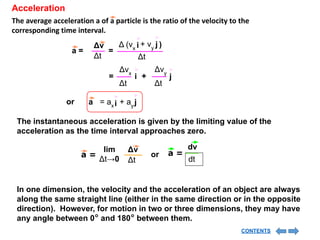
Acceleration
The average acceleration a of a particle is the ratio of the velocity to the
corresponding time interval.
= i
Δvx
Δt
j
+
Δvy
Δt
a =
Δt
Δv
=
Δt
i
Δ (vx
j
+ vy )
i
= ax
a j
+ ay
or
The instantaneous acceleration is given by the limiting value of the
acceleration as the time interval approaches zero.
a =
Δv
Δt
lim
Δt→0
dv
dt
a =
or
In one dimension, the velocity and the acceleration of an object are always
along the same straight line (either in the same direction or in the opposite
direction). However, for motion in two or three dimensions, they may have
any angle between 0° and 180° between them.
CONTENTS
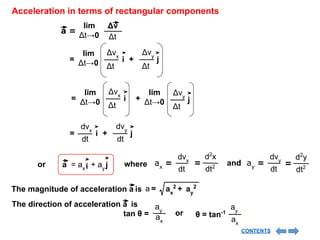
Acceleration in terms of rectangular components
a =
Δv
Δt
lim
Δt→0
= i
Δvx
Δt
j
+
Δvy
Δt
lim
Δt→0
= i
Δvx
Δt
+
lim
Δt→0 j
Δvy
Δt
lim
Δt→0
= i
dvx
dt
j
+
dvy
dt
or i
= ax
a j
+ ay
The direction of acceleration a is
tan θ =
ay
ax
or θ = tan-1
ay
ax
The magnitude of acceleration a is a = ax
2
+ ay
2
where
dvx
dt
ax
=
d2
x
dt2
= and
dvy
dt
ay
=
d2
y
dt2
=
CONTENTS
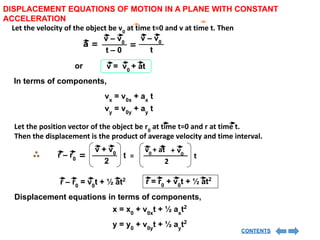
DISPLACEMENT EQUATIONS OF MOTION IN A PLANE WITH CONSTANT
ACCELERATION
Let the velocity of the object be v0
at time t=0 and v at time t. Then
a =
v – v0
t – 0
=
v – v0
t
v = v0
+ at
or
In terms of components,
vx
= v0x
+ ax
t
vy
= v0y
+ ay
t
Let the position vector of the object be r0
at time t=0 and r at time t.
Then the displacement is the product of average velocity and time interval.
t
r – r0
2
v + v0
= t
2
=
v0
v0
+ at +
r – r0
= v0
t + ½ at2 r = r0
+ v0
t + ½ at2
Displacement equations in terms of components,
x = x0
+ v0x
t + ½ ax
t2
y = y0
+ v0y
t + ½ ay
t2
CONTENTS
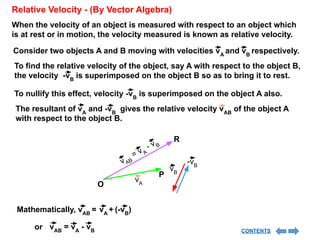
When the velocity of an object is measured with respect to an object which
is at rest or in motion, the velocity measured is known as relative velocity.
Relative Velocity - (By Vector Algebra)
Consider two objects A and B moving with velocities vA
and vB
respectively.
To find the relative velocity of the object, say A with respect to the object B,
the velocity -vB
is superimposed on the object B so as to bring it to rest.
To nullify this effect, velocity -vB
is superimposed on the object A also.
The resultant of vA
and -vB
gives the relative velocity vAB
of the object A
with respect to the object B.
Mathematically, vAB
= vA
+ (-vB
)
vA
vB
P
v AB
= v A
- v B
R
O
-vB
vAB
= vA
- vB
or CONTENTS
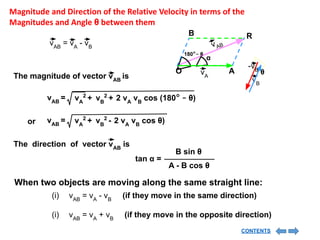
When two objects are moving along the same straight line:
B
O
R
α
θ
180°- θ
vA
vB
-vB
A
vAB
= vA
- vB vAB
The magnitude of vector vAB
is
The direction of vector vAB
is
B sin θ
tan α =
A - B cos θ
(i) vAB
= vA
- vB
(if they move in the same direction)
(i) vAB
= vA
+ vB
(if they move in the opposite direction)
vAB
= vA
2
+ vB
2
- 2 vA
vB
cos θ)
or
Magnitude and Direction of the Relative Velocity in terms of the
Magnitudes and Angle θ between them
vAB
= vA
2
+ vB
2
+ 2 vA
vB
cos (180° - θ)
CONTENTS
PROJECTILE MOTION
An object that is in flight after it being thrown or projected is called a
projectile.
Projectile
Projectile Motion
The motion of a projectile which is in flight after it being thrown or
projected is called projectile motion.
It can be understood as the result of two separate, simultaneously
occurring components of motion (along x- and y- axes).
The component along the horizontal direction (x- axis) is without
acceleration.
The component along the vertical direction (y- axis) is with constant
acceleration under the influence of gravity.
In our study, the air resistance is negligible and the acceleration due to
gravity is constant over the entire path of the projectile.
CONTENTS
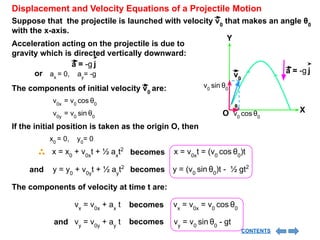
Displacement and Velocity Equations of a Projectile Motion
Suppose that the projectile is launched with velocity v0
that makes an angle θ0
with the x-axis.
X
Y
O
v0
θ0
v0
cos θ0
v0
sin θ0
j
a = -g
Acceleration acting on the projectile is due to
gravity which is directed vertically downward:
j
a = -g
or ax
= 0, ay
= -g
v0x
= v0
cos θ0
v0y
= v0
sin θ0
If the initial position is taken as the origin O, then
x0
= 0, y0
= 0
becomes
x = x0
+ v0x
t + ½ ax
t2
x = v0x
t = (v0
cos θ0
)t
The components of initial velocity v0
are:
and y = y0
+ v0y
t + ½ ay
t2
becomes y = (v0
sin θ0
)t - ½ gt2
The components of velocity at time t are:
vx
= v0x
+ ax
t becomes vx
= v0x
= v0
cos θ0
vy
= v0y
+ ay
t
and becomes vy
= v0
sin θ0
- gt
CONTENTS
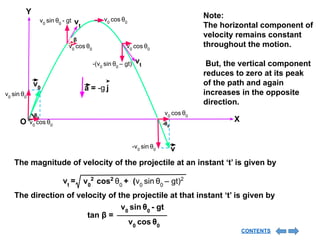
The magnitude of velocity of the projectile at an instant ‘t’ is given by
vt
= v0
2
cos2
θ0
+ (v0
sin θ0
– gt)2
The direction of velocity of the projectile at that instant ‘t’ is given by
v0
sin θ0
- gt
tan β =
v0
cos θ0
Note:
The horizontal component of
velocity remains constant
throughout the motion.
But, the vertical component
reduces to zero at its peak
of the path and again
increases in the opposite
direction.
j
a = -g
X
Y
O
v0
θ0
v0
cos θ0
v0
sin θ0
v0
cos θ0
v0
cos θ0
v0
sin θ0
- gt
-(v0
sin θ0
– gt)
v0
cos θ0
v
-θ0
v0
cos θ0
-v0
sin θ0
vt
β
vt
CONTENTS
Trajectory (Path) of a projectile
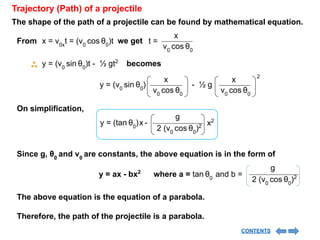
The shape of the path of a projectile can be found by mathematical equation.
x = v0x
t = (v0
cos θ0
)t
From we get
v0
cos θ0
x
t =
y = (v0
sin θ0
) - ½ g
v0
cos θ0
x
v0
cos θ0
x 2
On simplification,
y = (tan θ0
) -
x
2 (v0
cos θ0
)2
g
x2
Since g, θ0
and v0
are constants, the above equation is in the form of
y = ax - bx2
where a = tan θ0
and b =
2 (v0
cos θ0
)2
g
The above equation is the equation of a parabola.
Therefore, the path of the projectile is a parabola.
y = (v0
sin θ0
)t - ½ gt2
becomes
CONTENTS
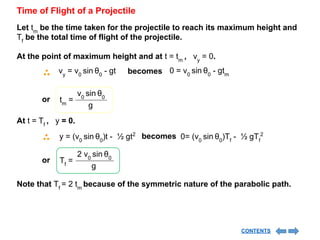
Time of Flight of a Projectile
Let tm
be the time taken for the projectile to reach its maximum height and
Tf
be the total time of flight of the projectile.
At the point of maximum height and at t = tm
, vy
= 0.
At t = Tf
, y = 0.
vy
= v0
sin θ0
- gt becomes 0 = v0
sin θ0
- gtm
y = (v0
sin θ0
)t - ½ gt2 becomes 0= (v0
sin θ0
)Tf
- ½ gTf
2
Note that Tf
= 2 tm
because of the symmetric nature of the parabolic path.
or
v0
sin θ0
g
tm
=
or
2 v0
sin θ0
g
Tf
=
CONTENTS
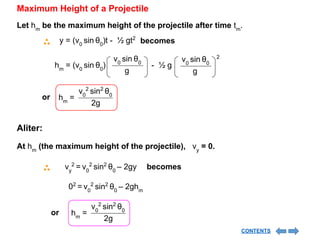
Maximum Height of a Projectile
Let hm
be the maximum height of the projectile after time tm
.
y = (v0
sin θ0
)t - ½ gt2
becomes
hm
= (v0
sin θ0
) - ½ g
2
v0
sin θ0
g
v0
sin θ0
g
or
v0
2
sin2
θ0
2g
hm
=
Aliter:
At hm
(the maximum height of the projectile), vy
= 0.
vy
2
= v0
2
sin2
θ0
– 2gy becomes
02
= v0
2
sin2
θ0
– 2ghm
or
v0
2
sin2
θ0
2g
hm
=
CONTENTS
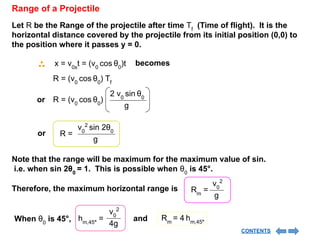
Range of a Projectile
Let R be the Range of the projectile after time Tf
(Time of flight). It is the
horizontal distance covered by the projectile from its initial position (0,0) to
the position where it passes y = 0.
becomes
x = v0x
t = (v0
cos θ0
)t
R = (v0
cos θ0
) Tf
or R = (v0
cos θ0
)
2 v0
sin θ0
g
or
v0
2
sin 2θ0
g
R =
Note that the range will be maximum for the maximum value of sin.
i.e. when sin 2θ0
= 1. This is possible when θ0
is 45°.
v0
2
g
Rm
=
Therefore, the maximum horizontal range is
When θ0
is 45°,
v0
2
4g
hm,45°
= and Rm
= 4 hm,45°
CONTENTS
X
Y
O
v0
Rmax
α
α
45°
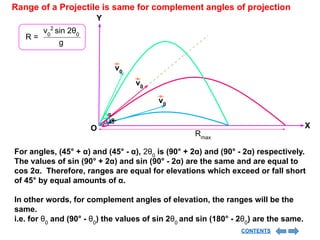
Range of a Projectile is same for complement angles of projection
v0
2
sin 2θ0
g
R =
For angles, (45° + α) and (45° - α), 2θ0
is (90° + 2α) and (90° - 2α) respectively.
The values of sin (90° + 2α) and sin (90° - 2α) are the same and are equal to
cos 2α. Therefore, ranges are equal for elevations which exceed or fall short
of 45° by equal amounts of α.
In other words, for complement angles of elevation, the ranges will be the
same.
i.e. for θ0
and (90° - θ0
) the values of sin 2θ0
and sin (180° - 2θ0
) are the same.
v0
v0
CONTENTS
UNIFORM CIRCULAR MOTION
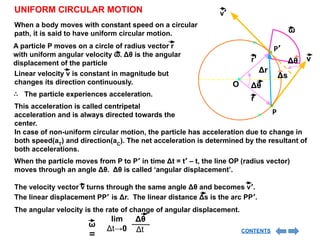
When a body moves with constant speed on a circular
path, it is said to have uniform circular motion.
P’
v’
ω
r'
A particle P moves on a circle of radius vector r
with uniform angular velocity ω. Δθ is the angular
displacement of the particle
Linear velocity v is constant in magnitude but
changes its direction continuously.
∴ The particle experiences acceleration.
This acceleration is called centripetal
acceleration and is always directed towards the
center.
v
P
r
O
Δr
The angular velocity is the rate of change of angular displacement.
Δs
Δθ
Δθ
ω
=
Δθ
Δt
lim
Δt→0
The velocity vector v turns through the same angle Δθ and becomes v’.
The linear displacement PP’ is Δr. The linear distance Δs is the arc PP’.
When the particle moves from P to P’ in time Δt = t’ – t, the line OP (radius vector)
moves through an angle Δθ. Δθ is called ‘angular displacement’.
In case of non-uniform circular motion, the particle has acceleration due to change in
both speed(aT
) and direction(aC
). The net acceleration is determined by the resultant of
both accelerations.
CONTENTS
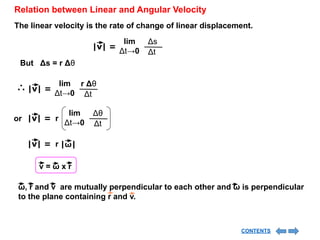
|v| =
Δs
Δt
lim
Δt→0
But Δs = r Δθ
|v| =
r Δθ
Δt
lim
Δt→0
|v| =
Δθ
Δt
lim
Δt→0
r
|v| = r |ω|
The linear velocity is the rate of change of linear displacement.
∴
or
ω, r and v are mutually perpendicular to each other and ω is perpendicular
to the plane containing r and v.
v = ω x r
Relation between Linear and Angular Velocity
CONTENTS
P’
v’
ω
r' v
P
r
O
Δr
Δs
Δθ
Δθ Δv
Δθ
Δv
Δθ
Δv
Δθ
Δv
Δθ
Δv
Δθ
v
v’
V
V
V
V
V’
β
β
β
β
Acceleration in Uniform Circular Motion : Centripetal Acceleration
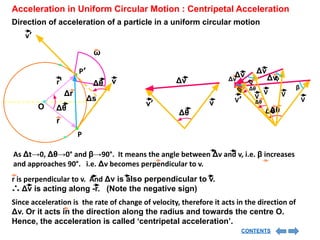
Direction of acceleration of a particle in a uniform circular motion
As Δt→0, Δθ→0° and β→90°. It means the angle between Δv and v, i.e. β increases
and approaches 90°. i.e. Δv becomes perpendicular to v.
r is perpendicular to v. And Δv is also perpendicular to v.
∴ Δv is acting along -r. (Note the negative sign)
Since acceleration is the rate of change of velocity, therefore it acts in the direction of
Δv. Or it acts in the direction along the radius and towards the centre O.
Hence, the acceleration is called ‘centripetal acceleration’.
CONTENTS
Magnitude of acceleration of a particle in a uniform circular motion
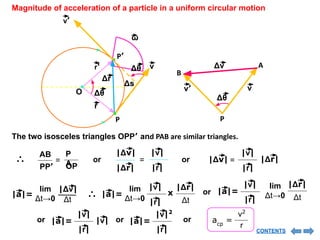
The two isosceles triangles OPP’ and PAB are similar triangles.
∴ =
AB
PP’
P
A
OP
or
|v|
|Δv|
=
|Δr| |r|
or
|v|
|Δv| = |Δr|
|r|
|Δv|
|a|=
Δt
lim
Δt→0
∴ |a|=
lim
Δt→0 Δt
|v| |Δr|
|r|
x |a|=
lim
Δt→0 Δt
|Δr|
|v|
|r|
or
or |a|=
|v|
|r|
|v| |a|=
|v|2
|r|
or or acp
=
v2
r
P’
v’
ω
r' v
P
r
O
Δr
Δs
Δθ
Δθ Δv
Δθ
v
v’
P
A
B
CONTENTS
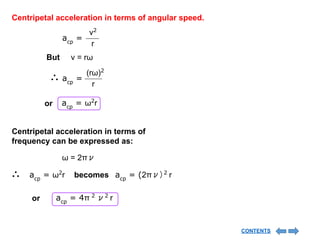
Centripetal acceleration in terms of angular speed.
acp
=
v2
r
But v = rω
∴ acp
=
(rω)2
r
or acp
= ω2
r
Centripetal acceleration in terms of
frequency can be expressed as:
ω = 2πν
∴ acp
= ω2
r becomes acp
= (2πν)2
r
or acp
= 4π 2
ν2
r
CONTENTS
ω
P
r
acp
O
v
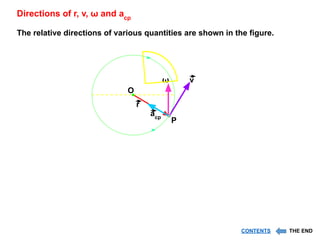
Directions of r, v, ω and acp
The relative directions of various quantities are shown in the figure.
CONTENTS THE END
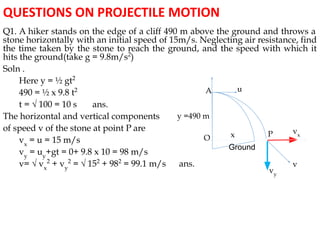
QUESTIONS ON PROJECTILE MOTION
Q1. A hiker stands on the edge of a cliff 490 m above the ground and throws a
stone horizontally with an initial speed of 15m/s. Neglecting air resistance, find
the time taken by the stone to reach the ground, and the speed with which it
hits the ground(take g = 9.8m/s2
)
Soln .
Here y = ½ gt2
490 = ½ x 9.8 t2
t = √ 100 = 10 s ans.
The horizontal and vertical components
of speed v of the stone at point P are
vx
= u = 15 m/s
vy
= uy
+gt = 0+ 9.8 x 10 = 98 m/s
v= √ vx
2
+ vy
2
= √ 152
+ 982
= 99.1 m/s ans.
A
O
Ground
x
y =490 m
v
vy
vx
u
P
QUESTIONS ON PROJECTILE MOTION
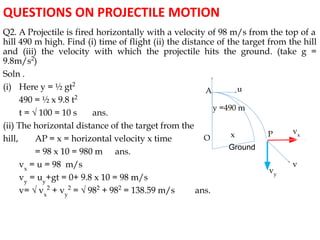
Q2. A Projectile is fired horizontally with a velocity of 98 m/s from the top of a
hill 490 m high. Find (i) time of flight (ii) the distance of the target from the hill
and (iii) the velocity with which the projectile hits the ground. (take g =
9.8m/s2
)
Soln .
(i) Here y = ½ gt2
490 = ½ x 9.8 t2
t = √ 100 = 10 s ans.
(ii) The horizontal distance of the target from the
hill, AP = x = horizontal velocity x time
= 98 x 10 = 980 m ans.
vx
= u = 98 m/s
vy
= uy
+gt = 0+ 9.8 x 10 = 98 m/s
v= √ vx
2
+ vy
2
= √ 982
+ 982
= 138.59 m/s ans.
A
O
Ground
x
y =490 m
v
vy
vx
u
P

4. Motion in a Plane 1.pptx.pdf

  • 1.
    MOTION IN APLANE –PROJECTILE & CIRCULAR MOTION TOPICS COVERED Position and Displacement Vectors Velocity Rectangular Components of Velocity Acceleration Rectangular Components of Acceleration Displacement equations of Motion in a Plane with constant acceleration Relative Velocity Magnitude and direction of Relative Velocity Projectile Motion Displacement and Velocity Equations of Projectile Motion Trajectory of Projectile Time of Flight of Projectile Maximum Height of Projectile Range of Projectile Uniform Circular Motion Relation between linear velocity and angular velocity. Centripetal Acceleration
  • 2.
    Position and DisplacementVectors X Y O r i x j y P The position vector r of a particle P located in a plane with reference to the origin of an x-y reference frame is given by i = x r j + y O Y X r P′ r′ P Δr Δy Δx Direction of vav Let the particle move through the curve from P at time t to P′ at time t′. Then Displacement vector is r r′- Δr = It is directed from P to P′. or Δr = (x′i j + y′ ) - i (x j + y ) i = Δx j + Δy where Δx = x′ - x and Δy = y′ - y where x and y are components of r along x- and y- axes.
  • 3.
    Velocity The velocity vof a particle is the ratio of the displacement to the corresponding time interval. v = Δt Δr = i Δx j + Δy Δt = i Δx Δt j + Δy Δt or The direction of vav is same that of Δr. The instantaneous velocity is given by the limiting value of the average velocity as the time interval approaches zero. v = Δr Δt lim Δt→0 dr dt v = or The direction of velocity at any point on the path of an object is tangential to the path at that point and is in the direction of motion. i = vx v j + vy The velocity is the first differential coefficient of displacement. CONTENTS
  • 4.
    Velocity in termsof rectangular components v = Δr Δt lim Δt→0 = i Δx Δt j + Δy Δt lim Δt→0 = i Δx Δt + lim Δt→0 j Δy Δt lim Δt→0 = i dx dt j + dy dt or dx dt vx = dy dt vy = where and i = vx v j + vy The direction of velocity v is tan θ = vy vx or θ = tan-1 vy vx The magnitude of velocity v is v = vx 2 + vy 2 X Y O i vx j vy v P θ CONTENTS
  • 5.
    Acceleration The average accelerationa of a particle is the ratio of the velocity to the corresponding time interval. = i Δvx Δt j + Δvy Δt a = Δt Δv = Δt i Δ (vx j + vy ) i = ax a j + ay or The instantaneous acceleration is given by the limiting value of the acceleration as the time interval approaches zero. a = Δv Δt lim Δt→0 dv dt a = or In one dimension, the velocity and the acceleration of an object are always along the same straight line (either in the same direction or in the opposite direction). However, for motion in two or three dimensions, they may have any angle between 0° and 180° between them. CONTENTS
  • 6.
    Acceleration in termsof rectangular components a = Δv Δt lim Δt→0 = i Δvx Δt j + Δvy Δt lim Δt→0 = i Δvx Δt + lim Δt→0 j Δvy Δt lim Δt→0 = i dvx dt j + dvy dt or i = ax a j + ay The direction of acceleration a is tan θ = ay ax or θ = tan-1 ay ax The magnitude of acceleration a is a = ax 2 + ay 2 where dvx dt ax = d2 x dt2 = and dvy dt ay = d2 y dt2 = CONTENTS
  • 7.
    DISPLACEMENT EQUATIONS OFMOTION IN A PLANE WITH CONSTANT ACCELERATION Let the velocity of the object be v0 at time t=0 and v at time t. Then a = v – v0 t – 0 = v – v0 t v = v0 + at or In terms of components, vx = v0x + ax t vy = v0y + ay t Let the position vector of the object be r0 at time t=0 and r at time t. Then the displacement is the product of average velocity and time interval. t r – r0 2 v + v0 = t 2 = v0 v0 + at + r – r0 = v0 t + ½ at2 r = r0 + v0 t + ½ at2 Displacement equations in terms of components, x = x0 + v0x t + ½ ax t2 y = y0 + v0y t + ½ ay t2 CONTENTS
  • 8.
    When the velocityof an object is measured with respect to an object which is at rest or in motion, the velocity measured is known as relative velocity. Relative Velocity - (By Vector Algebra) Consider two objects A and B moving with velocities vA and vB respectively. To find the relative velocity of the object, say A with respect to the object B, the velocity -vB is superimposed on the object B so as to bring it to rest. To nullify this effect, velocity -vB is superimposed on the object A also. The resultant of vA and -vB gives the relative velocity vAB of the object A with respect to the object B. Mathematically, vAB = vA + (-vB ) vA vB P v AB = v A - v B R O -vB vAB = vA - vB or CONTENTS
  • 9.
    When two objectsare moving along the same straight line: B O R α θ 180°- θ vA vB -vB A vAB = vA - vB vAB The magnitude of vector vAB is The direction of vector vAB is B sin θ tan α = A - B cos θ (i) vAB = vA - vB (if they move in the same direction) (i) vAB = vA + vB (if they move in the opposite direction) vAB = vA 2 + vB 2 - 2 vA vB cos θ) or Magnitude and Direction of the Relative Velocity in terms of the Magnitudes and Angle θ between them vAB = vA 2 + vB 2 + 2 vA vB cos (180° - θ) CONTENTS
  • 10.
    PROJECTILE MOTION An objectthat is in flight after it being thrown or projected is called a projectile. Projectile Projectile Motion The motion of a projectile which is in flight after it being thrown or projected is called projectile motion. It can be understood as the result of two separate, simultaneously occurring components of motion (along x- and y- axes). The component along the horizontal direction (x- axis) is without acceleration. The component along the vertical direction (y- axis) is with constant acceleration under the influence of gravity. In our study, the air resistance is negligible and the acceleration due to gravity is constant over the entire path of the projectile. CONTENTS
  • 11.
    Displacement and VelocityEquations of a Projectile Motion Suppose that the projectile is launched with velocity v0 that makes an angle θ0 with the x-axis. X Y O v0 θ0 v0 cos θ0 v0 sin θ0 j a = -g Acceleration acting on the projectile is due to gravity which is directed vertically downward: j a = -g or ax = 0, ay = -g v0x = v0 cos θ0 v0y = v0 sin θ0 If the initial position is taken as the origin O, then x0 = 0, y0 = 0 becomes x = x0 + v0x t + ½ ax t2 x = v0x t = (v0 cos θ0 )t The components of initial velocity v0 are: and y = y0 + v0y t + ½ ay t2 becomes y = (v0 sin θ0 )t - ½ gt2 The components of velocity at time t are: vx = v0x + ax t becomes vx = v0x = v0 cos θ0 vy = v0y + ay t and becomes vy = v0 sin θ0 - gt CONTENTS
  • 12.
    The magnitude ofvelocity of the projectile at an instant ‘t’ is given by vt = v0 2 cos2 θ0 + (v0 sin θ0 – gt)2 The direction of velocity of the projectile at that instant ‘t’ is given by v0 sin θ0 - gt tan β = v0 cos θ0 Note: The horizontal component of velocity remains constant throughout the motion. But, the vertical component reduces to zero at its peak of the path and again increases in the opposite direction. j a = -g X Y O v0 θ0 v0 cos θ0 v0 sin θ0 v0 cos θ0 v0 cos θ0 v0 sin θ0 - gt -(v0 sin θ0 – gt) v0 cos θ0 v -θ0 v0 cos θ0 -v0 sin θ0 vt β vt CONTENTS
  • 13.
    Trajectory (Path) ofa projectile The shape of the path of a projectile can be found by mathematical equation. x = v0x t = (v0 cos θ0 )t From we get v0 cos θ0 x t = y = (v0 sin θ0 ) - ½ g v0 cos θ0 x v0 cos θ0 x 2 On simplification, y = (tan θ0 ) - x 2 (v0 cos θ0 )2 g x2 Since g, θ0 and v0 are constants, the above equation is in the form of y = ax - bx2 where a = tan θ0 and b = 2 (v0 cos θ0 )2 g The above equation is the equation of a parabola. Therefore, the path of the projectile is a parabola. y = (v0 sin θ0 )t - ½ gt2 becomes CONTENTS
  • 14.
    Time of Flightof a Projectile Let tm be the time taken for the projectile to reach its maximum height and Tf be the total time of flight of the projectile. At the point of maximum height and at t = tm , vy = 0. At t = Tf , y = 0. vy = v0 sin θ0 - gt becomes 0 = v0 sin θ0 - gtm y = (v0 sin θ0 )t - ½ gt2 becomes 0= (v0 sin θ0 )Tf - ½ gTf 2 Note that Tf = 2 tm because of the symmetric nature of the parabolic path. or v0 sin θ0 g tm = or 2 v0 sin θ0 g Tf = CONTENTS
  • 15.
    Maximum Height ofa Projectile Let hm be the maximum height of the projectile after time tm . y = (v0 sin θ0 )t - ½ gt2 becomes hm = (v0 sin θ0 ) - ½ g 2 v0 sin θ0 g v0 sin θ0 g or v0 2 sin2 θ0 2g hm = Aliter: At hm (the maximum height of the projectile), vy = 0. vy 2 = v0 2 sin2 θ0 – 2gy becomes 02 = v0 2 sin2 θ0 – 2ghm or v0 2 sin2 θ0 2g hm = CONTENTS
  • 16.
    Range of aProjectile Let R be the Range of the projectile after time Tf (Time of flight). It is the horizontal distance covered by the projectile from its initial position (0,0) to the position where it passes y = 0. becomes x = v0x t = (v0 cos θ0 )t R = (v0 cos θ0 ) Tf or R = (v0 cos θ0 ) 2 v0 sin θ0 g or v0 2 sin 2θ0 g R = Note that the range will be maximum for the maximum value of sin. i.e. when sin 2θ0 = 1. This is possible when θ0 is 45°. v0 2 g Rm = Therefore, the maximum horizontal range is When θ0 is 45°, v0 2 4g hm,45° = and Rm = 4 hm,45° CONTENTS
  • 17.
    X Y O v0 Rmax α α 45° Range of aProjectile is same for complement angles of projection v0 2 sin 2θ0 g R = For angles, (45° + α) and (45° - α), 2θ0 is (90° + 2α) and (90° - 2α) respectively. The values of sin (90° + 2α) and sin (90° - 2α) are the same and are equal to cos 2α. Therefore, ranges are equal for elevations which exceed or fall short of 45° by equal amounts of α. In other words, for complement angles of elevation, the ranges will be the same. i.e. for θ0 and (90° - θ0 ) the values of sin 2θ0 and sin (180° - 2θ0 ) are the same. v0 v0 CONTENTS
  • 18.
    UNIFORM CIRCULAR MOTION Whena body moves with constant speed on a circular path, it is said to have uniform circular motion. P’ v’ ω r' A particle P moves on a circle of radius vector r with uniform angular velocity ω. Δθ is the angular displacement of the particle Linear velocity v is constant in magnitude but changes its direction continuously. ∴ The particle experiences acceleration. This acceleration is called centripetal acceleration and is always directed towards the center. v P r O Δr The angular velocity is the rate of change of angular displacement. Δs Δθ Δθ ω = Δθ Δt lim Δt→0 The velocity vector v turns through the same angle Δθ and becomes v’. The linear displacement PP’ is Δr. The linear distance Δs is the arc PP’. When the particle moves from P to P’ in time Δt = t’ – t, the line OP (radius vector) moves through an angle Δθ. Δθ is called ‘angular displacement’. In case of non-uniform circular motion, the particle has acceleration due to change in both speed(aT ) and direction(aC ). The net acceleration is determined by the resultant of both accelerations. CONTENTS
  • 19.
    |v| = Δs Δt lim Δt→0 But Δs= r Δθ |v| = r Δθ Δt lim Δt→0 |v| = Δθ Δt lim Δt→0 r |v| = r |ω| The linear velocity is the rate of change of linear displacement. ∴ or ω, r and v are mutually perpendicular to each other and ω is perpendicular to the plane containing r and v. v = ω x r Relation between Linear and Angular Velocity CONTENTS
  • 20.
    P’ v’ ω r' v P r O Δr Δs Δθ Δθ Δv Δθ Δv Δθ Δv Δθ Δv Δθ Δv Δθ v v’ V V V V V’ β β β β Accelerationin Uniform Circular Motion : Centripetal Acceleration Direction of acceleration of a particle in a uniform circular motion As Δt→0, Δθ→0° and β→90°. It means the angle between Δv and v, i.e. β increases and approaches 90°. i.e. Δv becomes perpendicular to v. r is perpendicular to v. And Δv is also perpendicular to v. ∴ Δv is acting along -r. (Note the negative sign) Since acceleration is the rate of change of velocity, therefore it acts in the direction of Δv. Or it acts in the direction along the radius and towards the centre O. Hence, the acceleration is called ‘centripetal acceleration’. CONTENTS
  • 21.
    Magnitude of accelerationof a particle in a uniform circular motion The two isosceles triangles OPP’ and PAB are similar triangles. ∴ = AB PP’ P A OP or |v| |Δv| = |Δr| |r| or |v| |Δv| = |Δr| |r| |Δv| |a|= Δt lim Δt→0 ∴ |a|= lim Δt→0 Δt |v| |Δr| |r| x |a|= lim Δt→0 Δt |Δr| |v| |r| or or |a|= |v| |r| |v| |a|= |v|2 |r| or or acp = v2 r P’ v’ ω r' v P r O Δr Δs Δθ Δθ Δv Δθ v v’ P A B CONTENTS
  • 22.
    Centripetal acceleration interms of angular speed. acp = v2 r But v = rω ∴ acp = (rω)2 r or acp = ω2 r Centripetal acceleration in terms of frequency can be expressed as: ω = 2πν ∴ acp = ω2 r becomes acp = (2πν)2 r or acp = 4π 2 ν2 r CONTENTS
  • 23.
    ω P r acp O v Directions of r,v, ω and acp The relative directions of various quantities are shown in the figure. CONTENTS THE END
  • 24.
    QUESTIONS ON PROJECTILEMOTION Q1. A hiker stands on the edge of a cliff 490 m above the ground and throws a stone horizontally with an initial speed of 15m/s. Neglecting air resistance, find the time taken by the stone to reach the ground, and the speed with which it hits the ground(take g = 9.8m/s2 ) Soln . Here y = ½ gt2 490 = ½ x 9.8 t2 t = √ 100 = 10 s ans. The horizontal and vertical components of speed v of the stone at point P are vx = u = 15 m/s vy = uy +gt = 0+ 9.8 x 10 = 98 m/s v= √ vx 2 + vy 2 = √ 152 + 982 = 99.1 m/s ans. A O Ground x y =490 m v vy vx u P
  • 25.
    QUESTIONS ON PROJECTILEMOTION Q2. A Projectile is fired horizontally with a velocity of 98 m/s from the top of a hill 490 m high. Find (i) time of flight (ii) the distance of the target from the hill and (iii) the velocity with which the projectile hits the ground. (take g = 9.8m/s2 ) Soln . (i) Here y = ½ gt2 490 = ½ x 9.8 t2 t = √ 100 = 10 s ans. (ii) The horizontal distance of the target from the hill, AP = x = horizontal velocity x time = 98 x 10 = 980 m ans. vx = u = 98 m/s vy = uy +gt = 0+ 9.8 x 10 = 98 m/s v= √ vx 2 + vy 2 = √ 982 + 982 = 138.59 m/s ans. A O Ground x y =490 m v vy vx u P