Project Time Management
“The processes required to accomplish
timely completion of the project”
Why Time Management?
Part of triple constraint, can’t manage one without
the others (scope, time, and quality)
Time has the least amount of flexibility; it passes
no matter what happens on a project
Schedule issues are the main reason for conflicts
on projects, especially during the second half of
projects
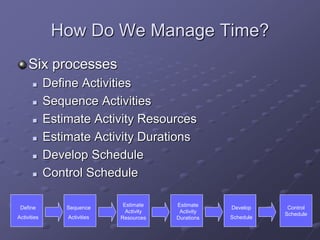
How Do We Manage Time?
Six processes
 Define Activities
 Sequence Activities
 Estimate Activity Resources
 Estimate Activity Durations
 Develop Schedule
 Control Schedule
Define
Activities
Sequence
Activities
Estimate
Activity
Resources
Estimate
Activity
Durations
Develop
Schedule
Control
Schedule
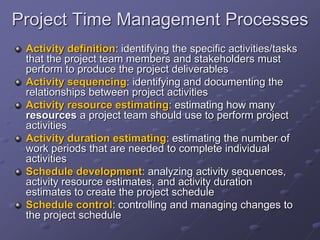
Project Time Management Processes
Activity definition: identifying the specific activities/tasks
that the project team members and stakeholders must
perform to produce the project deliverables
Activity sequencing: identifying and documenting the
relationships between project activities
Activity resource estimating: estimating how many
resources a project team should use to perform project
activities
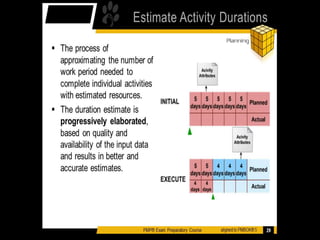
Activity duration estimating: estimating the number of
work periods that are needed to complete individual
activities
Schedule development: analyzing activity sequences,
activity resource estimates, and activity duration
estimates to create the project schedule
Schedule control: controlling and managing changes to
the project schedule
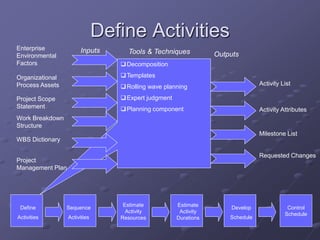
Define Activities
Enterprise
Environmental
Factors
Organizational
Process Assets
Project Scope
Statement
Decomposition
Templates
Rolling wave planning
Expert judgment
Planning component
Inputs
Outputs
Tools & Techniques
Work Breakdown
Structure
WBS Dictionary
Project
Management Plan
Activity List
Activity Attributes
Milestone List
Requested Changes
Define
Activities
Sequence
Activities
Estimate
Activity
Resources
Estimate
Activity
Durations
Develop
Schedule
Control
Schedule
Activity Lists and Attributes
An activity list is a tabulation of activities to be
included on a project schedule that includes:
 The activity name
 An activity identifier or number
 A brief description of the activity
Activity attributes provide more information such as
predecessors, successors, logical relationships,
resource requirements, constraints, imposed dates,
and assumptions related to the activity
Milestones
A milestone is a significant event that normally has no
duration
 Not every deliverable or output created for a project is a
milestone
It often takes several activities and a lot of work to
complete a milestone
They’re useful tools for setting schedule goals and
monitoring progress
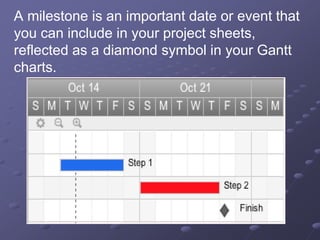
A milestone is an important date or event that
you can include in your project sheets,
reflected as a diamond symbol in your Gantt
charts.
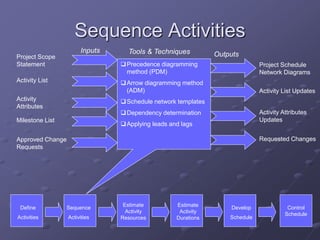
Sequence Activities
Project Scope
Statement
Activity List
Activity
Attributes
Precedence diagramming
method (PDM)
Arrow diagramming method
(ADM)
Schedule network templates
Dependency determination
Applying leads and lags
Inputs
Outputs
Tools & Techniques
Milestone List
Approved Change
Requests
Project Schedule
Network Diagrams
Activity List Updates
Activity Attributes
Updates
Requested Changes
Define
Activities
Sequence
Activities
Estimate
Activity
Resources
Estimate
Activity
Durations
Develop
Schedule
Control
Schedule
Activity Sequencing
After defining project activities, the next step is activity
sequencing
 Involves reviewing the activity list and attributes, project
scope statement, milestone list and approved change
requests to determine the relationships between activities
A dependency or relationship is the sequencing of
project activities or tasks
You must determine dependencies in order to use
critical path analysis
Three Types of Dependencies
Mandatory dependencies: inherent in the nature of
the work being performed on a project, sometimes
referred to as hard logic
Discretionary dependencies: defined by the project
team; sometimes referred to as soft logic and should
be used with care since they may limit later scheduling
options
 Don’t start detailed design work until users sign-off on all the
analysis – good practice but can delay project
External dependencies: involve relationships
between project and non-project activities
 Delivery of new hardware; if delayed can impact project
schedule
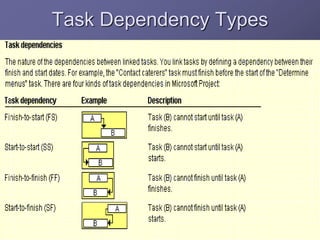
Task Dependency Types
Network Diagrams
Network diagrams are the preferred technique for
showing activity sequencing
A network diagram is a schematic display of the
logical relationships among, or sequencing of,
project activities
Two main formats are the arrow and precedence
diagramming methods
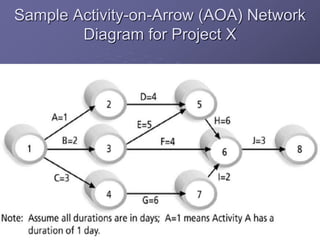
Sample Activity-on-Arrow (AOA) Network
Diagram for Project X
Arrow Diagramming Method (ADM)
Also called activity-on-arrow (AOA) network
diagrams
Activities are represented by arrows
Nodes or circles are the starting and ending points
of activities
Can only show finish-to-start dependencies
Can omit activities that have no dependencies
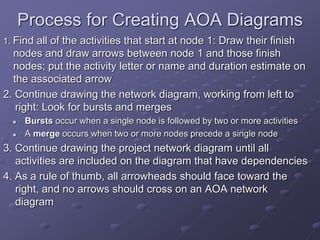
Process for Creating AOA Diagrams
1. Find all of the activities that start at node 1: Draw their finish
nodes and draw arrows between node 1 and those finish
nodes; put the activity letter or name and duration estimate on
the associated arrow
2. Continue drawing the network diagram, working from left to
right: Look for bursts and merges
 Bursts occur when a single node is followed by two or more activities
 A merge occurs when two or more nodes precede a single node
3. Continue drawing the project network diagram until all
activities are included on the diagram that have dependencies
4. As a rule of thumb, all arrowheads should face toward the
right, and no arrows should cross on an AOA network
diagram
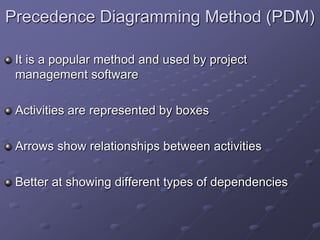
Precedence Diagramming Method (PDM)
It is a popular method and used by project
management software
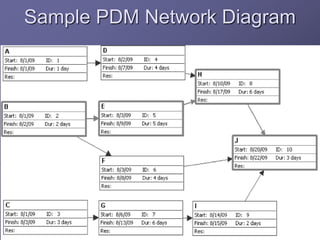
Activities are represented by boxes
Arrows show relationships between activities
Better at showing different types of dependencies
Sample PDM Network Diagram
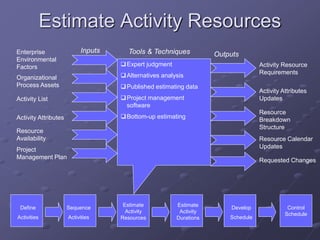
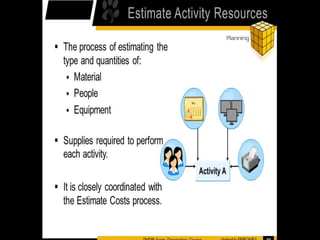
Estimate Activity Resources
Enterprise
Environmental
Factors
Organizational
Process Assets
Activity List
Expert judgment
Alternatives analysis
Published estimating data
Project management
software
Bottom-up estimating
Inputs
Outputs
Tools & Techniques
Activity Attributes
Resource
Availability
Activity Resource
Requirements
Activity Attributes
Updates
Resource
Breakdown
Structure
Resource Calendar
Updates
Project
Management Plan
Requested Changes
Define
Activities
Sequence
Activities
Estimate
Activity
Resources
Estimate
Activity
Durations
Develop
Schedule
Control
Schedule
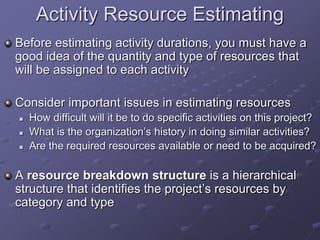
Activity Resource Estimating
Before estimating activity durations, you must have a
good idea of the quantity and type of resources that
will be assigned to each activity
Consider important issues in estimating resources
 How difficult will it be to do specific activities on this project?
 What is the organization’s history in doing similar activities?
 Are the required resources available or need to be acquired?
A resource breakdown structure is a hierarchical
structure that identifies the project’s resources by
category and type
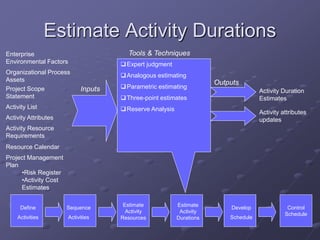
Estimate Activity Durations
Enterprise
Environmental Factors
Organizational Process
Assets
Project Scope
Statement
Expert judgment
Analogous estimating
Parametric estimating
Three-point estimates
Reserve Analysis
Inputs
Outputs
Tools & Techniques
Activity List
Activity Resource
Requirements
Activity Duration
Estimates
Activity attributes
updates
Resource Calendar
Activity Attributes
Project Management
Plan
•Risk Register
•Activity Cost
Estimates
Define
Activities
Sequence
Activities
Estimate
Activity
Resources
Estimate
Activity
Durations
Develop
Schedule
Control
Schedule
Estimating Methods
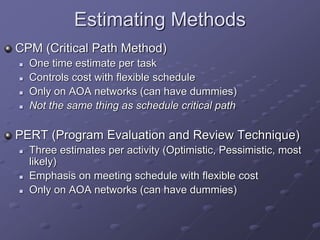
CPM (Critical Path Method)
 One time estimate per task
 Controls cost with flexible schedule
 Only on AOA networks (can have dummies)
 Not the same thing as schedule critical path
PERT (Program Evaluation and Review Technique)
 Three estimates per activity (Optimistic, Pessimistic, most
likely)
 Emphasis on meeting schedule with flexible cost
 Only on AOA networks (can have dummies)
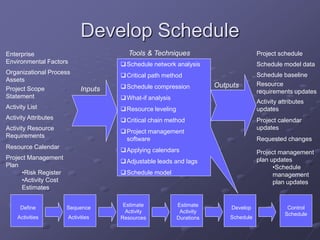
Develop Schedule
Enterprise
Environmental Factors
Organizational Process
Assets
Project Scope
Statement
Schedule network analysis
Critical path method
Schedule compression
What-if analysis
Resource leveling
Critical chain method
Project management
software
Applying calendars
Adjustable leads and lags
Schedule model
Inputs
Outputs
Tools & Techniques
Activity List
Activity Resource
Requirements
Schedule baseline
Activity attributes
updates
Resource Calendar
Activity Attributes
Project Management
Plan
•Risk Register
•Activity Cost
Estimates
Project schedule
Schedule model data
Resource
requirements updates
Requested changes
Project management
plan updates
•Schedule
management
plan updates
Project calendar
updates
Define
Activities
Sequence
Activities
Estimate
Activity
Resources
Estimate
Activity
Durations
Develop
Schedule
Control
Schedule
Scheduling from Estimates
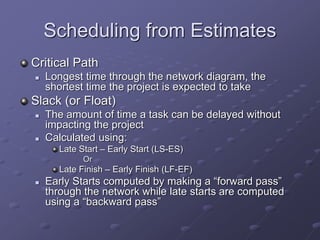
Critical Path
 Longest time through the network diagram, the
shortest time the project is expected to take
Slack (or Float)
 The amount of time a task can be delayed without
impacting the project
 Calculated using:
Late Start – Early Start (LS-ES)
Or
Late Finish – Early Finish (LF-EF)
 Early Starts computed by making a “forward pass”
through the network while late starts are computed
using a “backward pass”
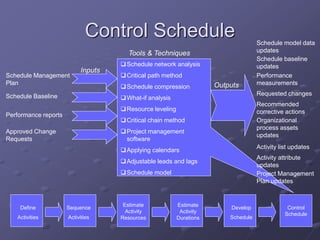
Control Schedule
Schedule Management
Plan
Schedule Baseline
Schedule network analysis
Critical path method
Schedule compression
What-if analysis
Resource leveling
Critical chain method
Project management
software
Applying calendars
Adjustable leads and lags
Schedule model
Inputs
Outputs
Tools & Techniques
Performance reports
Schedule baseline
updates
Requested changes
Approved Change
Requests
Schedule model data
updates
Performance
measurements
Organizational
process assets
updates
Activity list updates
Recommended
corrective actions
Activity attribute
updates
Project Management
Plan updates
Define
Activities
Sequence
Activities
Estimate
Activity
Resources
Estimate
Activity
Durations
Develop
Schedule
Control
Schedule
Project Time Management ICTI.ppt

Project Time Management ICTI.ppt

  • 1.
  • 2.
    Project Time Management “Theprocesses required to accomplish timely completion of the project”
  • 3.
    Why Time Management? Partof triple constraint, can’t manage one without the others (scope, time, and quality) Time has the least amount of flexibility; it passes no matter what happens on a project Schedule issues are the main reason for conflicts on projects, especially during the second half of projects
  • 4.
    How Do WeManage Time? Six processes  Define Activities  Sequence Activities  Estimate Activity Resources  Estimate Activity Durations  Develop Schedule  Control Schedule Define Activities Sequence Activities Estimate Activity Resources Estimate Activity Durations Develop Schedule Control Schedule
  • 5.
    Project Time ManagementProcesses Activity definition: identifying the specific activities/tasks that the project team members and stakeholders must perform to produce the project deliverables Activity sequencing: identifying and documenting the relationships between project activities Activity resource estimating: estimating how many resources a project team should use to perform project activities Activity duration estimating: estimating the number of work periods that are needed to complete individual activities Schedule development: analyzing activity sequences, activity resource estimates, and activity duration estimates to create the project schedule Schedule control: controlling and managing changes to the project schedule
  • 6.
    Define Activities Enterprise Environmental Factors Organizational Process Assets ProjectScope Statement Decomposition Templates Rolling wave planning Expert judgment Planning component Inputs Outputs Tools & Techniques Work Breakdown Structure WBS Dictionary Project Management Plan Activity List Activity Attributes Milestone List Requested Changes Define Activities Sequence Activities Estimate Activity Resources Estimate Activity Durations Develop Schedule Control Schedule
  • 7.
    Activity Lists andAttributes An activity list is a tabulation of activities to be included on a project schedule that includes:  The activity name  An activity identifier or number  A brief description of the activity Activity attributes provide more information such as predecessors, successors, logical relationships, resource requirements, constraints, imposed dates, and assumptions related to the activity
  • 8.
    Milestones A milestone isa significant event that normally has no duration  Not every deliverable or output created for a project is a milestone It often takes several activities and a lot of work to complete a milestone They’re useful tools for setting schedule goals and monitoring progress
  • 9.
    A milestone isan important date or event that you can include in your project sheets, reflected as a diamond symbol in your Gantt charts.
  • 10.
    Sequence Activities Project Scope Statement ActivityList Activity Attributes Precedence diagramming method (PDM) Arrow diagramming method (ADM) Schedule network templates Dependency determination Applying leads and lags Inputs Outputs Tools & Techniques Milestone List Approved Change Requests Project Schedule Network Diagrams Activity List Updates Activity Attributes Updates Requested Changes Define Activities Sequence Activities Estimate Activity Resources Estimate Activity Durations Develop Schedule Control Schedule
  • 11.
    Activity Sequencing After definingproject activities, the next step is activity sequencing  Involves reviewing the activity list and attributes, project scope statement, milestone list and approved change requests to determine the relationships between activities A dependency or relationship is the sequencing of project activities or tasks You must determine dependencies in order to use critical path analysis
  • 12.
    Three Types ofDependencies Mandatory dependencies: inherent in the nature of the work being performed on a project, sometimes referred to as hard logic Discretionary dependencies: defined by the project team; sometimes referred to as soft logic and should be used with care since they may limit later scheduling options  Don’t start detailed design work until users sign-off on all the analysis – good practice but can delay project External dependencies: involve relationships between project and non-project activities  Delivery of new hardware; if delayed can impact project schedule
  • 13.
  • 14.
    Network Diagrams Network diagramsare the preferred technique for showing activity sequencing A network diagram is a schematic display of the logical relationships among, or sequencing of, project activities Two main formats are the arrow and precedence diagramming methods
  • 15.
    Sample Activity-on-Arrow (AOA)Network Diagram for Project X
  • 16.
    Arrow Diagramming Method(ADM) Also called activity-on-arrow (AOA) network diagrams Activities are represented by arrows Nodes or circles are the starting and ending points of activities Can only show finish-to-start dependencies Can omit activities that have no dependencies
  • 17.
    Process for CreatingAOA Diagrams 1. Find all of the activities that start at node 1: Draw their finish nodes and draw arrows between node 1 and those finish nodes; put the activity letter or name and duration estimate on the associated arrow 2. Continue drawing the network diagram, working from left to right: Look for bursts and merges  Bursts occur when a single node is followed by two or more activities  A merge occurs when two or more nodes precede a single node 3. Continue drawing the project network diagram until all activities are included on the diagram that have dependencies 4. As a rule of thumb, all arrowheads should face toward the right, and no arrows should cross on an AOA network diagram
  • 18.
    Precedence Diagramming Method(PDM) It is a popular method and used by project management software Activities are represented by boxes Arrows show relationships between activities Better at showing different types of dependencies
  • 19.
  • 20.
    Estimate Activity Resources Enterprise Environmental Factors Organizational ProcessAssets Activity List Expert judgment Alternatives analysis Published estimating data Project management software Bottom-up estimating Inputs Outputs Tools & Techniques Activity Attributes Resource Availability Activity Resource Requirements Activity Attributes Updates Resource Breakdown Structure Resource Calendar Updates Project Management Plan Requested Changes Define Activities Sequence Activities Estimate Activity Resources Estimate Activity Durations Develop Schedule Control Schedule
  • 21.
    Activity Resource Estimating Beforeestimating activity durations, you must have a good idea of the quantity and type of resources that will be assigned to each activity Consider important issues in estimating resources  How difficult will it be to do specific activities on this project?  What is the organization’s history in doing similar activities?  Are the required resources available or need to be acquired? A resource breakdown structure is a hierarchical structure that identifies the project’s resources by category and type
  • 23.
    Estimate Activity Durations Enterprise EnvironmentalFactors Organizational Process Assets Project Scope Statement Expert judgment Analogous estimating Parametric estimating Three-point estimates Reserve Analysis Inputs Outputs Tools & Techniques Activity List Activity Resource Requirements Activity Duration Estimates Activity attributes updates Resource Calendar Activity Attributes Project Management Plan •Risk Register •Activity Cost Estimates Define Activities Sequence Activities Estimate Activity Resources Estimate Activity Durations Develop Schedule Control Schedule
  • 25.
    Estimating Methods CPM (CriticalPath Method)  One time estimate per task  Controls cost with flexible schedule  Only on AOA networks (can have dummies)  Not the same thing as schedule critical path PERT (Program Evaluation and Review Technique)  Three estimates per activity (Optimistic, Pessimistic, most likely)  Emphasis on meeting schedule with flexible cost  Only on AOA networks (can have dummies)
  • 26.
    Develop Schedule Enterprise Environmental Factors OrganizationalProcess Assets Project Scope Statement Schedule network analysis Critical path method Schedule compression What-if analysis Resource leveling Critical chain method Project management software Applying calendars Adjustable leads and lags Schedule model Inputs Outputs Tools & Techniques Activity List Activity Resource Requirements Schedule baseline Activity attributes updates Resource Calendar Activity Attributes Project Management Plan •Risk Register •Activity Cost Estimates Project schedule Schedule model data Resource requirements updates Requested changes Project management plan updates •Schedule management plan updates Project calendar updates Define Activities Sequence Activities Estimate Activity Resources Estimate Activity Durations Develop Schedule Control Schedule
  • 27.
    Scheduling from Estimates CriticalPath  Longest time through the network diagram, the shortest time the project is expected to take Slack (or Float)  The amount of time a task can be delayed without impacting the project  Calculated using: Late Start – Early Start (LS-ES) Or Late Finish – Early Finish (LF-EF)  Early Starts computed by making a “forward pass” through the network while late starts are computed using a “backward pass”
  • 28.
    Control Schedule Schedule Management Plan ScheduleBaseline Schedule network analysis Critical path method Schedule compression What-if analysis Resource leveling Critical chain method Project management software Applying calendars Adjustable leads and lags Schedule model Inputs Outputs Tools & Techniques Performance reports Schedule baseline updates Requested changes Approved Change Requests Schedule model data updates Performance measurements Organizational process assets updates Activity list updates Recommended corrective actions Activity attribute updates Project Management Plan updates Define Activities Sequence Activities Estimate Activity Resources Estimate Activity Durations Develop Schedule Control Schedule