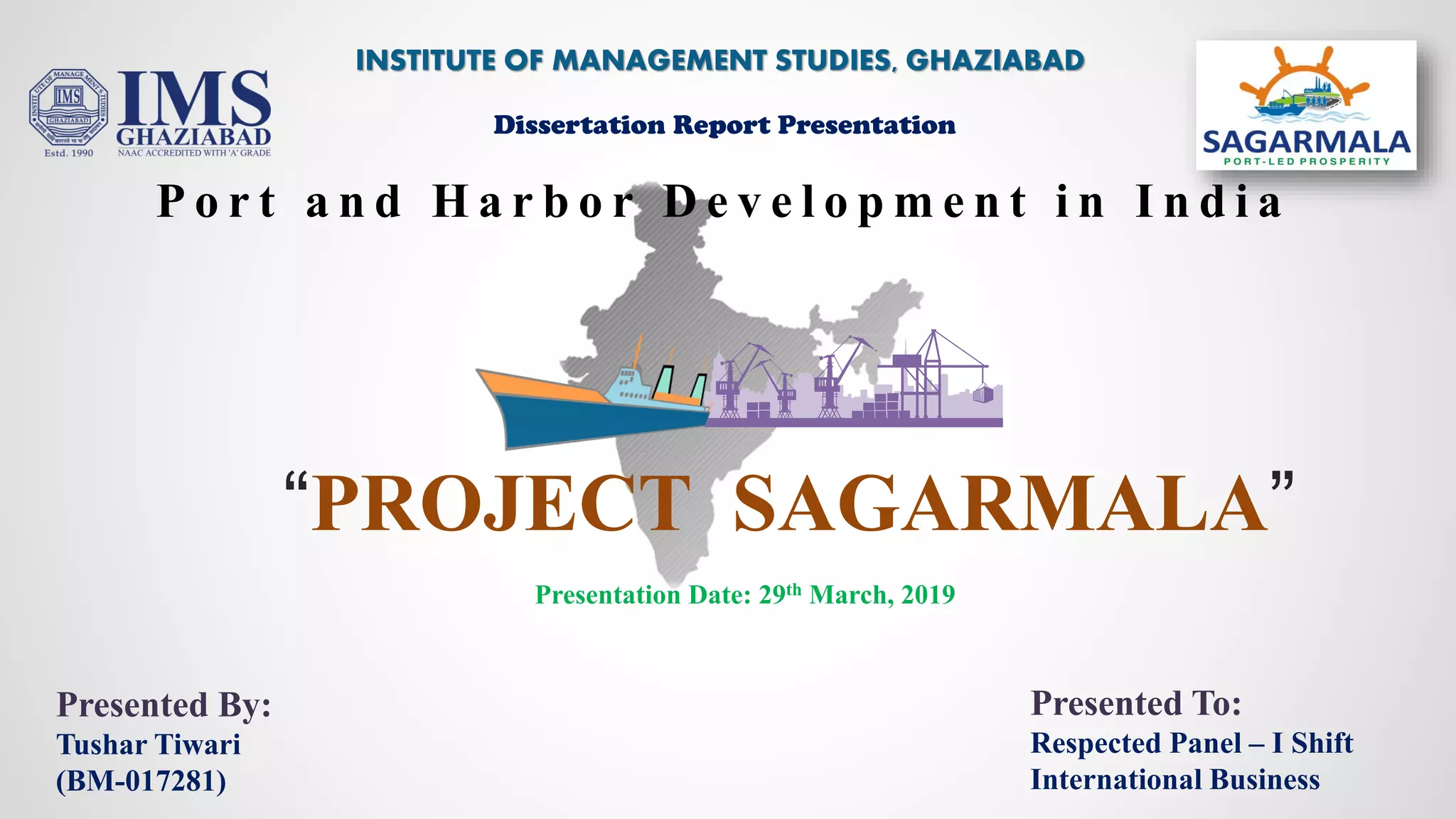
“PROJECT SAGARMALA”
P o r t a n d H a r b o r D e v e l o p m e n t i n I n d i a
INSTITUTE OF MANAGEMENT STUDIES, GHAZIABAD
Dissertation Report Presentation
Presented By:
Tushar Tiwari
(BM-017281)
Presentation Date: 29th March, 2019
Presented To:
Respected Panel – I Shift
International Business
Mode of
Presentation
Introduction01
Vision of Sagarmala02
Objective03
Data Analysis04
Mode of
Presentation
Learning Outcome05
Port Visit , Kandla The Port06
Limitation07
References08
Introduction
.
• Maritime sector in India has been the backbone of the country’s trade and has grown
manifold over the years.
• India’s 7,500 km long coastline, 14,500 km of potentially navigable waterways.
• The concept of Sagarmala was approved by the Union Cabinet on 25th March 2015.
• As part of the programme, a National Perspective Plan (NPP) for the comprehensive
development of India’s coastline and maritime sector has been prepared which was
released by the Hon’ble Prime Minister, on 14th April, 2016 at the Maritime India Summit
2016.
Objective
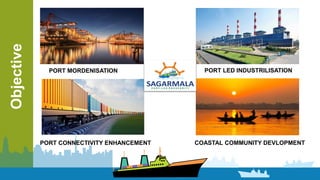
PORT MORDENISATION
PORT CONNECTIVITY ENHANCEMENT
PORT LED INDUSTRILISATION
COASTAL COMMUNITY DEVLOPMENT
Vision of Sagarmala
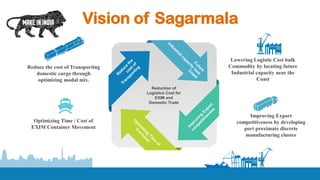
Lowering Logistic Cost bulk
Commodity by locating future
Industrial capacity near the
Coast
Reduce the cost of Transporting
domestic cargo through
optimizing modal mix.
Optimizing Time / Cost of
EXIM Container Movement
Reduction of
Logistics Cost for
EXIM and
Domestic Trade
Improving Export
competitiveness by developing
port proximate discrete
manufacturing cluster
Port Modernisation & New Port DevelopmentObjective
 Since about more than 90% of India's trade by volume is conducted via the country’s maritime
route, there is a continuous need to develop India's ports and trade related infrastructure to
accelerate growth in the manufacturing industry and to assist the 'Make in India' initiative.
 India has 12 major ports and approximately 200 non-major ports administered by Central and State
Governments respectively.
 As per the studies conducted under the Sagarmala Programme, it is expected that by 2025, cargo
traffic at Indian ports will be approximately 2500 MMTPA while the current cargo handling
capacity of Indian ports is only 1500 MMTPA.
 This includes port operational efficiency improvement, capacity expansion of existing ports and
new port development.
Port Connectivity Enhancement
Objective
• India's hinterland connectivity is mainly based on surface transport i.e. road and rail, wherein,
domestic waterways (coastal shipping and inland waterways) playing a very limited role.
• Pipelines are predominantly used only for transporting crude oil, refined petroleum products and
natural gas.
• In India, smooth connectivity to ports is even more important as the cargo generating centers are
mainly in the hinterland instead of in the coastal region.
• The long lead distance increases the logistics cost and time variability within which the cargo can be
delivered.
• Under Sagarmala Programme, endeavor is to provide enhanced connectivity between the ports and
the domestic production/consumption centres.
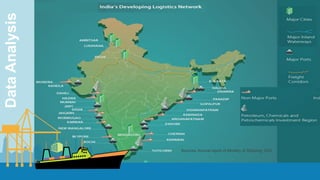
• More than 213 connectivity projects at an estimated investment of more than Rs. 2.50 Lac Crore
have been identified.
Objective Port Led Industrialisation
The concepts of Coastal Economic Zones (CEZs), Coastal Economic Units (CEUs), Port-Linked Industrial
& Maritime Clusters and Smart Industrial Port Cities have been introduced.
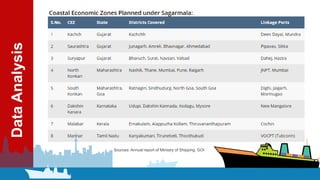
• 14 Coastal Economic Zones (CEZs) covering all the Maritime States and Union Territories have been
proposed.
• CEZ perspective plans have been prepared and Detailed Master Plans will be prepared for 4 pilot CEZs
(in Gujarat, Maharashtra, Tamil Nadu and Andhra Pradesh) in the first phase of development.
Objective Coastal Community Development
Coastal Tourism: Development of Coastal Circuits under Swadesh Darshan Scheme of Ministry of Tourism
• Development of infrastructure for promoting Cruise tourism
• Development of lighthouses
• National Maritime Heritage Museum Complex at Lothal
• Underwater viewing gallery and restaurant at Beyt Dwarka
Fisheries:
• Governments would fund capacity building, infrastructure, and social development projects related to
value addition in fisheries, aquaculture and cold chain development.
• As part of the coastal community development component of the Sagarmala Programme, Ministry is part-
funding fishing harbour projects in convergence with Department of Animal Husbandry and Dairying
(DADF). Rs. 198 Cr have been released so far for 17 projects (cost: Rs. 1,499 Cr).
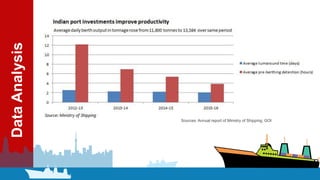
DataAnalysis
Sources: Annual report of Ministry of Shipping, GOI
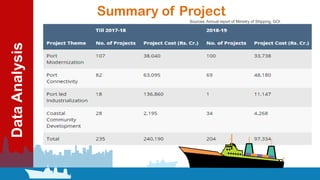
DataAnalysis Summary of Project
Sources: Annual report of Ministry of Shipping, GOI
DataAnalysisDataAnalysis
Sources: Annual report of Ministry of Shipping, GOI
DataAnalysis
Sources: Annual report of Ministry of Shipping, GOI
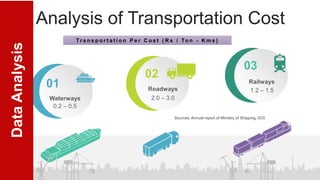
Analysis of Transportation Cost
Waterways
0.2 – 0.5
01 Roadways
2.0 – 3.0
02
Railways
1.2 – 1.5
03
Tr a n s p o r t a t i o n P e r C o s t ( R s / To n - K m s )
Sources: Annual report of Ministry of Shipping, GOI
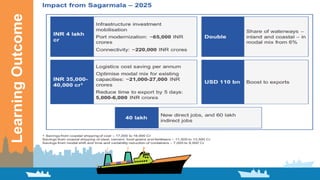
DataAnalysis
LearningOutcome
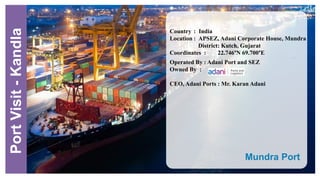
Mundra Port
.
Country : India
Location : APSEZ, Adani Corporate House, Mundra
District: Kutch, Gujarat
Coordinates : 22.746°N 69.700°E
Operated By : Adani Port and SEZ
Owned By :
CEO, Adani Ports : Mr. Karan Adani
PortVisit-Kandla
 Involvement of multiple agencies in development of infrastructure to promote industrialization, trade,
tourism and transportation across country.
 Presence of a dual institutional structure that has led to development of Major and Minor ports as
individual projects.
 Limited hinterland linkages that in turn increases the cost of transportation and cargo movement.
 Limited development of coastal centers for manufacturing, urban and economic activities.
 Low penetration of coastal and inland shipping in India due to limited facilities, higher costs and policy
constraints.
 Lack of scale, deep draft and other facilities at various ports in India
Challenges Faced by Maritime Sector
References http://sagarmala.gov.in
http://shipmin.gov.in
http://pib.nic.in/newsite/PrintRelease.aspx?relid=159037
https://www.india.gov.in/gsearch?s=+MINISTRY+OF+SHIPPING&op
=Search
http://www.sagarmala.gov.in/sites/default/files/7298227416DraftReport
onImperativesSagarmala.pdf
Thank You
Any Queries??

Project Sagarmala

  • 1.
    “PROJECT SAGARMALA” P or t a n d H a r b o r D e v e l o p m e n t i n I n d i a INSTITUTE OF MANAGEMENT STUDIES, GHAZIABAD Dissertation Report Presentation Presented By: Tushar Tiwari (BM-017281) Presentation Date: 29th March, 2019 Presented To: Respected Panel – I Shift International Business
  • 2.
    Mode of Presentation Introduction01 Vision ofSagarmala02 Objective03 Data Analysis04
  • 3.
    Mode of Presentation Learning Outcome05 PortVisit , Kandla The Port06 Limitation07 References08
  • 4.
    Introduction . • Maritime sectorin India has been the backbone of the country’s trade and has grown manifold over the years. • India’s 7,500 km long coastline, 14,500 km of potentially navigable waterways. • The concept of Sagarmala was approved by the Union Cabinet on 25th March 2015. • As part of the programme, a National Perspective Plan (NPP) for the comprehensive development of India’s coastline and maritime sector has been prepared which was released by the Hon’ble Prime Minister, on 14th April, 2016 at the Maritime India Summit 2016.
  • 5.
    Objective PORT MORDENISATION PORT CONNECTIVITYENHANCEMENT PORT LED INDUSTRILISATION COASTAL COMMUNITY DEVLOPMENT
  • 6.
    Vision of Sagarmala LoweringLogistic Cost bulk Commodity by locating future Industrial capacity near the Coast Reduce the cost of Transporting domestic cargo through optimizing modal mix. Optimizing Time / Cost of EXIM Container Movement Reduction of Logistics Cost for EXIM and Domestic Trade Improving Export competitiveness by developing port proximate discrete manufacturing cluster
  • 7.
    Port Modernisation &New Port DevelopmentObjective  Since about more than 90% of India's trade by volume is conducted via the country’s maritime route, there is a continuous need to develop India's ports and trade related infrastructure to accelerate growth in the manufacturing industry and to assist the 'Make in India' initiative.  India has 12 major ports and approximately 200 non-major ports administered by Central and State Governments respectively.  As per the studies conducted under the Sagarmala Programme, it is expected that by 2025, cargo traffic at Indian ports will be approximately 2500 MMTPA while the current cargo handling capacity of Indian ports is only 1500 MMTPA.  This includes port operational efficiency improvement, capacity expansion of existing ports and new port development.
  • 8.
    Port Connectivity Enhancement Objective •India's hinterland connectivity is mainly based on surface transport i.e. road and rail, wherein, domestic waterways (coastal shipping and inland waterways) playing a very limited role. • Pipelines are predominantly used only for transporting crude oil, refined petroleum products and natural gas. • In India, smooth connectivity to ports is even more important as the cargo generating centers are mainly in the hinterland instead of in the coastal region. • The long lead distance increases the logistics cost and time variability within which the cargo can be delivered. • Under Sagarmala Programme, endeavor is to provide enhanced connectivity between the ports and the domestic production/consumption centres. • More than 213 connectivity projects at an estimated investment of more than Rs. 2.50 Lac Crore have been identified.
  • 9.
    Objective Port LedIndustrialisation The concepts of Coastal Economic Zones (CEZs), Coastal Economic Units (CEUs), Port-Linked Industrial & Maritime Clusters and Smart Industrial Port Cities have been introduced. • 14 Coastal Economic Zones (CEZs) covering all the Maritime States and Union Territories have been proposed. • CEZ perspective plans have been prepared and Detailed Master Plans will be prepared for 4 pilot CEZs (in Gujarat, Maharashtra, Tamil Nadu and Andhra Pradesh) in the first phase of development.
  • 10.
    Objective Coastal CommunityDevelopment Coastal Tourism: Development of Coastal Circuits under Swadesh Darshan Scheme of Ministry of Tourism • Development of infrastructure for promoting Cruise tourism • Development of lighthouses • National Maritime Heritage Museum Complex at Lothal • Underwater viewing gallery and restaurant at Beyt Dwarka Fisheries: • Governments would fund capacity building, infrastructure, and social development projects related to value addition in fisheries, aquaculture and cold chain development. • As part of the coastal community development component of the Sagarmala Programme, Ministry is part- funding fishing harbour projects in convergence with Department of Animal Husbandry and Dairying (DADF). Rs. 198 Cr have been released so far for 17 projects (cost: Rs. 1,499 Cr).
  • 11.
    DataAnalysis Sources: Annual reportof Ministry of Shipping, GOI
  • 12.
    DataAnalysis Summary ofProject Sources: Annual report of Ministry of Shipping, GOI
  • 13.
  • 14.
    DataAnalysis Sources: Annual reportof Ministry of Shipping, GOI
  • 15.
    Analysis of TransportationCost Waterways 0.2 – 0.5 01 Roadways 2.0 – 3.0 02 Railways 1.2 – 1.5 03 Tr a n s p o r t a t i o n P e r C o s t ( R s / To n - K m s ) Sources: Annual report of Ministry of Shipping, GOI DataAnalysis
  • 16.
  • 17.
    Mundra Port . Country :India Location : APSEZ, Adani Corporate House, Mundra District: Kutch, Gujarat Coordinates : 22.746°N 69.700°E Operated By : Adani Port and SEZ Owned By : CEO, Adani Ports : Mr. Karan Adani PortVisit-Kandla
  • 18.
     Involvement ofmultiple agencies in development of infrastructure to promote industrialization, trade, tourism and transportation across country.  Presence of a dual institutional structure that has led to development of Major and Minor ports as individual projects.  Limited hinterland linkages that in turn increases the cost of transportation and cargo movement.  Limited development of coastal centers for manufacturing, urban and economic activities.  Low penetration of coastal and inland shipping in India due to limited facilities, higher costs and policy constraints.  Lack of scale, deep draft and other facilities at various ports in India Challenges Faced by Maritime Sector
  • 19.
  • 20.