• A practical means of doing something
• Specific goal, specific inputs,
• Defined starting point and completing time
frame
• Changes ideas/concepts into reality
consuming resources
• May be standalone or comprising other
number of projects/activities
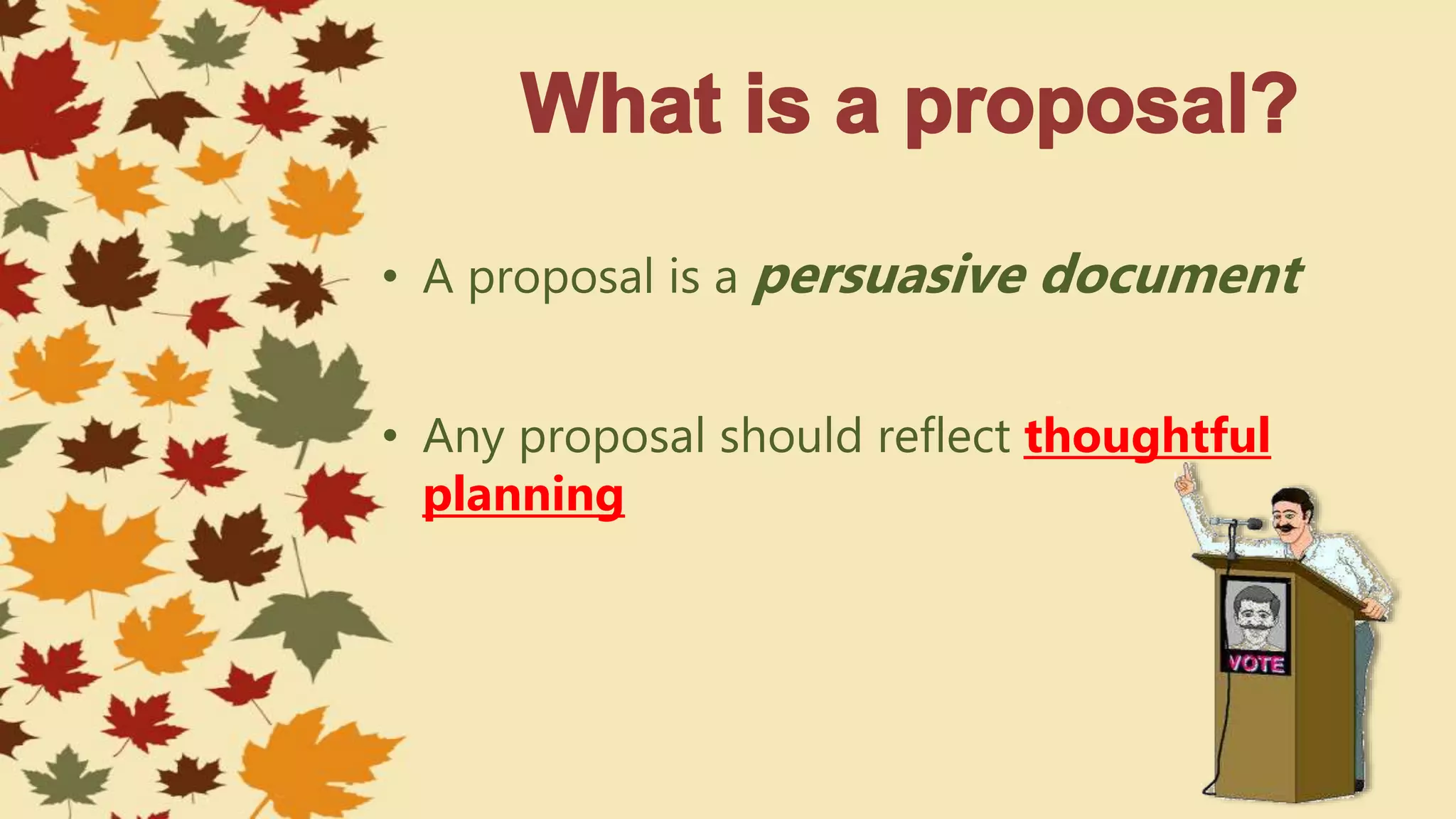
• A proposal is a persuasive document
• Any proposal should reflect thoughtful
planning
Designing a project is a process consisting of two
elements, which are equally important and thus
essential to forming a solid project proposal:
project planning(formulation of project
elements)
proposal writing (converting the plan into a
project document)
The project proposal should be a detailed and
directed manifestation of the project design. It is a
means of presenting the project to the outside
world in a format that is immediately recognised
and accepted.
• A full proposal should have the following parts:
• Title Page
• Project Title
• TOC
• Abstract/Executive Summary
• Context
• Project Justification
• Problem Statement
• Priority Needs
• The proposed approach (type of intervention)
• The implementing organisation
• Project Aims & Objectives
• Target Group
• Project Implementation
• Budget
• Monitoring and Evaluation
• Reporting
• Management and Personnel
• a. Title of project in initial capital letters
• b. The sponsoring company and contact person’s
name and information
• c. Team name and individual member names
• d. Date
• e. An appropriate picture of the product, a team
logo, or both
• The project title should be short, concise, and
preferably refer to a certain key project result or
the leading project activity.
• It is useful to insert a short project summary, an
abstract or executive summary. The abstract
should include: the problem statement, the
project’s objectives, implementing organisations;
key project activities; and potentially the total
project budget. Theoretically, the abstract should
be compiled after the relevant items already
exist in their long form.
• This part of the project describes the social,
economic, political and culturalbackground from
which the project is initiated. It should contain
relevant data from research carried out in the
project planning phase or collected from other
sources.
A rationale should be provided for the project. Due
to its importance, this section is sometimes divided
into four or more sub-sections:
• Problem statement:
The problem statement provides a description of
the specific problem(s) the project is trying to
solve.
• Priority needs:
The needs of the target group that have arisen as
a direct negative impact of the problem should be
prioritised. An explanation as to how this decision
• The proposed approach (type of
intervention):
The project proposal should describe
the strategy chosen for solving the problem and
precisely how it will lead to improvement.
• The implementing organization:
This section should describe the capabilities of
your organisation by referring to its capacity and
previous project record.
• Project aims:
This information should be obtained from the
Logframe Matrix, including the project goal (a
general aim that should explain what the core
problem is and why the project is important, i.e.
what the long-term benefits to the target group
are), project purpose (that should address the core
problem in terms of the benefits to be received by
the project beneficiaries or target group as a direct
result of the project) and the outputs (i.e. results
describe the services or products to be delivered to
the intended beneficiaries).
• The implementation plan should describe
activities and resource allocation in as much
detail as possible. It is exceptionally important to
provide a good overview of who is going to
implement the project’s activities, as well as
when and where.
• The implementation plan may be divided into
two key elements:
• Activity plan
• Resource plan
The activity plan should include specific
information and explanations of each of the
planned project activities.
In general, two main formats are used to express
the activity plan: a simple table (a simple table
with columns for activities, sub-activities, tasks,
timing and responsibility in a clear and readily
understandable format) and the Gantt chart (a
universal format for presenting activities in certain
times frames, shows the dependence and
sequence for each activity.
The resource plan should provide information on
the means necessary to undertake the project. Cost
categories are established at this stage in order to
aggregate and summarise the cost information for
budgeting.
An itemized summary of an organisation’s
expected income and expenses over a specified
period of time.
The basis for monitoring is set when
the indicators for results are set. The project
proposal should indicate: how and when the
project management team will conduct
activities to monitor the project’s progress;
which methods will be used to monitor and
evaluate; and who will do the evaluation.
The schedule of project progress and financial
report could be set in the project proposal. Often
these obligations are determined by the standard
requirements of the donor agency. The project
report may be compiled in different versions, with
regard to the audience they are targeting.
A brief description should be given of the project
personnel, the individual roles each one has
assumed, and the communication mechanisms that
exist between them. All the additional information
(such as CVs) should be attached to the
annexes(=>added as an extra or subordinate part,
especially to a document.).
– Project objectives must be SMART
• S = Specific
• M = Measurable
• A = Attainable
• R = Realistic
• T = Time bound
• This recommended format is flexible and not
compulsory for every project proposal. Points
can be added or removed on need basis
Title Page
An online library management system web app.
Project Title
Introduction
Propose of the System
User friendly interface
Fast access to database
Less error
Search facility
Look and Feel Environment
Quick transaction
Objectives
Providing Solution for the Problem
More Storage Capacity
Search facility
Look and Feel Environment
Quick transaction
User friendly interface
Fast access to database
Less error
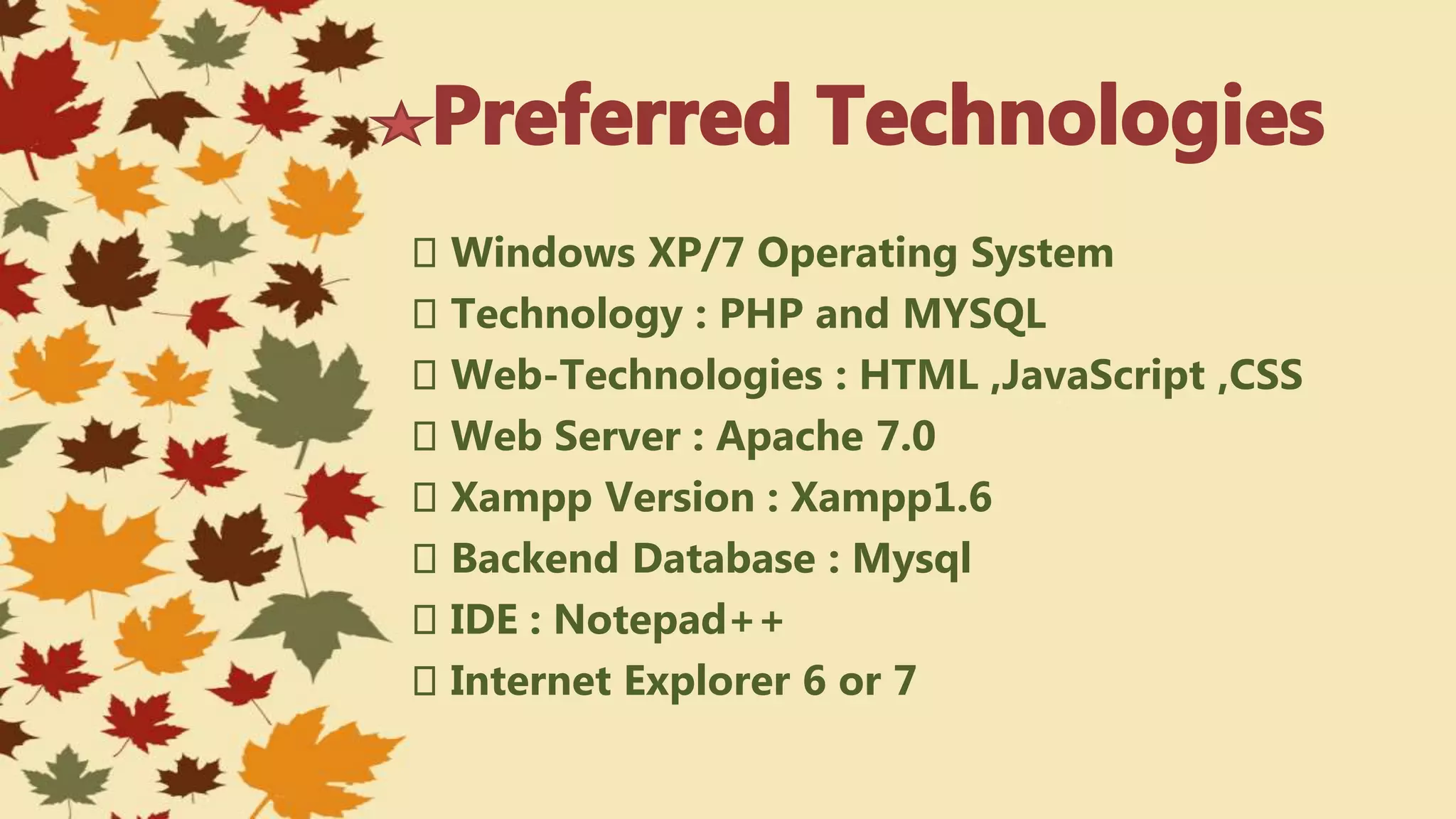
Preferred Technologies
Windows XP/7 Operating System
Technology : PHP and MYSQL
Web-Technologies : HTML ,JavaScript ,CSS Web Server : Apache 7.0
Xampp Version : Xampp1.6
Backend Database : Mysql
IDE : Notepad++
Internet Explorer 6 or 7
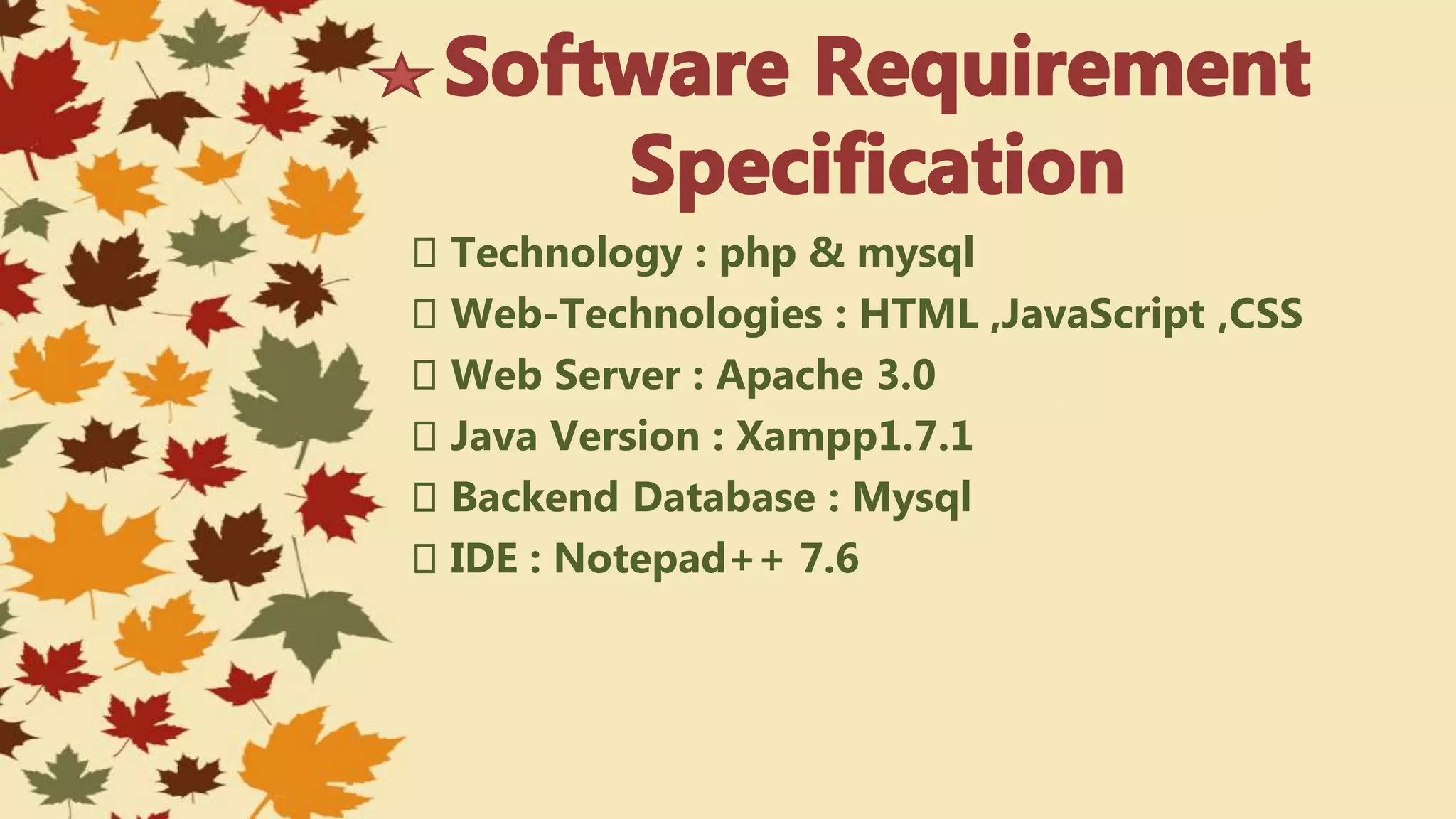
Software Requirement Specification
Technology : php & mysql
Web-Technologies : HTML ,JavaScript ,CSS
Web Server : Apache 3.0
Java Version : Xampp1.7.1
Backend Database : Mysql
IDE : Notepad++ 7.6
Admin Authentication
Admin Module
User Authentication
Librarian
Student Faculty
Conclusion
Future Enhancements
This E-library management system, that is a
proper web app. is going to change horizons of
libraries. As it is not only more convinient, due
to its flexible features but also affordable and
easily available to its multi-type audience.
Abstract/Executive Summary
Seeing the difficulties of book lovers who used to
go to libraries, even when they didn't wanted to,
for reading or lending books. We thought of an
idea to develop a web app. to fascilitate them.
Then, with a strong motive, we started working
over this project.
The project titled “Library Management System” is
Library management software for monitoring and
controlling the transactions in a library .The project
“Library Management System” is developed in php
& mysql which mainly focuses on basic operations
in a library like adding new member, new books,
and updating new information , searching books
and members and facility to borrow and return
books. “Library Management System” is a web
application designed & developed to help users
maintain and organize library. Our software is easy
to use for both beginners and advanced users. It
features a familiar and well thought-out, an
attractive user interface, combined with strong
searching Insertion and reporting capabilities. The
report generation facility of library system helps to
get a good idea of which are the books borrowed
by the members, makes users possible to generate
reports’ hard copy. The software Library
Management System has four main modules.
Insertion to Database Module – User friendly
input screen Extracting from Database module
– Attractive Output Screen Report Generation
module – borrowed book list & Available book
list Search Facility system – search for books
and members
Project Justification
All the manual difficulties in managing the Library
have been rectified by implementing
computerization.
Problem Statements and solution key-point
Propose of the system is an automated “Library
Management System”. Through our software user
can add members, add books, search members,
search books, update information, edit
information, borrow and return books in quick
time. Our system has the following advantages:
• User friendly interface
• Fast access to database
• Less error
• More Storage Capacity
• Search facility
• Look and Feel Environment
• Quick transaction
• More Storage Capacity
All the manual difficulties in managing the Library
have been rectified by implementing
computerization.
The Proposed Approach
• The objective of this application is to design a
system to maintain the information related to a
Library Management. The purpose is to
maintain a centralized repository of information
about all activities regarding a Library.
Project Aims.Objectives
Windows XP/7 Operating System
Technology : PHP and MYSQL
Web-Technologies : HTML ,JavaScript ,CSS
Web Server : Apache 7.0
Xampp Version : Xampp1.6
Backend Database : Mysql
IDE : Notepad++
Internet Explorer 6 or 7
Technology : php & mysql
Web-Technologies : HTML ,JavaScript ,CSS
Web Server : Apache 3.0
Java Version : Xampp1.7.1
Backend Database : Mysql
IDE : Notepad++ 7.6
Administrator Module:
Users are divided into two categories: Admin and
Librarian.
This module is used to maintain the details of users
of the project.
Monitoring & Evaluation
Librarian , Student , Faculty:
This module contains details about Librarian ,
Student , Faculty. Like Student name, email,
address, education details……. Here user can do
update, modify and delete. They can update
education details and Others details also.
Monitoring & Evaluation
This “The library Management System” has been
computed successfully and was also tested
successfully by taking “test cases”. It is user
friendly, and has required options, which can be
utilized by the user to perform the desired
operations.
The software is developed using php as front end
and mysql as back end in Windows environment.
The goals that are achieved by the software are:
Optimum utilization of resources.
Efficient management of records.
Simplification of the operations.
Less processing time and getting required
information.
User friendly.
Portable and flexible for further
enhancement.
It is not possible to develop a system that makes
all the requirements of the user. User requirements
keep changing as the system is being used.
Some of the future enhancements that can be
done to this system are:
As the technology emerges, it is possible to
upgrade the system and can be adaptable to
desired environment.
Based on the future security issues, security
can be improved using emerging technologies.
Sub admin module can be added.
Project proposal

Project proposal

  • 2.
    • A practicalmeans of doing something • Specific goal, specific inputs, • Defined starting point and completing time frame • Changes ideas/concepts into reality consuming resources • May be standalone or comprising other number of projects/activities
  • 3.
    • A proposalis a persuasive document • Any proposal should reflect thoughtful planning
  • 4.
    Designing a projectis a process consisting of two elements, which are equally important and thus essential to forming a solid project proposal: project planning(formulation of project elements) proposal writing (converting the plan into a project document) The project proposal should be a detailed and directed manifestation of the project design. It is a means of presenting the project to the outside world in a format that is immediately recognised and accepted.
  • 5.
    • A fullproposal should have the following parts: • Title Page • Project Title • TOC • Abstract/Executive Summary • Context • Project Justification • Problem Statement • Priority Needs • The proposed approach (type of intervention)
  • 6.
    • The implementingorganisation • Project Aims & Objectives • Target Group • Project Implementation • Budget • Monitoring and Evaluation • Reporting • Management and Personnel
  • 8.
    • a. Titleof project in initial capital letters • b. The sponsoring company and contact person’s name and information • c. Team name and individual member names • d. Date • e. An appropriate picture of the product, a team logo, or both
  • 9.
    • The projecttitle should be short, concise, and preferably refer to a certain key project result or the leading project activity.
  • 10.
    • It isuseful to insert a short project summary, an abstract or executive summary. The abstract should include: the problem statement, the project’s objectives, implementing organisations; key project activities; and potentially the total project budget. Theoretically, the abstract should be compiled after the relevant items already exist in their long form.
  • 11.
    • This partof the project describes the social, economic, political and culturalbackground from which the project is initiated. It should contain relevant data from research carried out in the project planning phase or collected from other sources.
  • 12.
    A rationale shouldbe provided for the project. Due to its importance, this section is sometimes divided into four or more sub-sections: • Problem statement: The problem statement provides a description of the specific problem(s) the project is trying to solve. • Priority needs: The needs of the target group that have arisen as a direct negative impact of the problem should be prioritised. An explanation as to how this decision
  • 13.
    • The proposedapproach (type of intervention): The project proposal should describe the strategy chosen for solving the problem and precisely how it will lead to improvement. • The implementing organization: This section should describe the capabilities of your organisation by referring to its capacity and previous project record.
  • 14.
    • Project aims: Thisinformation should be obtained from the Logframe Matrix, including the project goal (a general aim that should explain what the core problem is and why the project is important, i.e. what the long-term benefits to the target group are), project purpose (that should address the core problem in terms of the benefits to be received by the project beneficiaries or target group as a direct result of the project) and the outputs (i.e. results describe the services or products to be delivered to the intended beneficiaries).
  • 15.
    • The implementationplan should describe activities and resource allocation in as much detail as possible. It is exceptionally important to provide a good overview of who is going to implement the project’s activities, as well as when and where. • The implementation plan may be divided into two key elements: • Activity plan • Resource plan
  • 16.
    The activity planshould include specific information and explanations of each of the planned project activities. In general, two main formats are used to express the activity plan: a simple table (a simple table with columns for activities, sub-activities, tasks, timing and responsibility in a clear and readily understandable format) and the Gantt chart (a universal format for presenting activities in certain times frames, shows the dependence and sequence for each activity.
  • 17.
    The resource planshould provide information on the means necessary to undertake the project. Cost categories are established at this stage in order to aggregate and summarise the cost information for budgeting.
  • 18.
    An itemized summaryof an organisation’s expected income and expenses over a specified period of time.
  • 19.
    The basis formonitoring is set when the indicators for results are set. The project proposal should indicate: how and when the project management team will conduct activities to monitor the project’s progress; which methods will be used to monitor and evaluate; and who will do the evaluation.
  • 20.
    The schedule ofproject progress and financial report could be set in the project proposal. Often these obligations are determined by the standard requirements of the donor agency. The project report may be compiled in different versions, with regard to the audience they are targeting.
  • 21.
    A brief descriptionshould be given of the project personnel, the individual roles each one has assumed, and the communication mechanisms that exist between them. All the additional information (such as CVs) should be attached to the annexes(=>added as an extra or subordinate part, especially to a document.).
  • 22.
    – Project objectivesmust be SMART • S = Specific • M = Measurable • A = Attainable • R = Realistic • T = Time bound
  • 23.
    • This recommendedformat is flexible and not compulsory for every project proposal. Points can be added or removed on need basis
  • 25.
  • 26.
    An online librarymanagement system web app. Project Title
  • 27.
    Introduction Propose of theSystem User friendly interface Fast access to database Less error Search facility Look and Feel Environment Quick transaction Objectives Providing Solution for the Problem More Storage Capacity Search facility Look and Feel Environment Quick transaction User friendly interface Fast access to database Less error Preferred Technologies Windows XP/7 Operating System Technology : PHP and MYSQL Web-Technologies : HTML ,JavaScript ,CSS Web Server : Apache 7.0 Xampp Version : Xampp1.6 Backend Database : Mysql IDE : Notepad++ Internet Explorer 6 or 7 Software Requirement Specification Technology : php & mysql Web-Technologies : HTML ,JavaScript ,CSS Web Server : Apache 3.0 Java Version : Xampp1.7.1 Backend Database : Mysql IDE : Notepad++ 7.6 Admin Authentication Admin Module User Authentication Librarian Student Faculty Conclusion Future Enhancements
  • 28.
    This E-library managementsystem, that is a proper web app. is going to change horizons of libraries. As it is not only more convinient, due to its flexible features but also affordable and easily available to its multi-type audience. Abstract/Executive Summary
  • 29.
    Seeing the difficultiesof book lovers who used to go to libraries, even when they didn't wanted to, for reading or lending books. We thought of an idea to develop a web app. to fascilitate them. Then, with a strong motive, we started working over this project.
  • 30.
    The project titled“Library Management System” is Library management software for monitoring and controlling the transactions in a library .The project “Library Management System” is developed in php & mysql which mainly focuses on basic operations in a library like adding new member, new books, and updating new information , searching books and members and facility to borrow and return books. “Library Management System” is a web application designed & developed to help users maintain and organize library. Our software is easy
  • 31.
    to use forboth beginners and advanced users. It features a familiar and well thought-out, an attractive user interface, combined with strong searching Insertion and reporting capabilities. The report generation facility of library system helps to get a good idea of which are the books borrowed by the members, makes users possible to generate reports’ hard copy. The software Library Management System has four main modules.
  • 32.
    Insertion to DatabaseModule – User friendly input screen Extracting from Database module – Attractive Output Screen Report Generation module – borrowed book list & Available book list Search Facility system – search for books and members Project Justification
  • 33.
    All the manualdifficulties in managing the Library have been rectified by implementing computerization. Problem Statements and solution key-point
  • 34.
    Propose of thesystem is an automated “Library Management System”. Through our software user can add members, add books, search members, search books, update information, edit information, borrow and return books in quick time. Our system has the following advantages: • User friendly interface • Fast access to database • Less error • More Storage Capacity
  • 35.
    • Search facility •Look and Feel Environment • Quick transaction • More Storage Capacity All the manual difficulties in managing the Library have been rectified by implementing computerization. The Proposed Approach
  • 36.
    • The objectiveof this application is to design a system to maintain the information related to a Library Management. The purpose is to maintain a centralized repository of information about all activities regarding a Library. Project Aims.Objectives
  • 37.
    Windows XP/7 OperatingSystem Technology : PHP and MYSQL Web-Technologies : HTML ,JavaScript ,CSS Web Server : Apache 7.0 Xampp Version : Xampp1.6 Backend Database : Mysql IDE : Notepad++ Internet Explorer 6 or 7
  • 38.
    Technology : php& mysql Web-Technologies : HTML ,JavaScript ,CSS Web Server : Apache 3.0 Java Version : Xampp1.7.1 Backend Database : Mysql IDE : Notepad++ 7.6
  • 39.
    Administrator Module: Users aredivided into two categories: Admin and Librarian. This module is used to maintain the details of users of the project. Monitoring & Evaluation
  • 40.
    Librarian , Student, Faculty: This module contains details about Librarian , Student , Faculty. Like Student name, email, address, education details……. Here user can do update, modify and delete. They can update education details and Others details also. Monitoring & Evaluation
  • 41.
    This “The libraryManagement System” has been computed successfully and was also tested successfully by taking “test cases”. It is user friendly, and has required options, which can be utilized by the user to perform the desired operations. The software is developed using php as front end and mysql as back end in Windows environment.
  • 42.
    The goals thatare achieved by the software are: Optimum utilization of resources. Efficient management of records. Simplification of the operations. Less processing time and getting required information. User friendly. Portable and flexible for further enhancement.
  • 43.
    It is notpossible to develop a system that makes all the requirements of the user. User requirements keep changing as the system is being used. Some of the future enhancements that can be done to this system are: As the technology emerges, it is possible to upgrade the system and can be adaptable to desired environment. Based on the future security issues, security can be improved using emerging technologies. Sub admin module can be added.