Paragraph Types
& Ways to Write
them
By Shefa Idrees
Paragraph Types
– Paragraphs are “chunks” of information about
one single aspect of a topic.
– Paragraphs may be developed [created] in the
following ways:
1-Narrative
2-Descriptive
3-Expository
4-Persuasive
Narrative Paragraph
–Describes one primary topic and
narrates or tells its story
– Topic usually involves one main
topic, event, adventure, scene or
happening.
Example: picnic...
Tips for Writing Narrative
Paragraph
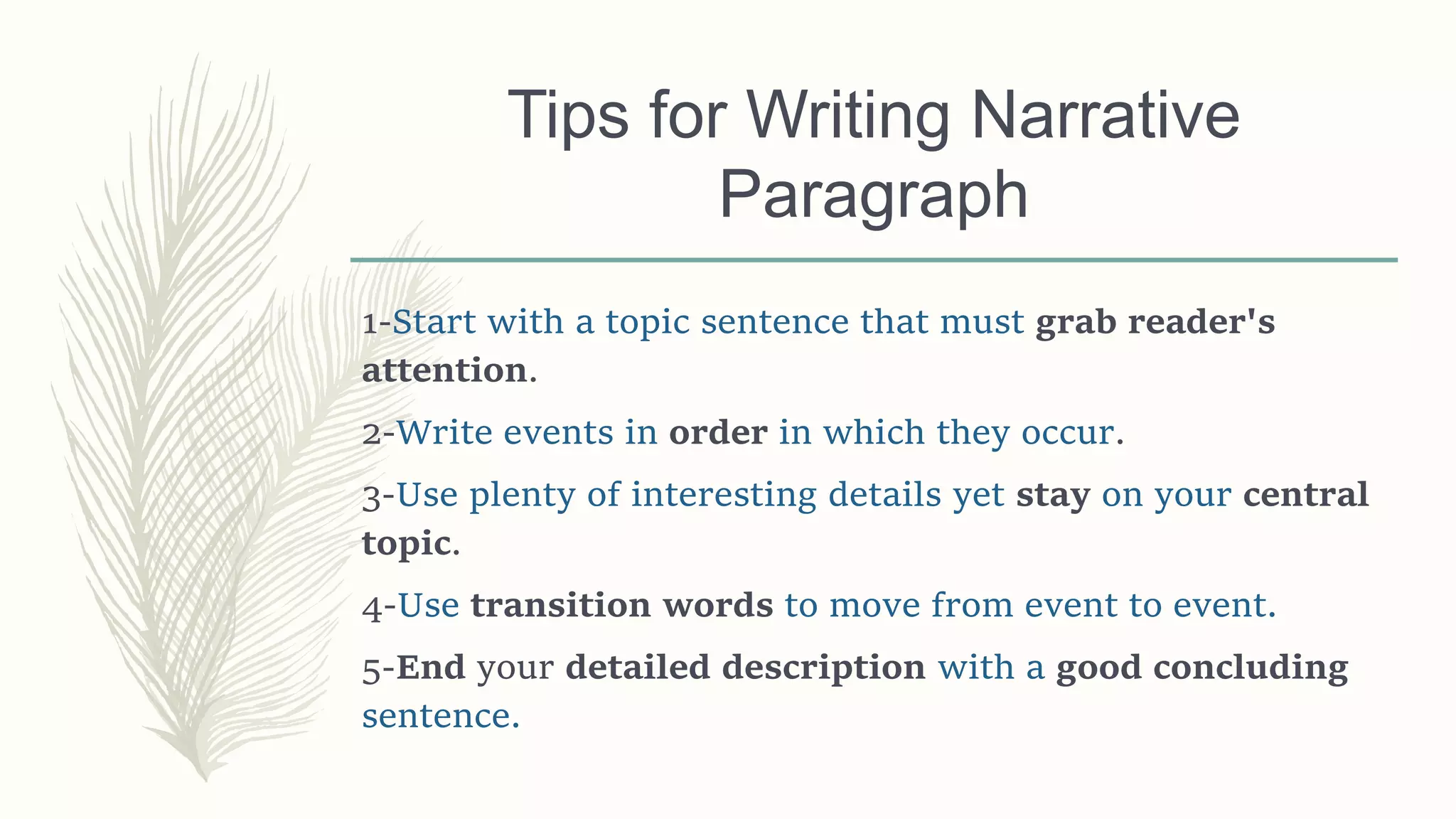
1-Start with a topic sentence that must grab reader's
attention.
2-Write events in order in which they occur.
3-Use plenty of interesting details yet stay on your central
topic.
4-Use transition words to move from event to event.
5-End your detailed description with a good concluding
sentence.
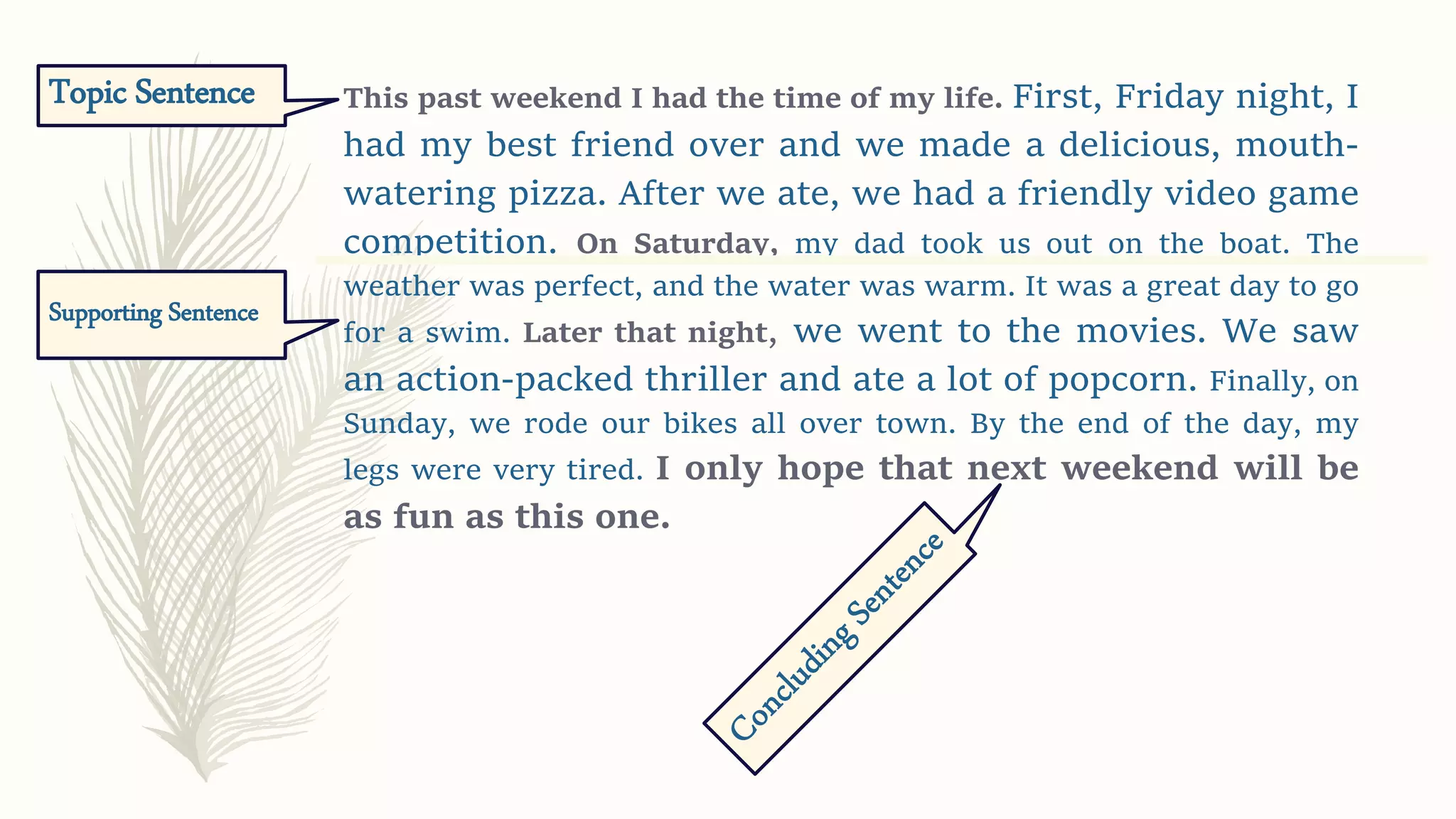
This past weekend I had the time of my life. First, Friday night, I
had my best friend over and we made a delicious, mouth-
watering pizza. After we ate, we had a friendly video game
competition. On Saturday, my dad took us out on the boat. The
weather was perfect, and the water was warm. It was a great day to go
for a swim. Later that night, we went to the movies. We saw
an action-packed thriller and ate a lot of popcorn. Finally, on
Sunday, we rode our bikes all over town. By the end of the day, my
legs were very tired. I only hope that next weekend will be
as fun as this one.
Topic Sentence
Supporting Sentence
Descriptive Paragraph
--When writing this type of paragraph,
you describe something with words
that allows your reader to almost
“see” what you’re describing.
--The words chosen in the description often
appeal to the five senses of touch, smell,
sight, sound, and taste.
Tips for Writing Descriptive
Paragraph
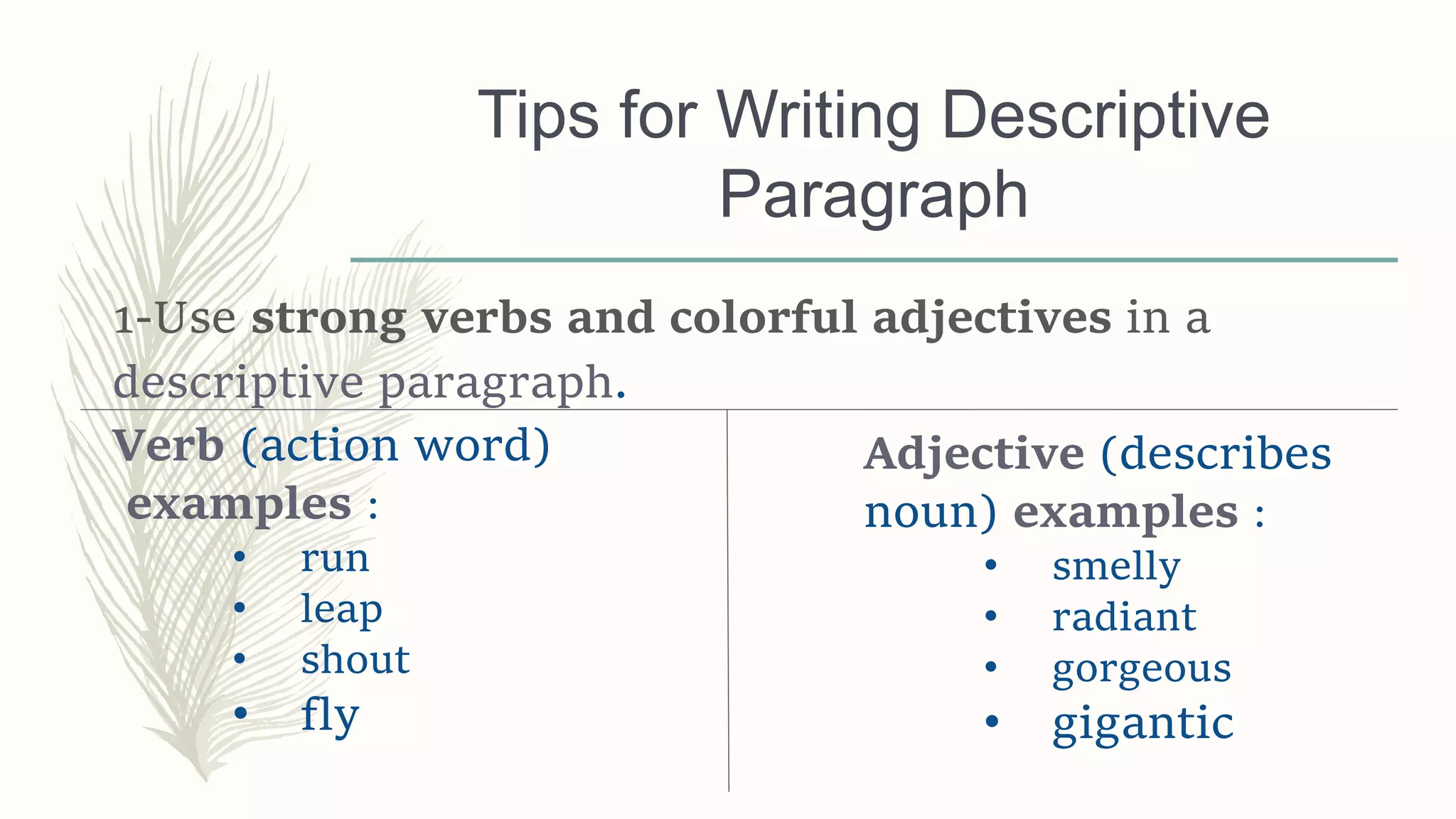
1-Use strong verbs and colorful adjectives in a
descriptive paragraph.
Verb (action word)
examples :
• run
• leap
• shout
• fly
Adjective (describes
noun) examples :
• smelly
• radiant
• gorgeous
• gigantic
Example Sentences
“The petite, young girl
merrily skipped
around the
blossoming, fragrant
bushes.”
“A strong, putrid
odor flowed through
the musty air outside
the garbage
dumpster.”The descriptive words in each sentence help the
reader see (and smell!) what is being described.
Expository Paragraph
When writing this type of paragraph,
you provide information. You write it
in a logical sequence so your reader
can follow the ideas. The topic
sentence in an expository paragraph
states the main idea, or what you’ll
write about.
Expository Paragraph
Each supporting detail may be followed by one or
two sentences that add details or give more
explanation. Their must be a logical sequence as
you move from one supporting sentence & detail
to another. Your paragraph should end with an
appropriate concluding sentence.
Example Paragraph
Going to college can be expensive. First, college tuition and room and
board can cost anywhere from $2,000 to more than $10,000 per
semester. Other expenses can add up, as well. For example, books
typically cost between $300 and $500 each term. Second, materials
are also very expensive. Paper, notebooks, writing utensils, and other
required supplies often cost more at the college bookstore than at a
discount store. For instance, a package of notepaper costing $2 at a
discount store might cost $5 at the college bookstore. Finally, there are
all kinds of special fees added onto the bill at registration time. A
college student might have to pay a $50 insurance fee, a $20 activity
fee, a $15 fee to the student government association and anywhere
from $100 to $1,000 for parking. There is another fee if a student
decides to add or drop a course after registration ends. The costs
required to attend college never seem to end.
Topic Sentence
When your reader reads
this sentence, he or she
will know your
paragraph is going to
cover the costs of
attending college.
Supporting Sentences
in Logical Way
Persuasive Paragraph
This type of paragraph tries to
change the reader's mind about
something or to convince the
reader to agree with the writer's
point of view.
Things to know about persuasive
paragraphs:
1.The first sentence should lay out
the writer’s point of view on the
topic at hand.
2. Supporting sentences should back
up the opinion with logic.
3. All claims should be able to be
supported with evidence.
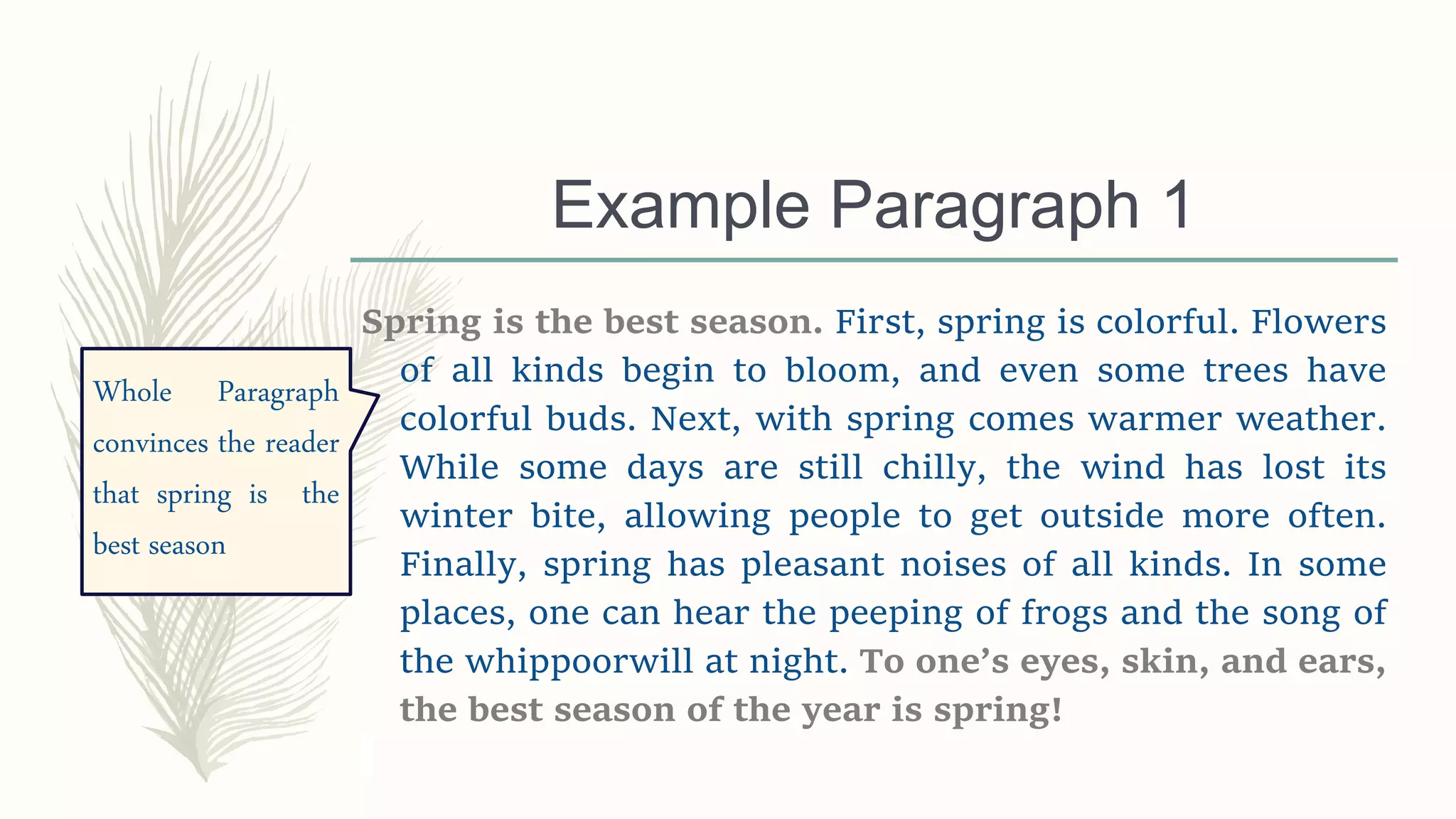
Example Paragraph 1
Spring is the best season. First, spring is colorful. Flowers
of all kinds begin to bloom, and even some trees have
colorful buds. Next, with spring comes warmer weather.
While some days are still chilly, the wind has lost its
winter bite, allowing people to get outside more often.
Finally, spring has pleasant noises of all kinds. In some
places, one can hear the peeping of frogs and the song of
the whippoorwill at night. To one’s eyes, skin, and ears,
the best season of the year is spring!
Whole Paragraph
convinces the reader
that spring is the
best season
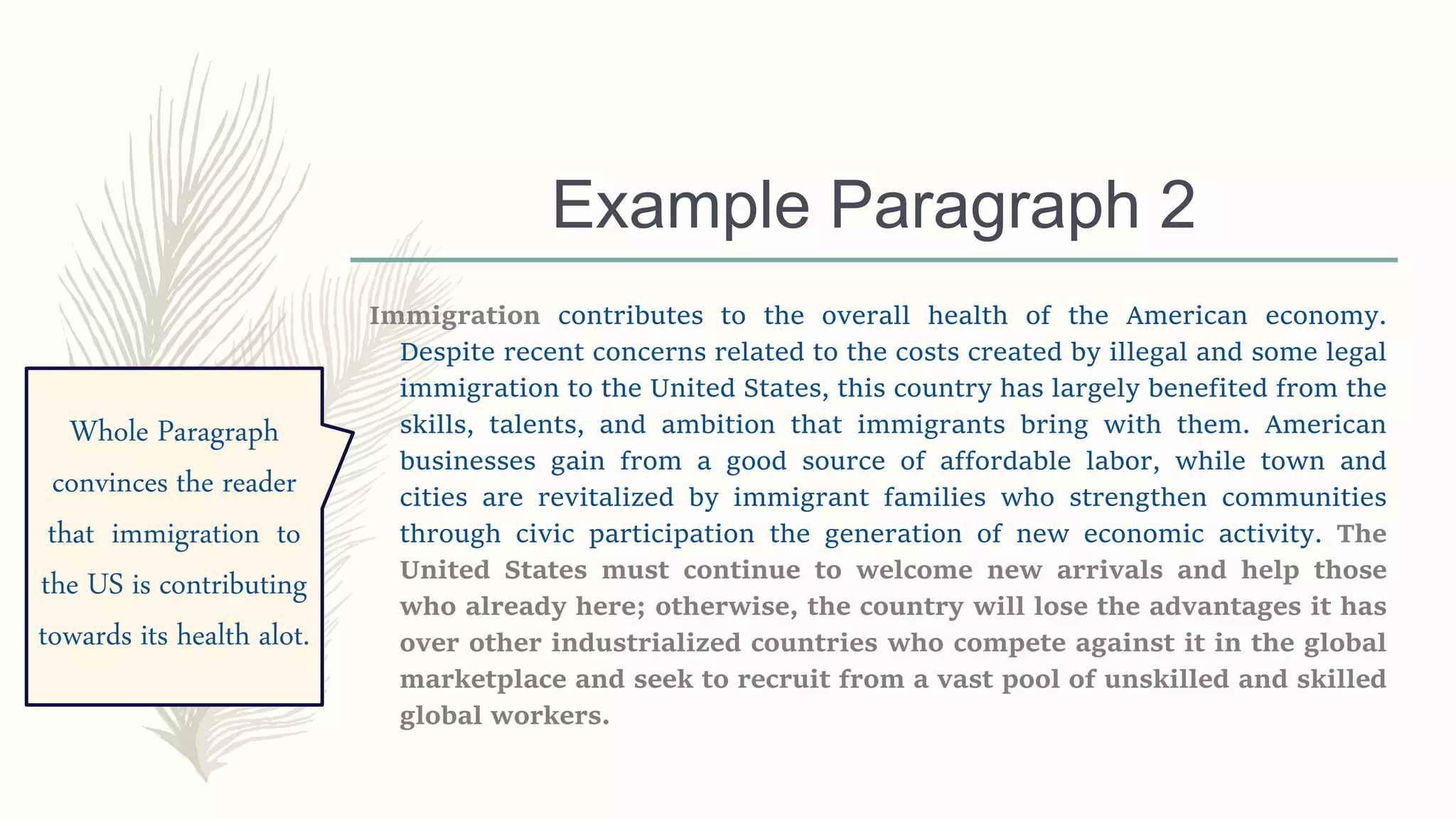
Example Paragraph 2
Immigration contributes to the overall health of the American economy.
Despite recent concerns related to the costs created by illegal and some legal
immigration to the United States, this country has largely benefited from the
skills, talents, and ambition that immigrants bring with them. American
businesses gain from a good source of affordable labor, while town and
cities are revitalized by immigrant families who strengthen communities
through civic participation the generation of new economic activity. The
United States must continue to welcome new arrivals and help those
who already here; otherwise, the country will lose the advantages it has
over other industrialized countries who compete against it in the global
marketplace and seek to recruit from a vast pool of unskilled and skilled
global workers.
Whole Paragraph
convinces the reader
that immigration to
the US is contributing
towards its health alot.
The End

Paragraph Types and Ways to Write Them

  • 1.
    Paragraph Types & Waysto Write them By Shefa Idrees
  • 2.
    Paragraph Types – Paragraphsare “chunks” of information about one single aspect of a topic. – Paragraphs may be developed [created] in the following ways: 1-Narrative 2-Descriptive 3-Expository 4-Persuasive
  • 3.
    Narrative Paragraph –Describes oneprimary topic and narrates or tells its story – Topic usually involves one main topic, event, adventure, scene or happening. Example: picnic...
  • 4.
    Tips for WritingNarrative Paragraph 1-Start with a topic sentence that must grab reader's attention. 2-Write events in order in which they occur. 3-Use plenty of interesting details yet stay on your central topic. 4-Use transition words to move from event to event. 5-End your detailed description with a good concluding sentence.
  • 5.
    This past weekendI had the time of my life. First, Friday night, I had my best friend over and we made a delicious, mouth- watering pizza. After we ate, we had a friendly video game competition. On Saturday, my dad took us out on the boat. The weather was perfect, and the water was warm. It was a great day to go for a swim. Later that night, we went to the movies. We saw an action-packed thriller and ate a lot of popcorn. Finally, on Sunday, we rode our bikes all over town. By the end of the day, my legs were very tired. I only hope that next weekend will be as fun as this one. Topic Sentence Supporting Sentence
  • 6.
    Descriptive Paragraph --When writingthis type of paragraph, you describe something with words that allows your reader to almost “see” what you’re describing. --The words chosen in the description often appeal to the five senses of touch, smell, sight, sound, and taste.
  • 7.
    Tips for WritingDescriptive Paragraph 1-Use strong verbs and colorful adjectives in a descriptive paragraph. Verb (action word) examples : • run • leap • shout • fly Adjective (describes noun) examples : • smelly • radiant • gorgeous • gigantic
  • 8.
    Example Sentences “The petite,young girl merrily skipped around the blossoming, fragrant bushes.” “A strong, putrid odor flowed through the musty air outside the garbage dumpster.”The descriptive words in each sentence help the reader see (and smell!) what is being described.
  • 9.
    Expository Paragraph When writingthis type of paragraph, you provide information. You write it in a logical sequence so your reader can follow the ideas. The topic sentence in an expository paragraph states the main idea, or what you’ll write about.
  • 10.
    Expository Paragraph Each supportingdetail may be followed by one or two sentences that add details or give more explanation. Their must be a logical sequence as you move from one supporting sentence & detail to another. Your paragraph should end with an appropriate concluding sentence.
  • 11.
    Example Paragraph Going tocollege can be expensive. First, college tuition and room and board can cost anywhere from $2,000 to more than $10,000 per semester. Other expenses can add up, as well. For example, books typically cost between $300 and $500 each term. Second, materials are also very expensive. Paper, notebooks, writing utensils, and other required supplies often cost more at the college bookstore than at a discount store. For instance, a package of notepaper costing $2 at a discount store might cost $5 at the college bookstore. Finally, there are all kinds of special fees added onto the bill at registration time. A college student might have to pay a $50 insurance fee, a $20 activity fee, a $15 fee to the student government association and anywhere from $100 to $1,000 for parking. There is another fee if a student decides to add or drop a course after registration ends. The costs required to attend college never seem to end. Topic Sentence When your reader reads this sentence, he or she will know your paragraph is going to cover the costs of attending college. Supporting Sentences in Logical Way
  • 12.
    Persuasive Paragraph This typeof paragraph tries to change the reader's mind about something or to convince the reader to agree with the writer's point of view.
  • 13.
    Things to knowabout persuasive paragraphs: 1.The first sentence should lay out the writer’s point of view on the topic at hand. 2. Supporting sentences should back up the opinion with logic. 3. All claims should be able to be supported with evidence.
  • 14.
    Example Paragraph 1 Springis the best season. First, spring is colorful. Flowers of all kinds begin to bloom, and even some trees have colorful buds. Next, with spring comes warmer weather. While some days are still chilly, the wind has lost its winter bite, allowing people to get outside more often. Finally, spring has pleasant noises of all kinds. In some places, one can hear the peeping of frogs and the song of the whippoorwill at night. To one’s eyes, skin, and ears, the best season of the year is spring! Whole Paragraph convinces the reader that spring is the best season
  • 15.
    Example Paragraph 2 Immigrationcontributes to the overall health of the American economy. Despite recent concerns related to the costs created by illegal and some legal immigration to the United States, this country has largely benefited from the skills, talents, and ambition that immigrants bring with them. American businesses gain from a good source of affordable labor, while town and cities are revitalized by immigrant families who strengthen communities through civic participation the generation of new economic activity. The United States must continue to welcome new arrivals and help those who already here; otherwise, the country will lose the advantages it has over other industrialized countries who compete against it in the global marketplace and seek to recruit from a vast pool of unskilled and skilled global workers. Whole Paragraph convinces the reader that immigration to the US is contributing towards its health alot.
  • 16.