PROJECT
Presented by:
Joves, Marielle M.
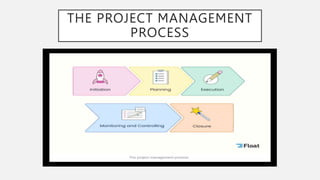
THE PROJECT MANAGEMENT
PROCESS
RELEVANCE OF PLANNING
• Project plans are important because they provide
a shared vision for what the project aims to
accomplish.
• Project plans give clarity on the responsibilities of
each team member and stakeholder in the
project.
THE BENEFITS OF EFFECTIVE PROJECT
PLANNING
☑️ Map your scope and effort to a realistic timeline
☑️ Provide a roadmap for the project
☑️ Outline roles, responsibilities, and resourcing
requirements
☑️ Help to identify and track project risks
☑️ Keep your project on time and within budget
☑️ Help to identify impacts due to project change
☑️ Keep stakeholders informed of project progress
☑️ Keep teams on task, within scope, and on budget
☑️ Help to keep team members efficient and productive
☑️ Allow for accurate reporting of progress
PLANNING STEPS
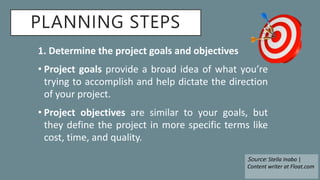
1. Determine the project goals and objectives
• Project goals provide a broad idea of what you’re
trying to accomplish and help dictate the direction
of your project.
• Project objectives are similar to your goals, but
they define the project in more specific terms like
cost, time, and quality.
Source: Stella Inabo |
Content writer at Float.com
PLANNING STEPS
2. Determine the project scope
• The project scope is based on the project goals
and objectives
• Project scope helps to distinguish what is and is
not involved in the project
Source: Stella Inabo |
Content writer at Float.com
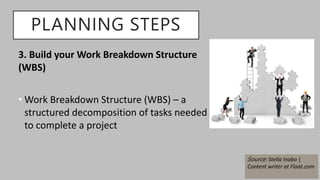
3. Build your Work Breakdown Structure
(WBS)
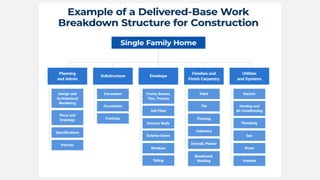
• Work Breakdown Structure (WBS) – a
structured decomposition of tasks needed
to complete a project
PLANNING STEPS
Source: Stella Inabo |
Content writer at Float.com
PLANNING STEPS
4. Set timelines
• We can set timelines by comparing the duration
of tasks in similar projects or asking the team
how long specific tasks take them.
• Project timelines help us estimate the
completion date and keep things on track.
Source: Stella Inabo |
Content writer at Float.com
PLANNING STEPS
5. Determine and plan resources
• For a project to succeed, you need the right
people and resources.
• This step involves a lot of project assumptions
and making estimates.
Source: Stella Inabo |
Content writer at Float.com
PLANNING STEPS
6. Estimate Costs
• Ballpark Estimation – A ballpark estimate is a rough
initial estimate based on high level client objectives,
and a large margin of uncertainty. A ballpark estimate
should be a price range, rather than a fixed fee.
• Parametric Estimation - The use of historical data or
past projects when calculating estimates
Source: Stella Inabo |
Content writer at Float.com
PLANNING STEPS
7. Determine risks and constraints
• The key to avoiding a project failure is identifying the
potential pitfalls and creating an action plan to handle
them.
Source: Stella Inabo |
Content writer at Float.com
PLANNING STEPS
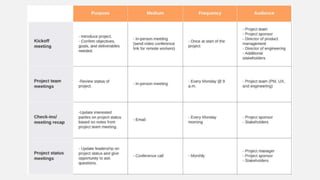
8. Plan out communication
• A project management communication plan
identifies how important information will be
communicated to stakeholders throughout the
project.
Source: Stella Inabo |
Content writer at Float.com
PLANNING STEPS
9. Make plans for quality control and assurance
Planning for project quality control involves providing
guidelines for managing, assuring, and maintaining
standards within the project.
Source: Stella Inabo |
Content writer at Float.com
THANK YOU! :)

Project Planning: It's Relevance & Steps

  • 1.
  • 2.
  • 3.
    RELEVANCE OF PLANNING •Project plans are important because they provide a shared vision for what the project aims to accomplish. • Project plans give clarity on the responsibilities of each team member and stakeholder in the project.
  • 4.
    THE BENEFITS OFEFFECTIVE PROJECT PLANNING ☑️ Map your scope and effort to a realistic timeline ☑️ Provide a roadmap for the project ☑️ Outline roles, responsibilities, and resourcing requirements ☑️ Help to identify and track project risks
  • 5.
    ☑️ Keep yourproject on time and within budget ☑️ Help to identify impacts due to project change ☑️ Keep stakeholders informed of project progress ☑️ Keep teams on task, within scope, and on budget ☑️ Help to keep team members efficient and productive ☑️ Allow for accurate reporting of progress
  • 6.
    PLANNING STEPS 1. Determinethe project goals and objectives • Project goals provide a broad idea of what you’re trying to accomplish and help dictate the direction of your project. • Project objectives are similar to your goals, but they define the project in more specific terms like cost, time, and quality. Source: Stella Inabo | Content writer at Float.com
  • 7.
    PLANNING STEPS 2. Determinethe project scope • The project scope is based on the project goals and objectives • Project scope helps to distinguish what is and is not involved in the project Source: Stella Inabo | Content writer at Float.com
  • 8.
    3. Build yourWork Breakdown Structure (WBS) • Work Breakdown Structure (WBS) – a structured decomposition of tasks needed to complete a project PLANNING STEPS Source: Stella Inabo | Content writer at Float.com
  • 10.
    PLANNING STEPS 4. Settimelines • We can set timelines by comparing the duration of tasks in similar projects or asking the team how long specific tasks take them. • Project timelines help us estimate the completion date and keep things on track. Source: Stella Inabo | Content writer at Float.com
  • 11.
    PLANNING STEPS 5. Determineand plan resources • For a project to succeed, you need the right people and resources. • This step involves a lot of project assumptions and making estimates. Source: Stella Inabo | Content writer at Float.com
  • 12.
    PLANNING STEPS 6. EstimateCosts • Ballpark Estimation – A ballpark estimate is a rough initial estimate based on high level client objectives, and a large margin of uncertainty. A ballpark estimate should be a price range, rather than a fixed fee. • Parametric Estimation - The use of historical data or past projects when calculating estimates Source: Stella Inabo | Content writer at Float.com
  • 13.
    PLANNING STEPS 7. Determinerisks and constraints • The key to avoiding a project failure is identifying the potential pitfalls and creating an action plan to handle them. Source: Stella Inabo | Content writer at Float.com
  • 14.
    PLANNING STEPS 8. Planout communication • A project management communication plan identifies how important information will be communicated to stakeholders throughout the project. Source: Stella Inabo | Content writer at Float.com
  • 16.
    PLANNING STEPS 9. Makeplans for quality control and assurance Planning for project quality control involves providing guidelines for managing, assuring, and maintaining standards within the project. Source: Stella Inabo | Content writer at Float.com
  • 17.