

Copyright © Wondershare Software
LOGO
Copyright © Wondershare Software
• Role of IT in Business
• Types of Projects IT should be engaged in
• Strategies for IT Project Management
• Introduction to project management
• Project Risk management
• Quality assurance and Management
• Component Based Software Engineering(CBSE)
Or Component Based Development(CBD)
Copyright © Wondershare Software
To provide the systems and technological
infrastructure to support improvements in
operational efficiency and responsiveness
 Productivity
 Significance
 Monitoring
 Business Performance Management
 E-Commerce
Copyright © Wondershare Software
1. Process and Product Design
1. Analysis and Design Tools
2. Knowledge Management
2. Production Systems
1. Equipment controls
2. Scheduling
3. Simulators
3. Infrastructure
1. Data Communications Networks
2. Database Systems
3. Intranet, Intranet and Extranet, EDI
4. Disaster Recovery
4. Administration and Management
1. Productivity tools
2. Supply Chain Management
3. Decision Support Systems
5. IT Focused Education
Copyright © Wondershare Software
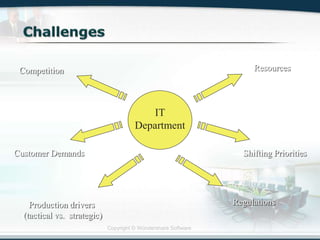
IT
Department
Resources
Shifting Priorities
Competition
Customer Demands
Production drivers
(tactical vs. strategic)
Regulations
Copyright © Wondershare Software
IT projects have a terrible track record
 A 1995 Standish Group study (CHAOS) found that
only 16.2% of IT projects were successful and over
31% were canceled before completion, costing over
$81 B in the U.S. alone
The need for IT projects keeps increasing
 In 2000, there were 300,000 new IT projects
 In 2001, over 500,000 new IT projects were started
 In 2004, IT spending in the US increased an estimated
4.4% over 2003 (Forrester Research)
 In 2005, another 5.7% growth is estimated (Forrester
Research)
Copyright © Wondershare Software
A project is “a temporary endeavor undertaken to
accomplish a unique Product or service.”
Project management is “the application of knowledge,
skills, tools, and techniques to project activities to meet
or exceed project requirements.”
Copyright © Wondershare Software
Information Technology (IT) projects are
organizational investments that require
 Time
 Money
 Other resources such as people, technology,
facilities, etc.
Organizations expect some type of value
in return of this investment
IT Project Management is a relatively
new discipline that combines traditional
Project Management with Software
Engineering/Management Information
Systems to make IT projects more
successful.
Copyright © Wondershare Software
 Larger projects have the lowest success rate and
appear to be more risky than medium and smaller
projects
 Technology, business models and markets change so
rapidly that a project that takes more than a year
can be obsolete before they are completed.
Copyright © Wondershare Software
Time Frame
Purpose (to provide value!)
Ownership
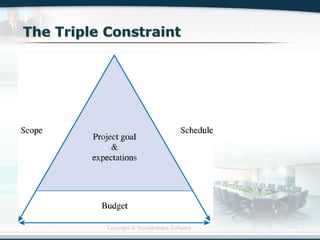
Resources (the triple constraint)
Roles
 Project Manager
 Project Sponsor
 SME (domain & technical)
Risk & Assumptions
Interdependent Tasks
Planned Organizational Change
Operate in Environments Larger than the
Project Itself
Copyright © Wondershare Software
Project Life Cycle (PLC)
 A collection of logical stages or phases that
maps the life of a project from its beginning to
its end in order to define, build and deliver the
product of the project – i.e., the information
system
Projects are divided into phases to
increase manageability and reduce
risk
 Phase exits, stage gates, or kill points are
decision points at the end of each phase to
evaluate performance, correct problems or
cancel the project
 Fast tracking is the overlapping of phases to
reduce the project’s schedule
 Can be risky!
Copyright © Wondershare Software
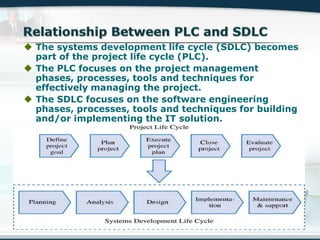
 The systems development life cycle (SDLC) becomes
part of the project life cycle (PLC).
 The PLC focuses on the project management
phases, processes, tools and techniques for
effectively managing the project.
 The SDLC focuses on the software engineering
phases, processes, tools and techniques for building
and/or implementing the IT solution.
Copyright © Wondershare Software
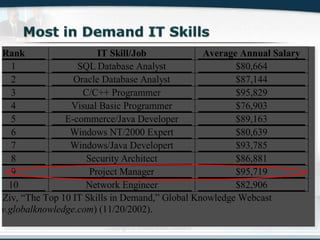
Rank IT Skill/Job Average Annual Salary
1 SQL Database Analyst $80,664
2 Oracle Database Analyst $87,144
3 C/C++ Programmer $95,829
4 Visual Basic Programmer $76,903
5 E-commerce/Java Developer $89,163
6 Windows NT/2000 Expert $80,639
7 Windows/Java Developert $93,785
8 Security Architect $86,881
9 Project Manager $95,719
10 Network Engineer $82,906
l Ziv, “The Top 10 IT Skills in Demand,” Global Knowledge Webcast
w.globalknowledge.com) (11/20/2002).
Copyright © Wondershare Software
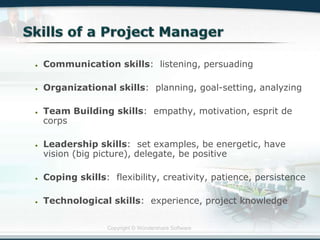
Communication skills: listening, persuading
Organizational skills: planning, goal-setting, analyzing
Team Building skills: empathy, motivation, esprit de
corps
Leadership skills: set examples, be energetic, have
vision (big picture), delegate, be positive
Coping skills: flexibility, creativity, patience, persistence
Technological skills: experience, project knowledge
Copyright © Wondershare Software
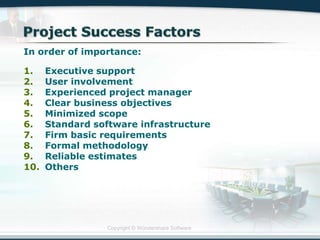
In order of importance:
1. Executive support
2. User involvement
3. Experienced project manager
4. Clear business objectives
5. Minimized scope
6. Standard software infrastructure
7. Firm basic requirements
8. Formal methodology
9. Reliable estimates
10. Others
Copyright © Wondershare Software
 Hire (or develop someone) with great project
management skills
 Adopt the Project Management Institute‟s PMBOK
(Project Management Body of Knowledge)
 Adopt a methodology or framework for operations
or systems development (ITIL/MOF, MSF, etc) or
develop your own
 Use technology to assist in managing projects
 Create a Project Management Office
Copyright © Wondershare Software
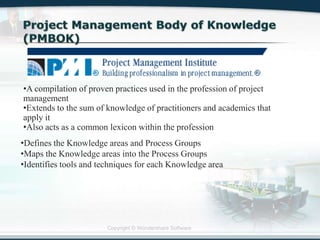
•A compilation of proven practices used in the profession of project
management
•Extends to the sum of knowledge of practitioners and academics that
apply it
•Also acts as a common lexicon within the profession
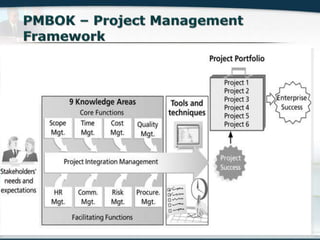
•Defines the Knowledge areas and Process Groups
•Maps the Knowledge areas into the Process Groups
•Identifies tools and techniques for each Knowledge area
Copyright © Wondershare Software
 Word processor and spreadsheet
 Communication software (email, virtual
meeting, portal, etc.)
 PMBOK – tools identified for each
knowledge area
 Project management software (like MS
Project)
Copyright © Wondershare Software
Small projects
 TurboProject, Milestone Simplicity, Project Vision,
Quick Gantt, Microsoft Project, Primavera SureTrak
Larger Cross-functional Projects
 Microsoft Project and Primavera
Multi-Project management
 Microsoft Project Server, Primavera, Open Plan,
Cobra, Enterprise PM, Micro Planner X-Pert
Microsoft Demos:
http://www.microsoft.com/office/project/prodinfo/demo
.mspx
Copyright © Wondershare Software
 Project Support
 Project Management
Methodology
 Training
 Home Base for Project
Managers
 Internal Consulting and
Mentoring
 Software Tools
 Portfolio Management
Copyright © Wondershare Software
 ROI is not quick
 Corporate culture could be resistant
 Difficult to develop metrics to track success
 Which model do you choose – central
project management or consulting?
Copyright © Wondershare Software
 Scope Management
 Time Management
 Quality Management
 Cost Management
 Risk Management
Copyright © Wondershare Software
 The scope can be completely defined
 Scope definition can be done before the project starts
 Software development consists of distinctly different
activities which can be measured and estimated
 Software development activities can be sequenced
 There is always a way to produce meaningful estimates
 The size of the project team doesn‟t affect the
development process. The mythical Man-Month
 One developer is equivalent to another
 Metrics are sufficient to assess the quality of software.
 Quality checklists solve all problems.
Copyright © Wondershare Software
 Project risk management is the art and science of
identifying, analyzing, and responding to risk
throughout the life of a project and in the best
interests of meeting project objectives
 Main processes include:
 Risk management planning
 Risk identification
 Qualitative risk analysis
 Quantitative risk analysis
 Risk response planning
 Risk monitoring and control
Copyright © Wondershare Software
 Risk management: process of identifying and
controlling risks facing an organization
 Risk identification: process of examining an
organization‟s current information technology security
situation
 Risk control: applying controls to reduce risks to an
organizations data and information systems
Copyright © Wondershare Software
 A dictionary definition of risk is
“the possibility of loss or injury”
 Negative risk involves
understanding potential problems
that might occur in the project and
how they might impede project
success
 Negative risk management is like a
form of insurance; it is an
investment
Copyright © Wondershare Software
 Positive risks are risks that result in good things
happening; sometimes called opportunities
 A general definition of project risk is an uncertainty
that can have a negative or positive effect on
meeting project objectives
 The goal of project risk management is to minimize
potential negative risks while maximizing potential
positive risks
Copyright © Wondershare Software
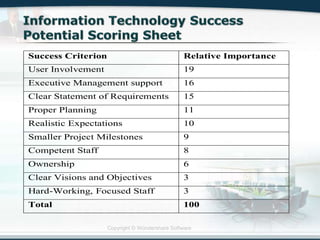
 Several studies show that IT projects share
some common sources of risk
 The Standish Group developed an IT
success potential scoring sheet based on
potential risks
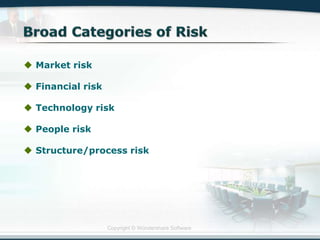
 Other broad categories of risk help identify
potential risks
Copyright © Wondershare Software
Success Criterion Relative Importance
User Involvement 19
Executive Management support 16
Clear Statement of Requirements 15
Proper Planning 11
Realistic Expectations 10
Smaller Project Milestones 9
Competent Staff 8
Ownership 6
Clear Visions and Objectives 3
Hard-Working, Focused Staff 3
Total 100
Copyright © Wondershare Software
 Market risk
 Financial risk
 Technology risk
 People risk
 Structure/process risk
Copyright © Wondershare Software
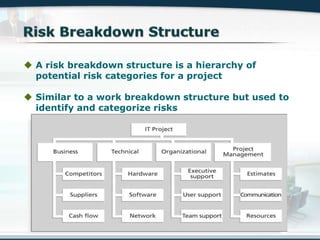
 A risk breakdown structure is a hierarchy of
potential risk categories for a project
 Similar to a work breakdown structure but used to
identify and categorize risks
Copyright © Wondershare Software
 Unlike crisis management, good project risk
management often goes unnoticed
 Well-run projects appear to be almost
effortless, but a lot of work goes into running
a project well
 Project managers should strive to make their
jobs look easy to reflect the results of well-
run projects
Copyright © Wondershare Software
 Concerned with ensuring that the required level
of quality is achieved in a software product.
 Involves defining appropriate quality standards
and procedures and ensuring that these are
followed.
 Should aim to develop a „quality culture‟ where
quality is seen as everyone‟s responsibility.
Copyright © Wondershare Software
Quality means that a product satisfies the
demands of its specifications
It also means achieving a high level of
customer satisfaction with the product
In software systems this is difficult
customer quality requirements (e.g. efficiency or
reliability) often conflict with developer quality
requirements (e.g. maintainability or
reusability)
 software specifications are often incomplete,
inconsistent, or ambiguous
Copyright © Wondershare Software
Quality assurance
 Establish organisational procedures and standards for
quality.
Quality planning
 Select applicable procedures and standards for a
particular project and modify these as required.
Quality control
 Ensure that procedures and standards are followed by
the software development team.
Quality management should be separate
from project management to ensure
independence.
Copyright © Wondershare Software
 Safety
 Security
 Reliability
 Resilience
 Robustness
 Understandability
 Testability
 Adaptability
 Modularity
 Complexity
 Portability
 Usability
 Reusability
 Accessibility
 Efficiency
 Learnability
Copyright © Wondershare Software
 International set of standards for quality
management
 Quality standards and procedures must be
documented in an organizational quality manual
 An external body is often used to certify that the
quality manual conforms to ISO 9000 standards
 Many customers are demanding that suppliers are
ISO 9000 certified
Copyright © Wondershare Software
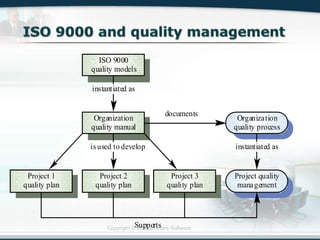
Project 1
quality plan
Project 2
quality plan
Project 3
quality plan
Project quality
management
Organization
quality manual
ISO 9000
quality models
Organization
quality process
is used to develop instantiated as
instantiated as
documents
Supports
Copyright © Wondershare Software
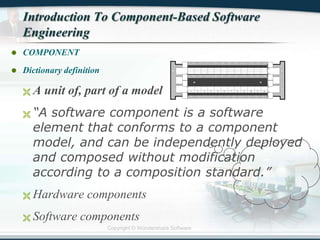
 COMPONENT
 Dictionary definition
 A unit of, part of a model
 “A software component is a software
element that conforms to a component
model, and can be independently deployed
and composed without modification
according to a composition standard.”
 Hardware components
 Software components
SD
1 2 3 4 5 6 7 8 9 10 11 12
Copyright © Wondershare Software
 Component-Based Software Engineering is a process that emphasizes the
design and construction of computer-based systems using reusable
software “components”.
In CBSE, reusable component construction and component
integration for software system are the major focus.
Who are involved in Component-Based Software Engineering
?
 -System analyst
- Software engineers
- Component software developers -
 Application software integration engineers
- Test engineers and QA
- Project and product managers
Copyright © Wondershare Software
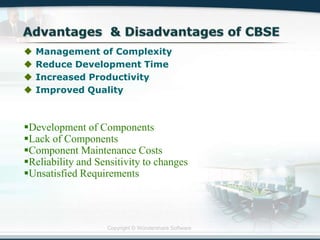
 Management of Complexity
 Reduce Development Time
 Increased Productivity
 Improved Quality
Development of Components
Lack of Components
Component Maintenance Costs
Reliability and Sensitivity to changes
Unsatisfied Requirements
Copyright © Wondershare Software
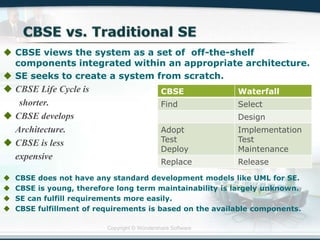
 CBSE views the system as a set of off-the-shelf
components integrated within an appropriate architecture.
 SE seeks to create a system from scratch.
 CBSE Life Cycle is
shorter.
 CBSE develops
Architecture.
 CBSE is less
expensive
 CBSE does not have any standard development models like UML for SE.
 CBSE is young, therefore long term maintainability is largely unknown.
 SE can fulfill requirements more easily.
 CBSE fulfillment of requirements is based on the available components.
CBSE Waterfall
Find Select
Design
Adopt
Test
Deploy
Implementation
Test
Maintenance
Replace Release
Copyright © Wondershare Software
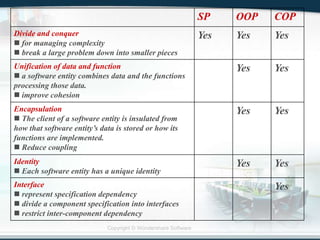
SP OOP COP
Divide and conquer
 for managing complexity
 break a large problem down into smaller pieces
Yes Yes Yes
Unification of data and function
 a software entity combines data and the functions
processing those data.
 improve cohesion
Yes Yes
Encapsulation
 The client of a software entity is insulated from
how that software entity’s data is stored or how its
functions are implemented.
 Reduce coupling
Yes Yes
Identity
 Each software entity has a unique identity
Yes Yes
Interface
 represent specification dependency
 divide a component specification into interfaces
 restrict inter-component dependency
Yes
51
Copyright © Wondershare Software
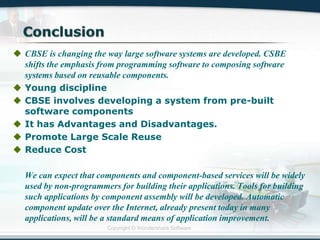
 CBSE is changing the way large software systems are developed. CSBE
shifts the emphasis from programming software to composing software
systems based on reusable components.
 Young discipline
 CBSE involves developing a system from pre-built
software components
 It has Advantages and Disadvantages.
 Promote Large Scale Reuse
 Reduce Cost
We can expect that components and component-based services will be widely
used by non-programmers for building their applications. Tools for building
such applications by component assembly will be developed. Automatic
component update over the Internet, already present today in many
applications, will be a standard means of application improvement.
Copyright © Wondershare Software
LOGO

Cse it seminar ppt1, An Approach To IT Project Management

  • 1.
  • 2.
    Copyright © WondershareSoftware • Role of IT in Business • Types of Projects IT should be engaged in • Strategies for IT Project Management • Introduction to project management • Project Risk management • Quality assurance and Management • Component Based Software Engineering(CBSE) Or Component Based Development(CBD)
  • 3.
    Copyright © WondershareSoftware To provide the systems and technological infrastructure to support improvements in operational efficiency and responsiveness  Productivity  Significance  Monitoring  Business Performance Management  E-Commerce
  • 4.
    Copyright © WondershareSoftware 1. Process and Product Design 1. Analysis and Design Tools 2. Knowledge Management 2. Production Systems 1. Equipment controls 2. Scheduling 3. Simulators 3. Infrastructure 1. Data Communications Networks 2. Database Systems 3. Intranet, Intranet and Extranet, EDI 4. Disaster Recovery 4. Administration and Management 1. Productivity tools 2. Supply Chain Management 3. Decision Support Systems 5. IT Focused Education
  • 5.
    Copyright © WondershareSoftware IT Department Resources Shifting Priorities Competition Customer Demands Production drivers (tactical vs. strategic) Regulations
  • 6.
    Copyright © WondershareSoftware IT projects have a terrible track record  A 1995 Standish Group study (CHAOS) found that only 16.2% of IT projects were successful and over 31% were canceled before completion, costing over $81 B in the U.S. alone The need for IT projects keeps increasing  In 2000, there were 300,000 new IT projects  In 2001, over 500,000 new IT projects were started  In 2004, IT spending in the US increased an estimated 4.4% over 2003 (Forrester Research)  In 2005, another 5.7% growth is estimated (Forrester Research)
  • 7.
    Copyright © WondershareSoftware A project is “a temporary endeavor undertaken to accomplish a unique Product or service.” Project management is “the application of knowledge, skills, tools, and techniques to project activities to meet or exceed project requirements.”
  • 8.
    Copyright © WondershareSoftware Information Technology (IT) projects are organizational investments that require  Time  Money  Other resources such as people, technology, facilities, etc. Organizations expect some type of value in return of this investment IT Project Management is a relatively new discipline that combines traditional Project Management with Software Engineering/Management Information Systems to make IT projects more successful.
  • 9.
    Copyright © WondershareSoftware  Larger projects have the lowest success rate and appear to be more risky than medium and smaller projects  Technology, business models and markets change so rapidly that a project that takes more than a year can be obsolete before they are completed.
  • 10.
    Copyright © WondershareSoftware Time Frame Purpose (to provide value!) Ownership Resources (the triple constraint) Roles  Project Manager  Project Sponsor  SME (domain & technical) Risk & Assumptions Interdependent Tasks Planned Organizational Change Operate in Environments Larger than the Project Itself
  • 11.
  • 12.
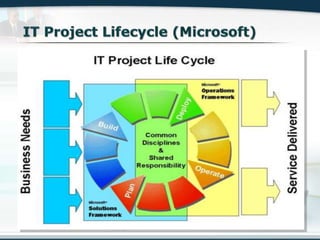
    Copyright © WondershareSoftware Project Life Cycle (PLC)  A collection of logical stages or phases that maps the life of a project from its beginning to its end in order to define, build and deliver the product of the project – i.e., the information system Projects are divided into phases to increase manageability and reduce risk  Phase exits, stage gates, or kill points are decision points at the end of each phase to evaluate performance, correct problems or cancel the project  Fast tracking is the overlapping of phases to reduce the project’s schedule  Can be risky!
  • 13.
    Copyright © WondershareSoftware  The systems development life cycle (SDLC) becomes part of the project life cycle (PLC).  The PLC focuses on the project management phases, processes, tools and techniques for effectively managing the project.  The SDLC focuses on the software engineering phases, processes, tools and techniques for building and/or implementing the IT solution.
  • 14.
    Copyright © WondershareSoftware Rank IT Skill/Job Average Annual Salary 1 SQL Database Analyst $80,664 2 Oracle Database Analyst $87,144 3 C/C++ Programmer $95,829 4 Visual Basic Programmer $76,903 5 E-commerce/Java Developer $89,163 6 Windows NT/2000 Expert $80,639 7 Windows/Java Developert $93,785 8 Security Architect $86,881 9 Project Manager $95,719 10 Network Engineer $82,906 l Ziv, “The Top 10 IT Skills in Demand,” Global Knowledge Webcast w.globalknowledge.com) (11/20/2002).
  • 15.
    Copyright © WondershareSoftware Communication skills: listening, persuading Organizational skills: planning, goal-setting, analyzing Team Building skills: empathy, motivation, esprit de corps Leadership skills: set examples, be energetic, have vision (big picture), delegate, be positive Coping skills: flexibility, creativity, patience, persistence Technological skills: experience, project knowledge
  • 16.
    Copyright © WondershareSoftware In order of importance: 1. Executive support 2. User involvement 3. Experienced project manager 4. Clear business objectives 5. Minimized scope 6. Standard software infrastructure 7. Firm basic requirements 8. Formal methodology 9. Reliable estimates 10. Others
  • 17.
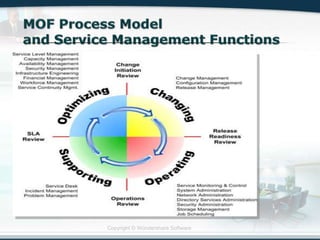
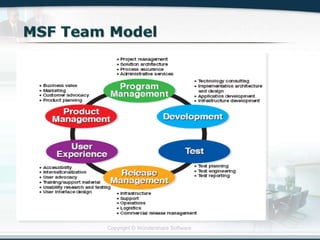
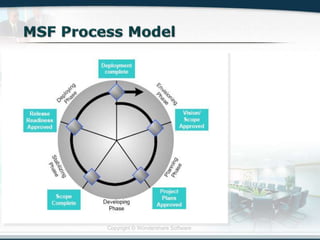
    Copyright © WondershareSoftware  Hire (or develop someone) with great project management skills  Adopt the Project Management Institute‟s PMBOK (Project Management Body of Knowledge)  Adopt a methodology or framework for operations or systems development (ITIL/MOF, MSF, etc) or develop your own  Use technology to assist in managing projects  Create a Project Management Office
  • 18.
    Copyright © WondershareSoftware •A compilation of proven practices used in the profession of project management •Extends to the sum of knowledge of practitioners and academics that apply it •Also acts as a common lexicon within the profession •Defines the Knowledge areas and Process Groups •Maps the Knowledge areas into the Process Groups •Identifies tools and techniques for each Knowledge area
  • 19.
  • 20.
  • 21.
  • 22.
  • 23.
  • 24.
  • 25.
    Copyright © WondershareSoftware  Word processor and spreadsheet  Communication software (email, virtual meeting, portal, etc.)  PMBOK – tools identified for each knowledge area  Project management software (like MS Project)
  • 26.
    Copyright © WondershareSoftware Small projects  TurboProject, Milestone Simplicity, Project Vision, Quick Gantt, Microsoft Project, Primavera SureTrak Larger Cross-functional Projects  Microsoft Project and Primavera Multi-Project management  Microsoft Project Server, Primavera, Open Plan, Cobra, Enterprise PM, Micro Planner X-Pert Microsoft Demos: http://www.microsoft.com/office/project/prodinfo/demo .mspx
  • 27.
    Copyright © WondershareSoftware  Project Support  Project Management Methodology  Training  Home Base for Project Managers  Internal Consulting and Mentoring  Software Tools  Portfolio Management
  • 28.
    Copyright © WondershareSoftware  ROI is not quick  Corporate culture could be resistant  Difficult to develop metrics to track success  Which model do you choose – central project management or consulting?
  • 29.
    Copyright © WondershareSoftware  Scope Management  Time Management  Quality Management  Cost Management  Risk Management
  • 30.
    Copyright © WondershareSoftware  The scope can be completely defined  Scope definition can be done before the project starts  Software development consists of distinctly different activities which can be measured and estimated  Software development activities can be sequenced  There is always a way to produce meaningful estimates  The size of the project team doesn‟t affect the development process. The mythical Man-Month  One developer is equivalent to another  Metrics are sufficient to assess the quality of software.  Quality checklists solve all problems.
  • 31.
    Copyright © WondershareSoftware  Project risk management is the art and science of identifying, analyzing, and responding to risk throughout the life of a project and in the best interests of meeting project objectives  Main processes include:  Risk management planning  Risk identification  Qualitative risk analysis  Quantitative risk analysis  Risk response planning  Risk monitoring and control
  • 32.
    Copyright © WondershareSoftware  Risk management: process of identifying and controlling risks facing an organization  Risk identification: process of examining an organization‟s current information technology security situation  Risk control: applying controls to reduce risks to an organizations data and information systems
  • 33.
  • 34.
    Copyright © WondershareSoftware  A dictionary definition of risk is “the possibility of loss or injury”  Negative risk involves understanding potential problems that might occur in the project and how they might impede project success  Negative risk management is like a form of insurance; it is an investment
  • 35.
    Copyright © WondershareSoftware  Positive risks are risks that result in good things happening; sometimes called opportunities  A general definition of project risk is an uncertainty that can have a negative or positive effect on meeting project objectives  The goal of project risk management is to minimize potential negative risks while maximizing potential positive risks
  • 36.
    Copyright © WondershareSoftware  Several studies show that IT projects share some common sources of risk  The Standish Group developed an IT success potential scoring sheet based on potential risks  Other broad categories of risk help identify potential risks
  • 37.
    Copyright © WondershareSoftware Success Criterion Relative Importance User Involvement 19 Executive Management support 16 Clear Statement of Requirements 15 Proper Planning 11 Realistic Expectations 10 Smaller Project Milestones 9 Competent Staff 8 Ownership 6 Clear Visions and Objectives 3 Hard-Working, Focused Staff 3 Total 100
  • 38.
    Copyright © WondershareSoftware  Market risk  Financial risk  Technology risk  People risk  Structure/process risk
  • 39.
    Copyright © WondershareSoftware  A risk breakdown structure is a hierarchy of potential risk categories for a project  Similar to a work breakdown structure but used to identify and categorize risks
  • 40.
    Copyright © WondershareSoftware  Unlike crisis management, good project risk management often goes unnoticed  Well-run projects appear to be almost effortless, but a lot of work goes into running a project well  Project managers should strive to make their jobs look easy to reflect the results of well- run projects
  • 41.
    Copyright © WondershareSoftware  Concerned with ensuring that the required level of quality is achieved in a software product.  Involves defining appropriate quality standards and procedures and ensuring that these are followed.  Should aim to develop a „quality culture‟ where quality is seen as everyone‟s responsibility.
  • 42.
    Copyright © WondershareSoftware Quality means that a product satisfies the demands of its specifications It also means achieving a high level of customer satisfaction with the product In software systems this is difficult customer quality requirements (e.g. efficiency or reliability) often conflict with developer quality requirements (e.g. maintainability or reusability)  software specifications are often incomplete, inconsistent, or ambiguous
  • 43.
    Copyright © WondershareSoftware Quality assurance  Establish organisational procedures and standards for quality. Quality planning  Select applicable procedures and standards for a particular project and modify these as required. Quality control  Ensure that procedures and standards are followed by the software development team. Quality management should be separate from project management to ensure independence.
  • 44.
    Copyright © WondershareSoftware  Safety  Security  Reliability  Resilience  Robustness  Understandability  Testability  Adaptability  Modularity  Complexity  Portability  Usability  Reusability  Accessibility  Efficiency  Learnability
  • 45.
    Copyright © WondershareSoftware  International set of standards for quality management  Quality standards and procedures must be documented in an organizational quality manual  An external body is often used to certify that the quality manual conforms to ISO 9000 standards  Many customers are demanding that suppliers are ISO 9000 certified
  • 46.
    Copyright © WondershareSoftware Project 1 quality plan Project 2 quality plan Project 3 quality plan Project quality management Organization quality manual ISO 9000 quality models Organization quality process is used to develop instantiated as instantiated as documents Supports
  • 47.
    Copyright © WondershareSoftware  COMPONENT  Dictionary definition  A unit of, part of a model  “A software component is a software element that conforms to a component model, and can be independently deployed and composed without modification according to a composition standard.”  Hardware components  Software components SD 1 2 3 4 5 6 7 8 9 10 11 12
  • 48.
    Copyright © WondershareSoftware  Component-Based Software Engineering is a process that emphasizes the design and construction of computer-based systems using reusable software “components”. In CBSE, reusable component construction and component integration for software system are the major focus. Who are involved in Component-Based Software Engineering ?  -System analyst - Software engineers - Component software developers -  Application software integration engineers - Test engineers and QA - Project and product managers
  • 49.
    Copyright © WondershareSoftware  Management of Complexity  Reduce Development Time  Increased Productivity  Improved Quality Development of Components Lack of Components Component Maintenance Costs Reliability and Sensitivity to changes Unsatisfied Requirements
  • 50.
    Copyright © WondershareSoftware  CBSE views the system as a set of off-the-shelf components integrated within an appropriate architecture.  SE seeks to create a system from scratch.  CBSE Life Cycle is shorter.  CBSE develops Architecture.  CBSE is less expensive  CBSE does not have any standard development models like UML for SE.  CBSE is young, therefore long term maintainability is largely unknown.  SE can fulfill requirements more easily.  CBSE fulfillment of requirements is based on the available components. CBSE Waterfall Find Select Design Adopt Test Deploy Implementation Test Maintenance Replace Release
  • 51.
    Copyright © WondershareSoftware SP OOP COP Divide and conquer  for managing complexity  break a large problem down into smaller pieces Yes Yes Yes Unification of data and function  a software entity combines data and the functions processing those data.  improve cohesion Yes Yes Encapsulation  The client of a software entity is insulated from how that software entity’s data is stored or how its functions are implemented.  Reduce coupling Yes Yes Identity  Each software entity has a unique identity Yes Yes Interface  represent specification dependency  divide a component specification into interfaces  restrict inter-component dependency Yes 51
  • 52.
    Copyright © WondershareSoftware  CBSE is changing the way large software systems are developed. CSBE shifts the emphasis from programming software to composing software systems based on reusable components.  Young discipline  CBSE involves developing a system from pre-built software components  It has Advantages and Disadvantages.  Promote Large Scale Reuse  Reduce Cost We can expect that components and component-based services will be widely used by non-programmers for building their applications. Tools for building such applications by component assembly will be developed. Automatic component update over the Internet, already present today in many applications, will be a standard means of application improvement.
  • 53.
  • 54.