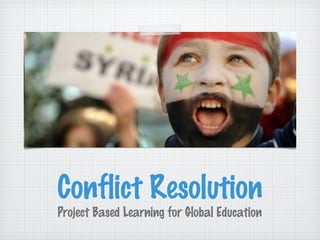
Conflict Resolution
Project Based Learning for Global Education
Big Idea
CONFLICT
Essential Question
What are the factors that
contribute to conflict?
Challenge
Improve conflict resolution
at your school
Sources of Inspiration
Challenge-Based Learning
Axis of Hope
Challenge 20/20
MUN
Apple challenge-based Learning
Environments
Students will know...
The historical context of current global
conflicts
The opposing arguments of current global
conflicts
Conflict Resolution Strategies
Sources of biased information and their
origins
Students will be able to...
Collaborate with a group of peers
Identify bias
Articulate opposing arguments
Utilize conflict resolution strategies to
define common agreements
Tech skills
Stage 1: Introduction
Introduction
Avatar and My Cultural History (Google
Site)
Students respond and share recorded
videos: How has conflict impacted my life?
Stage 2:
Global
Research and Interviews
Why do conflicts develop?
How are people, politics, and nations
affected by conflicts?
Guiding Questions:
Teacher directed
resources and activities
Engagement, background
knowledge,
understanding
Exposure to Global
Conflict
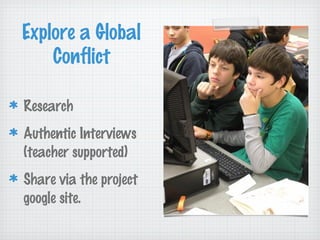
Research
Authentic Interviews
(teacher supported)
Share via the project
google site.
Explore a Global
Conflict
Skills Needed
developing interview questions
professionalism and bias
organization and time management
tech skills for website
Sharing and Making
Connections
Student comments on google sites page
Student Reflection in a Blog Post
make connections among different conflicts
conflict resolution strategies
Stage 3:
Role Play
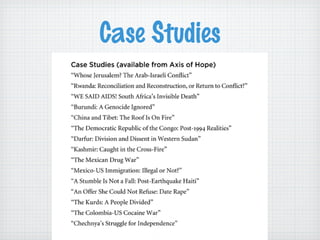
Case Studies
Stage 4:
Local
Challenge
Improve conflict resolution
in your community
Format
Students working in groups
Cooperative Group Contract
Individual Daily Journal - Accountability
Product: Solution Video and Reflection
Audience: Cooperating Class, School
Community
Process
Identify local conflicts
Guiding Questions, Research
Guiding Activities
Identify a Solution
Implementation
Publishing results and reflection
Guiding Questions
Armed with the big idea, the essential
question, and the challenge, students can
now generate their own guiding questions
to identify the knowledge they will need to
understand to develop a solution to the
challenge.
Students conduct thorough and thoughtful
research as this sets the foundation for
determining an suitable solution.
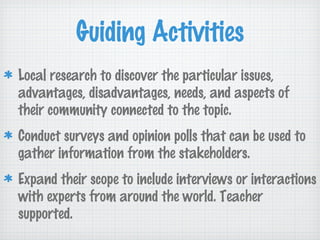
Guiding Activities
Local research to discover the particular issues,
advantages, disadvantages, needs, and aspects of
their community connected to the topic.
Conduct surveys and opinion polls that can be used to
gather information from the stakeholders.
Expand their scope to include interviews or interactions
with experts from around the world. Teacher
supported.
Identify a Solution
Each group selects a single solution to develop and
implement: action steps, needed materials and where
they will obtain them, responsibilities for each group
member, any relevant timing considerations,
documentation, appropriate audience, how success will
be measured, and so on.
All of these decisions are organized into a work plan.
Implementation
After identifying their solutions, the
students will implement them, measure
outcomes, reflect on what worked and
what didn’t, and determine whether they
made progress in addressing the challenge.
When implementation is complete,
students share their work with the rest of
the world.
Publishing Results and Reflections
Students build their solution video and record their
reflections. The three-to-five minute solution video should
include a description of the challenge, a brief description
of the learning process, the solution, and the results of
the implementation.
Students keep individual written, audio, or video journals
throughout the process.
As a culminating event, students can be provided a
series of prompts for final reflections about what they
learned about the subject matter and the process.

Project peace global issues

  • 1.
    Conflict Resolution Project BasedLearning for Global Education
  • 2.
  • 3.
    Essential Question What arethe factors that contribute to conflict?
  • 4.
  • 5.
    Sources of Inspiration Challenge-BasedLearning Axis of Hope Challenge 20/20 MUN Apple challenge-based Learning Environments
  • 6.
    Students will know... Thehistorical context of current global conflicts The opposing arguments of current global conflicts Conflict Resolution Strategies Sources of biased information and their origins
  • 7.
    Students will beable to... Collaborate with a group of peers Identify bias Articulate opposing arguments Utilize conflict resolution strategies to define common agreements Tech skills
  • 8.
  • 9.
    Introduction Avatar and MyCultural History (Google Site) Students respond and share recorded videos: How has conflict impacted my life?
  • 10.
  • 11.
    Research and Interviews Whydo conflicts develop? How are people, politics, and nations affected by conflicts? Guiding Questions:
  • 12.
    Teacher directed resources andactivities Engagement, background knowledge, understanding Exposure to Global Conflict
  • 13.
    Research Authentic Interviews (teacher supported) Sharevia the project google site. Explore a Global Conflict
  • 14.
    Skills Needed developing interviewquestions professionalism and bias organization and time management tech skills for website
  • 15.
    Sharing and Making Connections Studentcomments on google sites page Student Reflection in a Blog Post make connections among different conflicts conflict resolution strategies
  • 16.
  • 17.
  • 18.
  • 19.
  • 20.
    Format Students working ingroups Cooperative Group Contract Individual Daily Journal - Accountability Product: Solution Video and Reflection Audience: Cooperating Class, School Community
  • 21.
    Process Identify local conflicts GuidingQuestions, Research Guiding Activities Identify a Solution Implementation Publishing results and reflection
  • 22.
    Guiding Questions Armed withthe big idea, the essential question, and the challenge, students can now generate their own guiding questions to identify the knowledge they will need to understand to develop a solution to the challenge. Students conduct thorough and thoughtful research as this sets the foundation for determining an suitable solution.
  • 23.
    Guiding Activities Local researchto discover the particular issues, advantages, disadvantages, needs, and aspects of their community connected to the topic. Conduct surveys and opinion polls that can be used to gather information from the stakeholders. Expand their scope to include interviews or interactions with experts from around the world. Teacher supported.
  • 24.
    Identify a Solution Eachgroup selects a single solution to develop and implement: action steps, needed materials and where they will obtain them, responsibilities for each group member, any relevant timing considerations, documentation, appropriate audience, how success will be measured, and so on. All of these decisions are organized into a work plan.
  • 25.
    Implementation After identifying theirsolutions, the students will implement them, measure outcomes, reflect on what worked and what didn’t, and determine whether they made progress in addressing the challenge. When implementation is complete, students share their work with the rest of the world.
  • 26.
    Publishing Results andReflections Students build their solution video and record their reflections. The three-to-five minute solution video should include a description of the challenge, a brief description of the learning process, the solution, and the results of the implementation. Students keep individual written, audio, or video journals throughout the process. As a culminating event, students can be provided a series of prompts for final reflections about what they learned about the subject matter and the process.

Editor's Notes

  • #13 Publications: http://www.brandeis.edu/ethics/publications/ human rights http://www.foreignpolicy.com/articles/2012/12/27/10_conflicts_to_watch_in_2013?page=0,0
  • #15 Interview technique handout: http://wvde.state.wv.us/teach21/TaskManagement.html
  • #20 Once the students understand the challenge, organize them into teams so they can begin the search for a solution. Demonstrate the collaborative workspace you have set up and reinforce that you expect them to use it to store and share notes, documents, and other digital assets, and to collaborate and communicate throughout the process. Introduce them to any other technology that they will use during the process, including cameras and applicable software.
  • #22 Project evaluation rubrics: http://wvde.state.wv.us/teach21/SecondaryRubrics.html
  • #24 Possibilities
  • #27 Solutions Video Storyboard