ACTIVE CITIZENSHIP
Working and Growing together in a Global Village


                  Jeremy Black
                 Geoff Groholski
                  Heather Reid
WHAT IS ACTIVE CITIZENSHIP?
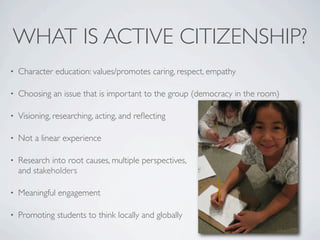
•   Character education: values/promotes caring, respect, empathy

•   Choosing an issue that is important to the group (democracy in the room)

•   Visioning, researching, acting, and reflecting

•   Not a linear experience

•   Research into root causes, multiple perspectives,
    and stakeholders

•   Meaningful engagement

•   Promoting students to think locally and globally
WHY DO IT?
•   Experiential (cater to different learning styles)

•   Authentic, relevant , meaningful opportunities and for taking responsibility

•   Can creates relationship between the people in the school and the wider
    community

•   Increases likelihood that students will
    engage in future action projects

•   Values cultural diversity
WHY DO IT?
•   Can be multi-disciplinary although it is often embedded within social studies

•   Follows a problem-based approach (you identify a problem and actively seek a
    realistic solution)

•   Covers the three broad areas of curriculum: life-long learning, social responsibility,
    and engaged citizenship

•   Promotes metacognitive thinking
    skills and has been correlated with
    increased cognitive achievement
CATEGORIES OF CITIZENSHIP
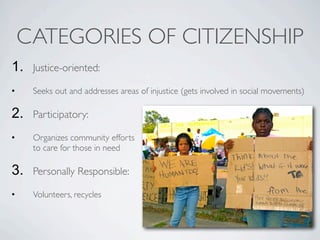
1.   Justice-oriented:

•    Seeks out and addresses areas of injustice (gets involved in social movements)

2.   Participatory:

•    Organizes community efforts
     to care for those in need

3.   Personally Responsible:

•    Volunteers, recycles
STEPS FOR TAKING MEANINGFUL
1.
                            ACTION
     Describe a good citizen:

•    What does it look, feel, sound like?


2.   Raise awareness:

•    Have students document issues they see around them (internet, the news, school)

•    Generate a list in the classroom


3.   Class will choose an issue:

•    Class will democratically choose the issue from the generated list and state the problem to
     addressed


4.   Build Motivation:

•    Research, create an individual written/visual response to the question “Why care?”
STEPS FOR TAKING MEANINGFUL
                ACTION
5.   Form the group:

•    Groups will be decided based on using the categories of citizenship OR based on similar interests


6.   Investigate:

•    5Ws/how, information needs (resources), categorizing causes, explore options for possible
     solutions and potential consequences of those solutions


7.   Make a plan:

•    Define parameters (develop timelines, deciding and defining roles and responsibilities of the group,
     revise as necessary)


8.   Define Success:

•    Choose a goal for success that is realistic, constructive, appropriate, and motivating
STEPS FOR TAKING MEANINGFUL
                 ACTION
9.    Identify Barriers:

•     Identify barriers and then devise methods to deal with them


10.   Teach Skills:

•     Decide what skills and knowledge students need to complete the project, which you may have to
      teach them explicitly


11.   DO IT!!!:

•     Check in with your action plan and continue to revise

•     Have students write reflections (i.e. Why do you think you are an effective group member? What
      do you think you could do differently?)
TIPS
1.Take only Positive Positions:

  • Saying what you are for not against
2. Listen to all Peoples’ Views:

  • Facilitate deliberative dialogue amongst
    students (listen to all views/alternatives)

3. Avoid Stereotyping:

  • Do not lump individuals into a category
4. Accept Responsibility:

  • Make sure students know that there will be no blaming the others if there is a lack of
    success
5. Be Persistent:
                                       TIPS
   • Remind students that complex
     issues take time.

6. Act:

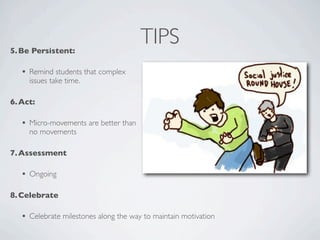
   • Micro-movements are better than
     no movements

7. Assessment

   • Ongoing

8. Celebrate

   • Celebrate milestones along the way to maintain motivation
EXAMPLES OF ACTION
Direct Action:

 •   Supplying schools around the world
     (project love)

 •   Building awareness in the school

 •   Adopting a salmon stream

Indirect Action:

 •   Fundraising to help build a school
     (www.freethechildren.com)

 •   Helping to reduce blindness in Nepal

 •   Writing for the local newspaper
ACTIVITY

 1. Turn and Talk:


 At your tables, you have 1 minute to discuss with your colleagues
  the pros and cons to implement this model of learning?


 2. Turn and Talk:


 Do you think this is a more progressive or more orthodox
  approach to teaching?
FINAL ACTIVITY


     10 x 10 Challenge

 (www.freethechildren.com)
REFERENCES
Burgess, T., (2003). Engaging students in sustainable action projects: workshop
   participant guide.


Case, R., Falk, C., Smith, N., Werner., (2004). Active citizenship: Student action projects.
   Vancouver: The Critical Thinking Consortium


Ponder, J., Lewis-Ferrel, G. (2009). The butterfly effect: The impact of citizenship education.
   California: Heldref
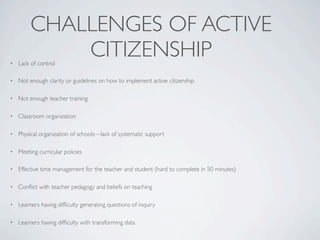
CHALLENGES OF ACTIVE
•
             CITIZENSHIP
    Lack of control

•   Not enough clarity or guidelines on how to implement active citizenship

•   Not enough teacher training

•   Classroom organization

•   Physical organization of schools—lack of systematic support

•   Meeting curricular policies

•   Effective time management for the teacher and student (hard to complete in 50 minutes)

•   Conflict with teacher pedagogy and beliefs on teaching

•   Learners having difficulty generating questions of inquiry

•   Learners having difficulty with transforming data
CHALLENGES OF ACTIVE
                CITIZENSHIP
•   Learners having difficulty constructing a logical argument

•   Learners struggling with sustaining their motivation with the inquiry

•   Not enough accessibility to technology

•   Increase of political pressure to meet learning outcomes

•   Can only cover depth not breadth of the curriculum

•   Teachers not showing their full expertise

•   A fear of fundamental concepts would be left out

•   Students restrict the different teaching styles--if students are given power in the learning environment then they may
    put the pressure for the teacher to control them again

•   Assessment— difficult in knowing/testing students factual knowledge

EFDN - Active Citizenship

  • 1.
    ACTIVE CITIZENSHIP Working andGrowing together in a Global Village Jeremy Black Geoff Groholski Heather Reid
  • 2.
    WHAT IS ACTIVECITIZENSHIP? • Character education: values/promotes caring, respect, empathy • Choosing an issue that is important to the group (democracy in the room) • Visioning, researching, acting, and reflecting • Not a linear experience • Research into root causes, multiple perspectives, and stakeholders • Meaningful engagement • Promoting students to think locally and globally
  • 3.
    WHY DO IT? • Experiential (cater to different learning styles) • Authentic, relevant , meaningful opportunities and for taking responsibility • Can creates relationship between the people in the school and the wider community • Increases likelihood that students will engage in future action projects • Values cultural diversity
  • 4.
    WHY DO IT? • Can be multi-disciplinary although it is often embedded within social studies • Follows a problem-based approach (you identify a problem and actively seek a realistic solution) • Covers the three broad areas of curriculum: life-long learning, social responsibility, and engaged citizenship • Promotes metacognitive thinking skills and has been correlated with increased cognitive achievement
  • 5.
    CATEGORIES OF CITIZENSHIP 1. Justice-oriented: • Seeks out and addresses areas of injustice (gets involved in social movements) 2. Participatory: • Organizes community efforts to care for those in need 3. Personally Responsible: • Volunteers, recycles
  • 6.
    STEPS FOR TAKINGMEANINGFUL 1. ACTION Describe a good citizen: • What does it look, feel, sound like? 2. Raise awareness: • Have students document issues they see around them (internet, the news, school) • Generate a list in the classroom 3. Class will choose an issue: • Class will democratically choose the issue from the generated list and state the problem to addressed 4. Build Motivation: • Research, create an individual written/visual response to the question “Why care?”
  • 7.
    STEPS FOR TAKINGMEANINGFUL ACTION 5. Form the group: • Groups will be decided based on using the categories of citizenship OR based on similar interests 6. Investigate: • 5Ws/how, information needs (resources), categorizing causes, explore options for possible solutions and potential consequences of those solutions 7. Make a plan: • Define parameters (develop timelines, deciding and defining roles and responsibilities of the group, revise as necessary) 8. Define Success: • Choose a goal for success that is realistic, constructive, appropriate, and motivating
  • 8.
    STEPS FOR TAKINGMEANINGFUL ACTION 9. Identify Barriers: • Identify barriers and then devise methods to deal with them 10. Teach Skills: • Decide what skills and knowledge students need to complete the project, which you may have to teach them explicitly 11. DO IT!!!: • Check in with your action plan and continue to revise • Have students write reflections (i.e. Why do you think you are an effective group member? What do you think you could do differently?)
  • 9.
    TIPS 1.Take only PositivePositions: • Saying what you are for not against 2. Listen to all Peoples’ Views: • Facilitate deliberative dialogue amongst students (listen to all views/alternatives) 3. Avoid Stereotyping: • Do not lump individuals into a category 4. Accept Responsibility: • Make sure students know that there will be no blaming the others if there is a lack of success
  • 10.
    5. Be Persistent: TIPS • Remind students that complex issues take time. 6. Act: • Micro-movements are better than no movements 7. Assessment • Ongoing 8. Celebrate • Celebrate milestones along the way to maintain motivation
  • 11.
    EXAMPLES OF ACTION DirectAction: • Supplying schools around the world (project love) • Building awareness in the school • Adopting a salmon stream Indirect Action: • Fundraising to help build a school (www.freethechildren.com) • Helping to reduce blindness in Nepal • Writing for the local newspaper
  • 12.
    ACTIVITY 1. Turnand Talk: At your tables, you have 1 minute to discuss with your colleagues the pros and cons to implement this model of learning? 2. Turn and Talk: Do you think this is a more progressive or more orthodox approach to teaching?
  • 13.
    FINAL ACTIVITY 10 x 10 Challenge (www.freethechildren.com)
  • 14.
    REFERENCES Burgess, T., (2003).Engaging students in sustainable action projects: workshop participant guide. Case, R., Falk, C., Smith, N., Werner., (2004). Active citizenship: Student action projects. Vancouver: The Critical Thinking Consortium Ponder, J., Lewis-Ferrel, G. (2009). The butterfly effect: The impact of citizenship education. California: Heldref
  • 15.
    CHALLENGES OF ACTIVE • CITIZENSHIP Lack of control • Not enough clarity or guidelines on how to implement active citizenship • Not enough teacher training • Classroom organization • Physical organization of schools—lack of systematic support • Meeting curricular policies • Effective time management for the teacher and student (hard to complete in 50 minutes) • Conflict with teacher pedagogy and beliefs on teaching • Learners having difficulty generating questions of inquiry • Learners having difficulty with transforming data
  • 16.
    CHALLENGES OF ACTIVE CITIZENSHIP • Learners having difficulty constructing a logical argument • Learners struggling with sustaining their motivation with the inquiry • Not enough accessibility to technology • Increase of political pressure to meet learning outcomes • Can only cover depth not breadth of the curriculum • Teachers not showing their full expertise • A fear of fundamental concepts would be left out • Students restrict the different teaching styles--if students are given power in the learning environment then they may put the pressure for the teacher to control them again • Assessment— difficult in knowing/testing students factual knowledge