Overview
 Till date, power generation has primarily remained dependent on fossil
fuels like ( Petroleum, Coal and Natural Gas etc.) or nuclear fuels.
 This has led to an ever increasing demand for oil, natural gases, coal,
etc., thereby also leading to gradual depletion of fossil fuels and
constant rise in fuel costs.
There is thus a crucial requirement to find an alternative energy source
that can serve as a solution to this problem.
We do have Hydropower/Atomic power projects, but they are very
high in cost and also dependent on favorable geography.
Also, if we see globally, there is very little development on sea power
projects due to certain reasons, such as:
1. Complex techniques
2. Lower power generation at significantly higher costs
Electricity generation using solar power has its own limitations
1. Solar Power projects cannot function during nights.
2. Reduced Power Generation on rainy, cloudy, foggy days etc.
3. It has major geographical limitations in areas covered by trees or
surrounded by huge buildings .
4. Most of the photovoltaic cells are made up of toxic metals like mercury,
lead and cadmium.
Project OCTOPUS is totally pollution free, radiation free power
generation concept which is purely based on utilizing the thrust
power of sea waves.
70% boundaries of our country being surrounded by sea, can add
up to our advantage for drawing maximum energy outputs at
minimal costs.
 This brings to our perception on how we can use wave
energy to generate electricity with maximum efficiency at
significantly lower costs!!
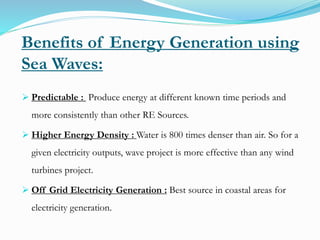
Actual Photo of the Prototype
 Predictable : Produce energy at different known time periods and
more consistently than other RE Sources.
 Higher Energy Density : Water is 800 times denser than air. So for a
given electricity outputs, wave project is more effective than any wind
turbines project.
 Off Grid Electricity Generation : Best source in coastal areas for
electricity generation.
Benefits of Energy Generation using
Sea Waves:
Core Advantages of Project Octopus :
 Zero Fuel Costs :- There is absolutely no requirement of any
kind of fuels for working of this machinery.
 Scalability:- Number of pods can be easily increased or
decreased as per the power requirement.
 Adaptability:- To overcome the geographical limitations of the
sea, the pods can be connected either in series or in parallels.
 Flexibility:- The size of float can be increased or decreased so as
to adjust the torque at the main shaft.
 Low Cost:- The overall operational cost of this project is
significantly low.
 No pollution
 Serves as a renewable energy source
 Ease of Installation
 Ease of maintenance
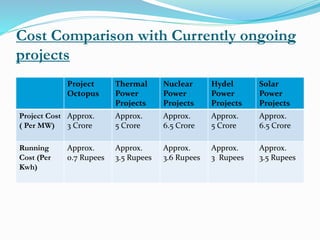
Cost Comparison with Currently ongoing
projects
Project
Octopus
Thermal
Power
Projects
Nuclear
Power
Projects
Hydel
Power
Projects
Solar
Power
Projects
Project Cost
( Per MW)
Approx.
3 Crore
Approx.
5 Crore
Approx.
6.5 Crore
Approx.
5 Crore
Approx.
6.5 Crore
Running
Cost (Per
Kwh)
Approx.
0.7 Rupees
Approx.
3.5 Rupees
Approx.
3.6 Rupees
Approx.
3 Rupees
Approx.
3.5 Rupees
Thank You!
For further details, please contact dmdmathur@yahoo.com or +91 8860428366

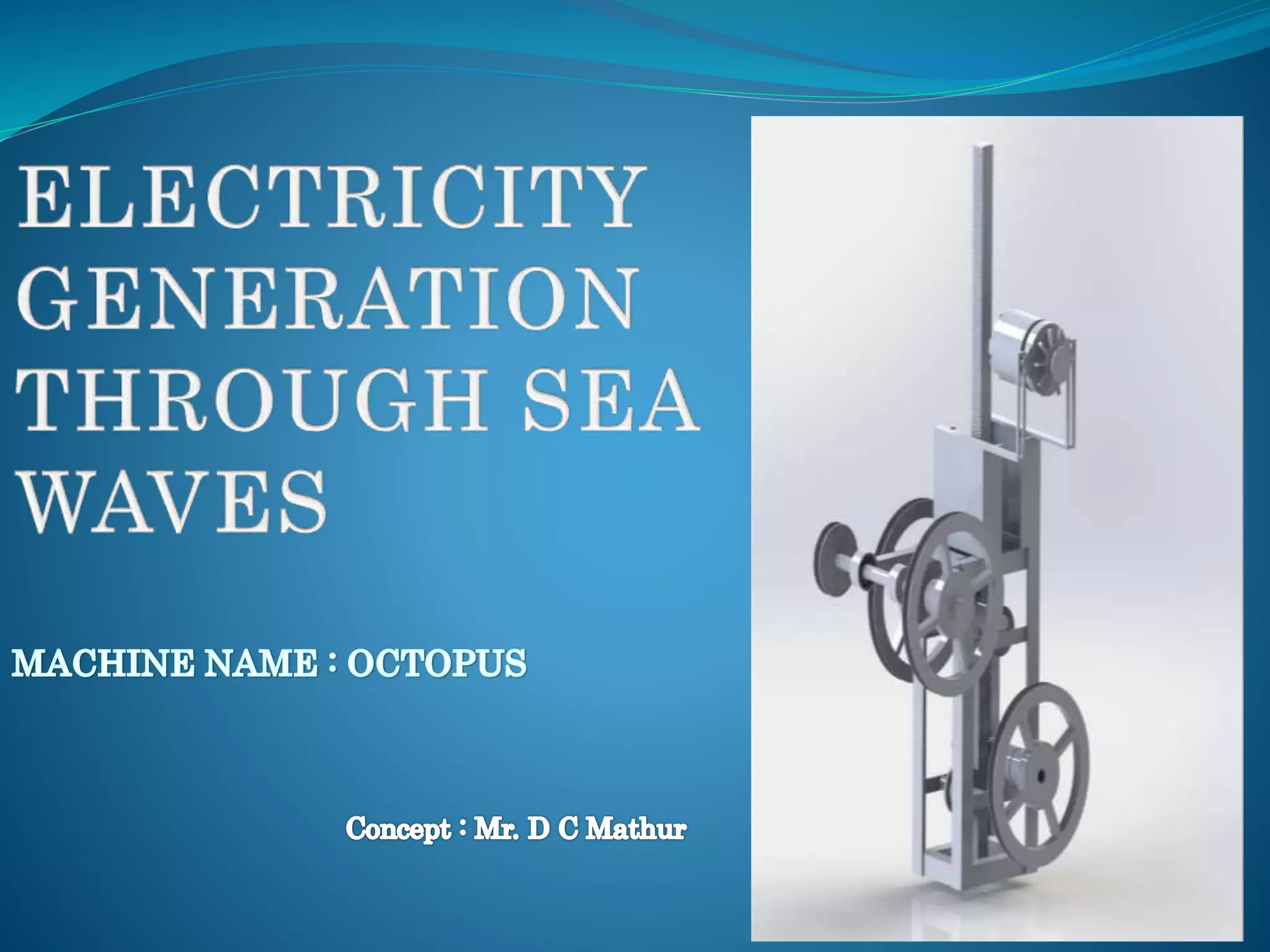
Project Octopus : An innovative Electricity Generation Approach

  • 2.
    Overview  Till date,power generation has primarily remained dependent on fossil fuels like ( Petroleum, Coal and Natural Gas etc.) or nuclear fuels.  This has led to an ever increasing demand for oil, natural gases, coal, etc., thereby also leading to gradual depletion of fossil fuels and constant rise in fuel costs. There is thus a crucial requirement to find an alternative energy source that can serve as a solution to this problem. We do have Hydropower/Atomic power projects, but they are very high in cost and also dependent on favorable geography.
  • 3.
    Also, if wesee globally, there is very little development on sea power projects due to certain reasons, such as: 1. Complex techniques 2. Lower power generation at significantly higher costs Electricity generation using solar power has its own limitations 1. Solar Power projects cannot function during nights. 2. Reduced Power Generation on rainy, cloudy, foggy days etc. 3. It has major geographical limitations in areas covered by trees or surrounded by huge buildings . 4. Most of the photovoltaic cells are made up of toxic metals like mercury, lead and cadmium.
  • 4.
    Project OCTOPUS istotally pollution free, radiation free power generation concept which is purely based on utilizing the thrust power of sea waves. 70% boundaries of our country being surrounded by sea, can add up to our advantage for drawing maximum energy outputs at minimal costs.  This brings to our perception on how we can use wave energy to generate electricity with maximum efficiency at significantly lower costs!!
  • 5.
    Actual Photo ofthe Prototype
  • 6.
     Predictable :Produce energy at different known time periods and more consistently than other RE Sources.  Higher Energy Density : Water is 800 times denser than air. So for a given electricity outputs, wave project is more effective than any wind turbines project.  Off Grid Electricity Generation : Best source in coastal areas for electricity generation. Benefits of Energy Generation using Sea Waves:
  • 7.
    Core Advantages ofProject Octopus :  Zero Fuel Costs :- There is absolutely no requirement of any kind of fuels for working of this machinery.  Scalability:- Number of pods can be easily increased or decreased as per the power requirement.  Adaptability:- To overcome the geographical limitations of the sea, the pods can be connected either in series or in parallels.
  • 8.
     Flexibility:- Thesize of float can be increased or decreased so as to adjust the torque at the main shaft.  Low Cost:- The overall operational cost of this project is significantly low.  No pollution  Serves as a renewable energy source  Ease of Installation  Ease of maintenance
  • 9.
    Cost Comparison withCurrently ongoing projects Project Octopus Thermal Power Projects Nuclear Power Projects Hydel Power Projects Solar Power Projects Project Cost ( Per MW) Approx. 3 Crore Approx. 5 Crore Approx. 6.5 Crore Approx. 5 Crore Approx. 6.5 Crore Running Cost (Per Kwh) Approx. 0.7 Rupees Approx. 3.5 Rupees Approx. 3.6 Rupees Approx. 3 Rupees Approx. 3.5 Rupees
  • 10.
    Thank You! For furtherdetails, please contact dmdmathur@yahoo.com or +91 8860428366