
Prepared By: K.C.Kameswaran
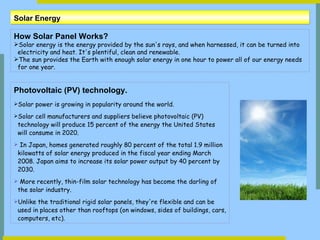
Solar Energy How Solar Panel Works?   Solar energy is the energy provided by the sun's rays, and when harnessed, it can be turned into electricity and heat. It's plentiful, clean and renewable. The sun provides the Earth with enough solar energy in one hour to power all of our energy needs for one year.  Photovoltaic (PV) technology. Solar power is growing in popularity around the world. Solar cell manufacturers and suppliers believe photovoltaic (PV) technology will produce 15 percent of the energy the United States will consume in 2020. In Japan, homes generated roughly 80 percent of the total 1.9 million kilowatts of solar energy produced in the fiscal year ending March 2008. Japan aims to increase its solar power output by 40 percent by 2030. More recently, thin-film solar technology has become the darling of the solar industry. Unlike the traditional rigid solar panels, they're flexible and can be used in places other than rooftops (on windows, sides of buildings, cars, computers, etc).
Ocean Power How Ocean Power Works Water crashing along the coast is a clear indication of the ocean's awesome power and the energy potential it holds. Humans have been interested in harnessing the energy of the ocean for centuries.  In 1799, a Frenchman teamed up with his son to design a giant lever attached to a ship. As the ship rocked on the sea, it would move the lever up and down, creating a reciprocating motion that could be used to drive pumps, mills and saws located on the shore.  Tidal Plants. The first real success came in 1966, when a tidal power plant opened in Bretagne, France, on the Rance River.  Today, the station produces 240 megawatts of power, better than a typical wind farm, but less than a coal plant.  Ocean Power Systems: Thermal Energy Most people think of solar collectors as the typical silicon-based photovoltaic cells so commonly seen on residential and commercial buildings.  But the largest solar collector is the ocean itself. Each day, the sun provides the equivalent of 250 billion barrels of oil in the form of thermal energy to Earth's oceans.
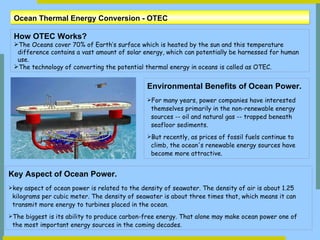
Ocean Thermal Energy Conversion - OTEC How OTEC Works? The Oceans cover 70% of Earth’s surface which is heated by the sun and this temperature difference contains a vast amount of solar energy, which can potentially be harnessed for human use.  The technology of converting the potential thermal energy in oceans is called as OTEC. Environmental Benefits of Ocean Power. For many years, power companies have interested themselves primarily in the non-renewable energy sources -- oil and natural gas -- trapped beneath seafloor sediments.  But recently, as prices of fossil fuels continue to climb, the ocean's renewable energy sources have become more attractive. Key Aspect of Ocean Power. key aspect of ocean power is related to the density of seawater. The density of air is about 1.25 kilograms per cubic meter. The density of seawater is about three times that, which means it can transmit more energy to turbines placed in the ocean.  The biggest is its ability to produce carbon-free energy. That alone may make ocean power one of the most important energy sources in the coming decades.
With Lu v Kay…

How stuff works

  • 1.
  • 2.
    Solar Energy HowSolar Panel Works? Solar energy is the energy provided by the sun's rays, and when harnessed, it can be turned into electricity and heat. It's plentiful, clean and renewable. The sun provides the Earth with enough solar energy in one hour to power all of our energy needs for one year. Photovoltaic (PV) technology. Solar power is growing in popularity around the world. Solar cell manufacturers and suppliers believe photovoltaic (PV) technology will produce 15 percent of the energy the United States will consume in 2020. In Japan, homes generated roughly 80 percent of the total 1.9 million kilowatts of solar energy produced in the fiscal year ending March 2008. Japan aims to increase its solar power output by 40 percent by 2030. More recently, thin-film solar technology has become the darling of the solar industry. Unlike the traditional rigid solar panels, they're flexible and can be used in places other than rooftops (on windows, sides of buildings, cars, computers, etc).
  • 3.
    Ocean Power HowOcean Power Works Water crashing along the coast is a clear indication of the ocean's awesome power and the energy potential it holds. Humans have been interested in harnessing the energy of the ocean for centuries. In 1799, a Frenchman teamed up with his son to design a giant lever attached to a ship. As the ship rocked on the sea, it would move the lever up and down, creating a reciprocating motion that could be used to drive pumps, mills and saws located on the shore. Tidal Plants. The first real success came in 1966, when a tidal power plant opened in Bretagne, France, on the Rance River. Today, the station produces 240 megawatts of power, better than a typical wind farm, but less than a coal plant. Ocean Power Systems: Thermal Energy Most people think of solar collectors as the typical silicon-based photovoltaic cells so commonly seen on residential and commercial buildings. But the largest solar collector is the ocean itself. Each day, the sun provides the equivalent of 250 billion barrels of oil in the form of thermal energy to Earth's oceans.
  • 4.
    Ocean Thermal EnergyConversion - OTEC How OTEC Works? The Oceans cover 70% of Earth’s surface which is heated by the sun and this temperature difference contains a vast amount of solar energy, which can potentially be harnessed for human use. The technology of converting the potential thermal energy in oceans is called as OTEC. Environmental Benefits of Ocean Power. For many years, power companies have interested themselves primarily in the non-renewable energy sources -- oil and natural gas -- trapped beneath seafloor sediments. But recently, as prices of fossil fuels continue to climb, the ocean's renewable energy sources have become more attractive. Key Aspect of Ocean Power. key aspect of ocean power is related to the density of seawater. The density of air is about 1.25 kilograms per cubic meter. The density of seawater is about three times that, which means it can transmit more energy to turbines placed in the ocean. The biggest is its ability to produce carbon-free energy. That alone may make ocean power one of the most important energy sources in the coming decades.
  • 5.
    With Lu vKay…