By: Ritul Chaudhary
PROJECT
MANAGEMENT
PROCESS
TABLE OF
CONTENTS
PROJECT
MANAGEMENT
An introduction
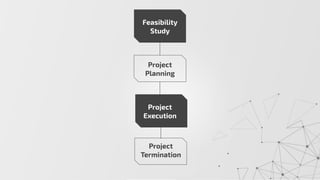
PHASES
Feasibility study
Project Planning
Project Execution
Project Termination
01
03
02
04
05
06
FEASIBILITY STUDY
Assessment of the
practicality of a
proposed project
PROJECT PLANNING
Documentation of
project plans
PROJECT EXECUTION
Development of
product/ service
PROJECT TERMINATION
End of work on a
project
WHAT IS PROJECT
MANAGEMENT?
01
Project Managementis the practice of initiating, planning, executing,
controlling, and closing the work of a team to achieve specific goals and meet specific
success criteria at the specified time. The primary challenge of project management is
to achieve all of the project goals within the given constraints.
Primary constraints: scope, time, quality, budget
Secondary constraints: optimization of allocation of inputs & their application to meet
pre-defined objectives
PHASES OF PROJECT
MANAGEMENT
02
Project
Planning
Feasibility
Study
Project
Execution
Project
Termination
FEASIBILITY STUDY
03
Feasibility study explores system requirements to determine project feasibility.
There are several fields of feasibility study including:
● economic feasibility
● operational feasibility
● technical feasibility
The goal is to determine whether the system can be implemented or not. The
process of feasibility study takes as input the requirement details as specified
by the user and other domain-specific details. The output of this process
simply tells whether the project should be undertaken or not and if yes, what
would the constraints be. Additionally, all the risks and their potential effects
on the projects are also evaluated before a decision to start the project is
taken.
PROJECT PLANNING
04
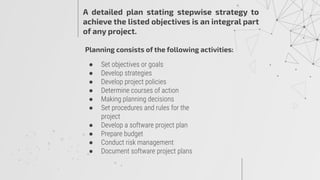
A detailed plan stating stepwise strategy to
achieve the listed objectives is an integral part
of any project.
Planning consists of the following activities:
● Set objectives or goals
● Develop strategies
● Develop project policies
● Determine courses of action
● Making planning decisions
● Set procedures and rules for the
project
● Develop a software project plan
● Prepare budget
● Conduct risk management
● Document software project plans
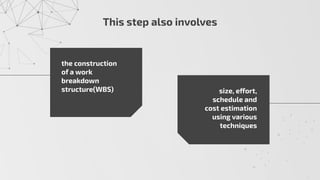
This step also involves
the construction
of a work
breakdown
structure(WBS) size, effort,
schedule and
cost estimation
using various
techniques
PROJECT EXECUTION
05
requirements analysis
design & coding
testing & implementation
A project is executed by choosing an appropriate software
development lifecycle model(SDLC)
There are a number of factors that need to
be considered while doing so including the
size of the system, the nature of the project,
time and budget constraints, domain
requirements, etc. An inappropriate SDLC
can lead to failure of the project.
delivery & maintenance
PROJECT TERMINATION
06
There can be several reasons for the termination of a project. Though expecting a project to terminate
after successful completion is conventional, but at times, a project may also terminate without
completion. Projects have to be closed down when the requirements are not fulfilled according to given
time and cost constraints.
Some of the reasons for failure include:
● Fast changing technology
● Project running out of time
● Organizational politics
● Too much change in customer requirements
● Project exceeding budget or funds
Once the project is terminated, a post-performance analysis is done. Also, a final report is published
describing the experiences, lessons learned, recommendations for handling future projects.
References
https://www.geeksforgeeks.org/software-engineering-project-management-process/
https://en.wikipedia.org/wiki/Project_management
CREDITS: This presentation template was created by Slidesgo, including
icons by Flaticon, and infographics & images by Freepik.
Please keep this slide for attribution.
THANK YOU

Project Management Process

  • 1.
  • 2.
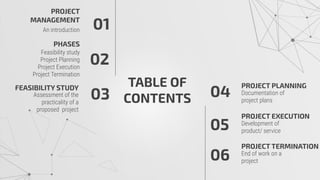
    TABLE OF CONTENTS PROJECT MANAGEMENT An introduction PHASES Feasibilitystudy Project Planning Project Execution Project Termination 01 03 02 04 05 06 FEASIBILITY STUDY Assessment of the practicality of a proposed project PROJECT PLANNING Documentation of project plans PROJECT EXECUTION Development of product/ service PROJECT TERMINATION End of work on a project
  • 3.
  • 4.
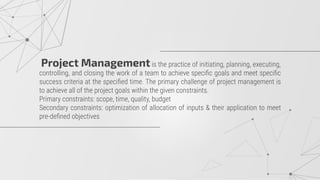
    Project Managementis thepractice of initiating, planning, executing, controlling, and closing the work of a team to achieve specific goals and meet specific success criteria at the specified time. The primary challenge of project management is to achieve all of the project goals within the given constraints. Primary constraints: scope, time, quality, budget Secondary constraints: optimization of allocation of inputs & their application to meet pre-defined objectives
  • 5.
  • 6.
  • 7.
  • 8.
    Feasibility study exploressystem requirements to determine project feasibility. There are several fields of feasibility study including: ● economic feasibility ● operational feasibility ● technical feasibility The goal is to determine whether the system can be implemented or not. The process of feasibility study takes as input the requirement details as specified by the user and other domain-specific details. The output of this process simply tells whether the project should be undertaken or not and if yes, what would the constraints be. Additionally, all the risks and their potential effects on the projects are also evaluated before a decision to start the project is taken.
  • 10.
  • 11.
    A detailed planstating stepwise strategy to achieve the listed objectives is an integral part of any project. Planning consists of the following activities: ● Set objectives or goals ● Develop strategies ● Develop project policies ● Determine courses of action ● Making planning decisions ● Set procedures and rules for the project ● Develop a software project plan ● Prepare budget ● Conduct risk management ● Document software project plans
  • 12.
    This step alsoinvolves the construction of a work breakdown structure(WBS) size, effort, schedule and cost estimation using various techniques
  • 13.
  • 14.
    requirements analysis design &coding testing & implementation A project is executed by choosing an appropriate software development lifecycle model(SDLC) There are a number of factors that need to be considered while doing so including the size of the system, the nature of the project, time and budget constraints, domain requirements, etc. An inappropriate SDLC can lead to failure of the project. delivery & maintenance
  • 15.
  • 16.
    There can beseveral reasons for the termination of a project. Though expecting a project to terminate after successful completion is conventional, but at times, a project may also terminate without completion. Projects have to be closed down when the requirements are not fulfilled according to given time and cost constraints. Some of the reasons for failure include: ● Fast changing technology ● Project running out of time ● Organizational politics ● Too much change in customer requirements ● Project exceeding budget or funds Once the project is terminated, a post-performance analysis is done. Also, a final report is published describing the experiences, lessons learned, recommendations for handling future projects.
  • 17.
  • 18.
    CREDITS: This presentationtemplate was created by Slidesgo, including icons by Flaticon, and infographics & images by Freepik. Please keep this slide for attribution. THANK YOU