Project Management “Made Simple” Using Technical and  Behavioral  Quick Connects
Project Management Made Simple:   from the Introduction of Mitch Manning by Matt Lewis at the 23 rd  Southeast ASQ FDC/FDA Conference on February 12, 2010 “ I can tell you this about Mitch Manning.  Mitch is one of the people we, the FDA, went to when we were trying to figure out Process Validation back in 1978.  He was already doing Process Validation at Burroughs Wellcome Co. and he helped us to teach the pharmaceutical industry.” Matt Lewis Former FDA Director of the New Jersey District
Project Management Made Simple:  Key Principles Know what you need Know when you need it Know what you can pay
Project Management Made Simple:  Guidelines Priorities Based Process Focused Systems Aligned Systems Integrated Results Driven
One Page Project Process Map One Page Question to the Void Worksheet One Page Project Overview Worksheet One Page Project Initiating Worksheet One Page Project Planning Worksheet One Page Effective Meeting Worksheet  Project Management Made Simple:  Technical Quick Connects
Project Management Made Simple:  Plan The Project Project Mission Identify Desired Outcomes Identify Customers Identify Customer Requirements Identify Supplier Specifications Identify Steps In The Process Identify Measures
Project Management Made Simple Analyze The Project Opportunity Define the Project Explore the Project Analyze the Project Identify Potential Solutions Select Solution(s)
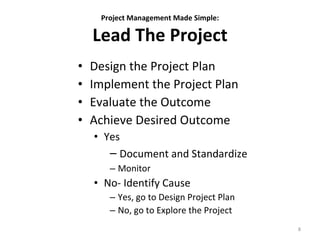
Project Management Made Simple: Lead The Project Design the Project Plan Implement the Project Plan Evaluate the Outcome Achieve Desired Outcome  Yes   –  Document and Standardize Monitor No- Identify Cause  Yes, go to Design Project Plan No, go to Explore the Project
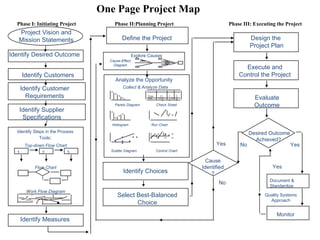
Project Vision and Mission Statements Identify Desired Outcome Identify Customers Identify Customer Requirements Identify Supplier Specifications Identify Steps in the Process Tools : Identify Measures Define the Project Analyze the Opportunity Identify Choices Select Best-Balanced Choice Design the  Project Plan Execute and Control the Project Evaluate Outcome Desired Outcome Achieved?  Monitor   Yes Cause Identified ? 1 2 3 Top-down Flow Chart Flow Chart Work Flow Diagram Document & Standardize  Yes Quality Systems Approach No Yes No Explore Causes Cause-Effect Diagram Collect & Analyze Data Pareto Diagram 6 3 9 6 3 1 11 1111 11 Type Size Check Sheet Histogram Run Chart Scatter Diagram Control Chart Phase I: Initiating Project Phase II:Planning Project Phase III: Executing the Project One Page Project Map . . . . . . .
Project Management Made Simple: Question to the Void What is the project? Why have the project? How to do the project? Where is the project? When is the project? Who does the project?
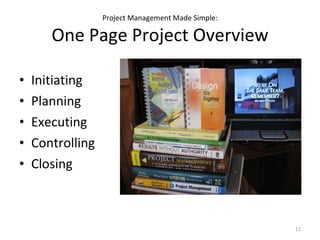
Project Management Made Simple: One Page Project Overview Initiating Planning Executing Controlling Closing
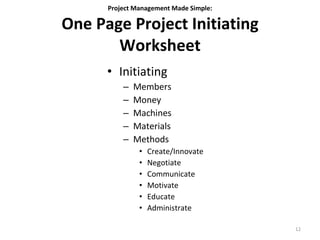
Project Management Made Simple: One Page Project Initiating Worksheet Initiating Members Money Machines Materials Methods Create/Innovate Negotiate Communicate Motivate Educate Administrate
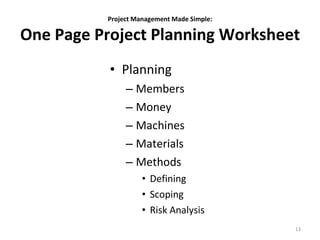
Project Management Made Simple: One Page Project Planning Worksheet Planning Members Money Machines Materials Methods Defining Scoping Risk Analysis
One Page Project Overview How Where When Who Initiating Headquarters First Quarter Sponsor Members Sponsor/Client Money Sponsor/Client Machines Sponsor/Client Materials Sponsor/Client Methods Sponsor/Client   Create/Innovate Client/Sponsor   Negotiate Sponsor/Client   Communicate Sponsor/Client/Manager   Motivate Sponsor/Leader/Client   Educate Leader/Sponsor/Client   Administrate Manager/Sponsor/Client Planning Headquarters/On-Site Second Quarter Sponsor/Manager/Client Members Operations Money Finance Machines Operations Materials Operations Methods Administration   Defining   Scoping   Risk Analysis   Scheduling Executing On-site Second - Fourth Quarter Team Basic Process Model Controlling On-Site/Headquarters/Client Second - Fourth Quarter Sponsor/Team/Client Situation Appraisal Team Closing On-site Fourth Quarter Sponsor/Manager/Client
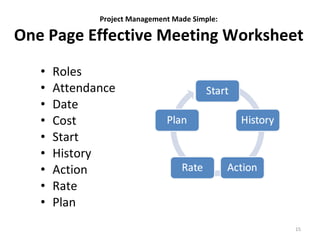
Project Management Made Simple: One Page Effective Meeting Worksheet Roles Attendance Date Cost Start History Action Rate Plan
TEAM NAME____________________LEADER_____________________DEPT____ FACILITATOR___________________RECORDER__________________DATE____ MEMBERS' NAMES TEAM MEETING COSTS ______________________ _______________ number of members present ______________________ _______________ (times) average hourly rate ______________________ _______________(times) average benefit value ______________________ _______________(equals) meeting costs   START :  Time______Location______Guests_______ List objectives of This Meeting _________________________________________________________________ _________________________________________________________________ HISTORY :  Read and Approve Previous Meeting Minutes  Yes____No_____ List Old Business Discussed ______________________________________________________________ ______________________________________________________________ ACTION :  Describe How the Objectives of This Meeting Were Accomplished ______________________________________________________________ ______________________________________________________________ RATE :  How Do We Feel About This Meeting?  _____________________ What Will We Do Different Next Meeting?  _________________________ PLAN :  Schedule the Next Meeting, List Objectives, List Assignments Date:_____________Time:___________________Location:______________ Objectives:  _____________________________________________________ _______________________________________________________________ _______________________________________________________________ Assignment  Responsible Party  Due Date _______________________________________________________________ _______________________________________________________________
CDRH Strategic Plan
CDRH Strategic Plan Our Mission   Promoting and protecting public health by ensuring the safety and effectiveness of medical devices and the safety of radiological products
CDRH Strategic Plan Our Vision Ensuring the health of the public through out the Total Product Life Cycle (TPLC)
CDRH Strategic Goals Goal 1: Public Health Impact  Goal 2: Magnet for Excellence Goal 3: Knowledge Management Goal 4: Total Product Life Cycle (TPLC)
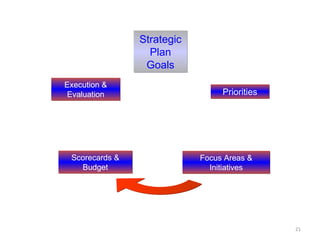
Strategic Plan Goals Priorities Focus Areas & Initiatives Scorecards & Budget Execution & Evaluation
In its most fundamental sense, execution is a systematic way of exposing reality and acting on it “ We don’t think ourselves into a new way of acting, we act ourselves into a new way of thinking” Execution
How do we execute the strategic plan ? Project Management Plans Long term projects New initiatives Scorecards  Performance in Key Result Areas (KRAs)
Meeting MDUFMA Performance Goals We're setting milestones for review… Scientific Review Scientific Review Interactive Review Filing Review Panel Planning Closeout Review Panel Go/No Go Panel Meeting Final Decision 320 days Major  Deficiency  Letter Clock  Stops Consults Complete PMA Received Status Letter Filing Letter
Quality System for Application Review We're using quality systems to assure quality reviews… Focusing on selected cross-cutting areas e.g., biocompatibility Using retrospective (post-decision) peer assessments  Assembling quality assessment teams Continuing with pilot program
So why do we need a strategic plan? We’re using strategic planning to meet our challenges… Managing a changing workload Meeting changing stakeholder demands and expectations Making best use of our limited resources Conducting business in an open and transparent manner Looking beyond the next “fire drill”!
And what do we need from you? Awareness  Energy Ideas Patience Support
Project Management Made Simple Conclusion Apply the Key Principles Know what you need Know when you need it Know what you can pay Follow the Guidelines Priorities Based Process Focused Aligned Integrated Results Driven Mitchell W. Manning Sr. [email_address] Chief Priorities Officer 252.714.3481 cell Priorities Limited LinkedIn.com
For other presentations and documents by Mitch: google “Mitchell Manning’s presentations on SlideShare” Project Management Made Simple The Corporate University Catalog Corporate Training for the Management Team Interview Skills Clinic Grant Writing Project Proposal Workbook Teambuilding for an FDA Inspection Our Leadership for an FDA Inspection Regulatory Compliance 2010 Process Mapping Career Development: A Fifty Year Process Working With People Mitch’s  programs can be customized to your site, and your  organization, and piloted within one week of contracting. Mitchell W. Manning Sr. [email_address] Chief Priorities Officer 252.714.3481 cell Priorities Limited LinkedIn.com

Project Management: "made simple" using quick connects

  • 1.
    Project Management “MadeSimple” Using Technical and Behavioral Quick Connects
  • 2.
    Project Management MadeSimple: from the Introduction of Mitch Manning by Matt Lewis at the 23 rd Southeast ASQ FDC/FDA Conference on February 12, 2010 “ I can tell you this about Mitch Manning. Mitch is one of the people we, the FDA, went to when we were trying to figure out Process Validation back in 1978. He was already doing Process Validation at Burroughs Wellcome Co. and he helped us to teach the pharmaceutical industry.” Matt Lewis Former FDA Director of the New Jersey District
  • 3.
    Project Management MadeSimple: Key Principles Know what you need Know when you need it Know what you can pay
  • 4.
    Project Management MadeSimple: Guidelines Priorities Based Process Focused Systems Aligned Systems Integrated Results Driven
  • 5.
    One Page ProjectProcess Map One Page Question to the Void Worksheet One Page Project Overview Worksheet One Page Project Initiating Worksheet One Page Project Planning Worksheet One Page Effective Meeting Worksheet Project Management Made Simple: Technical Quick Connects
  • 6.
    Project Management MadeSimple: Plan The Project Project Mission Identify Desired Outcomes Identify Customers Identify Customer Requirements Identify Supplier Specifications Identify Steps In The Process Identify Measures
  • 7.
    Project Management MadeSimple Analyze The Project Opportunity Define the Project Explore the Project Analyze the Project Identify Potential Solutions Select Solution(s)
  • 8.
    Project Management MadeSimple: Lead The Project Design the Project Plan Implement the Project Plan Evaluate the Outcome Achieve Desired Outcome Yes – Document and Standardize Monitor No- Identify Cause Yes, go to Design Project Plan No, go to Explore the Project
  • 9.
    Project Vision andMission Statements Identify Desired Outcome Identify Customers Identify Customer Requirements Identify Supplier Specifications Identify Steps in the Process Tools : Identify Measures Define the Project Analyze the Opportunity Identify Choices Select Best-Balanced Choice Design the Project Plan Execute and Control the Project Evaluate Outcome Desired Outcome Achieved? Monitor Yes Cause Identified ? 1 2 3 Top-down Flow Chart Flow Chart Work Flow Diagram Document & Standardize Yes Quality Systems Approach No Yes No Explore Causes Cause-Effect Diagram Collect & Analyze Data Pareto Diagram 6 3 9 6 3 1 11 1111 11 Type Size Check Sheet Histogram Run Chart Scatter Diagram Control Chart Phase I: Initiating Project Phase II:Planning Project Phase III: Executing the Project One Page Project Map . . . . . . .
  • 10.
    Project Management MadeSimple: Question to the Void What is the project? Why have the project? How to do the project? Where is the project? When is the project? Who does the project?
  • 11.
    Project Management MadeSimple: One Page Project Overview Initiating Planning Executing Controlling Closing
  • 12.
    Project Management MadeSimple: One Page Project Initiating Worksheet Initiating Members Money Machines Materials Methods Create/Innovate Negotiate Communicate Motivate Educate Administrate
  • 13.
    Project Management MadeSimple: One Page Project Planning Worksheet Planning Members Money Machines Materials Methods Defining Scoping Risk Analysis
  • 14.
    One Page ProjectOverview How Where When Who Initiating Headquarters First Quarter Sponsor Members Sponsor/Client Money Sponsor/Client Machines Sponsor/Client Materials Sponsor/Client Methods Sponsor/Client Create/Innovate Client/Sponsor Negotiate Sponsor/Client Communicate Sponsor/Client/Manager Motivate Sponsor/Leader/Client Educate Leader/Sponsor/Client Administrate Manager/Sponsor/Client Planning Headquarters/On-Site Second Quarter Sponsor/Manager/Client Members Operations Money Finance Machines Operations Materials Operations Methods Administration Defining Scoping Risk Analysis Scheduling Executing On-site Second - Fourth Quarter Team Basic Process Model Controlling On-Site/Headquarters/Client Second - Fourth Quarter Sponsor/Team/Client Situation Appraisal Team Closing On-site Fourth Quarter Sponsor/Manager/Client
  • 15.
    Project Management MadeSimple: One Page Effective Meeting Worksheet Roles Attendance Date Cost Start History Action Rate Plan
  • 16.
    TEAM NAME____________________LEADER_____________________DEPT____ FACILITATOR___________________RECORDER__________________DATE____MEMBERS' NAMES TEAM MEETING COSTS ______________________ _______________ number of members present ______________________ _______________ (times) average hourly rate ______________________ _______________(times) average benefit value ______________________ _______________(equals) meeting costs   START : Time______Location______Guests_______ List objectives of This Meeting _________________________________________________________________ _________________________________________________________________ HISTORY : Read and Approve Previous Meeting Minutes Yes____No_____ List Old Business Discussed ______________________________________________________________ ______________________________________________________________ ACTION : Describe How the Objectives of This Meeting Were Accomplished ______________________________________________________________ ______________________________________________________________ RATE : How Do We Feel About This Meeting? _____________________ What Will We Do Different Next Meeting? _________________________ PLAN : Schedule the Next Meeting, List Objectives, List Assignments Date:_____________Time:___________________Location:______________ Objectives: _____________________________________________________ _______________________________________________________________ _______________________________________________________________ Assignment Responsible Party Due Date _______________________________________________________________ _______________________________________________________________
  • 17.
  • 18.
    CDRH Strategic PlanOur Mission Promoting and protecting public health by ensuring the safety and effectiveness of medical devices and the safety of radiological products
  • 19.
    CDRH Strategic PlanOur Vision Ensuring the health of the public through out the Total Product Life Cycle (TPLC)
  • 20.
    CDRH Strategic GoalsGoal 1: Public Health Impact Goal 2: Magnet for Excellence Goal 3: Knowledge Management Goal 4: Total Product Life Cycle (TPLC)
  • 21.
    Strategic Plan GoalsPriorities Focus Areas & Initiatives Scorecards & Budget Execution & Evaluation
  • 22.
    In its mostfundamental sense, execution is a systematic way of exposing reality and acting on it “ We don’t think ourselves into a new way of acting, we act ourselves into a new way of thinking” Execution
  • 23.
    How do weexecute the strategic plan ? Project Management Plans Long term projects New initiatives Scorecards Performance in Key Result Areas (KRAs)
  • 24.
    Meeting MDUFMA PerformanceGoals We're setting milestones for review… Scientific Review Scientific Review Interactive Review Filing Review Panel Planning Closeout Review Panel Go/No Go Panel Meeting Final Decision 320 days Major Deficiency Letter Clock Stops Consults Complete PMA Received Status Letter Filing Letter
  • 25.
    Quality System forApplication Review We're using quality systems to assure quality reviews… Focusing on selected cross-cutting areas e.g., biocompatibility Using retrospective (post-decision) peer assessments Assembling quality assessment teams Continuing with pilot program
  • 26.
    So why dowe need a strategic plan? We’re using strategic planning to meet our challenges… Managing a changing workload Meeting changing stakeholder demands and expectations Making best use of our limited resources Conducting business in an open and transparent manner Looking beyond the next “fire drill”!
  • 27.
    And what dowe need from you? Awareness Energy Ideas Patience Support
  • 29.
    Project Management MadeSimple Conclusion Apply the Key Principles Know what you need Know when you need it Know what you can pay Follow the Guidelines Priorities Based Process Focused Aligned Integrated Results Driven Mitchell W. Manning Sr. [email_address] Chief Priorities Officer 252.714.3481 cell Priorities Limited LinkedIn.com
  • 30.
    For other presentationsand documents by Mitch: google “Mitchell Manning’s presentations on SlideShare” Project Management Made Simple The Corporate University Catalog Corporate Training for the Management Team Interview Skills Clinic Grant Writing Project Proposal Workbook Teambuilding for an FDA Inspection Our Leadership for an FDA Inspection Regulatory Compliance 2010 Process Mapping Career Development: A Fifty Year Process Working With People Mitch’s programs can be customized to your site, and your organization, and piloted within one week of contracting. Mitchell W. Manning Sr. [email_address] Chief Priorities Officer 252.714.3481 cell Priorities Limited LinkedIn.com

Editor's Notes

  • #3 Point to be made by Mitch Manning Sr. This is simple and very serious. Those of you who have worked with me know the differentiation between a need and a want. This is not the time for the “NBC” method of project management.
  • #4 Point to be made by Mitch Manning Sr. This is simple and very serious. Those of you who have worked with me know the differentiation between a need and a want. This is not the time for the “NBC” method of project management.
  • #5 Point to be made by Mitch Manning Sr. This is where project management teams and leaders are quickly separated into the good, the bad, and the very, very ugly. There is a systematic and logical progression of key organizational documents. You must respect and follow the hierarchy to be successful.
  • #6 Point to be made by Mitch Manning Sr. The objective to get the one pager correct, not to get to one page. You must do it right the first time.
  • #7 Point to be made by Mitch Manning Sr. Project planning follows the same basic steps from the playground to the executive board room. The high rate of project failure is not because we don’t know what to do. Project failure happens because we don’t do what needs to be done in the systematic and logical order needed to be successful.
  • #8 Point to be made by Mitch Manning Sr. Systematic and logical analyses are necessary to ensure project success. Scope creep, budget over runs, and extended due dates are the predictable outcomes of inadequate project opportunity analysis. One key to success is often to let the project definition determine the project solution. A solution should never define the project.
  • #9 Point to be made by Mitch Manning Sr. There are only 3 acceptable project outcomes . They are: Exceeds expectations Is under budget Completed before due date
  • #11 Point to be made by Mitch Manning Sr. Projects run on information. The way to get information is to question to the void, that is until there are no more logical questions.
  • #12 Point to be made by Mitch Manning Sr. There are only 5 clearly defined stages to successful project management.
  • #13 Point to be made by Mitch Manning Sr. Initiating a project requires resource planning in 5 key areas, and the masterful use of 4 behavior skills and 2 technical skills.
  • #14 Point to be made by Mitch Manning Sr. Project planning requires the same 5 areas of resource planning and 3 technical skills.
  • #16 Point to be made by Mitch Manning Sr. An effective meeting has a known purpose and a shared outcome. It starts on time, ends on time, and attendees know what they are to do next.
  • #18 Point to be made by Mitch Manning Sr. It is desirable and good practice to emulate exemplary project management behavior. CDRH provides an excellent model of “project management made simple” from a few years ago. Let me show you.
  • #19 Point to be made by Mitch Manning Sr. The mission needs to be clear, concise, correct and motivating for all levels of all stakeholders.
  • #20 Point to be made by Mitch Manning Sr. The vision needs to be communicated clearly, concisely, and correctly in a motivating manner in less than 8 seconds.
  • #21 Strategic planning helps us achieve our goals and establish a vision for the future Point to be made by Mitch Manning Sr. The key to success is “clear, concise, correct, and “encompassing” goals.
  • #22 Point to be made by Mitch Manning Sr. Priority, Focus, Execution, Measurement, and Evaluation are necessary for continuous improvement.
  • #23 Point to be made by Mitch Manning Sr. This slide says it all. “Strategy is a simple art. Execution is the thing.” Napoleon Bonepart
  • #24 Point to be made by Mitch Manning Sr. Expectations, Cost, and Schedule are the Key Result Areas for project management made simple. Notes from CDRH: Project Management Plans Purpose: Effectively manage long term projects and new initiatives Project milestones Resource requirements Quarterly reviews 19 Projects in FY 05 Scorecards Purpose: Help manage organizational performance in CDRH strategic areas CDRH Key Result Areas (KRAs) 1 Public Health Promotion 2 Public Health Protection 3 Effective Management According to TPLC 4 Knowledge Management and Stakeholder Collaboration Workforce Excellenc
  • #25 Point to be made by Mitch Manning Sr. The Medical Device User Fee is a complex project. A one page project overview is worth more than a 150 gigabytes of project management software . It accomplishes something the software can’t do. It gets all stakeholders from bottom to top on the same page.
  • #26 Point to be made by Mitch Manning Sr. The quality systems approach ensures alignment and integration with the strategic plan and quality policy which greatly simplifies project management.
  • #27 Point to be made by Mitch Manning Sr. The strategic plan provides priority and focus for all stakeholders.
  • #28 Point to be made by Mitch Manning Sr. Project Management is made simple by using clear, concise, correct and positive motivating language easily understood by all stakeholders.
  • #29 Point to be made by Mitch Manning Sr. Who wants to be a project member on the team to ensure the health of the public throughout the total project life cycle?
  • #30 Point to be made by Mitch Manning Sr. This concludes the presentation. Are there any questions? Lets let Tony Carfagno take us all to lunch. Thank you
  • #31 Point to be made by Mitch Manning Sr. This concludes the presentation. Are there any questions? Lets let Tony Carfagno take us all to lunch. Thank you