Nanthakkumar Appathurai
PROJECT
MANAGEMENT
ESSENTIALS
PROJECT MANAGEMENT ESSENTIALS 1
2
PROJECT MANAGEMENT ESSENTIALS
COURSE OUTLINE
 Project definition
 Portfolio, Programs and Projects
(including PMO’s)
 Strategic alignment of projects
 Types of Project Approach
o Waterfall/Traditional OR
Predictive
o Agile OR Adaptive
o Hybrid
 Project vs Product
 Project framework (Industry best
practices)
o Ex: PMP, Prince2, Scrum etc
 Project Challenges: Success or Failure
 Industry specific case study
 What it takes to be a PM
 Servant Leadership
 Stakeholder Management
 Project variables
o Cost
o Risk
o Time
o Quality
o Resources
o Scope
 Project Initiation
o Charter
o Stakeholders
 Project Planning
o Integration
o Scope
o Time
o Cost
o Quality
o HR
o Communications
o Risk
o Procurement
 Project Execution
o Directing and managing
o Training
 Project Monitoring and Control
o Workflow
o Change management
 Project Closing
DAY 1 DAY 2
3
PROJECT MANAGEMENT ESSENTIALS
PROJECT DEFINITION
UNIQUE
• A temporary endeavor
that produces a unique
product, service, or result
TEMPORARY
• Temporary in nature and
has a definite beginning
and ending
PROGRESSIVELY
ELABORATED
• Project is Progressively
Elaborated: It is the
iterative process of
increasing the level of
detail in a project
management plan as
greater amounts of
information and more
accurate estimates
become available.
Projects VS Operations
PROJECT
DEFINITION
PROJECT MANAGEMENT ESSENTIALS 4
5
PROJECT MANAGEMENT ESSENTIALS
PORTFOLIO, PROGRAMS AND PROJECTS: 3P’S
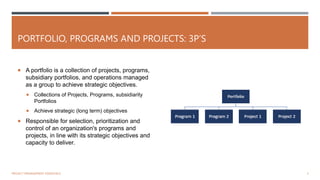
 A portfolio is a collection of projects, programs,
subsidiary portfolios, and operations managed
as a group to achieve strategic objectives.
 Collections of Projects, Programs, subsidiarity
Portfolios
 Achieve strategic (long term) objectives
 Responsible for selection, prioritization and
control of an organization's programs and
projects, in line with its strategic objectives and
capacity to deliver.
6
PROJECT MANAGEMENT ESSENTIALS
PORTFOLIO, PROGRAMS AND PROJECTS: 3P’S
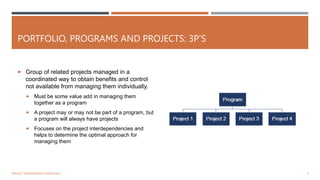
 Group of related projects managed in a
coordinated way to obtain benefits and control
not available from managing them individually.
 Must be some value add in managing them
together as a program
 A project may or may not be part of a program, but
a program will always have projects
 Focuses on the project interdependencies and
helps to determine the optimal approach for
managing them
7
PROJECT MANAGEMENT ESSENTIALS
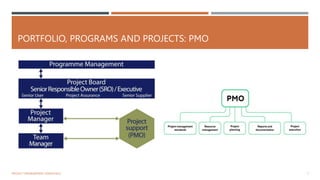
PORTFOLIO, PROGRAMS AND PROJECTS: PMO
8
PROJECT MANAGEMENT ESSENTIALS
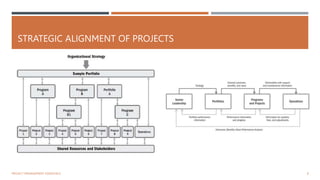
STRATEGIC ALIGNMENT OF PROJECTS
What are the types of Project’s?
TYPES OF
PROJECT
APPROACH
PROJECT MANAGEMENT ESSENTIALS 9
Waterfall VS Agile
TYPES OF
PROJECT
APPROACH
PROJECT MANAGEMENT ESSENTIALS 10
11
PROJECT MANAGEMENT ESSENTIALS
TYPES OF PROJECT APPROACH: WATERFALL VS AGILE
12
PROJECT MANAGEMENT ESSENTIALS
TYPES OF PROJECT APPROACH: WATERFALL VS AGILE
Hybrid
TYPES OF
PROJECT
APPROACH
PROJECT MANAGEMENT ESSENTIALS 13
14
PROJECT MANAGEMENT ESSENTIALS
TYPES OF PROJECT APPROACH
Example:
Predictive: A customer wants to build a house and
has the design approved and the land ready for
construction.
Adaptive: A company needs to build an ecommerce
application specialized in cosmetics, initial
requirements list has been developed but they are not
sure if it is final, and they may change their
requirements during the project.
Hybrid: An Enterprise needs to build a new customer
care center that consists of buildings, hardware,
software development, training and team development
work.
15
PROJECT MANAGEMENT ESSENTIALS
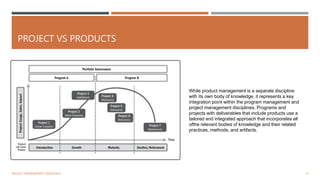
PROJECT VS PRODUCTS
While product management is a separate discipline
with its own body of knowledge, it represents a key
integration point within the program management and
project management disciplines. Programs and
projects with deliverables that include products use a
tailored and integrated approach that incorporates all
ofthe relevant bodies of knowledge and their related
practices, methods, and artifacts.
Industry Best Practices
PROJECT
FRAMEWORKS
PROJECT MANAGEMENT ESSENTIALS 16
Industry Best Practices
PROJECT
FRAMEWORKS
PROJECT MANAGEMENT ESSENTIALS 17
Success or Failure
PROJECT
CHALLENGES
PROJECT MANAGEMENT ESSENTIALS 18
19
PROJECT MANAGEMENT ESSENTIALS
PROJECT CHALLENGES: SUCCESS OR FAILURE
20
PROJECT MANAGEMENT ESSENTIALS
INDUSTRY CASE STUDY: AVIATION – AIRLINES MANAGEMENT
•Tailor-made offers will always appeal to the customer, thus encouraging loyalty. Airlines are in the fortunate position of being able
to learn an enormous amount about their client base from data. Even a single booking contains data which can teach an airline a
huge amount about its customers. For instance, United Airlines use their “collect, detect, act” protocol to analyze over 150
variables in each customer profile. These analyses measure everything from previous purchases to customer preferences in order
to generate a tailor-made offer. The collect, detect, act initiative has increased United’s year-to-year revenue by over 15%.
Encourage loyalty:
United Airlines
•Inflight, vast amounts of data are generated throughout the journey – pilot reports, warning reports, control positions, and air
traffic control communications. When this data is closely monitored and analyzed it can streamline operations and improve safety.
For example, Southwest Airlines have teamed up with NASA to continually improve airline safety. By using intelligent algorithms,
Southwest and NASA have created an automated system that can crunch an enormous amount of data to flag anomalies and
prevent accidents. The wide-ranging initiatives include institutional exchanges between faculty and staff from each partner
institution; joint knowledge-sharing sessions through the organization of events such as symposia, conferences, short courses,
development of collaborative projects and publications; as well as cross-marketing and promotional activities.
In-flight intelligence:
Southwest Airlines
•Malaysia Airlines Berhad to expand its partner-ship with Amadeus to improve the experience of its customers, including corporate
and travel retailers over the coming years. The multi-year deal will see Malaysia’s national airline adopting Altéa NDC, Reference
Experience, Dynamic Intelligence Hub and renewing its Amadeus Altéa Passenger Service System contract. In addition, the airline
has also renewed and expanded its multi-year air content distribution partner-ship. With the seamless integration of Altéa NDC
with the Amadeus Travel Platform, travel retailers will soon be able to access Malaysia Airlines’ full range of NDC-enabled content
with full servicing functionalities. New Distribution Capability (NDC) is a travel industry-supported program by the International Air
Transport Association (IATA) aimed at modernizing the way air products are retailed to travel agents, corporations and travelers.
Malaysia Airlines
Partnership with
Amadeus - 7th April
2022
WHAT IT TAKES TO
BE A PROJECT
MANAGER
Project managers play the lead role in planning, executing,
monitoring, controlling, and closing out projects. They are
accountable for the entire project scope, the project team
and resources, the project budget, and the success or failure
of the project.
Project managers play the lead role in planning, executing,
monitoring, controlling, and closing out projects. They are
accountable for the entire project scope, the project team
and resources, the project budget, and the success or failure
of the project.
Effective project managers need more than technical know-
how. The role also requires a strategic business mindset,
team building and confliction resolution capabilities, and
change management expertise, among other key skills in
high demand. At a base level, project managers must exhibit
leadership, be able to motivate team members,
prioritization, and problem-solve. Adaptability is another
key non-technical skill project managers must have to
succeed. Soft skills of effective project leaders can also help
project managers excel in this highly sought-after role.
21
PROJECT MANAGEMENT ESSENTIALS
22
PROJECT MANAGEMENT ESSENTIALS
SERVANT LEADERSHIP
Leadership
STAKEHOLDER
MANAGEMENT
PROJECT MANAGEMENT ESSENTIALS 23
24
PROJECT MANAGEMENT ESSENTIALS
STAKEHOLDER MANAGEMENT
Stakeholder:
An individual, group, or organization that may
affect, be affected by, or perceive itself to be affected by a
decision, activity, or outcome of a project, program, or
portfolio.
Stakeholder Analysis:
A method of systematically
gathering and analyzing quantitative and qualitative
information to determine whose interests should be
25
PROJECT MANAGEMENT ESSENTIALS
STAKEHOLDER MANAGEMENT
Stakeholder engagement includes implementing
strategies and actions to promote productive
involvement of stakeholders.
Stakeholder engagement activities start before or
when the project starts and continue throughout
the project.
Constraints
PROJECT
VARIABLES
PROJECT MANAGEMENT ESSENTIALS 26
27
PROJECT MANAGEMENT ESSENTIALS
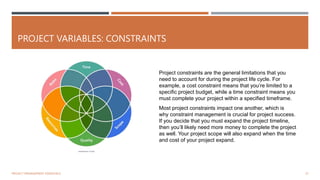
PROJECT VARIABLES: CONSTRAINTS
Project constraints are the general limitations that you
need to account for during the project life cycle. For
example, a cost constraint means that you’re limited to a
specific project budget, while a time constraint means you
must complete your project within a specified timeframe.
Most project constraints impact one another, which is
why constraint management is crucial for project success.
If you decide that you must expand the project timeline,
then you’ll likely need more money to complete the project
as well. Your project scope will also expand when the time
and cost of your project expand.
PROJECT
VARIABLES: SCOPE
Project scope refers to a project’s
magnitude in terms of quality, detail, and
deliverables. Time and money are
dependencies of project scope, because
as the project scope grows, the project
will require more time and money to
complete.
You’ll need to be aware of scope
creep throughout each project phase
and work hard to prevent it. You can
prevent scope creep by creating detailed
project plans and getting project
stakeholders to sign off on everything
before production begins.
28
PROJECT MANAGEMENT ESSENTIALS
PROJECT
VARIABLES: COST
Cost constraints include the project
budget as a whole and anything of
financial value required for your
project. Items that may be a cost
constraint include:
•Project cost
•Team member salaries
•Cost of equipment
•Cost of facilities
•Repair costs
•Material costs
Include any items in this section that
require you to pull from your
company’s financial resources.
29
PROJECT MANAGEMENT ESSENTIALS
PROJECT
VARIABLES: TIME
Time management is essential for project success, and there are various
time constraints you’ll face during each phase of your project. When you try
to increase your project timeline, there will be consequences like extended
deadlines, adjustments to the team calendar, or less time for planning.
Time elements in your project that can lead to constraints may include:
•Overall project timeline
•Hours worked on project
•Internal calendars and goalposts
•Time allotted for planning and strategy
•Number of project phases
Scope, cost, and time are called the iron triangle because these three
constraints can be difficult to maneuver around each other while maintaining
project quality. For example, if you cut your budget or increase your scope,
you’ll likely need to compensate by loosening up on time. You can do this by
extending deadlines, adding hours, or adjusting your project schedule.
.
30
PROJECT MANAGEMENT ESSENTIALS
PROJECT
VARIABLES: RISK
Project risks are any unexpected occurrences that can affect your
project. While most project risks are negative, some can be positive. For
example, a new technology may be released while your project is in
progress. This technology may help you finish your project quicker, or it
may cause more competition in the market and reduce your product
value.
You can determine project risks using risk analysis and risk management
strategies to keep them at bay. Some risks you may face include:
•Stretched resources
•Operational mishaps
•Low performance
•Lack of clarity
•Scope creep
•High costs
•Time crunch
Use a risk register to assess the likelihood and severity for each project
risk, then mitigate the most likely and severe risks first.
. 31
PROJECT MANAGEMENT ESSENTIALS
PROJECT
VARIABLES:
RESOURCES
Resources tie closely with cost constraints
on your project because these project
requirements cost money. Without
proper resource allocation, can experience
lower project quality, an increased budget,
and timeline delays.
Some resources to consider include:
•People
•Equipment or materials
•Facilities
•Software
Use a resource management plan to
ensure you have the resources you need
for every element of your project so that
this constraint doesn’t negatively affect
other project areas.
32
PROJECT MANAGEMENT ESSENTIALS
PROJECT
VARIABLES:
QUALITY
Project quality is the measure of how well
your project deliverables meet initial expectations.
Every project constraint affects project quality
because project quality is the ultimate result of
your project. However, project quality is also its
own constraint because there are aspects of the
project that can result in poor quality that aren’t
necessarily related to cost, time, resources, risk,
or scope. These include:
•Lack of communication
•Poor design or development skills
•Too many project changes
You must manage project quality as its own entity
while also balancing the other five project
constraints if you hope to achieve high project
performance. If you fail to manage your
constraints, the result can be low project quality
and low customer satisfaction.
33
PROJECT MANAGEMENT ESSENTIALS
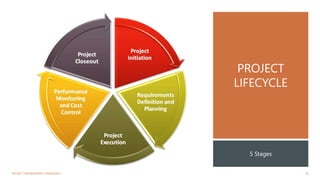
5 Stages
PROJECT
LIFECYCLE
PROJECT MANAGEMENT ESSENTIALS 34
35
PROJECT MANAGEMENT ESSENTIALS
PROJECT LIFECYCLE: INITIATION
The project initiation phase is the first stage of turning an abstract
idea into a meaningful goal. In this stage, you need to develop a
business case and define the project on a broad level. In order to
do that, you must determine the need for the project and create a
project charter.
The project charter is an important document consisting of details
like the project constraints, goals, appointment of the project
manager, budget, expected timeline, etc.
Once you have the project goals and project scope, identify key
project stakeholders–the people who are to be involved in the
project. Create a stakeholder register with the roles, designation,
communication requirements, and influence.
While a clear goal of the project is established in this phase, a
project charter does not contain any technical details that happen
in the planning stage.
Consider the example of an automobile manufacturer assigned to
develop an electric vehicle. The selection of the design, capacity,
and battery power of the vehicle will not be a part of the initiation
phase. The only certainty would be that an electric vehicle will be
developed within the given timeframe and budget.
36
PROJECT MANAGEMENT ESSENTIALS
PROJECT LIFECYCLE: INITIATION – PROJECT CHARTER
A project charter is a formal short document that states a project exists and provides project managers with written
authority to begin work. A project charter document describes a project to create a shared understanding of its goals,
objectives and resource requirements before the project is scoped out in detail.
The project charter helps project managers explain to participants and stakeholders the scope of a project, project
objectives, who will participate in the project, along with other details such as possible risks. Depending on a company's
culture and management style, a charter may serve the same purpose as a business case. In a large organization, the
charter may be a multipage document, but in smaller organizations, it may just be a few paragraphs with bulleted items.
The project manager should create the project charter at the beginning of the project. Signing the document can also act
as a way to authorize the project, giving the project manager the go-ahead to officially begin executing the project. This
includes the authority to begin employing organizational funds and resources. For larger projects that are multiphased,
project managers can create a charter for each phase.
PROJECT LIFECYCLE:
INITIATION – PROJECT
CHARTER EXAMPLE
Project charter templates often include the following parts
of the project:
• Project goal. This documents the reasons for undertaking the
project in clear, concise language. This should determine the
project's scope.
• Project participants. This identifies who will be involved in the
project and clearly states their roles.
• Stakeholders. This identifies project sponsors or other people
who will be directly affected by the project and need to know
about its progress.
• Requirements. This identifies the resources required for the
project's objectives to be achieved.
• Constraints. This documents potential roadblocks or
bottlenecks and should help prepare participants for the
potential issues of the project.
• Implementation milestones. This identifies the start and ideal
completion dates, as well as dates for other potentially
important checkpoints, like a project schedule.
• Communication. This specifies how the project manager will
communicate with project owners, participants and key
stakeholders throughout the project.
• Deliverables. This documents what specific products,
processes or services the project provides upon completion.
• Create an implementation plan. This identifies a general
overview of the project budget
37
PROJECT MANAGEMENT ESSENTIALS
38
PROJECT MANAGEMENT ESSENTIALS
PROJECT LIFECYCLE: PLANNING
 Scope planning – this specifies all the requirements of the project in order to produce a work break-down structure (WBS).
 Preparing of the WBS – this spells out the division of the project into specific task and sub-tasks.
 Project schedule development – it lists a timeline of the activities of the project and details an implementation sequence for
them.
 Resource planning- it indicates who is to do a specific task, and at what time it should be done, and if there is any specific
skills required to tackle it.
 Budget planning – it specifies the cost estimations for the whole project.
 Procurement planning – it focuses on suppliers and contractors involved in the project.
 Risk management – this involves planning on all risks to be possibly encountered in the project implementation and all
options available to counter them.
 Quality planning – this assesses a quality standard to be followed in the project.
 Communication planning – this involves producing a design of a communication protocol to be used between the parties
involved in the project.
WBS
PROJECT
LIFECYCLE:
PLANNING
PROJECT MANAGEMENT ESSENTIALS 39
40
PROJECT MANAGEMENT ESSENTIALS
PROJECT LIFECYCLE: PLANNING - WBS
Example
PROJECT
LIFECYCLE:
PLANNING -
SCHEDULING
PROJECT MANAGEMENT ESSENTIALS 41
42
PROJECT MANAGEMENT ESSENTIALS
PROJECT LIFECYCLE: PLANNING – RISK MANAGEMENT
Risk management is the process of minimizing any
potential problems that may negatively impact a
project's timetable. 'Risk' is any unexpected event that
might affect the people, processes, technology, and
resources involved in a project. Unlike 'issues', which
are certain to happen, risks are events that could occur,
and you may not be able to tell when. Because of this
uncertainty, project risk requires preparation in order
to manage them efficiently.
So, what is risk management in project management?
It is preparing for and handling obstacles and
problems that may challenge the success of your
project.
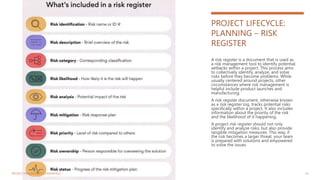
PROJECT LIFECYCLE:
PLANNING – RISK
REGISTER
A risk register is a document that is used as
a risk management tool to identify potential
setbacks within a project. This process aims
to collectively identify, analyze, and solve
risks before they become problems. While
usually centered around projects, other
circumstances where risk management is
helpful include product launches and
manufacturing.
A risk register document, otherwise known
as a risk register log, tracks potential risks
specifically within a project. It also includes
information about the priority of the risk
and the likelihood of it happening.
A project risk register should not only
identify and analyze risks, but also provide
tangible mitigation measures. This way, if
the risk becomes a larger threat, your team
is prepared with solutions and empowered
to solve the issues.
43
PROJECT MANAGEMENT ESSENTIALS
Example
PROJECT
LIFECYCLE:
PLANNING –
RISK REGISTER
PROJECT MANAGEMENT ESSENTIALS 44
45
PROJECT MANAGEMENT ESSENTIALS
PROJECT LIFECYCLE: EXECUTION
Project execution means that you’re rolling up your sleeves and acting on everything you outlined in your project plan.
Put simply, you’re executing those strategies (how’s that for being literal?) to get the project across the finish line.
You might also hear project execution referred to as project implementation. That’s another fancy name that means the
same thing.
Execution is the third step of the typical project lifecycle, which has 5 total stages: initiation, planning, execution, monitor
& control and closure.
You might think that the execution stage would be the easy gimme of the whole bunch, especially if you’ve already done
the hard stuff and established the groundwork for a successful project. But it’s in the execution stage where a lot of
team's struggle.
Think about it in the context of your personal life: establishing a budget is the easy part. It’s actually following it that
presents the challenge (especially when you really just want to cave in and order pizza regardless of what your wallet
says).
46
PROJECT MANAGEMENT ESSENTIALS
PROJECT LIFECYCLE: EXECUTION – COMMON ACTIVITIES AND
CHALLENGES
Depending on the nature of the project and your organizational
preferences, you’ll decide the sequence of activities that will
happen during the execution phase.
 Execute the project scope
 Manage the team’s work
 Recommend changes and corrective actions
 Manage project communication with stakeholders
 Conduct team-building exercises
 Celebrate project milestones and motivate team members
 Hold status review meetings to make sure everything is on
schedule
 Document all changes to the project plan
Common challenges in Project Execution:
• A lack of common understanding
• Uninvolved sponsors
• Misalignment with strategic project objectives and goals
• Poor change management processes
• Ineffective corporate governance
• Poor leadership
47
PROJECT MANAGEMENT ESSENTIALS
PROJECT LIFECYCLE: EXECUTION - INPUTS
Project Management Plan Project Documents
• Change Log
• Lesson Learned Register
• Milestone List
• Project Communication
• Project Schedule
• Requirements Traceability Matrix
• Risk Register
• Risk Report
Approved Changes Enterprise Environmental
Factor
• Stakeholder Risk Tolerance
• Culture and Structure of an
Organisation
• Infrastructure
Organisational Process Asset
• Standardized Guidelines and Work
Instructions
• Communications Requirements
• Issue and Defect Management
Procedures
• Process Measurement Database
• Project Files from Previous Projects
• Issue and Defect Management
Database
48
PROJECT MANAGEMENT ESSENTIALS
PROJECT LIFECYCLE: EXECUTION – TOOLS AND TECHNIQUES
Expert Judgment
Expert Judgment is an essential stage in the direct and manages project execution process as it involves taking opinions from various
units within the organization, consulting subject matter experts for reviews, including insights from the stakeholders, and finally views from
professionals and technical associations. Finally, the project manager must conduct procurements.
Project Management Information System (PMIS)
PMIS is the primary tool to direct and manage project execution. It is a collection of tools and techniques used to gather, integrate and
disseminate the output of Project Management processes. The PMIS is a methodological process used for collecting using project
information from initiating stage to the closure stage.
Meetings
Meetings should take place on a timely basis during the life cycle of the project. Regular meetings will allow the project manager to keep
track of the proceeding. And, to interact with all the departments and share important details with the stakeholders. On whole, conducting
meetings will keep things in an organized/structured manner.
49
PROJECT MANAGEMENT ESSENTIALS
PROJECT LIFECYCLE: EXECUTION - OUTPUTS
What’s produced during the execution phase?
The execution phase is where all the action happens, and the
plans start materializing. There will be changes to the scope and
the documentation will change as a result.
Project deliverables
Project deliverables are the tangible outputs of the project. They
need to be reviewed, tested, and meet the acceptance criteria
given by the clients.
Change requests
When client expectations change or there’s a disconnect between
the team’s understanding of the client’s requirements, scope
changes happen. These are documented in the change requests,
which are then reviewed and approved.
Performance data
The execution stage produces a lot of data points that you can use
to optimize your team’s performance. You can find where your
team is spending most of their time with the help of the project
dashboard and how you can cut down on time and costs.
Issue log
Whenever there are bugs, issues, or defects, you document them
in the issue log. This will help you get back to the issues and fix
them.
Documentation updates
Any changes to the documents created during the planning phase
like the project scope and project schedule will be documented.
50
PROJECT MANAGEMENT ESSENTIALS
PROJECT LIFECYCLE: MONITORING AND CONTROL
What is the monitoring and controlling phase?
In the project life cycle, the project monitoring and control phase happens in tandem with the execution phase. What it involves
depends on how a project is organized and defined.
Project management monitoring and controlling means actively reviewing the status of your project as it proceeds, evaluating
potential obstacles, and implementing necessary changes.
During this phase, organizations need to juggle several responsibilities, including:
 Keeping to the schedule
 Staying within budget
 Avoiding scope creep
 Managing risk
51
PROJECT MANAGEMENT ESSENTIALS
PROJECT LIFECYCLE: MONITORING AND CONTROL KEY ACTIVITIES
Report KPI
Monitor
Change
Request
Keep Track of
Scope
Control Cost,
Quality and
Risk
Facilitate
Stakeholder
Communication
52
PROJECT MANAGEMENT ESSENTIALS
PROJECT LIFECYCLE: CLOSING
Project closure is the last phase of a project. It’s when the
project manager verifies that the client, stakeholder or
customer has accepted the project deliverables. If the
project or product is ongoing after the project, then
maintenance must be set up.
The project manager will also review the entire project
before closing it, rating performance and comparing that
to the baseline. The project team will be part of this
process, offering their observations and feedback, which
is collected in a lesson’s learned document. This provides
guidance for future projects.
Arrange
Post
Mortem
Complete
Paperwork
Release
Resources
Archive
Documents
Celebrate
Success
Checklist
PROJECT
LIFECYCLE:
CLOSING
PROJECT MANAGEMENT ESSENTIALS 53
Start at the beginning with the project scope document you created and make sure that you’ve met
all the requirements listed there.
Make sure that all deliverables have been handed off and signed by stakeholders, getting their
approval and satisfaction.
Other project documents must also be signed by the appropriate person, this includes any
outstanding contracts and agreements with vendors and other contractors.
Once documents are signed off on, then process them and pay off all invoices and close out any
project-related contracts.
Add all documents together, including finalizing all project reports, then organize and archive them
as historical data to be used for future reference.
Use collected paperwork to identify and document the lessons learned over the course of the
project, including any feedback from stakeholders, so you don’t make the same mistakes in future
projects.
Assign a transition support person to shepherd the project after completion so that the project
closure is thorough.
Release or reassign the project resources, which includes your team and other project personnel
and any equipment or site rentals used for the project.
If you’ve not used a project management software, get one, as it helps control not only the life
cycle of the project but also the process of closing the project thoroughly.
Finally, but perhaps most importantly, celebrate with your project team. They did the work and
deserve credit and an opportunity to blow off steam until the next project is started.

PROJECT MANAGEMENT ESSENTIALS.pptx

  • 1.
  • 2.
    2 PROJECT MANAGEMENT ESSENTIALS COURSEOUTLINE  Project definition  Portfolio, Programs and Projects (including PMO’s)  Strategic alignment of projects  Types of Project Approach o Waterfall/Traditional OR Predictive o Agile OR Adaptive o Hybrid  Project vs Product  Project framework (Industry best practices) o Ex: PMP, Prince2, Scrum etc  Project Challenges: Success or Failure  Industry specific case study  What it takes to be a PM  Servant Leadership  Stakeholder Management  Project variables o Cost o Risk o Time o Quality o Resources o Scope  Project Initiation o Charter o Stakeholders  Project Planning o Integration o Scope o Time o Cost o Quality o HR o Communications o Risk o Procurement  Project Execution o Directing and managing o Training  Project Monitoring and Control o Workflow o Change management  Project Closing DAY 1 DAY 2
  • 3.
    3 PROJECT MANAGEMENT ESSENTIALS PROJECTDEFINITION UNIQUE • A temporary endeavor that produces a unique product, service, or result TEMPORARY • Temporary in nature and has a definite beginning and ending PROGRESSIVELY ELABORATED • Project is Progressively Elaborated: It is the iterative process of increasing the level of detail in a project management plan as greater amounts of information and more accurate estimates become available.
  • 4.
  • 5.
    5 PROJECT MANAGEMENT ESSENTIALS PORTFOLIO,PROGRAMS AND PROJECTS: 3P’S  A portfolio is a collection of projects, programs, subsidiary portfolios, and operations managed as a group to achieve strategic objectives.  Collections of Projects, Programs, subsidiarity Portfolios  Achieve strategic (long term) objectives  Responsible for selection, prioritization and control of an organization's programs and projects, in line with its strategic objectives and capacity to deliver.
  • 6.
    6 PROJECT MANAGEMENT ESSENTIALS PORTFOLIO,PROGRAMS AND PROJECTS: 3P’S  Group of related projects managed in a coordinated way to obtain benefits and control not available from managing them individually.  Must be some value add in managing them together as a program  A project may or may not be part of a program, but a program will always have projects  Focuses on the project interdependencies and helps to determine the optimal approach for managing them
  • 7.
  • 8.
  • 9.
    What are thetypes of Project’s? TYPES OF PROJECT APPROACH PROJECT MANAGEMENT ESSENTIALS 9
  • 10.
    Waterfall VS Agile TYPESOF PROJECT APPROACH PROJECT MANAGEMENT ESSENTIALS 10
  • 11.
    11 PROJECT MANAGEMENT ESSENTIALS TYPESOF PROJECT APPROACH: WATERFALL VS AGILE
  • 12.
    12 PROJECT MANAGEMENT ESSENTIALS TYPESOF PROJECT APPROACH: WATERFALL VS AGILE
  • 13.
  • 14.
    14 PROJECT MANAGEMENT ESSENTIALS TYPESOF PROJECT APPROACH Example: Predictive: A customer wants to build a house and has the design approved and the land ready for construction. Adaptive: A company needs to build an ecommerce application specialized in cosmetics, initial requirements list has been developed but they are not sure if it is final, and they may change their requirements during the project. Hybrid: An Enterprise needs to build a new customer care center that consists of buildings, hardware, software development, training and team development work.
  • 15.
    15 PROJECT MANAGEMENT ESSENTIALS PROJECTVS PRODUCTS While product management is a separate discipline with its own body of knowledge, it represents a key integration point within the program management and project management disciplines. Programs and projects with deliverables that include products use a tailored and integrated approach that incorporates all ofthe relevant bodies of knowledge and their related practices, methods, and artifacts.
  • 16.
  • 17.
  • 18.
  • 19.
    19 PROJECT MANAGEMENT ESSENTIALS PROJECTCHALLENGES: SUCCESS OR FAILURE
  • 20.
    20 PROJECT MANAGEMENT ESSENTIALS INDUSTRYCASE STUDY: AVIATION – AIRLINES MANAGEMENT •Tailor-made offers will always appeal to the customer, thus encouraging loyalty. Airlines are in the fortunate position of being able to learn an enormous amount about their client base from data. Even a single booking contains data which can teach an airline a huge amount about its customers. For instance, United Airlines use their “collect, detect, act” protocol to analyze over 150 variables in each customer profile. These analyses measure everything from previous purchases to customer preferences in order to generate a tailor-made offer. The collect, detect, act initiative has increased United’s year-to-year revenue by over 15%. Encourage loyalty: United Airlines •Inflight, vast amounts of data are generated throughout the journey – pilot reports, warning reports, control positions, and air traffic control communications. When this data is closely monitored and analyzed it can streamline operations and improve safety. For example, Southwest Airlines have teamed up with NASA to continually improve airline safety. By using intelligent algorithms, Southwest and NASA have created an automated system that can crunch an enormous amount of data to flag anomalies and prevent accidents. The wide-ranging initiatives include institutional exchanges between faculty and staff from each partner institution; joint knowledge-sharing sessions through the organization of events such as symposia, conferences, short courses, development of collaborative projects and publications; as well as cross-marketing and promotional activities. In-flight intelligence: Southwest Airlines •Malaysia Airlines Berhad to expand its partner-ship with Amadeus to improve the experience of its customers, including corporate and travel retailers over the coming years. The multi-year deal will see Malaysia’s national airline adopting Altéa NDC, Reference Experience, Dynamic Intelligence Hub and renewing its Amadeus Altéa Passenger Service System contract. In addition, the airline has also renewed and expanded its multi-year air content distribution partner-ship. With the seamless integration of Altéa NDC with the Amadeus Travel Platform, travel retailers will soon be able to access Malaysia Airlines’ full range of NDC-enabled content with full servicing functionalities. New Distribution Capability (NDC) is a travel industry-supported program by the International Air Transport Association (IATA) aimed at modernizing the way air products are retailed to travel agents, corporations and travelers. Malaysia Airlines Partnership with Amadeus - 7th April 2022
  • 21.
    WHAT IT TAKESTO BE A PROJECT MANAGER Project managers play the lead role in planning, executing, monitoring, controlling, and closing out projects. They are accountable for the entire project scope, the project team and resources, the project budget, and the success or failure of the project. Project managers play the lead role in planning, executing, monitoring, controlling, and closing out projects. They are accountable for the entire project scope, the project team and resources, the project budget, and the success or failure of the project. Effective project managers need more than technical know- how. The role also requires a strategic business mindset, team building and confliction resolution capabilities, and change management expertise, among other key skills in high demand. At a base level, project managers must exhibit leadership, be able to motivate team members, prioritization, and problem-solve. Adaptability is another key non-technical skill project managers must have to succeed. Soft skills of effective project leaders can also help project managers excel in this highly sought-after role. 21 PROJECT MANAGEMENT ESSENTIALS
  • 22.
  • 23.
  • 24.
    24 PROJECT MANAGEMENT ESSENTIALS STAKEHOLDERMANAGEMENT Stakeholder: An individual, group, or organization that may affect, be affected by, or perceive itself to be affected by a decision, activity, or outcome of a project, program, or portfolio. Stakeholder Analysis: A method of systematically gathering and analyzing quantitative and qualitative information to determine whose interests should be
  • 25.
    25 PROJECT MANAGEMENT ESSENTIALS STAKEHOLDERMANAGEMENT Stakeholder engagement includes implementing strategies and actions to promote productive involvement of stakeholders. Stakeholder engagement activities start before or when the project starts and continue throughout the project.
  • 26.
  • 27.
    27 PROJECT MANAGEMENT ESSENTIALS PROJECTVARIABLES: CONSTRAINTS Project constraints are the general limitations that you need to account for during the project life cycle. For example, a cost constraint means that you’re limited to a specific project budget, while a time constraint means you must complete your project within a specified timeframe. Most project constraints impact one another, which is why constraint management is crucial for project success. If you decide that you must expand the project timeline, then you’ll likely need more money to complete the project as well. Your project scope will also expand when the time and cost of your project expand.
  • 28.
    PROJECT VARIABLES: SCOPE Project scoperefers to a project’s magnitude in terms of quality, detail, and deliverables. Time and money are dependencies of project scope, because as the project scope grows, the project will require more time and money to complete. You’ll need to be aware of scope creep throughout each project phase and work hard to prevent it. You can prevent scope creep by creating detailed project plans and getting project stakeholders to sign off on everything before production begins. 28 PROJECT MANAGEMENT ESSENTIALS
  • 29.
    PROJECT VARIABLES: COST Cost constraintsinclude the project budget as a whole and anything of financial value required for your project. Items that may be a cost constraint include: •Project cost •Team member salaries •Cost of equipment •Cost of facilities •Repair costs •Material costs Include any items in this section that require you to pull from your company’s financial resources. 29 PROJECT MANAGEMENT ESSENTIALS
  • 30.
    PROJECT VARIABLES: TIME Time managementis essential for project success, and there are various time constraints you’ll face during each phase of your project. When you try to increase your project timeline, there will be consequences like extended deadlines, adjustments to the team calendar, or less time for planning. Time elements in your project that can lead to constraints may include: •Overall project timeline •Hours worked on project •Internal calendars and goalposts •Time allotted for planning and strategy •Number of project phases Scope, cost, and time are called the iron triangle because these three constraints can be difficult to maneuver around each other while maintaining project quality. For example, if you cut your budget or increase your scope, you’ll likely need to compensate by loosening up on time. You can do this by extending deadlines, adding hours, or adjusting your project schedule. . 30 PROJECT MANAGEMENT ESSENTIALS
  • 31.
    PROJECT VARIABLES: RISK Project risksare any unexpected occurrences that can affect your project. While most project risks are negative, some can be positive. For example, a new technology may be released while your project is in progress. This technology may help you finish your project quicker, or it may cause more competition in the market and reduce your product value. You can determine project risks using risk analysis and risk management strategies to keep them at bay. Some risks you may face include: •Stretched resources •Operational mishaps •Low performance •Lack of clarity •Scope creep •High costs •Time crunch Use a risk register to assess the likelihood and severity for each project risk, then mitigate the most likely and severe risks first. . 31 PROJECT MANAGEMENT ESSENTIALS
  • 32.
    PROJECT VARIABLES: RESOURCES Resources tie closelywith cost constraints on your project because these project requirements cost money. Without proper resource allocation, can experience lower project quality, an increased budget, and timeline delays. Some resources to consider include: •People •Equipment or materials •Facilities •Software Use a resource management plan to ensure you have the resources you need for every element of your project so that this constraint doesn’t negatively affect other project areas. 32 PROJECT MANAGEMENT ESSENTIALS
  • 33.
    PROJECT VARIABLES: QUALITY Project quality isthe measure of how well your project deliverables meet initial expectations. Every project constraint affects project quality because project quality is the ultimate result of your project. However, project quality is also its own constraint because there are aspects of the project that can result in poor quality that aren’t necessarily related to cost, time, resources, risk, or scope. These include: •Lack of communication •Poor design or development skills •Too many project changes You must manage project quality as its own entity while also balancing the other five project constraints if you hope to achieve high project performance. If you fail to manage your constraints, the result can be low project quality and low customer satisfaction. 33 PROJECT MANAGEMENT ESSENTIALS
  • 34.
  • 35.
    35 PROJECT MANAGEMENT ESSENTIALS PROJECTLIFECYCLE: INITIATION The project initiation phase is the first stage of turning an abstract idea into a meaningful goal. In this stage, you need to develop a business case and define the project on a broad level. In order to do that, you must determine the need for the project and create a project charter. The project charter is an important document consisting of details like the project constraints, goals, appointment of the project manager, budget, expected timeline, etc. Once you have the project goals and project scope, identify key project stakeholders–the people who are to be involved in the project. Create a stakeholder register with the roles, designation, communication requirements, and influence. While a clear goal of the project is established in this phase, a project charter does not contain any technical details that happen in the planning stage. Consider the example of an automobile manufacturer assigned to develop an electric vehicle. The selection of the design, capacity, and battery power of the vehicle will not be a part of the initiation phase. The only certainty would be that an electric vehicle will be developed within the given timeframe and budget.
  • 36.
    36 PROJECT MANAGEMENT ESSENTIALS PROJECTLIFECYCLE: INITIATION – PROJECT CHARTER A project charter is a formal short document that states a project exists and provides project managers with written authority to begin work. A project charter document describes a project to create a shared understanding of its goals, objectives and resource requirements before the project is scoped out in detail. The project charter helps project managers explain to participants and stakeholders the scope of a project, project objectives, who will participate in the project, along with other details such as possible risks. Depending on a company's culture and management style, a charter may serve the same purpose as a business case. In a large organization, the charter may be a multipage document, but in smaller organizations, it may just be a few paragraphs with bulleted items. The project manager should create the project charter at the beginning of the project. Signing the document can also act as a way to authorize the project, giving the project manager the go-ahead to officially begin executing the project. This includes the authority to begin employing organizational funds and resources. For larger projects that are multiphased, project managers can create a charter for each phase.
  • 37.
    PROJECT LIFECYCLE: INITIATION –PROJECT CHARTER EXAMPLE Project charter templates often include the following parts of the project: • Project goal. This documents the reasons for undertaking the project in clear, concise language. This should determine the project's scope. • Project participants. This identifies who will be involved in the project and clearly states their roles. • Stakeholders. This identifies project sponsors or other people who will be directly affected by the project and need to know about its progress. • Requirements. This identifies the resources required for the project's objectives to be achieved. • Constraints. This documents potential roadblocks or bottlenecks and should help prepare participants for the potential issues of the project. • Implementation milestones. This identifies the start and ideal completion dates, as well as dates for other potentially important checkpoints, like a project schedule. • Communication. This specifies how the project manager will communicate with project owners, participants and key stakeholders throughout the project. • Deliverables. This documents what specific products, processes or services the project provides upon completion. • Create an implementation plan. This identifies a general overview of the project budget 37 PROJECT MANAGEMENT ESSENTIALS
  • 38.
    38 PROJECT MANAGEMENT ESSENTIALS PROJECTLIFECYCLE: PLANNING  Scope planning – this specifies all the requirements of the project in order to produce a work break-down structure (WBS).  Preparing of the WBS – this spells out the division of the project into specific task and sub-tasks.  Project schedule development – it lists a timeline of the activities of the project and details an implementation sequence for them.  Resource planning- it indicates who is to do a specific task, and at what time it should be done, and if there is any specific skills required to tackle it.  Budget planning – it specifies the cost estimations for the whole project.  Procurement planning – it focuses on suppliers and contractors involved in the project.  Risk management – this involves planning on all risks to be possibly encountered in the project implementation and all options available to counter them.  Quality planning – this assesses a quality standard to be followed in the project.  Communication planning – this involves producing a design of a communication protocol to be used between the parties involved in the project.
  • 39.
  • 40.
  • 41.
  • 42.
    42 PROJECT MANAGEMENT ESSENTIALS PROJECTLIFECYCLE: PLANNING – RISK MANAGEMENT Risk management is the process of minimizing any potential problems that may negatively impact a project's timetable. 'Risk' is any unexpected event that might affect the people, processes, technology, and resources involved in a project. Unlike 'issues', which are certain to happen, risks are events that could occur, and you may not be able to tell when. Because of this uncertainty, project risk requires preparation in order to manage them efficiently. So, what is risk management in project management? It is preparing for and handling obstacles and problems that may challenge the success of your project.
  • 43.
    PROJECT LIFECYCLE: PLANNING –RISK REGISTER A risk register is a document that is used as a risk management tool to identify potential setbacks within a project. This process aims to collectively identify, analyze, and solve risks before they become problems. While usually centered around projects, other circumstances where risk management is helpful include product launches and manufacturing. A risk register document, otherwise known as a risk register log, tracks potential risks specifically within a project. It also includes information about the priority of the risk and the likelihood of it happening. A project risk register should not only identify and analyze risks, but also provide tangible mitigation measures. This way, if the risk becomes a larger threat, your team is prepared with solutions and empowered to solve the issues. 43 PROJECT MANAGEMENT ESSENTIALS
  • 44.
  • 45.
    45 PROJECT MANAGEMENT ESSENTIALS PROJECTLIFECYCLE: EXECUTION Project execution means that you’re rolling up your sleeves and acting on everything you outlined in your project plan. Put simply, you’re executing those strategies (how’s that for being literal?) to get the project across the finish line. You might also hear project execution referred to as project implementation. That’s another fancy name that means the same thing. Execution is the third step of the typical project lifecycle, which has 5 total stages: initiation, planning, execution, monitor & control and closure. You might think that the execution stage would be the easy gimme of the whole bunch, especially if you’ve already done the hard stuff and established the groundwork for a successful project. But it’s in the execution stage where a lot of team's struggle. Think about it in the context of your personal life: establishing a budget is the easy part. It’s actually following it that presents the challenge (especially when you really just want to cave in and order pizza regardless of what your wallet says).
  • 46.
    46 PROJECT MANAGEMENT ESSENTIALS PROJECTLIFECYCLE: EXECUTION – COMMON ACTIVITIES AND CHALLENGES Depending on the nature of the project and your organizational preferences, you’ll decide the sequence of activities that will happen during the execution phase.  Execute the project scope  Manage the team’s work  Recommend changes and corrective actions  Manage project communication with stakeholders  Conduct team-building exercises  Celebrate project milestones and motivate team members  Hold status review meetings to make sure everything is on schedule  Document all changes to the project plan Common challenges in Project Execution: • A lack of common understanding • Uninvolved sponsors • Misalignment with strategic project objectives and goals • Poor change management processes • Ineffective corporate governance • Poor leadership
  • 47.
    47 PROJECT MANAGEMENT ESSENTIALS PROJECTLIFECYCLE: EXECUTION - INPUTS Project Management Plan Project Documents • Change Log • Lesson Learned Register • Milestone List • Project Communication • Project Schedule • Requirements Traceability Matrix • Risk Register • Risk Report Approved Changes Enterprise Environmental Factor • Stakeholder Risk Tolerance • Culture and Structure of an Organisation • Infrastructure Organisational Process Asset • Standardized Guidelines and Work Instructions • Communications Requirements • Issue and Defect Management Procedures • Process Measurement Database • Project Files from Previous Projects • Issue and Defect Management Database
  • 48.
    48 PROJECT MANAGEMENT ESSENTIALS PROJECTLIFECYCLE: EXECUTION – TOOLS AND TECHNIQUES Expert Judgment Expert Judgment is an essential stage in the direct and manages project execution process as it involves taking opinions from various units within the organization, consulting subject matter experts for reviews, including insights from the stakeholders, and finally views from professionals and technical associations. Finally, the project manager must conduct procurements. Project Management Information System (PMIS) PMIS is the primary tool to direct and manage project execution. It is a collection of tools and techniques used to gather, integrate and disseminate the output of Project Management processes. The PMIS is a methodological process used for collecting using project information from initiating stage to the closure stage. Meetings Meetings should take place on a timely basis during the life cycle of the project. Regular meetings will allow the project manager to keep track of the proceeding. And, to interact with all the departments and share important details with the stakeholders. On whole, conducting meetings will keep things in an organized/structured manner.
  • 49.
    49 PROJECT MANAGEMENT ESSENTIALS PROJECTLIFECYCLE: EXECUTION - OUTPUTS What’s produced during the execution phase? The execution phase is where all the action happens, and the plans start materializing. There will be changes to the scope and the documentation will change as a result. Project deliverables Project deliverables are the tangible outputs of the project. They need to be reviewed, tested, and meet the acceptance criteria given by the clients. Change requests When client expectations change or there’s a disconnect between the team’s understanding of the client’s requirements, scope changes happen. These are documented in the change requests, which are then reviewed and approved. Performance data The execution stage produces a lot of data points that you can use to optimize your team’s performance. You can find where your team is spending most of their time with the help of the project dashboard and how you can cut down on time and costs. Issue log Whenever there are bugs, issues, or defects, you document them in the issue log. This will help you get back to the issues and fix them. Documentation updates Any changes to the documents created during the planning phase like the project scope and project schedule will be documented.
  • 50.
    50 PROJECT MANAGEMENT ESSENTIALS PROJECTLIFECYCLE: MONITORING AND CONTROL What is the monitoring and controlling phase? In the project life cycle, the project monitoring and control phase happens in tandem with the execution phase. What it involves depends on how a project is organized and defined. Project management monitoring and controlling means actively reviewing the status of your project as it proceeds, evaluating potential obstacles, and implementing necessary changes. During this phase, organizations need to juggle several responsibilities, including:  Keeping to the schedule  Staying within budget  Avoiding scope creep  Managing risk
  • 51.
    51 PROJECT MANAGEMENT ESSENTIALS PROJECTLIFECYCLE: MONITORING AND CONTROL KEY ACTIVITIES Report KPI Monitor Change Request Keep Track of Scope Control Cost, Quality and Risk Facilitate Stakeholder Communication
  • 52.
    52 PROJECT MANAGEMENT ESSENTIALS PROJECTLIFECYCLE: CLOSING Project closure is the last phase of a project. It’s when the project manager verifies that the client, stakeholder or customer has accepted the project deliverables. If the project or product is ongoing after the project, then maintenance must be set up. The project manager will also review the entire project before closing it, rating performance and comparing that to the baseline. The project team will be part of this process, offering their observations and feedback, which is collected in a lesson’s learned document. This provides guidance for future projects. Arrange Post Mortem Complete Paperwork Release Resources Archive Documents Celebrate Success
  • 53.
    Checklist PROJECT LIFECYCLE: CLOSING PROJECT MANAGEMENT ESSENTIALS53 Start at the beginning with the project scope document you created and make sure that you’ve met all the requirements listed there. Make sure that all deliverables have been handed off and signed by stakeholders, getting their approval and satisfaction. Other project documents must also be signed by the appropriate person, this includes any outstanding contracts and agreements with vendors and other contractors. Once documents are signed off on, then process them and pay off all invoices and close out any project-related contracts. Add all documents together, including finalizing all project reports, then organize and archive them as historical data to be used for future reference. Use collected paperwork to identify and document the lessons learned over the course of the project, including any feedback from stakeholders, so you don’t make the same mistakes in future projects. Assign a transition support person to shepherd the project after completion so that the project closure is thorough. Release or reassign the project resources, which includes your team and other project personnel and any equipment or site rentals used for the project. If you’ve not used a project management software, get one, as it helps control not only the life cycle of the project but also the process of closing the project thoroughly. Finally, but perhaps most importantly, celebrate with your project team. They did the work and deserve credit and an opportunity to blow off steam until the next project is started.

Editor's Notes

  • #39 The project planning stage requires complete diligence as it lays out the project’s roadmap. Unless you are using a modern project management methodology like agile project management, the second phase of project management is expected to take almost half of the entire project’s timespan. During the planning stage, the scope of the project is defined. There is a possibility of changing the scope if the project demands it, but the project manager must approve the change. Project managers also develop a work breakdown structure (WBS), which clearly visualizes the entire project in different sections for the team management. A detailed project timeline with each deliverable is another important element of the planning stage. Using that timeline, project managers can develop a project communication plan and a schedule of communication with the relevant stakeholders. Risk mitigation is another important aspect of project management that is a part of the planning stage. The project manager is responsible for extrapolating past data to identify potential project management risks and develop a strategy to minimize them. An important element that professionals often overlook is an effective change management plan. As a project manager, you must be ready to incorporate a few changes in the project to avoid bottlenecks and project delays. In the absence of a working change management plan, scope creep happens and causes huge problems for the project team in the later stages of the project. So, it’s best to reduce the possibility of unforeseen changes as much as possible.
  • #41 GATHER CRITICAL DOCUMENTS Gather critical project documents. Identify content containing project deliverables, such as the Project Charter, Scope Statement and Project Management Plan (PMP) subsidiary plans. IDENTIFY KEY TEAM MEMBERS Identify the appropriate project team members. Analyze the documents and identify the deliverables. DEFINE LEVEL 1 ELEMENTS Define the Level 1 Elements. Level 1 Elements are summary deliverable descriptions that must capture 100% of the project scope. Verify 100% of scope is captured. This requirement is commonly referred to as the 100% Rule. DECOMPOSE (BREAKDOWN) ELEMENTS Begin the process of breaking the Level 1 deliverables into unique lower Level deliverables. This “breaking down” technique is called Decomposition. Continue breaking down the work until the work covered in each Element is managed by a single individual or organization. Ensure that all Elements are mutually exclusive. Ask the question, would any additional decomposition make the project more manageable? If the answer is “no”, the WBS is done. CREATE WBS DICTIONARY Define the content of the WBS Dictionary. The WBS Dictionary is a narrative description of the work covered in each Element in the WBS. The lowest Level Elements in the WBS are called Work Packages. Create the WBS Dictionary descriptions at the Work Package Level with detail enough to ensure that 100% of the project scope is covered. The descriptions should include information such as, boundaries, milestones, risks, owner, costs, etc. CREATE GANTT CHART SCHEDULE Decompose the Work Packages to activities as appropriate. Export or enter the Work Breakdown Structure into a Gantt chart for further scheduling and project tracking.
  • #48 Project Management Plan Project Management Plan is the main agenda of the Directing and Managing Execution Process, as it contains all the subsidiary plans (scope baseline, cost baseline, schedule baseline, scope management, etc.) The PMP mainly guides the Project Manager on how to manage, execute, monitor, and control the project. Since the directing and managing process concentrates on how to implement the project, PMP is an essential input in the process. Project Document Change-log – Change-log is a process that records and stores all the information of the changes that are executed in the project from its initiation stage through to the completion stage. Lessons learned register – This process helps in improving the performance of the project through the lessons learned from the previously handled projects. The method mainly helps in avoiding the mistakes that have occurred in the previous project. All the rules and guidelines are properly aligned based on the information attained through this particular project. Milestone list – This is a process that describes and showcases the project scheduled dates and their specific milestones. Project communications – Any or whatsoever reports that are generated through the project are communicated and understood in this particular process. For example, performance reports, deliverable status, and other information. Project schedule – Describes the list of work activities, the work durations, the resources allocated, and the project’s scheduled initiation and completion stage. Requirements traceability matrix – This process links the product requirements to the project deliverables that satisfy them and helps to focus on the outcomes. Risk register – The risk register provides information on threats and opportunities that may occur and impact the execution of the project. Risk report – This process provides information about the sources of the overall project risks along with a detailed information summary of the identified individual project risks. Approved Change Requests The Change Requests are the predictable and authorized changes that concentrate on expanding or reducing the project scope. Directing and managing is the phase where the defects in the project, quality assurance, and preventive measures are all taken into high consideration. Every little aspect is taken care of and is corrected accordingly. One important thing to remember is that changes occur in every project, but making too many changes on a timely basis will hamper the quality of the project and will also affect the outcome. Enterprise Environmental Factors Stakeholder risk tolerances – Risk tolerance is the willingness to accommodate a high level of uncertainty when undertaking a task or making a decision. In simple terms, the desire to lose determines the risk tolerance of an individual or an organization. For instance, individuals spend money on products that come with no guarantee or performance assurance in the hope that the replacement product for the existing item might cost them more and there are others who pay more for the same product which has guaranteed performance. Culture and structure of an organization – Culture, and structure play an important role in determining the success rate of an organization. In any given organization the term culture should be given broader preference as it defines how the company works towards accomplishing a project successfully. When it comes to structuring, it mainly focuses on how the company is ideally structured. As in, how the workload is managed and distributed across various departments involved in the project. Infrastructure – Well, when it comes to the role of infrastructure it mainly revolves around the availability of proper facilities and equipment in an organization for achieving the set targets by the project manager. Organizational Process Assets Standardized guidelines and work instructions – Every organization have to set and implement standardized guidelines that are to be followed by all the departments and coming to the work instruction; they are the formalized rules and regulations that are to be adhered to by all teams during the project life cycle. Communication requirements – It’s a form where communication takes place between various interfaces of the organization (electronic and manual), to collect previous project details and records to have a clear vision. Issue and defect management procedures – When a project takes shape, it is bound to experience issues and defects in one or the other areas of the project. It is the responsibility of the team to identify the problems that are to arise and ensure that they have proper solutions. Process measurement database – Collecting and preparing a database of the available information that pertains to the ongoing processes and products. The process will help in measuring the real-time workflow concerning those carried out previously. Project files from previous projects – The availability of project files from previous projects will help provide scope for improvement in identifying the loopholes in the current project and bridging the gap where ever necessary. The process will mainly look into aspects of scope, cost, schedule, and performance measurement baselines for references also by focusing on the project calendars and project schedule for allocating and carrying out work. Issue and defect management database – The database will contain information on the status of historical issues and defects, methods used to control those issues, the resolutions that were churned out to tackle the problems, and finally getting to know about the results of real-time actions that were carried out. The process, in general, contains results for all the procedures carried out during the issue and defect management procedures stage.
  • #52 Report key performance indicators (KPIs). During your planning phase, you may have established a series of checkpoints or milestones for your project. Alternatively, you might have set goals of completing a specific number of deliverables per day, week, or month. Quantifiable measures like these, which are used to evaluate the success of your project, are called Key Performance Indicators (KPIs). During the project monitoring and controlling phase, keeping tabs on KPIs is essential to ensure your team is on the right track. If you start falling behind on production, you may not make your deadline for your deliverables. One way to keep your entire team up to date is to set up automated status reports that go out to all interested parties. Instead of relying on someone to send out daily updates, you can systematize the entire process using work management software. Monitor change requests. Even the best planning can’t eliminate all challenges. During the monitoring and controlling phase, you’ll need to review and address change requests from team members, clients, and other stakeholders. In some cases, you may have to overhaul entire processes. Using a centralized request hub can make monitoring change requests a breeze. In many cases, work management software enables your team to create intuitive request queues that organize input from internal and external sources. Keep track of scope. In some cases, your client may decide to change their mind about the project’s scope after you’ve begun work. During the project management monitoring and controlling phase, you may need to rethink your strategy, to evaluate whether you can accommodate increased scope within the original timeline or budget. If not, you need to circle back to your planning phase to: Clarify expectations Update your project charter Clarify new roles and responsibilities Once these steps have been taken, you can then continue on with your project execution. Control costs, quality, and risk. Managing costs is an essential part of successful project management. However, change orders, expanded scope, and unforeseen circumstances can put your budget at risk. During the project management monitoring and controlling phase, make sure to clearly and consistently track and report updates to your projected budget. That way you can keep a close watch on what has changed and how this will affect the profitability of a project. Tracking the end product from your product is crucial too. Quality management ensures your deliverables will meet your client’s expectations, keeping you in control. You should look to periodically review quality-related KPIs and processes, to ensure you’re on track to meet stated objectives. During the planning phase, it’s common to identify project risks that could potentially hinder your progress. As part of your project management monitoring and controlling efforts, take time to: Regularly review your list of potential risks Evaluate their likelihood of occurring Enact mitigation measures as needed Facilitate stakeholder communication. Effective project management monitoring and controlling requires keeping everyone in the loop and communication is key. Regular meetings with stakeholders, clients, and team members can help prevent misunderstandings and missed deadlines. For constant and consistent transparency that will keep remote teams on the same page, and save hours of time spent in status meetings, look to a centralized work management platform. This can empower teams to take advantage of dynamic reporting and enables asynchronous work that is vital for project success.
  • #53 Steps to Closing a Project The close of the project is the final phase of your job, it’s the last turn of the project life cycle, and like any other aspect of a project, it requires a process. The following are five steps you should take to make sure you’ve dotted all the I’s and crossed all the T’s, as well as taken full advantage of the experience. 1. Arrange a Post Mortem Managing a project isn’t only about tasks and resources, budget and deadlines, it’s an experience you can constantly learn from. While you should have been learning throughout the project, now is a great time to look back without the pressure and distractions that might have dulled your focus. Gather the core team to invite feedback about what worked, and what didn’t. Encourage honesty. By documenting the mistakes and the successes of the project, you’re building a catalog that offers historic data. You can go back and look over the information for precedents when planning for new projects. Projects are never standalone things, but part of a continuum, where the specifics might vary, but the general methods usually remain the same. There’s a wealth of knowledge produced after any project closes. 2. Complete Paperwork As noted, projects generate reams of documents. These documents are going to have to get sign off and approval from stakeholders. Everything needs attention and must be signed for, which is the legal proof that in fact these documents have concluded. That includes closing all contracts you might have made with internal partners or vendors or any other resources you contracted with. This includes addressing all outstanding payments. You want to make sure that all invoices, commissions, fees, bonus, what have you, are paid. Complete all the costs involved with the project. It’s not done if it’s not paid for. 3. Release Resources You assemble a team for the project, and now you must cut them loose. It’s a formal process, and a crucial one, which frees them for the next project. Each team is brought together for the mix of skills and experience they bring to a project. The project determines the team members you’ll want to work with, and each project is going to be a little bit different, which will be reflected in the team hired to execute it. This is true for internal as well as external resources. The external ones might be more obvious, as you contracted with them, and that contract is going to have a duration. When it’s over, make sure they’re all paid in full so they can sign off and leave. But internal resources remain, so you have to remind yourself that their time on the project is also limited, and you might be blocking other team’s projects if you don’t release your resources once the project is done. 4. Archive Documents There are lessons to be learned from old projects, which is why you meet with your team regularly during the project and look back on the process afterwards. However, if you don’t have an archive in which to pull the old records, then whatever knowledge you gain is lost because of poor organization and management. You worked hard to have great project documentation, don’t lose it. Before you close a project, archive all the documents and any notes and data that could prove useful. Even if you never access it, there’s a need to keep a paper trail of the work done on any project for other people in the organization. This might include legal teams, or HR teams, or even your successor. You never know when someone might have to go back and respond to a question or want to learn how an old issue was resolved. Consider it like putting away provisions for the winter. 5. Celebrate Success If it sounds silly to you, then you’re not doing your job. There’s nothing silly about rewarding your team to acknowledge a job well done. It creates closure, which is what this part of the project is all about, but it also plants a seed that will bloom in later projects when you work with members of the old team.