



Project Financial Appraisal Techniquespart of our advanced finance for non
financial managers Course programme

DELIVERED BY:
Business Services Support Limited
Visit www.businessservicessupport.com Tel: 0845 226 4315
Key Objectives


What is financial evaluation



Why project financial evaluation techniques



Project financial risks assessment



Practice illustration of financial plan

copyright© to Business Services Support Limited 2011
Definition of financial evaluation
Concern with the assessment of financial viability of

projects


Assessment of risk profile and financial efficiency

copyright© to Business Services Support Limited 2011
Why Project Financial Evaluation
Does the project create financial wealth
How quickly can we recover project investment
How risky is the project vis a viv it returns potentials
How much capital do we need to invest

copyright© to Business Services Support Limited 2011
Financial Risks Facing Projects
Demand Risk
Competition Risk
Financial Risk
Operational Risk
Interest Rate Risk

copyright© to Business Services Support Limited 2011
Financial Evaluation Techniques For
Effective Project Management

Payback Period

Return On Investment Profit Based Measures

Net Present Value
Method

copyright© to Business Services Support Limited 2011
Payback Period Technique
Payback Period
This is probably the most frequently used technique for assessing the financial viability of
projects. It regards projects which repay their capital cost most quickly as being the best. For
example, if a cafe purchases a new cooker for £1000 and makes an average of £.50 profit on each
meal, the cooker will be paid for after £1000/£0.50=2000 meals. If the cafe sells 40 meals a day,
the full price of the cooker is paid back after 2000/40=50days.

Attempt this question now:
Frank and Mary decided to set up a carpet cleaning business. They purchased carpet cleaning
equipment for £800. On average they expect to earn £5 per carpet after expenses and to be able
to clean two carpets, five days a week. Calculate their payback period in weeks

copyright© to Business Services Support Limited 2011
Payback Period Technique
The payback period is ( £800/ £5x2x5) = £800/50=16weeks.

You will appreciate as a project manager that the calculations above are rater simplistic.
The capital cost of equipment or machinery is fairly easy to work out. It is how much the
organisation paid for it together with delivery, installation and other costs incurred to get it up
and running. But how is income calculated?
And you know that income does not always flow in evenly

copyright© to Business Services Support Limited 2011
Project Management – Revenue &
Cost Projections
Project Management In Practice
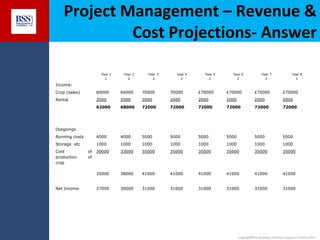
Hampdene Ltd is a company specialising in arable farming. It is thinking about purchasing
a combine harvester for a capital cost of £160,000 to be used from August to early October
on its fields. It will also be rented out to a neighboring farm for the remainder of October.
Harvest income flow in from October to December and total sales are expected to bring in
£60,000 in year 1, £66,000 in year 2 and £70000 for each year from year 3 to year 8
(additional competition in world markets is faced in the later years). Running costs of the
combine harvester are estimated at £4000 a year for year 1 and year 2 and £5000 for each
year thereafter. Seeds fertilisers and other costs of production are generally 50 percent of
sales income.
Rental income from hiring out the vehicle is estimated at £2000 per year for the
foreseeable future. While not in use, storage, security and maintenance expenses of the
combine harvester are estimated at £1000 per year.
Your task is to use a separate sheet and put together the projection of revenue and costs
including net profit or loss for this project.

copyright© to Business Services Support Limited 2011
Project Management – Revenue &
Cost Projections- Answer
Year 1
£

Year 2
£

Year 3
£

Year 4
£

Year 5
£

Year 6
£

Year 7
£

Year 8
£

Income:
Crop (sales)

60000

66000

70000

70000

£70000

£70000

£70000

£70000

Rental

2000

2000

2000

2000

2000

2000

2000

2000

62000

68000

72000

72000

72000

72000

72000

72000

Running costs

4000

4000

5000

5000

5000

5000

5000

5000

Storage etc

1000

1000

1000

1000

1000

1000

1000

1000

30000

33000

35000

35000

35000

35000

35000

35000

35000

38000

41000

41000

41000

41000

41000

41000

27000

30000

31000

31000

31000

31000

31000

31000

Outgoings

Cost
production
crop

Net Income

of
of

copyright© to Business Services Support Limited 2011
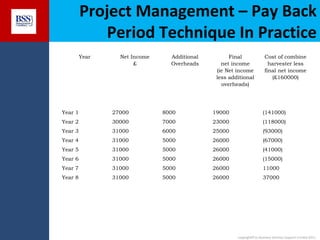
Project Management – Pay Back
Period Technique In Practice
Year

Net Income
£

Additional
Overheads

Final
net income
(ie Net income
less additional
overheads)

Cost of combine
harvester less
final net income
(£160000)

Year 1

27000

8000

19000

(141000)

Year 2

30000

7000

23000

(118000)

Year 3

31000

6000

25000

(93000)

Year 4

31000

5000

26000

(67000)

Year 5

31000

5000

26000

(41000)

Year 6

31000

5000

26000

(15000)

Year 7

31000

5000

26000

11000

Year 8

31000

5000

26000

37000

copyright© to Business Services Support Limited 2011
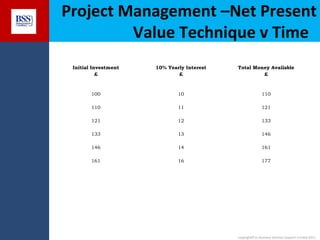
Project Management –Net Present
Value Technique v Time
Initial Investment
£

10% Yearly Interest
£

Total Money Available
£

100

10

110

110

11

121

121

12

133

133

13

146

146

14

161

161

16

177

copyright© to Business Services Support Limited 2011
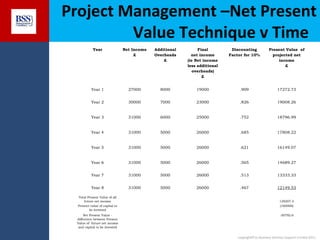
Project Management –Net Present
Value Technique v Time
Year

Net Income
£

Additional
Overheads
£

Final
net income
(ie Net income
less additional
overheads)
£

Discounting
Factor for 10%

Present Value of
projected net
income
£

Year 1

27000

8000

19000

.909

17272.73

Year 2

30000

7000

23000

.826

19008.26

Year 3

31000

6000

25000

.752

18796.99

Year 4

31000

5000

26000

.685

17808.22

Year 5

31000

5000

26000

.621

16149.07

Year 6

31000

5000

26000

.565

14689.27

Year 7

31000

5000

26000

.513

13333.33

Year 8

31000

5000

26000

.467

12149.53

Total Present Value of all
future net income
Present value of capital to
be invested
Net Present Value difference between Present
Value of future net income
and capital to be invested

129207.4
(160000)
-30792.6

copyright© to Business Services Support Limited 2011
Conclusion – The End


For more information about our courses visit:

http://www.businessservicessupport.com

copyright© to Business Services Support Limited 2011

Project financial appraisal techniquesv

  • 1.
    Project Financial AppraisalTechniquespart of our advanced finance for non financial managers Course programme DELIVERED BY: Business Services Support Limited Visit www.businessservicessupport.com Tel: 0845 226 4315
  • 2.
    Key Objectives  What isfinancial evaluation  Why project financial evaluation techniques  Project financial risks assessment  Practice illustration of financial plan copyright© to Business Services Support Limited 2011
  • 3.
    Definition of financialevaluation Concern with the assessment of financial viability of projects  Assessment of risk profile and financial efficiency copyright© to Business Services Support Limited 2011
  • 4.
    Why Project FinancialEvaluation Does the project create financial wealth How quickly can we recover project investment How risky is the project vis a viv it returns potentials How much capital do we need to invest copyright© to Business Services Support Limited 2011
  • 5.
    Financial Risks FacingProjects Demand Risk Competition Risk Financial Risk Operational Risk Interest Rate Risk copyright© to Business Services Support Limited 2011
  • 6.
    Financial Evaluation TechniquesFor Effective Project Management Payback Period Return On Investment Profit Based Measures Net Present Value Method copyright© to Business Services Support Limited 2011
  • 7.
    Payback Period Technique PaybackPeriod This is probably the most frequently used technique for assessing the financial viability of projects. It regards projects which repay their capital cost most quickly as being the best. For example, if a cafe purchases a new cooker for £1000 and makes an average of £.50 profit on each meal, the cooker will be paid for after £1000/£0.50=2000 meals. If the cafe sells 40 meals a day, the full price of the cooker is paid back after 2000/40=50days. Attempt this question now: Frank and Mary decided to set up a carpet cleaning business. They purchased carpet cleaning equipment for £800. On average they expect to earn £5 per carpet after expenses and to be able to clean two carpets, five days a week. Calculate their payback period in weeks copyright© to Business Services Support Limited 2011
  • 8.
    Payback Period Technique Thepayback period is ( £800/ £5x2x5) = £800/50=16weeks. You will appreciate as a project manager that the calculations above are rater simplistic. The capital cost of equipment or machinery is fairly easy to work out. It is how much the organisation paid for it together with delivery, installation and other costs incurred to get it up and running. But how is income calculated? And you know that income does not always flow in evenly copyright© to Business Services Support Limited 2011
  • 9.
    Project Management –Revenue & Cost Projections Project Management In Practice Hampdene Ltd is a company specialising in arable farming. It is thinking about purchasing a combine harvester for a capital cost of £160,000 to be used from August to early October on its fields. It will also be rented out to a neighboring farm for the remainder of October. Harvest income flow in from October to December and total sales are expected to bring in £60,000 in year 1, £66,000 in year 2 and £70000 for each year from year 3 to year 8 (additional competition in world markets is faced in the later years). Running costs of the combine harvester are estimated at £4000 a year for year 1 and year 2 and £5000 for each year thereafter. Seeds fertilisers and other costs of production are generally 50 percent of sales income. Rental income from hiring out the vehicle is estimated at £2000 per year for the foreseeable future. While not in use, storage, security and maintenance expenses of the combine harvester are estimated at £1000 per year. Your task is to use a separate sheet and put together the projection of revenue and costs including net profit or loss for this project. copyright© to Business Services Support Limited 2011
  • 10.
    Project Management –Revenue & Cost Projections- Answer Year 1 £ Year 2 £ Year 3 £ Year 4 £ Year 5 £ Year 6 £ Year 7 £ Year 8 £ Income: Crop (sales) 60000 66000 70000 70000 £70000 £70000 £70000 £70000 Rental 2000 2000 2000 2000 2000 2000 2000 2000 62000 68000 72000 72000 72000 72000 72000 72000 Running costs 4000 4000 5000 5000 5000 5000 5000 5000 Storage etc 1000 1000 1000 1000 1000 1000 1000 1000 30000 33000 35000 35000 35000 35000 35000 35000 35000 38000 41000 41000 41000 41000 41000 41000 27000 30000 31000 31000 31000 31000 31000 31000 Outgoings Cost production crop Net Income of of copyright© to Business Services Support Limited 2011
  • 11.
    Project Management –Pay Back Period Technique In Practice Year Net Income £ Additional Overheads Final net income (ie Net income less additional overheads) Cost of combine harvester less final net income (£160000) Year 1 27000 8000 19000 (141000) Year 2 30000 7000 23000 (118000) Year 3 31000 6000 25000 (93000) Year 4 31000 5000 26000 (67000) Year 5 31000 5000 26000 (41000) Year 6 31000 5000 26000 (15000) Year 7 31000 5000 26000 11000 Year 8 31000 5000 26000 37000 copyright© to Business Services Support Limited 2011
  • 12.
    Project Management –NetPresent Value Technique v Time Initial Investment £ 10% Yearly Interest £ Total Money Available £ 100 10 110 110 11 121 121 12 133 133 13 146 146 14 161 161 16 177 copyright© to Business Services Support Limited 2011
  • 13.
    Project Management –NetPresent Value Technique v Time Year Net Income £ Additional Overheads £ Final net income (ie Net income less additional overheads) £ Discounting Factor for 10% Present Value of projected net income £ Year 1 27000 8000 19000 .909 17272.73 Year 2 30000 7000 23000 .826 19008.26 Year 3 31000 6000 25000 .752 18796.99 Year 4 31000 5000 26000 .685 17808.22 Year 5 31000 5000 26000 .621 16149.07 Year 6 31000 5000 26000 .565 14689.27 Year 7 31000 5000 26000 .513 13333.33 Year 8 31000 5000 26000 .467 12149.53 Total Present Value of all future net income Present value of capital to be invested Net Present Value difference between Present Value of future net income and capital to be invested 129207.4 (160000) -30792.6 copyright© to Business Services Support Limited 2011
  • 14.
    Conclusion – TheEnd  For more information about our courses visit: http://www.businessservicessupport.com copyright© to Business Services Support Limited 2011