Managerial Finance Module
Presentation
“Investment Appraisal / Capital Budget”
Presented by Group No 06
Higher Diploma in Business & Finance Management
Aquinas University College
Content,
 Task 1 - Gut Feeling
“ I never get the accountants in before I start up a business” – Richard Branson
 Task 2 – Project Undertaken
Investment Appraisal and capital budgeting
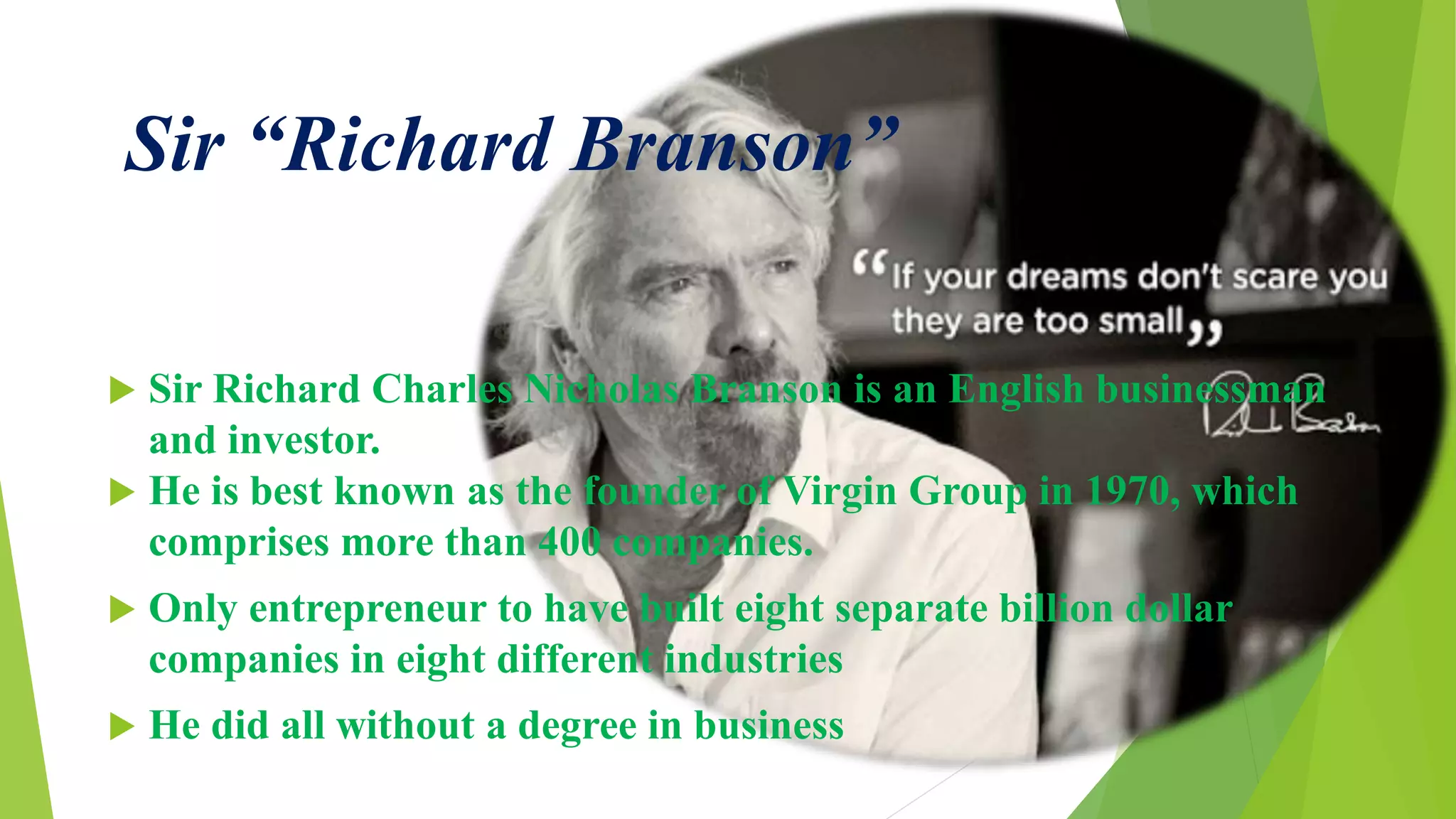
Sir “Richard Branson”
 Sir Richard Charles Nicholas Branson is an English businessman
and investor.
 He is best known as the founder of Virgin Group in 1970, which
comprises more than 400 companies.
 Only entrepreneur to have built eight separate billion dollar
companies in eight different industries
 He did all without a degree in business
The reason why?????
(Limitations of Management Accounting:)
1) Management Accounting is based on financial and cost accounting, in which historical
data is used to make future decisions. Thus, strength and weakness of the managerial
decisions are based on the strength and weakness of the accounting records.
2) Management Accounting is useful only to those people who are in the decision making
process.
3) Tools and techniques used in management accounting only provide information and not
ready made decision. Thus, it is only a supplementary service.
4) Personal prejudices and bias affect the decisions as the interpretation of financial
information is based on personal judgment of the interpreter.
5) Non financials plays a vital role
6) Accountants always are profits oriented and social benefits are ignored.
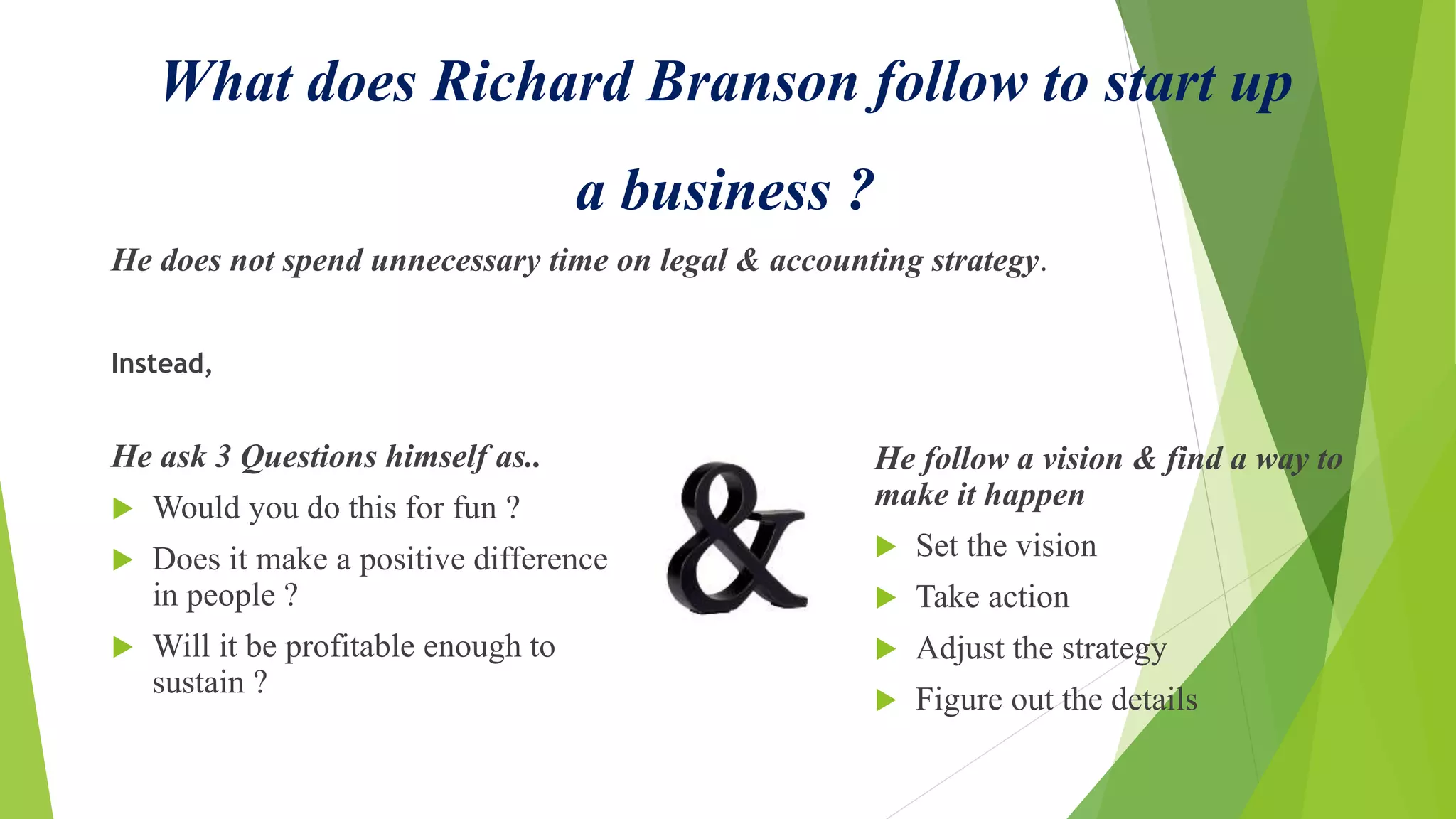
What does Richard Branson follow to start up
a business ?
He does not spend unnecessary time on legal & accounting strategy.
Instead,
He ask 3 Questions himself as..
 Would you do this for fun ?
 Does it make a positive difference
in people ?
 Will it be profitable enough to
sustain ?
He follow a vision & find a way to
make it happen
 Set the vision
 Take action
 Adjust the strategy
 Figure out the details
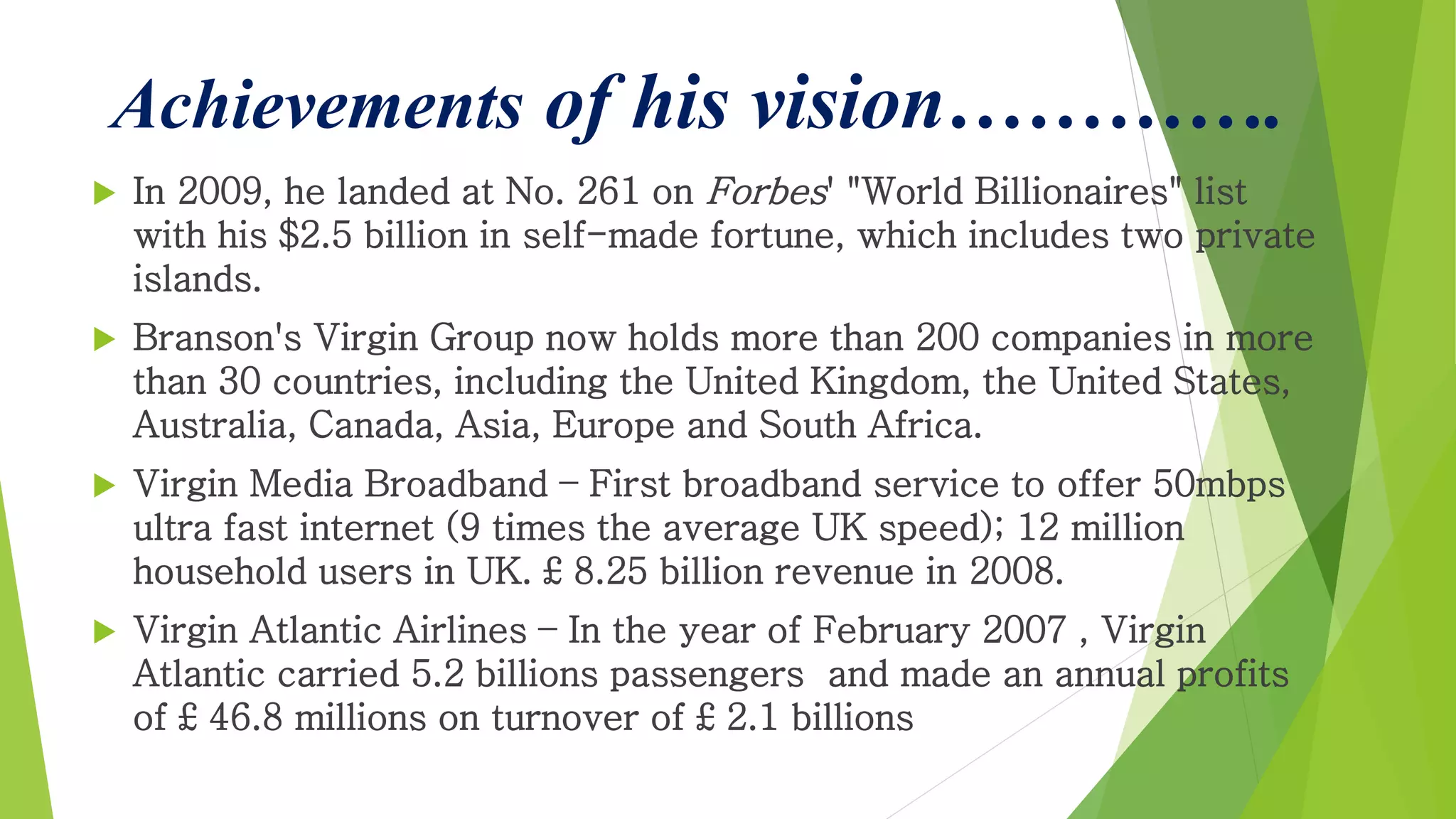
Achievements of his vision………….
 In 2009, he landed at No. 261 on Forbes' "World Billionaires" list
with his $2.5 billion in self-made fortune, which includes two private
islands.
 Branson's Virgin Group now holds more than 200 companies in more
than 30 countries, including the United Kingdom, the United States,
Australia, Canada, Asia, Europe and South Africa.
 Virgin Media Broadband – First broadband service to offer 50mbps
ultra fast internet (9 times the average UK speed); 12 million
household users in UK. £ 8.25 billion revenue in 2008.
 Virgin Atlantic Airlines – In the year of February 2007 , Virgin
Atlantic carried 5.2 billions passengers and made an annual profits
of £ 46.8 millions on turnover of £ 2.1 billions
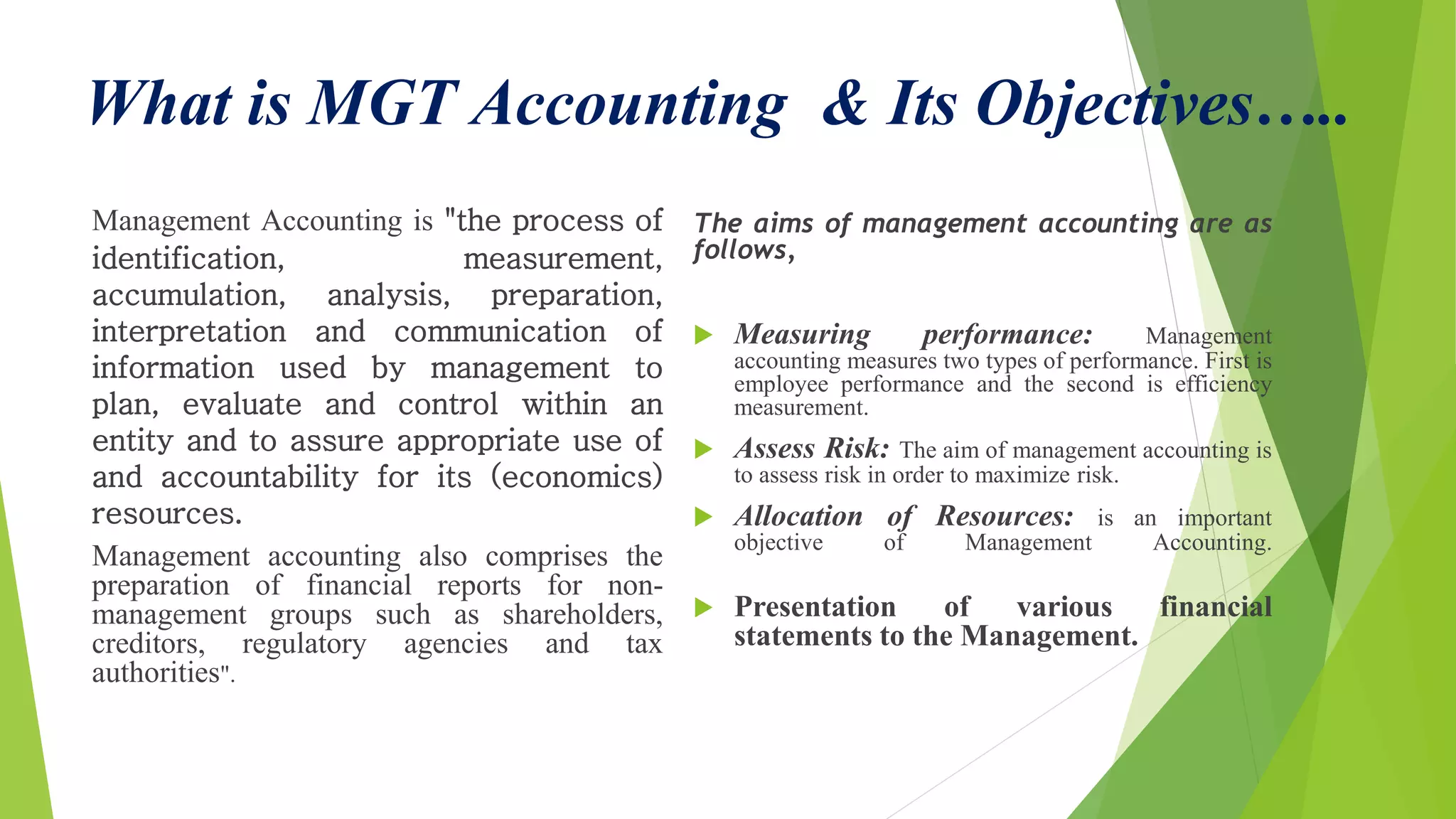
What is MGT Accounting & Its Objectives…..
Management Accounting is "the process of
identification, measurement,
accumulation, analysis, preparation,
interpretation and communication of
information used by management to
plan, evaluate and control within an
entity and to assure appropriate use of
and accountability for its (economics)
resources.
Management accounting also comprises the
preparation of financial reports for non-
management groups such as shareholders,
creditors, regulatory agencies and tax
authorities".
The aims of management accounting are as
follows,
 Measuring performance: Management
accounting measures two types of performance. First is
employee performance and the second is efficiency
measurement.
 Assess Risk: The aim of management accounting is
to assess risk in order to maximize risk.
 Allocation of Resources: is an important
objective of Management Accounting.
 Presentation of various financial
statements to the Management.
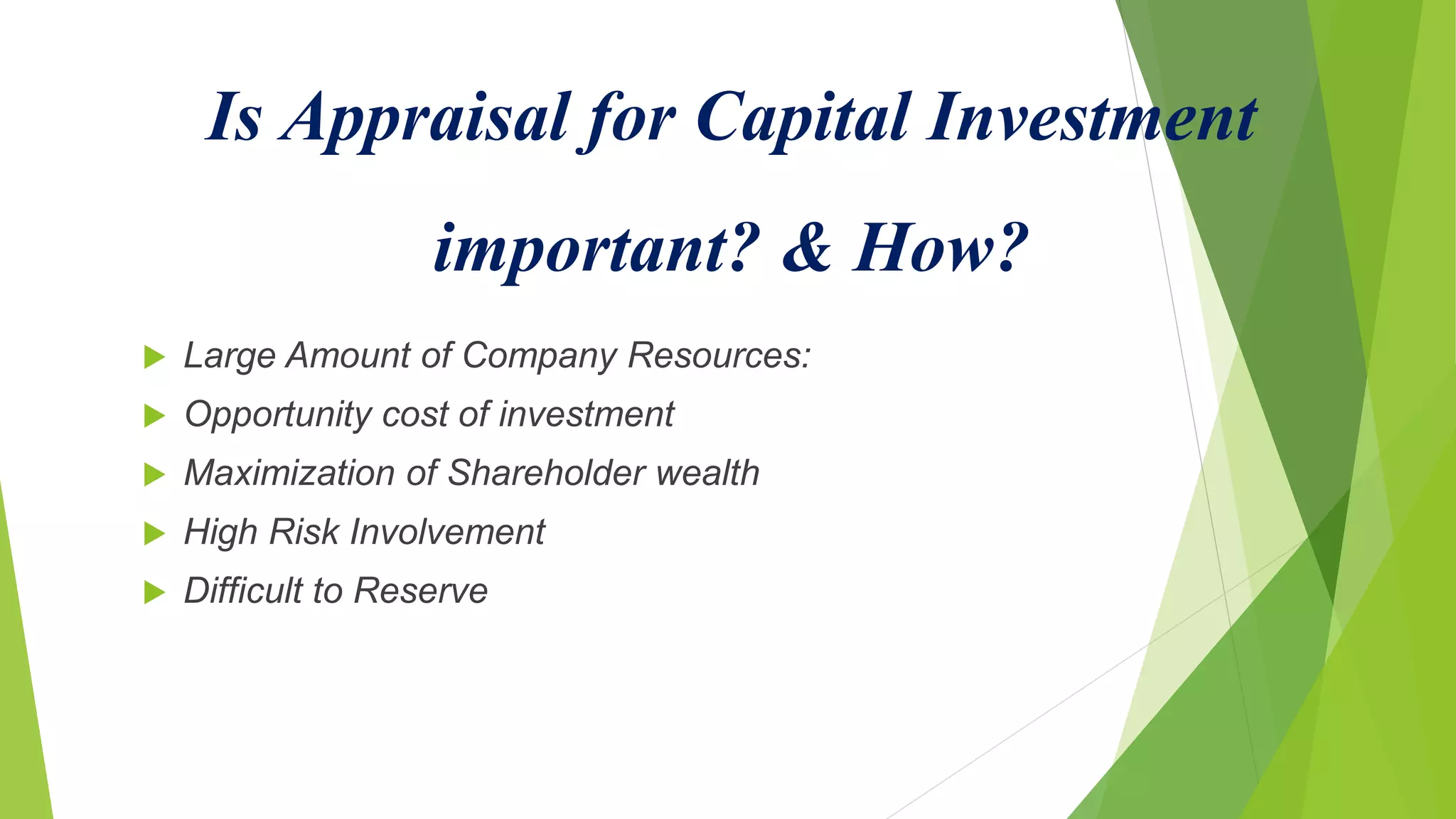
Is Appraisal for Capital Investment
important? & How?
 Large Amount of Company Resources:
 Opportunity cost of investment
 Maximization of Shareholder wealth
 High Risk Involvement
 Difficult to Reserve
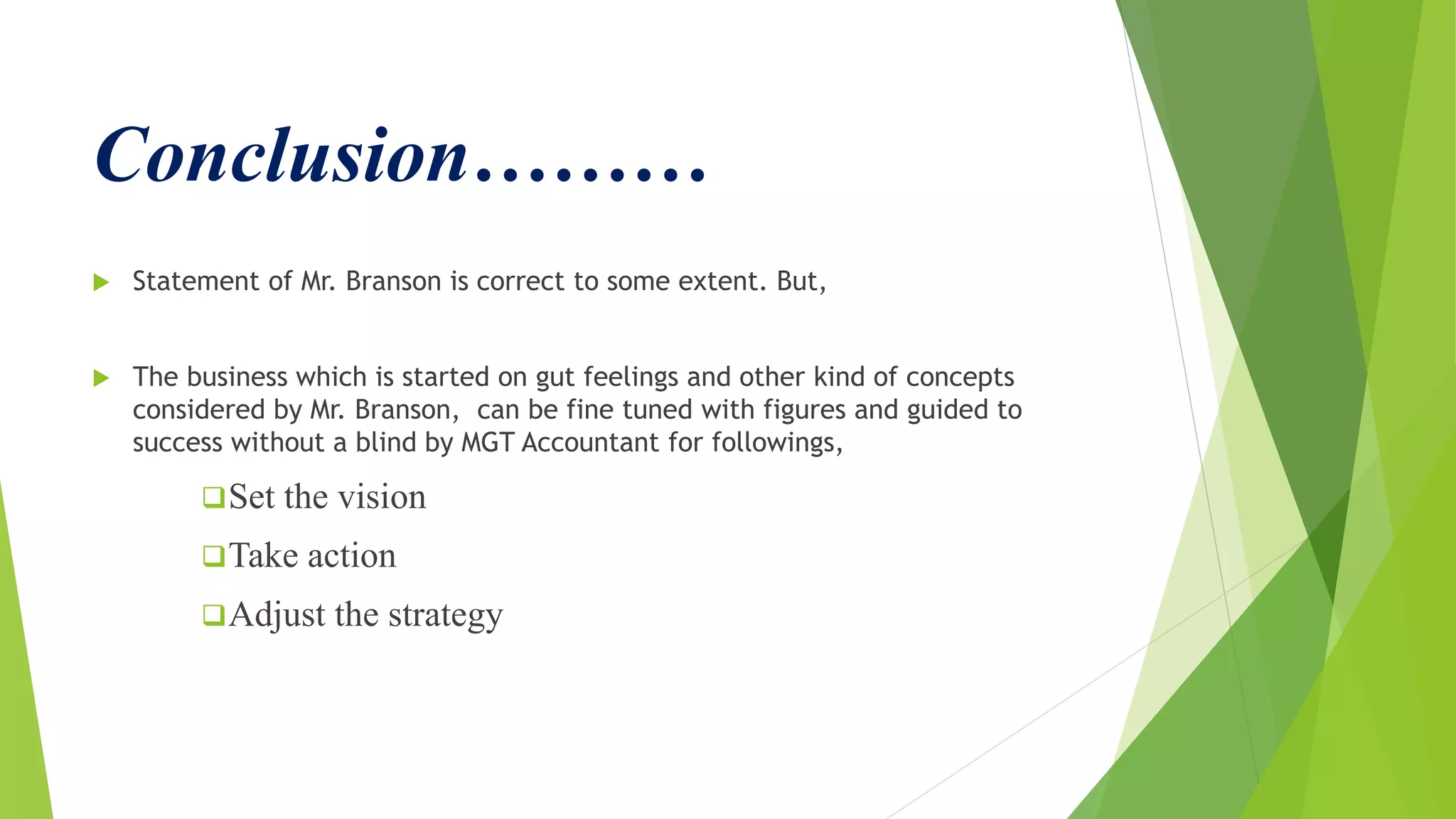
Conclusion………
 Statement of Mr. Branson is correct to some extent. But,
 The business which is started on gut feelings and other kind of concepts
considered by Mr. Branson, can be fine tuned with figures and guided to
success without a blind by MGT Accountant for followings,
Set the vision
Take action
Adjust the strategy
Investment Appraisal & Capital
Budgeting Project
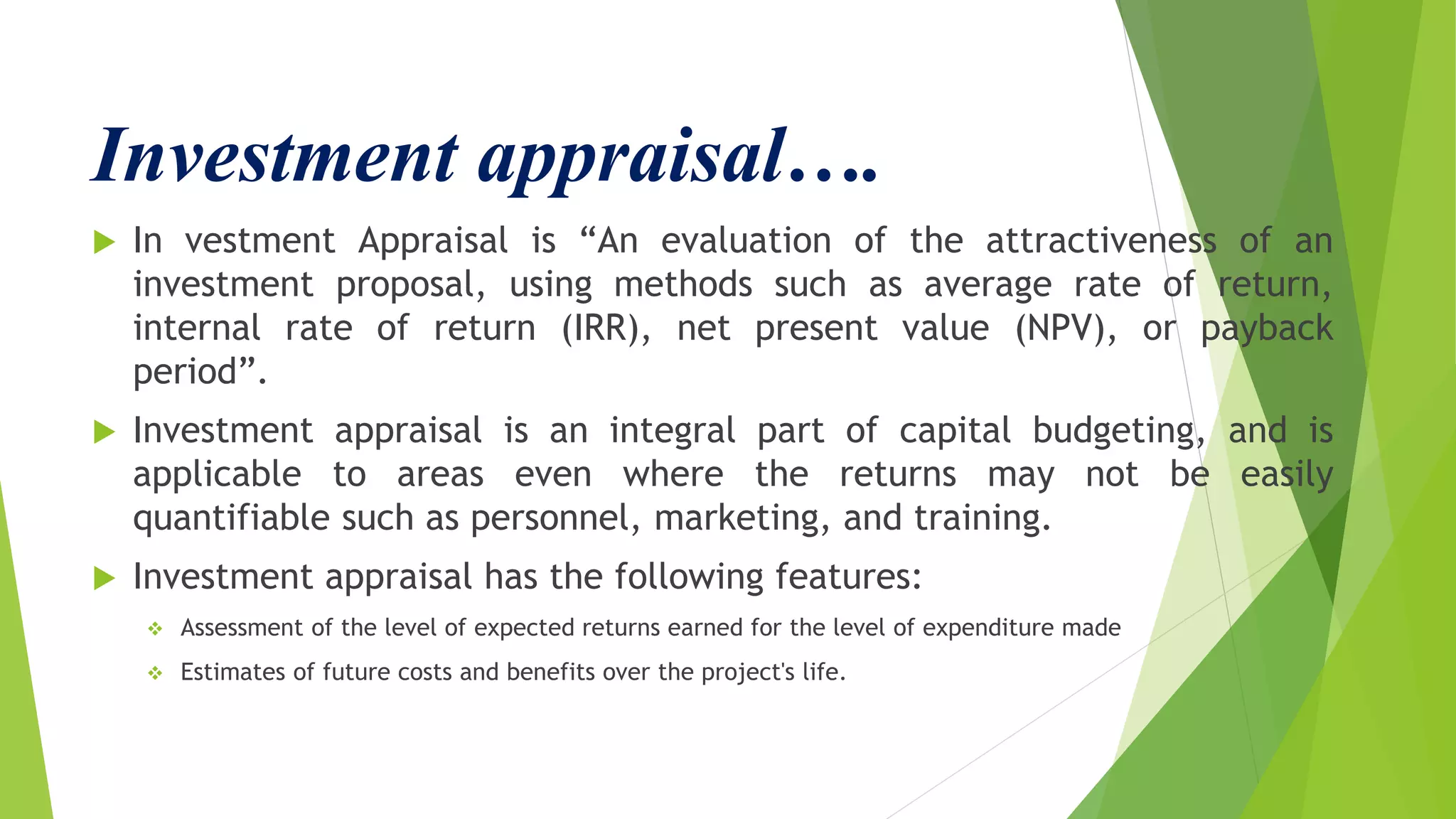
Investment appraisal….
 In vestment Appraisal is “An evaluation of the attractiveness of an
investment proposal, using methods such as average rate of return,
internal rate of return (IRR), net present value (NPV), or payback
period”.
 Investment appraisal is an integral part of capital budgeting, and is
applicable to areas even where the returns may not be easily
quantifiable such as personnel, marketing, and training.
 Investment appraisal has the following features:
 Assessment of the level of expected returns earned for the level of expenditure made
 Estimates of future costs and benefits over the project's life.
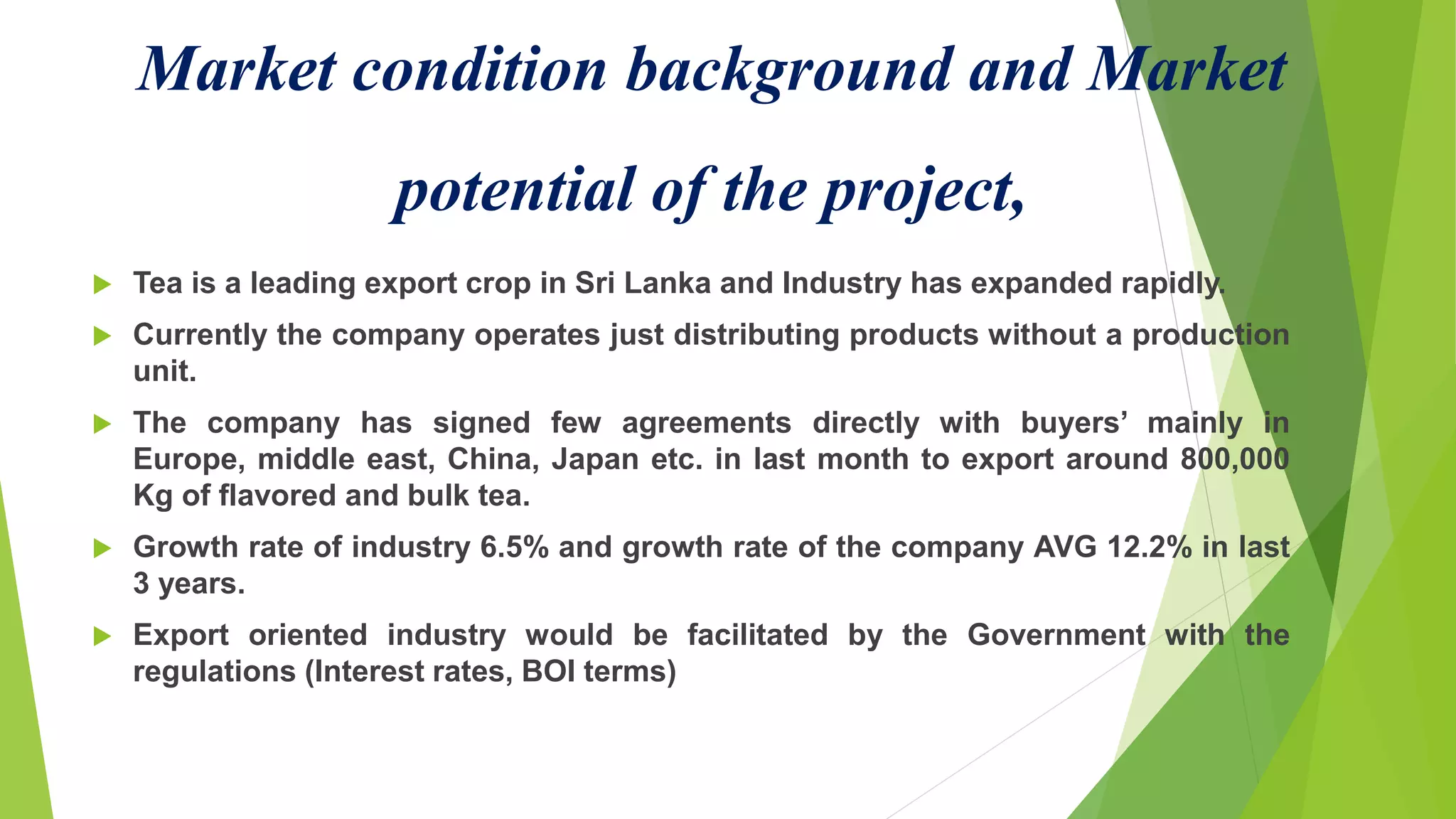
Market condition background and Market
potential of the project,
 Tea is a leading export crop in Sri Lanka and Industry has expanded rapidly.
 Currently the company operates just distributing products without a production
unit.
 The company has signed few agreements directly with buyers’ mainly in
Europe, middle east, China, Japan etc. in last month to export around 800,000
Kg of flavored and bulk tea.
 Growth rate of industry 6.5% and growth rate of the company AVG 12.2% in last
3 years.
 Export oriented industry would be facilitated by the Government with the
regulations (Interest rates, BOI terms)
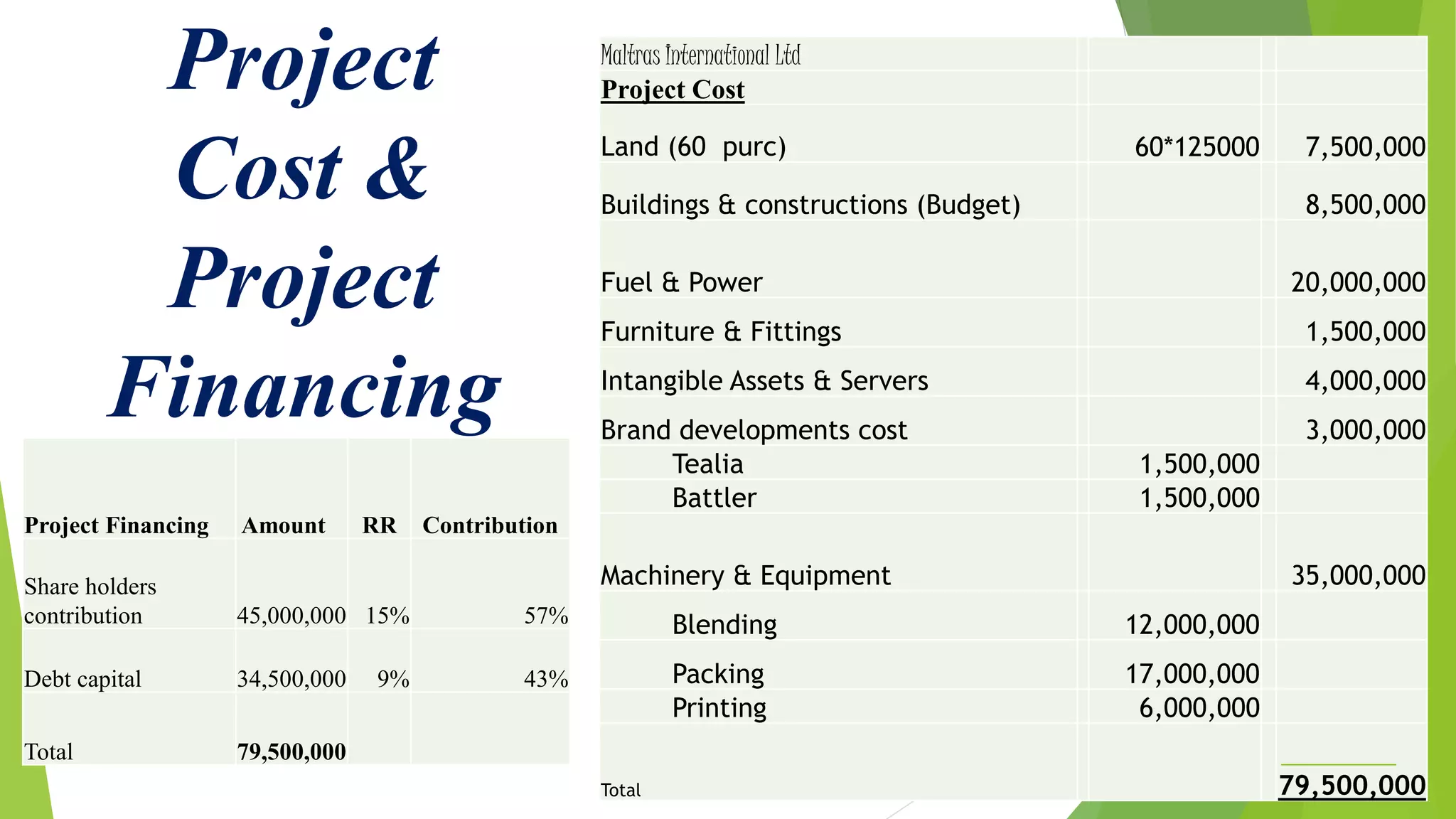
Project
Cost &
Project
Financing
Maltras International Ltd
Project Cost
Land (60 purc) 60*125000 7,500,000
Buildings & constructions (Budget) 8,500,000
Fuel & Power 20,000,000
Furniture & Fittings 1,500,000
Intangible Assets & Servers 4,000,000
Brand developments cost 3,000,000
Tealia 1,500,000
Battler 1,500,000
Machinery & Equipment 35,000,000
Blending 12,000,000
Packing 17,000,000
Printing 6,000,000
Total 79,500,000
Project Financing Amount RR Contribution
Share holders
contribution 45,000,000 15% 57%
Debt capital 34,500,000 9% 43%
Total 79,500,000
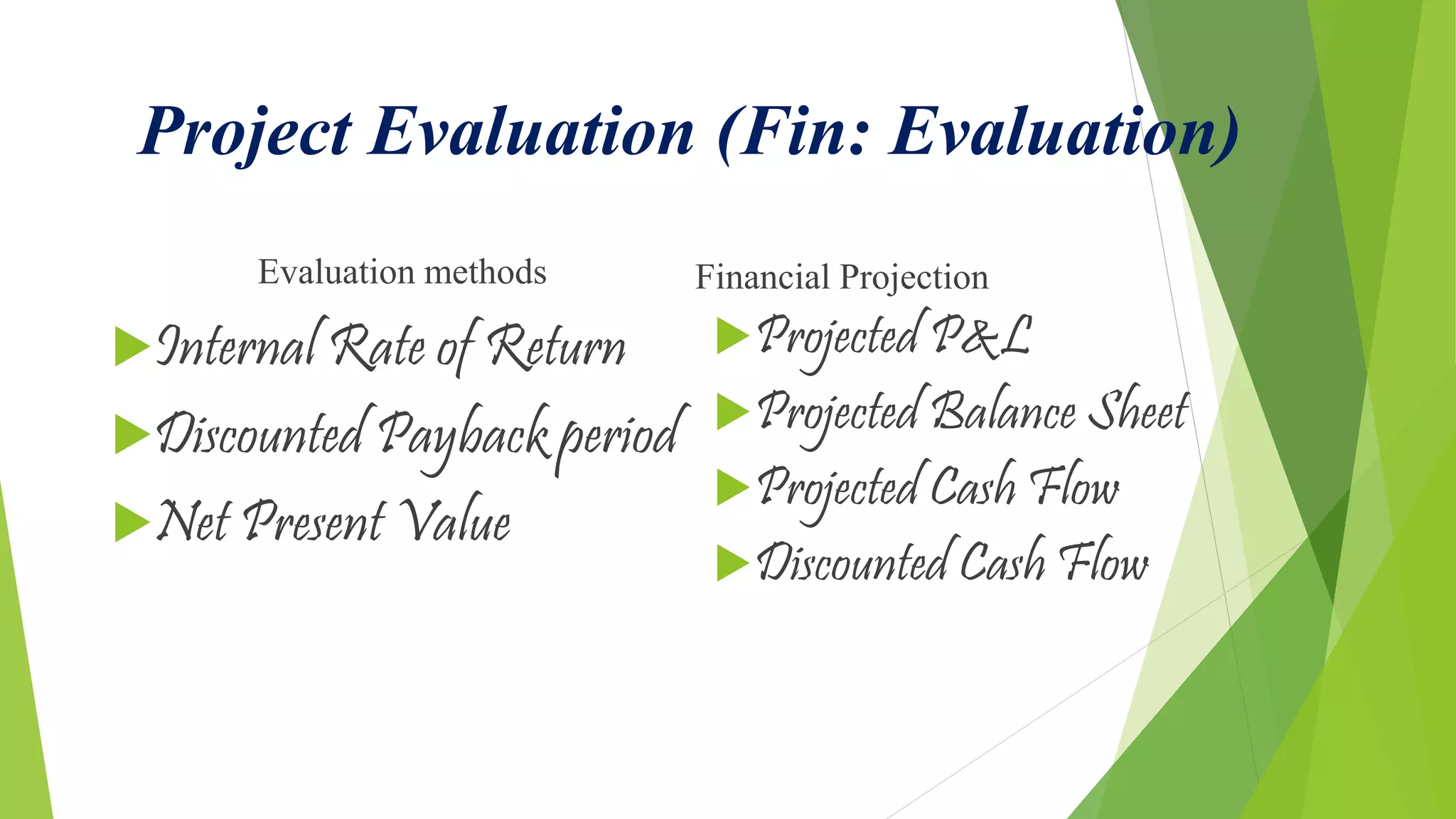
Project Evaluation (Fin: Evaluation)
Evaluation methods
Internal Rate of Return
Discounted Payback period
Net Present Value
Financial Projection
Projected P&L
Projected Balance Sheet
Projected Cash Flow
Discounted Cash Flow
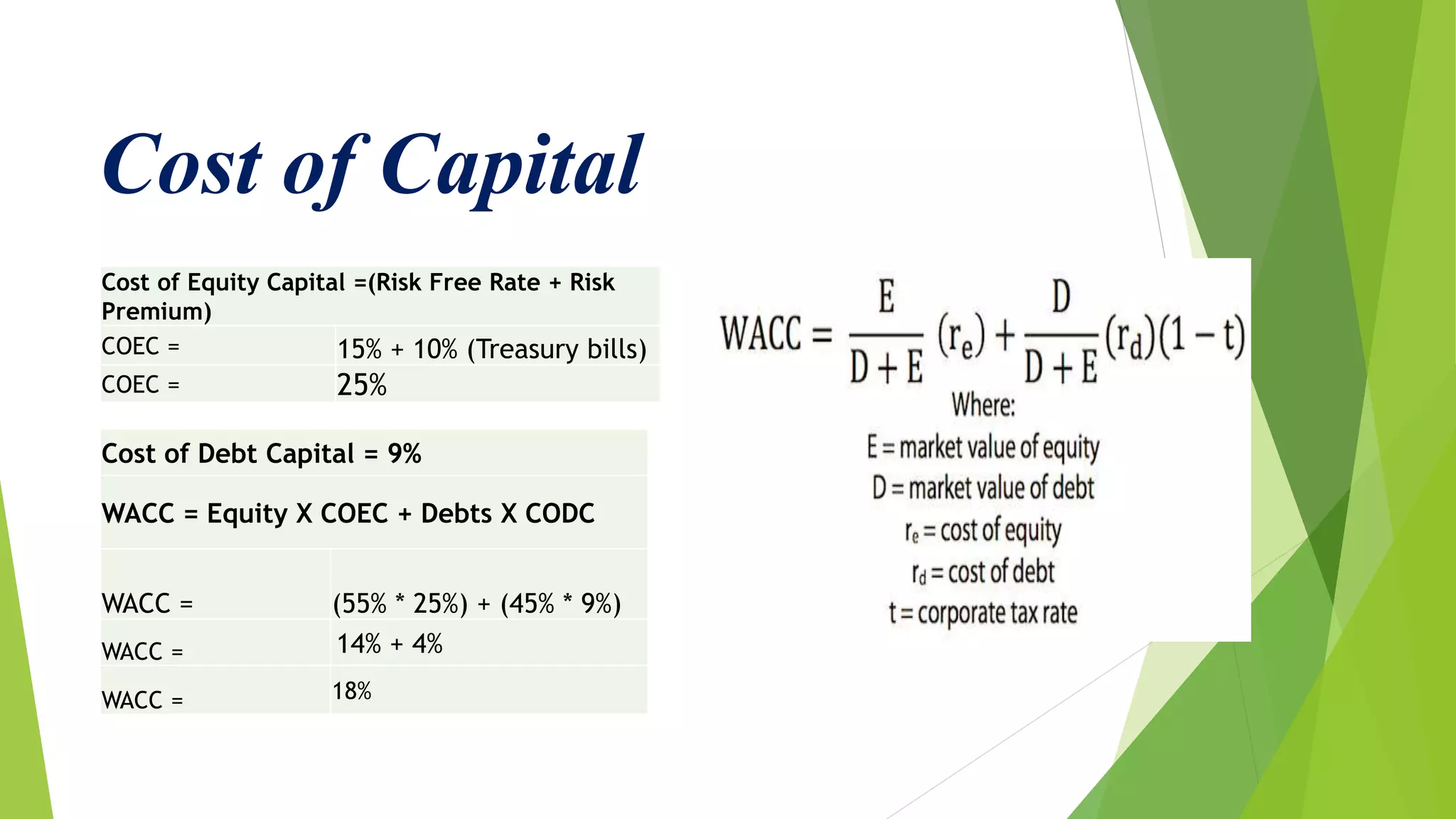
Cost of Capital
Cost of Equity Capital =(Risk Free Rate + Risk
Premium)
COEC = 15% + 10% (Treasury bills)
COEC = 25%
Cost of Debt Capital = 9%
WACC = Equity X COEC + Debts X CODC
WACC = (55% * 25%) + (45% * 9%)
WACC = 14% + 4%
WACC = 18%
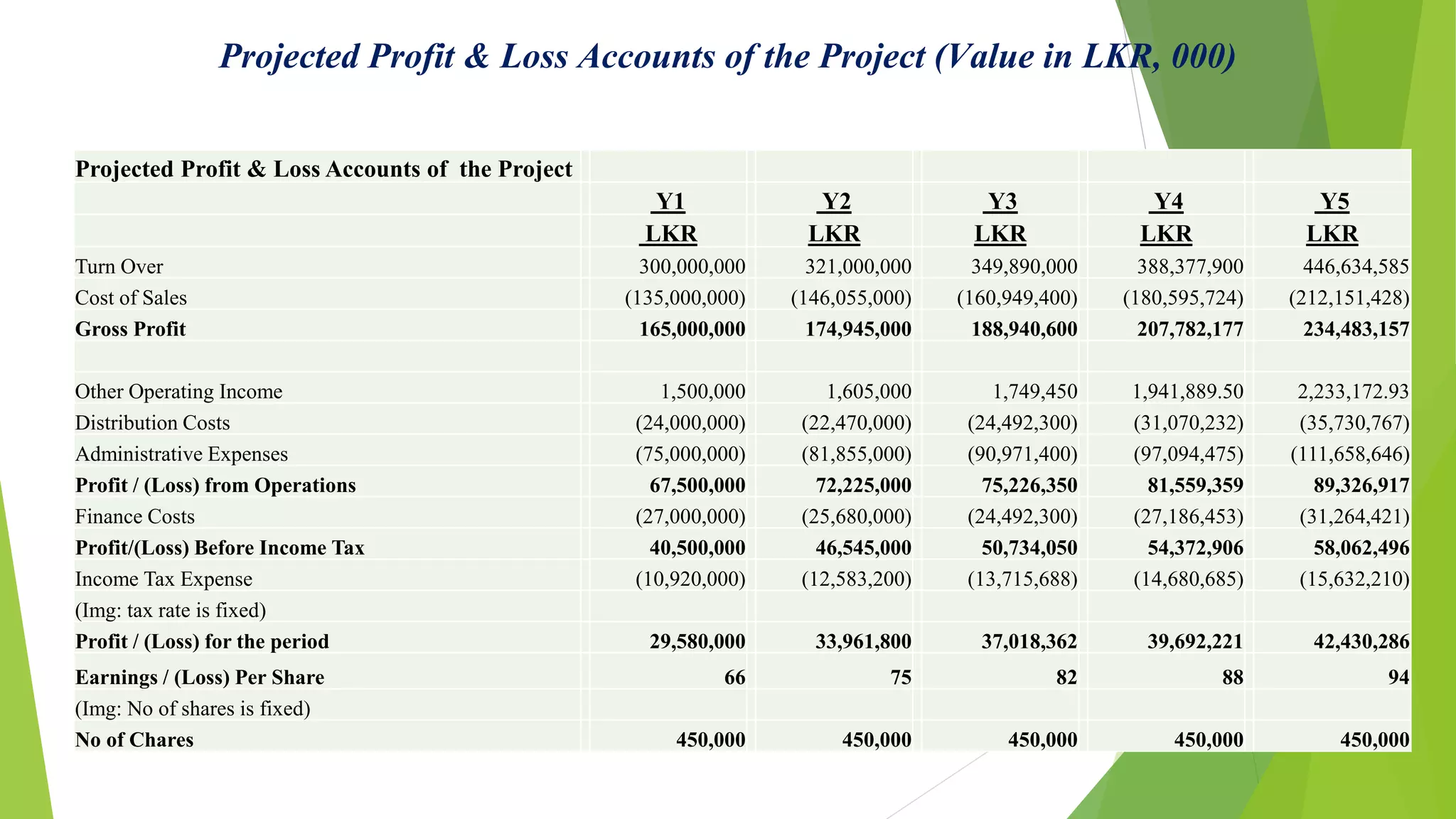
Projected Profit & Loss Accounts of the Project (Value in LKR, 000)
Projected Profit & Loss Accounts of the Project
Y1 Y2 Y3 Y4 Y5
LKR LKR LKR LKR LKR
Turn Over 300,000,000 321,000,000 349,890,000 388,377,900 446,634,585
Cost of Sales (135,000,000) (146,055,000) (160,949,400) (180,595,724) (212,151,428)
Gross Profit 165,000,000 174,945,000 188,940,600 207,782,177 234,483,157
Other Operating Income 1,500,000 1,605,000 1,749,450 1,941,889.50 2,233,172.93
Distribution Costs (24,000,000) (22,470,000) (24,492,300) (31,070,232) (35,730,767)
Administrative Expenses (75,000,000) (81,855,000) (90,971,400) (97,094,475) (111,658,646)
Profit / (Loss) from Operations 67,500,000 72,225,000 75,226,350 81,559,359 89,326,917
Finance Costs (27,000,000) (25,680,000) (24,492,300) (27,186,453) (31,264,421)
Profit/(Loss) Before Income Tax 40,500,000 46,545,000 50,734,050 54,372,906 58,062,496
Income Tax Expense (10,920,000) (12,583,200) (13,715,688) (14,680,685) (15,632,210)
(Img: tax rate is fixed)
Profit / (Loss) for the period 29,580,000 33,961,800 37,018,362 39,692,221 42,430,286
Earnings / (Loss) Per Share 66 75 82 88 94
(Img: No of shares is fixed)
No of Chares 450,000 450,000 450,000 450,000 450,000
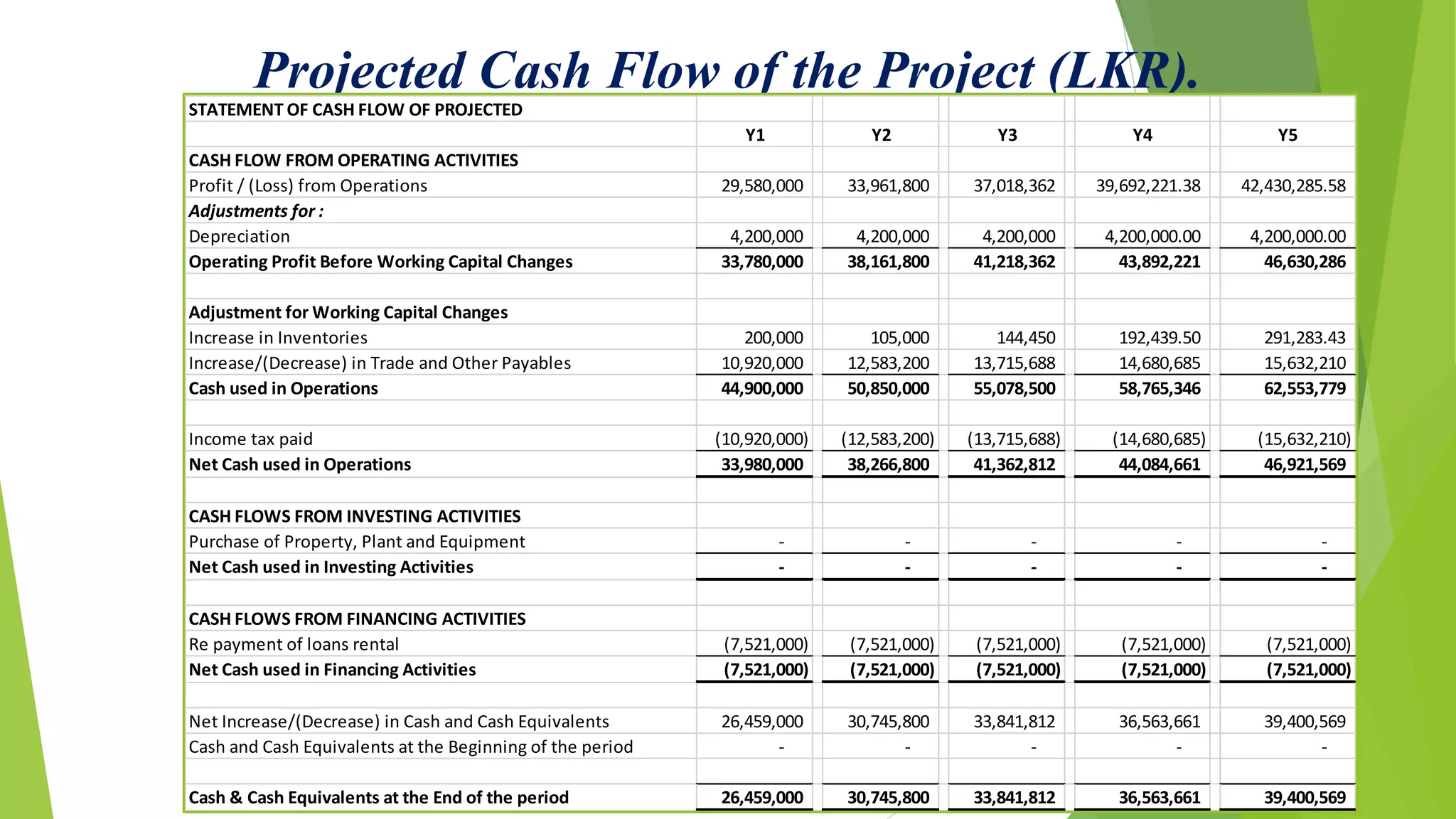
Projected Cash Flow of the Project (LKR).STATEMENT OF CASH FLOW OF PROJECTED
Y1 Y2 Y3 Y4 Y5
CASH FLOW FROM OPERATING ACTIVITIES
Profit / (Loss) from Operations 29,580,000 33,961,800 37,018,362 39,692,221.38 42,430,285.58
Adjustments for :
Depreciation 4,200,000 4,200,000 4,200,000 4,200,000.00 4,200,000.00
Operating Profit Before Working Capital Changes 33,780,000 38,161,800 41,218,362 43,892,221 46,630,286
Adjustment for Working Capital Changes
Increase in Inventories 200,000 105,000 144,450 192,439.50 291,283.43
Increase/(Decrease) in Trade and Other Payables 10,920,000 12,583,200 13,715,688 14,680,685 15,632,210
Cash used in Operations 44,900,000 50,850,000 55,078,500 58,765,346 62,553,779
Income tax paid (10,920,000) (12,583,200) (13,715,688) (14,680,685) (15,632,210)
Net Cash used in Operations 33,980,000 38,266,800 41,362,812 44,084,661 46,921,569
CASH FLOWS FROM INVESTING ACTIVITIES
Purchase of Property, Plant and Equipment - - - - -
Net Cash used in Investing Activities - - - - -
CASH FLOWS FROM FINANCING ACTIVITIES
Re payment of loans rental (7,521,000) (7,521,000) (7,521,000) (7,521,000) (7,521,000)
Net Cash used in Financing Activities (7,521,000) (7,521,000) (7,521,000) (7,521,000) (7,521,000)
Net Increase/(Decrease) in Cash and Cash Equivalents 26,459,000 30,745,800 33,841,812 36,563,661 39,400,569
Cash and Cash Equivalents at the Beginning of the period - - - - -
Cash & Cash Equivalents at the End of the period 26,459,000 30,745,800 33,841,812 36,563,661 39,400,569
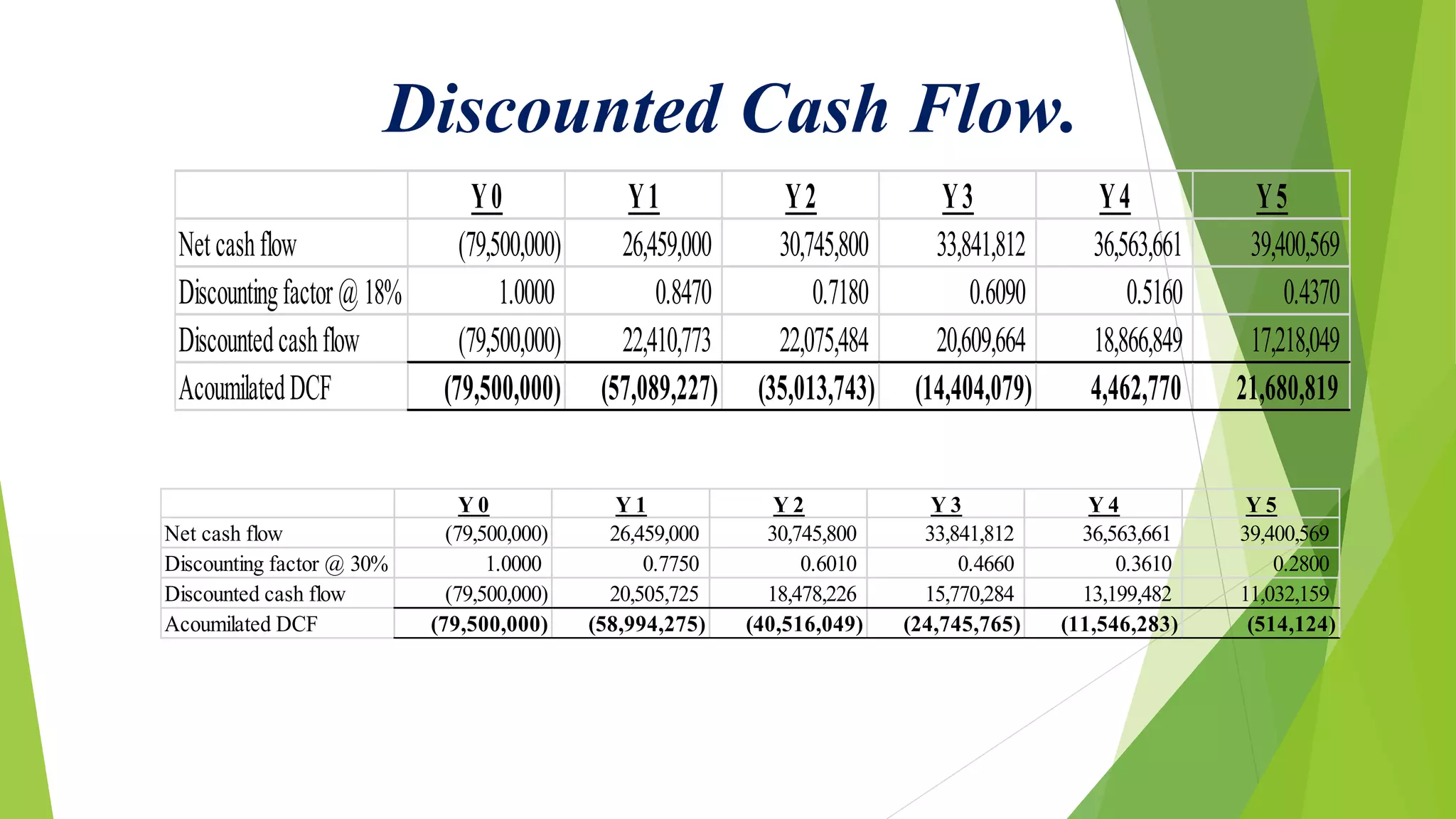
Discounted Cash Flow.
Y 0 Y 1 Y 2 Y 3 Y 4 Y 5
Net cash flow (79,500,000) 26,459,000 30,745,800 33,841,812 36,563,661 39,400,569
Discounting factor @ 30% 1.0000 0.7750 0.6010 0.4660 0.3610 0.2800
Discounted cash flow (79,500,000) 20,505,725 18,478,226 15,770,284 13,199,482 11,032,159
Acoumilated DCF (79,500,000) (58,994,275) (40,516,049) (24,745,765) (11,546,283) (514,124)
Y0 Y1 Y2 Y3 Y4 Y5
Netcashflow (79,500,000) 26,459,000 30,745,800 33,841,812 36,563,661 39,400,569
Discountingfactor @ 18% 1.0000 0.8470 0.7180 0.6090 0.5160 0.4370
Discountedcashflow (79,500,000) 22,410,773 22,075,484 20,609,664 18,866,849 17,218,049
AcoumilatedDCF (79,500,000) (57,089,227) (35,013,743) (14,404,079) 4,462,770 21,680,819
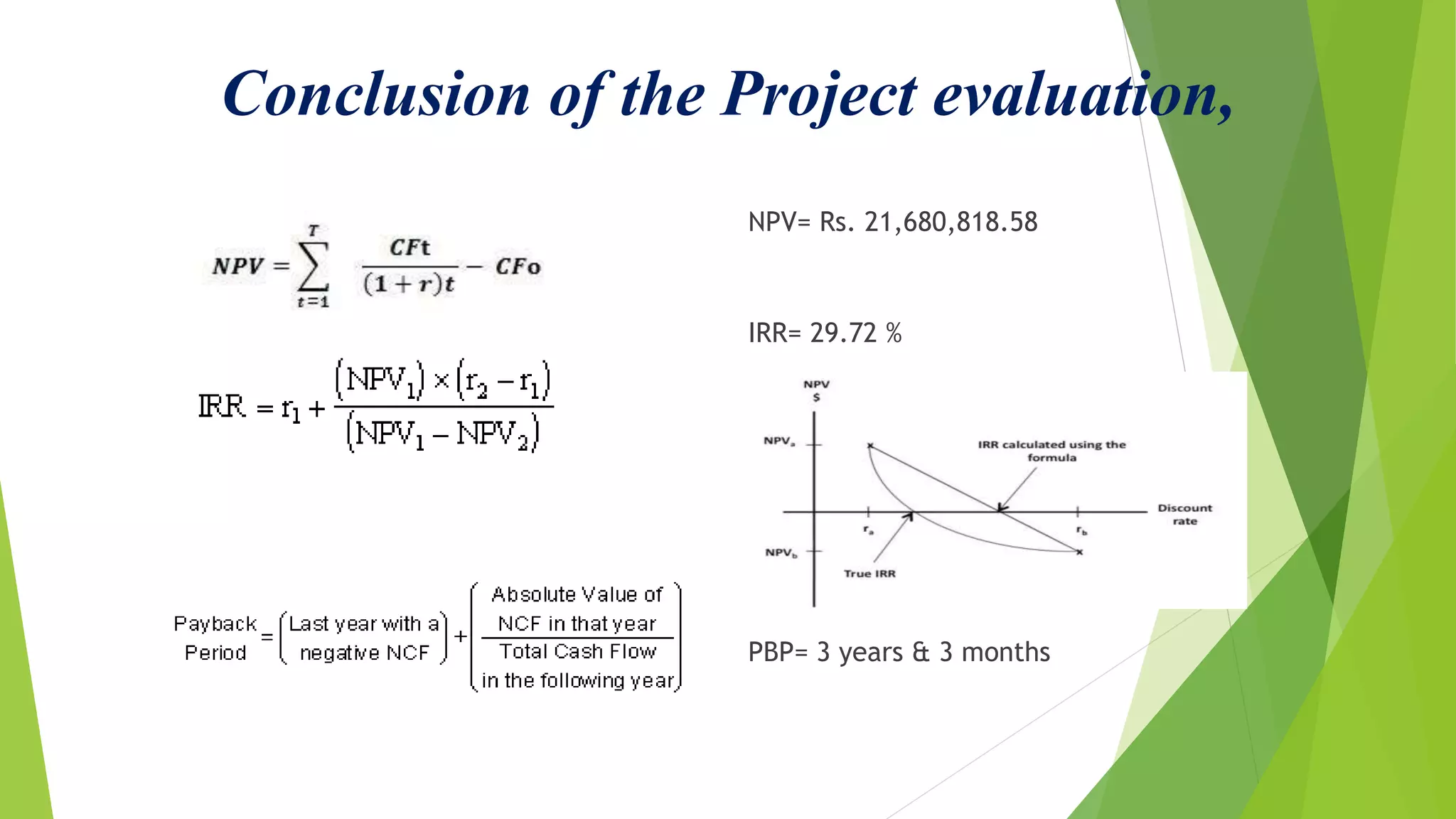
Conclusion of the Project evaluation,
NPV= Rs. 21,680,818.58
IRR= 29.72 %
PBP= 3 years & 3 months

Hdbfm assignment group 06(2)

  • 1.
    Managerial Finance Module Presentation “InvestmentAppraisal / Capital Budget” Presented by Group No 06 Higher Diploma in Business & Finance Management Aquinas University College
  • 2.
    Content,  Task 1- Gut Feeling “ I never get the accountants in before I start up a business” – Richard Branson  Task 2 – Project Undertaken Investment Appraisal and capital budgeting
  • 3.
    Sir “Richard Branson” Sir Richard Charles Nicholas Branson is an English businessman and investor.  He is best known as the founder of Virgin Group in 1970, which comprises more than 400 companies.  Only entrepreneur to have built eight separate billion dollar companies in eight different industries  He did all without a degree in business
  • 5.
    The reason why????? (Limitationsof Management Accounting:) 1) Management Accounting is based on financial and cost accounting, in which historical data is used to make future decisions. Thus, strength and weakness of the managerial decisions are based on the strength and weakness of the accounting records. 2) Management Accounting is useful only to those people who are in the decision making process. 3) Tools and techniques used in management accounting only provide information and not ready made decision. Thus, it is only a supplementary service. 4) Personal prejudices and bias affect the decisions as the interpretation of financial information is based on personal judgment of the interpreter. 5) Non financials plays a vital role 6) Accountants always are profits oriented and social benefits are ignored.
  • 6.
    What does RichardBranson follow to start up a business ? He does not spend unnecessary time on legal & accounting strategy. Instead, He ask 3 Questions himself as..  Would you do this for fun ?  Does it make a positive difference in people ?  Will it be profitable enough to sustain ? He follow a vision & find a way to make it happen  Set the vision  Take action  Adjust the strategy  Figure out the details
  • 7.
    Achievements of hisvision………….  In 2009, he landed at No. 261 on Forbes' "World Billionaires" list with his $2.5 billion in self-made fortune, which includes two private islands.  Branson's Virgin Group now holds more than 200 companies in more than 30 countries, including the United Kingdom, the United States, Australia, Canada, Asia, Europe and South Africa.  Virgin Media Broadband – First broadband service to offer 50mbps ultra fast internet (9 times the average UK speed); 12 million household users in UK. £ 8.25 billion revenue in 2008.  Virgin Atlantic Airlines – In the year of February 2007 , Virgin Atlantic carried 5.2 billions passengers and made an annual profits of £ 46.8 millions on turnover of £ 2.1 billions
  • 8.
    What is MGTAccounting & Its Objectives….. Management Accounting is "the process of identification, measurement, accumulation, analysis, preparation, interpretation and communication of information used by management to plan, evaluate and control within an entity and to assure appropriate use of and accountability for its (economics) resources. Management accounting also comprises the preparation of financial reports for non- management groups such as shareholders, creditors, regulatory agencies and tax authorities". The aims of management accounting are as follows,  Measuring performance: Management accounting measures two types of performance. First is employee performance and the second is efficiency measurement.  Assess Risk: The aim of management accounting is to assess risk in order to maximize risk.  Allocation of Resources: is an important objective of Management Accounting.  Presentation of various financial statements to the Management.
  • 9.
    Is Appraisal forCapital Investment important? & How?  Large Amount of Company Resources:  Opportunity cost of investment  Maximization of Shareholder wealth  High Risk Involvement  Difficult to Reserve
  • 10.
    Conclusion………  Statement ofMr. Branson is correct to some extent. But,  The business which is started on gut feelings and other kind of concepts considered by Mr. Branson, can be fine tuned with figures and guided to success without a blind by MGT Accountant for followings, Set the vision Take action Adjust the strategy
  • 11.
    Investment Appraisal &Capital Budgeting Project
  • 12.
    Investment appraisal….  Investment Appraisal is “An evaluation of the attractiveness of an investment proposal, using methods such as average rate of return, internal rate of return (IRR), net present value (NPV), or payback period”.  Investment appraisal is an integral part of capital budgeting, and is applicable to areas even where the returns may not be easily quantifiable such as personnel, marketing, and training.  Investment appraisal has the following features:  Assessment of the level of expected returns earned for the level of expenditure made  Estimates of future costs and benefits over the project's life.
  • 13.
    Market condition backgroundand Market potential of the project,  Tea is a leading export crop in Sri Lanka and Industry has expanded rapidly.  Currently the company operates just distributing products without a production unit.  The company has signed few agreements directly with buyers’ mainly in Europe, middle east, China, Japan etc. in last month to export around 800,000 Kg of flavored and bulk tea.  Growth rate of industry 6.5% and growth rate of the company AVG 12.2% in last 3 years.  Export oriented industry would be facilitated by the Government with the regulations (Interest rates, BOI terms)
  • 14.
    Project Cost & Project Financing Maltras InternationalLtd Project Cost Land (60 purc) 60*125000 7,500,000 Buildings & constructions (Budget) 8,500,000 Fuel & Power 20,000,000 Furniture & Fittings 1,500,000 Intangible Assets & Servers 4,000,000 Brand developments cost 3,000,000 Tealia 1,500,000 Battler 1,500,000 Machinery & Equipment 35,000,000 Blending 12,000,000 Packing 17,000,000 Printing 6,000,000 Total 79,500,000 Project Financing Amount RR Contribution Share holders contribution 45,000,000 15% 57% Debt capital 34,500,000 9% 43% Total 79,500,000
  • 15.
    Project Evaluation (Fin:Evaluation) Evaluation methods Internal Rate of Return Discounted Payback period Net Present Value Financial Projection Projected P&L Projected Balance Sheet Projected Cash Flow Discounted Cash Flow
  • 16.
    Cost of Capital Costof Equity Capital =(Risk Free Rate + Risk Premium) COEC = 15% + 10% (Treasury bills) COEC = 25% Cost of Debt Capital = 9% WACC = Equity X COEC + Debts X CODC WACC = (55% * 25%) + (45% * 9%) WACC = 14% + 4% WACC = 18%
  • 17.
    Projected Profit &Loss Accounts of the Project (Value in LKR, 000) Projected Profit & Loss Accounts of the Project Y1 Y2 Y3 Y4 Y5 LKR LKR LKR LKR LKR Turn Over 300,000,000 321,000,000 349,890,000 388,377,900 446,634,585 Cost of Sales (135,000,000) (146,055,000) (160,949,400) (180,595,724) (212,151,428) Gross Profit 165,000,000 174,945,000 188,940,600 207,782,177 234,483,157 Other Operating Income 1,500,000 1,605,000 1,749,450 1,941,889.50 2,233,172.93 Distribution Costs (24,000,000) (22,470,000) (24,492,300) (31,070,232) (35,730,767) Administrative Expenses (75,000,000) (81,855,000) (90,971,400) (97,094,475) (111,658,646) Profit / (Loss) from Operations 67,500,000 72,225,000 75,226,350 81,559,359 89,326,917 Finance Costs (27,000,000) (25,680,000) (24,492,300) (27,186,453) (31,264,421) Profit/(Loss) Before Income Tax 40,500,000 46,545,000 50,734,050 54,372,906 58,062,496 Income Tax Expense (10,920,000) (12,583,200) (13,715,688) (14,680,685) (15,632,210) (Img: tax rate is fixed) Profit / (Loss) for the period 29,580,000 33,961,800 37,018,362 39,692,221 42,430,286 Earnings / (Loss) Per Share 66 75 82 88 94 (Img: No of shares is fixed) No of Chares 450,000 450,000 450,000 450,000 450,000
  • 18.
    Projected Cash Flowof the Project (LKR).STATEMENT OF CASH FLOW OF PROJECTED Y1 Y2 Y3 Y4 Y5 CASH FLOW FROM OPERATING ACTIVITIES Profit / (Loss) from Operations 29,580,000 33,961,800 37,018,362 39,692,221.38 42,430,285.58 Adjustments for : Depreciation 4,200,000 4,200,000 4,200,000 4,200,000.00 4,200,000.00 Operating Profit Before Working Capital Changes 33,780,000 38,161,800 41,218,362 43,892,221 46,630,286 Adjustment for Working Capital Changes Increase in Inventories 200,000 105,000 144,450 192,439.50 291,283.43 Increase/(Decrease) in Trade and Other Payables 10,920,000 12,583,200 13,715,688 14,680,685 15,632,210 Cash used in Operations 44,900,000 50,850,000 55,078,500 58,765,346 62,553,779 Income tax paid (10,920,000) (12,583,200) (13,715,688) (14,680,685) (15,632,210) Net Cash used in Operations 33,980,000 38,266,800 41,362,812 44,084,661 46,921,569 CASH FLOWS FROM INVESTING ACTIVITIES Purchase of Property, Plant and Equipment - - - - - Net Cash used in Investing Activities - - - - - CASH FLOWS FROM FINANCING ACTIVITIES Re payment of loans rental (7,521,000) (7,521,000) (7,521,000) (7,521,000) (7,521,000) Net Cash used in Financing Activities (7,521,000) (7,521,000) (7,521,000) (7,521,000) (7,521,000) Net Increase/(Decrease) in Cash and Cash Equivalents 26,459,000 30,745,800 33,841,812 36,563,661 39,400,569 Cash and Cash Equivalents at the Beginning of the period - - - - - Cash & Cash Equivalents at the End of the period 26,459,000 30,745,800 33,841,812 36,563,661 39,400,569
  • 19.
    Discounted Cash Flow. Y0 Y 1 Y 2 Y 3 Y 4 Y 5 Net cash flow (79,500,000) 26,459,000 30,745,800 33,841,812 36,563,661 39,400,569 Discounting factor @ 30% 1.0000 0.7750 0.6010 0.4660 0.3610 0.2800 Discounted cash flow (79,500,000) 20,505,725 18,478,226 15,770,284 13,199,482 11,032,159 Acoumilated DCF (79,500,000) (58,994,275) (40,516,049) (24,745,765) (11,546,283) (514,124) Y0 Y1 Y2 Y3 Y4 Y5 Netcashflow (79,500,000) 26,459,000 30,745,800 33,841,812 36,563,661 39,400,569 Discountingfactor @ 18% 1.0000 0.8470 0.7180 0.6090 0.5160 0.4370 Discountedcashflow (79,500,000) 22,410,773 22,075,484 20,609,664 18,866,849 17,218,049 AcoumilatedDCF (79,500,000) (57,089,227) (35,013,743) (14,404,079) 4,462,770 21,680,819
  • 20.
    Conclusion of theProject evaluation, NPV= Rs. 21,680,818.58 IRR= 29.72 % PBP= 3 years & 3 months