PROJECT BASED LEARNING
(PBL)
By: Nabaegha Najam
Introduction
• “The teacher is not in the school to impose
certain ideas or to form certain habits in the
child, but is there as a member of the community
to select the influences which shall affect the
child and to assist him in properly responding to
these.......I believe, therefore, in the so-called
expressive or constructive activities as the center
of correlation.” (Dewey, 1897)
• Educational research has advanced this idea of
teaching and learning into a methodology known
as “Project-based Learning”.
Definitions
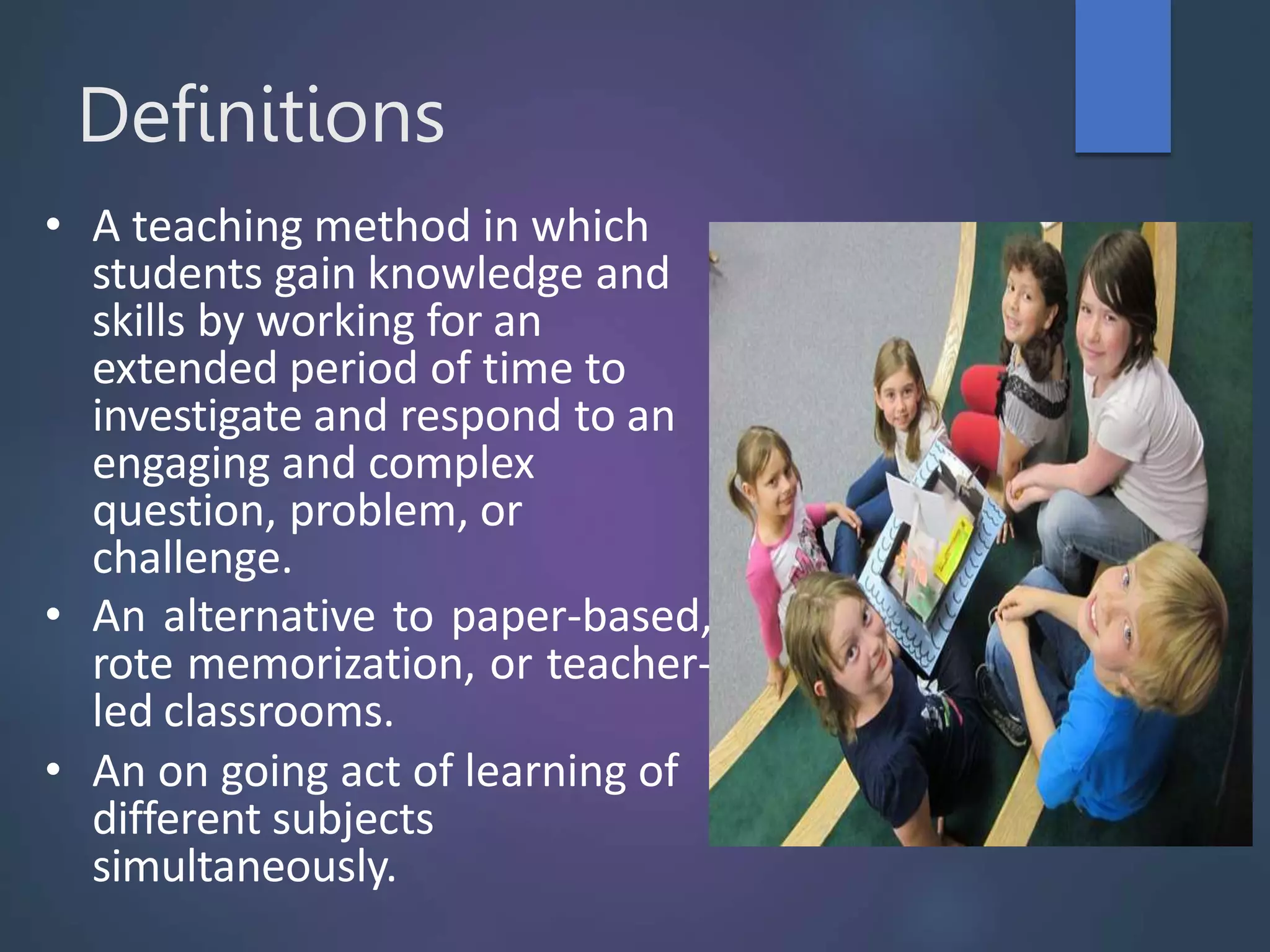
• A teaching method in which
students gain knowledge and
skills by working for an
extended period of time to
investigate and respond to an
engaging and complex
question, problem, or
challenge.
• An alternative to paper-based,
rote memorization, or teacher-
led classrooms.
• An on going act of learning of
different subjects
simultaneously.
PBL typically is grounded in
the following elements:
• Role-playing
• Real-world scenarios
• Blended writing genres
• Multiple reading genres
• Authentic assessments
• Authentic audiences
• Real-world expertise brought into the
classroom
• Units that assess multiple skills
• Units that require research and
comprehension of multiple subjects
• Student choice
• Collaboration
• Multiple methods of communication (writing,
oral speaking, visual presentations, publishing,
etc.)
Project based learning and
thinking skills
There are various different classifications of
Thinking Skills, one of the most popular of which is
based on Bloom's Taxonomy of Thinking, i.e
• Remembering
• Understanding
• Applying
• Analyzing
• Evaluating
• Creating
Thinking Skills model adopted for
use
• Information processing
• Reasoning
• Enquiring
• Creating
• Evaluating
Qualities
Project based learning:
• Cares about the mission to educate all.
• Never forgets to prepare students for
predicted future.
• Knows that all students can not be assessed in
a standardized manner.
• Doesn’t ask you to replace your content.
Drawbacks
• Foster tutors who can’t teach. Tutors enjoy
passing on their own knowledge and
understanding.
• Lack of resources.
• Requires more staff to take part in tutoring
process.
• Unsure students how much self directed study
to do and what information is relevant and
useful.
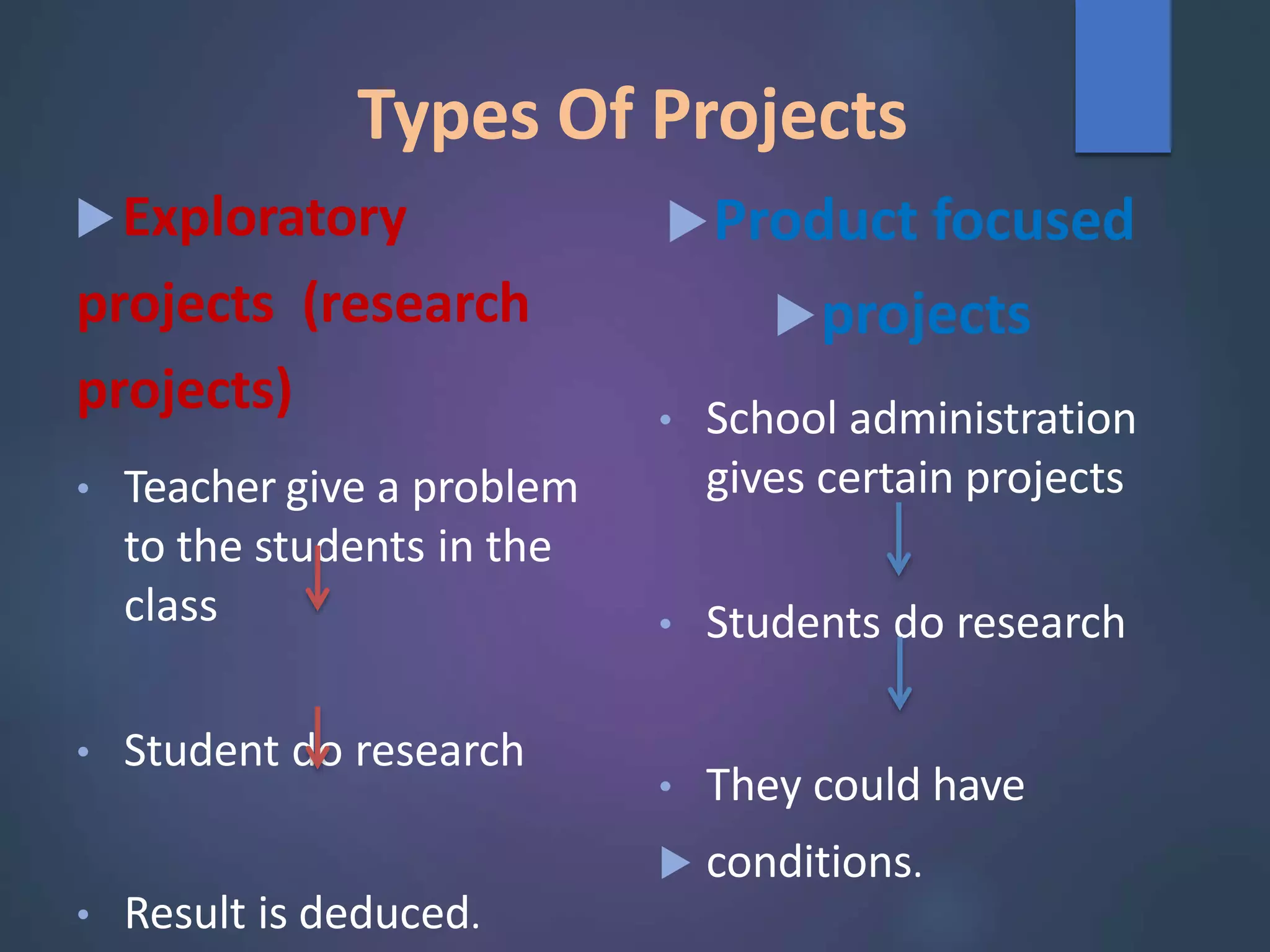
Types Of Projects
Exploratory
projects (research
projects)
• Teacher give a problem
to the students in the
class
• Student do research
• Result is deduced.
Product focused
projects
• School administration
gives certain projects
• Students do research
• They could have
 conditions.
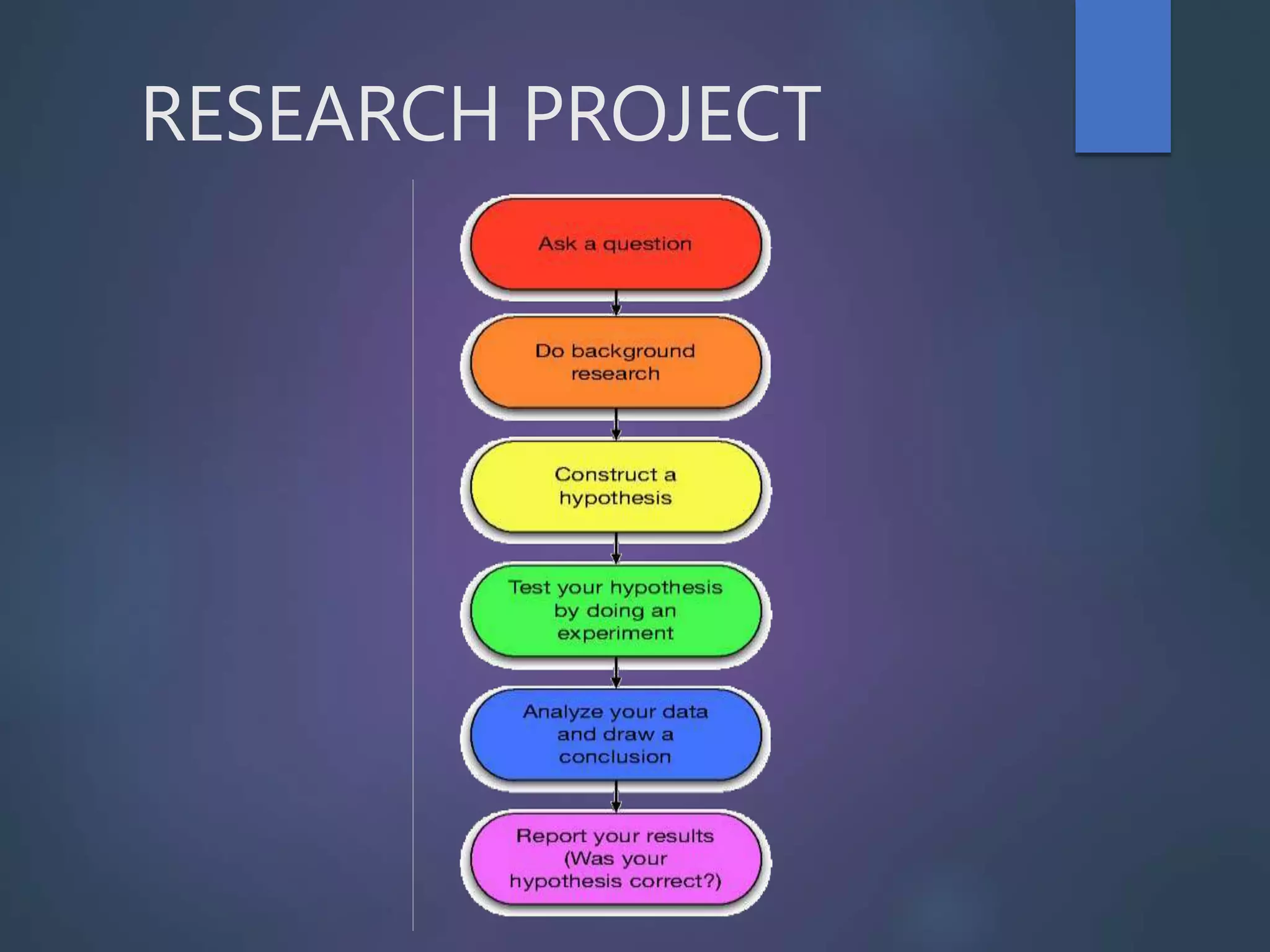
RESEARCH PROJECT
Components of Project Based
Learning Method
Significant content:
The problem must involve students working with the
essential content.
21st century skills:
The projects students participate in need to allow
them to problem-solve and engage in critical
thinking. Projects should push students to be
creative and require them to think to be successful.
In-depth inquiry:
A good project will last more than a day or
two. Teachers need to give students the time
to really investigate, ask questions and
construct their own answers.
Driving questions:
A quality project will be framed around a
question that both engages students and
helps focus their inquiry.
Need to know:
A project should entice students to want to
complete research to find the answer. Quality
projects motivate students to learn and investigate.
Voice and choice:
In order to give students ownership over the
project, teachers need to allow students to make
decisions about how to investigate the problem and
how to work together.
Reflection and revision:
Before students complete their work, there
should be time for students to receive feedback
about their progress.
Public audience:
Students should be given the opportunity to
deliver their final project to an authentic
audience that will either use or benefit from the
work.
LESSON PLAN
Subject: Science.
Topic: Layers of Earth.
Grade: 4.
Duration : 45 min.
Aims
By the end of this session students will be able
to:
• Understand the structure of earth.
• Know different types layers.
Objectives
By the end of the session:
• Define earth.
• Describe different 3 types of layers of the
earth.
• Design a project showing the different 3 layers
of the earth.
Previous knowledge
Teacher will ask few questions from the students
e.g.
• How many layers of Earth are there?
• What are the layers made of?
Teaching Aid
• Project model
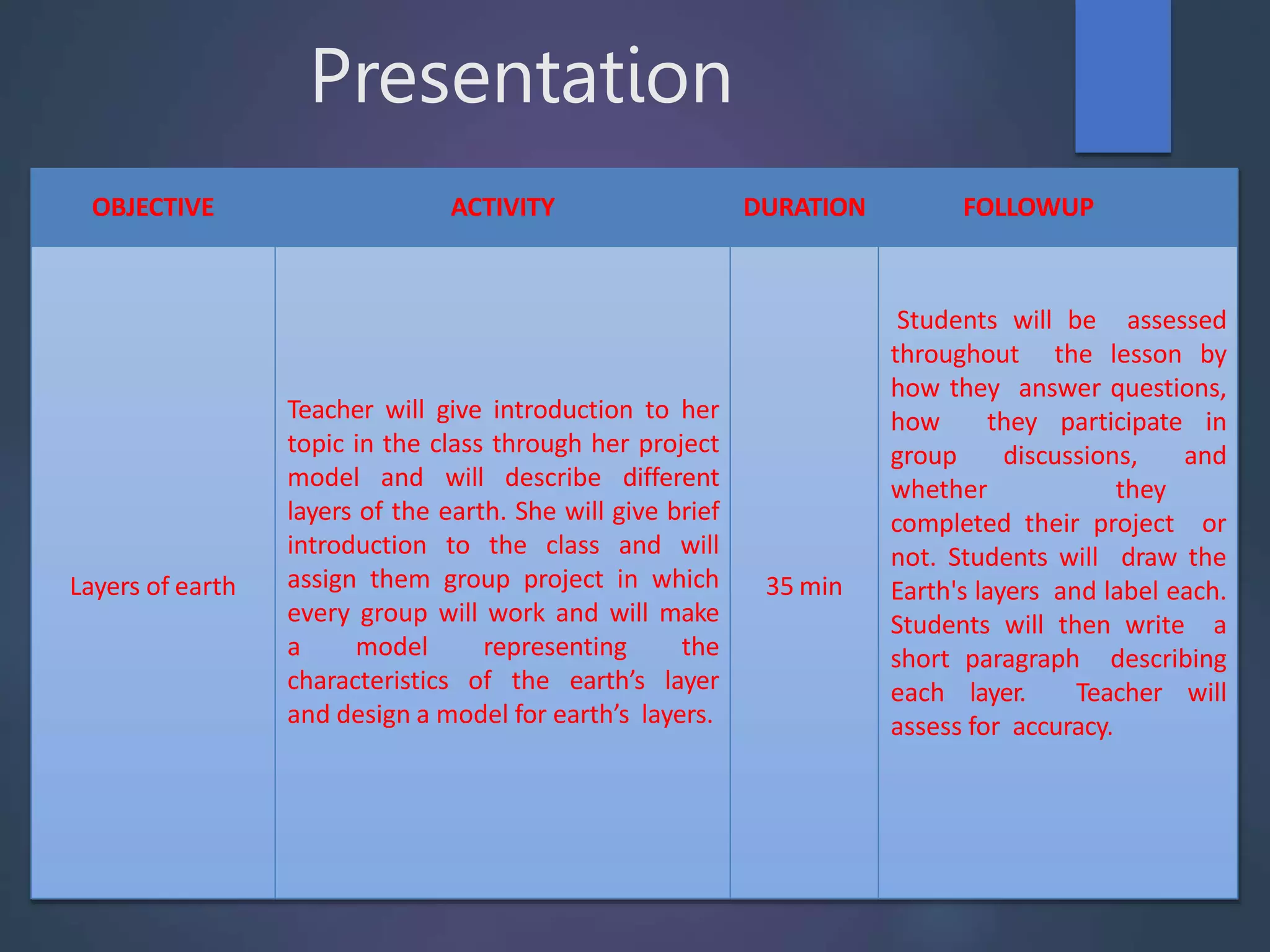
Presentation
OBJECTIVE ACTIVITY DURATION FOLLOWUP
Layers of earth
Teacher will give introduction to her
topic in the class through her project
model and will describe different
layers of the earth. She will give brief
introduction to the class and will
assign them group project in which
every group will work and will make
a model representing the
characteristics of the earth’s layer
and design a model for earth’s layers.
35 min
Students will be assessed
throughout the lesson by
how they answer questions,
how they participate in
group discussions, and
whether they
completed their project or
not. Students will draw the
Earth's layers and label each.
Students will then write a
short paragraph describing
each layer. Teacher will
assess for accuracy.
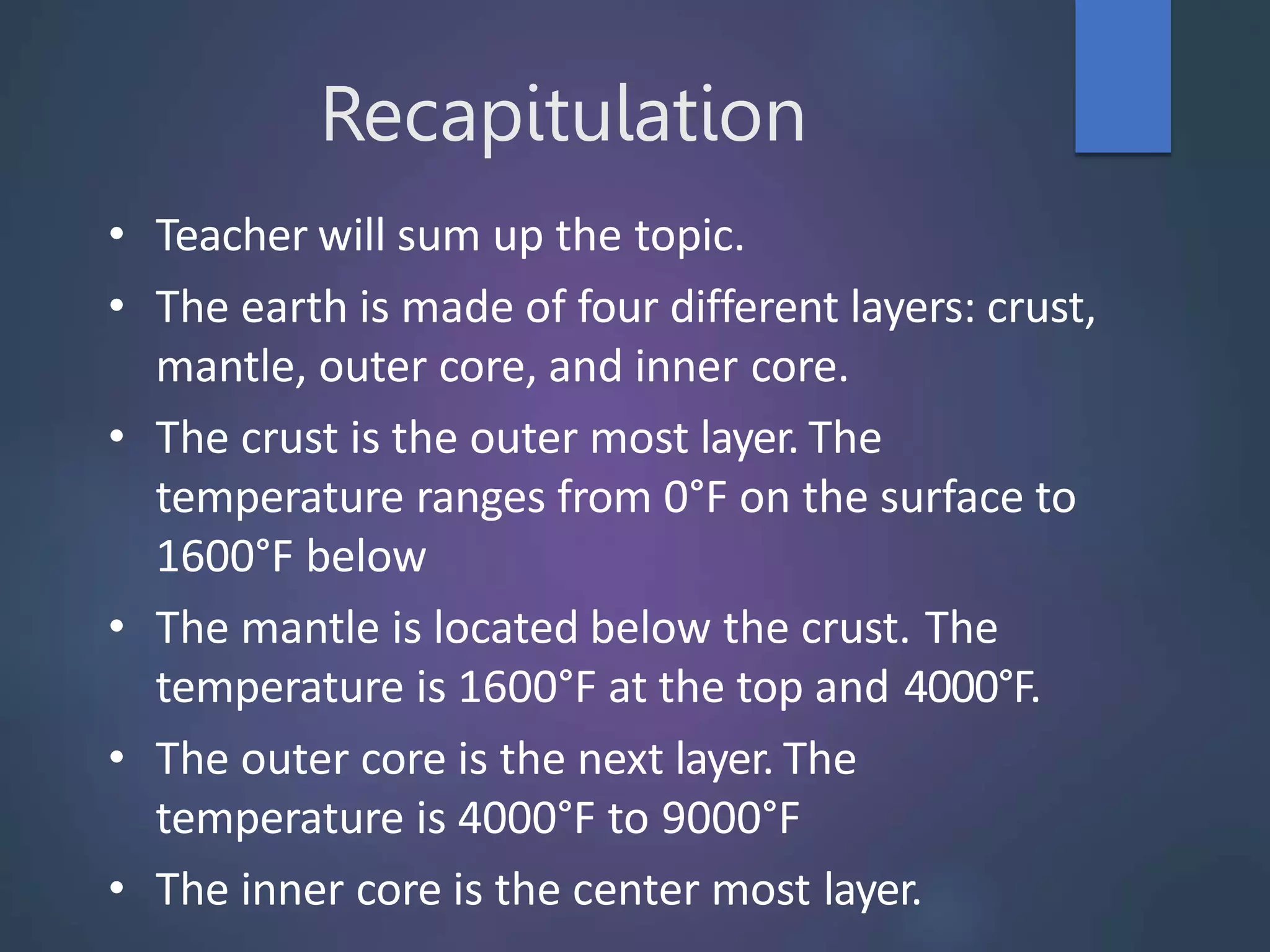
Recapitulation
• Teacher will sum up the topic.
• The earth is made of four different layers: crust,
mantle, outer core, and inner core.
• The crust is the outer most layer. The
temperature ranges from 0°F on the surface to
1600°F below
• The mantle is located below the crust. The
temperature is 1600°F at the top and 4000°F.
• The outer core is the next layer. The
temperature is 4000°F to 9000°F
• The inner core is the center most layer.
Homework
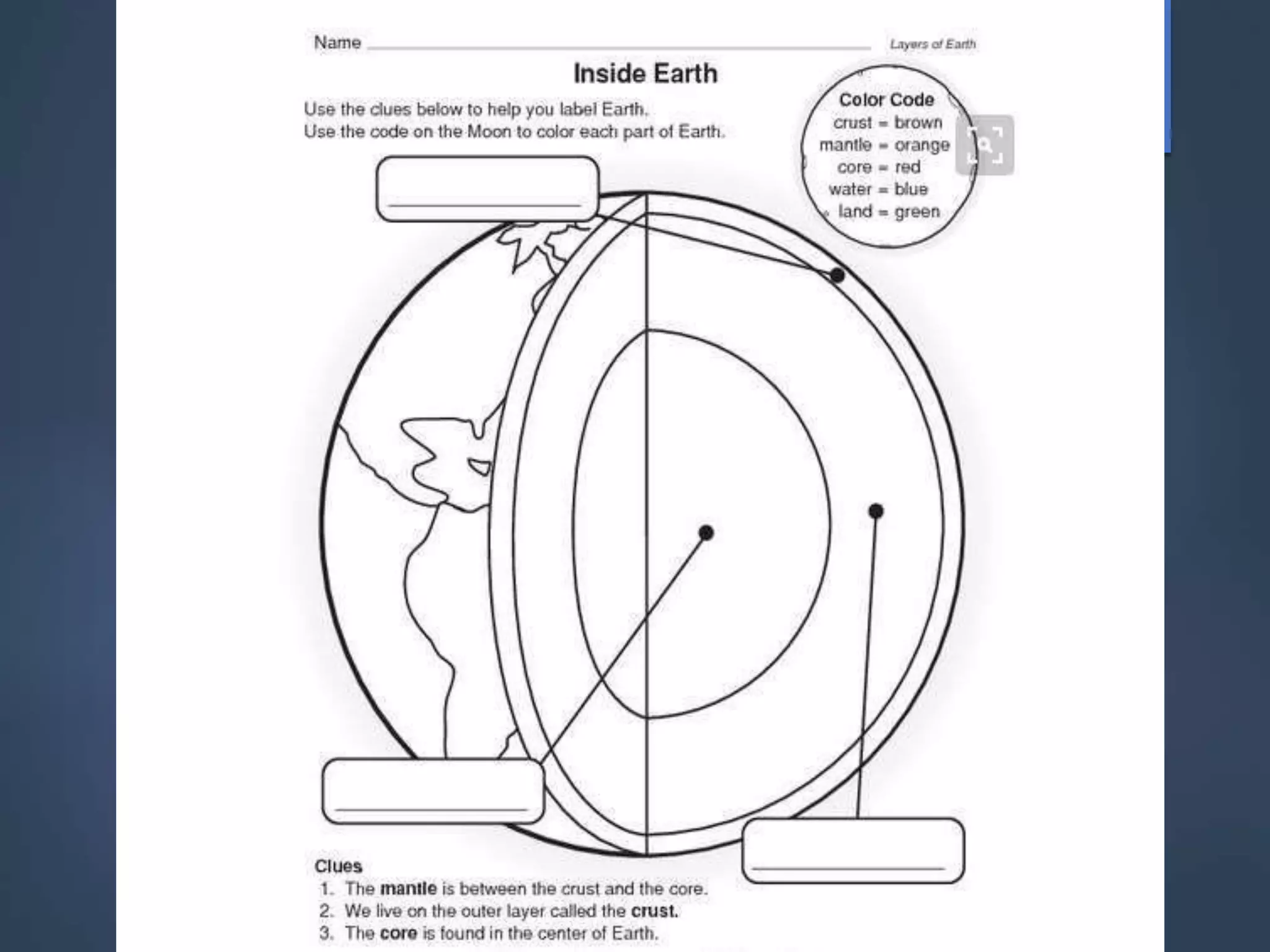
Teacher will distribute worksheet to the
students and will collect them in next class.
Project based learning Session 1.pptx

Project based learning Session 1.pptx

  • 1.
  • 2.
    Introduction • “The teacheris not in the school to impose certain ideas or to form certain habits in the child, but is there as a member of the community to select the influences which shall affect the child and to assist him in properly responding to these.......I believe, therefore, in the so-called expressive or constructive activities as the center of correlation.” (Dewey, 1897) • Educational research has advanced this idea of teaching and learning into a methodology known as “Project-based Learning”.
  • 3.
    Definitions • A teachingmethod in which students gain knowledge and skills by working for an extended period of time to investigate and respond to an engaging and complex question, problem, or challenge. • An alternative to paper-based, rote memorization, or teacher- led classrooms. • An on going act of learning of different subjects simultaneously.
  • 4.
    PBL typically isgrounded in the following elements: • Role-playing • Real-world scenarios • Blended writing genres • Multiple reading genres • Authentic assessments • Authentic audiences • Real-world expertise brought into the classroom
  • 5.
    • Units thatassess multiple skills • Units that require research and comprehension of multiple subjects • Student choice • Collaboration • Multiple methods of communication (writing, oral speaking, visual presentations, publishing, etc.)
  • 6.
    Project based learningand thinking skills There are various different classifications of Thinking Skills, one of the most popular of which is based on Bloom's Taxonomy of Thinking, i.e • Remembering • Understanding • Applying • Analyzing • Evaluating • Creating
  • 7.
    Thinking Skills modeladopted for use • Information processing • Reasoning • Enquiring • Creating • Evaluating
  • 8.
    Qualities Project based learning: •Cares about the mission to educate all. • Never forgets to prepare students for predicted future. • Knows that all students can not be assessed in a standardized manner. • Doesn’t ask you to replace your content.
  • 9.
    Drawbacks • Foster tutorswho can’t teach. Tutors enjoy passing on their own knowledge and understanding. • Lack of resources. • Requires more staff to take part in tutoring process. • Unsure students how much self directed study to do and what information is relevant and useful.
  • 10.
    Types Of Projects Exploratory projects(research projects) • Teacher give a problem to the students in the class • Student do research • Result is deduced. Product focused projects • School administration gives certain projects • Students do research • They could have  conditions.
  • 11.
  • 12.
    Components of ProjectBased Learning Method Significant content: The problem must involve students working with the essential content. 21st century skills: The projects students participate in need to allow them to problem-solve and engage in critical thinking. Projects should push students to be creative and require them to think to be successful.
  • 13.
    In-depth inquiry: A goodproject will last more than a day or two. Teachers need to give students the time to really investigate, ask questions and construct their own answers. Driving questions: A quality project will be framed around a question that both engages students and helps focus their inquiry.
  • 14.
    Need to know: Aproject should entice students to want to complete research to find the answer. Quality projects motivate students to learn and investigate. Voice and choice: In order to give students ownership over the project, teachers need to allow students to make decisions about how to investigate the problem and how to work together.
  • 15.
    Reflection and revision: Beforestudents complete their work, there should be time for students to receive feedback about their progress. Public audience: Students should be given the opportunity to deliver their final project to an authentic audience that will either use or benefit from the work.
  • 16.
  • 17.
    Subject: Science. Topic: Layersof Earth. Grade: 4. Duration : 45 min.
  • 18.
    Aims By the endof this session students will be able to: • Understand the structure of earth. • Know different types layers.
  • 19.
    Objectives By the endof the session: • Define earth. • Describe different 3 types of layers of the earth. • Design a project showing the different 3 layers of the earth.
  • 20.
    Previous knowledge Teacher willask few questions from the students e.g. • How many layers of Earth are there? • What are the layers made of? Teaching Aid • Project model
  • 21.
    Presentation OBJECTIVE ACTIVITY DURATIONFOLLOWUP Layers of earth Teacher will give introduction to her topic in the class through her project model and will describe different layers of the earth. She will give brief introduction to the class and will assign them group project in which every group will work and will make a model representing the characteristics of the earth’s layer and design a model for earth’s layers. 35 min Students will be assessed throughout the lesson by how they answer questions, how they participate in group discussions, and whether they completed their project or not. Students will draw the Earth's layers and label each. Students will then write a short paragraph describing each layer. Teacher will assess for accuracy.
  • 22.
    Recapitulation • Teacher willsum up the topic. • The earth is made of four different layers: crust, mantle, outer core, and inner core. • The crust is the outer most layer. The temperature ranges from 0°F on the surface to 1600°F below • The mantle is located below the crust. The temperature is 1600°F at the top and 4000°F. • The outer core is the next layer. The temperature is 4000°F to 9000°F • The inner core is the center most layer.
  • 23.
    Homework Teacher will distributeworksheet to the students and will collect them in next class.