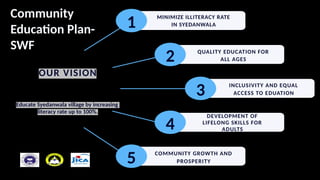
MINIMIZE ILLITERACY RATE
INSYEDANWALA
1
QUALITY EDUCATION FOR
ALL AGES
2
INCLUSIVITY AND EQUAL
ACCESS TO EDUATION
3
DEVELOPMENT OF
LIFELONG SKILLS FOR
ADULTS
4
COMMUNITY GROWTH AND
PROSPERITY
5
Community
Education Plan-
SWF
OUR VISION
Educate Syedanwala village by increasing
literacy rate up to 100%.
4.
FIELD DATA COLLECTEDBY
JICA
DATA ANALYSIS &
REPORTING
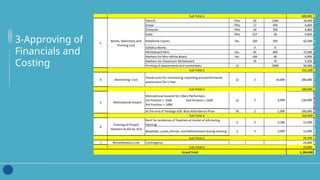
APPROVING OF FINANCIALS
AND COSTING
MONITORING &
EVALUATION
EXECUTION OF
PLAN
TRAINING OF TRAINERS
CURRICULUM &
SYLLABUS
GLIMPSES &
Successful Stories WAY FORWARD
PLANNING
Out of SchoolChildren
90 172
19 children of 5-7 years can be enrolled in existing schools
• Placement test for assessing learning levels
• Remedial courses
• Enrollment in relevant Grade
24 children of age 08-16 years can be taught ALP Course
(Package-A, B & C)
• Placement test for assessing learning levels
• Enrollment in relevant ALP Package
Strategies
Strategies for Youthand Adults
•36 youth of 17-24 years can be consulted and given Package-A with
desired skill
• Placement test for assessing learning levels
• Skill assessment
• Entrepreneur training
•318 adult illiterates of 25+ years can be taught 3 months Literacy Course
14.
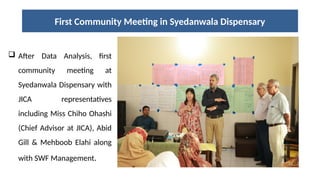
First Community Meetingin Syedanwala Dispensary
After Data Analysis, first
community meeting at
Syedanwala Dispensary with
JICA representatives
including Miss Chiho Ohashi
(Chief Advisor at JICA), Abid
Gill & Mehboob Elahi along
with SWF Management.
Community Education
Plan
Enrollment of
Childrenin
Govt. School
Age (5-7
Years)
Enrollment in
CEP Age (8-24)
Package A for
8 Months
Package B
8 Months
Package C
9 Months
Adult Literacy
Program Age
(25+)
Basic Literacy Life Skills
Income
Generation
Students Updates
Classes arein progress
Books, stationary, resources
supplied to community centers
Daily Feedback by AIE team
through Watsapp
Attendance is maintained
Placement test has been taken
Males Females
16 22
26.
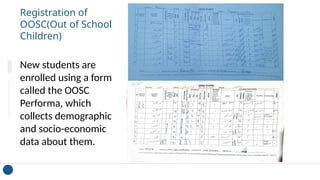
Registration of
OOSC(Out ofSchool
Children)
New students are
enrolled using a form
called the OOSC
Performa, which
collects demographic
and socio-economic
data about them.
27.
Activity Chart ofOOSC & Illiterate (Male)
Age Group
No of
OOSC
Enrolled
Students
Remaining Remarks
Children (5-7) 9 9 0
8 Students are enrolled in Govt. Primary
School and 1 Student is enrolled in CEP.
Youth (8-16) 17 12 5 Many out-of-school children are engaged in
part-time labor during the day.
Adult (17-24) 18 0 18 People of this age group are engaged in full-
time labor and are not present in Syedanwala
during the morning hours.
Adults(25+) 122 0 122
They are uninterested in attending classes
during the daytime. According to a recent
survey, individuals in this age group prefer to
take classes at 7 PM.
Total 166 21 145
28.
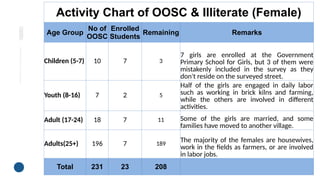
Activity Chart ofOOSC & Illiterate (Female)
Age Group
No of
OOSC
Enrolled
Students
Remaining Remarks
Children (5-7) 10 7 3
7 girls are enrolled at the Government
Primary School for Girls, but 3 of them were
mistakenly included in the survey as they
don't reside on the surveyed street.
Youth (8-16) 7 2 5
Half of the girls are engaged in daily labor
such as working in brick kilns and farming,
while the others are involved in different
activities.
Adult (17-24) 18 7 11 Some of the girls are married, and some
families have moved to another village.
Adults(25+) 196 7 189
The majority of the females are housewives,
work in the fields as farmers, or are involved
in labor jobs.
Total 231 23 208
29.
Other Reasons forless Enrollment
Children cannot pursue formal education due to working as “Half Day Laborers”.
Inability to be selected at Syedanwala Secondary School due to the Merit System.
Government Primary School does not admit them based on the B-Form Criteria, which
they lack.
Lack of awareness about the importance of education among parents and guardians.
Early marriage or other familial obligations leading to early dropout rates among
students.
Some students drop out of school early because they get married young or have to take
care of family responsibilities.
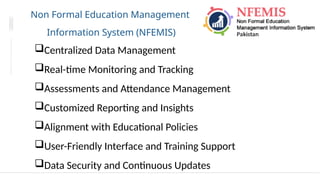
Non Formal EducationManagement
Information System (NFEMIS)
Centralized Data Management
Real-time Monitoring and Tracking
Assessments and Attendance Management
Customized Reporting and Insights
Alignment with Educational Policies
User-Friendly Interface and Training Support
Data Security and Continuous Updates
37.
Non Formal EducationManagement
Information System (NFEMIS)
JICA organized a 2-week online training for 5 members of Ali
Institute of Education (AIE) to familiarize them with NFEMIS.
The training focused on understanding NFEMIS's online
portal, enhancing skills in data management, monitoring,
reporting, and aimed to improve proficiency in utilizing
NFEMIS effectively for non-formal education.
We are nowat…
Syllabus Activity - Package A, SW-CEP
Subject Male Center Female Center
Urdu
Unit# 5
چوٹ
Unit# 7
لڑکی
Math's
Unit# 1
اعداد
Unit 2
عوامل پر اعداد
English Will be started
soon
Will be started
soon
9- Way Fwd.
Asecond shift will begin for
males as they are busy in the
afternoon.(Need to identify a local teacher)
We have collected their data and
also inquired about a suitable
time. (They have asked for 7 pm)
Additionally, children who are
unable to attend classes during
the day can also attend these
classes.
49.
Adult Literacy Survey
An Adult Literacy Survey is underway for
individuals aged between 25 and 40 years,
aiming to gather detailed information
about:
The total number of participants in this age
group.
The number of individuals interested in
attending Adult Literacy Classes.
Preferred timings for evening classes.
Comprehensive details of participants
holding B-Forms and CNICs.
Provision of facilitation by a NADRA Van for
individuals without B-Forms and CNICs.
50.
Female
Centre
Separation of Age
Groupsin May
Age Group (8-16 Years) will
continue Package B
Age Group (17-24) will start
package B on the base of mid
term & final term Assessment
Remaining & Age Group 25+ Will
Continue Adult Literacy Program
51.
Adult Literacy
Program
Basic Literacy
PackageA & B
Health
Community Hygiene
Islamic Values
Life Skill
For Male
Farming
Livestock
Animal Husbandry
For Female
Beautician
Sewing
Child Care
Home Management
Health Hygeine
Income
Generation
Entrepreneurship