












The Learning Project Organization
                     Session ISS 13


Thomas Juli, Ph.D., PMP®, CSM®
Thomas Juli Empowerment Partners & i-Sparks
Why Learn?


             © 2011 by Thomas Juli   2
© 2011 by by Thomas Juli
  © 2011 Thomas Juli       Picture © Sabrina Gonstalla | Pixelio.de   3
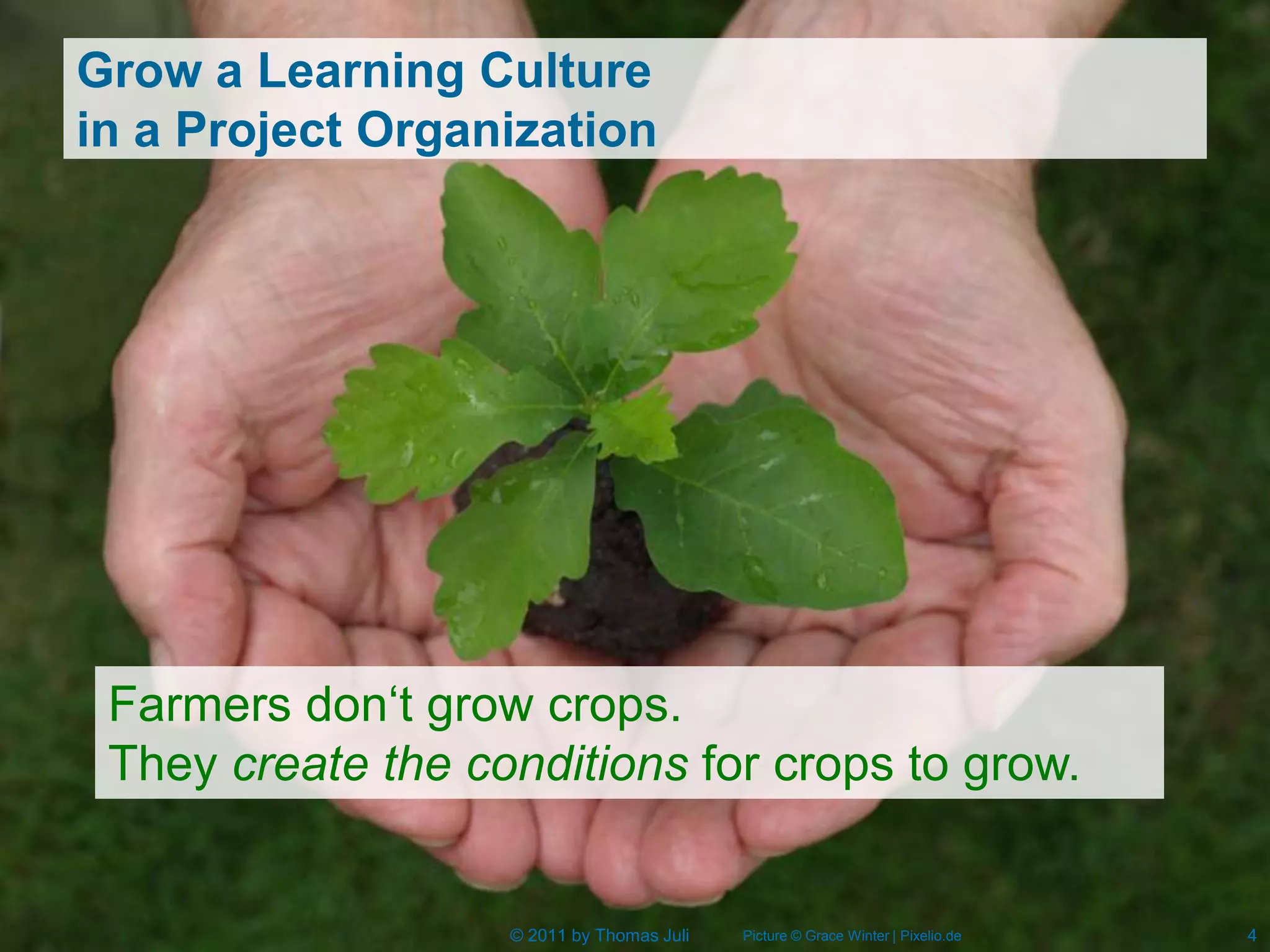
Grow a Learning Culture
in a Project Organization


 Farmers don‘t grow crops.
 They create the conditions for crops to grow.


                   © 2011 by Thomas Juli   Picture © Grace Winter | Pixelio.de   4
Prerequisite for Project Success


Actively create a culture of learning


                     © 2011 by Thomas Juli   Picture © Michael Ottersbach| Pixelio.de   5
This Session We Will Look At


                 © 2011 by Thomas Juli   Picture © WRW | Pixelio.de   6
This Session We Will Look At

o Critical success factors for a learning project
  organization
o Tools to help cultivate learning
o Innovation and learning
o Learning challenges


                       © 2011 by Thomas Juli   Picture © WRW | Pixelio.de   7
Critical Success Factors (CSF)
for a Learning Project Organization


            © 2011 by Thomas Juli   Picture © Rainer Sturm | Pixelio.de
CSF 1
    Build a common vision of and for your project organization


.
                                © 2011 by Thomas Juli   Photo retrieved from http://tinyurl.com/39uvg8c   9
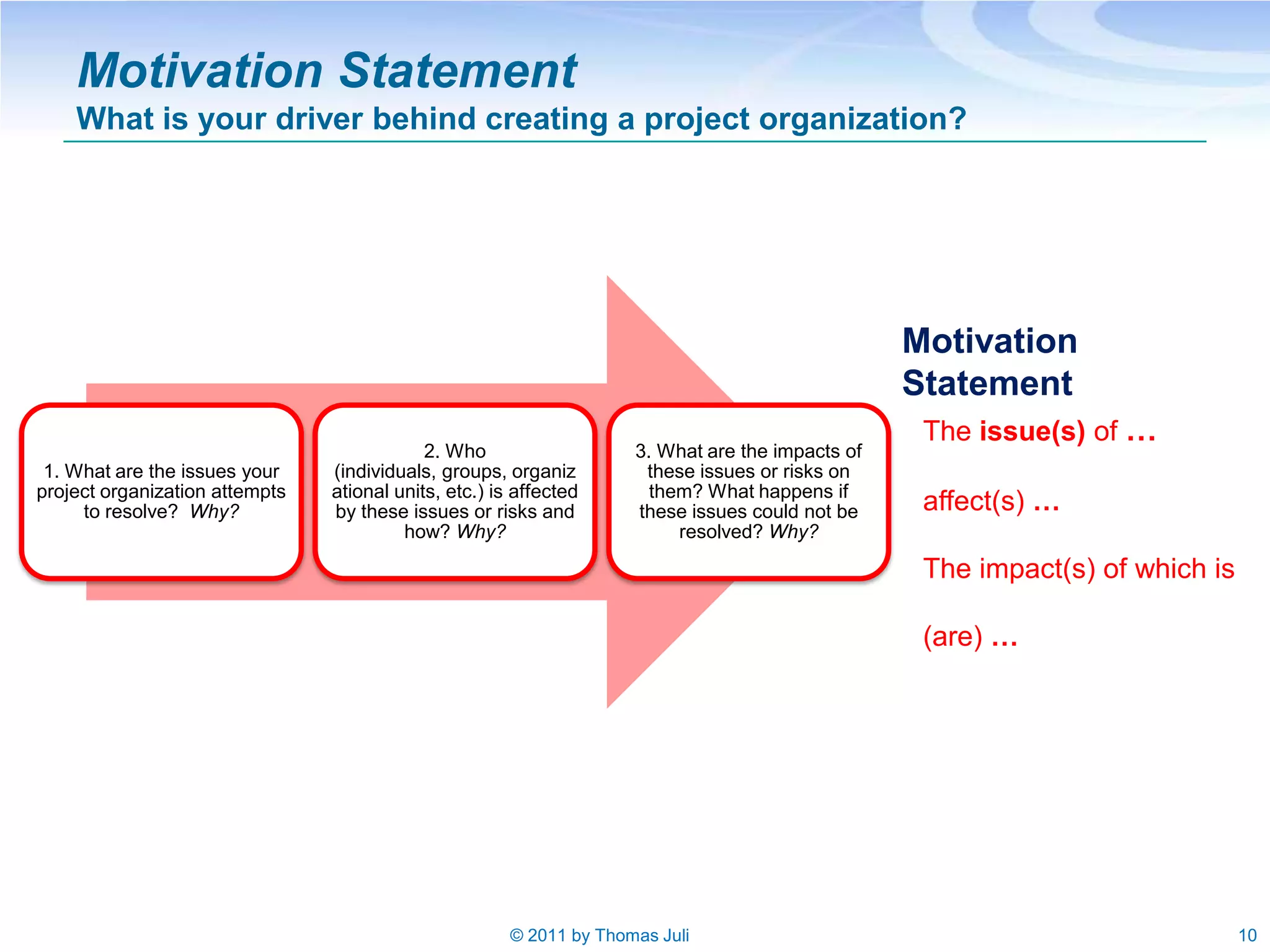
Motivation Statement
    What is your driver behind creating a project organization?


                                                                                                  Motivation
                                                                                                  Statement
                                                                                                   The issue(s) of …
                                            2. Who                   3. What are the impacts of
 1. What are the issues your    (individuals, groups, organiz         these issues or risks on
project organization attempts   ational units, etc.) is affected       them? What happens if
     to resolve? Why?           by these issues or risks and         these issues could not be     affect(s) …
                                         how? Why?                        resolved? Why?

                                                                                                   The impact(s) of which is

                                                                                                   (are) …


                                                       © 2011 by Thomas Juli                                                   10
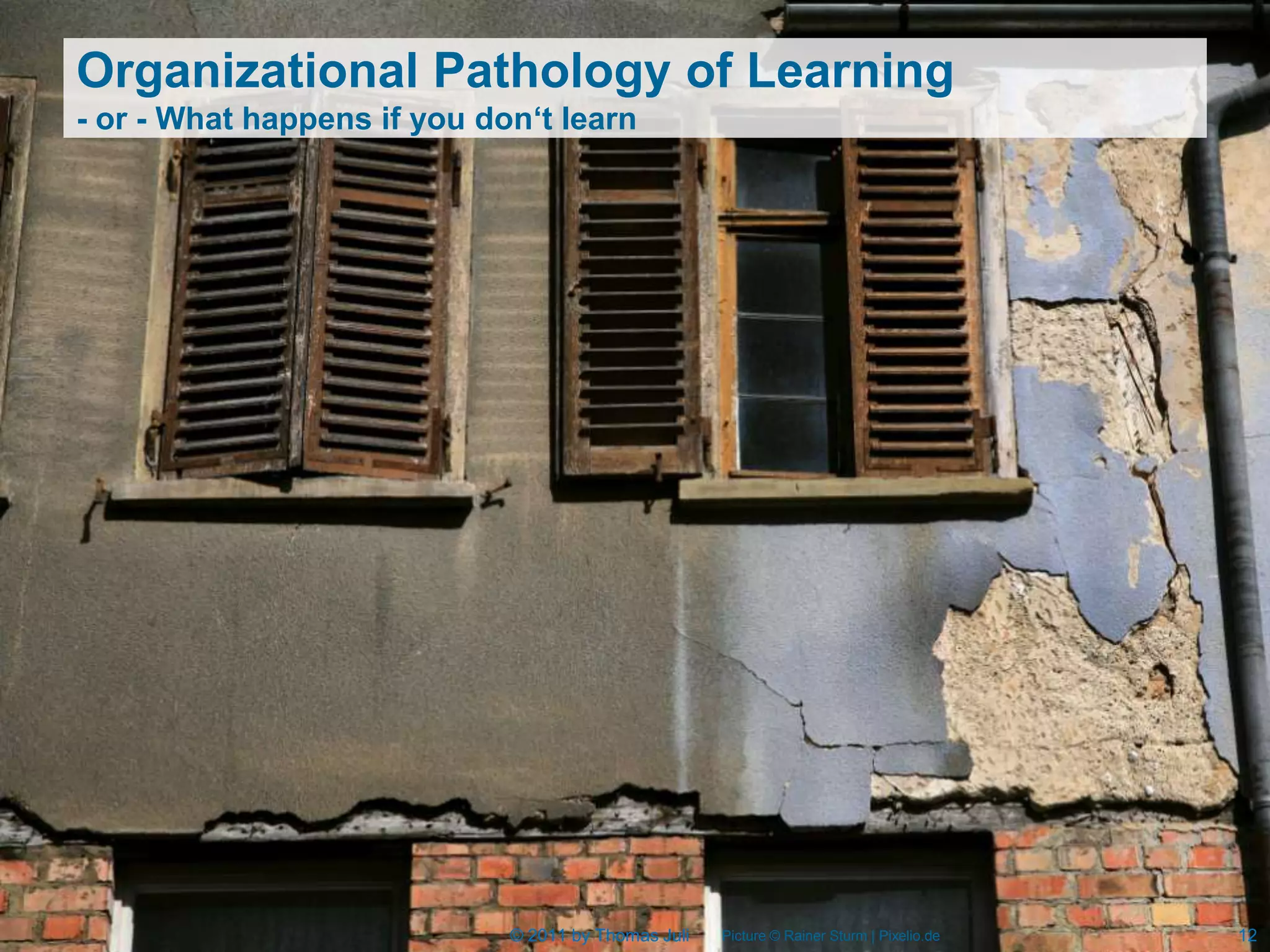
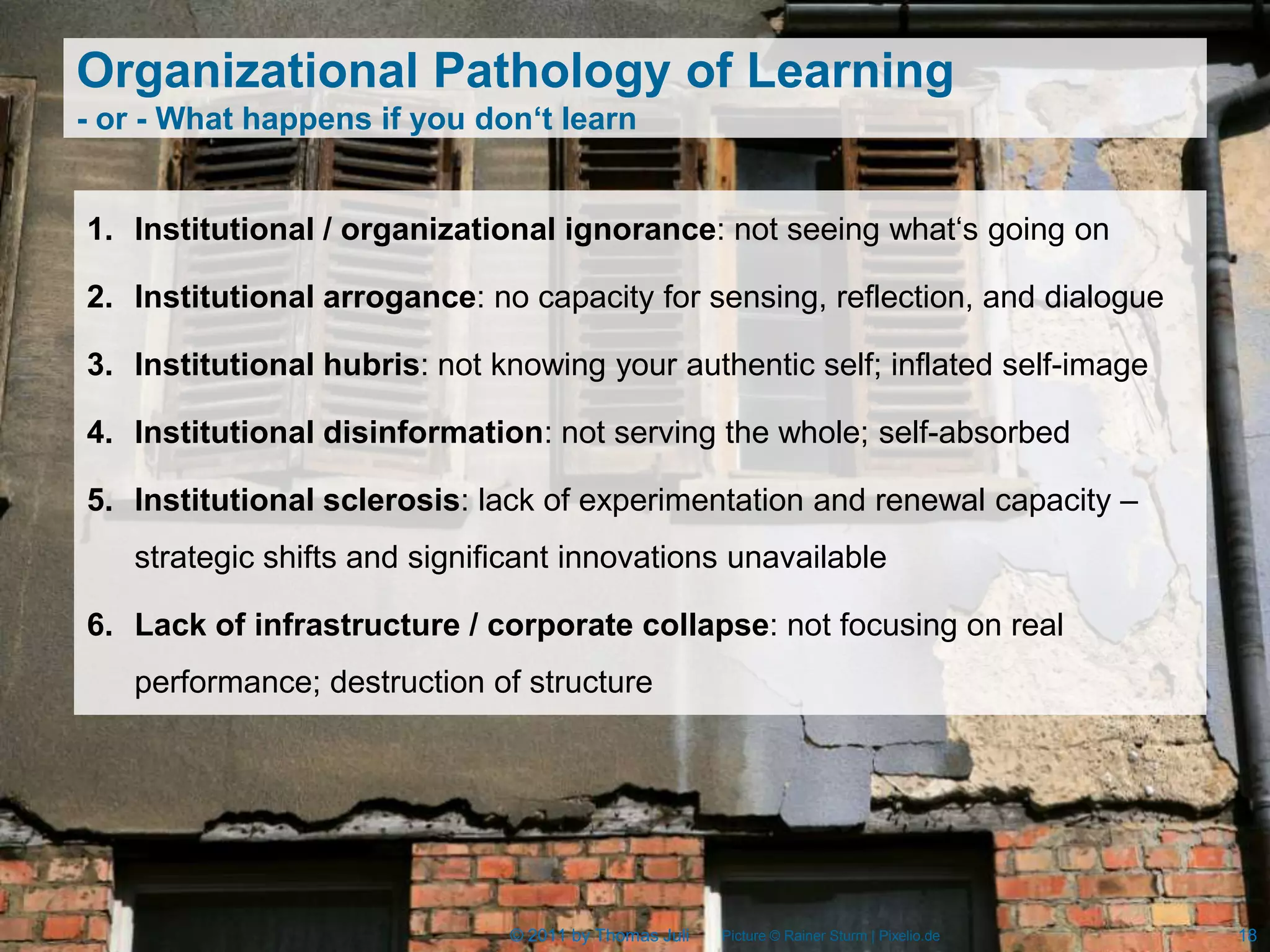
Organizational Pathology of Learning
- or - What happens if you don‘t learn


                             © 2011 by Thomas Juli   11
Organizational Pathology of Learning
- or - What happens if you don‘t learn


                             © 2011 by Thomas Juli   Picture © Rainer Sturm | Pixelio.de   12
Organizational Pathology of Learning
- or - What happens if you don‘t learn


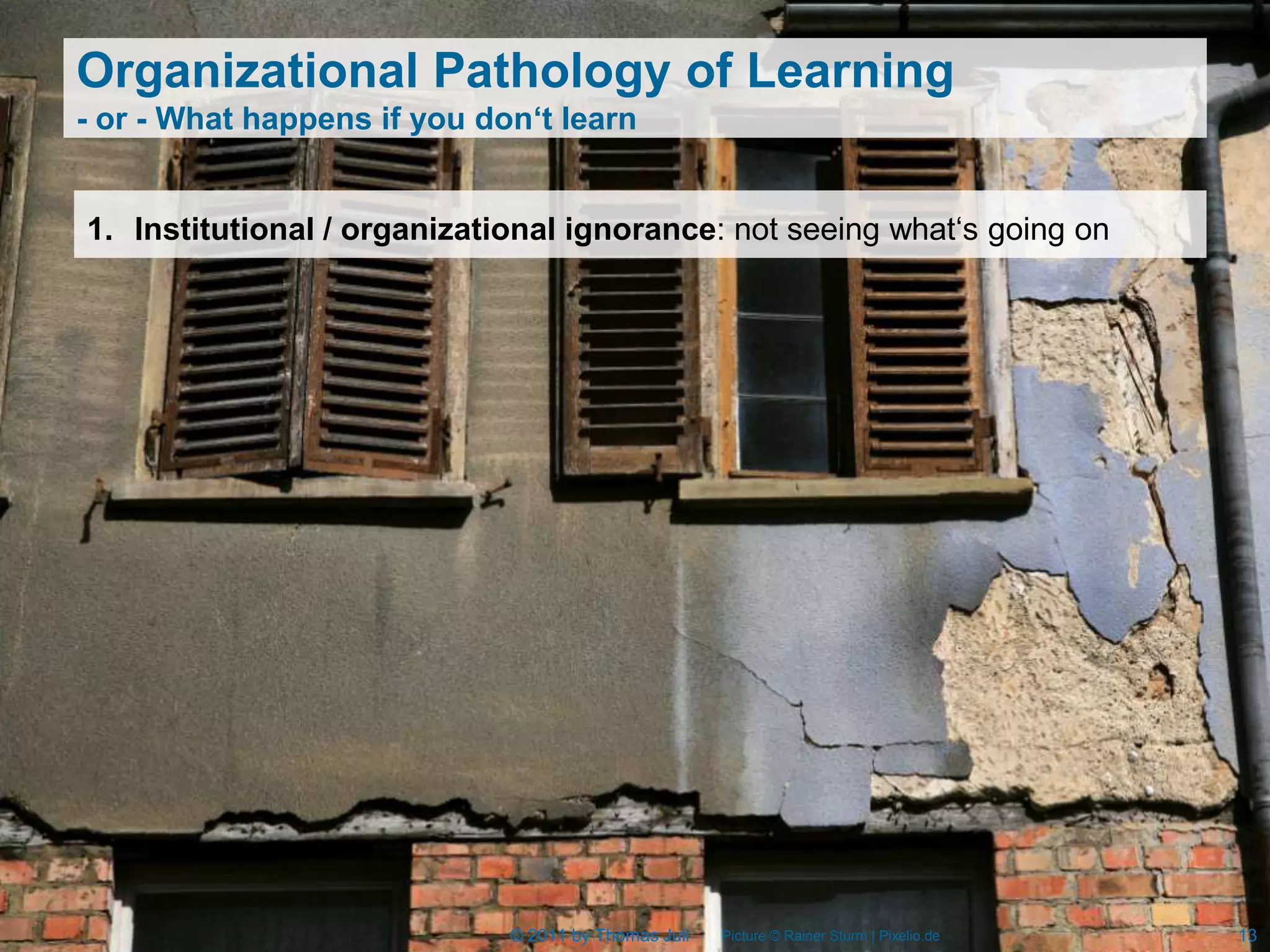
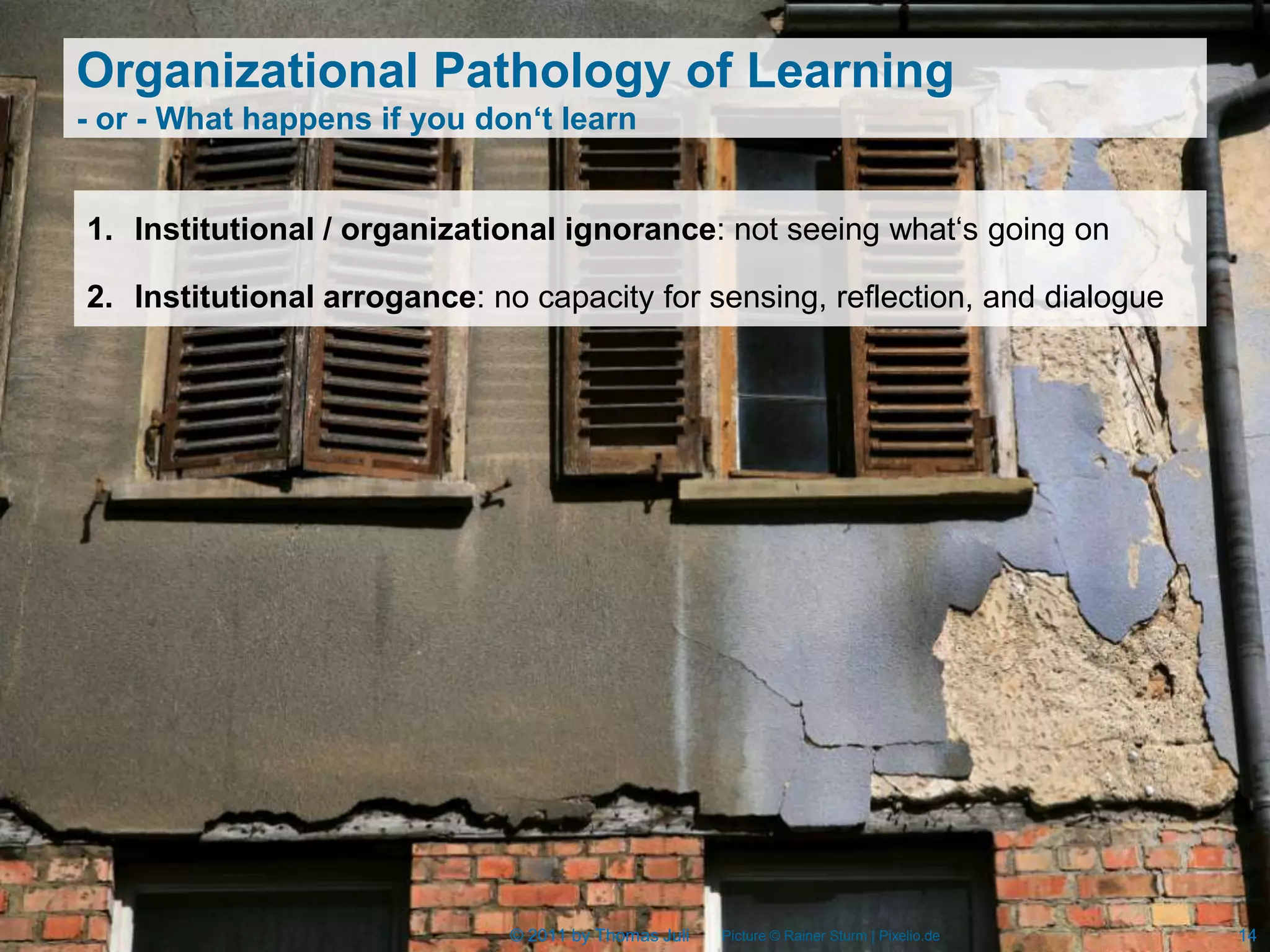
1. Institutional / organizational ignorance: not seeing what‘s going on


                             © 2011 by Thomas Juli   Picture © Rainer Sturm | Pixelio.de   13
Organizational Pathology of Learning
- or - What happens if you don‘t learn


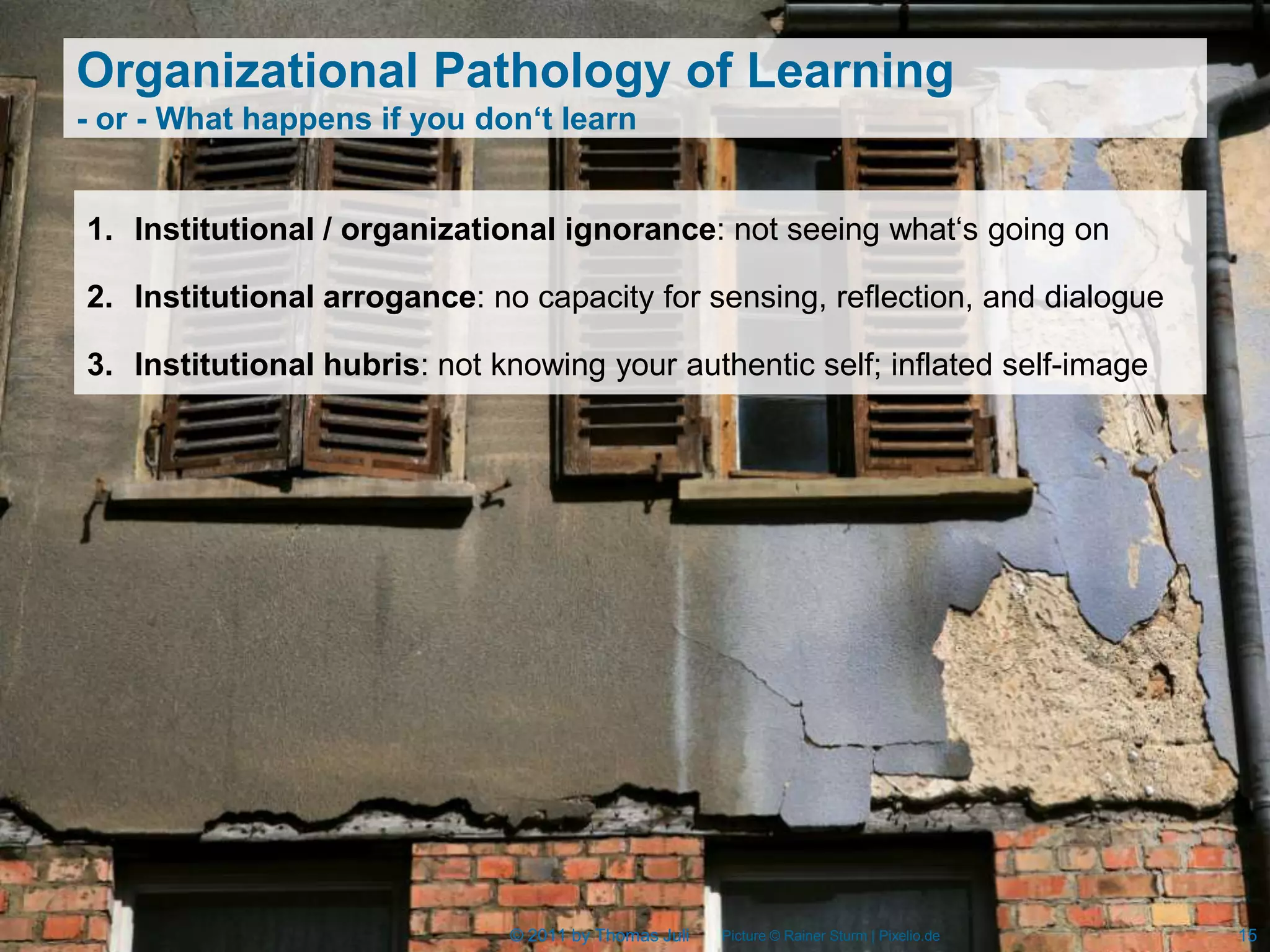
1. Institutional / organizational ignorance: not seeing what‘s going on

2. Institutional arrogance: no capacity for sensing, reflection, and dialogue


                              © 2011 by Thomas Juli   Picture © Rainer Sturm | Pixelio.de   14
Organizational Pathology of Learning
- or - What happens if you don‘t learn


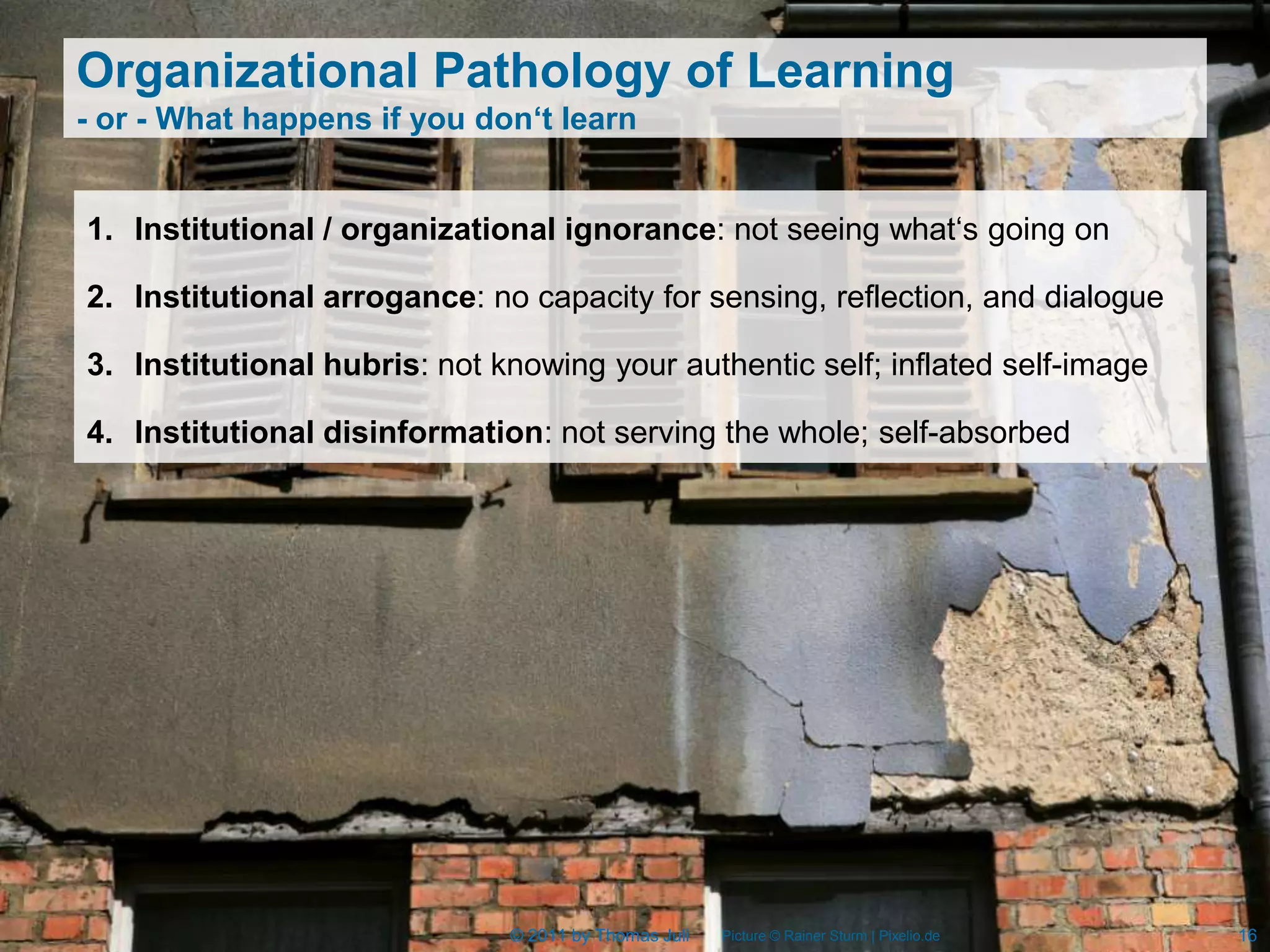
1. Institutional / organizational ignorance: not seeing what‘s going on

2. Institutional arrogance: no capacity for sensing, reflection, and dialogue

3. Institutional hubris: not knowing your authentic self; inflated self-image


                              © 2011 by Thomas Juli   Picture © Rainer Sturm | Pixelio.de   15
Organizational Pathology of Learning
- or - What happens if you don‘t learn


1. Institutional / organizational ignorance: not seeing what‘s going on

2. Institutional arrogance: no capacity for sensing, reflection, and dialogue

3. Institutional hubris: not knowing your authentic self; inflated self-image

4. Institutional disinformation: not serving the whole; self-absorbed


                              © 2011 by Thomas Juli   Picture © Rainer Sturm | Pixelio.de   16
Organizational Pathology of Learning
- or - What happens if you don‘t learn


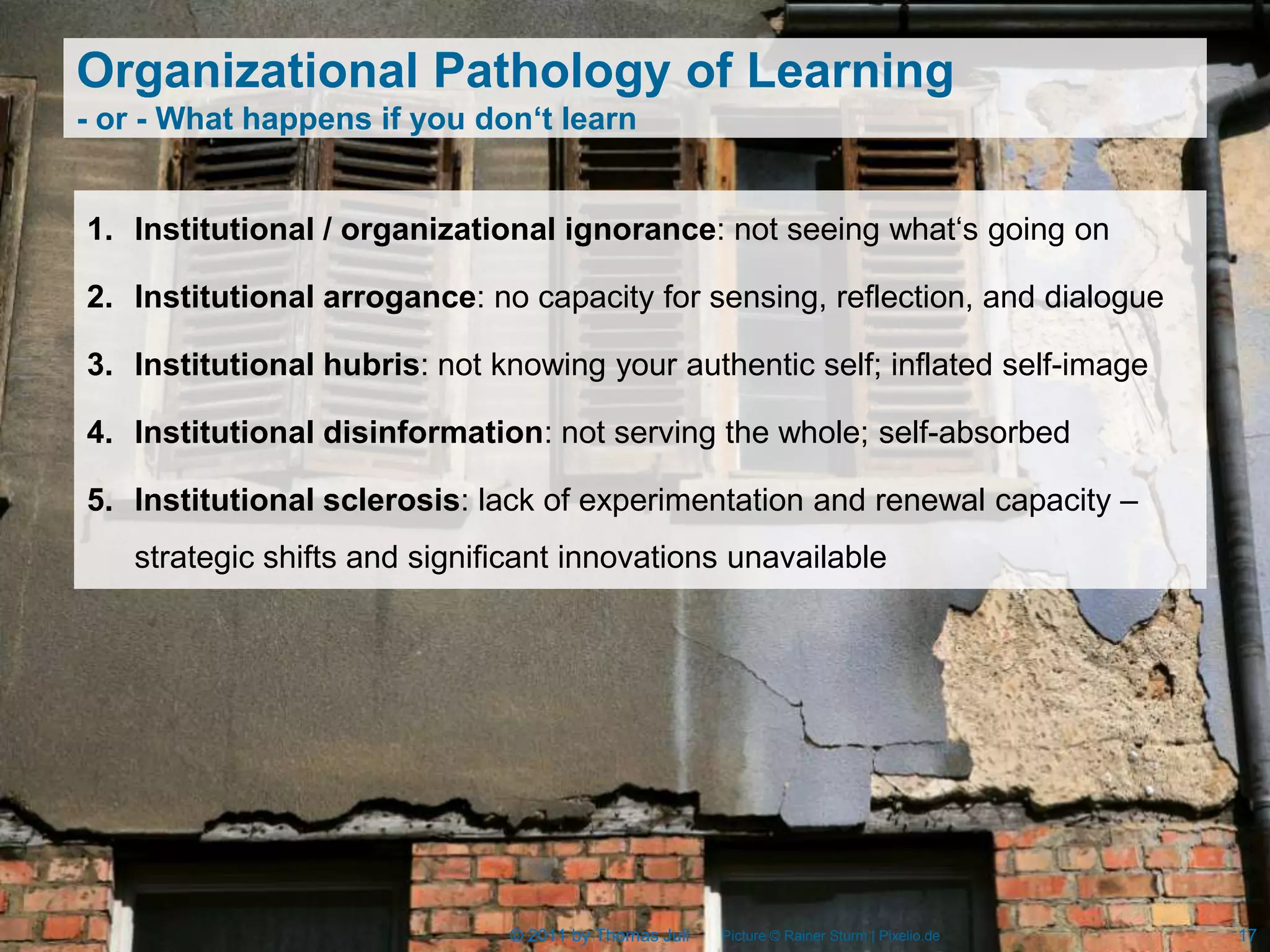
1. Institutional / organizational ignorance: not seeing what‘s going on

2. Institutional arrogance: no capacity for sensing, reflection, and dialogue

3. Institutional hubris: not knowing your authentic self; inflated self-image

4. Institutional disinformation: not serving the whole; self-absorbed

5. Institutional sclerosis: lack of experimentation and renewal capacity –
   strategic shifts and significant innovations unavailable


                              © 2011 by Thomas Juli   Picture © Rainer Sturm | Pixelio.de   17
Organizational Pathology of Learning
- or - What happens if you don‘t learn


1. Institutional / organizational ignorance: not seeing what‘s going on

2. Institutional arrogance: no capacity for sensing, reflection, and dialogue

3. Institutional hubris: not knowing your authentic self; inflated self-image

4. Institutional disinformation: not serving the whole; self-absorbed

5. Institutional sclerosis: lack of experimentation and renewal capacity –
   strategic shifts and significant innovations unavailable

6. Lack of infrastructure / corporate collapse: not focusing on real
   performance; destruction of structure


                              © 2011 by Thomas Juli   Picture © Rainer Sturm | Pixelio.de   18
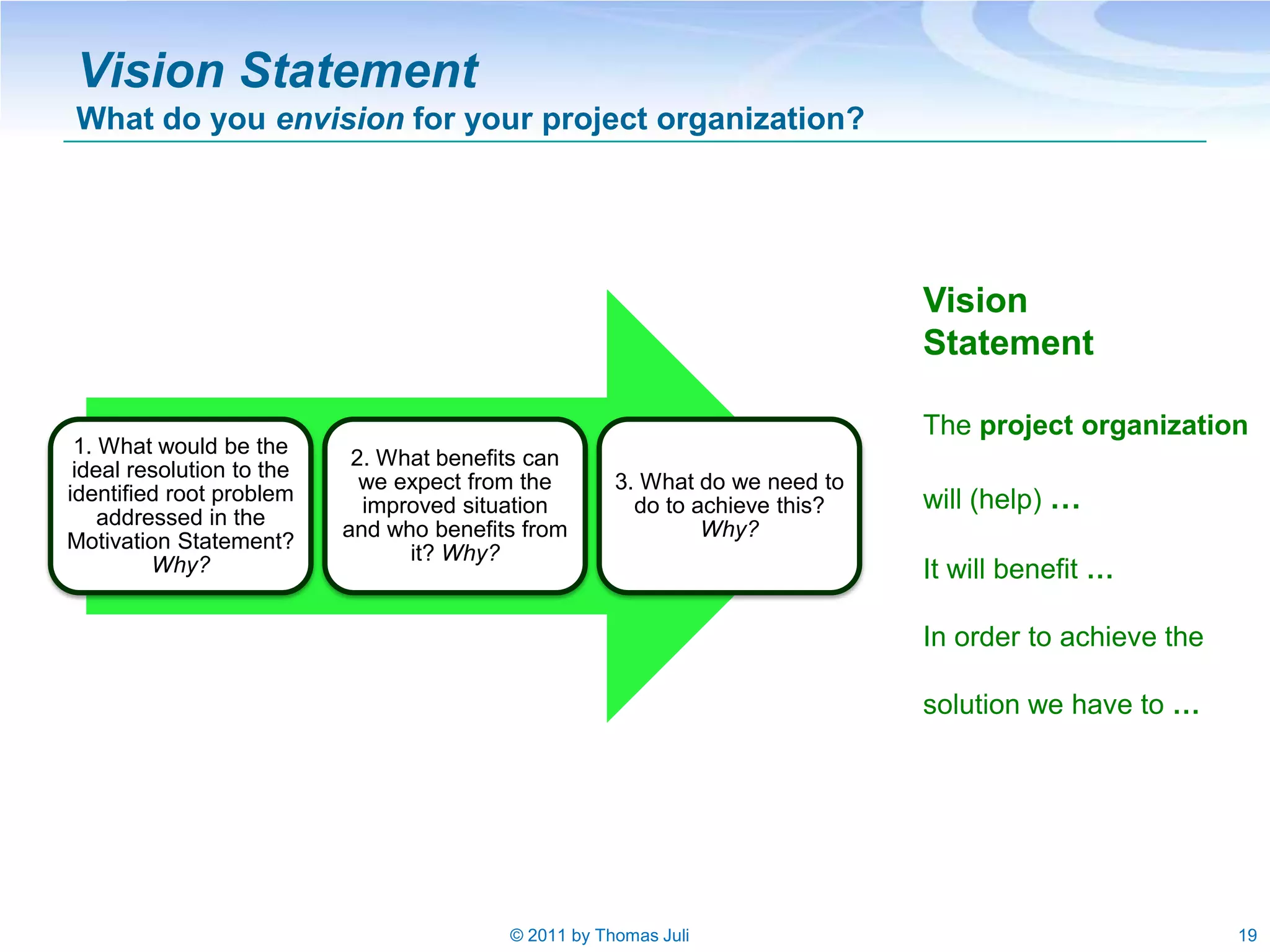
Vision Statement
What do you envision for your project organization?


                                                                              Vision
                                                                              Statement

                                                                              The project organization
 1. What would be the
                            2. What benefits can
 ideal resolution to the
                             we expect from the       3. What do we need to
identified root problem
                             improved situation         do to achieve this?   will (help) …
    addressed in the
                           and who benefits from               Why?
Motivation Statement?
                                 it? Why?
         Why?                                                                 It will benefit …

                                                                              In order to achieve the

                                                                              solution we have to …


                                          © 2011 by Thomas Juli                                         19
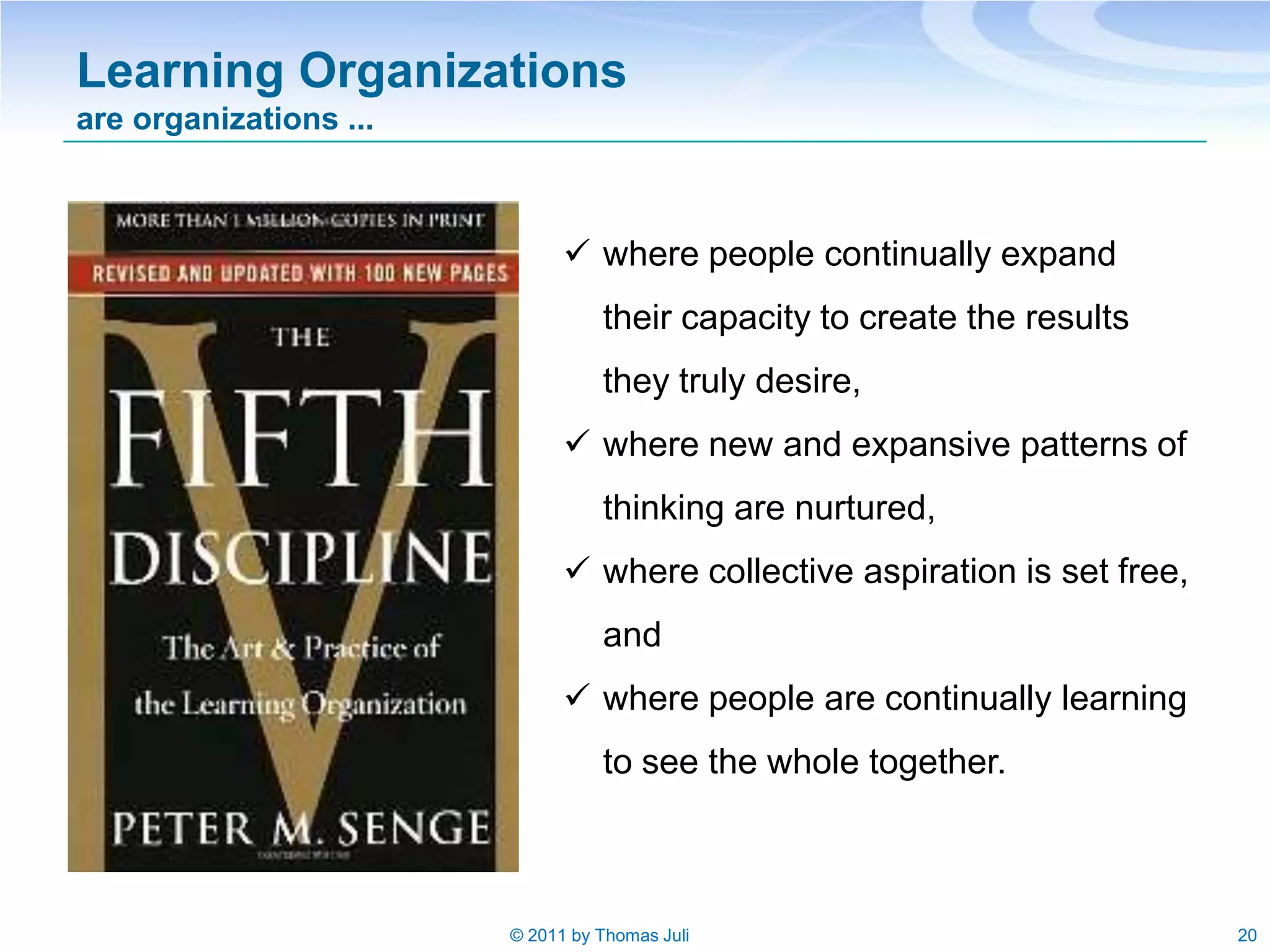
Learning Organizations
are organizations ...


                               where people continually expand
                                  their capacity to create the results
                                  they truly desire,
                               where new and expansive patterns of
                                  thinking are nurtured,
                               where collective aspiration is set free,
                                  and
                               where people are continually learning
                                  to see the whole together.


                        © 2011 by Thomas Juli                              20
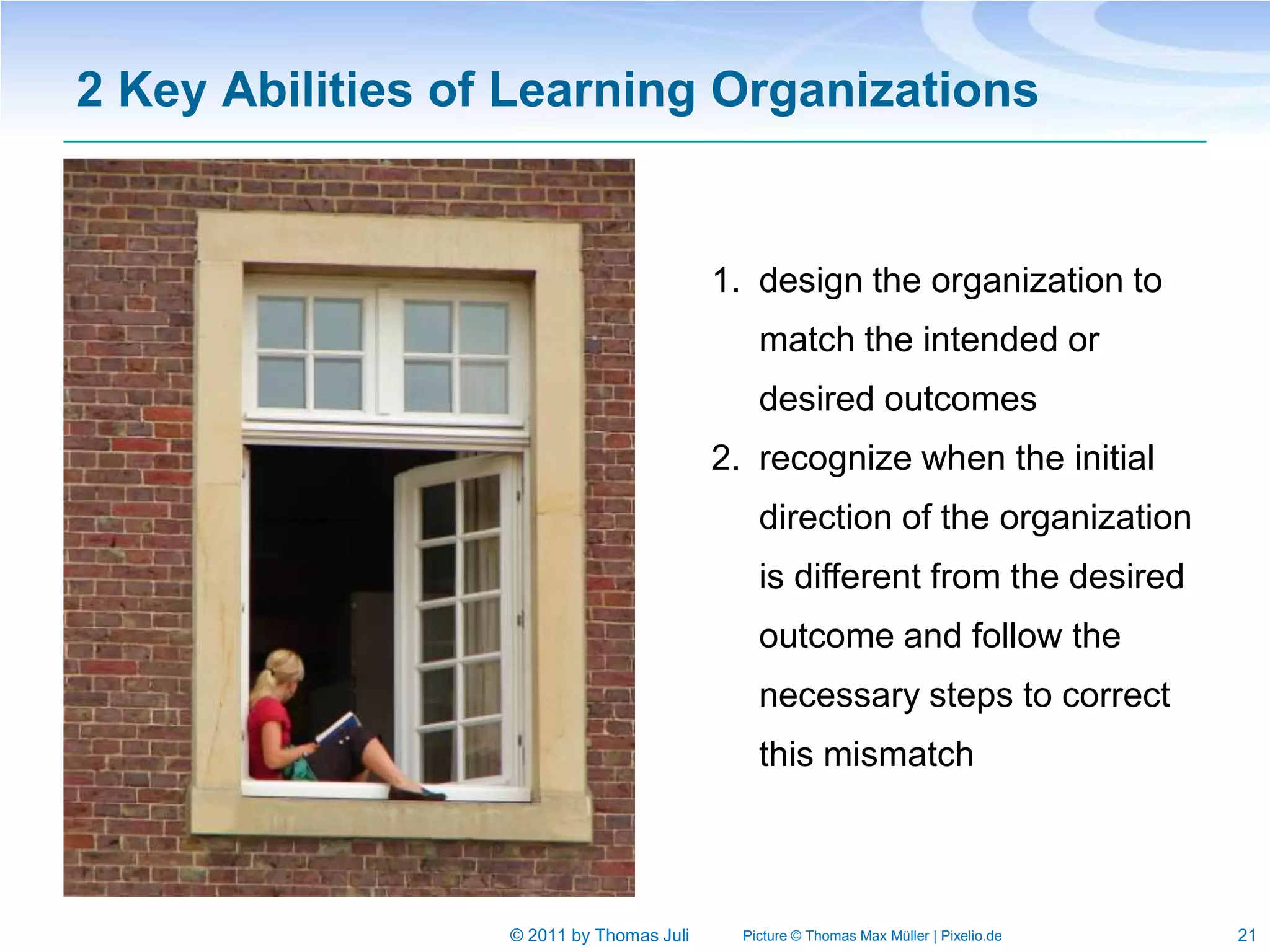
2 Key Abilities of Learning Organizations


                                          1. design the organization to
                                              match the intended or
                                              desired outcomes
                                          2. recognize when the initial
                                              direction of the organization
                                              is different from the desired
                                              outcome and follow the
                                              necessary steps to correct
                                              this mismatch


                  © 2011 by Thomas Juli     Picture © Thomas Max Müller | Pixelio.de   21
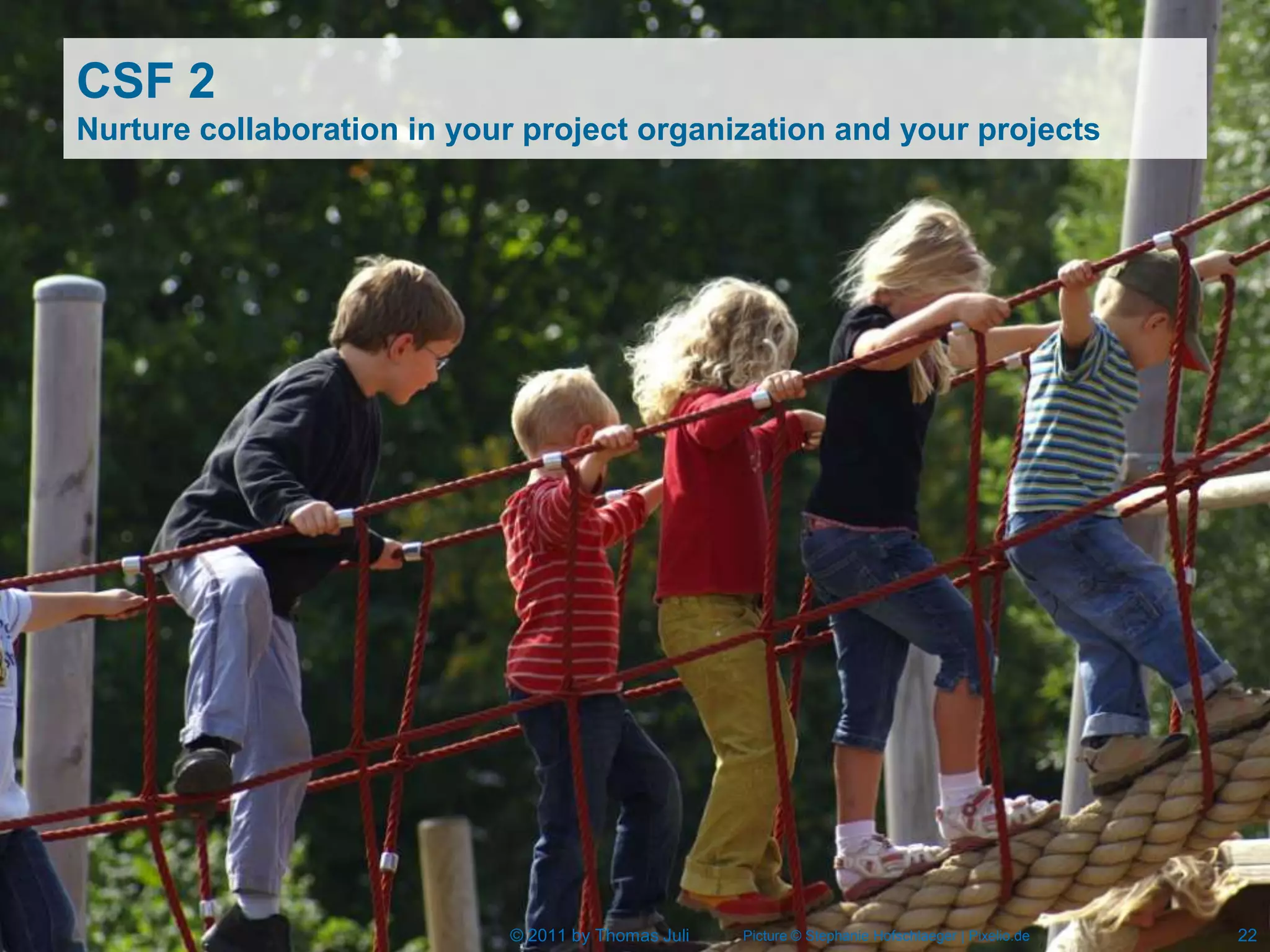
CSF 2
Nurture collaboration in your project organization and your projects


                            © 2011 by Thomas Juli   Picture © Stephanie Hofschlaeger | Pixelio.de   22
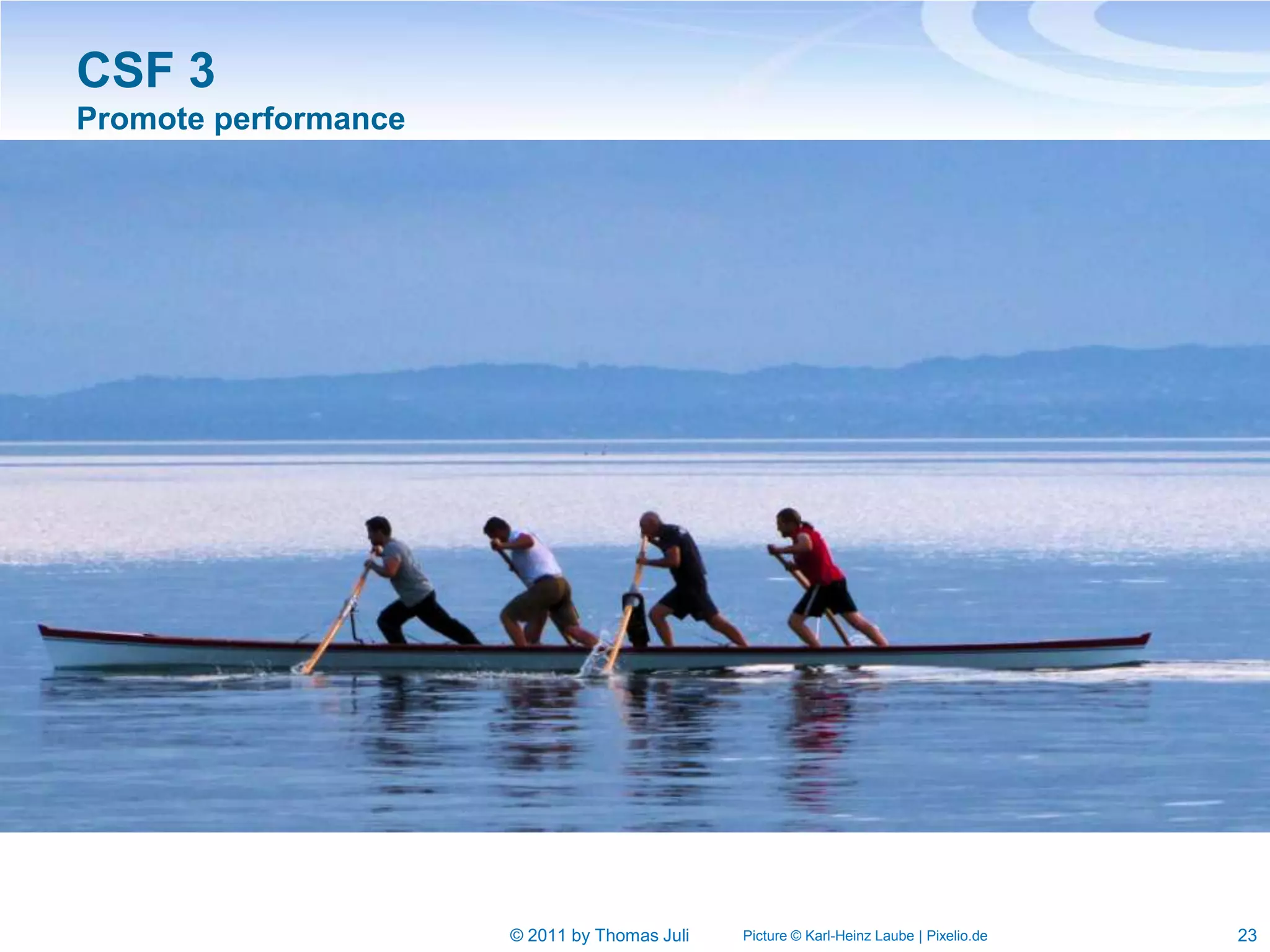
CSF 3
Promote performance


                      © 2011 by Thomas Juli   Picture © Karl-Heinz Laube | Pixelio.de   23
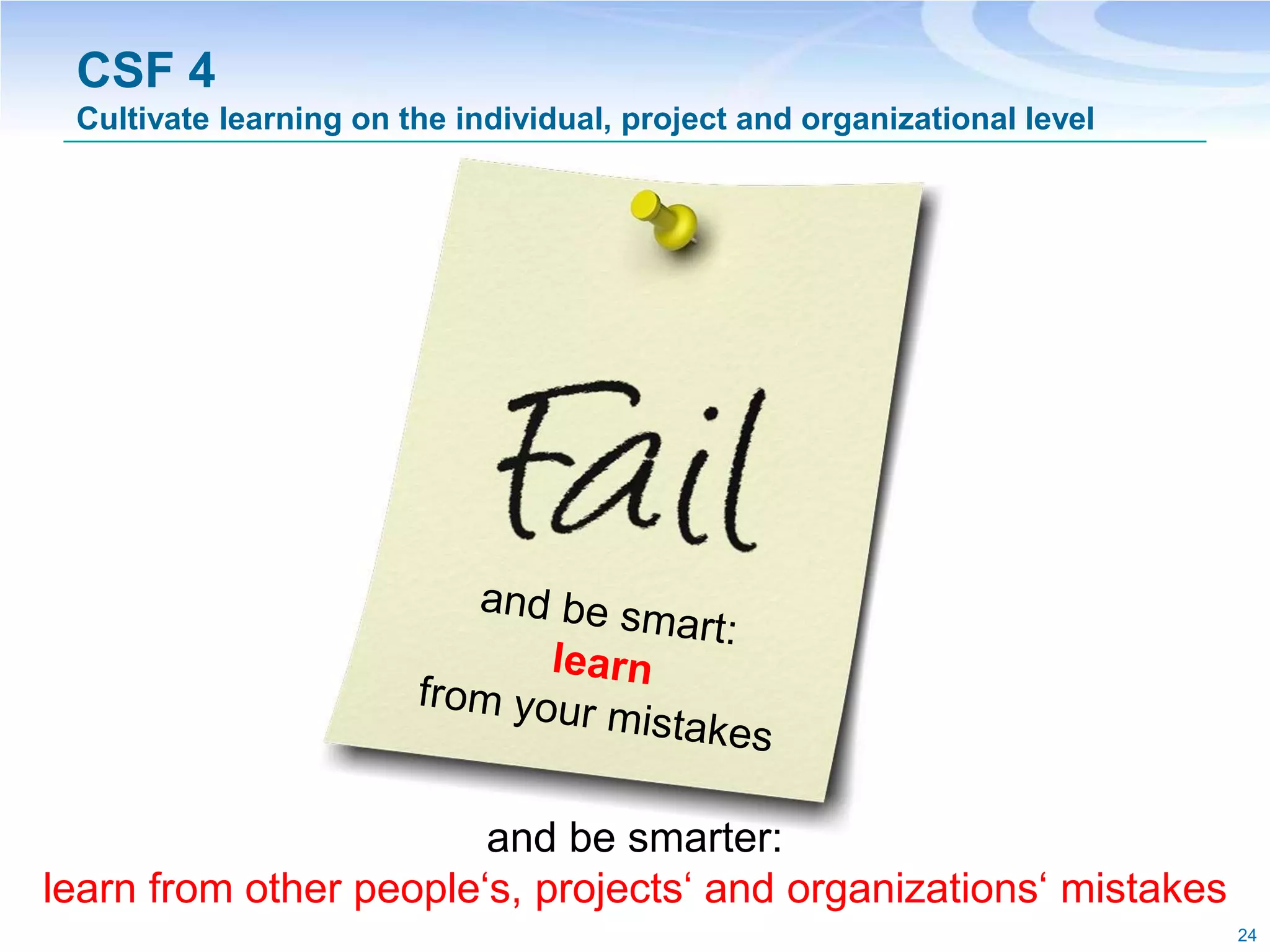
CSF 4
 Cultivate learning on the individual, project and organizational level


                        and be smarter:
learn from other people‘s, projects‘ and organizations‘ mistakes
                                                                          24
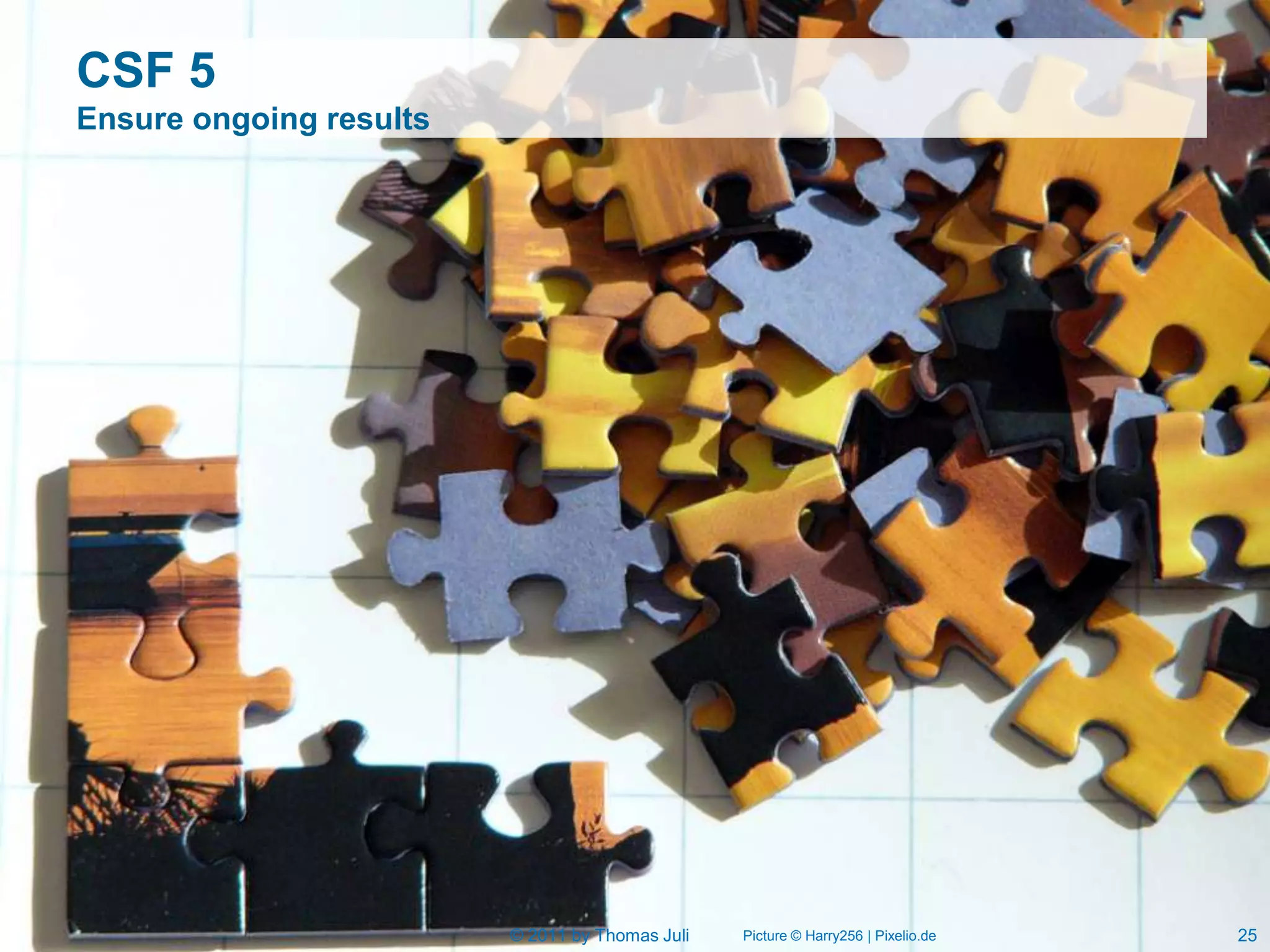
CSF 5
Ensure ongoing results


                         © 2011 by Thomas Juli   Picture © Harry256 | Pixelio.de   25
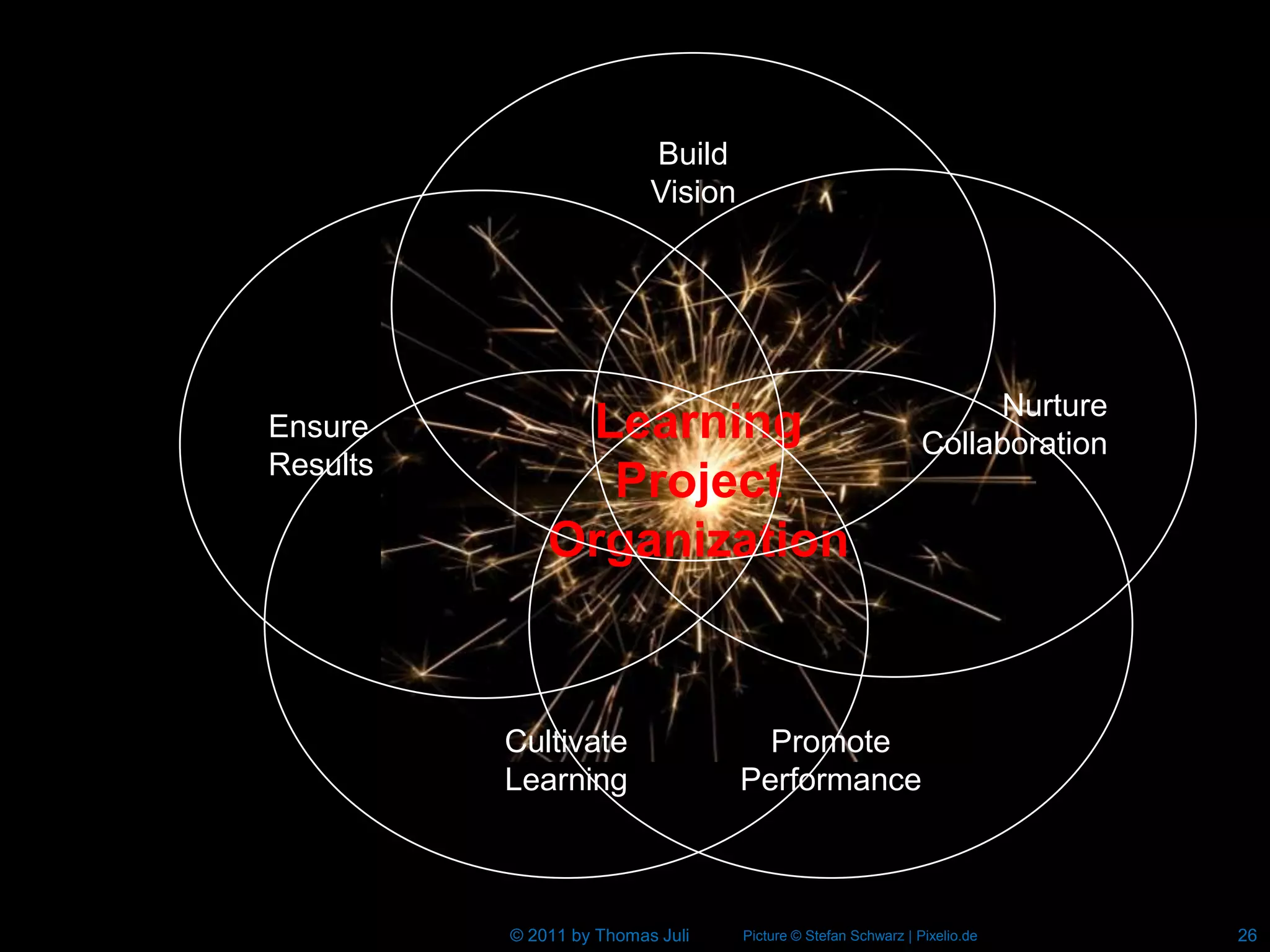
Build
                          Vision


                                                                    Nurture
Ensure         Learning                                        Collaboration
Results
                Project
              Organization


          Cultivate                  Promote
          Learning                 Performance


          © 2011 by Thomas Juli    Picture © Stefan Schwarz | Pixelio.de       26
Tools to Grow a Learning Culture


                 © 2011 by Thomas Juli   Picture © Matthias Balzer | Pixelio.de   27
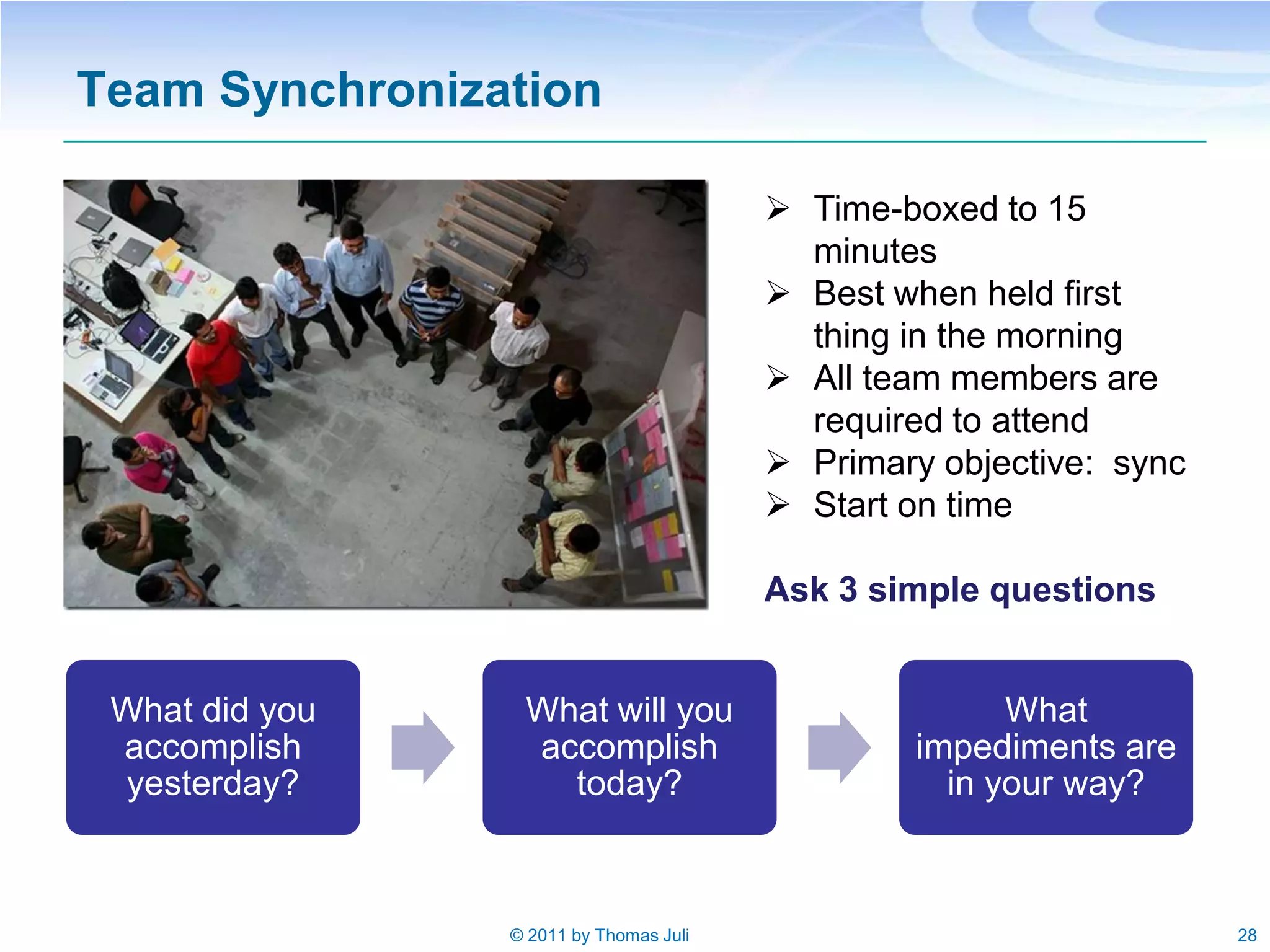
Team Synchronization

                                         Time-boxed to 15
                                          minutes
                                         Best when held first
                                          thing in the morning
                                         All team members are
                                          required to attend
                                         Primary objective: sync
                                         Start on time

                                        Ask 3 simple questions


 What did you    What will you                        What
 accomplish      accomplish                     impediments are
 yesterday?        today?                         in your way?


                © 2011 by Thomas Juli                               28
Status Reporting as a Learning Tool


                 © 2011 by Thomas Juli   Picture © Gerd Altmann | Pixelio.de   29
Internal Project Reviews


                           32
External Project Reviews
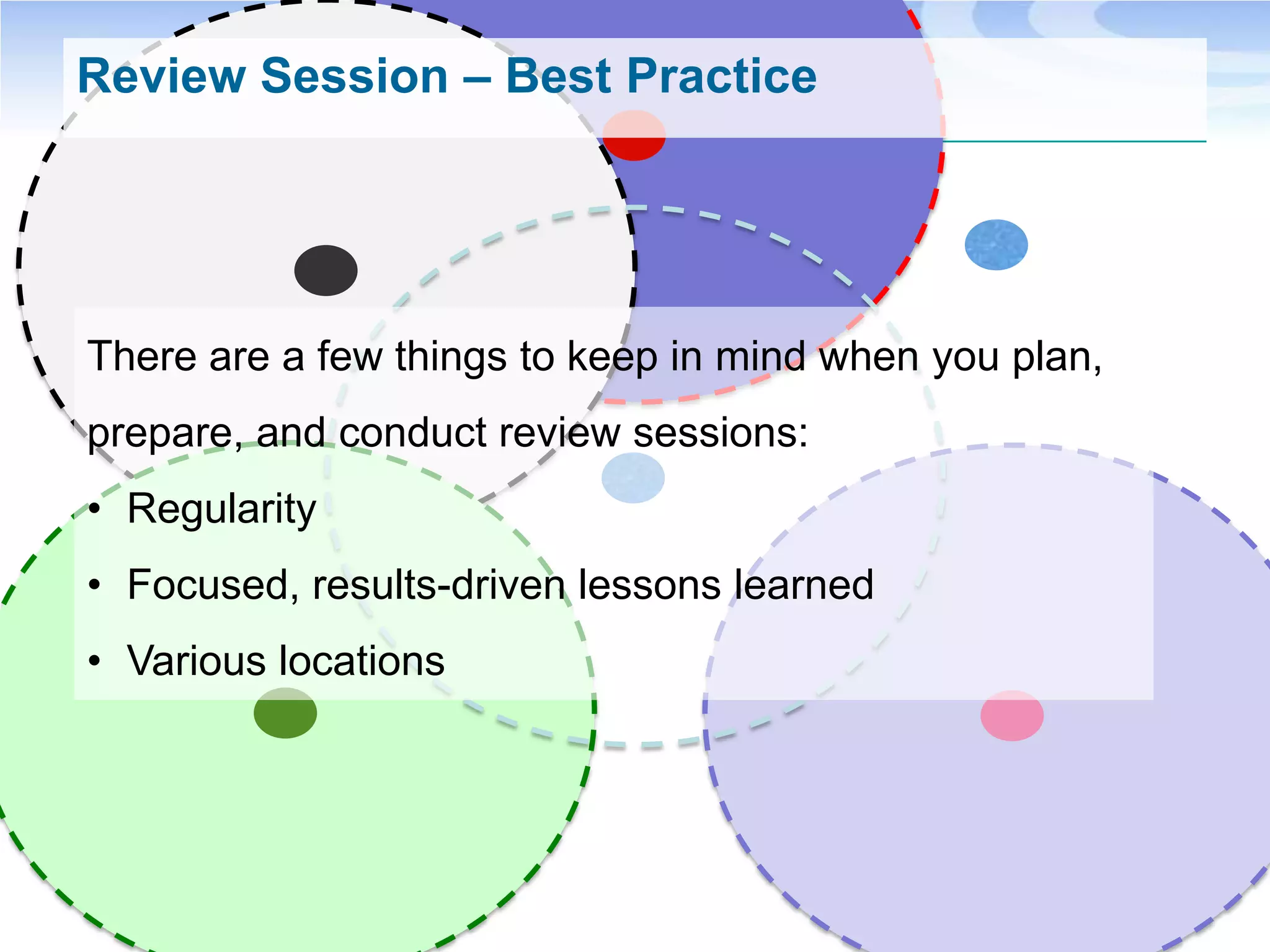
Review Session – Best Practice


There are a few things to keep in mind when you plan,
prepare, and conduct review sessions:
• Regularity
• Focused, results-driven lessons learned
• Various locations
Training


           36
Learning and Innovation


                 © 2011 by Thomas Juli   Picture © Gerd Altmann | Pixelio.de   37
Emerging Futures


  „We have the need to sense our own emerging future in order to meet

  today‘s challenges. ...
  In this kind of ... environment, making decisions based on the habits
  of past experience is no longer optimal – or wise. ...
  You need to develop the capacity to avoid imposing old frameworks
  on new realities.“
  Senge et al (2005), Presence, page 84


                                          © 2011 by Thomas Juli   Picture © Andreas Trapp | Pixelio.de   38
Emerging Futures


  „We have the need to sense our own emerging future in order to meet

  today‘s challenges. ...
  In this kind of ... environment, making decisions based on the habits
  of past experience is no longer optimal – or wise. ...
  You need to develop the capacity to avoid imposing old frameworks
  on new realities.“
  Senge et al (2005), Presence, page 84


                                                                          39
Learning Challenges


                © 2011 by Thomas Juli   Picture © Kunstart | Pixelio.de   40
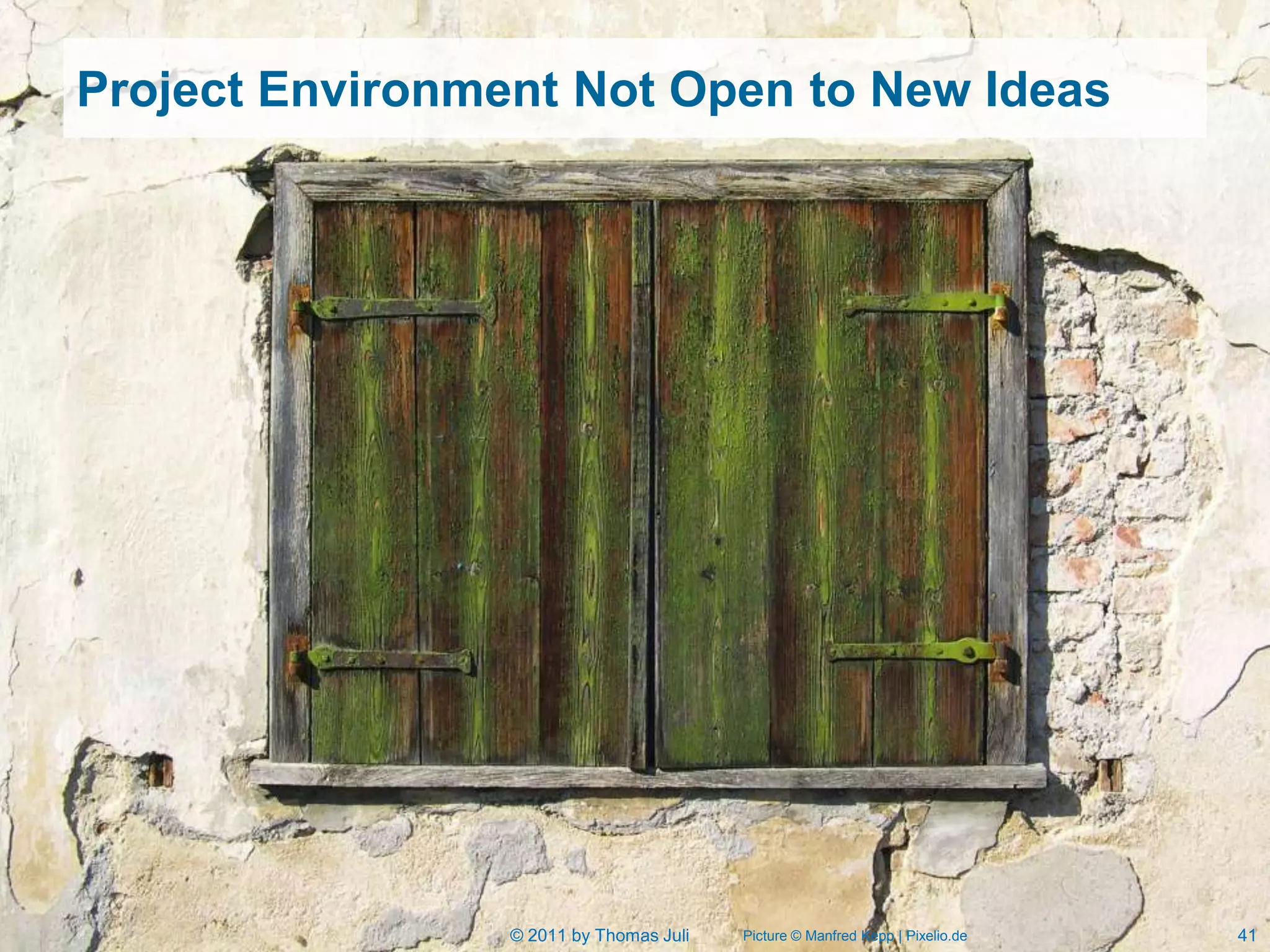
Project Environment Not Open to New Ideas


                 © 2011 by Thomas Juli   Picture © Manfred Kepp | Pixelio.de   41
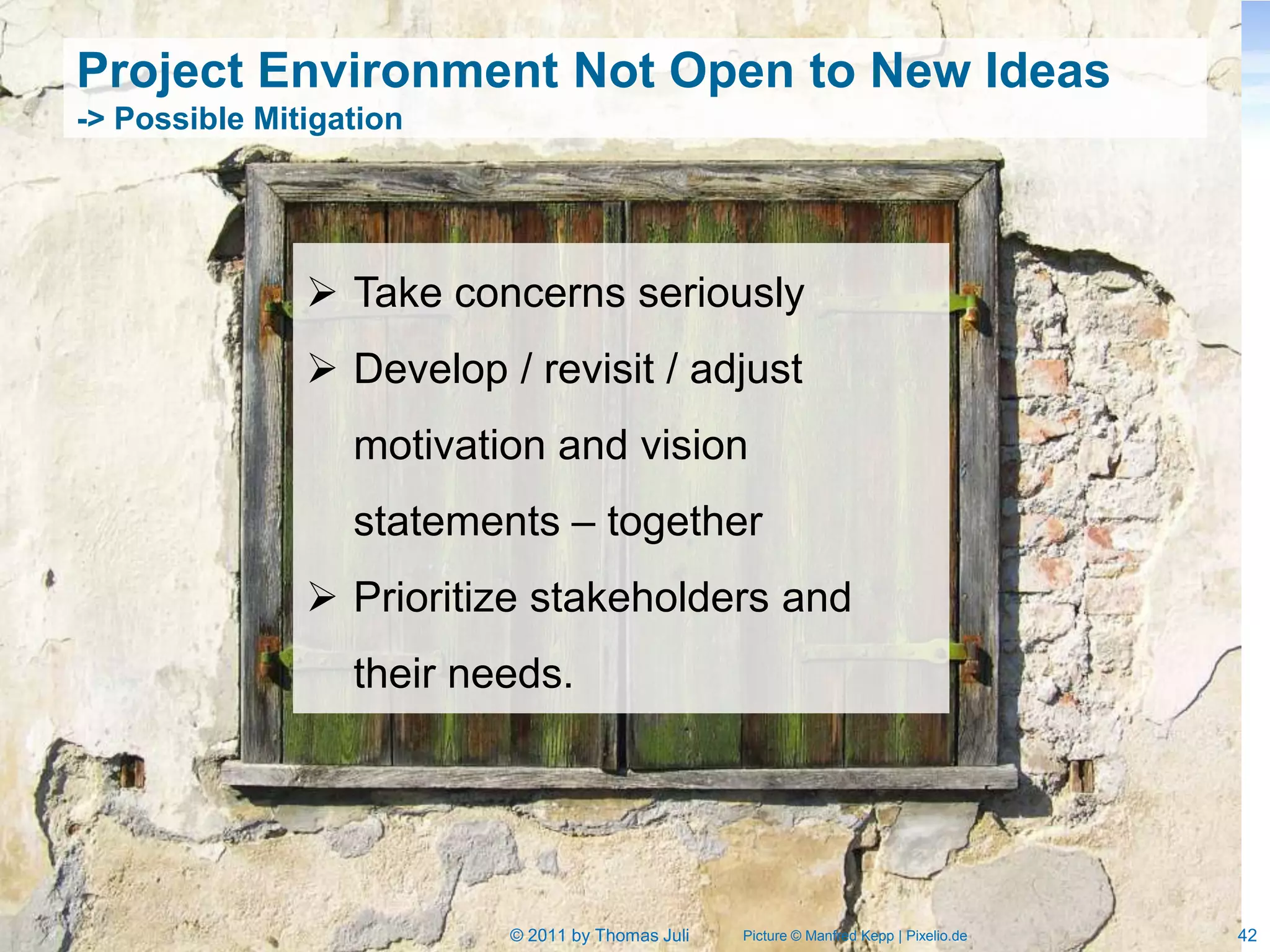
Project Environment Not Open to New Ideas
-> Possible Mitigation


                Take concerns seriously
                Develop / revisit / adjust
                  motivation and vision
                  statements – together
                Prioritize stakeholders and
                  their needs.


                          © 2011 by Thomas Juli   Picture © Manfred Kepp | Pixelio.de   42
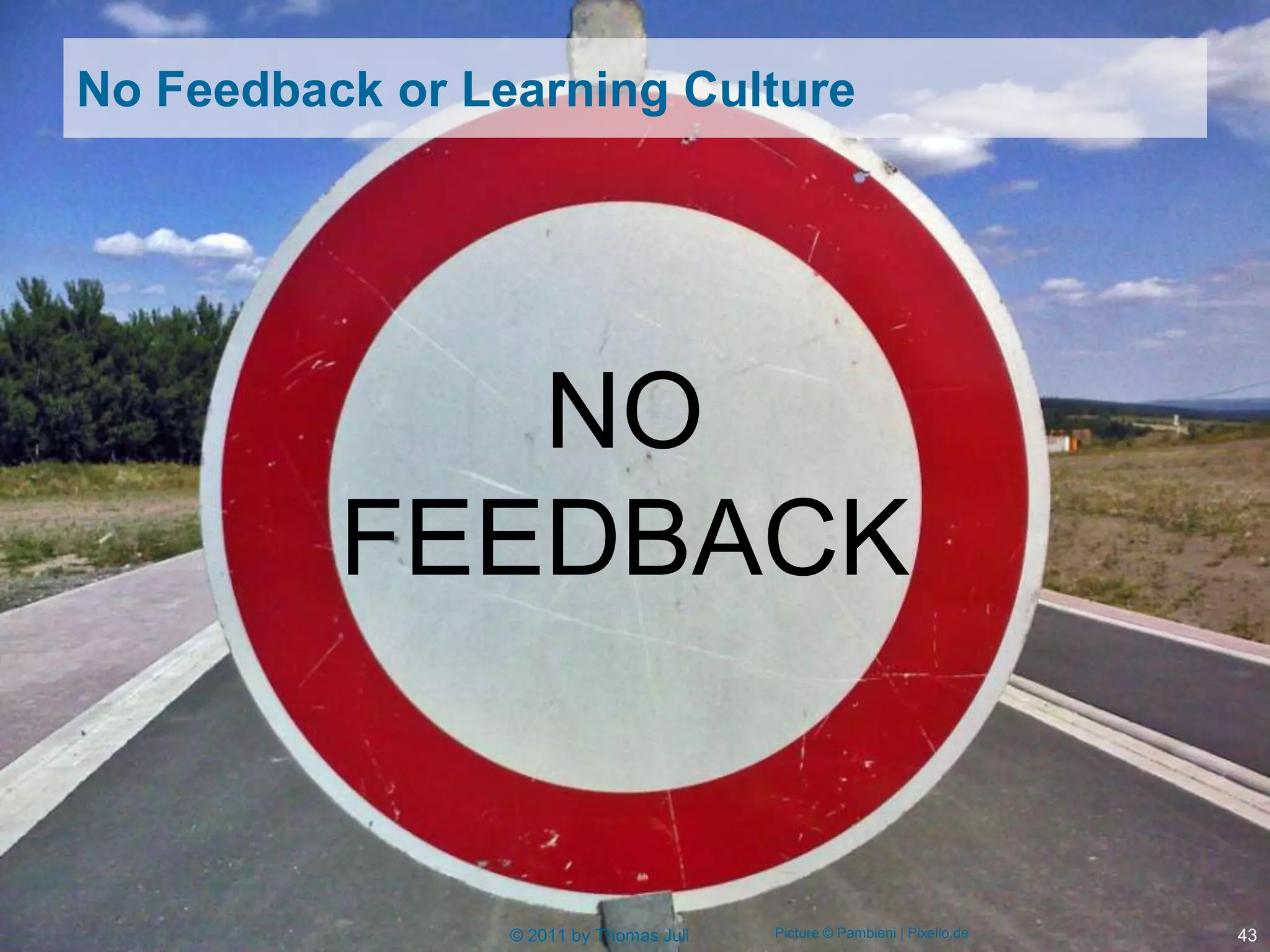
No Feedback or Learning Culture


             NO
          FEEDBACK


                 © 2011 by Thomas Juli   Picture © Pambieni | Pixelio.de   43
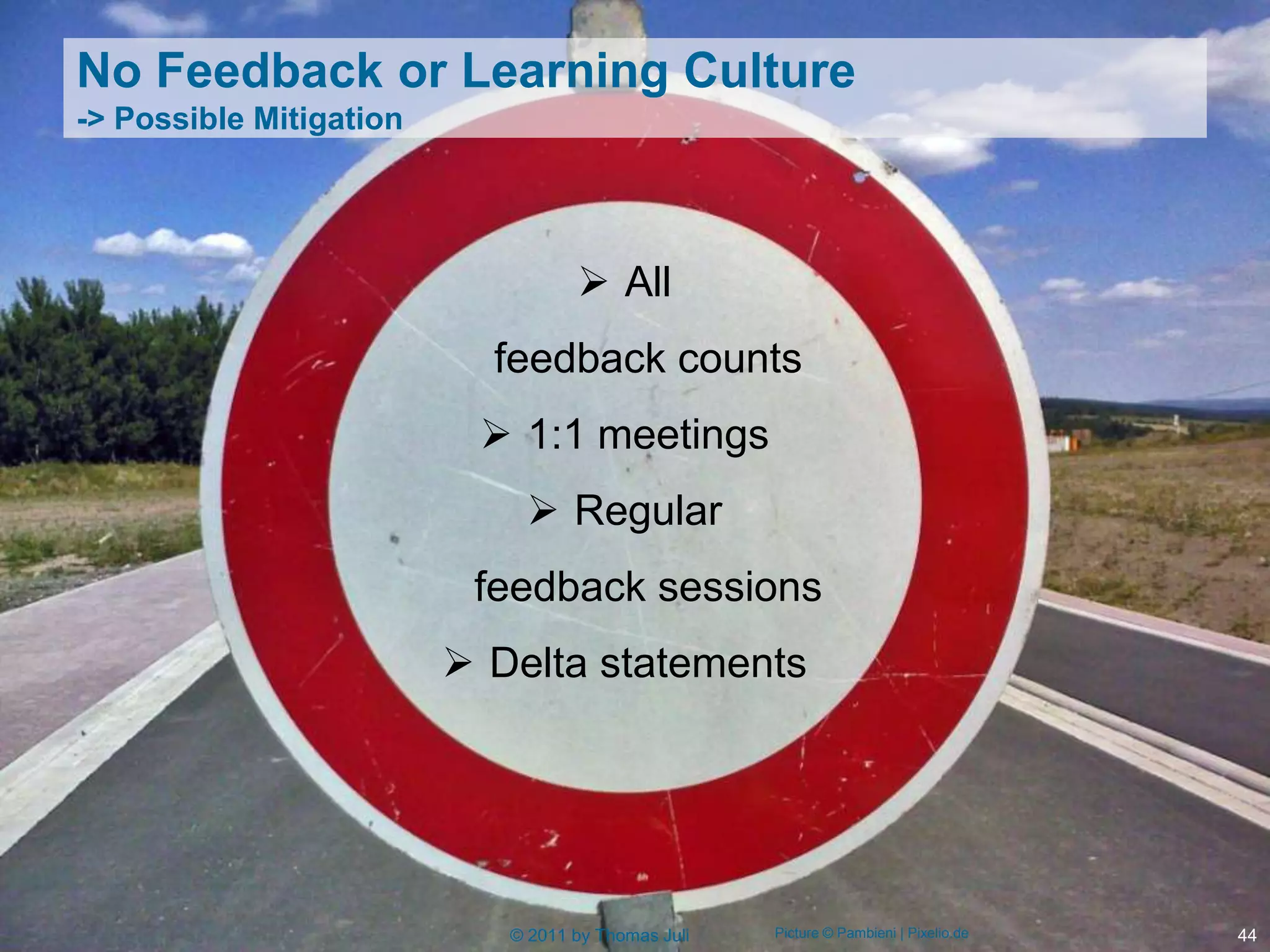
No Feedback or Learning Culture
-> Possible Mitigation


                                    All
                           feedback counts
                           1:1 meetings
                              Regular
                          feedback sessions
                          Delta statements


                            © 2011 by Thomas Juli   Picture © Pambieni | Pixelio.de   44
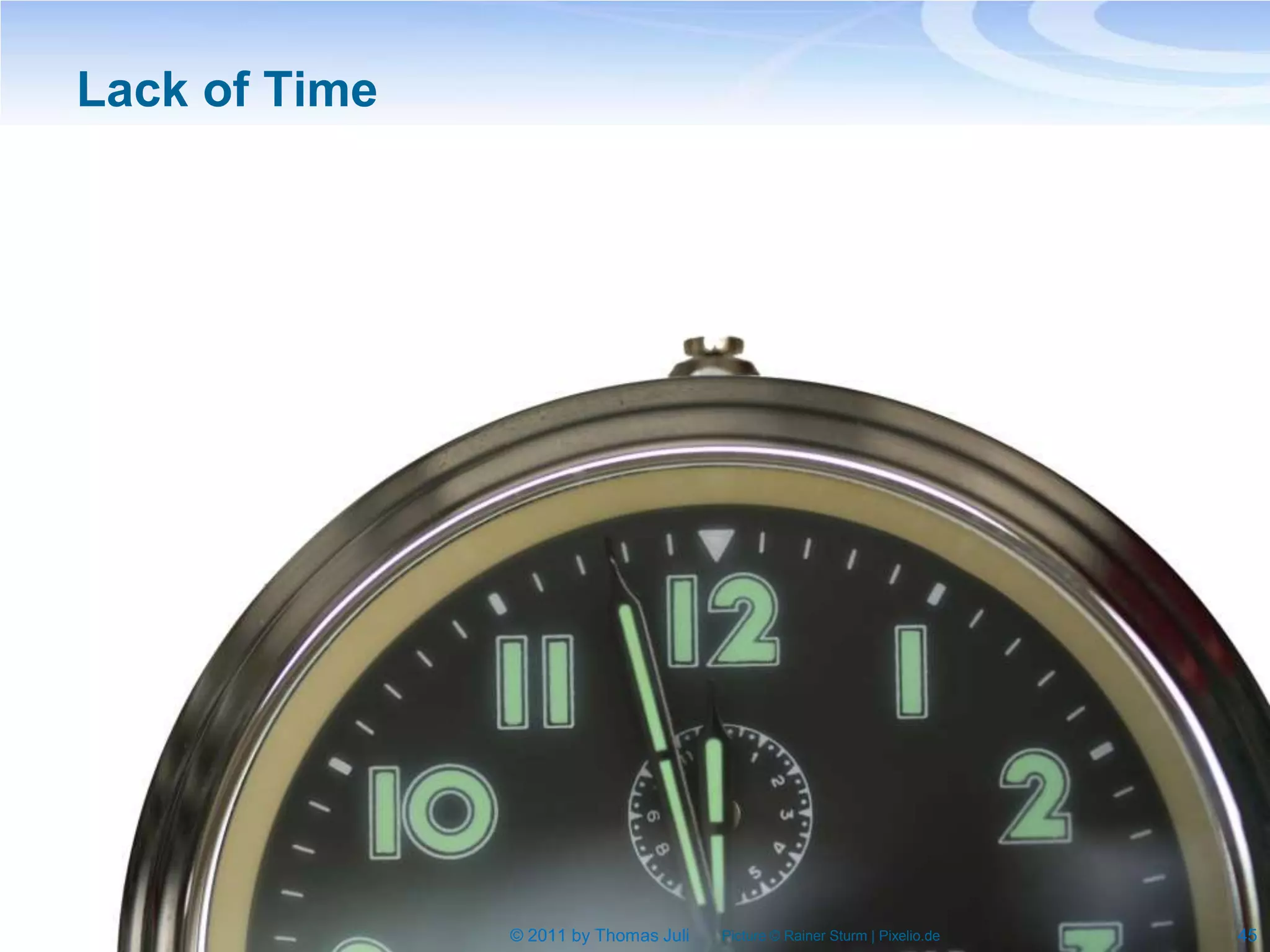
Lack of Time


               © 2011 by Thomas Juli   Picture © Rainer Sturm | Pixelio.de   45
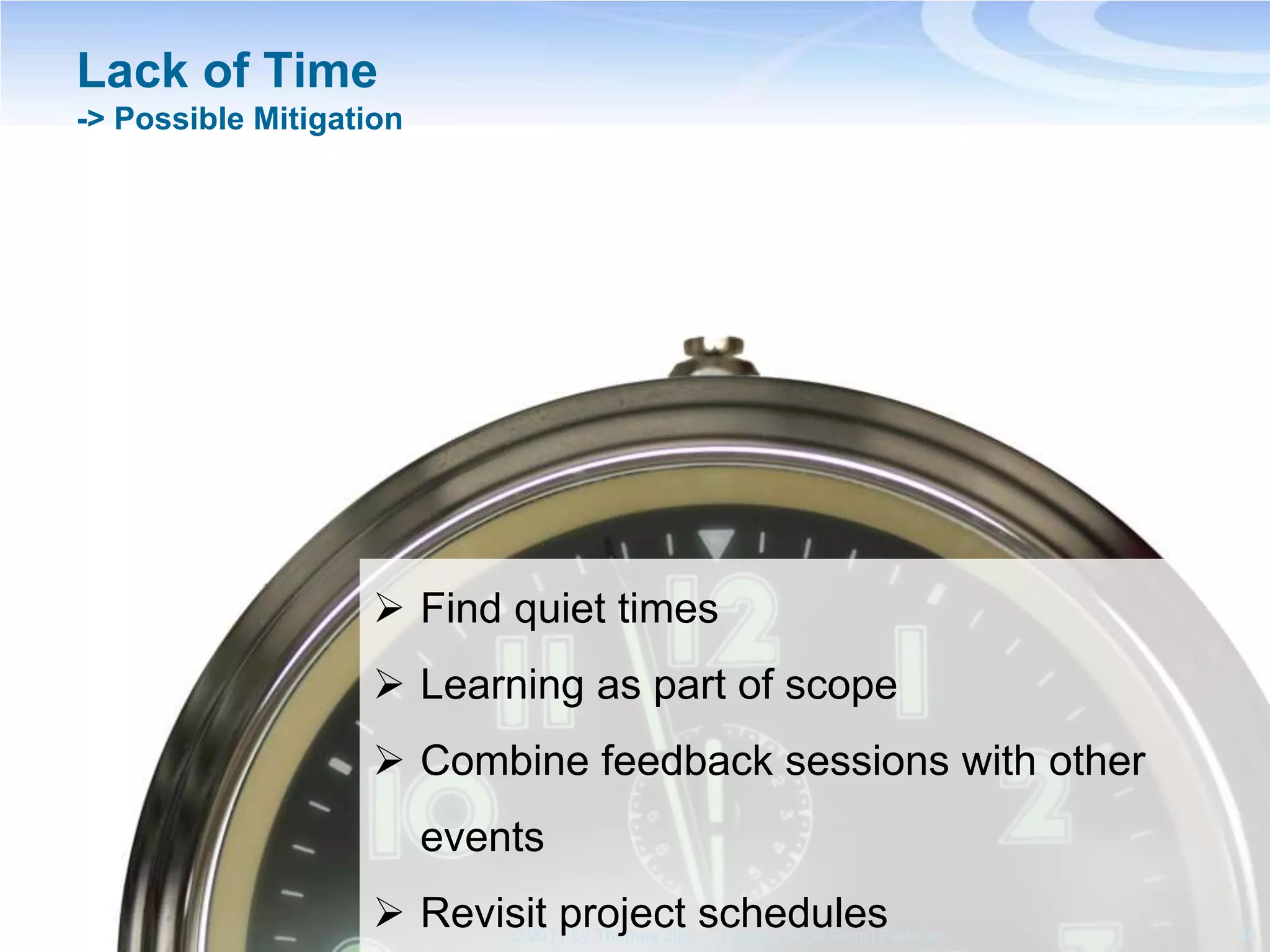
Lack of Time
-> Possible Mitigation


                    Find quiet times
                    Learning as part of scope
                    Combine feedback sessions with other
                         events
                    Revisit project schedules
                         © 2011 by Thomas Juli
                                        Picture © Rainer Sturm | Pixelio.de   46
„What do you do as a leader in order to support a
fast paced innovation process?
What is your leadership work?“

A good reply:

„My real leadership work is that I facilitate the
opening process.“


                     © 2011 by Thomas Juli          47
© 2011 by Thomas Juli   48
Picture retrieved from http://tinyurl.com/5rjt8pa   49
© 2011 by Thomas Juli
© 2011 by Thomas Juli   Picture © Bernd Boscolo | Pixelio.de   50
© 2011 by Thomas Juli   Picture © ViewFotoCommunity-877619   51
© 2011 by Thomas Juli   Picture © Stephanie Hofschläger | Pixelio.de   52
Picture © Stephanie Hofschläger | Pixelio.de

The Good and Evil of
Picture © Stephanie Hofschläger | Pixelio.de

The Good and Evil of
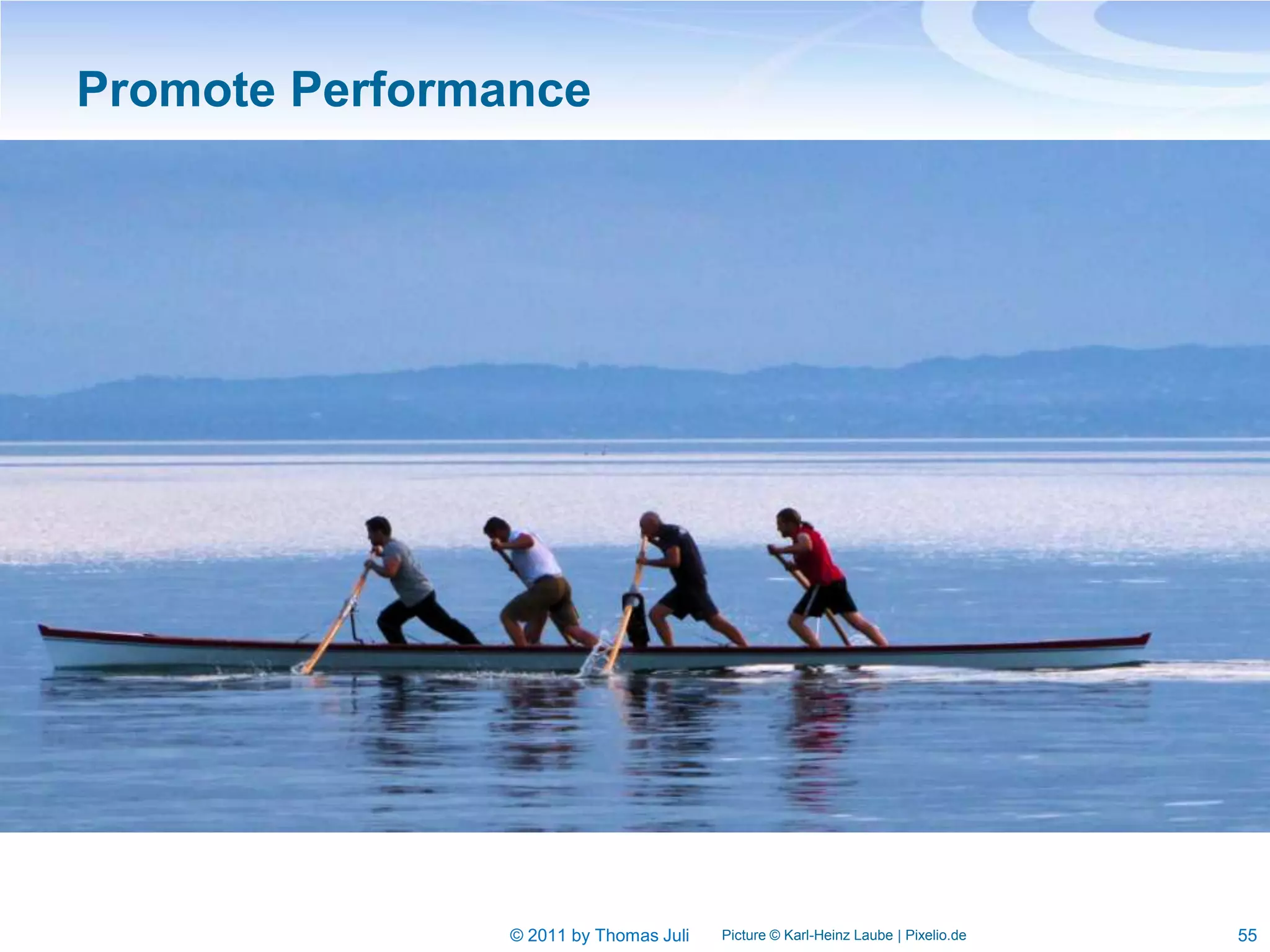
Promote Performance


                © 2011 by Thomas Juli   Picture © Karl-Heinz Laube | Pixelio.de   55
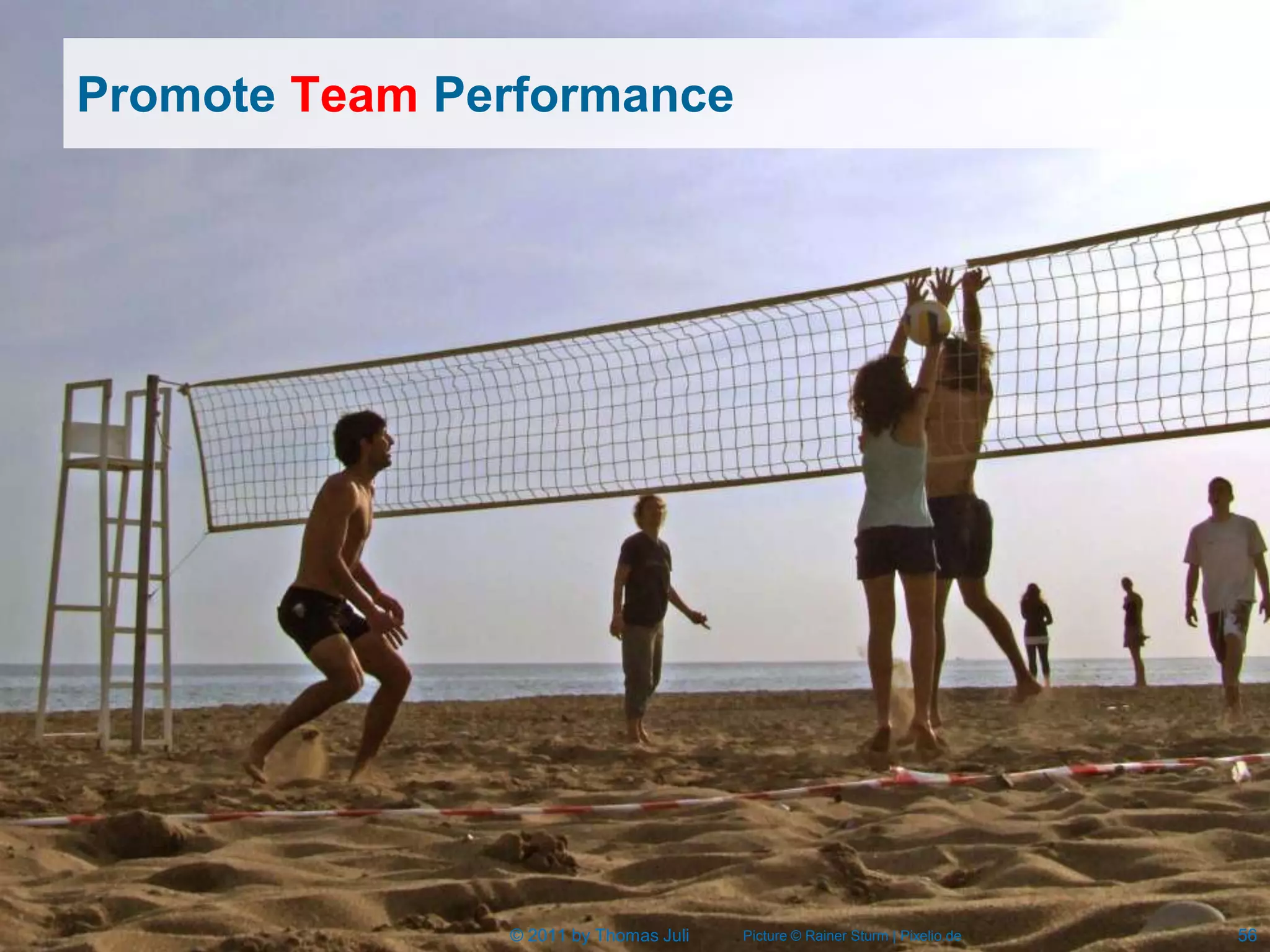
Promote Team Performance


               © 2011 by Thomas Juli   Picture © Rainer Sturm | Pixelio.de   56
And Have Fun!


                © 2011 by Thomas Juli   Picture © Rainer Sturm | Pixelio.de   57
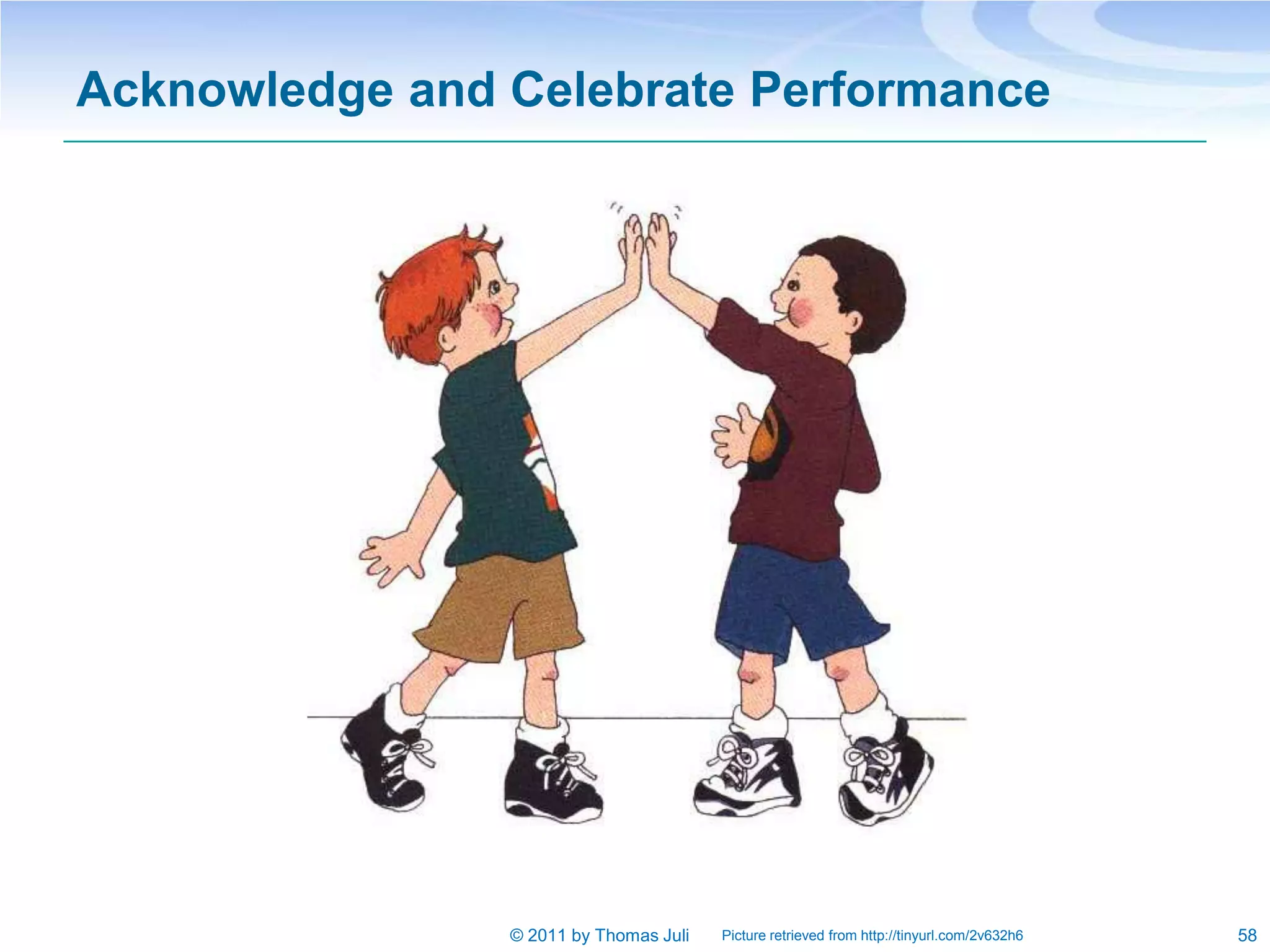
Acknowledge and Celebrate Performance


                © 2011 by Thomas Juli   Picture retrieved from http://tinyurl.com/2v632h6   58
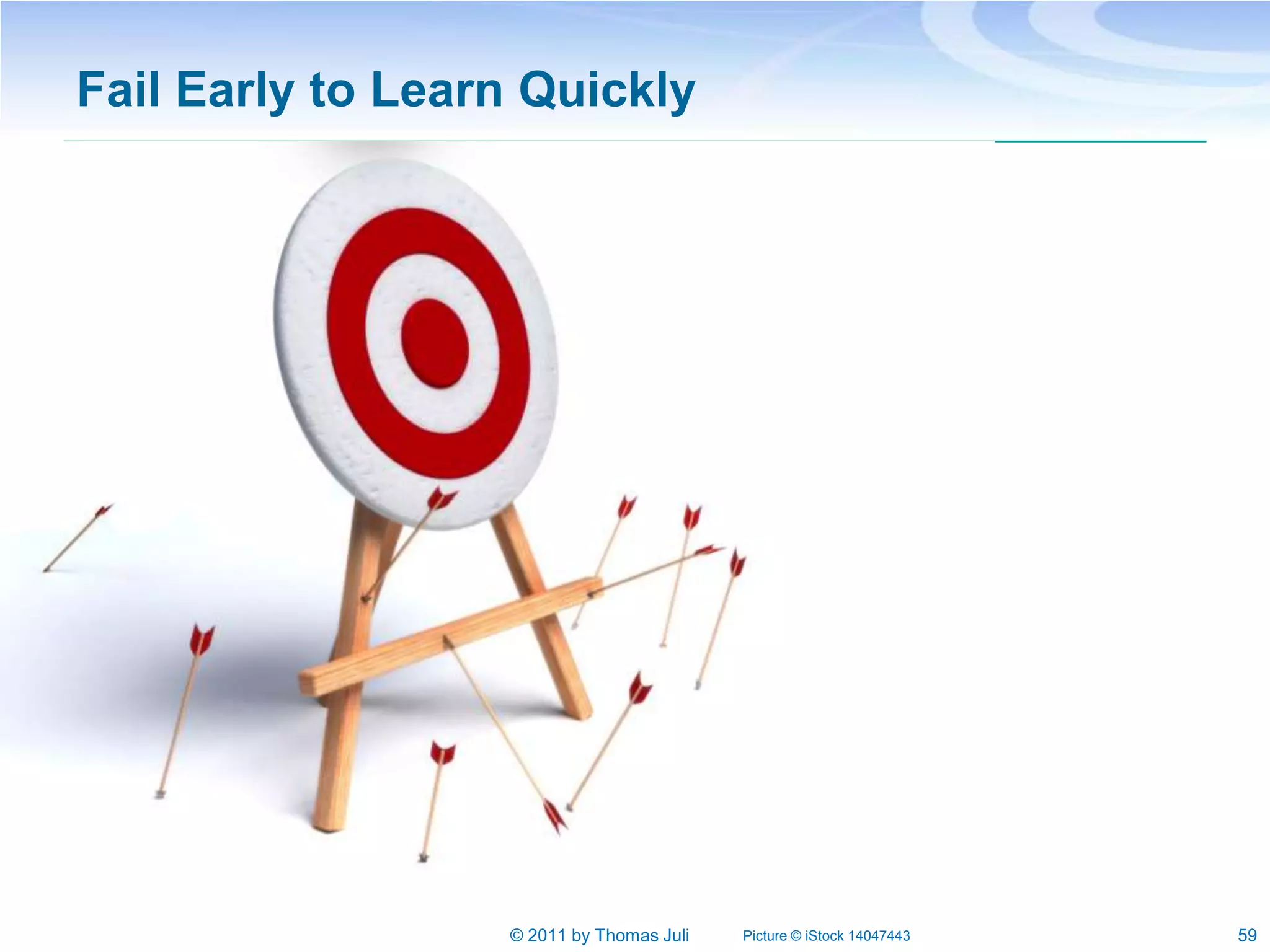
Fail Early to Learn Quickly


                  © 2011 by Thomas Juli   Picture © iStock 14047443   59
Take small steps
Ensure Ongoing Results... one at a time


                     © 2011 by Thomas Juli © NASA
                                    Picture         60
Grow a Learning Culture
in a Project Organization


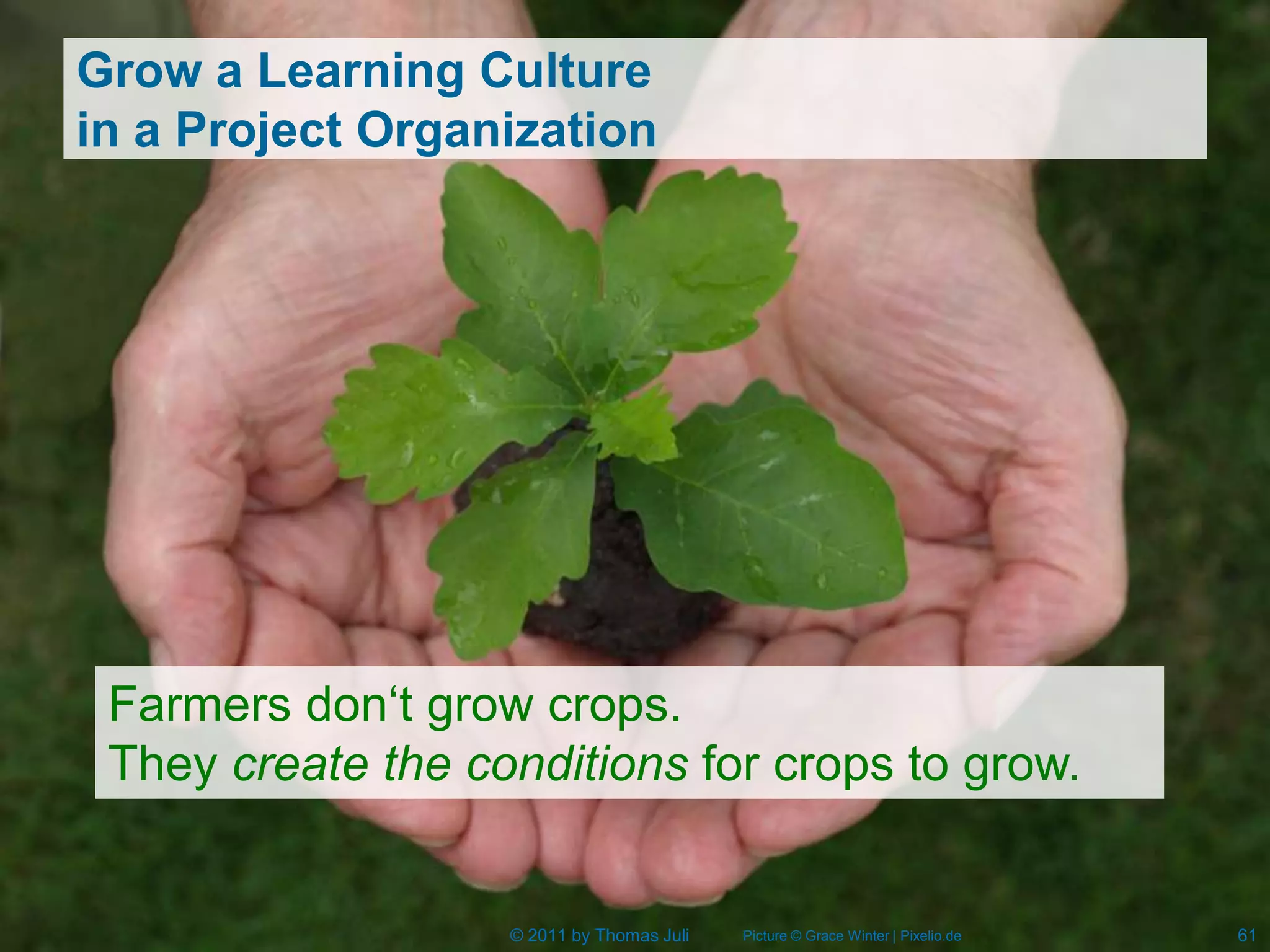
 Farmers don‘t grow crops.
 They create the conditions for crops to grow.


                   © 2011 by Thomas Juli   Picture © Grace Winter | Pixelio.de   61
Prerequisite for Project Success


Actively create a culture of learning


                     © 2011 by Thomas Juli   Picture © Michael Ottersbach| Pixelio.de   62
© 2011 by Thomas Juli   63
Ignite Sparks of Innovation


                   Don‘t talk. – ACT!
                  © 2011 by Thomas Juli   Picture © Gerd Altmann | Pixelio.de   64
References & Book Recommendations


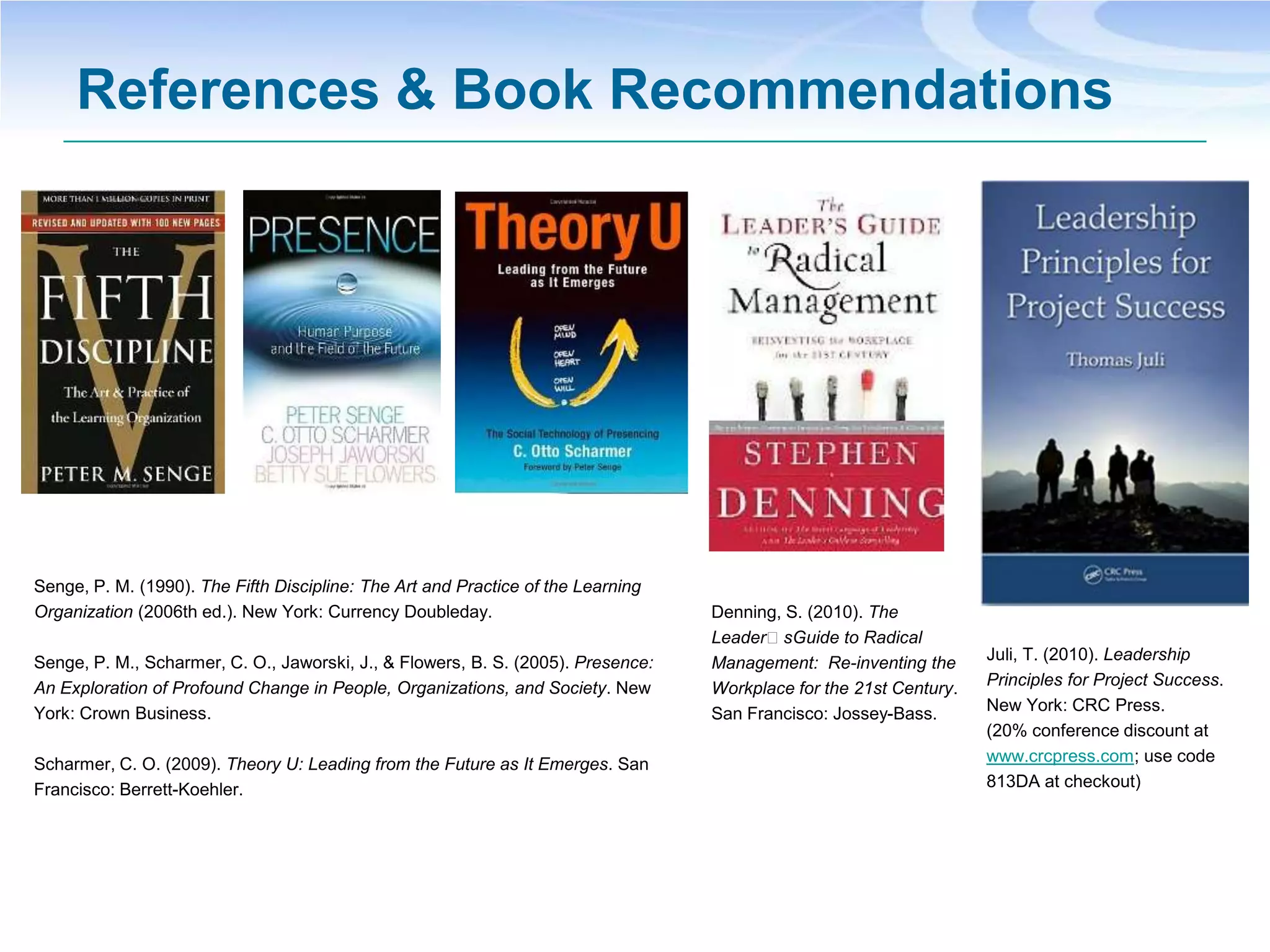
Senge, P. M. (1990). The Fifth Discipline: The Art and Practice of the Learning
Organization (2006th ed.). New York: Currency Doubleday.                          Denning, S. (2010). The
                                                                                  LeaderʼsGuide to Radical
Senge, P. M., Scharmer, C. O., Jaworski, J., & Flowers, B. S. (2005). Presence:   Management: Re-inventing the      Juli, T. (2010). Leadership
An Exploration of Profound Change in People, Organizations, and Society. New      Workplace for the 21st Century.   Principles for Project Success.
York: Crown Business.                                                             San Francisco: Jossey-Bass.       New York: CRC Press.
                                                                                                                    (20% conference discount at
Scharmer, C. O. (2009). Theory U: Leading from the Future as It Emerges. San                                        www.crcpress.com; use code
Francisco: Berrett-Koehler.                                                                                         813DA at checkout)
Thomas Juli, Ph.D., PMP®, CSM®
Managing Director, Thomas Juli Empowerment Partners
Co-Founder, i-Sparks LLC


                                 Web:
                                 www.ThomasJuli.com
                                 www.TheProjectLeadershipPyramid.net
                                 www.i-Sparks.com

                                 Blog:
                                 www.thomasjuli.wordpress.com
                                 Email: tj@thomasjuli.com
                                 Twitter: thomasjuli, i_sparks
                                 LinkedIn
                                 Xing
                                 Phone: +49 (0)15 15 16 333 22


                                  © 2011 by Thomas Juli   Picture of sparks © Stefan Schwarz | Pixelio.de   66

The Learning Project Organization

  • 1.
    The Learning ProjectOrganization Session ISS 13 Thomas Juli, Ph.D., PMP®, CSM® Thomas Juli Empowerment Partners & i-Sparks
  • 2.
    Why Learn? © 2011 by Thomas Juli 2
  • 3.
    © 2011 byby Thomas Juli © 2011 Thomas Juli Picture © Sabrina Gonstalla | Pixelio.de 3
  • 4.
    Grow a LearningCulture in a Project Organization Farmers don‘t grow crops. They create the conditions for crops to grow. © 2011 by Thomas Juli Picture © Grace Winter | Pixelio.de 4
  • 5.
    Prerequisite for ProjectSuccess Actively create a culture of learning © 2011 by Thomas Juli Picture © Michael Ottersbach| Pixelio.de 5
  • 6.
    This Session WeWill Look At © 2011 by Thomas Juli Picture © WRW | Pixelio.de 6
  • 7.
    This Session WeWill Look At o Critical success factors for a learning project organization o Tools to help cultivate learning o Innovation and learning o Learning challenges © 2011 by Thomas Juli Picture © WRW | Pixelio.de 7
  • 8.
    Critical Success Factors(CSF) for a Learning Project Organization © 2011 by Thomas Juli Picture © Rainer Sturm | Pixelio.de
  • 9.
    CSF 1 Build a common vision of and for your project organization . © 2011 by Thomas Juli Photo retrieved from http://tinyurl.com/39uvg8c 9
  • 10.
    Motivation Statement What is your driver behind creating a project organization? Motivation Statement The issue(s) of … 2. Who 3. What are the impacts of 1. What are the issues your (individuals, groups, organiz these issues or risks on project organization attempts ational units, etc.) is affected them? What happens if to resolve? Why? by these issues or risks and these issues could not be affect(s) … how? Why? resolved? Why? The impact(s) of which is (are) … © 2011 by Thomas Juli 10
  • 11.
    Organizational Pathology ofLearning - or - What happens if you don‘t learn © 2011 by Thomas Juli 11
  • 12.
    Organizational Pathology ofLearning - or - What happens if you don‘t learn © 2011 by Thomas Juli Picture © Rainer Sturm | Pixelio.de 12
  • 13.
    Organizational Pathology ofLearning - or - What happens if you don‘t learn 1. Institutional / organizational ignorance: not seeing what‘s going on © 2011 by Thomas Juli Picture © Rainer Sturm | Pixelio.de 13
  • 14.
    Organizational Pathology ofLearning - or - What happens if you don‘t learn 1. Institutional / organizational ignorance: not seeing what‘s going on 2. Institutional arrogance: no capacity for sensing, reflection, and dialogue © 2011 by Thomas Juli Picture © Rainer Sturm | Pixelio.de 14
  • 15.
    Organizational Pathology ofLearning - or - What happens if you don‘t learn 1. Institutional / organizational ignorance: not seeing what‘s going on 2. Institutional arrogance: no capacity for sensing, reflection, and dialogue 3. Institutional hubris: not knowing your authentic self; inflated self-image © 2011 by Thomas Juli Picture © Rainer Sturm | Pixelio.de 15
  • 16.
    Organizational Pathology ofLearning - or - What happens if you don‘t learn 1. Institutional / organizational ignorance: not seeing what‘s going on 2. Institutional arrogance: no capacity for sensing, reflection, and dialogue 3. Institutional hubris: not knowing your authentic self; inflated self-image 4. Institutional disinformation: not serving the whole; self-absorbed © 2011 by Thomas Juli Picture © Rainer Sturm | Pixelio.de 16
  • 17.
    Organizational Pathology ofLearning - or - What happens if you don‘t learn 1. Institutional / organizational ignorance: not seeing what‘s going on 2. Institutional arrogance: no capacity for sensing, reflection, and dialogue 3. Institutional hubris: not knowing your authentic self; inflated self-image 4. Institutional disinformation: not serving the whole; self-absorbed 5. Institutional sclerosis: lack of experimentation and renewal capacity – strategic shifts and significant innovations unavailable © 2011 by Thomas Juli Picture © Rainer Sturm | Pixelio.de 17
  • 18.
    Organizational Pathology ofLearning - or - What happens if you don‘t learn 1. Institutional / organizational ignorance: not seeing what‘s going on 2. Institutional arrogance: no capacity for sensing, reflection, and dialogue 3. Institutional hubris: not knowing your authentic self; inflated self-image 4. Institutional disinformation: not serving the whole; self-absorbed 5. Institutional sclerosis: lack of experimentation and renewal capacity – strategic shifts and significant innovations unavailable 6. Lack of infrastructure / corporate collapse: not focusing on real performance; destruction of structure © 2011 by Thomas Juli Picture © Rainer Sturm | Pixelio.de 18
  • 19.
    Vision Statement What doyou envision for your project organization? Vision Statement The project organization 1. What would be the 2. What benefits can ideal resolution to the we expect from the 3. What do we need to identified root problem improved situation do to achieve this? will (help) … addressed in the and who benefits from Why? Motivation Statement? it? Why? Why? It will benefit … In order to achieve the solution we have to … © 2011 by Thomas Juli 19
  • 20.
    Learning Organizations are organizations...  where people continually expand their capacity to create the results they truly desire,  where new and expansive patterns of thinking are nurtured,  where collective aspiration is set free, and  where people are continually learning to see the whole together. © 2011 by Thomas Juli 20
  • 21.
    2 Key Abilitiesof Learning Organizations 1. design the organization to match the intended or desired outcomes 2. recognize when the initial direction of the organization is different from the desired outcome and follow the necessary steps to correct this mismatch © 2011 by Thomas Juli Picture © Thomas Max Müller | Pixelio.de 21
  • 22.
    CSF 2 Nurture collaborationin your project organization and your projects © 2011 by Thomas Juli Picture © Stephanie Hofschlaeger | Pixelio.de 22
  • 23.
    CSF 3 Promote performance © 2011 by Thomas Juli Picture © Karl-Heinz Laube | Pixelio.de 23
  • 24.
    CSF 4 Cultivatelearning on the individual, project and organizational level and be smarter: learn from other people‘s, projects‘ and organizations‘ mistakes 24
  • 25.
    CSF 5 Ensure ongoingresults © 2011 by Thomas Juli Picture © Harry256 | Pixelio.de 25
  • 26.
    Build Vision Nurture Ensure Learning Collaboration Results Project Organization Cultivate Promote Learning Performance © 2011 by Thomas Juli Picture © Stefan Schwarz | Pixelio.de 26
  • 27.
    Tools to Growa Learning Culture © 2011 by Thomas Juli Picture © Matthias Balzer | Pixelio.de 27
  • 28.
    Team Synchronization  Time-boxed to 15 minutes  Best when held first thing in the morning  All team members are required to attend  Primary objective: sync  Start on time Ask 3 simple questions What did you What will you What accomplish accomplish impediments are yesterday? today? in your way? © 2011 by Thomas Juli 28
  • 29.
    Status Reporting asa Learning Tool © 2011 by Thomas Juli Picture © Gerd Altmann | Pixelio.de 29
  • 30.
  • 31.
  • 32.
  • 33.
  • 34.
  • 35.
    Review Session –Best Practice There are a few things to keep in mind when you plan, prepare, and conduct review sessions: • Regularity • Focused, results-driven lessons learned • Various locations
  • 36.
  • 37.
    Learning and Innovation © 2011 by Thomas Juli Picture © Gerd Altmann | Pixelio.de 37
  • 38.
    Emerging Futures „We have the need to sense our own emerging future in order to meet today‘s challenges. ... In this kind of ... environment, making decisions based on the habits of past experience is no longer optimal – or wise. ... You need to develop the capacity to avoid imposing old frameworks on new realities.“ Senge et al (2005), Presence, page 84 © 2011 by Thomas Juli Picture © Andreas Trapp | Pixelio.de 38
  • 39.
    Emerging Futures „We have the need to sense our own emerging future in order to meet today‘s challenges. ... In this kind of ... environment, making decisions based on the habits of past experience is no longer optimal – or wise. ... You need to develop the capacity to avoid imposing old frameworks on new realities.“ Senge et al (2005), Presence, page 84 39
  • 40.
    Learning Challenges © 2011 by Thomas Juli Picture © Kunstart | Pixelio.de 40
  • 41.
    Project Environment NotOpen to New Ideas © 2011 by Thomas Juli Picture © Manfred Kepp | Pixelio.de 41
  • 42.
    Project Environment NotOpen to New Ideas -> Possible Mitigation  Take concerns seriously  Develop / revisit / adjust motivation and vision statements – together  Prioritize stakeholders and their needs. © 2011 by Thomas Juli Picture © Manfred Kepp | Pixelio.de 42
  • 43.
    No Feedback orLearning Culture NO FEEDBACK © 2011 by Thomas Juli Picture © Pambieni | Pixelio.de 43
  • 44.
    No Feedback orLearning Culture -> Possible Mitigation  All feedback counts  1:1 meetings  Regular feedback sessions  Delta statements © 2011 by Thomas Juli Picture © Pambieni | Pixelio.de 44
  • 45.
    Lack of Time © 2011 by Thomas Juli Picture © Rainer Sturm | Pixelio.de 45
  • 46.
    Lack of Time ->Possible Mitigation  Find quiet times  Learning as part of scope  Combine feedback sessions with other events  Revisit project schedules © 2011 by Thomas Juli Picture © Rainer Sturm | Pixelio.de 46
  • 47.
    „What do youdo as a leader in order to support a fast paced innovation process? What is your leadership work?“ A good reply: „My real leadership work is that I facilitate the opening process.“ © 2011 by Thomas Juli 47
  • 48.
    © 2011 byThomas Juli 48
  • 49.
    Picture retrieved fromhttp://tinyurl.com/5rjt8pa 49
  • 50.
    © 2011 byThomas Juli © 2011 by Thomas Juli Picture © Bernd Boscolo | Pixelio.de 50
  • 51.
    © 2011 byThomas Juli Picture © ViewFotoCommunity-877619 51
  • 52.
    © 2011 byThomas Juli Picture © Stephanie Hofschläger | Pixelio.de 52
  • 53.
    Picture © StephanieHofschläger | Pixelio.de The Good and Evil of
  • 54.
    Picture © StephanieHofschläger | Pixelio.de The Good and Evil of
  • 55.
    Promote Performance © 2011 by Thomas Juli Picture © Karl-Heinz Laube | Pixelio.de 55
  • 56.
    Promote Team Performance © 2011 by Thomas Juli Picture © Rainer Sturm | Pixelio.de 56
  • 57.
    And Have Fun! © 2011 by Thomas Juli Picture © Rainer Sturm | Pixelio.de 57
  • 58.
    Acknowledge and CelebratePerformance © 2011 by Thomas Juli Picture retrieved from http://tinyurl.com/2v632h6 58
  • 59.
    Fail Early toLearn Quickly © 2011 by Thomas Juli Picture © iStock 14047443 59
  • 60.
    Take small steps EnsureOngoing Results... one at a time © 2011 by Thomas Juli © NASA Picture 60
  • 61.
    Grow a LearningCulture in a Project Organization Farmers don‘t grow crops. They create the conditions for crops to grow. © 2011 by Thomas Juli Picture © Grace Winter | Pixelio.de 61
  • 62.
    Prerequisite for ProjectSuccess Actively create a culture of learning © 2011 by Thomas Juli Picture © Michael Ottersbach| Pixelio.de 62
  • 63.
    © 2011 byThomas Juli 63
  • 64.
    Ignite Sparks ofInnovation Don‘t talk. – ACT! © 2011 by Thomas Juli Picture © Gerd Altmann | Pixelio.de 64
  • 65.
    References & BookRecommendations Senge, P. M. (1990). The Fifth Discipline: The Art and Practice of the Learning Organization (2006th ed.). New York: Currency Doubleday. Denning, S. (2010). The LeaderʼsGuide to Radical Senge, P. M., Scharmer, C. O., Jaworski, J., & Flowers, B. S. (2005). Presence: Management: Re-inventing the Juli, T. (2010). Leadership An Exploration of Profound Change in People, Organizations, and Society. New Workplace for the 21st Century. Principles for Project Success. York: Crown Business. San Francisco: Jossey-Bass. New York: CRC Press. (20% conference discount at Scharmer, C. O. (2009). Theory U: Leading from the Future as It Emerges. San www.crcpress.com; use code Francisco: Berrett-Koehler. 813DA at checkout)
  • 66.
    Thomas Juli, Ph.D.,PMP®, CSM® Managing Director, Thomas Juli Empowerment Partners Co-Founder, i-Sparks LLC Web: www.ThomasJuli.com www.TheProjectLeadershipPyramid.net www.i-Sparks.com Blog: www.thomasjuli.wordpress.com Email: tj@thomasjuli.com Twitter: thomasjuli, i_sparks LinkedIn Xing Phone: +49 (0)15 15 16 333 22 © 2011 by Thomas Juli Picture of sparks © Stefan Schwarz | Pixelio.de 66