PROJECT MANAGEMENT [MGT60403 / ARC3614]
PROJECT 2: DOCUMENTATION OF A MEDIUM-SIZED PROJECT
PROPOSED PARKOUR PLAYGROUND AT TAMAN TITIWANGSA
NAME JAMES TAY JIA CHUEN
STUDENT ID 0322210
TUTOR AR. HJH. SATEERAH HJ. HASSAN
Marks for 2 criteria: 1. ____/20% 2. ____/10%
: Total ____/30%
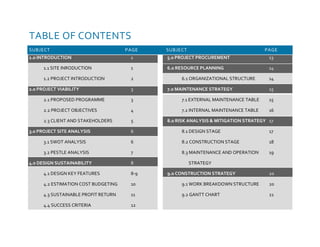
TABLE OF CONTENTS
SUBJECT PAGE SUBJECT PAGE
1.0 INTRODUCTION 1
1.1 SITE INRODUCTION 1
1.2 PROJECT INTRODUCTION 2
2.0 PROJECT VIABILITY 3
2.1 PROPOSED PROGRAMME 3
2.2 PROJECT OBJECTIVES 4
2.3 CLIENT AND STAKEHOLDERS 5
3.0 PROJECT SITE ANALYSIS 6
3.1 SWOT ANALYSIS 6
3.2 PESTLE ANALYSIS 7
4.0 DESIGN SUSTAINABILITY 8
4.1 DESIGN KEY FEATURES 8-9
4.2 ESTIMATION COST BUDGETING 10
4.3 SUSTAINABLE PROFIT RETURN 11
4.4 SUCCESS CRITERIA 12
5.0 PROJECT PROCUREMENT 13
6.0 RESOURCE PLANNING 14
6.1 ORGANIZATIONAL STRUCTURE 14
7.0 MAINTENANCE STRATEGY 15
7.1 EXTERNAL MAINTENANCE TABLE 15
7.2 INTERNAL MAINTENANCE TABLE 16
8.0 RISK ANALYSIS & MITIGATION STRATEGY 17
8.1 DESIGN STAGE 17
8.2 CONSTRUCTION STAGE 18
8.3 MAINTENANCE AND OPERATION 19
STRATEGY
9.0 CONSTRUCTION STRATEGY 20
9.1 WORK BREAKDOWN STRUCTURE 20
9.2 GANTT CHART 21
INTRODUCTION
1.1 SITE INTRODUCTION
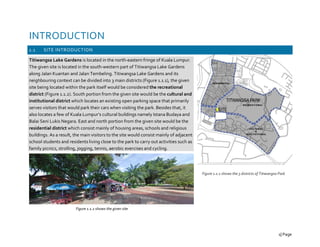
Titiwangsa Lake Gardens is located in the north-eastern fringe of Kuala Lumpur.
The given site is located in the south-western part of Titiwangsa Lake Gardens
along Jalan Kuantan and Jalan Tembeling. Titiwangsa Lake Gardens and its
neighbouring context can be divided into 3 main districts (Figure 1.1.1), the given
site being located within the park itself would be considered the recreational
district (Figure 1.1.2). South portion from the given site would be the cultural and
institutional district which locates an existing open parking space that primarily
serves visitors that would park their cars when visiting the park. Besides that, it
also locates a few of Kuala Lumpur’s cultural buildings namely Istana Budaya and
Balai Seni Lukis Negara. East and north portion from the given site would be the
residential district which consist mainly of housing areas, schools and religious
buildings. As a result, the main visitors to the site would consist mainly of adjacent
school students and residents living close to the park to carry out activities such as
family picnics, strolling, jogging, tennis, aerobic exercises and cycling.
Figure 1.1.2 shows the given site
Figure 1.1.1 shows the 3 districts of Titiwangsa Park
1| Page
INTRODUCTION
1.2 PROJECT INTRODUCTION
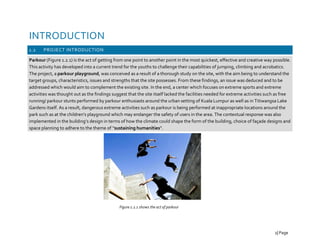
Parkour (Figure 1.2.1) is the act of getting from one point to another point in the most quickest, effective and creative way possible.
This activity has developed into a current trend for the youths to challenge their capabilities of jumping, climbing and acrobatics.
The project, a parkour playground, was conceived as a result of a thorough study on the site, with the aim being to understand the
target groups, characteristics, issues and strengths that the site possesses. From these findings, an issue was deduced and to be
addressed which would aim to complement the existing site. In the end, a center which focuses on extreme sports and extreme
activities was thought out as the findings suggest that the site itself lacked the facilities needed for extreme activities such as free
running/ parkour stunts performed by parkour enthusiasts around the urban setting of Kuala Lumpur as well as in Titiwangsa Lake
Gardens itself. As a result, dangerous extreme activities such as parkour is being performed at inappropriate locations around the
park such as at the children’s playground which may endanger the safety of users in the area. The contextual response was also
implemented in the building’s design in terms of how the climate could shape the form of the building, choice of façade designs and
space planning to adhere to the theme of “sustaining humanities”.
Figure 1.2.1 shows the act of parkour
2| Page
PROJECT VIABILITY
2.1 PROPOSED PROGRAMME
The programmes and design language of this building is aimed to accommodate parkour enthusiasts by providing a proper
platform for them to push their boundaries in parkour. As parkour is only popular and more suitable for adolescents and young
adults whom are physically more active and stronger, thus providing a building which only serves the purpose of parkour alone is
insufficient to bring success to a building as the target group tackled is limited. With that being said, there are primary schools,
sports schools and secondary schools located in close proximity to the site, thus, it can be assured that children is one of the major
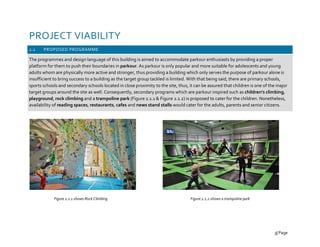
target groups around the site as well. Consequently, secondary programs which are parkour inspired such as children’s climbing,
playground, rock climbing and a trampoline park (Figure 2.1.1 & Figure 2.1.2) is proposed to cater for the children. Nonetheless,
availability of reading spaces, restaurants, cafes and news stand stalls would cater for the adults, parents and senior citizens.
Figure 2.1.1 shows Rock Climbing Figure 2.1.2 shows a trampoline park
3| Page
PROJECT VIABILITY
2.2 PROJECT OBJECTIVES
• The main objective of the project through the building and its programmes is centered on creating spaces that attracts users
of all ages and providing them with a reason to stay on site beyond the usual office hours or after school hours, providing
them a park filled with different kinds of fun filled activities with all of its programmes being parkour inspired and related to
parkour in terms of its movement which requires running, jumping and climbing.
• The project aims to allow parkour users of the center to motivate and inspire other parkour users and non-parkour users
which in long term promotes the popularity of the center.
• The project aims to create a learning ground for users to develop their skills in parkour and rock climbing which may prove
beneficial for the future, for instance, rock climbing as an extreme sport has now evolved into a very competitive sport and is
to be premiered in the coming Olympics games. Therefore, associations such as the Malaysian Extreme Sports Association
are in efforts to find new talents in this field.
• There exists the objectives that are more relevant to project management, such as the need for the project to be completed
on time. Completion of the project within its stipulated timeframe would require planning well in accordance of the entire
duration of the project with thoughts into any unforeseen errors that may add more time to the overall project.
• The building when completed, should also be ready with the flexibility of facing any potential emergencies or accidents that
may arise throughout the lifespan of the usage of the building. When called upon, the features of the building should be able
to protect or serve the users well in that it does not become a detriment to them.
4| Page
PROJECT VIABILITY
2.3 CLIENT AND STAKEHOLDERS
CLIENT AND STAKEHOLDERS
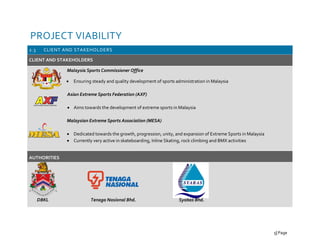
Malaysia Sports Commissioner Office
• Ensuring steady and quality development of sports administration in Malaysia
Asian Extreme Sports Federation (AXF)
• Aims towards the development of extreme sports in Malaysia
Malaysian Extreme Sports Association (MESA)
• Dedicated towards the growth, progression, unity, and expansion of Extreme Sports in Malaysia
• Currently very active in skateboarding, Inline Skating, rock climbing and BMX activities
AUTHORITIES
DBKL Tenaga Nasional Bhd. Syabas Bhd.
5| Page
PROJECT SITE ANALYSIS
3.1 SWOT ANALYSIS
STRENGTH
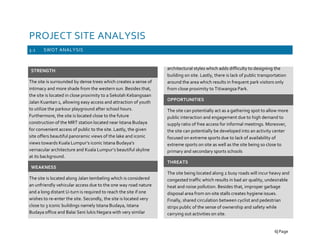
The site is surrounded by dense trees which creates a sense of
intimacy and more shade from the western sun. Besides that,
the site is located in close proximity to a Sekolah Kebangsaan
Jalan Kuantan 1, allowing easy access and attraction of youth
to utilize the parkour playground after school hours.
Furthermore, the site is located close to the future
construction of the MRT station located near Istana Budaya
for convenient access of public to the site. Lastly, the given
site offers beautiful panoramic views of the lake and iconic
views towards Kuala Lumpur’s iconic Istana Budaya’s
vernacular architecture and Kuala Lumpur’s beautiful skyline
at its background.
WEAKNESS
The site is located along Jalan tembeling which is considered
an unfriendly vehicular access due to the one way road nature
and a long distant U-turn is required to reach the site if one
wishes to re-enter the site. Secondly, the site is located very
close to 3 iconic buildings namely Istana Budaya, Istana
Budaya office and Balai Seni lukis Negara with very similar
architectural styles which adds difficulty to designing the
building on site. Lastly, there is lack of public transportation
around the area which results in frequent park visitors only
from close proximity to Titiwangsa Park.
OPPORTUNITIES
The site can potentially act as a gathering spot to allow more
public interaction and engagement due to high demand to
supply ratio of free access for informal meetings. Moreover,
the site can potentially be developed into an activity center
focused on extreme sports due to lack of availability of
extreme sports on site as well as the site being so close to
primary and secondary sports schools
THREATS
The site being located along 2 busy roads will incur heavy and
congested traffic which results in bad air quality, undesirable
heat and noise pollution. Besides that, improper garbage
disposal area from on-site stalls creates hygiene issues.
Finally, shared circulation between cyclist and pedestrian
strips public of the sense of ownership and safety while
carrying out activities on site.
6| Page
PROJECT SITE ANALYSIS
3.2 P.E.S.T.L.E ANALYSIS
POLITICAL FACTOR
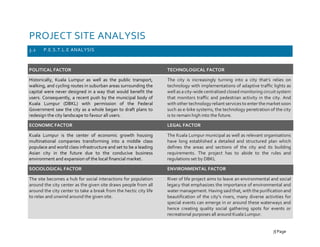
Historically, Kuala Lumpur as well as the public transport,
walking, and cycling routes in suburban areas surrounding the
capital were never designed in a way that would benefit the
users. Consequently, a recent push by the municipal body of
Kuala Lumpur (DBKL) with permission of the Federal
Government saw the city as a whole began to draft plans to
redesign the city landscape to favour all users.
ECONOMIC FACTOR
Kuala Lumpur is the center of economic growth housing
multinational companies transforming into a middle class
populace and world class infrastructure and set to be a leading
Asian city in the future due to the conducive business
environment and expansion of the local financial market.
SOCIOLOGICAL FACTOR
The site becomes a hub for social interactions for population
around the city center as the given site draws people from all
around the city center to take a break from the hectic city life
to relax and unwind around the given site.
TECHNOLOGICAL FACTOR
The city is increasingly turning into a city that’s relies on
technology with implementations of adaptive traffic lights as
well as a city-wide centralised closed monitoring circuit system
that monitors traffic and pedestrian activity in the city. And
with other technologyreliant services to enter themarket soon
such as e-bike systems, the technology penetration of the city
is to remain high into the future.
LEGAL FACTOR
The Kuala Lumpur municipal as well as relevant organisations
have long established a detailed and structured plan which
defines the areas and sections of the city and its building
requirements. The project has to abide to the rules and
regulations set by DBKL
ENVIRONMENTAL FACTOR
River of life project aims to leave an environmental and social
legacy that emphasizes the importance of environmental and
water management. Having said that, with the purification and
beautification of the city’s rivers, many diverse activities for
special events can emerge in or around these waterways and
hence creating quality social gathering spots for events or
recreational purposes all around Kuala Lumpur.
7| Page
DESIGN SUSTAINABILITY
4.1 KEY FEATURES
FAÇADE SYSTEM
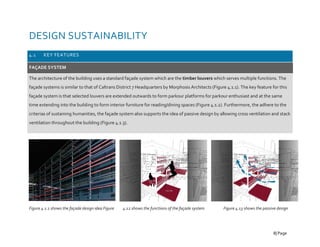
The architecture of the building uses a standard façade system which are the timber louvers which serves multiple functions. The
façade systems is similar to that of Caltrans District 7 Headquarters by Morphosis Architects (Figure 4.1.1). The key feature for this
façade system is that selected louvers are extended outwards to form parkour platforms for parkour enthusiast and at the same
time extending into the building to form interior furniture for reading/dining spaces (Figure 4.1.2). Furthermore, the adhere to the
criterias of sustaining humanities, the façade system also supports the idea of passive design by allowing cross ventilation and stack
ventilation throughout the building (Figure 4.1.3).
Figure 4.1.1 shows the façade design idea Figure 4.12 shows the functions of the façade system Figure 4.13 shows the passive design
8| Page
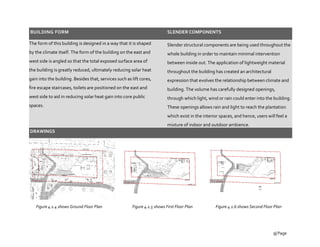
BUILDING FORM
The form of this building is designed in a way that it is shaped
by the climate itself. The form of the building on the east and
west side is angled so that the total exposed surface area of
the building is greatly reduced, ultimately reducing solar heat
gain into the building. Besides that, services such as lift cores,
fire escape staircases, toilets are positioned on the east and
west side to aid in reducing solar heat gain into core public
spaces.
DRAWINGS
SLENDER COMPONENTS
Slender structural components are being used throughout the
whole building in order to maintain minimal intervention
between inside out. The application of lightweight material
throughout the building has created an architectural
expression that evolves the relationship between climate and
building. The volume has carefully designed openings,
through which light, wind or rain could enter into the building.
These openings allows rain and light to reach the plantation
which exist in the interior spaces, and hence, users will feel a
mixture of indoor and outdoor ambience.
Figure 4.1.4 shows Ground Floor Plan Figure 4.1.5 shows First Floor Plan Figure 4.1.6 shows Second Floor Plan
9| Page
DESIGN SUSTAINABILITY
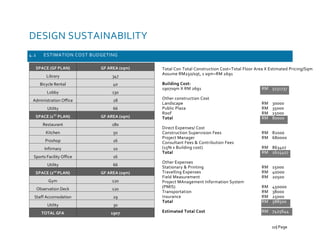
4.2 ESTIMATION COST BUDGETING
SPACE (GF PLAN) GF AREA (sqm)
Library 347
Bicycle Rental 40
Lobby 130
Administration Office 28
Utility 66
SPACE (1ST
PLAN) GF AREA (sqm)
Restaurant 180
Kitchen 50
Proshop 16
Infirmary 10
Sports Facility Office 16
Utility 66
SPACE (2nd
PLAN) GF AREA (sqm)
Gym 120
Observation Deck 120
Staff Accomodation 29
Utility 30
TOTAL GFA 1907
10| Page
DESIGN SUSTAINABILITY
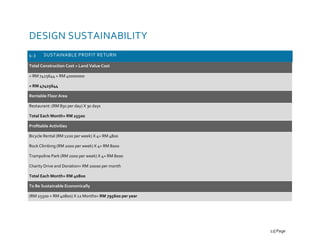
4.3 SUSTAINABLE PROFIT RETURN
Total Construction Cost + Land Value Cost
= RM 7425644 + RM 40000000
= RM 47425644
Rentable Floor Area
Restaurant: (RM 850 per day) X 30 days
Total Each Month= RM 25500
Profitable Activities
Bicycle Rental (RM 1200 per week) X 4= RM 4800
Rock Climbing (RM 2000 per week) X 4= RM 8000
Trampoline Park (RM 2000 per week) X 4= RM 8000
Charity Drive and Donation= RM 20000 per month
Total Each Month= RM 40800
To Be Sustainable Economically
(RM 25500 + RM 40800) X 12 Months= RM 795600 per year
11| Page
DESIGN SUSTAINABILITY
4.4 SUCCESS CRITERIA
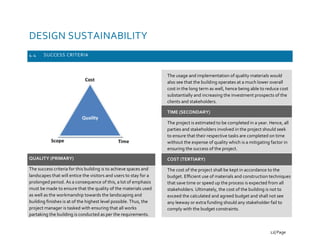
QUALITY (PRIMARY)
The success criteria for this building is to achieve spaces and
landscapes that will entice the visitors and users to stay for a
prolonged period. As a consequence of this, a lot of emphasis
must be made to ensure that the quality of the materials used
as well as the workmanship towards the landscaping and
building finishes is at of the highest level possible. Thus, the
project manager is tasked with ensuring that all works
partaking the building is conducted as per the requirements.
The usage and implementation of quality materials would
also see that the building operates at a much lower overall
cost in the long term as well, hence being able to reduce cost
substantially and increasing the investment prospects of the
clients and stakeholders.
TIME (SECONDARY)
The project is estimated to be completed in a year. Hence, all
parties and stakeholders involved in the project should seek
to ensure that their respective tasks are completed on time
without the expense of quality which is a mitigating factor in
ensuring the success of the project.
COST (TERTIARY)
The cost of the project shall be kept in accordance to the
budget. Efficient use of materials and construction techniques
that save time or speed up the process is expected from all
stakeholders. Ultimately, the cost of the building is not to
exceed the calculated and agreed budget and shall not see
any leeway or extra funding should any stakeholder fail to
comply with the budget constraints.
12| Page
PROJECT PROCUREMENT
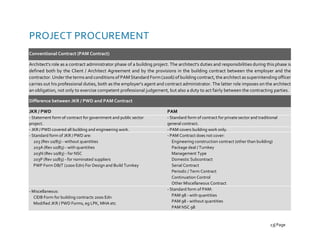
Conventional Contract (PAM Contract)
Architect's role as a contract administrator phase of a building project. The architect's duties and responsibilities during this phase is
defined both by the Client / Architect Agreement and by the provisions in the building contract between the employer and the
contractor. Under the terms and conditions of PAM Standard Form (2006) of building contract, the architect as superintending officer
carries out his professional duties, both as the employer's agent and contract administrator. The latter role imposes on the architect
an obligation, not only to exercise competent professional judgement, but also a duty to act fairly between the contracting parties.
Difference between JKR / PWD and PAM Contract
JKR / PWD
- Statement form of contract for government and public sector
project.
- JKR / PWD covered all building and engineering work.
- Standard form of JKR / PWD are:
203 (Rev 10/83) - without quantities
203A (Rev 10/83) - with quantities
203N (Rev 10/83) - for NSC
203P (Rev 10/83) - for nominated suppliers
PWP Form DB/T (2000 Edn) For Design and Build Turnkey
- Miscellaneous:
CIDB Form for building contracts 2000 Edn
Modified JKR / PWD Forms, eg LPK, MHA etc
PAM
- Standard form of contract for private sector and traditional
general contract.
- PAM covers building work only.
- PAM Contract does not cover:
Engineering construction contract (other than building)
Package deal / Turnkey
Management Type
Domestic Subcontract
Serial Contract
Periodic / Term Contract
Continuation Control
Other Miscellaneous Contract
- Standard form of PAM:
PAM 98 - with quantities
PAM 98 - without quantities
PAM NSC 98
13| Page
- Acoustic Insulation to spec
- Doors & Windows to spec
- Stainless Steel Railing to spec
- Tiles & Toilet to spec
- Reinforcing steel bar to spec
Client
Architect
Civil &
Structural
Engineer
Quantity
Surveyor
Mechanical&
Electrical
Engineer
Contractor
Landscape
Architect
Project
Manager
Equipment Resource
Office Equipment Construction Equipment
- Computer - Piling Machine
- Plotter - Backhoe
- Photocopiers - Excavator
- Measuring Tools - Concrete Mixer
- Calculator - Crane Lorry
RESOURCE PLANNING
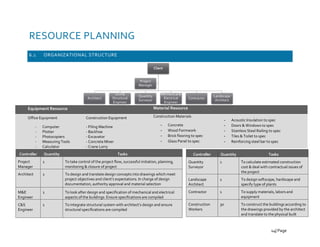
6.1 ORGANIZATIONAL STRUCTURE
Controller Quantity Tasks
Quantity
Surveyor
1 To calculate estimated construction
cost & deal with contractual issues of
the project
Landscape
Architect
1 To design softscape, hardscape and
specify type of plants
Contractor 1 To supply materials, labors and
equipment
Construction
Workers
30 To construct the buildings according to
the drawings provided by the architect
and translate to the physical built
Controller Quantity Tasks
Project
Manager
1 To take control of the project flow, successful initiation, planning,
monitoring & closure of project
Architect 1 To design and translate design concepts into drawings which meet
project objectives and client’s expectations. In charge of design
documentation, authority approval and material selection
M&E
Engineer
1 To look after design and specification of mechanical and electrical
aspects of the buildings. Ensure specifications are compiled
C&S
Engineer
1 To integrate structural system with architect’s design and ensure
structural specifications are compiled
Material Resource
Construction Materials
- Concrete
- Wood Formwork
- Brick flooring to spec
- Glass Panel to spec
14| Page
MAINTENANCE STRATEGY
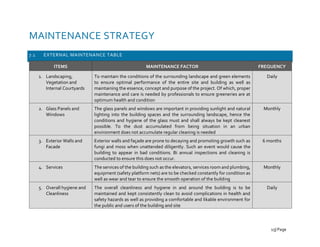
7.1 EXTERNAL MAINTENANCE TABLE
ITEMS MAINTENANCE FACTOR FREQUENCY
1. Landscaping,
Vegetation and
Internal Courtyards
To maintain the conditions of the surrounding landscape and green elements
to ensure optimal performance of the entire site and building as well as
maintaining the essence, concept and purpose of the project. Of which, proper
maintenance and care is needed by professionals to ensure greeneries are at
optimum health and condition
Daily
2. Glass Panels and
Windows
The glass panels and windows are important in providing sunlight and natural
lighting into the building spaces and the surrounding landscape, hence the
conditions and hygiene of the glass must and shall always be kept cleanest
possible. To the dust accumulated from being situation in an urban
environment does not accumulate regular cleaning is needed
Monthly
3. Exterior Walls and
Facade
Exterior walls and façade are prone to decaying and promoting growth such as
fungi and moss when unattended diligently. Such an event would cause the
building to appear in bad conditions. Bi annual inspections and cleaning is
conducted to ensure this does not occur.
6 months
4. Services The services of the building such as the elevators, services room and plumbing,
equipment (safety platform nets) are to be checked constantly for condition as
well as wear and tear to ensure the smooth operation of the building
Monthly
5. Overall hygiene and
Cleanliness
The overall cleanliness and hygiene in and around the building is to be
maintained and kept consistently clean to avoid complications in health and
safety hazards as well as providing a comfortable and likable environment for
the public and users of the building and site
Daily
15| Page
MAINTENANCE STRATEGY
7.2 INTERNAL MAINTENANCE TABLE
ITEMS MAINTENANCE FACTOR FREQUENCY
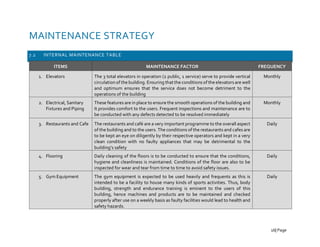
1. Elevators The 3 total elevators in operation (2 public, 1 service) serve to provide vertical
circulation of the building. Ensuring that the conditions of the elevators are well
and optimum ensures that the service does not become detriment to the
operations of the building
Monthly
2. Electrical, Sanitary
Fixtures and Piping
These features are in place to ensure the smooth operations of the building and
It provides comfort to the users. Frequent inspections and maintenance are to
be conducted with any defects detected to be resolved immediately
Monthly
3. Restaurants and Cafe The restaurants and café are a very important programme to the overall aspect
of the building and to the users. The conditions of the restaurants and cafes are
to be kept an eye on diligently by their respective operators and kept in a very
clean condition with no faulty appliances that may be detrimental to the
building’s safety
Daily
4. Flooring Daily cleaning of the floors is to be conducted to ensure that the conditions,
hygiene and cleanliness is maintained. Conditions of the floor are also to be
inspected for wear and tear from time to time to avoid safety issues.
Daily
5. Gym Equipment The gym equipment is expected to be used heavily and frequents as this is
intended to be a facility to house many kinds of sports activities. Thus, body
building, strength and endurance training is eminent to the users of this
building, hence machines and products are to be maintained and checked
properly after use on a weekly basis as faulty facilities would lead to health and
safety hazards.
Daily
16| Page
RISK ANALYSIS AND MIGITATION STRATEGY
8.1 RISK IDENTIFICATION – DESIGN STAGE
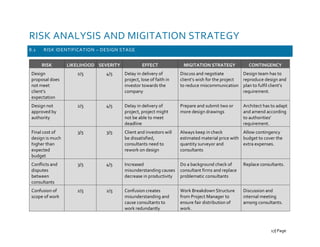
RISK LIKELIHOOD SEVERITY EFFECT MIGITATION STRATEGY CONTINGENCY
Design
proposal does
not meet
client’s
expectation
2/5 4/5 Delay in delivery of
project, lose of faith in
investor towards the
company
Discuss and negotiate
client’s wish for the project
to reduce miscommunication
Design team has to
reproduce design and
plan to fulfil client’s
requirement.
Design not
approved by
authority
2/5 4/5 Delay in delivery of
project, project might
not be able to meet
deadline
Prepare and submit two or
more design drawings
Architect has to adapt
and amend according
to authorities’
requirement.
Final cost of
design is much
higher than
expected
budget
3/5 3/5 Client and investors will
be dissatisfied,
consultants need to
rework on design
Always keep in check
estimated material price with
quantity surveyor and
consultants
Allow contingency
budget to cover the
extra expenses.
Conflicts and
disputes
between
consultants
3/5 4/5 Increased
misunderstanding causes
decrease in productivity
Do a background check of
consultant firms and replace
problematic consultants
Replace consultants.
Confusion of
scope of work
2/5 2/5 Confusion creates
misunderstanding and
cause consultants to
work redundantly
Work Breakdown Structure
from Project Manager to
ensure fair distribution of
work.
Discussion and
internal meeting
among consultants.
17| Page
RISK ANALYSIS AND MIGITATION STRATEGY
8.2 RISK IDENTIFICATION - CONSTRUCTION STAGE
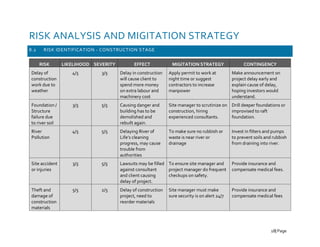
RISK LIKELIHOOD SEVERITY EFFECT MIGITATION STRATEGY CONTINGENCY
Delay of
construction
work due to
weather
4/5 3/5 Delay in construction
will cause client to
spend more money
on extra labour and
machinery cost
Apply permit to work at
night time or suggest
contractors to increase
manpower
Make announcement on
project delay early and
explain cause of delay,
hoping investors would
understand.
Foundation /
Structure
failure due
to river soil
3/5 5/5 Causing danger and
building has to be
demolished and
rebuilt again.
Site manager to scrutinize on
construction, hiring
experienced consultants.
Drill deeper foundations or
improvised to raft
foundation.
River
Pollution
4/5 5/5 Delaying River of
Life’s cleaning
progress, may cause
trouble from
authorities
To make sure no rubbish or
waste is near river or
drainage
Invest in filters and pumps
to prevent soils and rubbish
from draining into river.
Site accident
or injuries
3/5 5/5 Lawsuits may be filled
against consultant
and client causing
delay of project.
To ensure site manager and
project manager do frequent
checkups on safety.
Provide insurance and
compensate medical fees.
Theft and
damage of
construction
materials
5/5 2/5 Delay of construction
project, need to
reorder materials
Site manager must make
sure security is on alert 24/7
Provide insurance and
compensate medical fees
18| Page
RISK ANALYSIS AND MIGITATION STRATEGY
8.3 RISK IDENTIFICATION – MAINTENANCE AND OPERATION STARTEGY
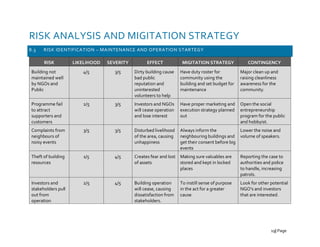
RISK LIKELIHOOD SEVERITY EFFECT MIGITATION STRATEGY CONTINGENCY
Building not
maintained well
by NGOs and
Public
4/5 3/5 Dirty building cause
bad public
reputation and
uninterested
volunteers to help
Have duty roster for
community using the
building and set budget for
maintenance
Major clean up and
raising cleanliness
awareness for the
community.
Programme fail
to attract
supporters and
customers
2/5 3/5 Investors and NGOs
will cease operation
and lose interest
Have proper marketing and
execution strategy planned
out
Open the social
entrepreneurship
program for the public
and hobbyist.
Complaints from
neighbours of
noisy events
3/5 3/5 Disturbed livelihood
of the area, causing
unhappiness
Always inform the
neighbouring buildings and
get their consent before big
events
Lower the noise and
volume of speakers.
Theft of building
resources
1/5 4/5 Creates fear and lost
of assets
Making sure valuables are
stored and kept in locked
places
Reporting the case to
authorities and police
to handle, increasing
patrols.
Investors and
stakeholders pull
out from
operation
2/5 4/5 Building operation
will cease, causing
dissatisfaction from
stakeholders.
To instill sense of purpose
in the act for a greater
cause
Look for other potential
NGO’s and investors
that are interested.
19| Page
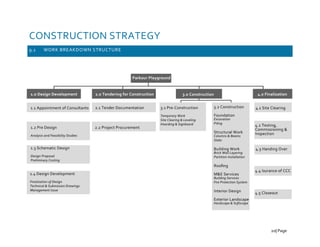
CONSTRUCTION STRATEGY
9.1 WORK BREAKDOWN STRUCTURE
20| Page

Project 2: Documenting a Medium sized Project

  • 1.
    PROJECT MANAGEMENT [MGT60403/ ARC3614] PROJECT 2: DOCUMENTATION OF A MEDIUM-SIZED PROJECT PROPOSED PARKOUR PLAYGROUND AT TAMAN TITIWANGSA NAME JAMES TAY JIA CHUEN STUDENT ID 0322210 TUTOR AR. HJH. SATEERAH HJ. HASSAN Marks for 2 criteria: 1. ____/20% 2. ____/10% : Total ____/30%
  • 2.
    TABLE OF CONTENTS SUBJECTPAGE SUBJECT PAGE 1.0 INTRODUCTION 1 1.1 SITE INRODUCTION 1 1.2 PROJECT INTRODUCTION 2 2.0 PROJECT VIABILITY 3 2.1 PROPOSED PROGRAMME 3 2.2 PROJECT OBJECTIVES 4 2.3 CLIENT AND STAKEHOLDERS 5 3.0 PROJECT SITE ANALYSIS 6 3.1 SWOT ANALYSIS 6 3.2 PESTLE ANALYSIS 7 4.0 DESIGN SUSTAINABILITY 8 4.1 DESIGN KEY FEATURES 8-9 4.2 ESTIMATION COST BUDGETING 10 4.3 SUSTAINABLE PROFIT RETURN 11 4.4 SUCCESS CRITERIA 12 5.0 PROJECT PROCUREMENT 13 6.0 RESOURCE PLANNING 14 6.1 ORGANIZATIONAL STRUCTURE 14 7.0 MAINTENANCE STRATEGY 15 7.1 EXTERNAL MAINTENANCE TABLE 15 7.2 INTERNAL MAINTENANCE TABLE 16 8.0 RISK ANALYSIS & MITIGATION STRATEGY 17 8.1 DESIGN STAGE 17 8.2 CONSTRUCTION STAGE 18 8.3 MAINTENANCE AND OPERATION 19 STRATEGY 9.0 CONSTRUCTION STRATEGY 20 9.1 WORK BREAKDOWN STRUCTURE 20 9.2 GANTT CHART 21
  • 3.
    INTRODUCTION 1.1 SITE INTRODUCTION TitiwangsaLake Gardens is located in the north-eastern fringe of Kuala Lumpur. The given site is located in the south-western part of Titiwangsa Lake Gardens along Jalan Kuantan and Jalan Tembeling. Titiwangsa Lake Gardens and its neighbouring context can be divided into 3 main districts (Figure 1.1.1), the given site being located within the park itself would be considered the recreational district (Figure 1.1.2). South portion from the given site would be the cultural and institutional district which locates an existing open parking space that primarily serves visitors that would park their cars when visiting the park. Besides that, it also locates a few of Kuala Lumpur’s cultural buildings namely Istana Budaya and Balai Seni Lukis Negara. East and north portion from the given site would be the residential district which consist mainly of housing areas, schools and religious buildings. As a result, the main visitors to the site would consist mainly of adjacent school students and residents living close to the park to carry out activities such as family picnics, strolling, jogging, tennis, aerobic exercises and cycling. Figure 1.1.2 shows the given site Figure 1.1.1 shows the 3 districts of Titiwangsa Park 1| Page
  • 4.
    INTRODUCTION 1.2 PROJECT INTRODUCTION Parkour(Figure 1.2.1) is the act of getting from one point to another point in the most quickest, effective and creative way possible. This activity has developed into a current trend for the youths to challenge their capabilities of jumping, climbing and acrobatics. The project, a parkour playground, was conceived as a result of a thorough study on the site, with the aim being to understand the target groups, characteristics, issues and strengths that the site possesses. From these findings, an issue was deduced and to be addressed which would aim to complement the existing site. In the end, a center which focuses on extreme sports and extreme activities was thought out as the findings suggest that the site itself lacked the facilities needed for extreme activities such as free running/ parkour stunts performed by parkour enthusiasts around the urban setting of Kuala Lumpur as well as in Titiwangsa Lake Gardens itself. As a result, dangerous extreme activities such as parkour is being performed at inappropriate locations around the park such as at the children’s playground which may endanger the safety of users in the area. The contextual response was also implemented in the building’s design in terms of how the climate could shape the form of the building, choice of façade designs and space planning to adhere to the theme of “sustaining humanities”. Figure 1.2.1 shows the act of parkour 2| Page
  • 5.
    PROJECT VIABILITY 2.1 PROPOSEDPROGRAMME The programmes and design language of this building is aimed to accommodate parkour enthusiasts by providing a proper platform for them to push their boundaries in parkour. As parkour is only popular and more suitable for adolescents and young adults whom are physically more active and stronger, thus providing a building which only serves the purpose of parkour alone is insufficient to bring success to a building as the target group tackled is limited. With that being said, there are primary schools, sports schools and secondary schools located in close proximity to the site, thus, it can be assured that children is one of the major target groups around the site as well. Consequently, secondary programs which are parkour inspired such as children’s climbing, playground, rock climbing and a trampoline park (Figure 2.1.1 & Figure 2.1.2) is proposed to cater for the children. Nonetheless, availability of reading spaces, restaurants, cafes and news stand stalls would cater for the adults, parents and senior citizens. Figure 2.1.1 shows Rock Climbing Figure 2.1.2 shows a trampoline park 3| Page
  • 6.
    PROJECT VIABILITY 2.2 PROJECTOBJECTIVES • The main objective of the project through the building and its programmes is centered on creating spaces that attracts users of all ages and providing them with a reason to stay on site beyond the usual office hours or after school hours, providing them a park filled with different kinds of fun filled activities with all of its programmes being parkour inspired and related to parkour in terms of its movement which requires running, jumping and climbing. • The project aims to allow parkour users of the center to motivate and inspire other parkour users and non-parkour users which in long term promotes the popularity of the center. • The project aims to create a learning ground for users to develop their skills in parkour and rock climbing which may prove beneficial for the future, for instance, rock climbing as an extreme sport has now evolved into a very competitive sport and is to be premiered in the coming Olympics games. Therefore, associations such as the Malaysian Extreme Sports Association are in efforts to find new talents in this field. • There exists the objectives that are more relevant to project management, such as the need for the project to be completed on time. Completion of the project within its stipulated timeframe would require planning well in accordance of the entire duration of the project with thoughts into any unforeseen errors that may add more time to the overall project. • The building when completed, should also be ready with the flexibility of facing any potential emergencies or accidents that may arise throughout the lifespan of the usage of the building. When called upon, the features of the building should be able to protect or serve the users well in that it does not become a detriment to them. 4| Page
  • 7.
    PROJECT VIABILITY 2.3 CLIENTAND STAKEHOLDERS CLIENT AND STAKEHOLDERS Malaysia Sports Commissioner Office • Ensuring steady and quality development of sports administration in Malaysia Asian Extreme Sports Federation (AXF) • Aims towards the development of extreme sports in Malaysia Malaysian Extreme Sports Association (MESA) • Dedicated towards the growth, progression, unity, and expansion of Extreme Sports in Malaysia • Currently very active in skateboarding, Inline Skating, rock climbing and BMX activities AUTHORITIES DBKL Tenaga Nasional Bhd. Syabas Bhd. 5| Page
  • 8.
    PROJECT SITE ANALYSIS 3.1SWOT ANALYSIS STRENGTH The site is surrounded by dense trees which creates a sense of intimacy and more shade from the western sun. Besides that, the site is located in close proximity to a Sekolah Kebangsaan Jalan Kuantan 1, allowing easy access and attraction of youth to utilize the parkour playground after school hours. Furthermore, the site is located close to the future construction of the MRT station located near Istana Budaya for convenient access of public to the site. Lastly, the given site offers beautiful panoramic views of the lake and iconic views towards Kuala Lumpur’s iconic Istana Budaya’s vernacular architecture and Kuala Lumpur’s beautiful skyline at its background. WEAKNESS The site is located along Jalan tembeling which is considered an unfriendly vehicular access due to the one way road nature and a long distant U-turn is required to reach the site if one wishes to re-enter the site. Secondly, the site is located very close to 3 iconic buildings namely Istana Budaya, Istana Budaya office and Balai Seni lukis Negara with very similar architectural styles which adds difficulty to designing the building on site. Lastly, there is lack of public transportation around the area which results in frequent park visitors only from close proximity to Titiwangsa Park. OPPORTUNITIES The site can potentially act as a gathering spot to allow more public interaction and engagement due to high demand to supply ratio of free access for informal meetings. Moreover, the site can potentially be developed into an activity center focused on extreme sports due to lack of availability of extreme sports on site as well as the site being so close to primary and secondary sports schools THREATS The site being located along 2 busy roads will incur heavy and congested traffic which results in bad air quality, undesirable heat and noise pollution. Besides that, improper garbage disposal area from on-site stalls creates hygiene issues. Finally, shared circulation between cyclist and pedestrian strips public of the sense of ownership and safety while carrying out activities on site. 6| Page
  • 9.
    PROJECT SITE ANALYSIS 3.2P.E.S.T.L.E ANALYSIS POLITICAL FACTOR Historically, Kuala Lumpur as well as the public transport, walking, and cycling routes in suburban areas surrounding the capital were never designed in a way that would benefit the users. Consequently, a recent push by the municipal body of Kuala Lumpur (DBKL) with permission of the Federal Government saw the city as a whole began to draft plans to redesign the city landscape to favour all users. ECONOMIC FACTOR Kuala Lumpur is the center of economic growth housing multinational companies transforming into a middle class populace and world class infrastructure and set to be a leading Asian city in the future due to the conducive business environment and expansion of the local financial market. SOCIOLOGICAL FACTOR The site becomes a hub for social interactions for population around the city center as the given site draws people from all around the city center to take a break from the hectic city life to relax and unwind around the given site. TECHNOLOGICAL FACTOR The city is increasingly turning into a city that’s relies on technology with implementations of adaptive traffic lights as well as a city-wide centralised closed monitoring circuit system that monitors traffic and pedestrian activity in the city. And with other technologyreliant services to enter themarket soon such as e-bike systems, the technology penetration of the city is to remain high into the future. LEGAL FACTOR The Kuala Lumpur municipal as well as relevant organisations have long established a detailed and structured plan which defines the areas and sections of the city and its building requirements. The project has to abide to the rules and regulations set by DBKL ENVIRONMENTAL FACTOR River of life project aims to leave an environmental and social legacy that emphasizes the importance of environmental and water management. Having said that, with the purification and beautification of the city’s rivers, many diverse activities for special events can emerge in or around these waterways and hence creating quality social gathering spots for events or recreational purposes all around Kuala Lumpur. 7| Page
  • 10.
    DESIGN SUSTAINABILITY 4.1 KEYFEATURES FAÇADE SYSTEM The architecture of the building uses a standard façade system which are the timber louvers which serves multiple functions. The façade systems is similar to that of Caltrans District 7 Headquarters by Morphosis Architects (Figure 4.1.1). The key feature for this façade system is that selected louvers are extended outwards to form parkour platforms for parkour enthusiast and at the same time extending into the building to form interior furniture for reading/dining spaces (Figure 4.1.2). Furthermore, the adhere to the criterias of sustaining humanities, the façade system also supports the idea of passive design by allowing cross ventilation and stack ventilation throughout the building (Figure 4.1.3). Figure 4.1.1 shows the façade design idea Figure 4.12 shows the functions of the façade system Figure 4.13 shows the passive design 8| Page
  • 11.
    BUILDING FORM The formof this building is designed in a way that it is shaped by the climate itself. The form of the building on the east and west side is angled so that the total exposed surface area of the building is greatly reduced, ultimately reducing solar heat gain into the building. Besides that, services such as lift cores, fire escape staircases, toilets are positioned on the east and west side to aid in reducing solar heat gain into core public spaces. DRAWINGS SLENDER COMPONENTS Slender structural components are being used throughout the whole building in order to maintain minimal intervention between inside out. The application of lightweight material throughout the building has created an architectural expression that evolves the relationship between climate and building. The volume has carefully designed openings, through which light, wind or rain could enter into the building. These openings allows rain and light to reach the plantation which exist in the interior spaces, and hence, users will feel a mixture of indoor and outdoor ambience. Figure 4.1.4 shows Ground Floor Plan Figure 4.1.5 shows First Floor Plan Figure 4.1.6 shows Second Floor Plan 9| Page
  • 12.
    DESIGN SUSTAINABILITY 4.2 ESTIMATIONCOST BUDGETING SPACE (GF PLAN) GF AREA (sqm) Library 347 Bicycle Rental 40 Lobby 130 Administration Office 28 Utility 66 SPACE (1ST PLAN) GF AREA (sqm) Restaurant 180 Kitchen 50 Proshop 16 Infirmary 10 Sports Facility Office 16 Utility 66 SPACE (2nd PLAN) GF AREA (sqm) Gym 120 Observation Deck 120 Staff Accomodation 29 Utility 30 TOTAL GFA 1907 10| Page
  • 13.
    DESIGN SUSTAINABILITY 4.3 SUSTAINABLEPROFIT RETURN Total Construction Cost + Land Value Cost = RM 7425644 + RM 40000000 = RM 47425644 Rentable Floor Area Restaurant: (RM 850 per day) X 30 days Total Each Month= RM 25500 Profitable Activities Bicycle Rental (RM 1200 per week) X 4= RM 4800 Rock Climbing (RM 2000 per week) X 4= RM 8000 Trampoline Park (RM 2000 per week) X 4= RM 8000 Charity Drive and Donation= RM 20000 per month Total Each Month= RM 40800 To Be Sustainable Economically (RM 25500 + RM 40800) X 12 Months= RM 795600 per year 11| Page
  • 14.
    DESIGN SUSTAINABILITY 4.4 SUCCESSCRITERIA QUALITY (PRIMARY) The success criteria for this building is to achieve spaces and landscapes that will entice the visitors and users to stay for a prolonged period. As a consequence of this, a lot of emphasis must be made to ensure that the quality of the materials used as well as the workmanship towards the landscaping and building finishes is at of the highest level possible. Thus, the project manager is tasked with ensuring that all works partaking the building is conducted as per the requirements. The usage and implementation of quality materials would also see that the building operates at a much lower overall cost in the long term as well, hence being able to reduce cost substantially and increasing the investment prospects of the clients and stakeholders. TIME (SECONDARY) The project is estimated to be completed in a year. Hence, all parties and stakeholders involved in the project should seek to ensure that their respective tasks are completed on time without the expense of quality which is a mitigating factor in ensuring the success of the project. COST (TERTIARY) The cost of the project shall be kept in accordance to the budget. Efficient use of materials and construction techniques that save time or speed up the process is expected from all stakeholders. Ultimately, the cost of the building is not to exceed the calculated and agreed budget and shall not see any leeway or extra funding should any stakeholder fail to comply with the budget constraints. 12| Page
  • 15.
    PROJECT PROCUREMENT Conventional Contract(PAM Contract) Architect's role as a contract administrator phase of a building project. The architect's duties and responsibilities during this phase is defined both by the Client / Architect Agreement and by the provisions in the building contract between the employer and the contractor. Under the terms and conditions of PAM Standard Form (2006) of building contract, the architect as superintending officer carries out his professional duties, both as the employer's agent and contract administrator. The latter role imposes on the architect an obligation, not only to exercise competent professional judgement, but also a duty to act fairly between the contracting parties. Difference between JKR / PWD and PAM Contract JKR / PWD - Statement form of contract for government and public sector project. - JKR / PWD covered all building and engineering work. - Standard form of JKR / PWD are: 203 (Rev 10/83) - without quantities 203A (Rev 10/83) - with quantities 203N (Rev 10/83) - for NSC 203P (Rev 10/83) - for nominated suppliers PWP Form DB/T (2000 Edn) For Design and Build Turnkey - Miscellaneous: CIDB Form for building contracts 2000 Edn Modified JKR / PWD Forms, eg LPK, MHA etc PAM - Standard form of contract for private sector and traditional general contract. - PAM covers building work only. - PAM Contract does not cover: Engineering construction contract (other than building) Package deal / Turnkey Management Type Domestic Subcontract Serial Contract Periodic / Term Contract Continuation Control Other Miscellaneous Contract - Standard form of PAM: PAM 98 - with quantities PAM 98 - without quantities PAM NSC 98 13| Page
  • 16.
    - Acoustic Insulationto spec - Doors & Windows to spec - Stainless Steel Railing to spec - Tiles & Toilet to spec - Reinforcing steel bar to spec Client Architect Civil & Structural Engineer Quantity Surveyor Mechanical& Electrical Engineer Contractor Landscape Architect Project Manager Equipment Resource Office Equipment Construction Equipment - Computer - Piling Machine - Plotter - Backhoe - Photocopiers - Excavator - Measuring Tools - Concrete Mixer - Calculator - Crane Lorry RESOURCE PLANNING 6.1 ORGANIZATIONAL STRUCTURE Controller Quantity Tasks Quantity Surveyor 1 To calculate estimated construction cost & deal with contractual issues of the project Landscape Architect 1 To design softscape, hardscape and specify type of plants Contractor 1 To supply materials, labors and equipment Construction Workers 30 To construct the buildings according to the drawings provided by the architect and translate to the physical built Controller Quantity Tasks Project Manager 1 To take control of the project flow, successful initiation, planning, monitoring & closure of project Architect 1 To design and translate design concepts into drawings which meet project objectives and client’s expectations. In charge of design documentation, authority approval and material selection M&E Engineer 1 To look after design and specification of mechanical and electrical aspects of the buildings. Ensure specifications are compiled C&S Engineer 1 To integrate structural system with architect’s design and ensure structural specifications are compiled Material Resource Construction Materials - Concrete - Wood Formwork - Brick flooring to spec - Glass Panel to spec 14| Page
  • 17.
    MAINTENANCE STRATEGY 7.1 EXTERNALMAINTENANCE TABLE ITEMS MAINTENANCE FACTOR FREQUENCY 1. Landscaping, Vegetation and Internal Courtyards To maintain the conditions of the surrounding landscape and green elements to ensure optimal performance of the entire site and building as well as maintaining the essence, concept and purpose of the project. Of which, proper maintenance and care is needed by professionals to ensure greeneries are at optimum health and condition Daily 2. Glass Panels and Windows The glass panels and windows are important in providing sunlight and natural lighting into the building spaces and the surrounding landscape, hence the conditions and hygiene of the glass must and shall always be kept cleanest possible. To the dust accumulated from being situation in an urban environment does not accumulate regular cleaning is needed Monthly 3. Exterior Walls and Facade Exterior walls and façade are prone to decaying and promoting growth such as fungi and moss when unattended diligently. Such an event would cause the building to appear in bad conditions. Bi annual inspections and cleaning is conducted to ensure this does not occur. 6 months 4. Services The services of the building such as the elevators, services room and plumbing, equipment (safety platform nets) are to be checked constantly for condition as well as wear and tear to ensure the smooth operation of the building Monthly 5. Overall hygiene and Cleanliness The overall cleanliness and hygiene in and around the building is to be maintained and kept consistently clean to avoid complications in health and safety hazards as well as providing a comfortable and likable environment for the public and users of the building and site Daily 15| Page
  • 18.
    MAINTENANCE STRATEGY 7.2 INTERNALMAINTENANCE TABLE ITEMS MAINTENANCE FACTOR FREQUENCY 1. Elevators The 3 total elevators in operation (2 public, 1 service) serve to provide vertical circulation of the building. Ensuring that the conditions of the elevators are well and optimum ensures that the service does not become detriment to the operations of the building Monthly 2. Electrical, Sanitary Fixtures and Piping These features are in place to ensure the smooth operations of the building and It provides comfort to the users. Frequent inspections and maintenance are to be conducted with any defects detected to be resolved immediately Monthly 3. Restaurants and Cafe The restaurants and café are a very important programme to the overall aspect of the building and to the users. The conditions of the restaurants and cafes are to be kept an eye on diligently by their respective operators and kept in a very clean condition with no faulty appliances that may be detrimental to the building’s safety Daily 4. Flooring Daily cleaning of the floors is to be conducted to ensure that the conditions, hygiene and cleanliness is maintained. Conditions of the floor are also to be inspected for wear and tear from time to time to avoid safety issues. Daily 5. Gym Equipment The gym equipment is expected to be used heavily and frequents as this is intended to be a facility to house many kinds of sports activities. Thus, body building, strength and endurance training is eminent to the users of this building, hence machines and products are to be maintained and checked properly after use on a weekly basis as faulty facilities would lead to health and safety hazards. Daily 16| Page
  • 19.
    RISK ANALYSIS ANDMIGITATION STRATEGY 8.1 RISK IDENTIFICATION – DESIGN STAGE RISK LIKELIHOOD SEVERITY EFFECT MIGITATION STRATEGY CONTINGENCY Design proposal does not meet client’s expectation 2/5 4/5 Delay in delivery of project, lose of faith in investor towards the company Discuss and negotiate client’s wish for the project to reduce miscommunication Design team has to reproduce design and plan to fulfil client’s requirement. Design not approved by authority 2/5 4/5 Delay in delivery of project, project might not be able to meet deadline Prepare and submit two or more design drawings Architect has to adapt and amend according to authorities’ requirement. Final cost of design is much higher than expected budget 3/5 3/5 Client and investors will be dissatisfied, consultants need to rework on design Always keep in check estimated material price with quantity surveyor and consultants Allow contingency budget to cover the extra expenses. Conflicts and disputes between consultants 3/5 4/5 Increased misunderstanding causes decrease in productivity Do a background check of consultant firms and replace problematic consultants Replace consultants. Confusion of scope of work 2/5 2/5 Confusion creates misunderstanding and cause consultants to work redundantly Work Breakdown Structure from Project Manager to ensure fair distribution of work. Discussion and internal meeting among consultants. 17| Page
  • 20.
    RISK ANALYSIS ANDMIGITATION STRATEGY 8.2 RISK IDENTIFICATION - CONSTRUCTION STAGE RISK LIKELIHOOD SEVERITY EFFECT MIGITATION STRATEGY CONTINGENCY Delay of construction work due to weather 4/5 3/5 Delay in construction will cause client to spend more money on extra labour and machinery cost Apply permit to work at night time or suggest contractors to increase manpower Make announcement on project delay early and explain cause of delay, hoping investors would understand. Foundation / Structure failure due to river soil 3/5 5/5 Causing danger and building has to be demolished and rebuilt again. Site manager to scrutinize on construction, hiring experienced consultants. Drill deeper foundations or improvised to raft foundation. River Pollution 4/5 5/5 Delaying River of Life’s cleaning progress, may cause trouble from authorities To make sure no rubbish or waste is near river or drainage Invest in filters and pumps to prevent soils and rubbish from draining into river. Site accident or injuries 3/5 5/5 Lawsuits may be filled against consultant and client causing delay of project. To ensure site manager and project manager do frequent checkups on safety. Provide insurance and compensate medical fees. Theft and damage of construction materials 5/5 2/5 Delay of construction project, need to reorder materials Site manager must make sure security is on alert 24/7 Provide insurance and compensate medical fees 18| Page
  • 21.
    RISK ANALYSIS ANDMIGITATION STRATEGY 8.3 RISK IDENTIFICATION – MAINTENANCE AND OPERATION STARTEGY RISK LIKELIHOOD SEVERITY EFFECT MIGITATION STRATEGY CONTINGENCY Building not maintained well by NGOs and Public 4/5 3/5 Dirty building cause bad public reputation and uninterested volunteers to help Have duty roster for community using the building and set budget for maintenance Major clean up and raising cleanliness awareness for the community. Programme fail to attract supporters and customers 2/5 3/5 Investors and NGOs will cease operation and lose interest Have proper marketing and execution strategy planned out Open the social entrepreneurship program for the public and hobbyist. Complaints from neighbours of noisy events 3/5 3/5 Disturbed livelihood of the area, causing unhappiness Always inform the neighbouring buildings and get their consent before big events Lower the noise and volume of speakers. Theft of building resources 1/5 4/5 Creates fear and lost of assets Making sure valuables are stored and kept in locked places Reporting the case to authorities and police to handle, increasing patrols. Investors and stakeholders pull out from operation 2/5 4/5 Building operation will cease, causing dissatisfaction from stakeholders. To instill sense of purpose in the act for a greater cause Look for other potential NGO’s and investors that are interested. 19| Page
  • 22.
    CONSTRUCTION STRATEGY 9.1 WORKBREAKDOWN STRUCTURE 20| Page