PROJECTILE MOTION
Projectile motion
Projectile motion is a motion in which an
object is thrown near the earth’s
surface, and it moves along the curved
path under the action of gravity only.
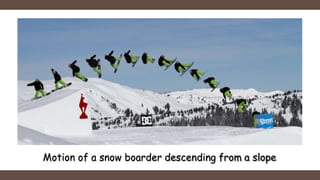
Motion of a snow boarder descending from a slope
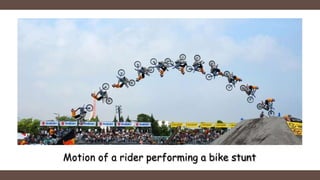
Motion of a rider performing a bike stunt
Motion of water jets coming out from nozzles
Assumptions used in projectile motion
1. The effect due to air resistance is negligible.
2. The effect due to curvature of the earth is negligible.
3. The effect due to rotation of the earth is negligible.
4. The acceleration due to gravity is constant over the
range of motion.
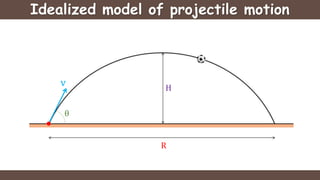
Idealized model of projectile motion
θ
v H
R
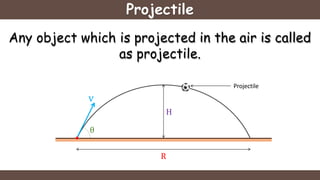
Projectile
Any object which is projected in the air is called
as projectile.
Projectile
θ
v
H
R
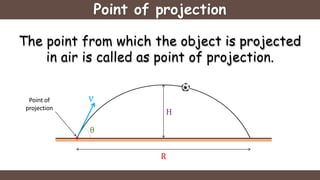
Point of projection
The point from which the object is projected
in air is called as point of projection.
Point of
projection
θ
v
H
R
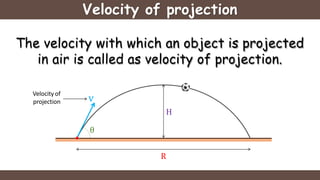
Velocity of projection
The velocity with which an object is projected
in air is called as velocity of projection.
Velocity of
projection
θ
v
H
R
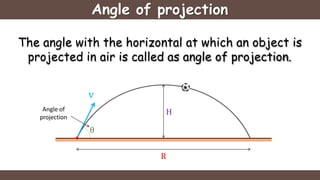
Angle of projection
Angle of
projection
θ
The angle with the horizontal at which an object is
projected in air is called as angle of projection.
v
H
R
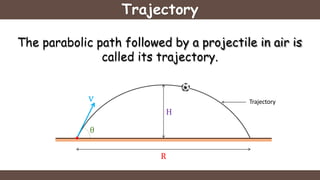
Trajectory
The parabolic path followed by a projectile in air is
called its trajectory.
Trajectory
θ
v
H
R
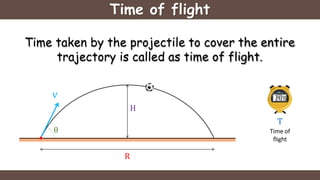
Time of flight
θ
Time taken by the projectile to cover the entire
trajectory is called as time of flight.
v
H
R
T
Time of
flight
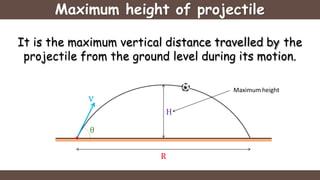
Maximum height of projectile
It is the maximum vertical distance travelled by the
projectile from the ground level during its motion.
Maximum height
θ
v
H
R
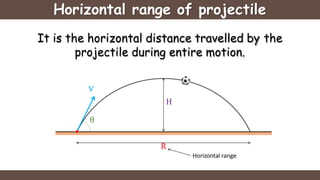
Horizontal range of projectile
Horizontal range
It is the horizontal distance travelled by the
projectile during entire motion.
v
H
θ
R
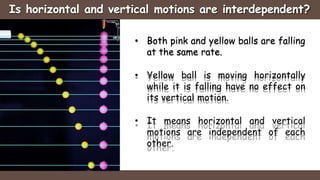
Is horizontal and vertical motions are interdependent?
• Both pink and yellow balls are falling
at the same rate.
• Yellow ball is moving horizontally
while it is falling have no effect on
its vertical motion.
• It means horizontal and vertical
motions are independent of each
other.
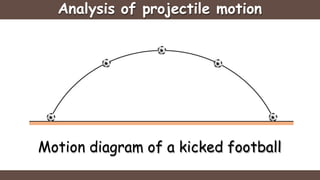
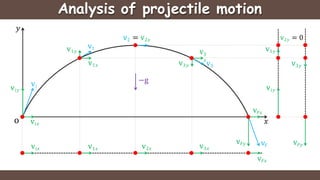
Analysis of projectile motion
Motion diagram of a kicked football
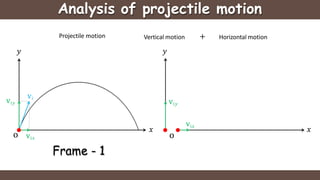
Analysis of projectile motion
vi𝑥
vi𝑦
+
Projectile motion Vertical motion Horizontal motion
𝑥
𝑦 𝑦
Frame - 1
o o
𝑥
vi
vi𝑦
vi𝑥
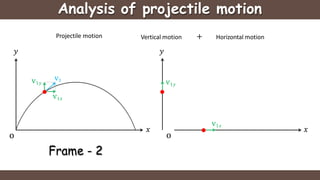
Analysis of projectile motion
v1𝑥
v1𝑦
+
Projectile motion Vertical motion Horizontal motion
𝑥
𝑦 𝑦
Frame - 2
o o
𝑥
v1
v1𝑦
v1𝑥
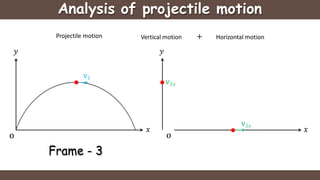
Analysis of projectile motion
+
Projectile motion Vertical motion Horizontal motion
𝑥
𝑦 𝑦
v2𝑦
v2𝑥
Frame - 3
o o
𝑥
v2
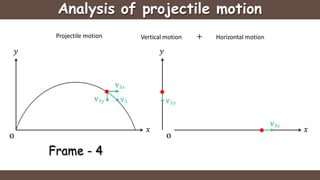
Analysis of projectile motion
v3𝑥
v3𝑦
+
Projectile motion Vertical motion Horizontal motion
𝑥
𝑦 𝑦
v3𝑦
Frame - 4
o o
𝑥
v3𝑥
v3
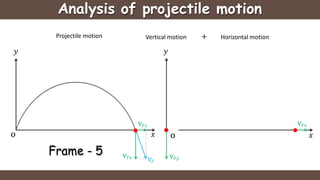
Analysis of projectile motion
v𝐹𝑥
v𝐹𝑦
+
Projectile motion Vertical motion Horizontal motion
𝑥
𝑦 𝑦
Frame - 5
o o 𝑥
v𝐹
v𝐹𝑥
v𝐹𝑦
Analysis of projectile motion
vi𝑥
vi𝑦
vi
o
v1𝑥
v1𝑦
−g
v2 = v2𝑥
v3
𝑥
v3
v3𝑦
v𝐹𝑥
v𝐹𝑦 v𝐹
vi𝑥 v1𝑥 v2𝑥 v3𝑥
v𝐹𝑥
v1
vi𝑦
v𝐹𝑦
v1𝑦
v2𝑦 = 0
v3𝑦
𝑦
𝑥
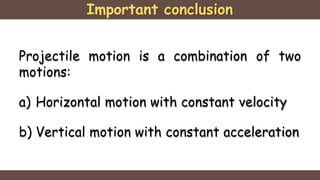
Important conclusion
Projectile motion is a combination of two
motions:
a) Horizontal motion with constant velocity
b) Vertical motion with constant acceleration
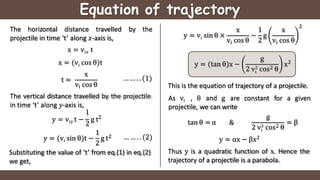
Equation of trajectory
by the
The horizontal distance travelled
projectile in time ‘t’ along 𝑥-axis is,
x = vi𝑥 t
i
x = (v cos θ)t
t =
x
vi cos θ
The vertical distance travelled by the projectile
in time ‘t’ along 𝑦-axis is,
1
y = vi𝑦 t −
2
g t2
… … . . (1)
… … . . (2)
Substituting the value of ‘t’ from eq.(1) in eq.(2)
we get,
1
2
y = (vi sin θ)t − g t2
i
y = v sin θ ×
x
i
v cos θ
1
− g
x
i
2 v cos θ
2
y = tan θ x −
g
i
2 v2
cos2 θ
x2
y = αx − βx2
Thus y is a quadratic function of x. Hence the
trajectory of a projectile is a parabola.
This is the equation of trajectory of a projectile.
As vi , θ and g are constant for a given
projectile, we can write
tan θ = α &
g
i
2 v2
cos2 θ
= β
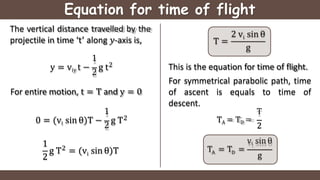
Equation for time of flight
2
The vertical distance travelled by the
projectile in time ‘t’ along 𝑦-axis is,
1
y = viy t −
2
g t
For entire motion, t = T and y = 0
1
0 = (vi sin θ)T −
2
g T2
1
2
2
i
g T = (v sin θ)T
T =
i
2 v sin θ
g
T
TA = TD =
2
A D
vi sin θ
T = T =
g
This is the equation for time of flight.
For symmetrical parabolic path, time
of ascent is equals to time of
descent.
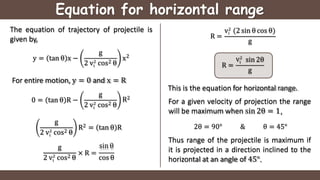
Equation for horizontal range
The equation of trajectory of projectile is
given by,
y = tan θ x −
g
i
2 v2
cos2 θ
x2
For entire motion, y = 0 and x = R
0 = tan θ R −
g
i
2 v2
cos2 θ
R2
g
i
2 v2
cos2 θ
R2 = tan θ R
g
i
2 v2
cos2 θ
sin θ
× R =
cos θ
R =
i
v2
(2 sin θ cos θ)
g
R =
i
v2
sin 2θ
g
This is the equation for horizontal range.
For a given velocity of projection the range
will be maximum when sin 2θ = 1,
2θ = 90° & θ = 45°
Thus range of the projectile is maximum if
it is projected in a direction inclined to the
horizontal at an angle of 45°.
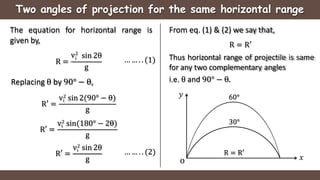
Two angles of projection for the same horizontal range
The equation for horizontal range is
given by,
R =
i
v2
sin 2θ
g
R′ =
i
v2
sin 2(90° − θ)
g
Replacing θ by 90° − θ,
R′ =
i
v2
sin(180° − 2θ)
g
R′ =
i
v2
sin 2θ
g
… … . . (1)
… … . . (2)
From eq. (1) & (2) we say that,
R = R′
Thus horizontal range of projectile is same
for any two complementary angles
i.e. θ and 90° − θ.
𝑥
𝑦
o
30°
60°
R = R′
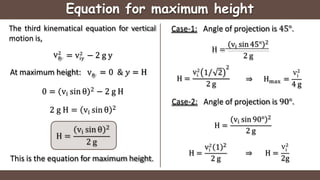
Equation for maximum height
The third kinematical equation for vertical
motion is,
v2
𝐹
𝑦 iy
= v2
− 2 g y
𝐹
y
At maximum height: v = 0 & 𝑦 = H
0 = vi sin θ 2 − 2 g H
2 g H = vi sin θ 2
H =
vi sin θ 2
2 g
This is the equation for maximum height.
Case-1: Angle of projection is 45°.
H = i
v sin 45° 2
2 g
H =
i
v2
1/ 2
2
2 g max
⇒ H =
v2
i
4 g
Case-2: Angle of projection is 90°.
H =
vi sin 90° 2
2 g
H =
i
v2
1 2
2 g
⇒ H =
v2
i
2g
Thank
you

8-projectilemotion project Assignment with full details

  • 1.
  • 2.
    Projectile motion Projectile motionis a motion in which an object is thrown near the earth’s surface, and it moves along the curved path under the action of gravity only.
  • 3.
    Motion of asnow boarder descending from a slope
  • 4.
    Motion of arider performing a bike stunt
  • 5.
    Motion of waterjets coming out from nozzles
  • 6.
    Assumptions used inprojectile motion 1. The effect due to air resistance is negligible. 2. The effect due to curvature of the earth is negligible. 3. The effect due to rotation of the earth is negligible. 4. The acceleration due to gravity is constant over the range of motion.
  • 7.
    Idealized model ofprojectile motion θ v H R
  • 8.
    Projectile Any object whichis projected in the air is called as projectile. Projectile θ v H R
  • 9.
    Point of projection Thepoint from which the object is projected in air is called as point of projection. Point of projection θ v H R
  • 10.
    Velocity of projection Thevelocity with which an object is projected in air is called as velocity of projection. Velocity of projection θ v H R
  • 11.
    Angle of projection Angleof projection θ The angle with the horizontal at which an object is projected in air is called as angle of projection. v H R
  • 12.
    Trajectory The parabolic pathfollowed by a projectile in air is called its trajectory. Trajectory θ v H R
  • 13.
    Time of flight θ Timetaken by the projectile to cover the entire trajectory is called as time of flight. v H R T Time of flight
  • 14.
    Maximum height ofprojectile It is the maximum vertical distance travelled by the projectile from the ground level during its motion. Maximum height θ v H R
  • 15.
    Horizontal range ofprojectile Horizontal range It is the horizontal distance travelled by the projectile during entire motion. v H θ R
  • 16.
    Is horizontal andvertical motions are interdependent? • Both pink and yellow balls are falling at the same rate. • Yellow ball is moving horizontally while it is falling have no effect on its vertical motion. • It means horizontal and vertical motions are independent of each other.
  • 17.
    Analysis of projectilemotion Motion diagram of a kicked football
  • 18.
    Analysis of projectilemotion vi𝑥 vi𝑦 + Projectile motion Vertical motion Horizontal motion 𝑥 𝑦 𝑦 Frame - 1 o o 𝑥 vi vi𝑦 vi𝑥
  • 19.
    Analysis of projectilemotion v1𝑥 v1𝑦 + Projectile motion Vertical motion Horizontal motion 𝑥 𝑦 𝑦 Frame - 2 o o 𝑥 v1 v1𝑦 v1𝑥
  • 20.
    Analysis of projectilemotion + Projectile motion Vertical motion Horizontal motion 𝑥 𝑦 𝑦 v2𝑦 v2𝑥 Frame - 3 o o 𝑥 v2
  • 21.
    Analysis of projectilemotion v3𝑥 v3𝑦 + Projectile motion Vertical motion Horizontal motion 𝑥 𝑦 𝑦 v3𝑦 Frame - 4 o o 𝑥 v3𝑥 v3
  • 22.
    Analysis of projectilemotion v𝐹𝑥 v𝐹𝑦 + Projectile motion Vertical motion Horizontal motion 𝑥 𝑦 𝑦 Frame - 5 o o 𝑥 v𝐹 v𝐹𝑥 v𝐹𝑦
  • 23.
    Analysis of projectilemotion vi𝑥 vi𝑦 vi o v1𝑥 v1𝑦 −g v2 = v2𝑥 v3 𝑥 v3 v3𝑦 v𝐹𝑥 v𝐹𝑦 v𝐹 vi𝑥 v1𝑥 v2𝑥 v3𝑥 v𝐹𝑥 v1 vi𝑦 v𝐹𝑦 v1𝑦 v2𝑦 = 0 v3𝑦 𝑦 𝑥
  • 24.
    Important conclusion Projectile motionis a combination of two motions: a) Horizontal motion with constant velocity b) Vertical motion with constant acceleration
  • 25.
    Equation of trajectory bythe The horizontal distance travelled projectile in time ‘t’ along 𝑥-axis is, x = vi𝑥 t i x = (v cos θ)t t = x vi cos θ The vertical distance travelled by the projectile in time ‘t’ along 𝑦-axis is, 1 y = vi𝑦 t − 2 g t2 … … . . (1) … … . . (2) Substituting the value of ‘t’ from eq.(1) in eq.(2) we get, 1 2 y = (vi sin θ)t − g t2 i y = v sin θ × x i v cos θ 1 − g x i 2 v cos θ 2 y = tan θ x − g i 2 v2 cos2 θ x2 y = αx − βx2 Thus y is a quadratic function of x. Hence the trajectory of a projectile is a parabola. This is the equation of trajectory of a projectile. As vi , θ and g are constant for a given projectile, we can write tan θ = α & g i 2 v2 cos2 θ = β
  • 26.
    Equation for timeof flight 2 The vertical distance travelled by the projectile in time ‘t’ along 𝑦-axis is, 1 y = viy t − 2 g t For entire motion, t = T and y = 0 1 0 = (vi sin θ)T − 2 g T2 1 2 2 i g T = (v sin θ)T T = i 2 v sin θ g T TA = TD = 2 A D vi sin θ T = T = g This is the equation for time of flight. For symmetrical parabolic path, time of ascent is equals to time of descent.
  • 27.
    Equation for horizontalrange The equation of trajectory of projectile is given by, y = tan θ x − g i 2 v2 cos2 θ x2 For entire motion, y = 0 and x = R 0 = tan θ R − g i 2 v2 cos2 θ R2 g i 2 v2 cos2 θ R2 = tan θ R g i 2 v2 cos2 θ sin θ × R = cos θ R = i v2 (2 sin θ cos θ) g R = i v2 sin 2θ g This is the equation for horizontal range. For a given velocity of projection the range will be maximum when sin 2θ = 1, 2θ = 90° & θ = 45° Thus range of the projectile is maximum if it is projected in a direction inclined to the horizontal at an angle of 45°.
  • 28.
    Two angles ofprojection for the same horizontal range The equation for horizontal range is given by, R = i v2 sin 2θ g R′ = i v2 sin 2(90° − θ) g Replacing θ by 90° − θ, R′ = i v2 sin(180° − 2θ) g R′ = i v2 sin 2θ g … … . . (1) … … . . (2) From eq. (1) & (2) we say that, R = R′ Thus horizontal range of projectile is same for any two complementary angles i.e. θ and 90° − θ. 𝑥 𝑦 o 30° 60° R = R′
  • 29.
    Equation for maximumheight The third kinematical equation for vertical motion is, v2 𝐹 𝑦 iy = v2 − 2 g y 𝐹 y At maximum height: v = 0 & 𝑦 = H 0 = vi sin θ 2 − 2 g H 2 g H = vi sin θ 2 H = vi sin θ 2 2 g This is the equation for maximum height. Case-1: Angle of projection is 45°. H = i v sin 45° 2 2 g H = i v2 1/ 2 2 2 g max ⇒ H = v2 i 4 g Case-2: Angle of projection is 90°. H = vi sin 90° 2 2 g H = i v2 1 2 2 g ⇒ H = v2 i 2g
  • 30.