2013 초등영어교사교육

Issues in teachers’ reinterpretation of a
task-based innovation in primary
schools
TESOLQUARTERLY Vol.38, No.4,Winter 2004
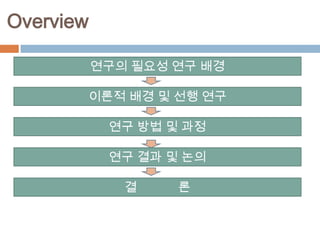
Overview
연구의 필요성 연구 배경

이론적 배경 및 선행 연구
연구 방법 및 과정

연구 결과 및 논의
결

론
I 연구의 필요성 및 연구 배경



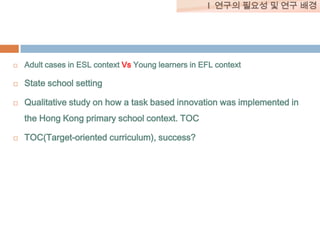
Adult cases in ESL context Vs Young learners in EFL context



State school setting



Qualitative study on how a task based innovation was implemented in
the Hong Kong primary school context. TOC



TOC(Target-oriented curriculum), success?
II 이론적 배경 및 선행 연구

Notion of TASK
& 3 issues of TBL implementation


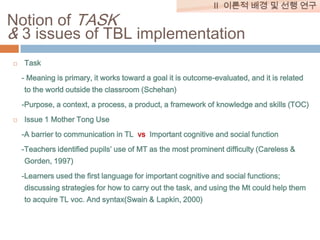
Task

- Meaning is primary, it works toward a goal it is outcome-evaluated, and it is related
to the world outside the classroom (Schehan)
-Purpose, a context, a process, a product, a framework of knowledge and skills (TOC)


Issue 1 Mother Tong Use
-A barrier to communication in TL vs Important cognitive and social function
-Teachers identified pupils’ use of MT as the most prominent difficulty (Careless &
Gorden, 1997)
-Learners used the first language for important cognitive and social functions;
discussing strategies for how to carry out the task, and using the Mt could help them
to acquire TL voc. And syntax(Swain & Lapkin, 2000)
II 이론적 배경 및 선행 연구

Notion of TASK
& 3 issues of TBL implementation


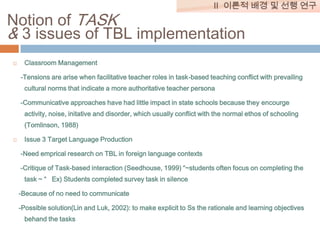
Classroom Management

-Tensions are arise when facilitative teacher roles in task-based teaching conflict with prevailing
cultural norms that indicate a more authoritative teacher persona
-Communicative approaches have had little impact in state schools because they encourge
activity, noise, initative and disorder, which usually conflict with the normal ethos of schooling
(Tomlinson, 1988)


Issue 3 Target Language Production
-Need emprical research on TBL in foreign language contexts
-Critique of Task-based interaction (Seedhouse, 1999) “~students often focus on completing the
task ~ “ Ex) Students completed survey task in silence
-Because of no need to communicate
-Possible solution(Lin and Luk, 2002): to make explicit to Ss the rationale and learning objectives
behand the tasks
II 이론적 배경 및 선행 연구

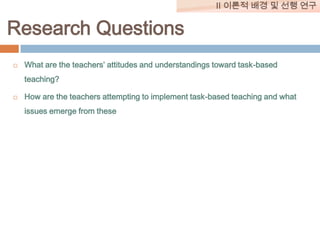
Research Questions


What are the teachers’ attitudes and understandings toward task-based
teaching?



How are the teachers attempting to implement task-based teaching and what
issues emerge from these
III. 연구 방법 및 연구 과정

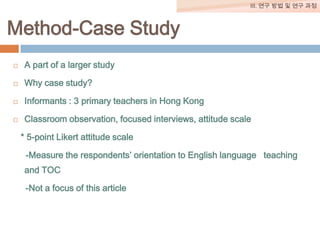
Method-Case Study


A part of a larger study



Why case study?



Informants : 3 primary teachers in Hong Kong



Classroom observation, focused interviews, attitude scale
* 5-point Likert attitude scale
-Measure the respondents’ orientation to English language teaching
and TOC

-Not a focus of this article
III. 연구 방법 및 연구 과정

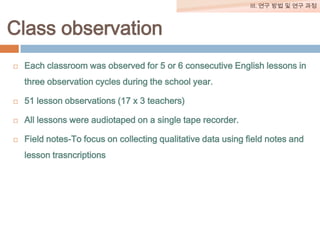
Class observation


Each classroom was observed for 5 or 6 consecutive English lessons in
three observation cycles during the school year.



51 lesson observations (17 x 3 teachers)



All lessons were audiotaped on a single tape recorder.



Field notes-To focus on collecting qualitative data using field notes and
lesson trasncriptions
III. 연구 방법 및 연구 과정

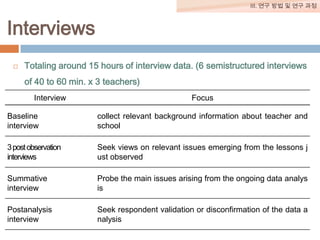
Interviews


Totaling around 15 hours of interview data. (6 semistructured interviews
of 40 to 60 min. x 3 teachers)
Interview

Focus

Baseline
interview

collect relevant background information about teacher and
school

3 post observation
interviews

Seek views on relevant issues emerging from the lessons j
ust observed

Summative
interview

Probe the main issues arising from the ongoing data analys
is

Postanalysis
interview

Seek respondent validation or disconfirmation of the data a
nalysis
III. 연구 방법 및 연구 과정

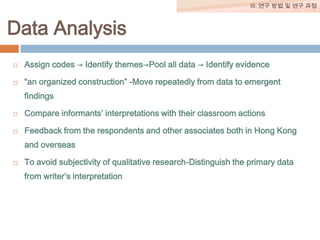
Data Analysis


Assign codes → Identify themes→Pool all data → Identify evidence



“an organized construction” -Move repeatedly from data to emergent
findings



Compare informants’ interpretations with their classroom actions



Feedback from the respondents and other associates both in Hong Kong
and overseas



To avoid subjectivity of qualitative research-Distinguish the primary data
from writer’s interpretation
III. 연구 방법 및 과정

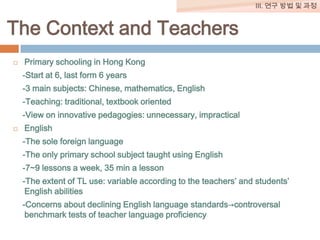
The Context and Teachers


Primary schooling in Hong Kong

-Start at 6, last form 6 years
-3 main subjects: Chinese, mathematics, English
-Teaching: traditional, textbook oriented
-View on innovative pedagogies: unnecessary, impractical


English
-The sole foreign language
-The only primary school subject taught using English
-7~9 lessons a week, 35 min a lesson

-The extent of TL use: variable according to the teachers’ and students’
English abilities
-Concerns about declining English language standards→controversal
benchmark tests of teacher language proficiency
III. 연구 방법 및 과정

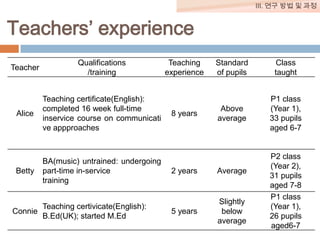
Teachers’ experience
Teacher

Qualifications
/training

Alice

Teaching certificate(English):
completed 16 week full-time
inservice course on communicati
ve appproaches

Betty

BA(music) untrained: undergoing
part-time in-service
training

Teaching certivicate(English):
Connie
B.Ed(UK); started M.Ed

Teaching
experience

8 years

Standard
of pupils

Class
taught

Above
average

P1 class
(Year 1),
33 pupils
aged 6-7

2 years

Average

5 years

Slightly
below
average

P2 class
(Year 2),
31 pupils
aged 7-8
P1 class
(Year 1),
26 pupils
aged6-7
III. 연구 방법 및 과정

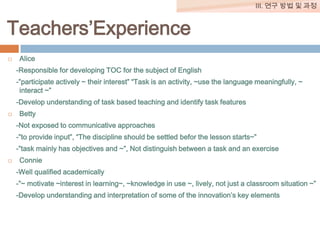
Teachers’Experience


Alice
-Responsible for developing TOC for the subject of English
-”participate actively ~ their interest” “Task is an activity, ~use the language meaningfully, ~
interact ~”
-Develop understanding of task based teaching and identify task features



Betty
-Not exposed to communicative approaches
-”to provide input”, “The discipline should be settled befor the lesson starts~”

-”task mainly has objectives and ~”, Not distinguish between a task and an exercise


Connie
-Well qualified academically
-”~ motivate ~interest in learning~, ~knowledge in use ~, lively, not just a classroom situation ~”
-Develop understanding and interpretation of some of the innovation’s key elements
III. 연구 방법 및 과정

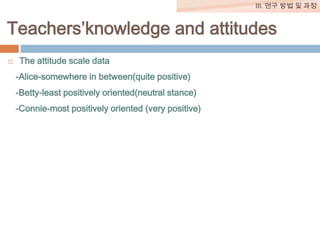
Teachers’knowledge and attitudes


The attitude scale data
-Alice-somewhere in between(quite positive)

-Betty-least positively oriented(neutral stance)
-Connie-most positively oriented (very positive)
IV. 연구 결과

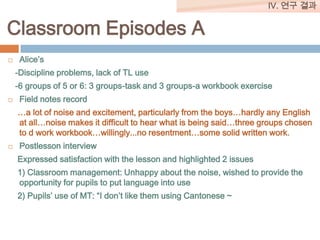
Classroom Episodes A


Alice’s
-Discipline problems, lack of TL use
-6 groups of 5 or 6: 3 groups-task and 3 groups-a workbook exercise



Field notes record
…a lot of noise and excitement, particularly from the boys…hardly any English
at all…noise makes it difficult to hear what is being said…three groups chosen
to d work workbook…willingly...no resentment…some solid written work.



Postlesson interview
Expressed satisfaction with the lesson and highlighted 2 issues
1) Classroom management: Unhappy about the noise, wished to provide the
opportunity for pupils to put language into use
2) Pupils’ use of MT: “I don’t like them using Cantonese ~
IV. 연구 결과

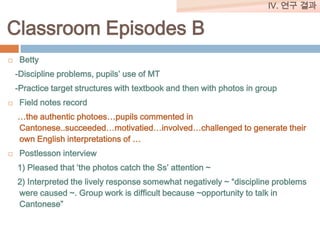
Classroom Episodes B


Betty
-Discipline problems, pupils’ use of MT
-Practice target structures with textbook and then with photos in group



Field notes record
…the authentic photoes…pupils commented in
Cantonese..succeeded…motivatied…involved…challenged to generate their
own English interpretations of …



Postlesson interview
1) Pleased that ‘the photos catch the Ss’ attention ~
2) Interpreted the lively response somewhat negatively ~ “discipline problems
were caused ~. Group work is difficult because ~opportunity to talk in
Cantonese”
IV. 연구 결과

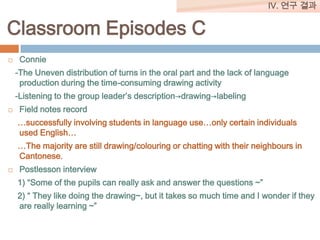
Classroom Episodes C


Connie
-The Uneven distribution of turns in the oral part and the lack of language
production during the time-consuming drawing activity

-Listening to the group leader’s description→drawing→labeling


Field notes record
…successfully involving students in language use…only certain individuals
used English…

…The majority are still drawing/colouring or chatting with their neighbours in
Cantonese.


Postlesson interview
1) “Some of the pupils can really ask and answer the questions ~”
2) “ They like doing the drawing~, but it takes so much time and I wonder if they
are really learning ~”
IV. 연구 결과 및 논의

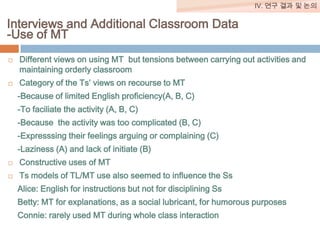
Interviews and Additional Classroom Data
-Use of MT




Different views on using MT but tensions between carrying out activities and
maintaining orderly classroom
Category of the Ts’ views on recourse to MT

-Because of limited English proficiency(A, B, C)
-To faciliate the activity (A, B, C)
-Because the activity was too complicated (B, C)
-Expresssing their feelings arguing or complaining (C)

-Laziness (A) and lack of initiate (B)


Constructive uses of MT



Ts models of TL/MT use also seemed to influence the Ss
Alice: English for instructions but not for disciplining Ss

Betty: MT for explanations, as a social lubricant, for humorous purposes
Connie: rarely used MT during whole class interaction
IV. 연구 결과 및 논의

Interviews and Additional Classroom Data
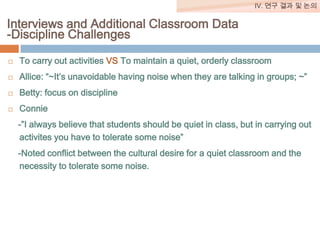
-Discipline Challenges


To carry out activities VS To maintain a quiet, orderly classroom



Allice: “~It’s unavoidable having noise when they are talking in groups; ~”



Betty: focus on discipline



Connie
-”I always believe that students should be quiet in class, but in carrying out
activites you have to tolerate some noise”

-Noted conflict between the cultural desire for a quiet classroom and the
necessity to tolerate some noise.
IV. 연구 결과 및 논의

Interviews and Additional Classroom Data
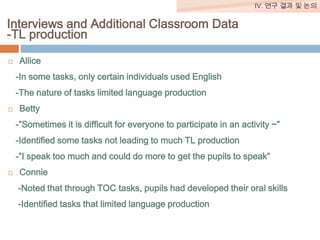
-TL production


Allice
-In some tasks, only certain individuals used English

-The nature of tasks limited language production


Betty
-”Sometimes it is difficult for everyone to participate in an activity ~”
-Identified some tasks not leading to much TL production
-”I speak too much and could do more to get the pupils to speak”



Connie
-Noted that through TOC tasks, pupils had developed their oral skills

-Identified tasks that limited language production
IV. 연구 결과 및 논의

Interviews and Additional Classroom Data
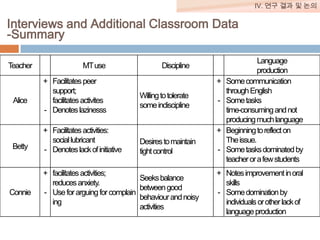
-Summary
Teacher

Alice

Betty

Connie

MT use
+ Facilitates peer
support;
facilitates activites
- Denotes lazinesss
+ Facilitates activities:
social lubricant
- Denotes lack of initiative

Discipline
+
Willing to tolerate
some indiscipline

-

+
Desires to maintain
tight control

+ facilitates activities;
Seeks balance
reduces anxiety.
between good
- Use for arguing for complain
behaviour and noisy
ing
activities

-

Language
production
Some communication
through English
Some tasks
time-consuming and not
producing much language
Beginning to reflect on
The issue.
Some tasks dominated by
teacher or a few students

+ Notes improvement in oral
skills
- Some domination by
individuals or other lack of
language production
IV. 연구 결과 및 논의

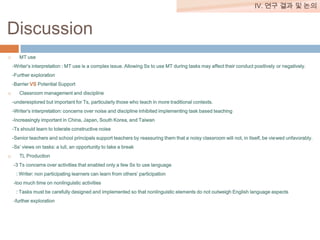
Discussion


MT use
-Writer’s interpretation : MT use is a complex issue. Allowing Ss to use MT during tasks may affect their conduct positively or negatively.
-Further exploration
-Barrier VS Potential Support



Classroom management and discipline
-underexplored but important for Ts, particularly those who teach in more traditional contexts.
-Writer’s interpretation: concerns over noise and discipline inhibited implementing task based teaching
-Increasingly important in China, Japan, South Korea, and Taiwan
-Ts should learn to tolerate constructive noise
-Senior teachers and school principals support teachers by reassuring them that a noisy classroom will not, in itself, be viewed unfavorably.

-Ss’ views on tasks: a lull, an opportunity to take a break


TL Production
-3 Ts concerns over activities that enabled only a few Ss to use language
: Writer: non participating learners can learn from others’ participation
-too much time on nonlinguistic activities
: Tasks must be carefully designed and implemented so that nonlinguistic elements do not outweigh English language aspects

-further exploration
V. 결 론

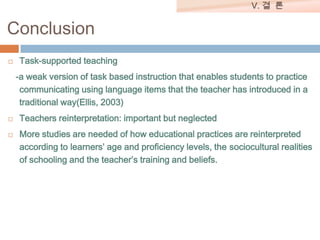
Conclusion


Task-supported teaching
-a weak version of task based instruction that enables students to practice
communicating using language items that the teacher has introduced in a
traditional way(Ellis, 2003)




Teachers reinterpretation: important but neglected
More studies are needed of how educational practices are reinterpreted
according to learners’ age and proficiency levels, the sociocultural realities
of schooling and the teacher’s training and beliefs.
감사합니다.

Smile ,
and the world smiles with you.

TBLT research article _Carless 2004

  • 1.
    2013 초등영어교사교육 Issues inteachers’ reinterpretation of a task-based innovation in primary schools TESOLQUARTERLY Vol.38, No.4,Winter 2004
  • 2.
    Overview 연구의 필요성 연구배경 이론적 배경 및 선행 연구 연구 방법 및 과정 연구 결과 및 논의 결 론
  • 3.
    I 연구의 필요성및 연구 배경  Adult cases in ESL context Vs Young learners in EFL context  State school setting  Qualitative study on how a task based innovation was implemented in the Hong Kong primary school context. TOC  TOC(Target-oriented curriculum), success?
  • 4.
    II 이론적 배경및 선행 연구 Notion of TASK & 3 issues of TBL implementation  Task - Meaning is primary, it works toward a goal it is outcome-evaluated, and it is related to the world outside the classroom (Schehan) -Purpose, a context, a process, a product, a framework of knowledge and skills (TOC)  Issue 1 Mother Tong Use -A barrier to communication in TL vs Important cognitive and social function -Teachers identified pupils’ use of MT as the most prominent difficulty (Careless & Gorden, 1997) -Learners used the first language for important cognitive and social functions; discussing strategies for how to carry out the task, and using the Mt could help them to acquire TL voc. And syntax(Swain & Lapkin, 2000)
  • 5.
    II 이론적 배경및 선행 연구 Notion of TASK & 3 issues of TBL implementation  Classroom Management -Tensions are arise when facilitative teacher roles in task-based teaching conflict with prevailing cultural norms that indicate a more authoritative teacher persona -Communicative approaches have had little impact in state schools because they encourge activity, noise, initative and disorder, which usually conflict with the normal ethos of schooling (Tomlinson, 1988)  Issue 3 Target Language Production -Need emprical research on TBL in foreign language contexts -Critique of Task-based interaction (Seedhouse, 1999) “~students often focus on completing the task ~ “ Ex) Students completed survey task in silence -Because of no need to communicate -Possible solution(Lin and Luk, 2002): to make explicit to Ss the rationale and learning objectives behand the tasks
  • 6.
    II 이론적 배경및 선행 연구 Research Questions  What are the teachers’ attitudes and understandings toward task-based teaching?  How are the teachers attempting to implement task-based teaching and what issues emerge from these
  • 7.
    III. 연구 방법및 연구 과정 Method-Case Study  A part of a larger study  Why case study?  Informants : 3 primary teachers in Hong Kong  Classroom observation, focused interviews, attitude scale * 5-point Likert attitude scale -Measure the respondents’ orientation to English language teaching and TOC -Not a focus of this article
  • 8.
    III. 연구 방법및 연구 과정 Class observation  Each classroom was observed for 5 or 6 consecutive English lessons in three observation cycles during the school year.  51 lesson observations (17 x 3 teachers)  All lessons were audiotaped on a single tape recorder.  Field notes-To focus on collecting qualitative data using field notes and lesson trasncriptions
  • 9.
    III. 연구 방법및 연구 과정 Interviews  Totaling around 15 hours of interview data. (6 semistructured interviews of 40 to 60 min. x 3 teachers) Interview Focus Baseline interview collect relevant background information about teacher and school 3 post observation interviews Seek views on relevant issues emerging from the lessons j ust observed Summative interview Probe the main issues arising from the ongoing data analys is Postanalysis interview Seek respondent validation or disconfirmation of the data a nalysis
  • 10.
    III. 연구 방법및 연구 과정 Data Analysis  Assign codes → Identify themes→Pool all data → Identify evidence  “an organized construction” -Move repeatedly from data to emergent findings  Compare informants’ interpretations with their classroom actions  Feedback from the respondents and other associates both in Hong Kong and overseas  To avoid subjectivity of qualitative research-Distinguish the primary data from writer’s interpretation
  • 11.
    III. 연구 방법및 과정 The Context and Teachers  Primary schooling in Hong Kong -Start at 6, last form 6 years -3 main subjects: Chinese, mathematics, English -Teaching: traditional, textbook oriented -View on innovative pedagogies: unnecessary, impractical  English -The sole foreign language -The only primary school subject taught using English -7~9 lessons a week, 35 min a lesson -The extent of TL use: variable according to the teachers’ and students’ English abilities -Concerns about declining English language standards→controversal benchmark tests of teacher language proficiency
  • 12.
    III. 연구 방법및 과정 Teachers’ experience Teacher Qualifications /training Alice Teaching certificate(English): completed 16 week full-time inservice course on communicati ve appproaches Betty BA(music) untrained: undergoing part-time in-service training Teaching certivicate(English): Connie B.Ed(UK); started M.Ed Teaching experience 8 years Standard of pupils Class taught Above average P1 class (Year 1), 33 pupils aged 6-7 2 years Average 5 years Slightly below average P2 class (Year 2), 31 pupils aged 7-8 P1 class (Year 1), 26 pupils aged6-7
  • 13.
    III. 연구 방법및 과정 Teachers’Experience  Alice -Responsible for developing TOC for the subject of English -”participate actively ~ their interest” “Task is an activity, ~use the language meaningfully, ~ interact ~” -Develop understanding of task based teaching and identify task features  Betty -Not exposed to communicative approaches -”to provide input”, “The discipline should be settled befor the lesson starts~” -”task mainly has objectives and ~”, Not distinguish between a task and an exercise  Connie -Well qualified academically -”~ motivate ~interest in learning~, ~knowledge in use ~, lively, not just a classroom situation ~” -Develop understanding and interpretation of some of the innovation’s key elements
  • 14.
    III. 연구 방법및 과정 Teachers’knowledge and attitudes  The attitude scale data -Alice-somewhere in between(quite positive) -Betty-least positively oriented(neutral stance) -Connie-most positively oriented (very positive)
  • 15.
    IV. 연구 결과 ClassroomEpisodes A  Alice’s -Discipline problems, lack of TL use -6 groups of 5 or 6: 3 groups-task and 3 groups-a workbook exercise  Field notes record …a lot of noise and excitement, particularly from the boys…hardly any English at all…noise makes it difficult to hear what is being said…three groups chosen to d work workbook…willingly...no resentment…some solid written work.  Postlesson interview Expressed satisfaction with the lesson and highlighted 2 issues 1) Classroom management: Unhappy about the noise, wished to provide the opportunity for pupils to put language into use 2) Pupils’ use of MT: “I don’t like them using Cantonese ~
  • 16.
    IV. 연구 결과 ClassroomEpisodes B  Betty -Discipline problems, pupils’ use of MT -Practice target structures with textbook and then with photos in group  Field notes record …the authentic photoes…pupils commented in Cantonese..succeeded…motivatied…involved…challenged to generate their own English interpretations of …  Postlesson interview 1) Pleased that ‘the photos catch the Ss’ attention ~ 2) Interpreted the lively response somewhat negatively ~ “discipline problems were caused ~. Group work is difficult because ~opportunity to talk in Cantonese”
  • 17.
    IV. 연구 결과 ClassroomEpisodes C  Connie -The Uneven distribution of turns in the oral part and the lack of language production during the time-consuming drawing activity -Listening to the group leader’s description→drawing→labeling  Field notes record …successfully involving students in language use…only certain individuals used English… …The majority are still drawing/colouring or chatting with their neighbours in Cantonese.  Postlesson interview 1) “Some of the pupils can really ask and answer the questions ~” 2) “ They like doing the drawing~, but it takes so much time and I wonder if they are really learning ~”
  • 18.
    IV. 연구 결과및 논의 Interviews and Additional Classroom Data -Use of MT   Different views on using MT but tensions between carrying out activities and maintaining orderly classroom Category of the Ts’ views on recourse to MT -Because of limited English proficiency(A, B, C) -To faciliate the activity (A, B, C) -Because the activity was too complicated (B, C) -Expresssing their feelings arguing or complaining (C) -Laziness (A) and lack of initiate (B)  Constructive uses of MT  Ts models of TL/MT use also seemed to influence the Ss Alice: English for instructions but not for disciplining Ss Betty: MT for explanations, as a social lubricant, for humorous purposes Connie: rarely used MT during whole class interaction
  • 19.
    IV. 연구 결과및 논의 Interviews and Additional Classroom Data -Discipline Challenges  To carry out activities VS To maintain a quiet, orderly classroom  Allice: “~It’s unavoidable having noise when they are talking in groups; ~”  Betty: focus on discipline  Connie -”I always believe that students should be quiet in class, but in carrying out activites you have to tolerate some noise” -Noted conflict between the cultural desire for a quiet classroom and the necessity to tolerate some noise.
  • 20.
    IV. 연구 결과및 논의 Interviews and Additional Classroom Data -TL production  Allice -In some tasks, only certain individuals used English -The nature of tasks limited language production  Betty -”Sometimes it is difficult for everyone to participate in an activity ~” -Identified some tasks not leading to much TL production -”I speak too much and could do more to get the pupils to speak”  Connie -Noted that through TOC tasks, pupils had developed their oral skills -Identified tasks that limited language production
  • 21.
    IV. 연구 결과및 논의 Interviews and Additional Classroom Data -Summary Teacher Alice Betty Connie MT use + Facilitates peer support; facilitates activites - Denotes lazinesss + Facilitates activities: social lubricant - Denotes lack of initiative Discipline + Willing to tolerate some indiscipline - + Desires to maintain tight control + facilitates activities; Seeks balance reduces anxiety. between good - Use for arguing for complain behaviour and noisy ing activities - Language production Some communication through English Some tasks time-consuming and not producing much language Beginning to reflect on The issue. Some tasks dominated by teacher or a few students + Notes improvement in oral skills - Some domination by individuals or other lack of language production
  • 22.
    IV. 연구 결과및 논의 Discussion  MT use -Writer’s interpretation : MT use is a complex issue. Allowing Ss to use MT during tasks may affect their conduct positively or negatively. -Further exploration -Barrier VS Potential Support  Classroom management and discipline -underexplored but important for Ts, particularly those who teach in more traditional contexts. -Writer’s interpretation: concerns over noise and discipline inhibited implementing task based teaching -Increasingly important in China, Japan, South Korea, and Taiwan -Ts should learn to tolerate constructive noise -Senior teachers and school principals support teachers by reassuring them that a noisy classroom will not, in itself, be viewed unfavorably. -Ss’ views on tasks: a lull, an opportunity to take a break  TL Production -3 Ts concerns over activities that enabled only a few Ss to use language : Writer: non participating learners can learn from others’ participation -too much time on nonlinguistic activities : Tasks must be carefully designed and implemented so that nonlinguistic elements do not outweigh English language aspects -further exploration
  • 23.
    V. 결 론 Conclusion  Task-supportedteaching -a weak version of task based instruction that enables students to practice communicating using language items that the teacher has introduced in a traditional way(Ellis, 2003)   Teachers reinterpretation: important but neglected More studies are needed of how educational practices are reinterpreted according to learners’ age and proficiency levels, the sociocultural realities of schooling and the teacher’s training and beliefs.
  • 24.
    감사합니다. Smile , and theworld smiles with you.