8/12/2022 1
In The name of ALLAH, The most BENEFICENT and The MERCIFUL.
8/12/2022 2
Dr. EHTISHAM Ul Haq
Outlines of the Presentation
1. The Physical Therapist as
Professional
2. Characteristics of a professional
3. Difference between occupation and
Profession
8/12/2022 3
1. The Physical Therapist As
Professional
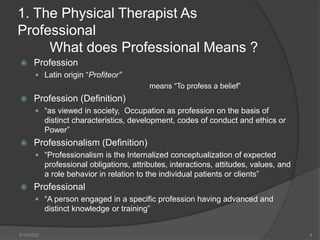
What does Professional Means ?
 Profession
 Latin origin “Profiteor”
means “To profess a belief”
 Profession (Definition)
 “as viewed in society, Occupation as profession on the basis of
distinct characteristics, development, codes of conduct and ethics or
Power”
 Professionalism (Definition)
 “Professionalism is the Internalized conceptualization of expected
professional obligations, attributes, interactions, attitudes, values, and
a role behavior in relation to the individual patients or clients”
 Professional
 “A person engaged in a specific profession having advanced and
distinct knowledge or training”
8/12/2022 4
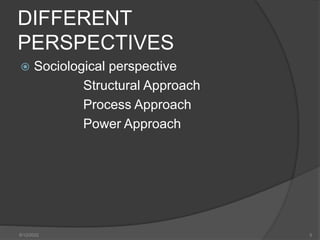
DIFFERENT
PERSPECTIVES
 Sociological perspective
Structural Approach
Process Approach
Power Approach
8/12/2022 5
Sociological Approach
 Professionalism in Sociology
 Structural Approach:-
Static characteristics than an occupation
should be considered as profession
 Process Approach:-
Focuses on either the stages and
developmental periods that an
occupation to be pass through to be
recognized as profession .
8/12/2022 6
 POWER APPROACH:-
Profession’s ability to obtain the
political and social power to define its
work and it is the important
characteristic.
According to Ritzer these approaches can
be blended to deal up with the
professionalism.
8/12/2022 7
2. Characteristics of Professionals
A. Education
B. knowledge
C. Self-Regulation of Ethical Standards
D. Autonomy
E. Accountability
F. Nature of Work and Decisions
G. Authority
8/12/2022 8
2. Characteristics of Professionals
A. Education and Knowledge
 Education
 Extensive
 Skilled, Technical
 High standard for admission
 Knowledge
 Broad, Theoretical & Practical
 Generalized and Specific, Systematic
knowledge
 Unique Body of Knowledge(Professional)
8/12/2022 9
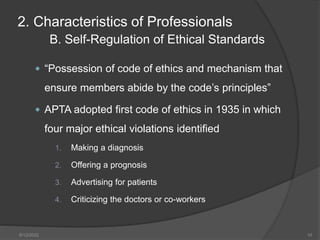
 “Possession of code of ethics and mechanism that
ensure members abide by the code’s principles”
 APTA adopted first code of ethics in 1935 in which
four major ethical violations identified
1. Making a diagnosis
2. Offering a prognosis
3. Advertising for patients
4. Criticizing the doctors or co-workers
2. Characteristics of Professionals
B. Self-Regulation of Ethical Standards
8/12/2022 10
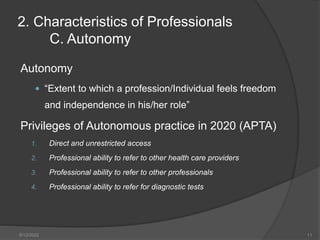
Autonomy
 “Extent to which a profession/Individual feels freedom
and independence in his/her role”
Privileges of Autonomous practice in 2020 (APTA)
1. Direct and unrestricted access
2. Professional ability to refer to other health care providers
3. Professional ability to refer to other professionals
4. Professional ability to refer for diagnostic tests
2. Characteristics of Professionals
C. Autonomy
8/12/2022 11
Direct and un restricted Access
 The physical therapist has a
professional capability and ability to
provide to all individuals physical
therapy services they chose without any
restriction
Professional ability to refer to
other health care providers
 The PT has professional capability and
ability to refer to others in the health
care system for possible medical needs
beyond the physical therapist practice
Professional ability to refer to
other Professionals
 The PT has professional capability and
ability to refer to others in the health
care system for possible medical needs
beyond the physical therapist practice
Professional ability to refer for
diagnostic tests
 The PT has professional capability and
ability to refer for diagnostic test that
would clarify the patient situation and
enhance the provision of physical
therapy services
True Professionals
 High Autonomy in decision making and
high control over their work.
 Opposite to true professionals are para
professional, semi professional or non
professional .
 Professionals have obligations and must “account”
to the public for these”
 Emanual defined
○ “The process by which a party justifies its actions and
policies”
 Physiotherapist is accountable to
○ Professional Associations
○ Patients
○ Government
○ Lawyers and Courts
○ Employers
○ Investors
○ Hospital administration
○ Private payers (Insurance)
2. Characteristics of Professionals
D. Accountability
8/12/2022 17
2. Characteristics of Professionals
D. Accountability
8/12/2022 18
2. Characteristics of Professionals
E. Nature of Work and Decisions
 Important or essential to client
 Complex
8/12/2022 19
2. Characteristics of Professionals
F. Authority
 Based on Internal Knowledge
 Granted by Society
 Demonstrated by power and status in
society
 Demonstrated by symbolic award
8/12/2022 20
Pavalko’s Continuum
 Pavalko’s Continuum
Difference between occupation and
profession
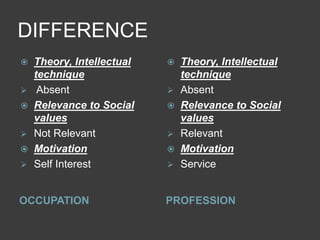
DIFFERENCE
OCCUPATION PROFESSION
 Theory, Intellectual
technique
 Absent
 Relevance to Social
values
 Not Relevant
 Motivation
 Self Interest
 Theory, Intellectual
technique
 Absent
 Relevance to Social
values
 Relevant
 Motivation
 Service
Cont…
OCCUPATION PROFESSION
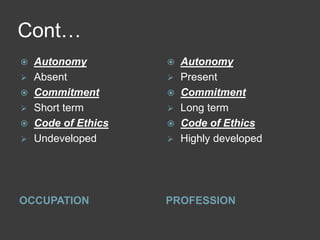
 Autonomy
 Absent
 Commitment
 Short term
 Code of Ethics
 Undeveloped
 Autonomy
 Present
 Commitment
 Long term
 Code of Ethics
 Highly developed
Cont…
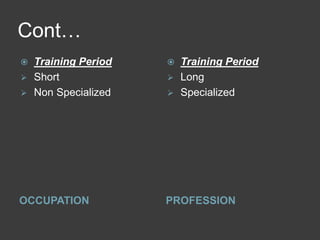
OCCUPATION PROFESSION
 Training Period
 Short
 Non Specialized
 Training Period
 Long
 Specialized
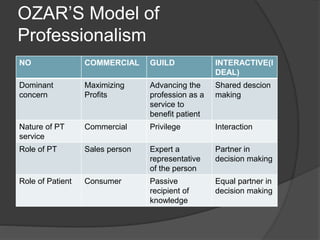
OZAR’S Model of
Professionalism
NO COMMERCIAL GUILD INTERACTIVE(I
DEAL)
Dominant
concern
Maximizing
Profits
Advancing the
profession as a
service to
benefit patient
Shared descion
making
Nature of PT
service
Commercial Privilege Interaction
Role of PT Sales person Expert a
representative
of the person
Partner in
decision making
Role of Patient Consumer Passive
recipient of
knowledge
Equal partner in
decision making
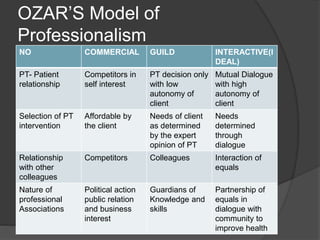
OZAR’S Model of
Professionalism
NO COMMERCIAL GUILD INTERACTIVE(I
DEAL)
PT- Patient
relationship
Competitors in
self interest
PT decision only
with low
autonomy of
client
Mutual Dialogue
with high
autonomy of
client
Selection of PT
intervention
Affordable by
the client
Needs of client
as determined
by the expert
opinion of PT
Needs
determined
through
dialogue
Relationship
with other
colleagues
Competitors Colleagues Interaction of
equals
Nature of
professional
Associations
Political action
public relation
and business
interest
Guardians of
Knowledge and
skills
Partnership of
equals in
dialogue with
community to
improve health
Thanks to All
8/12/2022 27

Physiotherapist as professional.pptx

  • 1.
    8/12/2022 1 In Thename of ALLAH, The most BENEFICENT and The MERCIFUL.
  • 2.
  • 3.
    Outlines of thePresentation 1. The Physical Therapist as Professional 2. Characteristics of a professional 3. Difference between occupation and Profession 8/12/2022 3
  • 4.
    1. The PhysicalTherapist As Professional What does Professional Means ?  Profession  Latin origin “Profiteor” means “To profess a belief”  Profession (Definition)  “as viewed in society, Occupation as profession on the basis of distinct characteristics, development, codes of conduct and ethics or Power”  Professionalism (Definition)  “Professionalism is the Internalized conceptualization of expected professional obligations, attributes, interactions, attitudes, values, and a role behavior in relation to the individual patients or clients”  Professional  “A person engaged in a specific profession having advanced and distinct knowledge or training” 8/12/2022 4
  • 5.
    DIFFERENT PERSPECTIVES  Sociological perspective StructuralApproach Process Approach Power Approach 8/12/2022 5
  • 6.
    Sociological Approach  Professionalismin Sociology  Structural Approach:- Static characteristics than an occupation should be considered as profession  Process Approach:- Focuses on either the stages and developmental periods that an occupation to be pass through to be recognized as profession . 8/12/2022 6
  • 7.
     POWER APPROACH:- Profession’sability to obtain the political and social power to define its work and it is the important characteristic. According to Ritzer these approaches can be blended to deal up with the professionalism. 8/12/2022 7
  • 8.
    2. Characteristics ofProfessionals A. Education B. knowledge C. Self-Regulation of Ethical Standards D. Autonomy E. Accountability F. Nature of Work and Decisions G. Authority 8/12/2022 8
  • 9.
    2. Characteristics ofProfessionals A. Education and Knowledge  Education  Extensive  Skilled, Technical  High standard for admission  Knowledge  Broad, Theoretical & Practical  Generalized and Specific, Systematic knowledge  Unique Body of Knowledge(Professional) 8/12/2022 9
  • 10.
     “Possession ofcode of ethics and mechanism that ensure members abide by the code’s principles”  APTA adopted first code of ethics in 1935 in which four major ethical violations identified 1. Making a diagnosis 2. Offering a prognosis 3. Advertising for patients 4. Criticizing the doctors or co-workers 2. Characteristics of Professionals B. Self-Regulation of Ethical Standards 8/12/2022 10
  • 11.
    Autonomy  “Extent towhich a profession/Individual feels freedom and independence in his/her role” Privileges of Autonomous practice in 2020 (APTA) 1. Direct and unrestricted access 2. Professional ability to refer to other health care providers 3. Professional ability to refer to other professionals 4. Professional ability to refer for diagnostic tests 2. Characteristics of Professionals C. Autonomy 8/12/2022 11
  • 12.
    Direct and unrestricted Access  The physical therapist has a professional capability and ability to provide to all individuals physical therapy services they chose without any restriction
  • 13.
    Professional ability torefer to other health care providers  The PT has professional capability and ability to refer to others in the health care system for possible medical needs beyond the physical therapist practice
  • 14.
    Professional ability torefer to other Professionals  The PT has professional capability and ability to refer to others in the health care system for possible medical needs beyond the physical therapist practice
  • 15.
    Professional ability torefer for diagnostic tests  The PT has professional capability and ability to refer for diagnostic test that would clarify the patient situation and enhance the provision of physical therapy services
  • 16.
    True Professionals  HighAutonomy in decision making and high control over their work.  Opposite to true professionals are para professional, semi professional or non professional .
  • 17.
     Professionals haveobligations and must “account” to the public for these”  Emanual defined ○ “The process by which a party justifies its actions and policies”  Physiotherapist is accountable to ○ Professional Associations ○ Patients ○ Government ○ Lawyers and Courts ○ Employers ○ Investors ○ Hospital administration ○ Private payers (Insurance) 2. Characteristics of Professionals D. Accountability 8/12/2022 17
  • 18.
    2. Characteristics ofProfessionals D. Accountability 8/12/2022 18
  • 19.
    2. Characteristics ofProfessionals E. Nature of Work and Decisions  Important or essential to client  Complex 8/12/2022 19
  • 20.
    2. Characteristics ofProfessionals F. Authority  Based on Internal Knowledge  Granted by Society  Demonstrated by power and status in society  Demonstrated by symbolic award 8/12/2022 20
  • 21.
    Pavalko’s Continuum  Pavalko’sContinuum Difference between occupation and profession
  • 22.
    DIFFERENCE OCCUPATION PROFESSION  Theory,Intellectual technique  Absent  Relevance to Social values  Not Relevant  Motivation  Self Interest  Theory, Intellectual technique  Absent  Relevance to Social values  Relevant  Motivation  Service
  • 23.
    Cont… OCCUPATION PROFESSION  Autonomy Absent  Commitment  Short term  Code of Ethics  Undeveloped  Autonomy  Present  Commitment  Long term  Code of Ethics  Highly developed
  • 24.
    Cont… OCCUPATION PROFESSION  TrainingPeriod  Short  Non Specialized  Training Period  Long  Specialized
  • 25.
    OZAR’S Model of Professionalism NOCOMMERCIAL GUILD INTERACTIVE(I DEAL) Dominant concern Maximizing Profits Advancing the profession as a service to benefit patient Shared descion making Nature of PT service Commercial Privilege Interaction Role of PT Sales person Expert a representative of the person Partner in decision making Role of Patient Consumer Passive recipient of knowledge Equal partner in decision making
  • 26.
    OZAR’S Model of Professionalism NOCOMMERCIAL GUILD INTERACTIVE(I DEAL) PT- Patient relationship Competitors in self interest PT decision only with low autonomy of client Mutual Dialogue with high autonomy of client Selection of PT intervention Affordable by the client Needs of client as determined by the expert opinion of PT Needs determined through dialogue Relationship with other colleagues Competitors Colleagues Interaction of equals Nature of professional Associations Political action public relation and business interest Guardians of Knowledge and skills Partnership of equals in dialogue with community to improve health
  • 27.