PEDAGOGY?
• Study ofteaching methods
including the aims of education
and ways in which such goals
may be achieved.(Encyclopedia
Britannica)
• Considered as an art, a science,
an profession of teaching.
(Merriam Webster)
3.
PEDAGOGICAL KNOWLEWDGE
• Involvesthe general understanding the
concepts, theories and principles of
effective teaching.
• Process and practice of teaching and
learning.
• Teacher’s pedagogical content
knowledge(PCK) must be integrated
with technology. Hence, the acronym
TPCK(Technological Pedagogical content
Knowledge) emerges(Serrano, 2015)
4.
TPCK FRAMEWORK
Technological PedagogicalContent Knowledge
• Attempts to identify the nature of
knowledge required by teachers for
technology integration in their teaching,
while addressing the complex,
multifaceted and situated nature of
teacher knowledge.
• The complex interplay of three primary
forms of knowledge: content(CK),
pedagogy (PK), and technology (TK).
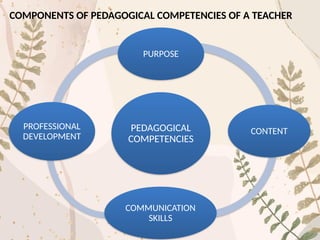
PURPOSE
• Teachers areresponsible for
delivering lessons that are planned,
organized and implemented based on
the objective that are based on the
mnemonics SMART (Specific,
Measurable, Attainable, Relevant and
Time Bound).
• Flexible enough to provide room for
the learners to make their own
personal and independent
connections from the classroom to
real-life situations (Serrano, 2015)
7.
• Teachers mustdevelop the confidence to be
conscious on starting on perspective of what the
learners are expected to manifest after a certain
period of study.
• Vigilant to integrate a very fundamental legal basis
of education in the Philippines that are
emphasized in Article XIV of the 1987 Philippine
Constitution;
• The right of all citizens to quality
education at all levels.
• Provision for complete, adequate, and
integrated system education.
• Inclusion of the study of the constitution
in the curriculum.
8.
• Education toput emphasis in inculcation of
nationalism and patriotism as a well as other
values deemed important in developing better
person and responsible citizen.
• Enjoyment of academic freedom(teachers,
students, institutions) in all institutions of
higher learning.
• Filipino as national language; Filipino and
English as official languages for use in
communication and instruction.
• Promotion of science and technology
• Preservation and enrichment of Filipino culture
• Promotion of physical education and other
related programs
9.
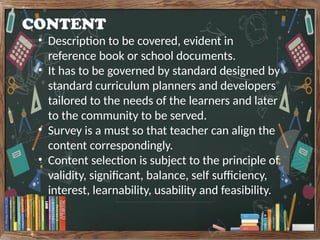
CONTENT
• Description tobe covered, evident in
reference book or school documents.
• It has to be governed by standard designed by
standard curriculum planners and developers
tailored to the needs of the learners and later
to the community to be served.
• Survey is a must so that teacher can align the
content correspondingly.
• Content selection is subject to the principle of
validity, significant, balance, self sufficiency,
interest, learnability, usability and feasibility.
10.
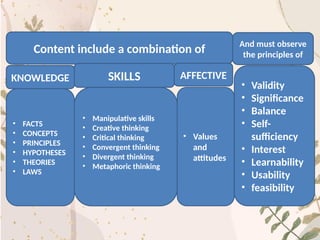
Content include acombination of
AFFECTIVE
SKILLS
KNOWLEDGE
• Validity
• Significance
• Balance
• Self-
sufficiency
• Interest
• Learnability
• Usability
• feasibility
And must observe
the principles of
• FACTS
• CONCEPTS
• PRINCIPLES
• HYPOTHESES
• THEORIES
• LAWS
• Values
and
attitudes
• Manipulative skills
• Creative thinking
• Critical thinking
• Convergent thinking
• Divergent thinking
• Metaphoric thinking
11.
USES acronym capturesthe essence of why content is of
paramount importance as one of the components in
pedagogical skills (Serrano, 2015).
• Unravel the latent learning skills of the learners
to provide the learners with novel concepts,
facts and experiences that could satisfy their
thirst for learning. Guiding them towards the
right questions will most probably allow them to
go beyond their limits.
• Sharpen the mind of the students in seemingly
difficult if the content is bordering on the
practices of the past. It enables learners to be
aware that they are accountable for their own
outputs. Knowing the potential of every students
helps the teacher to further hone their talents.
12.
• Enhance thelearners desire to explore
by themselves thereby allowing them to
experience learning on the first hand
basis. It will be joy and fulfillment in the
community if they themselves are
involved in learning the crafts useful to
their setting.
• This Steers in the students to make a
significant contribution to the daily
lesson. If they are moved by the novelty
and richness of the learning contents
they will learn out of their own volition.
13.
COMMUNICATION SKILLS
• Communicativecompetence of the teacher both in
writing and speaking. This possibly affects the way
students speak and write.
• Reflecting on the following questions can shed light
on how a teacher must seriously attend to the
development of his or her communication skills:
• Are higher thinking and critical analysis
evident in his/her delivery of the lesson?
• Do the student’s feedbacks provide
evidences of their clear understanding of
the facts and ideas as shared by the teacher
in the medium of instructions used?
• Is there a provision for the students to
critique concepts and ideas in the language
that is clear and meaningful as guided by
the teacher?
14.
• Is theteacher mindful of the
correct usage of language
grammar and technical
vocabularies?
• Is there an attempt on the part
of the teacher to further improve
and enrich his or her
communicative skills?
• Is the teacher principally
conscious of how she or he
communicates to his or her
students well?
15.
PROFESSIONAL DEVELOPMENT
• Teacher’spurpose is to improve teaching
and learning process.
• Education is a life long learning so teacher’s
also improve and enrich their professional
skills and competencies. The following
reasons will somehow justify the felt need
to continue the teacher’s professional
growth:
1.The demands of the local and global
standards.
2.The overwhelming trends in science
and technology.
3.The interest of the stakeholders