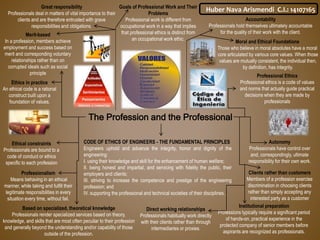
The Profession and the Professional
Accountability
Professionals hold themselves ultimately accountable
for the quality of their work with the client.
Based on specialized, theoretical knowledge
Professionals render specialized services based on theory,
knowledge, and skills that are most often peculiar to their profession
and generally beyond the understanding and/or capability of those
outside of the profession.
Institutional preparation
Professions typically require a significant period
of hands-on, practical experience in the
protected company of senior members before
aspirants are recognized as professionals.
Autonomy
Professionals have control over
and, correspondingly, ultimate
responsibility for their own work.
Clients rather than customers
Members of a profession exercise
discrimination in choosing clients
rather than simply accepting any
interested party as a customer
Direct working relationships
Professionals habitually work directly
with their clients rather than through
intermediaries or proxies.
Ethical constraints
Professionals are bound to a
code of conduct or ethics
specific to each profession
Merit-based
In a profession, members achieve
employment and success based on
merit and corresponding voluntary
relationships rather than on
corrupted ideals such as social
principle
Moral and Ethical Foundations
Those who believe in moral absolutes have a moral
core articulated by various core values. When those
values are mutually consistent, the individual then,
by definition, has integrity.
Ethics in practice
An ethical code is a rational
construct built upon a
foundation of values.
Professionalism
Means behaving in an ethical
manner, while taking and fulfill their
legitimate responsibilities in every
situation every time, without fail.
Professional Ethics
Professional ethics is a code of values
and norms that actually guide practical
decisions when they are made by
professionals
Goals of Professional Work and Their
Problems
Professional work is different from
occupational work in a way that implies
that professional ethics is distinct from
an occupational work ethic.
Great responsibility
Professionals deal in matters of vital importance to their
clients and are therefore entrusted with grave
responsibilities and obligations.
CODE OF ETHICS OF ENGINEERS - THE FUNDAMENTAL PRINCIPLES
Engineers uphold and advance the integrity, honor and dignity of the
engineering:
I. using their knowledge and skill for the enhancement of human welfare;
II. being honest and impartial, and servicing with fidelity the public, their
employers and clients;
III. striving to increase the competence and prestige of the engineering
profession; and
IV. supporting the professional and technical societies of their disciplines.
Huber Nava Arismendi C.I.: 14107165

Mapa mental

  • 1.
    The Profession andthe Professional Accountability Professionals hold themselves ultimately accountable for the quality of their work with the client. Based on specialized, theoretical knowledge Professionals render specialized services based on theory, knowledge, and skills that are most often peculiar to their profession and generally beyond the understanding and/or capability of those outside of the profession. Institutional preparation Professions typically require a significant period of hands-on, practical experience in the protected company of senior members before aspirants are recognized as professionals. Autonomy Professionals have control over and, correspondingly, ultimate responsibility for their own work. Clients rather than customers Members of a profession exercise discrimination in choosing clients rather than simply accepting any interested party as a customer Direct working relationships Professionals habitually work directly with their clients rather than through intermediaries or proxies. Ethical constraints Professionals are bound to a code of conduct or ethics specific to each profession Merit-based In a profession, members achieve employment and success based on merit and corresponding voluntary relationships rather than on corrupted ideals such as social principle Moral and Ethical Foundations Those who believe in moral absolutes have a moral core articulated by various core values. When those values are mutually consistent, the individual then, by definition, has integrity. Ethics in practice An ethical code is a rational construct built upon a foundation of values. Professionalism Means behaving in an ethical manner, while taking and fulfill their legitimate responsibilities in every situation every time, without fail. Professional Ethics Professional ethics is a code of values and norms that actually guide practical decisions when they are made by professionals Goals of Professional Work and Their Problems Professional work is different from occupational work in a way that implies that professional ethics is distinct from an occupational work ethic. Great responsibility Professionals deal in matters of vital importance to their clients and are therefore entrusted with grave responsibilities and obligations. CODE OF ETHICS OF ENGINEERS - THE FUNDAMENTAL PRINCIPLES Engineers uphold and advance the integrity, honor and dignity of the engineering: I. using their knowledge and skill for the enhancement of human welfare; II. being honest and impartial, and servicing with fidelity the public, their employers and clients; III. striving to increase the competence and prestige of the engineering profession; and IV. supporting the professional and technical societies of their disciplines. Huber Nava Arismendi C.I.: 14107165