1
Context and Language
Integrated Learning ?
CLIL in historical
perspective.
Henry Widdowson
University of Vienna
Consider 2 definitions:
Definition1
CLIL refers to situations where
subjects, or parts of subjects,
are taught through a foreign
language with dual-focused aims,
namely the learning of content
and the simultaneous learning of a
foreign language.
(Marsh 1994)2
3
Content or Subject
Content suggests topics
but subjects are not only topics,
they are modes of instruction
whereby content is contextualised
to develop conceptual
understanding – not just to
acquire a knowledge of content
but ways of thinking about it.
CLIL
Content or Subject
Content = Topics
Subject = Topics + Modes of
instruction
= Content+Context
4
5
CLIL
Learning of Language or
Subject?
What kind of learning does
CLIL refer to?
Is it designed to develop
subject or language learning?
6
CLIL
Integration:
Content integrated with
language
or
Language integrated with
content?
CLIL or SLIL?
Integration of
methodologies?
1.subject teaching
2.language teaching
CLIL as approach to
language teaching?
7
Definition 2
The overall socioeducational goals of the
CLIL concept have been translated into a
widely used pedagogical model, the 4 Cs
model, with the components content,
culture, communication and cognition (Coyle
2007). This combination of components
directly reflects the conception of CLIL as an
approach that aims to transcend established
pedagogic practices in both content and
language education in order to create an
innovative space where fields of learning
separated by tradition can be brought
together. (Dalton-Puffer 2017:153) 8
The 4 Cs Model of CLIL
Content
Culture
Communication
Cognition
9
10
What is the relationship
between these components and
how do they get combined or
integrated in CLIL methodology
so as to ‘transcend established
pedagogic practices’ in language
teaching?
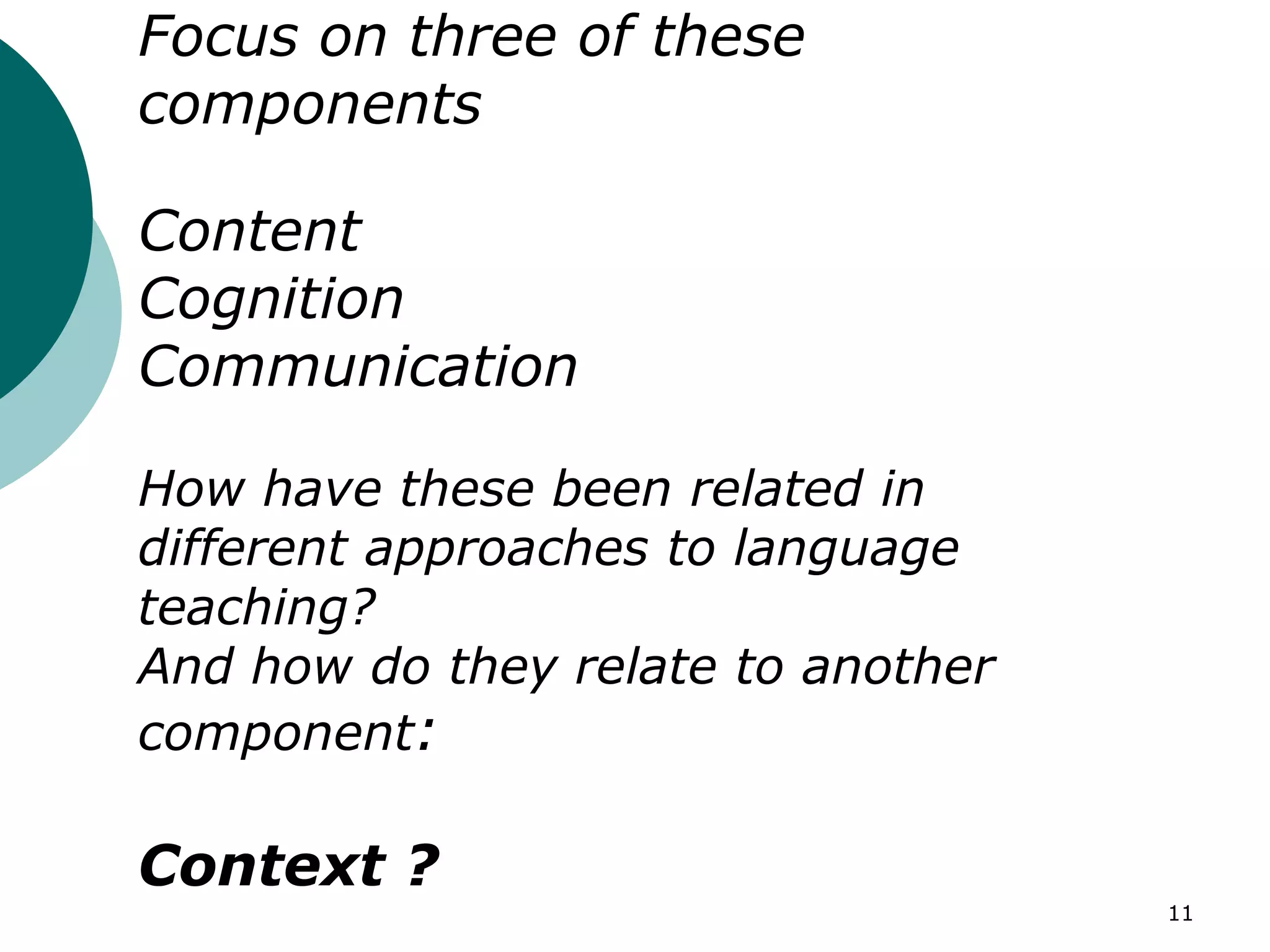
Focus on three of these
components
Content
Cognition
Communication
How have these been related in
different approaches to language
teaching?
And how do they relate to another
component:
Context ?
11
12
Language +Content + Context
Language is an abstraction that has
be made actual by association with
some content in a context that
makes them meaningful.
Different approaches to language
teaching have defined and related
these in different ways.
13
Grammar Translation Language
Teaching. GTLT
No need to pay separate attention to
content or context since these would
already be incorporated in the familiar L1
and transferred into the L2 on the
assumption that they would be integrated
into the corresponding encodings of the
second language
focus on cognition the objective being to
get learners to acquire the formal encoded
properties of the foreign or other language
Grammar Translation
Language Teaching. GTLT
Content
} L1 > L2 Cognition
Context
14
15
Structural Language Teaching.
SLT
Content and context separated from
the first language, and related directly
to the second language.
The focus still on cognition, the
objective still to get students to acquire
linguistic competence -the L2 language
code, but now without reference to their
pre-existing knowledge of their own L1.
16
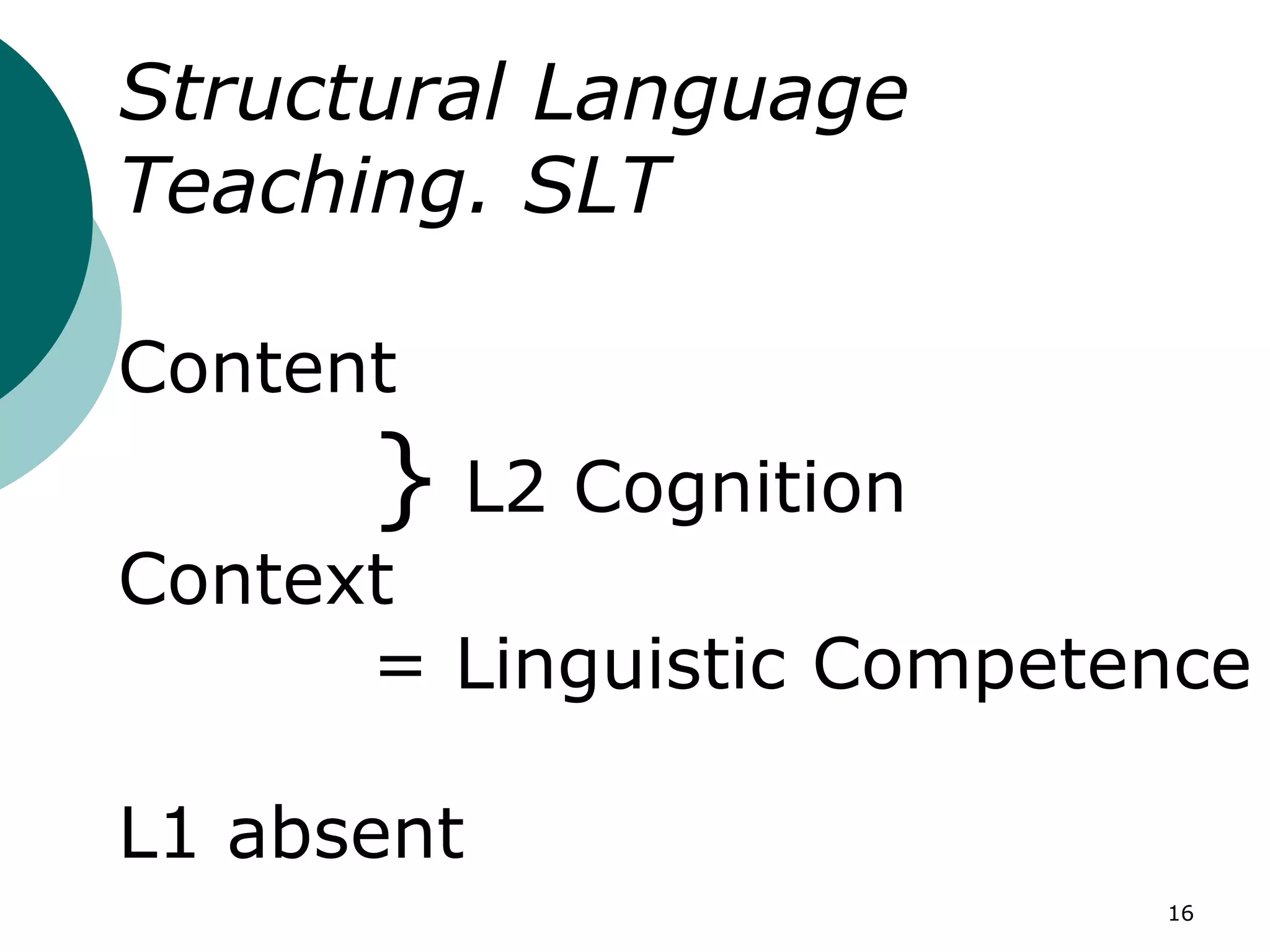
Structural Language
Teaching. SLT
Content
} L2 Cognition
Context
= Linguistic Competence
L1 absent
17
Content and context devised
in the classroom.
to develop cognition of the
linguistic properties of L2
This book is on the table.
This book is here
That book on the chair
That book is there
I am walking to the door
She is walking to the door
Communicative language
teaching. CLT
Content and context had now to
be subordinated to
communication, so that they
were effective not for the teaching
of how meaning is encoded in
linguistic forms but how these
forms function when they are put
to use.
18
19
CLT
Content
} L2 Communication
Context
= Communicative
Competence
L1 absent
20
Task-Based Language Teaching.
TBLT
Content and context devised as tasks
Tasks designed to resemble“real world“
activities to encourage“natural“
communication
Also focus on cognition.
Fluency (communication)
Accuracy & complexity ( cognition)
21
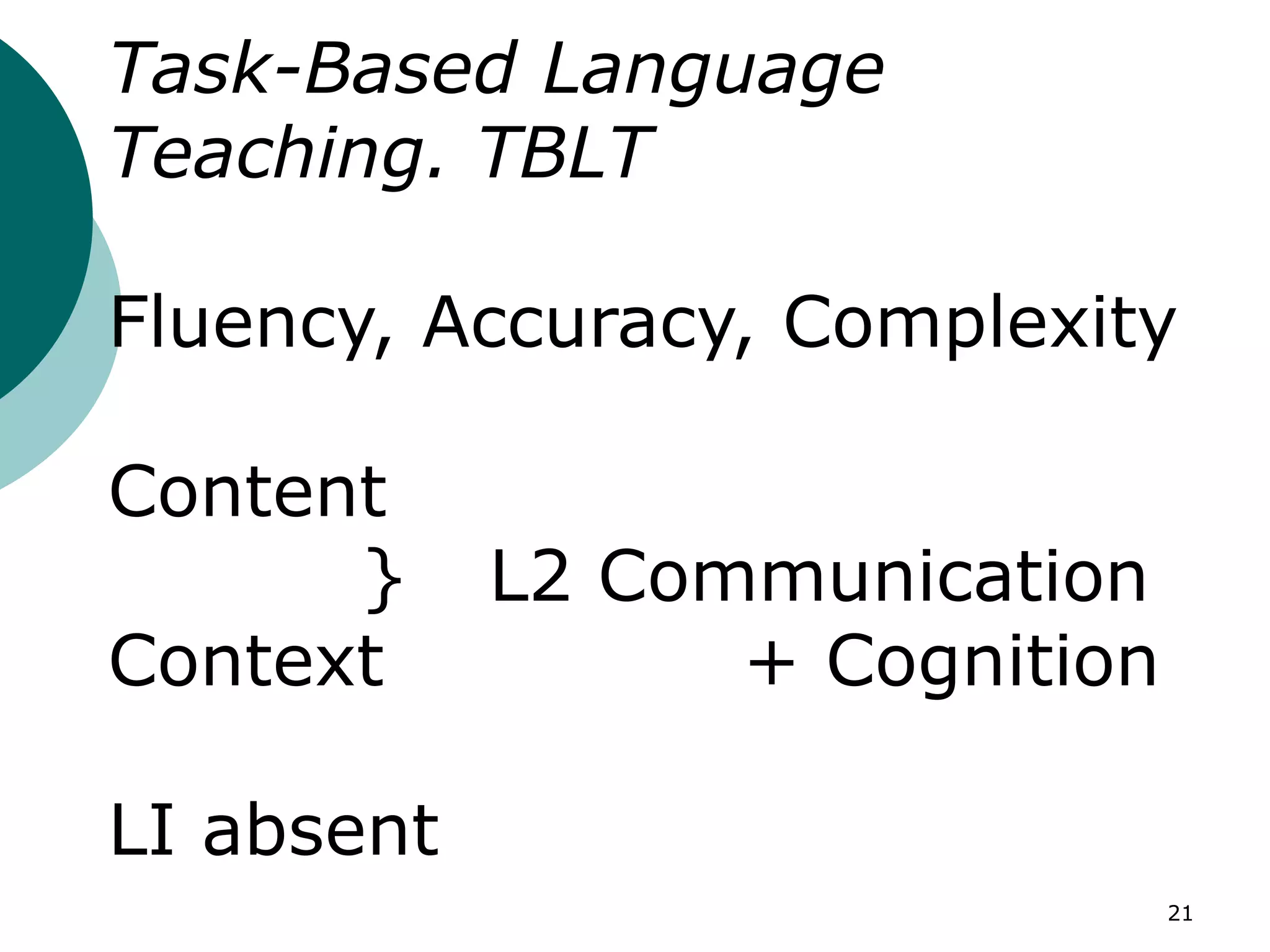
Task-Based Language
Teaching. TBLT
Fluency, Accuracy, Complexity
Content
} L2 Communication
Context + Cognition
LI absent
22
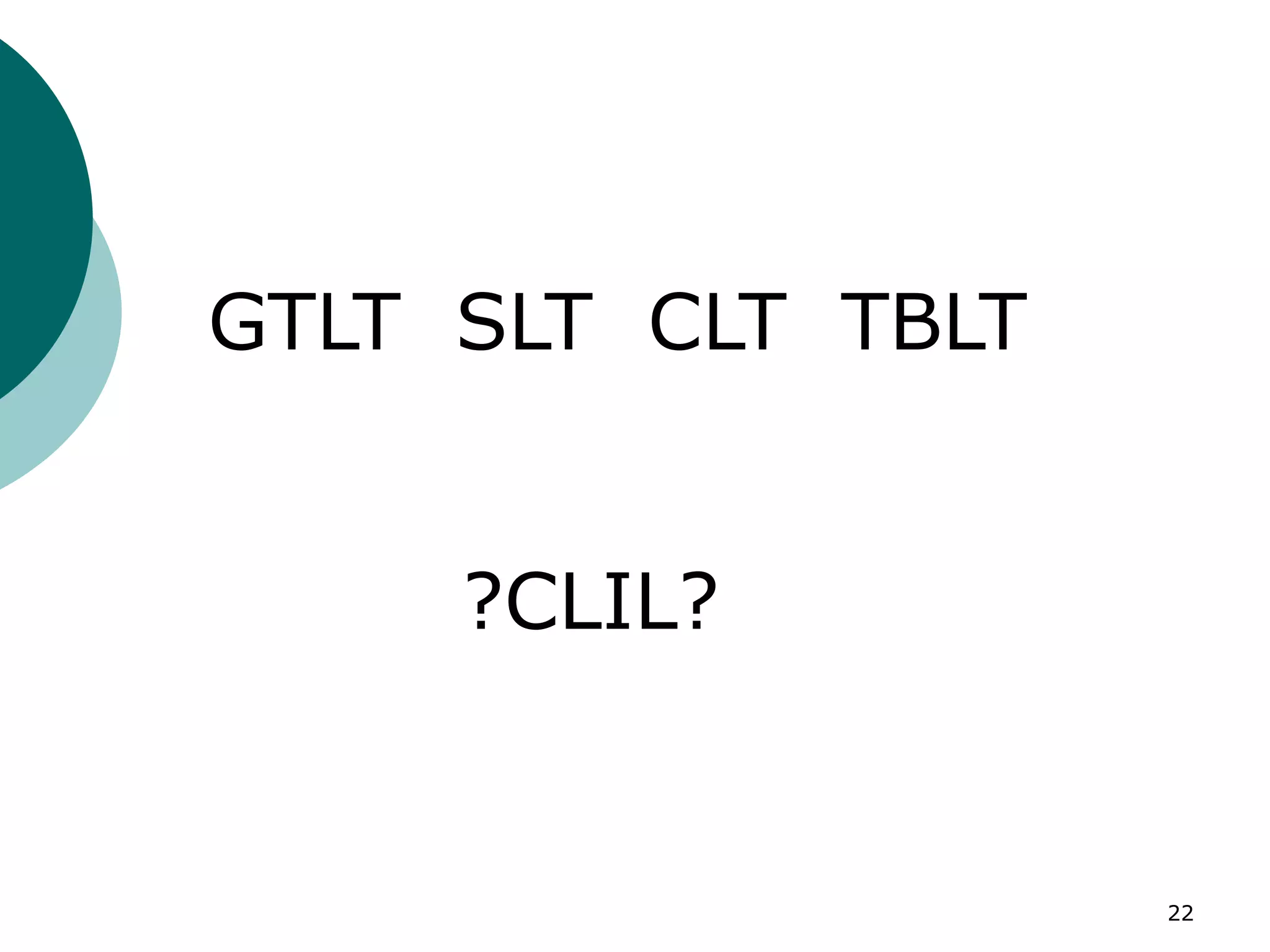
GTLT SLT CLT TBLT
?CLIL?
23
CLIL and TBLT
Unlike TBLT the context and content to be
integrated with language are already provided by
other subjects and so does not have to specially
contrived as language learning tasks.
Focus on communication.
Cognition?
How far enabling acquisition of linguistic
competence?
Fluency? Yes
Accuracy & complexity ??
24
CLIL vs TBLT
Content
} Subject
Context
Communication
+?Cognition?
L1 absent
25
CLIL or SLIL?
If what is to be integrated it is not
just content but subject – how topics
are conceptually contextualized in
the methodology of particular
subjects - then what is proposed in
CLIL is a methodology of L2 teaching
adopted or adapted from the
methodologies of other subjects
rather than a separate methodology
of its own.
26
CLIL/SLIL and learner reality.
Relating language to subject would
also in principle make the language
more meaningful, and language
learning more purposeful by relating
the language to what learners
experience as a daily school reality.
But learner reality also experience of
their own L1.
27
CLIL
Integration with learners’ subject
experience
+ ?
Integration with learners
language experience
28
CLIL
What does the L stand for?
L2?
L2 + L1?
If English
CLIL = CEIL
ENL?
ELF?
29
CLIL
CLIL
CLIL
CLIL
Content
Context
Communication
Cognition
30
Each element of the acronym
raises questions about how
these four components are
defined and related.
And so how CLIL as an
approach to language teaching
compares with or ‘transcends’
other ‘pedagogic practices’.
31
Dalton-Puffer, C. 2017. Same but Different: Content and
Language Integrated Learning and Content-Based Instruction.
In Snow, M.A & D.M. Brinton (eds)The Content-Based
Classroom. Ann Arbor: University of Michigan Press.
Marsh, D. 1994. Bilingual Education & Content and Language
Integrated Learning. International Association for Cross-cultural
Communication, Language Teaching in the Member States of
the European Union (Lingua). Paris: University of Sorbonne.

Prof. henry widdowson

  • 1.
    1 Context and Language IntegratedLearning ? CLIL in historical perspective. Henry Widdowson University of Vienna
  • 2.
    Consider 2 definitions: Definition1 CLILrefers to situations where subjects, or parts of subjects, are taught through a foreign language with dual-focused aims, namely the learning of content and the simultaneous learning of a foreign language. (Marsh 1994)2
  • 3.
    3 Content or Subject Contentsuggests topics but subjects are not only topics, they are modes of instruction whereby content is contextualised to develop conceptual understanding – not just to acquire a knowledge of content but ways of thinking about it.
  • 4.
    CLIL Content or Subject Content= Topics Subject = Topics + Modes of instruction = Content+Context 4
  • 5.
    5 CLIL Learning of Languageor Subject? What kind of learning does CLIL refer to? Is it designed to develop subject or language learning?
  • 6.
  • 7.
    CLIL or SLIL? Integrationof methodologies? 1.subject teaching 2.language teaching CLIL as approach to language teaching? 7
  • 8.
    Definition 2 The overallsocioeducational goals of the CLIL concept have been translated into a widely used pedagogical model, the 4 Cs model, with the components content, culture, communication and cognition (Coyle 2007). This combination of components directly reflects the conception of CLIL as an approach that aims to transcend established pedagogic practices in both content and language education in order to create an innovative space where fields of learning separated by tradition can be brought together. (Dalton-Puffer 2017:153) 8
  • 9.
    The 4 CsModel of CLIL Content Culture Communication Cognition 9
  • 10.
    10 What is therelationship between these components and how do they get combined or integrated in CLIL methodology so as to ‘transcend established pedagogic practices’ in language teaching?
  • 11.
    Focus on threeof these components Content Cognition Communication How have these been related in different approaches to language teaching? And how do they relate to another component: Context ? 11
  • 12.
    12 Language +Content +Context Language is an abstraction that has be made actual by association with some content in a context that makes them meaningful. Different approaches to language teaching have defined and related these in different ways.
  • 13.
    13 Grammar Translation Language Teaching.GTLT No need to pay separate attention to content or context since these would already be incorporated in the familiar L1 and transferred into the L2 on the assumption that they would be integrated into the corresponding encodings of the second language focus on cognition the objective being to get learners to acquire the formal encoded properties of the foreign or other language
  • 14.
    Grammar Translation Language Teaching.GTLT Content } L1 > L2 Cognition Context 14
  • 15.
    15 Structural Language Teaching. SLT Contentand context separated from the first language, and related directly to the second language. The focus still on cognition, the objective still to get students to acquire linguistic competence -the L2 language code, but now without reference to their pre-existing knowledge of their own L1.
  • 16.
    16 Structural Language Teaching. SLT Content }L2 Cognition Context = Linguistic Competence L1 absent
  • 17.
    17 Content and contextdevised in the classroom. to develop cognition of the linguistic properties of L2 This book is on the table. This book is here That book on the chair That book is there I am walking to the door She is walking to the door
  • 18.
    Communicative language teaching. CLT Contentand context had now to be subordinated to communication, so that they were effective not for the teaching of how meaning is encoded in linguistic forms but how these forms function when they are put to use. 18
  • 19.
    19 CLT Content } L2 Communication Context =Communicative Competence L1 absent
  • 20.
    20 Task-Based Language Teaching. TBLT Contentand context devised as tasks Tasks designed to resemble“real world“ activities to encourage“natural“ communication Also focus on cognition. Fluency (communication) Accuracy & complexity ( cognition)
  • 21.
    21 Task-Based Language Teaching. TBLT Fluency,Accuracy, Complexity Content } L2 Communication Context + Cognition LI absent
  • 22.
    22 GTLT SLT CLTTBLT ?CLIL?
  • 23.
    23 CLIL and TBLT UnlikeTBLT the context and content to be integrated with language are already provided by other subjects and so does not have to specially contrived as language learning tasks. Focus on communication. Cognition? How far enabling acquisition of linguistic competence? Fluency? Yes Accuracy & complexity ??
  • 24.
    24 CLIL vs TBLT Content }Subject Context Communication +?Cognition? L1 absent
  • 25.
    25 CLIL or SLIL? Ifwhat is to be integrated it is not just content but subject – how topics are conceptually contextualized in the methodology of particular subjects - then what is proposed in CLIL is a methodology of L2 teaching adopted or adapted from the methodologies of other subjects rather than a separate methodology of its own.
  • 26.
    26 CLIL/SLIL and learnerreality. Relating language to subject would also in principle make the language more meaningful, and language learning more purposeful by relating the language to what learners experience as a daily school reality. But learner reality also experience of their own L1.
  • 27.
    27 CLIL Integration with learners’subject experience + ? Integration with learners language experience
  • 28.
    28 CLIL What does theL stand for? L2? L2 + L1? If English CLIL = CEIL ENL? ELF?
  • 29.
  • 30.
    30 Each element ofthe acronym raises questions about how these four components are defined and related. And so how CLIL as an approach to language teaching compares with or ‘transcends’ other ‘pedagogic practices’.
  • 31.
    31 Dalton-Puffer, C. 2017.Same but Different: Content and Language Integrated Learning and Content-Based Instruction. In Snow, M.A & D.M. Brinton (eds)The Content-Based Classroom. Ann Arbor: University of Michigan Press. Marsh, D. 1994. Bilingual Education & Content and Language Integrated Learning. International Association for Cross-cultural Communication, Language Teaching in the Member States of the European Union (Lingua). Paris: University of Sorbonne.