Filippo Arfini, Università di Parma/SinerGI
Giovanni Belletti, Università di Firenze/SinerGI
Andrea Marescotti, Università di Firenze/SinerGI
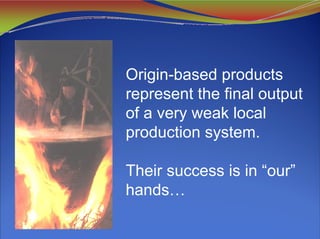
Origin-based products
represent the final output
of a very weak local
production system.
Their success is in “our”
hands…
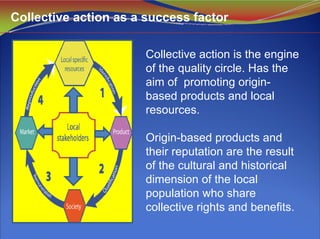
Collective action is the engine
of the quality circle. Has the
aim of promoting origin-
based products and local
resources.
Origin-based products and
their reputation are the result
of the cultural and historical
dimension of the local
population who share
collective rights and benefits.
Collective action as a success factor
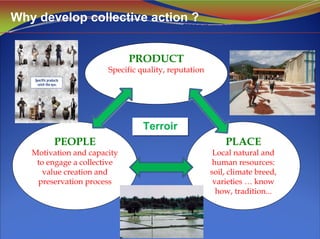
TerroirTerroir
Why develop collective action ?
PEOPLE
Motivation and capacity
to engage a collective
value creation and
preservation process
PLACE
Local natural and
human resources:
soil, climate breed,
varieties … know
how, tradition...
PRODUCT
Specific quality, reputation
General objectives of collective action
Sustainable development in 
rural areas
Economic pillar:  adding value and 
benefits to collective action
Environmental pillar: practice a 
sustainable use of natural resources 
and protection of biodiversity
Social pillar: preservation of 
tradition and cultural heritage; to 
develop links between the local 
population and stakeholders; to create 
job opportunities (especially for 
women) and offer opportunity for 
growth.  
Sustainable development in 
rural areas
Economic pillar:  adding value and 
benefits to collective action
Environmental pillar: practice a 
sustainable use of natural resources 
and protection of biodiversity
Social pillar: preservation of 
tradition and cultural heritage; to 
develop links between the local 
population and stakeholders; to create 
job opportunities (especially for 
women) and offer opportunity for 
growth.  
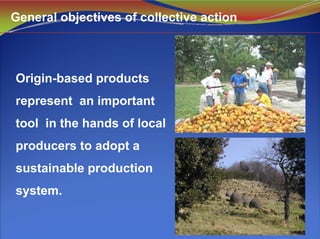
Origin-based products
represent an important
tool in the hands of local
producers to adopt a
sustainable production
system.
General objectives of collective action
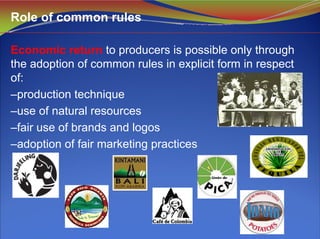
Economic return to producers is possible only through
the adoption of common rules in explicit form in respect
of:
–production technique
–use of natural resources
–fair use of brands and logos
–adoption of fair marketing practices
Role of common rules
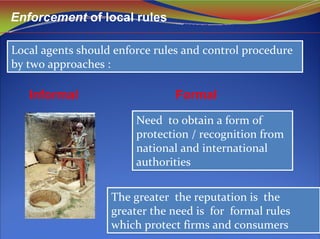
Local agents should enforce rules and control procedure 
by two approaches :
Local agents should enforce rules and control procedure 
by two approaches :
Enforcement of local rules
Informal Formal
The greater  the reputation is  the 
greater the need is  for  formal rules 
which protect firms and consumers
The greater  the reputation is  the 
greater the need is  for  formal rules 
which protect firms and consumers
Need  to obtain a form of 
protection / recognition from 
national and international 
authorities
Need  to obtain a form of 
protection / recognition from 
national and international 
authorities
How to develop a common approach
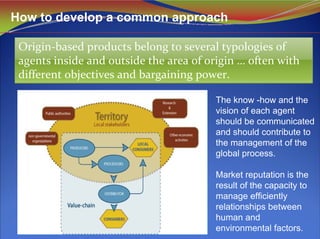
Origin‐based products belong to several typologies of 
agents inside and outside the area of origin … often with 
different objectives and bargaining power. 
Origin‐based products belong to several typologies of 
agents inside and outside the area of origin … often with 
different objectives and bargaining power. 
The know -how and the
vision of each agent
should be communicated
and should contribute to
the management of the
global process.
Market reputation is the
result of the capacity to
manage efficiently
relationships between
human and
environmental factors.
How to adopt a common approach
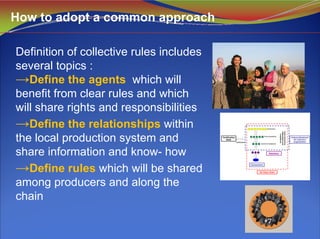
Definition of collective rules includes
several topics :
→Define the agents which will
benefit from clear rules and which
will share rights and responsibilities
→Define the relationships within
the local production system and
share information and know- how
→Define rules which will be shared
among producers and along the
chain
producers
first processors
second processors
certification
Consumers
Retailers
Certification
Body
Interprofessional
GI collective
organization
GI Value Chain
Codeofpractice:
Elaborationand
compliance
How to adopt a common approach
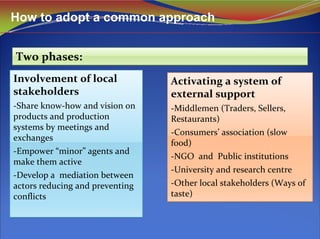
Two phases:Two phases:
Involvement of local 
stakeholders
‐Share know‐how and vision on 
products and production 
systems by meetings and 
exchanges
‐Empower “minor” agents and 
make them active
‐Develop a  mediation between 
actors reducing and preventing 
conflicts
Involvement of local 
stakeholders
‐Share know‐how and vision on 
products and production 
systems by meetings and 
exchanges
‐Empower “minor” agents and 
make them active
‐Develop a  mediation between 
actors reducing and preventing 
conflicts
Activating a system of 
external support
‐Middlemen (Traders, Sellers, 
Restaurants)
‐Consumers’ association (slow 
food)
‐NGO  and  Public institutions
‐University and research centre
‐Other local stakeholders (Ways of 
taste)
Activating a system of 
external support
‐Middlemen (Traders, Sellers, 
Restaurants)
‐Consumers’ association (slow 
food)
‐NGO  and  Public institutions
‐University and research centre
‐Other local stakeholders (Ways of 
taste)
Collective rules should not be
perceived as constraints
but …
as tools useful in order to reach
efficiency
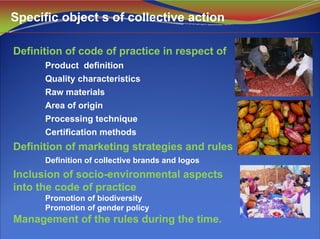
Definition of code of practice in respect of
Product definition
Quality characteristics
Raw materials
Area of origin
Processing technique
Certification methods
Definition of marketing strategies and rules
Definition of collective brands and logos
Inclusion of socio-environmental aspects
into the code of practice
Promotion of biodiversity
Promotion of gender policy
Management of the rules during the time.
Specific object s of collective action
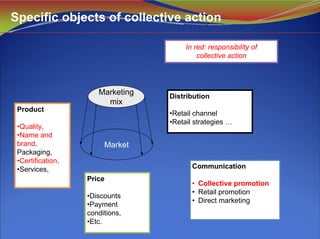
Specific objects of collective action
Marketing
mix
Market
Product
•Quality,
•Name and
brand,
Packaging,
•Certification,
•Services,
Price
•Discounts
•Payment
conditions,
•Etc.
Distribution
•Retail channel
•Retail strategies …
Communication
• Collective promotion
• Retail promotion
• Direct marketing
In red: responsibility of
collective action
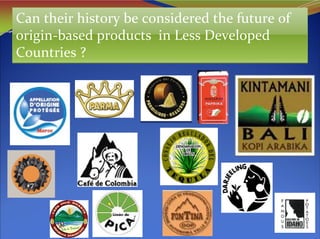
Can their history be considered the future of 
origin‐based products  in Less Developed 
Countries ? 
Can their history be considered the future of 
origin‐based products  in Less Developed 
Countries ? 
Yes, we believe so!!!Yes, we believe so!!!
Thank you !!!

Prof. F. Arfini (English)

  • 1.
  • 2.
    Origin-based products represent thefinal output of a very weak local production system. Their success is in “our” hands…
  • 3.
    Collective action isthe engine of the quality circle. Has the aim of promoting origin- based products and local resources. Origin-based products and their reputation are the result of the cultural and historical dimension of the local population who share collective rights and benefits. Collective action as a success factor
  • 4.
    TerroirTerroir Why develop collectiveaction ? PEOPLE Motivation and capacity to engage a collective value creation and preservation process PLACE Local natural and human resources: soil, climate breed, varieties … know how, tradition... PRODUCT Specific quality, reputation
  • 5.
    General objectives ofcollective action Sustainable development in  rural areas Economic pillar:  adding value and  benefits to collective action Environmental pillar: practice a  sustainable use of natural resources  and protection of biodiversity Social pillar: preservation of  tradition and cultural heritage; to  develop links between the local  population and stakeholders; to create  job opportunities (especially for  women) and offer opportunity for  growth.   Sustainable development in  rural areas Economic pillar:  adding value and  benefits to collective action Environmental pillar: practice a  sustainable use of natural resources  and protection of biodiversity Social pillar: preservation of  tradition and cultural heritage; to  develop links between the local  population and stakeholders; to create  job opportunities (especially for  women) and offer opportunity for  growth.  
  • 6.
    Origin-based products represent animportant tool in the hands of local producers to adopt a sustainable production system. General objectives of collective action
  • 7.
    Economic return toproducers is possible only through the adoption of common rules in explicit form in respect of: –production technique –use of natural resources –fair use of brands and logos –adoption of fair marketing practices Role of common rules
  • 8.
    Local agents should enforce rules and control procedure  by two approaches : Local agents should enforce rules and control procedure  by two approaches : Enforcement of localrules Informal Formal The greater  the reputation is  the  greater the need is  for  formal rules  which protect firms and consumers The greater  the reputation is  the  greater the need is  for  formal rules  which protect firms and consumers Need  to obtain a form of  protection / recognition from  national and international  authorities Need  to obtain a form of  protection / recognition from  national and international  authorities
  • 9.
    How to developa common approach Origin‐based products belong to several typologies of  agents inside and outside the area of origin … often with  different objectives and bargaining power.  Origin‐based products belong to several typologies of  agents inside and outside the area of origin … often with  different objectives and bargaining power.  The know -how and the vision of each agent should be communicated and should contribute to the management of the global process. Market reputation is the result of the capacity to manage efficiently relationships between human and environmental factors.
  • 10.
    How to adopta common approach Definition of collective rules includes several topics : →Define the agents which will benefit from clear rules and which will share rights and responsibilities →Define the relationships within the local production system and share information and know- how →Define rules which will be shared among producers and along the chain producers first processors second processors certification Consumers Retailers Certification Body Interprofessional GI collective organization GI Value Chain Codeofpractice: Elaborationand compliance
  • 11.
    How to adopta common approach Two phases:Two phases: Involvement of local  stakeholders ‐Share know‐how and vision on  products and production  systems by meetings and  exchanges ‐Empower “minor” agents and  make them active ‐Develop a  mediation between  actors reducing and preventing  conflicts Involvement of local  stakeholders ‐Share know‐how and vision on  products and production  systems by meetings and  exchanges ‐Empower “minor” agents and  make them active ‐Develop a  mediation between  actors reducing and preventing  conflicts Activating a system of  external support ‐Middlemen (Traders, Sellers,  Restaurants) ‐Consumers’ association (slow  food) ‐NGO  and  Public institutions ‐University and research centre ‐Other local stakeholders (Ways of  taste) Activating a system of  external support ‐Middlemen (Traders, Sellers,  Restaurants) ‐Consumers’ association (slow  food) ‐NGO  and  Public institutions ‐University and research centre ‐Other local stakeholders (Ways of  taste)
  • 12.
    Collective rules shouldnot be perceived as constraints but … as tools useful in order to reach efficiency
  • 13.
    Definition of codeof practice in respect of Product definition Quality characteristics Raw materials Area of origin Processing technique Certification methods Definition of marketing strategies and rules Definition of collective brands and logos Inclusion of socio-environmental aspects into the code of practice Promotion of biodiversity Promotion of gender policy Management of the rules during the time. Specific object s of collective action
  • 14.
    Specific objects ofcollective action Marketing mix Market Product •Quality, •Name and brand, Packaging, •Certification, •Services, Price •Discounts •Payment conditions, •Etc. Distribution •Retail channel •Retail strategies … Communication • Collective promotion • Retail promotion • Direct marketing In red: responsibility of collective action
  • 15.
  • 16.