Using and Evaluating Instructional Materials
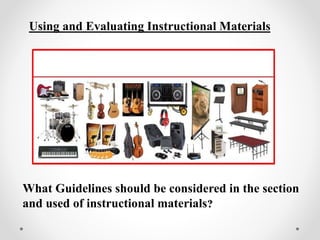
What Guidelines should be considered in the section
and used of instructional materials?
Instructional Materials- are educational resources used to
improve students’ knowledge, abilities, and skills to monitor
their absorb of information to contribute to their overall
development and upbringing or early training
 Instructional Materials- are materials that also
assist the facilitator in the teaching-learning process.
 Instructional materials- are not self-
supporting instead, they are supplementary
training or additional devices.
 One of the instructional materials used to attain
instructional objectives is field trip.
A field trip or excursion- is a journey by a group of people to
a place away from their normal environment. The purpose of
the field trip is usually observation for education, non-
experimental research or to provide students experiences
outside their everyday activities, such us going camping with
teachers and their classmates. The aim of this research is to
observe the subject in its natural state and possibly collect
samples. In western culture first come across this method
during school years when classes are taken on school trips to
visit a geological or geographical feature of the landscape, for
example. Much of early research into the natural sciences was
of this form. Charles Darwin is an important example of
someone who has contributed to science thru the used of field
trips.
 Charles Darwin
 1809-1882
Excelled in Geology and Biology
Studied Medicine and Theology
Published on the origin
of species.
 Travelled within 5
years around the world
 He was developed a
Human Evolution Theory.
Selections of Materials
For an effective use of instructional materials
such as field trip, there are guidelines that ought
to be observed, first of all, in their selection and
second, in their use.
 Do the material give a true picture of the ideas they present?
To avoid misconceptions or bad, it is always good to ask
when the material was produced.
 Do the material contribute or to give meaningful content to
the topic under study?
 Do the material help you achieve the
instructional objective?
Guidelines for effective use of materials
 Is the physical condition of the material
satisfactory? An example, is the microscope
properly working?
 Is there a teacher’s guide to provide a briefing
for effective use? The chance that the
instructional material will be used to the
maximum and to the optimum is increased with
a teacher’s guide.
 Can the material in question help to make students better
thinkers and develop their critical faculties? With exposure to
mass media. It is highly important that we maintain and
strengthen our rational powers.
 Do the use of material make learners collaborate
with one another?
 Is the material worth the time, expenses and effort
involved? A field trip, for instance, requires much time,
effort, and money. It is more effective than any other less
expensive and less demanding instructional material that
can take its place? Or is there a better substitute?
PREPARE YOURSELF
PREPARE YOUR STUDENT
PRESENT THE MATERIAL
FOLLLOW-UP
To ensure effective use of instructional material,
Hayden Smith and Thomas Nigel, (1972) book
authors on Instructional Media, advise us to abide
by the acronym PPPF.
Proper Use of Materials
 “ It is one thing to select a good instructional
material; it is another thing to use it
well.“…Hyden and Thomas
 Hayden Smith and Thomas Nagel
(1972) both authors on Instructional
Media.
 Thomas Nagel is a professor of
philosophy at New York
University.
 He is known within philosophy of mind
as an advocate of the idea that
consciousness and subjective experience
cannot be reduced to brain activity.
Thomas Nagel
Prepare Yourself
 You know your lesson
objective and what you expect
from the class after the session
and why you have selected such
particular instructional material.
 You have a plan on how you
will proceed, what question to
ask, how you will evaluate
learning and how you will end
before the bell rings.
Prepare your students
 Set reasonably high class
expectations and learning
goals. It is sound practice
to give them guide
questions for them to be
able to answer during the
discussion.
 Motivate them and keep
them interested and
engaged.
Present the material
 Present the material under the best possible
conditions. Many teachers are guilty of the R.O.G
Syndrome. This is means “running out of gas” which
usually results from the poor planning. (Smith, 1972)
Using media and materials, especially if they are
mechanical in nature, often requires rehearsal and a
carefully planned performance.
Follow up
 Remember that you use
instructional materials to achieve
objectives, not to kill time nor to
give yourself a break, neither to
merely entertain the class. Your
use of the instructional material is
not the end itself. It is a means to
an end, the attainment of a
learning objectives. So, there is
need to follow up to find out if
objective was attained, otherwise
they become useless.
To ensure that instructional materials serve their
purpose in instruction, we need to observe some
guidelines in their selection and use. The materials
that we select must,
1. Give a true picture of the ideas they present
2. Contribute to the attainment of
the learning objective
3. Be aligned to curriculum
standards and competencies
4. Be appropriate to the age,
intelligence and experience
of the learners
5. Be in good and satisfactory condition.
6. Be culture sensitive and gender
sensitive.
7. Provide for a teacher’s guide
8. Help develop the critical and
creative thinking powers of
students.
9. Promote collaborative learning
10. Be worth the time, expense and
effort involved.
For optimum use of the instructional materials, it is necessary
That the teacher prepares:
 Herself:
 Her students:
 The instructional material and does, follow-up:
Herself
Her student
The instructional material and does follow up
Promote Independent study
2. To accomplish this learning log…ask yourself
What I learned? (deposit) How I apply what I learned (divided)
Robert Gagne’s nine (9) instructional material in the
subject facilitating learning.
Robert Mills Gagné (August 21, 1916 – April 28, 2002) was
an American educational psychologist best known for his
Conditions of Learning. He pioneered the science of
instruction during World War II when he worked with the
Army Air Corps training pilots. He went on to develop a
series of studies and works that simplified and explained
what he and others believed to be "good instruction."
Gagné was also involved in applying concepts of
instructional theory to the design of computer-based
training and multimedia-based learning.
These are the (9) instructional material in the subject
facilitating learning:
1. Gain attention
2. Inform learner of objectives
3. Stimulate recall of prior learning
4. Present stimulus material
5. Provide learner guidance
7.) Provide feedback
8.) Assess performance
9.) Enhance retention transfer
Connect Gagne’s nine instructional events to the
PPPF Acronym in this lesson in relation to use of
instructional materials. Are Smith and Gagne saying
similar things?.
“You should have a good idea of your destination, both in
the over-all purposes of education and in the everyday work
of your teaching. If you do not know where you are going,
you cannot properly choose a way to get there.”….unknown.
There is no such thing as the best
instructional material!
Any instructional material can be the best provided it
helps the teacher accomplish her intended learning objective.
No instructional material, no matter how superior, can
take the place of an effective teacher.
Instructional materials maybe perceived to be labor-
saying devices for the teacher. On the contrary, the teacher
even works harder when she makes good use of instructional
materials.
The use of instructional materials is not the end in
itself, but it is a means to an end, which is the
attainment of the learning objective. Selecting
appropriate instructional materials is one thing and it is
another thing to ensure or sure its effective use. And
there is a need to follow up to find out if the objective
was attained or not, otherwise they become useless.
The use of instructional materials can be of great help
to the teacher to become effective in facilitating
learning. As a teacher, you should adopt the
guidelines provided by the experts in the selection of
instructional materials and in their use. Likewise you
should try to avoid the R.O.G. Syndrome (running out
of gas) especially if the materials to be used are
mechanical ones, hence it is a wise move to try out the
materials ahead of the class schedule to avoid
unwanted situations. If careful planning is employed,
the use of instructional materials can be an effective
partner in attaining the teacher’s mission.
God Bless us all…!
PEC BATCH 24…rench

Using and evaluating instructional materials

  • 1.
    Using and EvaluatingInstructional Materials What Guidelines should be considered in the section and used of instructional materials?
  • 2.
    Instructional Materials- areeducational resources used to improve students’ knowledge, abilities, and skills to monitor their absorb of information to contribute to their overall development and upbringing or early training  Instructional Materials- are materials that also assist the facilitator in the teaching-learning process.  Instructional materials- are not self- supporting instead, they are supplementary training or additional devices.
  • 3.
     One ofthe instructional materials used to attain instructional objectives is field trip.
  • 4.
    A field tripor excursion- is a journey by a group of people to a place away from their normal environment. The purpose of the field trip is usually observation for education, non- experimental research or to provide students experiences outside their everyday activities, such us going camping with teachers and their classmates. The aim of this research is to observe the subject in its natural state and possibly collect samples. In western culture first come across this method during school years when classes are taken on school trips to visit a geological or geographical feature of the landscape, for example. Much of early research into the natural sciences was of this form. Charles Darwin is an important example of someone who has contributed to science thru the used of field trips.
  • 5.
     Charles Darwin 1809-1882 Excelled in Geology and Biology Studied Medicine and Theology Published on the origin of species.  Travelled within 5 years around the world  He was developed a Human Evolution Theory.
  • 6.
    Selections of Materials Foran effective use of instructional materials such as field trip, there are guidelines that ought to be observed, first of all, in their selection and second, in their use.
  • 7.
     Do thematerial give a true picture of the ideas they present? To avoid misconceptions or bad, it is always good to ask when the material was produced.  Do the material contribute or to give meaningful content to the topic under study?  Do the material help you achieve the instructional objective? Guidelines for effective use of materials
  • 8.
     Is thephysical condition of the material satisfactory? An example, is the microscope properly working?  Is there a teacher’s guide to provide a briefing for effective use? The chance that the instructional material will be used to the maximum and to the optimum is increased with a teacher’s guide.
  • 9.
     Can thematerial in question help to make students better thinkers and develop their critical faculties? With exposure to mass media. It is highly important that we maintain and strengthen our rational powers.  Do the use of material make learners collaborate with one another?  Is the material worth the time, expenses and effort involved? A field trip, for instance, requires much time, effort, and money. It is more effective than any other less expensive and less demanding instructional material that can take its place? Or is there a better substitute?
  • 10.
    PREPARE YOURSELF PREPARE YOURSTUDENT PRESENT THE MATERIAL FOLLLOW-UP To ensure effective use of instructional material, Hayden Smith and Thomas Nigel, (1972) book authors on Instructional Media, advise us to abide by the acronym PPPF. Proper Use of Materials
  • 11.
     “ Itis one thing to select a good instructional material; it is another thing to use it well.“…Hyden and Thomas  Hayden Smith and Thomas Nagel (1972) both authors on Instructional Media.  Thomas Nagel is a professor of philosophy at New York University.  He is known within philosophy of mind as an advocate of the idea that consciousness and subjective experience cannot be reduced to brain activity. Thomas Nagel
  • 12.
    Prepare Yourself  Youknow your lesson objective and what you expect from the class after the session and why you have selected such particular instructional material.  You have a plan on how you will proceed, what question to ask, how you will evaluate learning and how you will end before the bell rings.
  • 13.
    Prepare your students Set reasonably high class expectations and learning goals. It is sound practice to give them guide questions for them to be able to answer during the discussion.  Motivate them and keep them interested and engaged.
  • 14.
    Present the material Present the material under the best possible conditions. Many teachers are guilty of the R.O.G Syndrome. This is means “running out of gas” which usually results from the poor planning. (Smith, 1972) Using media and materials, especially if they are mechanical in nature, often requires rehearsal and a carefully planned performance.
  • 15.
    Follow up  Rememberthat you use instructional materials to achieve objectives, not to kill time nor to give yourself a break, neither to merely entertain the class. Your use of the instructional material is not the end itself. It is a means to an end, the attainment of a learning objectives. So, there is need to follow up to find out if objective was attained, otherwise they become useless.
  • 16.
    To ensure thatinstructional materials serve their purpose in instruction, we need to observe some guidelines in their selection and use. The materials that we select must,
  • 17.
    1. Give atrue picture of the ideas they present 2. Contribute to the attainment of the learning objective 3. Be aligned to curriculum standards and competencies 4. Be appropriate to the age, intelligence and experience of the learners 5. Be in good and satisfactory condition.
  • 18.
    6. Be culturesensitive and gender sensitive. 7. Provide for a teacher’s guide 8. Help develop the critical and creative thinking powers of students. 9. Promote collaborative learning 10. Be worth the time, expense and effort involved.
  • 19.
    For optimum useof the instructional materials, it is necessary That the teacher prepares:  Herself:  Her students:  The instructional material and does, follow-up:
  • 20.
  • 21.
  • 22.
    The instructional materialand does follow up
  • 23.
    Promote Independent study 2.To accomplish this learning log…ask yourself What I learned? (deposit) How I apply what I learned (divided)
  • 24.
    Robert Gagne’s nine(9) instructional material in the subject facilitating learning.
  • 25.
    Robert Mills Gagné(August 21, 1916 – April 28, 2002) was an American educational psychologist best known for his Conditions of Learning. He pioneered the science of instruction during World War II when he worked with the Army Air Corps training pilots. He went on to develop a series of studies and works that simplified and explained what he and others believed to be "good instruction." Gagné was also involved in applying concepts of instructional theory to the design of computer-based training and multimedia-based learning.
  • 26.
    These are the(9) instructional material in the subject facilitating learning: 1. Gain attention 2. Inform learner of objectives 3. Stimulate recall of prior learning 4. Present stimulus material 5. Provide learner guidance 7.) Provide feedback 8.) Assess performance 9.) Enhance retention transfer
  • 27.
    Connect Gagne’s nineinstructional events to the PPPF Acronym in this lesson in relation to use of instructional materials. Are Smith and Gagne saying similar things?. “You should have a good idea of your destination, both in the over-all purposes of education and in the everyday work of your teaching. If you do not know where you are going, you cannot properly choose a way to get there.”….unknown.
  • 28.
    There is nosuch thing as the best instructional material! Any instructional material can be the best provided it helps the teacher accomplish her intended learning objective. No instructional material, no matter how superior, can take the place of an effective teacher. Instructional materials maybe perceived to be labor- saying devices for the teacher. On the contrary, the teacher even works harder when she makes good use of instructional materials.
  • 29.
    The use ofinstructional materials is not the end in itself, but it is a means to an end, which is the attainment of the learning objective. Selecting appropriate instructional materials is one thing and it is another thing to ensure or sure its effective use. And there is a need to follow up to find out if the objective was attained or not, otherwise they become useless.
  • 30.
    The use ofinstructional materials can be of great help to the teacher to become effective in facilitating learning. As a teacher, you should adopt the guidelines provided by the experts in the selection of instructional materials and in their use. Likewise you should try to avoid the R.O.G. Syndrome (running out of gas) especially if the materials to be used are mechanical ones, hence it is a wise move to try out the materials ahead of the class schedule to avoid unwanted situations. If careful planning is employed, the use of instructional materials can be an effective partner in attaining the teacher’s mission.
  • 31.
    God Bless usall…! PEC BATCH 24…rench