INFORMATION
PROCESSING
Module 10
Information Processing
- Is a cognitive theoretical
framework that focuses on how
knowledge enters and is stored
in and is retrieved from our
memory.
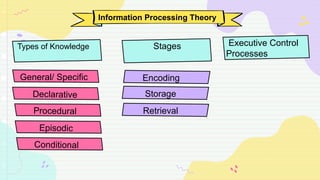
Encoding
Information Processing Theory
General/ Specific
Declarative
Procedural
Episodic
Conditional
Types of Knowledge Stages
Storage
Retrieval
Executive Control
Processes
—Information
Processing Theory
- Relating how the mind and the
computer work is a powerful analogy.
- In fact, those who program and
design computers aim to make
computers solve problems through
processes similar to that of the human
mind.
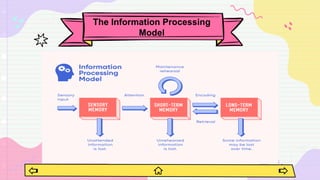
-Describe how the learner receives
information (stimuli) from the
environment through the senses and
what takes place in between determines
whether the information will continue to
pass through the sensory register, then
the short term memory and the long term
memory.
IPT
General vs. Specific
This involves whether the
knowledge is useful in many
tasks, or only in one.
Declarative
This refers to factual knowledge.
They relate to the nature of how
things are. They may be in the form of
a word or an image.
Procedural
This include knowledge on how
to do things.
Episodic
This includes memories of life events.
Conditional
This is about “knowing when and
why” to apply declarative or
procedural strategies
Stages in the Information
Processing Theory
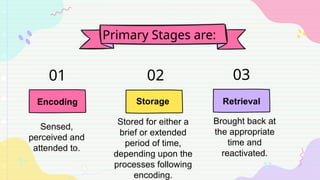
Primary Stages are:
Retrieval
Brought back at
the appropriate
time and
reactivated.
Storage
Stored for either a
brief or extended
period of time,
depending upon the
processes following
encoding.
Encoding
Sensed,
perceived and
attended to.
01 02 03
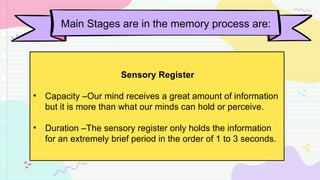
Main Stages are in the memory process are:
Sensory Register
• Capacity –Our mind receives a great amount of information
but it is more than what our minds can hold or perceive.
• Duration –The sensory register only holds the information
for an extremely brief period in the order of 1 to 3 seconds.
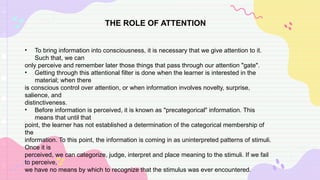
THE ROLE OF ATTENTION
• To bring information into consciousness, it is necessary that we give attention to it.
Such that, we can
only perceive and remember later those things that pass through our attention "gate".
• Getting through this attentional filter is done when the learner is interested in the
material; when there
is conscious control over attention, or when information involves novelty, surprise,
salience, and
distinctiveness.
• Before information is perceived, it is known as "precategorical" information. This
means that until that
point, the learner has not established a determination of the categorical membership of
the
information. To this point, the information is coming in as uninterpreted patterns of stimuli.
Once it is
perceived, we can categorize, judge, interpret and place meaning to the stimuli. If we fail
to perceive,
we have no means by which to recognize that the stimulus was ever encountered.
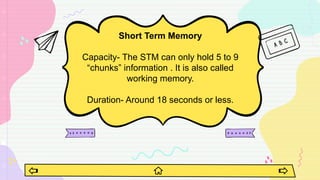
Short Term Memory
Capacity- The STM can only hold 5 to 9
“chunks” information . It is also called
working memory.
Duration- Around 18 seconds or less.
Long Term Memory
Capacity- Unlimited Capacity
Duration- Indefinite
The executive control process
involve the executive processor
or what is referred to as
metacognitive skills.
Executive Control
Processess
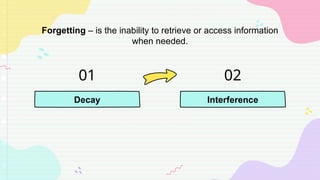
Forgetting – is the inability to retrieve or access information
when needed.
Interference
Decay
01 02
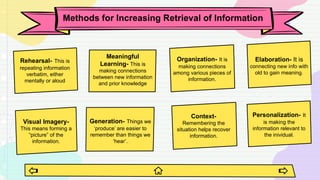
Methods for Increasing Retrieval of Information
Rehearsal- This is
repeating information
verbatim, either
mentally or aloud
Meaningful
Learning- This is
making connections
between new information
and prior knowledge
Organization- It is
making connections
among various pieces of
information.
Elaboration- It is
connecting new info with
old to gain meaning.
Visual Imagery-
This means forming a
“picture” of the
information.
Generation- Things we
‘produce’ are easier to
remember than things we
‘hear’.
Context-
Remembering the
situation helps recover
information.
Personalization- It
is making the
information relevant to
the inividual.
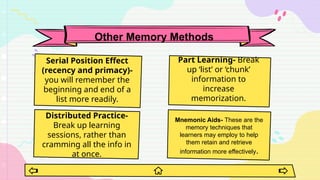
Other Memory Methods
Mnemonic Aids- These are the
memory techniques that
learners may employ to help
them retain and retrieve
information more effectively.
Serial Position Effect
(recency and primacy)-
you will remember the
beginning and end of a
list more readily.
Part Learning- Break
up ‘list’ or ‘chunk’
information to
increase
memorization.
Distributed Practice-
Break up learning
sessions, rather than
cramming all the info in
at once.
The Information Processing
Model
THANK YOU!

reporting for MAM MATIAS presenting .pptx

  • 1.
  • 2.
    Information Processing - Isa cognitive theoretical framework that focuses on how knowledge enters and is stored in and is retrieved from our memory.
  • 3.
    Encoding Information Processing Theory General/Specific Declarative Procedural Episodic Conditional Types of Knowledge Stages Storage Retrieval Executive Control Processes
  • 4.
    —Information Processing Theory - Relatinghow the mind and the computer work is a powerful analogy. - In fact, those who program and design computers aim to make computers solve problems through processes similar to that of the human mind.
  • 5.
    -Describe how thelearner receives information (stimuli) from the environment through the senses and what takes place in between determines whether the information will continue to pass through the sensory register, then the short term memory and the long term memory. IPT
  • 6.
    General vs. Specific Thisinvolves whether the knowledge is useful in many tasks, or only in one.
  • 7.
    Declarative This refers tofactual knowledge. They relate to the nature of how things are. They may be in the form of a word or an image.
  • 8.
  • 9.
  • 10.
    Conditional This is about“knowing when and why” to apply declarative or procedural strategies
  • 11.
    Stages in theInformation Processing Theory
  • 12.
    Primary Stages are: Retrieval Broughtback at the appropriate time and reactivated. Storage Stored for either a brief or extended period of time, depending upon the processes following encoding. Encoding Sensed, perceived and attended to. 01 02 03
  • 13.
    Main Stages arein the memory process are: Sensory Register • Capacity –Our mind receives a great amount of information but it is more than what our minds can hold or perceive. • Duration –The sensory register only holds the information for an extremely brief period in the order of 1 to 3 seconds.
  • 14.
    THE ROLE OFATTENTION • To bring information into consciousness, it is necessary that we give attention to it. Such that, we can only perceive and remember later those things that pass through our attention "gate". • Getting through this attentional filter is done when the learner is interested in the material; when there is conscious control over attention, or when information involves novelty, surprise, salience, and distinctiveness. • Before information is perceived, it is known as "precategorical" information. This means that until that point, the learner has not established a determination of the categorical membership of the information. To this point, the information is coming in as uninterpreted patterns of stimuli. Once it is perceived, we can categorize, judge, interpret and place meaning to the stimuli. If we fail to perceive, we have no means by which to recognize that the stimulus was ever encountered.
  • 15.
    Short Term Memory Capacity-The STM can only hold 5 to 9 “chunks” information . It is also called working memory. Duration- Around 18 seconds or less.
  • 16.
    Long Term Memory Capacity-Unlimited Capacity Duration- Indefinite
  • 17.
    The executive controlprocess involve the executive processor or what is referred to as metacognitive skills. Executive Control Processess
  • 18.
    Forgetting – isthe inability to retrieve or access information when needed. Interference Decay 01 02
  • 19.
    Methods for IncreasingRetrieval of Information Rehearsal- This is repeating information verbatim, either mentally or aloud Meaningful Learning- This is making connections between new information and prior knowledge Organization- It is making connections among various pieces of information. Elaboration- It is connecting new info with old to gain meaning. Visual Imagery- This means forming a “picture” of the information. Generation- Things we ‘produce’ are easier to remember than things we ‘hear’. Context- Remembering the situation helps recover information. Personalization- It is making the information relevant to the inividual.
  • 20.
    Other Memory Methods MnemonicAids- These are the memory techniques that learners may employ to help them retain and retrieve information more effectively. Serial Position Effect (recency and primacy)- you will remember the beginning and end of a list more readily. Part Learning- Break up ‘list’ or ‘chunk’ information to increase memorization. Distributed Practice- Break up learning sessions, rather than cramming all the info in at once.
  • 21.
  • 22.

Editor's Notes

  • #2 Information Processing Theory uses a computer model to describe human learning. Information comes in, it gets processed, and then it gets stored and retrieved. Of course this is an oversimplification of human learning, but it gives us a good overview and simile by using the computer model.
  • #4 Sa pilosopiya ng pag-iisip, ang computational theory of mind (CTM), na kilala rin bilang computationalism, ay isang pamilya ng mga pananaw na naniniwala na ang isip ng tao ay isang sistema ng pagproseso ng impormasyon at ang cognition at consciousness na magkasama ay isang anyo ng computation
  • #5 Without the senses walang iproprocess mas matalino parin ang tao kasi di naman gagana ang computer kung walang magpapagana dito