Nature and
Background of
the Different
Dances
CHARIES MORENO-ABING
What you are expected to learn?
Discuss the nature and
background of the different
dances.
 Dancing is the most vibrant and beautiful
form of art.
 It's a great way of social interaction and
provides a fun workout, which increases
flexibility and cardiovascular health. It is
an act of moving rhythmically and
expressively to an accompaniment
The word dancing came
from an old German word
“damson” which means to
“stretch”.
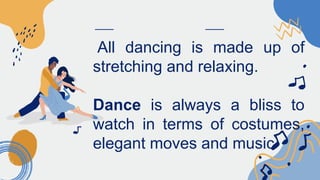
All dancing is made up of
stretching and relaxing.
Dance is always a bliss to
watch in terms of costumes,
elegant moves and music
Dance forms take
centuries to develop and
reflect the customs of the
society.
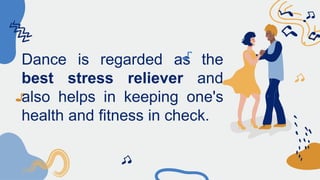
Dance is regarded as the
best stress reliever and
also helps in keeping one's
health and fitness in check.
For centuries, people
around the globe have
expressed themselves
through dance, where the
practice still continues,
today.
Dance refers to movement set to
music where there emerges
organization, structure and pattern. It
is a composition that implies
arrangement of parts into a form.
Dance is one of the
most beautiful forms of
art that has grown in
leaps and bounds.
Dance is no longer just a
hobby; it is also one of the
most lucrative professions as
well.
Dance therapy is very much
in vogue these days simply
because the experience of
dancing helps a person to
heal from within.
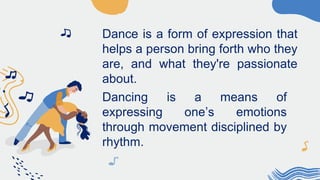
Dance is a form of expression that
helps a person bring forth who they
are, and what they're passionate
about.
Dancing is a means of
expressing one’s emotions
through movement disciplined by
rhythm.
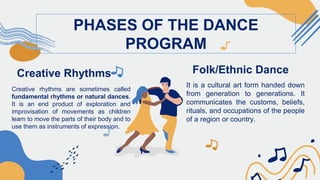
Creative Rhythms
Creative rhythms are sometimes called
fundamental rhythms or natural dances.
It is an end product of exploration and
improvisation of movements as children
learn to move the parts of their body and to
use them as instruments of expression.
PHASES OF THE DANCE
PROGRAM
Folk/Ethnic Dance
It is a cultural art form handed down
from generation to generations. It
communicates the customs, beliefs,
rituals, and occupations of the people
of a region or country.
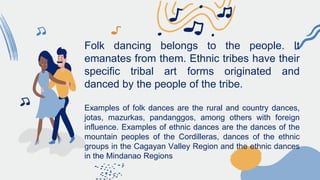
Folk dancing belongs to the people. It
emanates from them. Ethnic tribes have their
specific tribal art forms originated and
danced by the people of the tribe.
Examples of folk dances are the rural and country dances,
jotas, mazurkas, pandanggos, among others with foreign
influence. Examples of ethnic dances are the dances of the
mountain peoples of the Cordilleras, dances of the ethnic
groups in the Cagayan Valley Region and the ethnic dances
in the Mindanao Regions
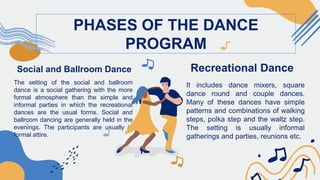
Social and Ballroom Dance
The setting of the social and ballroom
dance is a social gathering with the more
formal atmosphere than the simple and
informal parties in which the recreational
dances are the usual forms. Social and
ballroom dancing are generally held in the
evenings. The participants are usually in
formal attire.
PHASES OF THE DANCE
PROGRAM
Recreational Dance
It includes dance mixers, square
dance round and couple dances.
Many of these dances have simple
patterns and combinations of walking
steps, polka step and the waltz step.
The setting is usually informal
gatherings and parties, reunions etc.
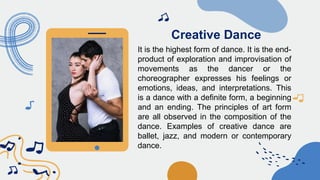
Creative Dance
It is the highest form of dance. It is the end-
product of exploration and improvisation of
movements as the dancer or the
choreographer expresses his feelings or
emotions, ideas, and interpretations. This
is a dance with a definite form, a beginning
and an ending. The principles of art form
are all observed in the composition of the
dance. Examples of creative dance are
ballet, jazz, and modern or contemporary
dance.
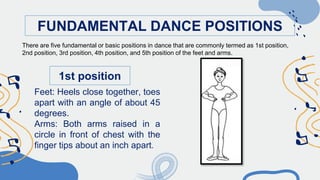
FUNDAMENTAL DANCE POSITIONS
1st position
Feet: Heels close together, toes
apart with an angle of about 45
degrees.
Arms: Both arms raised in a
circle in front of chest with the
finger tips about an inch apart.
There are five fundamental or basic positions in dance that are commonly termed as 1st position,
2nd position, 3rd position, 4th position, and 5th position of the feet and arms.
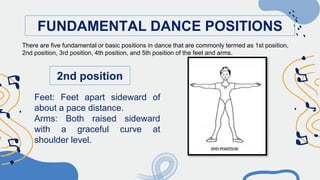
FUNDAMENTAL DANCE POSITIONS
2nd position
Feet: Feet apart sideward of
about a pace distance.
Arms: Both raised sideward
with a graceful curve at
shoulder level.
There are five fundamental or basic positions in dance that are commonly termed as 1st position,
2nd position, 3rd position, 4th position, and 5th position of the feet and arms.
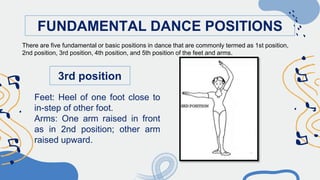
FUNDAMENTAL DANCE POSITIONS
3rd position
Feet: Heel of one foot close to
in-step of other foot.
Arms: One arm raised in front
as in 2nd position; other arm
raised upward.
There are five fundamental or basic positions in dance that are commonly termed as 1st position,
2nd position, 3rd position, 4th position, and 5th position of the feet and arms.
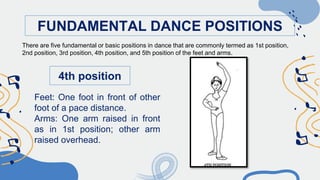
FUNDAMENTAL DANCE POSITIONS
4th position
Feet: One foot in front of other
foot of a pace distance.
Arms: One arm raised in front
as in 1st position; other arm
raised overhead.
There are five fundamental or basic positions in dance that are commonly termed as 1st position,
2nd position, 3rd position, 4th position, and 5th position of the feet and arms.
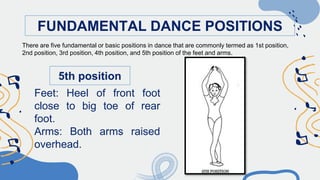
FUNDAMENTAL DANCE POSITIONS
5th position
Feet: Heel of front foot
close to big toe of rear
foot.
Arms: Both arms raised
overhead.
There are five fundamental or basic positions in dance that are commonly termed as 1st position,
2nd position, 3rd position, 4th position, and 5th position of the feet and arms.
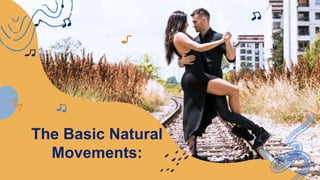
The Basic Natural
Movements:
1. Locomotor movements - are those that move the
body in space in any direction with the feet as the
moving base. Examples: walking, running, jumping,
hopping, skipping, leaping, galloping and sliding.
2. Non-locomotor - are those in which various parts of
the body move in space with a fixed base. The base
may be standing, kneeling, sitting or lying.
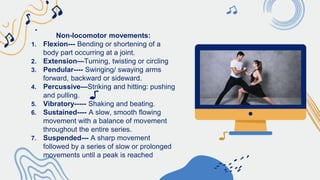
Non-locomotor movements:
1. Flexion--- Bending or shortening of a
body part occurring at a joint.
2. Extension—Turning, twisting or circling
3. Pendular---- Swinging/ swaying arms
forward, backward or sideward.
4. Percussive—Striking and hitting: pushing
and pulling.
5. Vibratory----- Shaking and beating.
6. Sustained---- A slow, smooth flowing
movement with a balance of movement
throughout the entire series.
7. Suspended--- A sharp movement
followed by a series of slow or prolonged
movements until a peak is reached
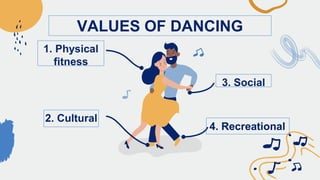
VALUES OF DANCING
1. Physical
fitness
3. Social
2. Cultural
4. Recreational
RECURSOS ALTERNATIVOS
A continuación, se muestra una variedad de recursos
alternativos cuyo estilo encaja en esta plantilla

HOPE 4 WEEK 1.pptx

  • 1.
    Nature and Background of theDifferent Dances CHARIES MORENO-ABING
  • 2.
    What you areexpected to learn? Discuss the nature and background of the different dances.
  • 3.
     Dancing isthe most vibrant and beautiful form of art.  It's a great way of social interaction and provides a fun workout, which increases flexibility and cardiovascular health. It is an act of moving rhythmically and expressively to an accompaniment
  • 4.
    The word dancingcame from an old German word “damson” which means to “stretch”.
  • 5.
    All dancing ismade up of stretching and relaxing. Dance is always a bliss to watch in terms of costumes, elegant moves and music
  • 6.
    Dance forms take centuriesto develop and reflect the customs of the society.
  • 7.
    Dance is regardedas the best stress reliever and also helps in keeping one's health and fitness in check.
  • 8.
    For centuries, people aroundthe globe have expressed themselves through dance, where the practice still continues, today.
  • 9.
    Dance refers tomovement set to music where there emerges organization, structure and pattern. It is a composition that implies arrangement of parts into a form.
  • 10.
    Dance is oneof the most beautiful forms of art that has grown in leaps and bounds. Dance is no longer just a hobby; it is also one of the most lucrative professions as well. Dance therapy is very much in vogue these days simply because the experience of dancing helps a person to heal from within.
  • 11.
    Dance is aform of expression that helps a person bring forth who they are, and what they're passionate about. Dancing is a means of expressing one’s emotions through movement disciplined by rhythm.
  • 12.
    Creative Rhythms Creative rhythmsare sometimes called fundamental rhythms or natural dances. It is an end product of exploration and improvisation of movements as children learn to move the parts of their body and to use them as instruments of expression. PHASES OF THE DANCE PROGRAM Folk/Ethnic Dance It is a cultural art form handed down from generation to generations. It communicates the customs, beliefs, rituals, and occupations of the people of a region or country.
  • 13.
    Folk dancing belongsto the people. It emanates from them. Ethnic tribes have their specific tribal art forms originated and danced by the people of the tribe. Examples of folk dances are the rural and country dances, jotas, mazurkas, pandanggos, among others with foreign influence. Examples of ethnic dances are the dances of the mountain peoples of the Cordilleras, dances of the ethnic groups in the Cagayan Valley Region and the ethnic dances in the Mindanao Regions
  • 14.
    Social and BallroomDance The setting of the social and ballroom dance is a social gathering with the more formal atmosphere than the simple and informal parties in which the recreational dances are the usual forms. Social and ballroom dancing are generally held in the evenings. The participants are usually in formal attire. PHASES OF THE DANCE PROGRAM Recreational Dance It includes dance mixers, square dance round and couple dances. Many of these dances have simple patterns and combinations of walking steps, polka step and the waltz step. The setting is usually informal gatherings and parties, reunions etc.
  • 15.
    Creative Dance It isthe highest form of dance. It is the end- product of exploration and improvisation of movements as the dancer or the choreographer expresses his feelings or emotions, ideas, and interpretations. This is a dance with a definite form, a beginning and an ending. The principles of art form are all observed in the composition of the dance. Examples of creative dance are ballet, jazz, and modern or contemporary dance.
  • 16.
    FUNDAMENTAL DANCE POSITIONS 1stposition Feet: Heels close together, toes apart with an angle of about 45 degrees. Arms: Both arms raised in a circle in front of chest with the finger tips about an inch apart. There are five fundamental or basic positions in dance that are commonly termed as 1st position, 2nd position, 3rd position, 4th position, and 5th position of the feet and arms.
  • 17.
    FUNDAMENTAL DANCE POSITIONS 2ndposition Feet: Feet apart sideward of about a pace distance. Arms: Both raised sideward with a graceful curve at shoulder level. There are five fundamental or basic positions in dance that are commonly termed as 1st position, 2nd position, 3rd position, 4th position, and 5th position of the feet and arms.
  • 18.
    FUNDAMENTAL DANCE POSITIONS 3rdposition Feet: Heel of one foot close to in-step of other foot. Arms: One arm raised in front as in 2nd position; other arm raised upward. There are five fundamental or basic positions in dance that are commonly termed as 1st position, 2nd position, 3rd position, 4th position, and 5th position of the feet and arms.
  • 19.
    FUNDAMENTAL DANCE POSITIONS 4thposition Feet: One foot in front of other foot of a pace distance. Arms: One arm raised in front as in 1st position; other arm raised overhead. There are five fundamental or basic positions in dance that are commonly termed as 1st position, 2nd position, 3rd position, 4th position, and 5th position of the feet and arms.
  • 20.
    FUNDAMENTAL DANCE POSITIONS 5thposition Feet: Heel of front foot close to big toe of rear foot. Arms: Both arms raised overhead. There are five fundamental or basic positions in dance that are commonly termed as 1st position, 2nd position, 3rd position, 4th position, and 5th position of the feet and arms.
  • 21.
  • 22.
    1. Locomotor movements- are those that move the body in space in any direction with the feet as the moving base. Examples: walking, running, jumping, hopping, skipping, leaping, galloping and sliding. 2. Non-locomotor - are those in which various parts of the body move in space with a fixed base. The base may be standing, kneeling, sitting or lying.
  • 23.
    Non-locomotor movements: 1. Flexion---Bending or shortening of a body part occurring at a joint. 2. Extension—Turning, twisting or circling 3. Pendular---- Swinging/ swaying arms forward, backward or sideward. 4. Percussive—Striking and hitting: pushing and pulling. 5. Vibratory----- Shaking and beating. 6. Sustained---- A slow, smooth flowing movement with a balance of movement throughout the entire series. 7. Suspended--- A sharp movement followed by a series of slow or prolonged movements until a peak is reached
  • 24.
    VALUES OF DANCING 1.Physical fitness 3. Social 2. Cultural 4. Recreational
  • 25.
    RECURSOS ALTERNATIVOS A continuación,se muestra una variedad de recursos alternativos cuyo estilo encaja en esta plantilla