Information Processing
Theory
By: Jan Marc P. Damasing
INTRODUCTION TO INFORMATION
PROCESSING THEORY
•Information Processing Theory (IPT) is a cognitive approach that explores how
the human mind works, akin to how a computer processes information. The brain
receives input from the environment, processes it, and generates a response.
The theory was pioneered by George A. Miller in 1956, who introduced the
concept that humans can only hold around 7 (plus or minus 2) chunks of
information in their short-term memory at any given time.
•The main objectives of this theory are:
1. To explain the fundamental components and stages of the theory.
2. To derive and discuss the pedagogical implications from this cognitive
approach.
3. To explore effective teaching strategies that support information retention and
retrieval in learners.
KEY COMPONENTS OF THE
INFORMATION PROCESSING
MODEL
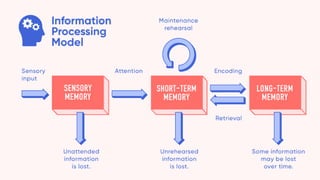
•Sensory Memory: The initial stage of processing, where the brain gathers
information from the senses (sight, sound, touch, taste, and smell). This
input is held for only a brief moment, typically a fraction of a second.
•Short-term Memory (STM): After sensory input is acknowledged and
attended to, it moves into short-term memory, which can hold limited
pieces of information (7±2) for a short duration.
•Long-term Memory (LTM): Information that is rehearsed or deemed
important is transferred into long-term memory, where it can be stored
indefinitely. This storage is vast, allowing us to recall information after
long periods.
SENSORY MEMORY
•Sensory memory acts as a buffer for stimuli received through the five
senses. It holds onto this raw sensory data for a very brief period before
either passing it to short-term memory (if attention is given) or allowing it
to fade away.
•It functions as a gatekeeper by filtering out irrelevant data that doesn't
capture our attention, thereby protecting the brain from becoming
overwhelmed by constant stimuli.
Example: When you walk into a room and hear a loud noise, it grabs your
attention (entering sensory memory). If you choose not to focus on it, the
sound is quickly forgotten. But if you pay attention, it moves to short-term
memory, allowing you to understand the source.
SHORT-TERM MEMORY
•Short-term memory is where conscious processing occurs. It can store a
limited amount of information for a brief time (around 15 to 30 seconds),
unless it is actively rehearsed or practiced, which helps keep it in mind
longer.
One technique for improving short-term memory retention is “chunking”—
grouping items into meaningful units to increase retention. Without this,
the brain easily forgets or loses track of the information due to limited
capacity.
Example: Trying to remember a random sequence of numbers like 6-4-3-8-9-
1-0-5-7-3 may be hard. However, breaking it into chunks (643, 891, 0573)
makes it easier to retain.
LONG-TERM MEMORY
•Long-term memory refers to the brain’s more permanent storage system.
Unlike short-term memory, it can hold vast amounts of information over a
long period—sometimes for a lifetime.
There are three key types of long-term memory:
1. Procedural Memory: This involves knowledge of how to perform tasks or
actions, like riding a bike or playing a musical instrument.
2. Episodic Memory: This holds personal experiences and specific events
that occur in one’s life, often associated with particular times and places.
3. Semantic Memory: This stores factual information, general knowledge,
concepts, and meanings that are not tied to personal experiences..
RETRIEVING INFORMATION FROM
LONG-TERM MEMORY
•Retrieving information from long-term memory involves two processes:
1. Recognition: Identifying previously learned information when
encountered again.
2. Recall: Actively pulling information from memory without external
prompts. This process can sometimes be slower or more difficult,
depending on how well the information was encoded.
Retrieval can be influenced by cues and context, meaning the environment
or triggers can help bring memories to mind.
Example: Recognition occurs when you see a face in a crowd and realize
you’ve met the person before. Recall happens when you try to remember
the name of that person without any external clues.
FORGETTING: CAUSES AND SOLUTIONS
•Forgetting happens for a variety of reasons:
Interference: When new information conflicts with old information
(retroactive interference) or when older information prevents learning new
material (proactive interference).
Decay: If information is not reviewed or rehearsed, it gradually fades over
time from memory.
To prevent forgetting, regular review and active engagement with the
material can strengthen neural connections and make memories more
durable.
Example: After cramming for an exam, you might forget much of the
material within a week because of decay. But if you review the notes every
few days, the information is less likely to be forgotten.
TEACHING IMPLICATIONS OF
INFORMATION PROCESSING THEORY
Following the experts and principles associated with the IPT, Woolfolk (2016), Slavin
(2018), and Schunk (2012) recommend the following to be used in helping learners to
understand and recall what they have learned:
1. Make sure you have the students' attention. Develop a signal that tells students to
stop what they are doing and focus on you. Make sure that students respond to the
signal right away.
2. Move around the room, use gestures, and avoid speaking in a monotone.
3. Begin a lesson by asking a question that stimulates interest in the topic.
4. Retain the attention of individual students by walking closer to them, calling on them
by name, or giving them a question.
5. Help students to separate essential from nonessential details and focus on the most
important information. Summarize instructional objectives to indicate what students
should remember. Relate the material you are presenting to the objectives so the
students understand why they are learning.
.
TEACHING IMPLICATIONS OF
INFORMATION PROCESSING THEORY
6. When you make an important point, pause, repeat, ask a student to paraphrase,
note the information on the board in colored chalk, or tell students to highlight
their notes and/or readings. The use of mnemonic devices could assist learners'
retention of the essential information.
7. Help students to make connections between new information and what they
already know.
8. Review prerequisites to help students bring to mind the information they need
for understanding new material.
9. Provide for repetition and review of information. Using graphic organizers for
rehearsals can help.
10. Present material in a clear and organized way. Make the purpose of the lesson
very clear. Advance organizers can help.
11. Focus on meaning, not memorization. For instance, in teaching new words,
help students to associate the new word to a related word they already
understand.
Thank You

Information-Processing-Theory.pptx about

  • 1.
  • 2.
    INTRODUCTION TO INFORMATION PROCESSINGTHEORY •Information Processing Theory (IPT) is a cognitive approach that explores how the human mind works, akin to how a computer processes information. The brain receives input from the environment, processes it, and generates a response. The theory was pioneered by George A. Miller in 1956, who introduced the concept that humans can only hold around 7 (plus or minus 2) chunks of information in their short-term memory at any given time. •The main objectives of this theory are: 1. To explain the fundamental components and stages of the theory. 2. To derive and discuss the pedagogical implications from this cognitive approach. 3. To explore effective teaching strategies that support information retention and retrieval in learners.
  • 3.
    KEY COMPONENTS OFTHE INFORMATION PROCESSING MODEL •Sensory Memory: The initial stage of processing, where the brain gathers information from the senses (sight, sound, touch, taste, and smell). This input is held for only a brief moment, typically a fraction of a second. •Short-term Memory (STM): After sensory input is acknowledged and attended to, it moves into short-term memory, which can hold limited pieces of information (7±2) for a short duration. •Long-term Memory (LTM): Information that is rehearsed or deemed important is transferred into long-term memory, where it can be stored indefinitely. This storage is vast, allowing us to recall information after long periods.
  • 5.
    SENSORY MEMORY •Sensory memoryacts as a buffer for stimuli received through the five senses. It holds onto this raw sensory data for a very brief period before either passing it to short-term memory (if attention is given) or allowing it to fade away. •It functions as a gatekeeper by filtering out irrelevant data that doesn't capture our attention, thereby protecting the brain from becoming overwhelmed by constant stimuli. Example: When you walk into a room and hear a loud noise, it grabs your attention (entering sensory memory). If you choose not to focus on it, the sound is quickly forgotten. But if you pay attention, it moves to short-term memory, allowing you to understand the source.
  • 6.
    SHORT-TERM MEMORY •Short-term memoryis where conscious processing occurs. It can store a limited amount of information for a brief time (around 15 to 30 seconds), unless it is actively rehearsed or practiced, which helps keep it in mind longer. One technique for improving short-term memory retention is “chunking”— grouping items into meaningful units to increase retention. Without this, the brain easily forgets or loses track of the information due to limited capacity. Example: Trying to remember a random sequence of numbers like 6-4-3-8-9- 1-0-5-7-3 may be hard. However, breaking it into chunks (643, 891, 0573) makes it easier to retain.
  • 7.
    LONG-TERM MEMORY •Long-term memoryrefers to the brain’s more permanent storage system. Unlike short-term memory, it can hold vast amounts of information over a long period—sometimes for a lifetime. There are three key types of long-term memory: 1. Procedural Memory: This involves knowledge of how to perform tasks or actions, like riding a bike or playing a musical instrument. 2. Episodic Memory: This holds personal experiences and specific events that occur in one’s life, often associated with particular times and places. 3. Semantic Memory: This stores factual information, general knowledge, concepts, and meanings that are not tied to personal experiences..
  • 8.
    RETRIEVING INFORMATION FROM LONG-TERMMEMORY •Retrieving information from long-term memory involves two processes: 1. Recognition: Identifying previously learned information when encountered again. 2. Recall: Actively pulling information from memory without external prompts. This process can sometimes be slower or more difficult, depending on how well the information was encoded. Retrieval can be influenced by cues and context, meaning the environment or triggers can help bring memories to mind. Example: Recognition occurs when you see a face in a crowd and realize you’ve met the person before. Recall happens when you try to remember the name of that person without any external clues.
  • 9.
    FORGETTING: CAUSES ANDSOLUTIONS •Forgetting happens for a variety of reasons: Interference: When new information conflicts with old information (retroactive interference) or when older information prevents learning new material (proactive interference). Decay: If information is not reviewed or rehearsed, it gradually fades over time from memory. To prevent forgetting, regular review and active engagement with the material can strengthen neural connections and make memories more durable. Example: After cramming for an exam, you might forget much of the material within a week because of decay. But if you review the notes every few days, the information is less likely to be forgotten.
  • 10.
    TEACHING IMPLICATIONS OF INFORMATIONPROCESSING THEORY Following the experts and principles associated with the IPT, Woolfolk (2016), Slavin (2018), and Schunk (2012) recommend the following to be used in helping learners to understand and recall what they have learned: 1. Make sure you have the students' attention. Develop a signal that tells students to stop what they are doing and focus on you. Make sure that students respond to the signal right away. 2. Move around the room, use gestures, and avoid speaking in a monotone. 3. Begin a lesson by asking a question that stimulates interest in the topic. 4. Retain the attention of individual students by walking closer to them, calling on them by name, or giving them a question. 5. Help students to separate essential from nonessential details and focus on the most important information. Summarize instructional objectives to indicate what students should remember. Relate the material you are presenting to the objectives so the students understand why they are learning. .
  • 11.
    TEACHING IMPLICATIONS OF INFORMATIONPROCESSING THEORY 6. When you make an important point, pause, repeat, ask a student to paraphrase, note the information on the board in colored chalk, or tell students to highlight their notes and/or readings. The use of mnemonic devices could assist learners' retention of the essential information. 7. Help students to make connections between new information and what they already know. 8. Review prerequisites to help students bring to mind the information they need for understanding new material. 9. Provide for repetition and review of information. Using graphic organizers for rehearsals can help. 10. Present material in a clear and organized way. Make the purpose of the lesson very clear. Advance organizers can help. 11. Focus on meaning, not memorization. For instance, in teaching new words, help students to associate the new word to a related word they already understand.
  • 12.