Antihypertensive Agents
1-davolash 311-a guruh talabalari
Abduqodirov Muhammadsafo
Baxtiyorov Axrorbek
Sobirjonov Sardor
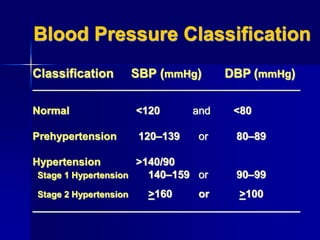
Blood Pressure Classification
Classification SBP (mmHg) DBP (mmHg)
______________________________________________________
Normal <120 and <80
Prehypertension 120–139 or 80–89
Hypertension >140/90
Stage 1 Hypertension 140–159 or 90–99
Stage 2 Hypertension >160 or >100
_____________________________________________
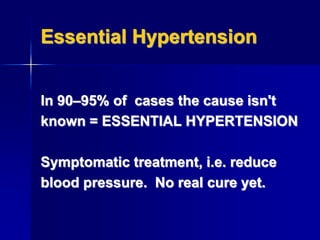
Essential Hypertension
In 90–95% of cases the cause isn't
known = ESSENTIAL HYPERTENSION
Symptomatic treatment, i.e. reduce
blood pressure. No real cure yet.
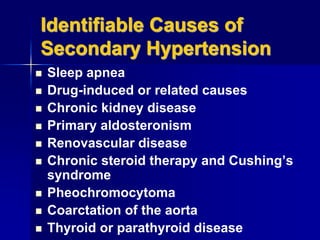
Identifiable Causes of
Secondary Hypertension
 Sleep apnea
 Drug-induced or related causes
 Chronic kidney disease
 Primary aldosteronism
 Renovascular disease
 Chronic steroid therapy and Cushing’s
syndrome
 Pheochromocytoma
 Coarctation of the aorta
 Thyroid or parathyroid disease
Prevalence
 High in this country: 50% of adults,
60% of whites, 71% of African
Americans, 61% Mexican Americans
over the age of 60
 More prevalent in men than in
women
 Highest prevalence in elderly
African-American females
Complications
 Cardiovascular system
 CNS
 Renal system
 Retinal damage
Target Organ Damage
 Heart
 Left ventricular hypertrophy
 Coronary artery disease
 Myocardial infarcts
 Heart failure
 Brain
 Stroke or transient ischemic
attacks
 Chronic kidney disease, kidney failure
 Retinopathy
Contributing Factors
 Obesity
 Stress
 Lack of exercise
 Diet (excess dietary salt)
 Alcohol intake
 Cigarette smoking
Treatment Overview
 Goals of therapy
 Lifestyle modification
 Pharmacologic treatment
 Algorithm for treatment of
hypertension
 Classification and management of
BP for adults
 Follow-up and monitoring
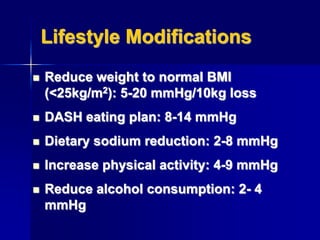
Lifestyle Modifications
 Reduce weight to normal BMI
(<25kg/m2): 5-20 mmHg/10kg loss
 DASH eating plan: 8-14 mmHg
 Dietary sodium reduction: 2-8 mmHg
 Increase physical activity: 4-9 mmHg
 Reduce alcohol consumption: 2- 4
mmHg
DASH Diet
Dietary
Approaches
to
Stop
Hypertension
• Emphasizes: Fruits,
vegetables, low fat dairy
foods, and reduced
sodium intake
• Includes whole grains,
poultry, fish, nuts
• Reduced amounts of red
meat, sugar, total and
saturated fat, and
cholesterol
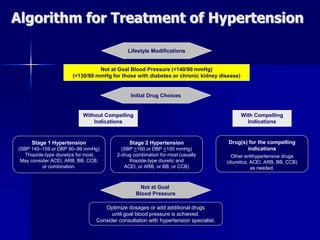
Algorithm for Treatment of Hypertension
Not at Goal Blood Pressure (<140/90 mmHg)
(<130/80 mmHg for those with diabetes or chronic kidney disease)
Initial Drug Choices
Drug(s) for the compelling
indications
Other antihypertensive drugs
(diuretics, ACEI, ARB, BB, CCB)
as needed.
With Compelling
Indications
Lifestyle Modifications
Stage 2 Hypertension
(SBP >160 or DBP >100 mmHg)
2-drug combination for most (usually
thiazide-type diuretic and
ACEI, or ARB, or BB, or CCB)
Stage 1 Hypertension
(SBP 140–159 or DBP 90–99 mmHg)
Thiazide-type diuretics for most.
May consider ACEI, ARB, BB, CCB,
or combination.
Without Compelling
Indications
Not at Goal
Blood Pressure
Optimize dosages or add additional drugs
until goal blood pressure is achieved.
Consider consultation with hypertension specialist.
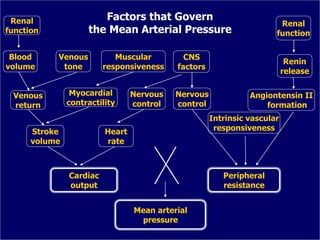
Renal
function
Blood
volume
Venous
tone
Venous
return
Heart
rate
Nervous
control
Muscular
responsiveness
Myocardial
contractility
Stroke
volume
Cardiac
output
CNS
factors
Renin
release
Angiontensin II
formation
Intrinsic vascular
responsiveness
Peripheral
resistance
Nervous
control
Renal
function
Mean arterial
pressure
Factors that Govern
the Mean Arterial Pressure
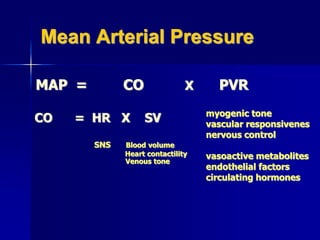
Mean Arterial Pressure
MAP = CO
CO = HR X SV
SNS Blood volume
Heart contactility
Venous tone
X PVR
myogenic tone
vascular responsivenes
nervous control
vasoactive metabolites
endothelial factors
circulating hormones
Antihypertensive Drugs
Classification
 Diuretics
 Agents affecting adrenergic
function
 Vasodilators
 Agents affecting Renin
Angiotensin System (RAS)
Diuretics
Used as initial therapy alone or in combination with
drugs from other groups
Adverse effects: renin secretion due to volume and Na
depletion
 Thiazides: chlorothiazide, hydrochorothiazide
 Loop Diuretics: furosemide, bumetanide,
ethacrynic acid
 Potassium sparing diuretics: spironolactone,
triamterene, amiloride
About Diuretics
Antihypertensive and Lipid Lowering Treatment to
Prevent Heart Attack Trial (ALLHAT): Diuretics
have been virtually unsurpassed in preventing the
cardiovascular complications of hypertension.
Diuretics enhance the antihypertensive efficacy of
multidrug regimens, can be useful in achieving BP
control, and are more affordable than other anti-
hypertensive agents.
Despite these findings, diuretics remain under-
utilized.
Agents that affect
adrenergic function
a) Agents that prevent adrenergic
transmission (reserpine, guanethedine,
guanadrel)
b) Selective alpha-1 adrenergic receptor
blockers (prazosin, terazosin, doxazosin)
c) Beta-adrenergic blocking agents
(propranolol and others)
d) Agents that act on the CNS (methyldopa,
clonidine, guanabenz, guanfacine)
a) Agents that prevent adrenergic
transmission: Reserpine (Serpasil)
 Mechanism: depletes neurotransmitters (NE,
DA, 5HT) in the storage vesicle of the central
and peripheral nerve endings
 Main effects: depress SNS function centrally
and peripherally  decreased HR, contractility
and PVR
 Adverse effects: depression, insomnia,
nightmares, ulcers, diarrhea, abdominal
cramping, nasal stuffiness, orthostatic
hypotension, dry mouth, impotence
 Pharmacokinetics: onset is slow and full effect
is seen in weeks
 Use: infrequently
Mechanism: Depletes the nerve ending of NE
in the periphery
Main effects: decrease in PVR and decrease in
HR  decrease in BP
Adverse effects: Orthostatic hypotension, Na+
and water retention. Other side-effects
similar to reserpine except the CNS effects
Pharmacokinetics: Poorly absorbed from the
G.I. Onset slow (1-2 weeks). Metabolites
excreted in urine
Use: Not used anymore because of severe
side effects
a) Agents that prevent adrenergic
transmission: Guanethedine (Ismelin)
Mechanism and main effects Similar to
guanethidine
Adverse effects are less than gunethidine:
less orthostatic hypotension, less diarrhea,
less effect on sexual function.
Pharmacokinetics: better absorption, rapid
onset, shorter duration of action than
guanethidine
a) Agents that prevent adrenergic
transmission: Guanadrel (Hylorel)
b) Selective alpha-1 adrenergic
receptor blockers (prazosin-Minipres,
terazosin-Hytrin, doxazosin-Cardura)
They favorably influence plasma lipid profile, and do not
interfere with glucose metabolism.
Mechanism: block 1 receptors in vasculature
Main effects: decreased PVR  decrease BP
Adverse effects: 1st dose phenomenon, fluid
retention, dizziness, headache
Pharmacokinetics: t1/2= 4.5, 12, 20, respectively
Use: used in stage 1 and stage 2 HT in
combination with a diuretic and a -blocker
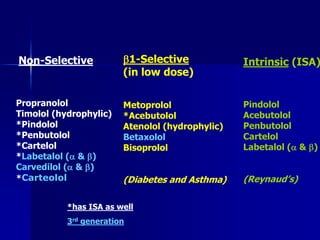
c) Beta-adrenergic blocking
agents (see table)
Classification
 Nonselective (1st generation)
 Cardioselective (-1 selective, 2nd generation)
 -blockers with intrinsic sympathomimetic
activity (ISA)
 With additional CV actions (3rd generation)
Proposed mechanisms:
Block cardiac 1 receptors  lower CO
Block renal 1 receptors  lower renin,
lower PVR
Decrease SNS output
Non-Selective
Propranolol
Timolol (hydrophylic)
*Pindolol
*Penbutolol
*Cartelol
*Labetalol ( & )
Carvedilol ( & )
*Carteolol
1-Selective
(in low dose)
Metoprolol
*Acebutolol
Atenolol (hydrophylic)
Betaxolol
Bisoprolol
(Diabetes and Asthma)
Intrinsic (ISA)
Pindolol
Acebutolol
Penbutolol
Cartelol
Labetalol ( & )
(Reynaud’s)
*has ISA as well
3rd generation
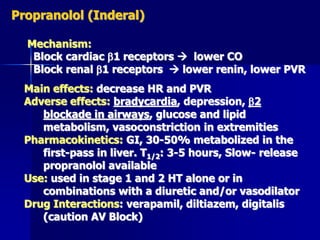
Propranolol (Inderal)
Mechanism:
Block cardiac 1 receptors  lower CO
Block renal 1 receptors  lower renin, lower PVR
Main effects: decrease HR and PVR
Adverse effects: bradycardia, depression, 2
blockade in airways, glucose and lipid
metabolism, vasoconstriction in extremities
Pharmacokinetics: GI, 30-50% metabolized in the
first-pass in liver. T1/2: 3-5 hours, Slow- release
propranolol available
Use: used in stage 1 and 2 HT alone or in
combinations with a diuretic and/or vasodilator
Drug Interactions: verapamil, diltiazem, digitalis
(caution AV Block)
Labetalol (Trandate)
 A combined alpha-1, beta-1, and
beta-2 blocker. Beta blocking
action is more prominent. It also
has some ISA property.
 Can be given i.v. for hypertensive
emergencies
d) Agents that act on the CNS
(-methyldopa-Aldomet, clonidine- Catapres,
guanabenz-Wytensin, guanfacine-Tenex)
Favorable effect: lower PRA
Mechanism: -me-dopa metabolized to -me-
norepinephrine, an -2 agonist, that suppresses
SNS output from the CNS. Others are -2 agonist
themselves.
Main effects: decreases PVR and HR
Adverse effects: sedation, drowsiness, dry mouth,
impotence, bradycardia, withdrawal syndrome
(rebound HT), false (+) Coombs’ antiglobulin test
Pharmacokinetics: oral or parenteral, transdermal;
T1/2 = 2, 10, 6, 14-17 h, respectively
Use: stage 1 and 2 HT
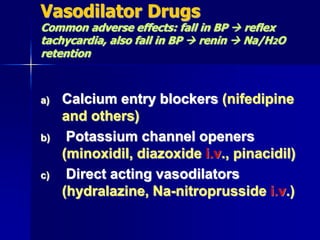
Vasodilator Drugs
Common adverse effects: fall in BP  reflex
tachycardia, also fall in BP  renin  Na/H2O
retention
a) Calcium entry blockers (nifedipine
and others)
b) Potassium channel openers
(minoxidil, diazoxide i.v., pinacidil)
c) Direct acting vasodilators
(hydralazine, Na-nitroprusside i.v.)
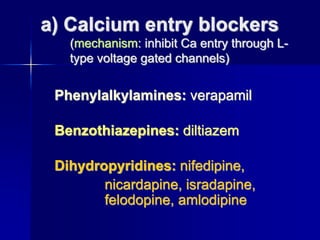
a) Calcium entry blockers
(mechanism: inhibit Ca entry through L-
type voltage gated channels)
Phenylalkylamines: verapamil
Benzothiazepines: diltiazem
Dihydropyridines: nifedipine,
nicardapine, isradapine,
felodopine, amlodipine
Nifedipine (Procardia)
Mech: selective blockade of vascular Ca
channels
Main effect: vasodilatation  lower PVR 
lower BP
Adverse effects: headache, flushing,
nausea, ankle edema, dizziness, reflex
tachycardia with short acting version (now
have Procardia SR)
(no reflex tachycardia with verapamil and
diltiazem)
Use: Hypertension (more effective in African-
Americans), angina. Not useful as an
antiarrhythmic drug
Verapamil and Diltiazem
Mechanism: Blockade of Ca channels in the
vasculature, heart muscle and the AV node
Main effects: same as nifedipine group
Adverse effects: Similar to nifedipine except
that they do not cause reflex tahycardia
Drug interactions: Caution for AV block with
beta blockers, and digitalis
Use: Hypertension, angina, arrhythmias
b) Potassium channel openers
(minoxidil-Loniten, diazoxide i.v.-Hyperstat,
pinacidil)
Mechanism: open K-channels of vascular
smooth muscle cells  K-efflux 
hyperpolarization  vasodilatation
Main effect: vasodilation  lower PVR 
lower BP
Adverse effects: reflex tachycardia, Na and
fluid retention, (minoxidil: hirsutism-
Rogaine. Diazoxide: hyperuricemia,
hyperglycemia –used in hypoglycemia)
Use: Diazoxide i.v. in hypertensive
emergencies
c) Direct acting vasodilators (Na-
nitroprusside i.v. Nipride)
Mechanism: metabolite is nitric oxide 
cGMP. NO is a rapid acting venous and
arteriolar vasodilator
Main effect: vasodilation  lower PVR 
lower BP
Adverse Effects: Reflex tachycardia, severe
hypotension, possible cyanide poisoning
Pharmacokinetics: rapid acting, i.v. drip,
short plasma half-life
Use: Hypertensive emergencies
c) Direct acting vasodilators
(hydralazine-Apresoline)
Mechanism: Direct vasodilator of arterioles
Main effect: vasodilation  lower PVR 
lower BP
Adverse effects: reflex tachycardia, Na
retention, hirsutism, lupus–like syndrome
Pharmacokinetics: oral, slow onset
Use: with a beta blocker and a diuretic
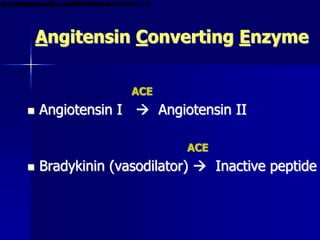
Angitensin Converting Enzyme
ACE
 Angiotensin I  Angiotensin II
ACE
 Bradykinin (vasodilator)  Inactive peptide
ANGIOTENSIN I ANGIOTENSIN II
ACE
 


ANGIOTENSIN I ANGIOTENSIN II
ACE
 


BRADYKININ (vasodialtor) INACTIVE PEPTIDE
ACE
 


BRADYKININ (vasodialtor) INACTIVE PEPTIDE
ACE
 


Agents that affect RAS
a) ACE inhibitors
captopril, enalapril, lisinopril
b) Angiotensin II receptor
blockers (ARB)
losartan, valsartan, irbesartan
a) ACE inhibitors (captopril-Capoten,
enalapril-Vasotec, lisinopril-Privinil, rampiril-
Altace)
No adverse effects on plasma lipids, glucose, sexual
function. Drug of choice in diabetes-related early stage
proteinuria. Contraindicated in pregnancy. Not as effective in
African-Americans
Mechanism: inhibit ACE  low circulating Ang II 
decreased PVR
Main effects: decreased PVR  decreased BP
Adverse effects: skin rash, taste, cough, hyperkalemia
Pharmacokinetics: T1/2 = 3, 11, 12, respectively
Use: used in stage 1 and 2 HT; also for congestive heart
failure
b) Angiotensin II receptor blockers
(ARB) (losartan-Coozar, valsartan-Diovan,
irbesartan-Avapro)
Mechanism: selectively block Ang II AT-1
receptor  decrease PVR  decrease BP
Adverse effects: No Cough, very few
adverse similar to ACE inhibitors
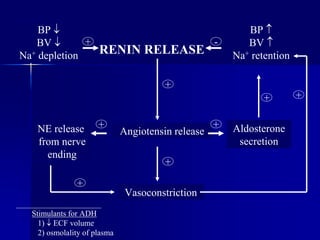
BP 
BV 
Na+ depletion
NE release
from nerve
ending
RENIN RELEASE
BP 
BV 
Na+ retention
+ -
Vasoconstriction
Aldosterone
secretion
Angiotensin release
+
+ +
+
+
+
Stimulants for ADH
1)  ECF volume
2) osmolality of plasma
+
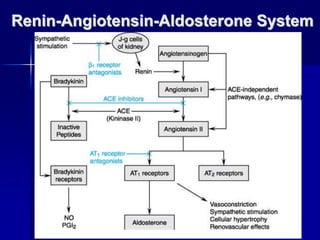
Renin-Angiotensin-Aldosterone System

Antihypertensive Agents Drugs Classification

  • 1.
    Antihypertensive Agents 1-davolash 311-aguruh talabalari Abduqodirov Muhammadsafo Baxtiyorov Axrorbek Sobirjonov Sardor
  • 2.
    Blood Pressure Classification ClassificationSBP (mmHg) DBP (mmHg) ______________________________________________________ Normal <120 and <80 Prehypertension 120–139 or 80–89 Hypertension >140/90 Stage 1 Hypertension 140–159 or 90–99 Stage 2 Hypertension >160 or >100 _____________________________________________
  • 3.
    Essential Hypertension In 90–95%of cases the cause isn't known = ESSENTIAL HYPERTENSION Symptomatic treatment, i.e. reduce blood pressure. No real cure yet.
  • 4.
    Identifiable Causes of SecondaryHypertension  Sleep apnea  Drug-induced or related causes  Chronic kidney disease  Primary aldosteronism  Renovascular disease  Chronic steroid therapy and Cushing’s syndrome  Pheochromocytoma  Coarctation of the aorta  Thyroid or parathyroid disease
  • 5.
    Prevalence  High inthis country: 50% of adults, 60% of whites, 71% of African Americans, 61% Mexican Americans over the age of 60  More prevalent in men than in women  Highest prevalence in elderly African-American females
  • 6.
    Complications  Cardiovascular system CNS  Renal system  Retinal damage
  • 7.
    Target Organ Damage Heart  Left ventricular hypertrophy  Coronary artery disease  Myocardial infarcts  Heart failure  Brain  Stroke or transient ischemic attacks  Chronic kidney disease, kidney failure  Retinopathy
  • 8.
    Contributing Factors  Obesity Stress  Lack of exercise  Diet (excess dietary salt)  Alcohol intake  Cigarette smoking
  • 9.
    Treatment Overview  Goalsof therapy  Lifestyle modification  Pharmacologic treatment  Algorithm for treatment of hypertension  Classification and management of BP for adults  Follow-up and monitoring
  • 10.
    Lifestyle Modifications  Reduceweight to normal BMI (<25kg/m2): 5-20 mmHg/10kg loss  DASH eating plan: 8-14 mmHg  Dietary sodium reduction: 2-8 mmHg  Increase physical activity: 4-9 mmHg  Reduce alcohol consumption: 2- 4 mmHg
  • 11.
    DASH Diet Dietary Approaches to Stop Hypertension • Emphasizes:Fruits, vegetables, low fat dairy foods, and reduced sodium intake • Includes whole grains, poultry, fish, nuts • Reduced amounts of red meat, sugar, total and saturated fat, and cholesterol
  • 12.
    Algorithm for Treatmentof Hypertension Not at Goal Blood Pressure (<140/90 mmHg) (<130/80 mmHg for those with diabetes or chronic kidney disease) Initial Drug Choices Drug(s) for the compelling indications Other antihypertensive drugs (diuretics, ACEI, ARB, BB, CCB) as needed. With Compelling Indications Lifestyle Modifications Stage 2 Hypertension (SBP >160 or DBP >100 mmHg) 2-drug combination for most (usually thiazide-type diuretic and ACEI, or ARB, or BB, or CCB) Stage 1 Hypertension (SBP 140–159 or DBP 90–99 mmHg) Thiazide-type diuretics for most. May consider ACEI, ARB, BB, CCB, or combination. Without Compelling Indications Not at Goal Blood Pressure Optimize dosages or add additional drugs until goal blood pressure is achieved. Consider consultation with hypertension specialist.
  • 13.
  • 14.
    Mean Arterial Pressure MAP= CO CO = HR X SV SNS Blood volume Heart contactility Venous tone X PVR myogenic tone vascular responsivenes nervous control vasoactive metabolites endothelial factors circulating hormones
  • 15.
    Antihypertensive Drugs Classification  Diuretics Agents affecting adrenergic function  Vasodilators  Agents affecting Renin Angiotensin System (RAS)
  • 16.
    Diuretics Used as initialtherapy alone or in combination with drugs from other groups Adverse effects: renin secretion due to volume and Na depletion  Thiazides: chlorothiazide, hydrochorothiazide  Loop Diuretics: furosemide, bumetanide, ethacrynic acid  Potassium sparing diuretics: spironolactone, triamterene, amiloride
  • 17.
    About Diuretics Antihypertensive andLipid Lowering Treatment to Prevent Heart Attack Trial (ALLHAT): Diuretics have been virtually unsurpassed in preventing the cardiovascular complications of hypertension. Diuretics enhance the antihypertensive efficacy of multidrug regimens, can be useful in achieving BP control, and are more affordable than other anti- hypertensive agents. Despite these findings, diuretics remain under- utilized.
  • 18.
    Agents that affect adrenergicfunction a) Agents that prevent adrenergic transmission (reserpine, guanethedine, guanadrel) b) Selective alpha-1 adrenergic receptor blockers (prazosin, terazosin, doxazosin) c) Beta-adrenergic blocking agents (propranolol and others) d) Agents that act on the CNS (methyldopa, clonidine, guanabenz, guanfacine)
  • 19.
    a) Agents thatprevent adrenergic transmission: Reserpine (Serpasil)  Mechanism: depletes neurotransmitters (NE, DA, 5HT) in the storage vesicle of the central and peripheral nerve endings  Main effects: depress SNS function centrally and peripherally  decreased HR, contractility and PVR  Adverse effects: depression, insomnia, nightmares, ulcers, diarrhea, abdominal cramping, nasal stuffiness, orthostatic hypotension, dry mouth, impotence  Pharmacokinetics: onset is slow and full effect is seen in weeks  Use: infrequently
  • 20.
    Mechanism: Depletes thenerve ending of NE in the periphery Main effects: decrease in PVR and decrease in HR  decrease in BP Adverse effects: Orthostatic hypotension, Na+ and water retention. Other side-effects similar to reserpine except the CNS effects Pharmacokinetics: Poorly absorbed from the G.I. Onset slow (1-2 weeks). Metabolites excreted in urine Use: Not used anymore because of severe side effects a) Agents that prevent adrenergic transmission: Guanethedine (Ismelin)
  • 21.
    Mechanism and maineffects Similar to guanethidine Adverse effects are less than gunethidine: less orthostatic hypotension, less diarrhea, less effect on sexual function. Pharmacokinetics: better absorption, rapid onset, shorter duration of action than guanethidine a) Agents that prevent adrenergic transmission: Guanadrel (Hylorel)
  • 22.
    b) Selective alpha-1adrenergic receptor blockers (prazosin-Minipres, terazosin-Hytrin, doxazosin-Cardura) They favorably influence plasma lipid profile, and do not interfere with glucose metabolism. Mechanism: block 1 receptors in vasculature Main effects: decreased PVR  decrease BP Adverse effects: 1st dose phenomenon, fluid retention, dizziness, headache Pharmacokinetics: t1/2= 4.5, 12, 20, respectively Use: used in stage 1 and stage 2 HT in combination with a diuretic and a -blocker
  • 23.
    c) Beta-adrenergic blocking agents(see table) Classification  Nonselective (1st generation)  Cardioselective (-1 selective, 2nd generation)  -blockers with intrinsic sympathomimetic activity (ISA)  With additional CV actions (3rd generation) Proposed mechanisms: Block cardiac 1 receptors  lower CO Block renal 1 receptors  lower renin, lower PVR Decrease SNS output
  • 24.
    Non-Selective Propranolol Timolol (hydrophylic) *Pindolol *Penbutolol *Cartelol *Labetalol (& ) Carvedilol ( & ) *Carteolol 1-Selective (in low dose) Metoprolol *Acebutolol Atenolol (hydrophylic) Betaxolol Bisoprolol (Diabetes and Asthma) Intrinsic (ISA) Pindolol Acebutolol Penbutolol Cartelol Labetalol ( & ) (Reynaud’s) *has ISA as well 3rd generation
  • 25.
    Propranolol (Inderal) Mechanism: Block cardiac1 receptors  lower CO Block renal 1 receptors  lower renin, lower PVR Main effects: decrease HR and PVR Adverse effects: bradycardia, depression, 2 blockade in airways, glucose and lipid metabolism, vasoconstriction in extremities Pharmacokinetics: GI, 30-50% metabolized in the first-pass in liver. T1/2: 3-5 hours, Slow- release propranolol available Use: used in stage 1 and 2 HT alone or in combinations with a diuretic and/or vasodilator Drug Interactions: verapamil, diltiazem, digitalis (caution AV Block)
  • 26.
    Labetalol (Trandate)  Acombined alpha-1, beta-1, and beta-2 blocker. Beta blocking action is more prominent. It also has some ISA property.  Can be given i.v. for hypertensive emergencies
  • 27.
    d) Agents thatact on the CNS (-methyldopa-Aldomet, clonidine- Catapres, guanabenz-Wytensin, guanfacine-Tenex) Favorable effect: lower PRA Mechanism: -me-dopa metabolized to -me- norepinephrine, an -2 agonist, that suppresses SNS output from the CNS. Others are -2 agonist themselves. Main effects: decreases PVR and HR Adverse effects: sedation, drowsiness, dry mouth, impotence, bradycardia, withdrawal syndrome (rebound HT), false (+) Coombs’ antiglobulin test Pharmacokinetics: oral or parenteral, transdermal; T1/2 = 2, 10, 6, 14-17 h, respectively Use: stage 1 and 2 HT
  • 28.
    Vasodilator Drugs Common adverseeffects: fall in BP  reflex tachycardia, also fall in BP  renin  Na/H2O retention a) Calcium entry blockers (nifedipine and others) b) Potassium channel openers (minoxidil, diazoxide i.v., pinacidil) c) Direct acting vasodilators (hydralazine, Na-nitroprusside i.v.)
  • 29.
    a) Calcium entryblockers (mechanism: inhibit Ca entry through L- type voltage gated channels) Phenylalkylamines: verapamil Benzothiazepines: diltiazem Dihydropyridines: nifedipine, nicardapine, isradapine, felodopine, amlodipine
  • 30.
    Nifedipine (Procardia) Mech: selectiveblockade of vascular Ca channels Main effect: vasodilatation  lower PVR  lower BP Adverse effects: headache, flushing, nausea, ankle edema, dizziness, reflex tachycardia with short acting version (now have Procardia SR) (no reflex tachycardia with verapamil and diltiazem) Use: Hypertension (more effective in African- Americans), angina. Not useful as an antiarrhythmic drug
  • 31.
    Verapamil and Diltiazem Mechanism:Blockade of Ca channels in the vasculature, heart muscle and the AV node Main effects: same as nifedipine group Adverse effects: Similar to nifedipine except that they do not cause reflex tahycardia Drug interactions: Caution for AV block with beta blockers, and digitalis Use: Hypertension, angina, arrhythmias
  • 32.
    b) Potassium channelopeners (minoxidil-Loniten, diazoxide i.v.-Hyperstat, pinacidil) Mechanism: open K-channels of vascular smooth muscle cells  K-efflux  hyperpolarization  vasodilatation Main effect: vasodilation  lower PVR  lower BP Adverse effects: reflex tachycardia, Na and fluid retention, (minoxidil: hirsutism- Rogaine. Diazoxide: hyperuricemia, hyperglycemia –used in hypoglycemia) Use: Diazoxide i.v. in hypertensive emergencies
  • 33.
    c) Direct actingvasodilators (Na- nitroprusside i.v. Nipride) Mechanism: metabolite is nitric oxide  cGMP. NO is a rapid acting venous and arteriolar vasodilator Main effect: vasodilation  lower PVR  lower BP Adverse Effects: Reflex tachycardia, severe hypotension, possible cyanide poisoning Pharmacokinetics: rapid acting, i.v. drip, short plasma half-life Use: Hypertensive emergencies
  • 34.
    c) Direct actingvasodilators (hydralazine-Apresoline) Mechanism: Direct vasodilator of arterioles Main effect: vasodilation  lower PVR  lower BP Adverse effects: reflex tachycardia, Na retention, hirsutism, lupus–like syndrome Pharmacokinetics: oral, slow onset Use: with a beta blocker and a diuretic
  • 35.
    Angitensin Converting Enzyme ACE Angiotensin I  Angiotensin II ACE  Bradykinin (vasodilator)  Inactive peptide ANGIOTENSIN I ANGIOTENSIN II ACE     ANGIOTENSIN I ANGIOTENSIN II ACE     BRADYKININ (vasodialtor) INACTIVE PEPTIDE ACE     BRADYKININ (vasodialtor) INACTIVE PEPTIDE ACE    
  • 36.
    Agents that affectRAS a) ACE inhibitors captopril, enalapril, lisinopril b) Angiotensin II receptor blockers (ARB) losartan, valsartan, irbesartan
  • 37.
    a) ACE inhibitors(captopril-Capoten, enalapril-Vasotec, lisinopril-Privinil, rampiril- Altace) No adverse effects on plasma lipids, glucose, sexual function. Drug of choice in diabetes-related early stage proteinuria. Contraindicated in pregnancy. Not as effective in African-Americans Mechanism: inhibit ACE  low circulating Ang II  decreased PVR Main effects: decreased PVR  decreased BP Adverse effects: skin rash, taste, cough, hyperkalemia Pharmacokinetics: T1/2 = 3, 11, 12, respectively Use: used in stage 1 and 2 HT; also for congestive heart failure
  • 38.
    b) Angiotensin IIreceptor blockers (ARB) (losartan-Coozar, valsartan-Diovan, irbesartan-Avapro) Mechanism: selectively block Ang II AT-1 receptor  decrease PVR  decrease BP Adverse effects: No Cough, very few adverse similar to ACE inhibitors
  • 39.
    BP  BV  Na+depletion NE release from nerve ending RENIN RELEASE BP  BV  Na+ retention + - Vasoconstriction Aldosterone secretion Angiotensin release + + + + + + Stimulants for ADH 1)  ECF volume 2) osmolality of plasma +
  • 40.