‱ Common name: Pineapple
Scientific name:Ananas comosus
‱ Family :Bromeliacea
‱ Origin : South America
‱ Chromosome No : 2-2x-50
‱ Name: K.MAGESHWARMAN
‱ ID No : 22164111
‱ Course code and title: 22CHOR45
Production technology of Fruits and
Plantation Crops 2(1+1)
‱ Course Teacher: Dr. M. Kumeresan
Production Technology of Pineapple
Introduction
Pineapple is herbaceous perennial, 90 to 100 cm in height with spreading leaves
which gives the plant a rosette appearance.
‱ Plant bears a single fruit terminally on a peduncle.
‱ Good source of vitamins A and 8. pineapple is fairly rich in vitamins C, calcium,
magnesium, potassium and iron.
‱ Average acid range lies between 0.5 and 1.0% and Total Soluble Solids (TSS)
between 12 and 16” Brix.
‱ It is also a source of bromelin, a digestive enzyme.
‱ At present pineapple grown commercially in Assam, Meghalaya, Tripura.
Mizoram, West Bengal, Kerala, Karnataka and Gon, and on a small scale in
Gujarat, Maharashtra, Tamil Nadu, Andhra Pradesh, Orissa, Bihar and Uttar
Pradesh.
Origin and distribution
‱ Origin of pineapple has been traced to Brazil.
‱ production started by 15 century.
‱ Pineapple was distributed in Europe and the tropical regions of the
world.
‱ Most spread variety is Smooth Cayenne.
Climate
Pineapple is a crop of humid tropics.
Fruit grows well near the sea coast.
Optimum temperature for successful cultivation is 22°-32°C.
High temperature at night is deleterious and a difference of at least 4°C
between day and night temperatures is desirabic.
It can be grown up to 1,100m above mean sea-level, if the area is frost-free.
‱ Although optimum annual rainfall for its commercial cultivation is 100-
150cm, it grows remarkably well under a wide range of rainfall.
Soil
Plants come up well in any type of soil except on very heavy clay soil.
Sandy loam soils are ideal.
Soil should be 45-60cm in depth without hard pan or stones.
Low-lying areas with high water table should be avoided.
‱ Plants prefer a soil pH of 5.0-6.0.
Species
Ananas was considered the only gmus including many cultivars but later, two
genera viz.
Ananas and Pseudnananas
Ananas bears a terminal crown and produces slips but no stalons
Pseudoanatus produces clongated stolens and no crown or slips
Ananas is diploid having chromosome number 2n -2x-50 and Psesadounanas
is tetraploid with Zu4x-100
‱ Current classification is given below:
Ananas comosus var, ananassoides
Ananas comoxas var. comosus
‱ Amanas comosus vat, erectifolius
‱ Ananas comosus var. bracteatus
‱ Ananas macrodontes
‱ Ananas commosus var. puguazensis
5 groups of pineapple
varieties
1. Spanish Group
‱ Shape of the fruit is globose and have large deep set eyes with fruit
ranging from 0.9-1.8 kg weight.
‱ Leaves are spiny and the color of the rind is deep reddish-orange while
the flesh is pale-yellow to white
‱
‱ Fruit have a spicy-acid taste and fibrous texture.
2.Queen Group
Grown mainly for table purpose
Fruit shape is conical with deep eyes and weigh around 0.5-1.1 kg
‱ They have yellow rind and the flesh is deep yellow in color
3. Cayenne Group
Suitable for canning, fruits have flat eyes and cylindrical in shape
Rind is dark-orange in color and flesh is pale-yellow to yellow in color
Fruits are sweet with low fiber content
‱ Fruit weighs around 2.3 kg on average
4. Abacaxi Group
Mostly grown in Brazil for domestic consumption
Fruits are conical shape and weighs 14 kg
‱ They have yellow rind and pale yellow or white flesh
which is sweet and juicy
Varieties
In international trade, the numerous pineapple (Ananas comosus) cultivars are
grouped in four main classes.
1. Smooth Cayenne
2. Red Spanish
3. Queen
4. Abacaxi
Kew, Mauritius and Queen are the commercially cultivated pineapple varieties in
Tamil Nadu.
Smooth Cayenne or Cayenne (Maipuri, Kew, Sarawak. Esmeralda, Saint Michel)
Smooth Cayenne is extensively cultivated in Hawaii, Philippines, Australia,
South Africa, Kenya, Mexico.
Ovoid medium-sized fruit (1.5 to 2.5 kg) of short and strong peduncle.
It ripens progressively, turning yellow from the base to the top.
‱ Flesh is pale-yellow to yellow colour at maturity.
Smooth Cayenne or Cayenne (Maipuri, Kew, Sarawak, Esmeralda, Claire,
Typhoon, Saint Michel)
Production cycle is longer than for most other cultivars
Sensitive to many known pests (fruit borers, mites, mealybug, nematodes) and
diseases (wilt, fruitlet core rot, bud rot), and to internal browning
‱ However, it is considered tolerant to Phytophthora sp. And resistant to fruit
collapse, caused by Erwinia chrysanthemi
Kew
It is a leading commercial variety valued particularly for canning
Its fruits are big-sized (1.5-2.5kg), oblong
Fruit with broad and shallow eyes becomes yellow when fully ripe
‱ Flesh is light yellow, almost fibreless and very juicy
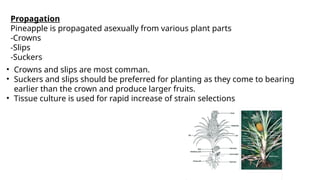
‱ Crowns and slips are most comman.
‱ Suckers and slips should be preferred for planting as they come to bearing
earlier than the crown and produce larger fruits.
‱ Tissue culture is used for rapid increase of strain selections
Propagation
Pineapple is propagated asexually from various plant parts
-Crowns
-Slips
-Suckers
Propagation crowns
‱ Crowns are currently the preferred planting materials which are cut from the
fruit at harvest
‱ Crowns are dipped in fungicide and planted soon after harvest
‱ Crowns grow more slowly and are less drought resistant than slips but may
have the potential to develop better root system
Propagation slip
Slips develop from buds in the axils of leaves borne on the peduncle
Slips become visible on the peduncle when the fruit is about half
developed
Slips are broken from the peduncle, then cured or dipped in fungicide
Slips may be stored in a dry place for up to one year, but they should be
planted within one month of harvest for best results
‱ Slips of 350-450g are considered suitable as planting material
‱ Suckers weighing 400-500g considered suitable as planting
material.
‱ Prior to planting curing of suckers for 8-10 days in shade is
necessary as fresh suckers planted in moist soil begin to
decay.
‱ Planting material should be treated with Carbendazim (0.1%)
solution to protect against mealy bugs and heart rot
‱ For Coorg (Karnataka) and Jorhat (Assam) sockers 501-750g
are ideal planting
‱ Suckers weighing 501-1000g is the best material for Thrissur
(Kerala)
Propagation suckers
Pineapple is generally planted in double hedge system for better intercultural
operations
A spacing of about 90 cm x 30 cm x 60 cm is recommended for a planting density of
44,000 plants per hectare.
The other spacing adopted are 120cm x 60 cm x 40cm for 41,600 plants/ha
75cm x 30cm x 30xm for 63,000 plantsha
Planning
The planting method varies depending upon the topography of land,
rainfall and drainage
‱ There are five planting methods in practice, viz

‱ Raised bed or ridge (in paddy lands, poorly drained soils or high rainfall
areas).
‱ Flatbed (in soils with assured drainage)
‱ Furrow (in areas with good drainage or poor rainfall)
‱ Trench (in rainfed areas with water scarcity)
‱ Contour planting (in hilly areas or sloppy lands).
‱ Suckers are planted at 90 cm width in rows/ strips, leaving the
interspaces undisturbed Planting is done in paired rows of 70 cm
distance between rows and 30 cm within the
‱ Suckers may be planted in triangular method in the paired rows
‱ Interspace hetween the paired rows is kept at 150-170 cm
‱ Contour planting may be adopted in sloppy areas.
High-density planting
Indian Institute of Horticultural Research in Bangalore
Two row trench system-Spacing of 22.5cm x 60cm x 75cm was found
best for a plant density of 63,000 plants per ha in semi-arid moderate
tropical regions
Spacing of 25cm x 60cm x 90cm with plant density of 53000 plants per
ha is ideal for hot, humid tropical areas
‱ Yield also increased upto almost 70-105 tha, which was 45-85 tha
more than the conventional planting densities
Manuring & fertilizer
Pincapple is a shallow feeder with high N and K. requirement.
FYM 40-50 t/ha, N 16 g. P4 g and K 12 g/plant in two equal splits at 6th
and 12th
month after planting
‱ Apply as foliar spray 0.5% 1.0% sulphate of Zinc and Ferrous solutions at 15
days interval to overcome the deficiencies in the carly crop phase
Removal of suckers, slips and crowns
Suckers start growing with the emergence of inflorescence, whereas slips
grow with the developing fruits
Fruit weight increases with increasing number of suckers/plant, while the
increased number of slips delay fruit maturity
Hence desuckering can be delayed as much as possible, while the slips
are recommended to be removed as soon as they attain the size required
for planting
Removal of crown is not required as it mars the appeal of the fruit and
also makes handling difficult
‱ Partial pinching of crown consisting of the removal of the innermost
whorl of leaflets along with growing tips 45 days after fruit set is ideal
to get fruits of better size and shape
Mulching
It is essential to conserve soil moisture
Mulching is not a common practice in India, use of dry leaves or straw is in
practice in south India
‱ Mulching with black polythene and saw-dust results in better growth of
plants than white polythene and paddy-straw.
Earthing
up
This is an essential operation in pineapple cultivation aimed at good
anchorage to the plants.
As its roots are very shallow, the plants are eventually lodged especially under
flat- bed planting in heavy rainfall areas.
Lodging of plants at the time of fruit development results in lopsided growth,
uneven development and ripening of fruits.
It is more important in ratoon crop as the base of ratoon plants shifts up, crop
after crop.
‱ High-density planting minimizes its necessity as the plants prop each other
preventing lodging.
Physiological disorder
Multiple Crowns
Ordinarily fruit bears a single crown but in some cases fruit bears more
than one. Consequently the top of the fruit will be flat and brood and
fruit will be unfit for canning
‱ Such fruits taste insipid and are corky. It is supposed to be a heritable
character (found mostly in Cayenne group to which the variety Kew
belongs).
Fruit & crown fascination
Fasciated fruits are deformed to such an extent that they are totally
useless
In certain cases, proliferation is so extreme that fruit is highly flattened
and twisted with innumerable crowns.
Fruit and crown fasciation is associated with high vigour of plants, which
take longer time to flower
‱ High fertility of soil, warm weather and calcium or zinc deficiency may
Harvesting
Fruits can be harvested from 18 to 24 months after planting
Slight colour change at the base of the fruit indicates maturity
Pineapple plants flower 10-12 months after planting and fruits become
ready 15-18 months after planting
Irregular flowering results in the harvesting spread over a long period.
Under natural conditions, pineapple comes to harvest during May-
August
‱ Fruits which mature in winter are acidic
Grading
After harvesting, the fruits are graded according to size, shape,
maturity, and freedom from diseases and blemishes
‱ Cut surface is treated with a suitable fungicide to control fungal
decay
Yields
Yield of pincapple fruit varies with the variety, agroclimate, agrotechniques
and planting density
An average of 50 t/ha can be harvested from well-maintained pineapple
orchard
One plant crop and twe ratoon crops normally practiced in most of varieties
and in Mauritius variety up to five crops can be taken
Plant crop after harvest can be retained as ratoon crop for two more years
Suckers retained should be limited to one or two per mother plant
Excesa suckers and slips if any should be removed
Earthing up should be done
‱ Other management practices are same as for the plant crop.
Packing
For local markets, fruits are packed in bamboo baskets lined with paddy-
straw
First layer of fraits is arranged in such a way that they stand on their stumps
Second layer of fruits is arranged on the crowns of the first layer fruits
Each basket weighs 20-25 kg
For distant markets, fruit are wrapped individually with paddy straw and then
packed
For export purpose the pineapples are packed into fibreboard or wood
containers
Interspace between the fruits should be filled with straw and firm lining all
around the container
‱ For long-distance transportation, fruits are held at 7°C for 10-20 days
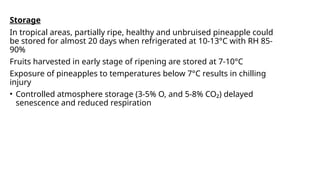
Storage
In tropical areas, partially ripe, healthy and unbruised pineapple could
be stored for almost 20 days when refrigerated at 10-13°C with RH 85-
90%
Fruits harvested in early stage of ripening are stored at 7-10°C
Exposure of pineapples to temperatures below 7°C results in chilling
injury
‱ Controlled atmosphere storage (3-5% O, and 5-8% CO₂) delayed
senescence and reduced respiration

Production Technology of Pineapple.......

  • 1.
    ‱ Common name:Pineapple Scientific name:Ananas comosus ‱ Family :Bromeliacea ‱ Origin : South America ‱ Chromosome No : 2-2x-50 ‱ Name: K.MAGESHWARMAN ‱ ID No : 22164111 ‱ Course code and title: 22CHOR45 Production technology of Fruits and Plantation Crops 2(1+1) ‱ Course Teacher: Dr. M. Kumeresan Production Technology of Pineapple
  • 2.
    Introduction Pineapple is herbaceousperennial, 90 to 100 cm in height with spreading leaves which gives the plant a rosette appearance. ‱ Plant bears a single fruit terminally on a peduncle. ‱ Good source of vitamins A and 8. pineapple is fairly rich in vitamins C, calcium, magnesium, potassium and iron. ‱ Average acid range lies between 0.5 and 1.0% and Total Soluble Solids (TSS) between 12 and 16” Brix. ‱ It is also a source of bromelin, a digestive enzyme. ‱ At present pineapple grown commercially in Assam, Meghalaya, Tripura. Mizoram, West Bengal, Kerala, Karnataka and Gon, and on a small scale in Gujarat, Maharashtra, Tamil Nadu, Andhra Pradesh, Orissa, Bihar and Uttar Pradesh.
  • 3.
    Origin and distribution ‱Origin of pineapple has been traced to Brazil. ‱ production started by 15 century. ‱ Pineapple was distributed in Europe and the tropical regions of the world. ‱ Most spread variety is Smooth Cayenne. Climate Pineapple is a crop of humid tropics. Fruit grows well near the sea coast. Optimum temperature for successful cultivation is 22°-32°C. High temperature at night is deleterious and a difference of at least 4°C between day and night temperatures is desirabic. It can be grown up to 1,100m above mean sea-level, if the area is frost-free. ‱ Although optimum annual rainfall for its commercial cultivation is 100- 150cm, it grows remarkably well under a wide range of rainfall.
  • 4.
    Soil Plants come upwell in any type of soil except on very heavy clay soil. Sandy loam soils are ideal. Soil should be 45-60cm in depth without hard pan or stones. Low-lying areas with high water table should be avoided. ‱ Plants prefer a soil pH of 5.0-6.0. Species Ananas was considered the only gmus including many cultivars but later, two genera viz. Ananas and Pseudnananas Ananas bears a terminal crown and produces slips but no stalons Pseudoanatus produces clongated stolens and no crown or slips Ananas is diploid having chromosome number 2n -2x-50 and Psesadounanas is tetraploid with Zu4x-100 ‱ Current classification is given below:
  • 5.
    Ananas comosus var,ananassoides Ananas comoxas var. comosus ‱ Amanas comosus vat, erectifolius ‱ Ananas comosus var. bracteatus ‱ Ananas macrodontes ‱ Ananas commosus var. puguazensis 5 groups of pineapple varieties 1. Spanish Group ‱ Shape of the fruit is globose and have large deep set eyes with fruit ranging from 0.9-1.8 kg weight. ‱ Leaves are spiny and the color of the rind is deep reddish-orange while the flesh is pale-yellow to white ‱ ‱ Fruit have a spicy-acid taste and fibrous texture.
  • 6.
    2.Queen Group Grown mainlyfor table purpose Fruit shape is conical with deep eyes and weigh around 0.5-1.1 kg ‱ They have yellow rind and the flesh is deep yellow in color 3. Cayenne Group Suitable for canning, fruits have flat eyes and cylindrical in shape Rind is dark-orange in color and flesh is pale-yellow to yellow in color Fruits are sweet with low fiber content ‱ Fruit weighs around 2.3 kg on average 4. Abacaxi Group Mostly grown in Brazil for domestic consumption Fruits are conical shape and weighs 14 kg ‱ They have yellow rind and pale yellow or white flesh which is sweet and juicy
  • 7.
    Varieties In international trade,the numerous pineapple (Ananas comosus) cultivars are grouped in four main classes. 1. Smooth Cayenne 2. Red Spanish 3. Queen 4. Abacaxi Kew, Mauritius and Queen are the commercially cultivated pineapple varieties in Tamil Nadu. Smooth Cayenne or Cayenne (Maipuri, Kew, Sarawak. Esmeralda, Saint Michel) Smooth Cayenne is extensively cultivated in Hawaii, Philippines, Australia, South Africa, Kenya, Mexico. Ovoid medium-sized fruit (1.5 to 2.5 kg) of short and strong peduncle. It ripens progressively, turning yellow from the base to the top. ‱ Flesh is pale-yellow to yellow colour at maturity.
  • 8.
    Smooth Cayenne orCayenne (Maipuri, Kew, Sarawak, Esmeralda, Claire, Typhoon, Saint Michel) Production cycle is longer than for most other cultivars Sensitive to many known pests (fruit borers, mites, mealybug, nematodes) and diseases (wilt, fruitlet core rot, bud rot), and to internal browning ‱ However, it is considered tolerant to Phytophthora sp. And resistant to fruit collapse, caused by Erwinia chrysanthemi Kew It is a leading commercial variety valued particularly for canning Its fruits are big-sized (1.5-2.5kg), oblong Fruit with broad and shallow eyes becomes yellow when fully ripe ‱ Flesh is light yellow, almost fibreless and very juicy
  • 9.
    ‱ Crowns andslips are most comman. ‱ Suckers and slips should be preferred for planting as they come to bearing earlier than the crown and produce larger fruits. ‱ Tissue culture is used for rapid increase of strain selections Propagation Pineapple is propagated asexually from various plant parts -Crowns -Slips -Suckers
  • 10.
    Propagation crowns ‱ Crownsare currently the preferred planting materials which are cut from the fruit at harvest ‱ Crowns are dipped in fungicide and planted soon after harvest ‱ Crowns grow more slowly and are less drought resistant than slips but may have the potential to develop better root system Propagation slip Slips develop from buds in the axils of leaves borne on the peduncle Slips become visible on the peduncle when the fruit is about half developed Slips are broken from the peduncle, then cured or dipped in fungicide Slips may be stored in a dry place for up to one year, but they should be planted within one month of harvest for best results ‱ Slips of 350-450g are considered suitable as planting material
  • 11.
    ‱ Suckers weighing400-500g considered suitable as planting material. ‱ Prior to planting curing of suckers for 8-10 days in shade is necessary as fresh suckers planted in moist soil begin to decay. ‱ Planting material should be treated with Carbendazim (0.1%) solution to protect against mealy bugs and heart rot ‱ For Coorg (Karnataka) and Jorhat (Assam) sockers 501-750g are ideal planting ‱ Suckers weighing 501-1000g is the best material for Thrissur (Kerala) Propagation suckers Pineapple is generally planted in double hedge system for better intercultural operations A spacing of about 90 cm x 30 cm x 60 cm is recommended for a planting density of 44,000 plants per hectare. The other spacing adopted are 120cm x 60 cm x 40cm for 41,600 plants/ha 75cm x 30cm x 30xm for 63,000 plantsha Planning
  • 12.
    The planting methodvaries depending upon the topography of land, rainfall and drainage ‱ There are five planting methods in practice, viz
 ‱ Raised bed or ridge (in paddy lands, poorly drained soils or high rainfall areas). ‱ Flatbed (in soils with assured drainage) ‱ Furrow (in areas with good drainage or poor rainfall) ‱ Trench (in rainfed areas with water scarcity) ‱ Contour planting (in hilly areas or sloppy lands). ‱ Suckers are planted at 90 cm width in rows/ strips, leaving the interspaces undisturbed Planting is done in paired rows of 70 cm distance between rows and 30 cm within the ‱ Suckers may be planted in triangular method in the paired rows ‱ Interspace hetween the paired rows is kept at 150-170 cm ‱ Contour planting may be adopted in sloppy areas.
  • 13.
    High-density planting Indian Instituteof Horticultural Research in Bangalore Two row trench system-Spacing of 22.5cm x 60cm x 75cm was found best for a plant density of 63,000 plants per ha in semi-arid moderate tropical regions Spacing of 25cm x 60cm x 90cm with plant density of 53000 plants per ha is ideal for hot, humid tropical areas ‱ Yield also increased upto almost 70-105 tha, which was 45-85 tha more than the conventional planting densities Manuring & fertilizer Pincapple is a shallow feeder with high N and K. requirement. FYM 40-50 t/ha, N 16 g. P4 g and K 12 g/plant in two equal splits at 6th and 12th month after planting ‱ Apply as foliar spray 0.5% 1.0% sulphate of Zinc and Ferrous solutions at 15 days interval to overcome the deficiencies in the carly crop phase
  • 14.
    Removal of suckers,slips and crowns Suckers start growing with the emergence of inflorescence, whereas slips grow with the developing fruits Fruit weight increases with increasing number of suckers/plant, while the increased number of slips delay fruit maturity Hence desuckering can be delayed as much as possible, while the slips are recommended to be removed as soon as they attain the size required for planting Removal of crown is not required as it mars the appeal of the fruit and also makes handling difficult ‱ Partial pinching of crown consisting of the removal of the innermost whorl of leaflets along with growing tips 45 days after fruit set is ideal to get fruits of better size and shape
  • 15.
    Mulching It is essentialto conserve soil moisture Mulching is not a common practice in India, use of dry leaves or straw is in practice in south India ‱ Mulching with black polythene and saw-dust results in better growth of plants than white polythene and paddy-straw. Earthing up This is an essential operation in pineapple cultivation aimed at good anchorage to the plants. As its roots are very shallow, the plants are eventually lodged especially under flat- bed planting in heavy rainfall areas. Lodging of plants at the time of fruit development results in lopsided growth, uneven development and ripening of fruits. It is more important in ratoon crop as the base of ratoon plants shifts up, crop after crop. ‱ High-density planting minimizes its necessity as the plants prop each other preventing lodging.
  • 16.
    Physiological disorder Multiple Crowns Ordinarilyfruit bears a single crown but in some cases fruit bears more than one. Consequently the top of the fruit will be flat and brood and fruit will be unfit for canning ‱ Such fruits taste insipid and are corky. It is supposed to be a heritable character (found mostly in Cayenne group to which the variety Kew belongs). Fruit & crown fascination Fasciated fruits are deformed to such an extent that they are totally useless In certain cases, proliferation is so extreme that fruit is highly flattened and twisted with innumerable crowns. Fruit and crown fasciation is associated with high vigour of plants, which take longer time to flower ‱ High fertility of soil, warm weather and calcium or zinc deficiency may
  • 17.
    Harvesting Fruits can beharvested from 18 to 24 months after planting Slight colour change at the base of the fruit indicates maturity Pineapple plants flower 10-12 months after planting and fruits become ready 15-18 months after planting Irregular flowering results in the harvesting spread over a long period. Under natural conditions, pineapple comes to harvest during May- August ‱ Fruits which mature in winter are acidic Grading After harvesting, the fruits are graded according to size, shape, maturity, and freedom from diseases and blemishes ‱ Cut surface is treated with a suitable fungicide to control fungal decay
  • 18.
    Yields Yield of pincapplefruit varies with the variety, agroclimate, agrotechniques and planting density An average of 50 t/ha can be harvested from well-maintained pineapple orchard One plant crop and twe ratoon crops normally practiced in most of varieties and in Mauritius variety up to five crops can be taken Plant crop after harvest can be retained as ratoon crop for two more years Suckers retained should be limited to one or two per mother plant Excesa suckers and slips if any should be removed Earthing up should be done ‱ Other management practices are same as for the plant crop.
  • 19.
    Packing For local markets,fruits are packed in bamboo baskets lined with paddy- straw First layer of fraits is arranged in such a way that they stand on their stumps Second layer of fruits is arranged on the crowns of the first layer fruits Each basket weighs 20-25 kg For distant markets, fruit are wrapped individually with paddy straw and then packed For export purpose the pineapples are packed into fibreboard or wood containers Interspace between the fruits should be filled with straw and firm lining all around the container ‱ For long-distance transportation, fruits are held at 7°C for 10-20 days
  • 20.
    Storage In tropical areas,partially ripe, healthy and unbruised pineapple could be stored for almost 20 days when refrigerated at 10-13°C with RH 85- 90% Fruits harvested in early stage of ripening are stored at 7-10°C Exposure of pineapples to temperatures below 7°C results in chilling injury ‱ Controlled atmosphere storage (3-5% O, and 5-8% CO₂) delayed senescence and reduced respiration