Cultivation Practice of Pineapple
Prepared by
Umesh Timilsina
Assistant Professor
CNRM, Bardibas, AFU
Pineapple
Scientific name: Ananas comosus/ A. sativus
Family: Bromeliaceae
Edible part: Rachis/peduncle, perianth, bracts
Fruit type: Sorosis
Chromosome no: 2n= 28/30
• It is a perennial monocarpic herb (each stem flowers only
once and dies after fruiting, zerophytic plant with thick,
long sessile and spiny leaves.
• Multiple fruit called synocarp is a parthenocarpic fruit.
• It is given the name pineapple because of it resemble the
shape of pine cone.
• Pineapple is considered
as one of the most
popular tropical fruit, and
is known as “Golden
Queen” all over the
globe.
• Pineapple can be grown
in fallow, sloppy and
marginal land and
contributes in soil
conservation and fulfill
the requirement of
nutrients to human and
generate income to
households.
Composition and uses
• Pineapple has been described as an excellent source of
vitamin C and also good source of vitamin A and B, Sugar
13%, Acidity-0.6-1.0%mineral matter-0.05%, Fiber, 0.3%, Ca,
Fe, P.
• The fruit contains a protein digestive enzyme Bromelin.
• Fruits are relished as dessert in the form of slices either fresh
or canned, preparation of juice, squash and jam and mixed
jam.
• Fruits are used in preparation of alcohol, vinegar, calcium
citrate, citric acid, gum and pineapple flavors.
• The leaves yield silky fiber which is used for making a fine
fabric known as Pina cloth in Philippines and Taiwan.
• The pineapple plants and the fruit residues after extraction of
juice are used as cattle feed.
Origin and distribution
• It is believed to have originated in South America,
especially the Brazil-Paraguay region from where
it spread to other tropical parts of the world.
• The major pineapple growing countries are Tropical
America, Mexico, Malaysia, Kenya, Taiwan,
Australia, Srilanka, Singapore and India.
Climate and Soil
• Pineapple can be grown successfully from seacoast to an
altitude of about 1500m above sea level.
• The optimum temperature is from 21⁰C-24⁰C.
• It can be grown in areas with a temperature range of 22⁰C-
32⁰C with optimum rainfall ranges from 100-150cm.
• The higher temperature is beneficial for fruit development,
low temperature is harmful and does not improve colour of
fruits.
• The fruits grow well in sandy loam soil.
• Fruit size is larger on the heavier soil but flavor of he fruit is
better when grown on lighter soil.
• It prefers soils which are acidic (pH 4.5-5.5).
• While high Mg and Mn content are injurious to the crop.
Species and varieties:
• Smith (1979) established two genera, Ananas and
Pseudananas.
• Pseudananas at maturity bears a minute
inconspicuous coma of bracts and plants produce
elongated stolons and no slips, where as Ananas
bears conspicuous coma of foliaceous bracts and
plant produce slips but not stolons and fruits remains
seedless.
• The genus Ananas has 8 species viz.,
1. Ananas comosus: The cultivated species with large
fruits and a short thick spike.
2. A monstrosus: Crownless- There is no leaf formation
on fruit.
3. A bracteatus: has well developed, bright red flower
bracts. Fruit is edible and relatively large.
4. A Fruitzmuelleri: It bears pale green, developed
bracts.
5. A ananassoides: With small fruits, erect leaves and a
long fairly thin spike.
6. A nanus: A dwarf species.
7. A parguazensis: with curved leaves.
8. A lucidus: It has smooth (Spineless) leaves from which
good quality fibre can be obtained.
Varieties
• The varieties have been classified in to
5 groups.
1. Spanish group:
Fruits are of 1-2 kg in weight, globose in
shape, fibrous, sub acid, spiny, resistant
to mealy bugs. Eg: Mauritius, Red
Spanish, Singapore, Spanish, Green
Selangor, Castilla, P.R.1- 67.
2. Queen Group:
• Conical fruits, spiny, deep eyes, low in
fiber 0-5-1.1kg, sweet with yellow
flesh. Eg: Queen, Ripley Queen,
McGregor, Natal, and Alexandria.
• Queen is famous in Nepal as an
excellent table variety.
3. Cayenne group:
• Cylindrical fruits with mild acidic,
yellow (Spiny tip) 2-3 kg. Flesh
sweet, suitable for sweet canning,
low fibre.
• Eg: cayenne, Baron, Rothschild,
Smooth Guatemalan, Kew, Giant
Kew and Typhone.
4. Abacaxi group:
• Concal fruits, pale yellow- white
flesh, spiny 1.4 kg sweet tender
and juicy grown in Brazil.
• Eg: perola, Abakka, Sugar loaf,
Papelon, Venezolana, Amarella.
5. Maipure Group:
• Fruits ovoid to cylindrical, sweeter, fibrous 1-2.5kg
with yellow flesh, very juicy.
• Eg: Maipure, Bumuguesa, Rondon, Perolera, monte
lirio.
Different stage of Pineapple growth
Propagation
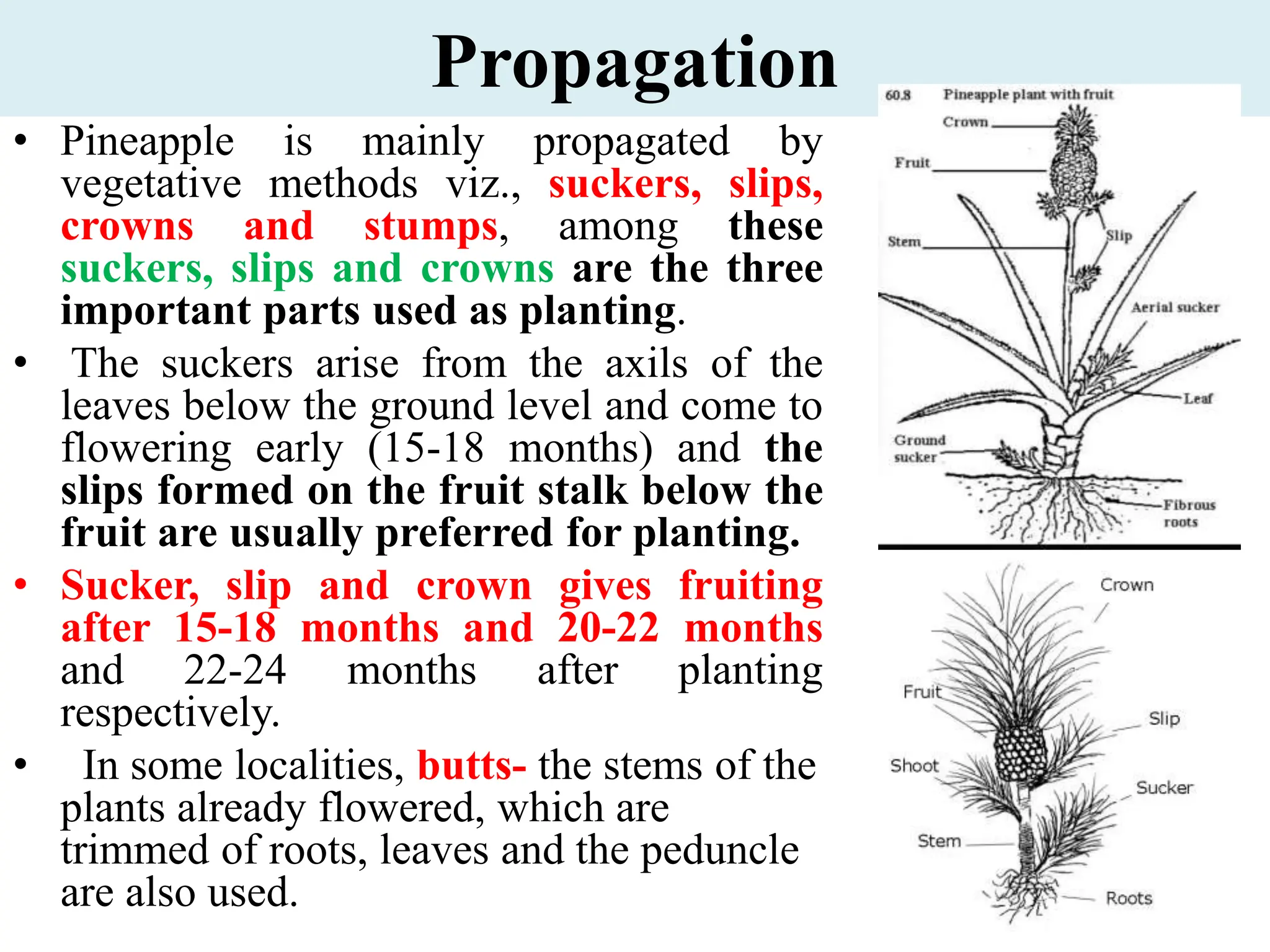
• Pineapple is mainly propagated by
vegetative methods viz., suckers, slips,
crowns and stumps, among these
suckers, slips and crowns are the three
important parts used as planting.
• The suckers arise from the axils of the
leaves below the ground level and come to
flowering early (15-18 months) and the
slips formed on the fruit stalk below the
fruit are usually preferred for planting.
• Sucker, slip and crown gives fruiting
after 15-18 months and 20-22 months
and 22-24 months after planting
respectively.
• In some localities, butts- the stems of the
plants already flowered, which are
trimmed of roots, leaves and the peduncle
are also used.
• About 250-500 gm of suckers 250-450g slips and 40-45cm crowns
are selected for planting.
• The planting materials should be treated with mercurial fungicide.
• The planting materials should not be stored more than 14 days.
• Suckers production can be enhanced by giving additional
Nitrogenous fertilizers and more water.
• In recent years micro propagated plants are also available.
Planting
• Planting is done during kharif
season, before planting suckers or
slips should be sun-cured, dry
leaves and scales at the base should
be removed basal end of planting
materials should be dipped in 0.4
% difolton and 0.05% ekalux to
avoid fungal & mealy bugs
infestation.
• The suckers or slips are planted in
10-15cm deep holes, while
planting, the growing part should
not be buried.
• Planting may be done in single or
double row systems.
• In single row system,
the row are spaced 150
cm and plant spaced
60cm with in a row in
which we can
accommodate about
11000plants/ha.
• In double row system
which is considered best
for pineapple
cultivation.
• The spacing of
(30x60x90cm) between
plants rows and beds
respectively which can
accommodates 43,500
plants/ha.
Planting Season
• Early Monsoom
• July – September
Manures and Fertilizers:
• FYM is applied 40-50 t/ha.
• 16 g N, 4 g P and 12 g K/plant in two equal splits
at 6th and 12th month after planting.
• Apply as foliar spray 0.5%-1.0% Zinc sulphate and
Ferrous solutions at 15 days interval to overcome
the deficiencies in the early crop phase.
Irrigation
• Pineapple is a rainfed crop, 4-6 irrigations may be
necessary during dry season at 20-25 days interval.
Weed control
• The Combination spray of Bromocil and Diuron
@ 2kg a.i/ha as pre-emergence herbicides can
control weeds efficiently.
Flowering and fruiting
• A pineapple plant generally attains flowering stage 11-12 months after
planting by which time the plant should have produced at least 40
leaves.
• Irregular flowering behavior is one of its major drawback.
• Flowering is not uniform in pineapple.
• To induce good and uniform flowering (synchronization of
flowering) the following measures are to be taken:
 The main products to induce flowering are NAA and ethrel.
 Spraying of NAA@20 ppm (Planofix), ethephon (200 ppm) and
CaC2 (2%).
 Pouring of 50 ml solution in to the center (heart) of plant to induce
uniform flowering, increases fruit size and fruits all the year.
 Also, ethrel at 25ppm combining with Urea (2%) and sodium
carbonate (0.04%) applied at 30-40 leaf stage to induce uniform
flowering.
 Ethylene induces 90-100% of flowering and CaC2 induces 60-66%
flowering in pineapple
 Application of NAA@200ppm enhanced the fruit weight.
NAA induces 60% flowering and 15-20 % large
size fruit.
These application has to be done, when the plants
have 35-40 functional leaves and applied on a clear
sunny days (one year old plants).
Increased no. of slips delay maturity of fruits so
they are recommended to remove as soon as
possible.
Desuckering may be not delayed as soon as possible
because fruit weight decreases with increase in
number of sucker per plant.
•
Earthing up
• Prone to lodging due to shallow root system
• Promotes good anchorage.
Mulching
• Weed control and soil moisture
conservation.
• Best for rainfed crop.
• Leaves or straw mulch.
• HDP requires less muching
Removal of suckers
• Only one or two suckers are retained for ratooning
Crop duration
18-24 months
Harvest:
• Being a non climacteric fruit, pine apple should be
harvested at full maturity.
• Fruits can be harvested from 18 to 24 months.
Maturity indices
• Slight colour change at the base of the fruit indicates
maturity.
• TSS= 8-16%
Yield: 40-50 t/ha
Plant Protection
• Major Pests
 Mealy bugs(Pseudococcus bromeli)
 Affects both leaves and fruits
 Spray Chloropyriphos 0.05%
 Destroy ant colonies to check the spread of
mealy bug
 Scale insects (Diapus bromeli)
 Leaves are affected
 Control is same to mealy bugs
 Major diseases
• Black-rot or soft-rot
• Heart-rot (Phytopthora parasitica)
• Leaf and fruit-rot (Cryatostomella paradoxa )
• Leaf spot (Phytopthora sp.)
• Thielaviopsis rot (Thielaviopsis paradoxa)
Heart rot Soft rot
Leaf spot Leaf rot
Major physiological disorders
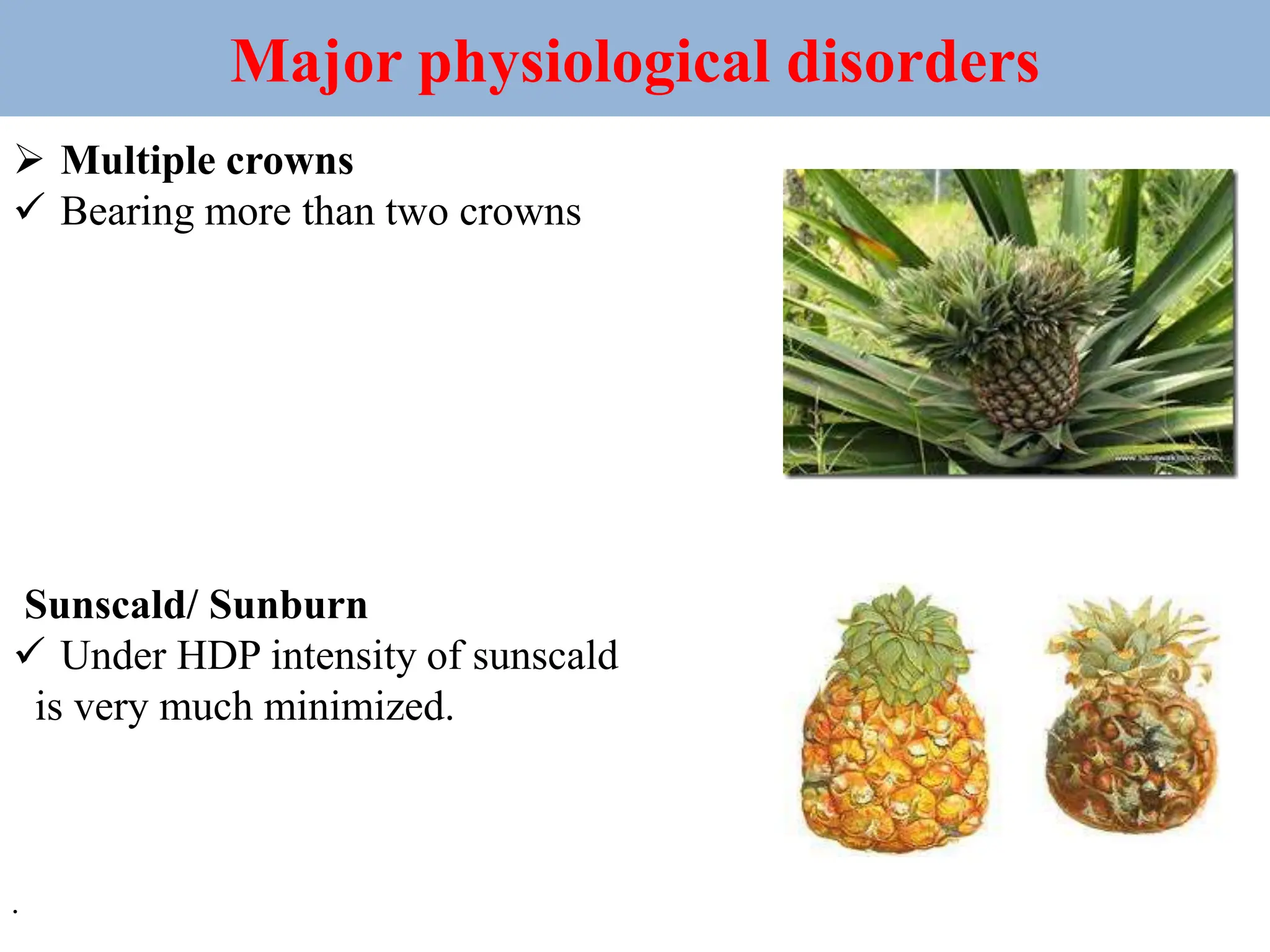
 Multiple crowns
 Bearing more than two crowns
Sunscald/ Sunburn
 Under HDP intensity of sunscald
is very much minimized.
•
 Collar of slips
 High N fertilization and rainfall
 Fruit and Crown fasciation
 High fertility of soil, warm weather
and Ca and Zn deficiency
Thank you for your kind
attention
Any queries

Cultivation practice of Pineapple in Nepal .pptx

  • 1.
    Cultivation Practice ofPineapple Prepared by Umesh Timilsina Assistant Professor CNRM, Bardibas, AFU
  • 2.
    Pineapple Scientific name: Ananascomosus/ A. sativus Family: Bromeliaceae Edible part: Rachis/peduncle, perianth, bracts Fruit type: Sorosis Chromosome no: 2n= 28/30 • It is a perennial monocarpic herb (each stem flowers only once and dies after fruiting, zerophytic plant with thick, long sessile and spiny leaves. • Multiple fruit called synocarp is a parthenocarpic fruit. • It is given the name pineapple because of it resemble the shape of pine cone.
  • 3.
    • Pineapple isconsidered as one of the most popular tropical fruit, and is known as “Golden Queen” all over the globe. • Pineapple can be grown in fallow, sloppy and marginal land and contributes in soil conservation and fulfill the requirement of nutrients to human and generate income to households.
  • 4.
    Composition and uses •Pineapple has been described as an excellent source of vitamin C and also good source of vitamin A and B, Sugar 13%, Acidity-0.6-1.0%mineral matter-0.05%, Fiber, 0.3%, Ca, Fe, P. • The fruit contains a protein digestive enzyme Bromelin. • Fruits are relished as dessert in the form of slices either fresh or canned, preparation of juice, squash and jam and mixed jam. • Fruits are used in preparation of alcohol, vinegar, calcium citrate, citric acid, gum and pineapple flavors. • The leaves yield silky fiber which is used for making a fine fabric known as Pina cloth in Philippines and Taiwan. • The pineapple plants and the fruit residues after extraction of juice are used as cattle feed.
  • 7.
    Origin and distribution •It is believed to have originated in South America, especially the Brazil-Paraguay region from where it spread to other tropical parts of the world. • The major pineapple growing countries are Tropical America, Mexico, Malaysia, Kenya, Taiwan, Australia, Srilanka, Singapore and India.
  • 10.
    Climate and Soil •Pineapple can be grown successfully from seacoast to an altitude of about 1500m above sea level. • The optimum temperature is from 21⁰C-24⁰C. • It can be grown in areas with a temperature range of 22⁰C- 32⁰C with optimum rainfall ranges from 100-150cm. • The higher temperature is beneficial for fruit development, low temperature is harmful and does not improve colour of fruits. • The fruits grow well in sandy loam soil. • Fruit size is larger on the heavier soil but flavor of he fruit is better when grown on lighter soil. • It prefers soils which are acidic (pH 4.5-5.5). • While high Mg and Mn content are injurious to the crop.
  • 11.
    Species and varieties: •Smith (1979) established two genera, Ananas and Pseudananas. • Pseudananas at maturity bears a minute inconspicuous coma of bracts and plants produce elongated stolons and no slips, where as Ananas bears conspicuous coma of foliaceous bracts and plant produce slips but not stolons and fruits remains seedless. • The genus Ananas has 8 species viz.,
  • 12.
    1. Ananas comosus:The cultivated species with large fruits and a short thick spike. 2. A monstrosus: Crownless- There is no leaf formation on fruit. 3. A bracteatus: has well developed, bright red flower bracts. Fruit is edible and relatively large. 4. A Fruitzmuelleri: It bears pale green, developed bracts. 5. A ananassoides: With small fruits, erect leaves and a long fairly thin spike. 6. A nanus: A dwarf species. 7. A parguazensis: with curved leaves. 8. A lucidus: It has smooth (Spineless) leaves from which good quality fibre can be obtained.
  • 15.
    Varieties • The varietieshave been classified in to 5 groups. 1. Spanish group: Fruits are of 1-2 kg in weight, globose in shape, fibrous, sub acid, spiny, resistant to mealy bugs. Eg: Mauritius, Red Spanish, Singapore, Spanish, Green Selangor, Castilla, P.R.1- 67. 2. Queen Group: • Conical fruits, spiny, deep eyes, low in fiber 0-5-1.1kg, sweet with yellow flesh. Eg: Queen, Ripley Queen, McGregor, Natal, and Alexandria. • Queen is famous in Nepal as an excellent table variety.
  • 16.
    3. Cayenne group: •Cylindrical fruits with mild acidic, yellow (Spiny tip) 2-3 kg. Flesh sweet, suitable for sweet canning, low fibre. • Eg: cayenne, Baron, Rothschild, Smooth Guatemalan, Kew, Giant Kew and Typhone. 4. Abacaxi group: • Concal fruits, pale yellow- white flesh, spiny 1.4 kg sweet tender and juicy grown in Brazil. • Eg: perola, Abakka, Sugar loaf, Papelon, Venezolana, Amarella.
  • 18.
    5. Maipure Group: •Fruits ovoid to cylindrical, sweeter, fibrous 1-2.5kg with yellow flesh, very juicy. • Eg: Maipure, Bumuguesa, Rondon, Perolera, monte lirio.
  • 19.
    Different stage ofPineapple growth
  • 20.
    Propagation • Pineapple ismainly propagated by vegetative methods viz., suckers, slips, crowns and stumps, among these suckers, slips and crowns are the three important parts used as planting. • The suckers arise from the axils of the leaves below the ground level and come to flowering early (15-18 months) and the slips formed on the fruit stalk below the fruit are usually preferred for planting. • Sucker, slip and crown gives fruiting after 15-18 months and 20-22 months and 22-24 months after planting respectively. • In some localities, butts- the stems of the plants already flowered, which are trimmed of roots, leaves and the peduncle are also used.
  • 21.
    • About 250-500gm of suckers 250-450g slips and 40-45cm crowns are selected for planting. • The planting materials should be treated with mercurial fungicide. • The planting materials should not be stored more than 14 days. • Suckers production can be enhanced by giving additional Nitrogenous fertilizers and more water. • In recent years micro propagated plants are also available.
  • 22.
    Planting • Planting isdone during kharif season, before planting suckers or slips should be sun-cured, dry leaves and scales at the base should be removed basal end of planting materials should be dipped in 0.4 % difolton and 0.05% ekalux to avoid fungal & mealy bugs infestation. • The suckers or slips are planted in 10-15cm deep holes, while planting, the growing part should not be buried. • Planting may be done in single or double row systems.
  • 23.
    • In singlerow system, the row are spaced 150 cm and plant spaced 60cm with in a row in which we can accommodate about 11000plants/ha. • In double row system which is considered best for pineapple cultivation. • The spacing of (30x60x90cm) between plants rows and beds respectively which can accommodates 43,500 plants/ha.
  • 24.
    Planting Season • EarlyMonsoom • July – September Manures and Fertilizers: • FYM is applied 40-50 t/ha. • 16 g N, 4 g P and 12 g K/plant in two equal splits at 6th and 12th month after planting. • Apply as foliar spray 0.5%-1.0% Zinc sulphate and Ferrous solutions at 15 days interval to overcome the deficiencies in the early crop phase.
  • 25.
    Irrigation • Pineapple isa rainfed crop, 4-6 irrigations may be necessary during dry season at 20-25 days interval. Weed control • The Combination spray of Bromocil and Diuron @ 2kg a.i/ha as pre-emergence herbicides can control weeds efficiently.
  • 26.
    Flowering and fruiting •A pineapple plant generally attains flowering stage 11-12 months after planting by which time the plant should have produced at least 40 leaves. • Irregular flowering behavior is one of its major drawback. • Flowering is not uniform in pineapple. • To induce good and uniform flowering (synchronization of flowering) the following measures are to be taken:  The main products to induce flowering are NAA and ethrel.  Spraying of NAA@20 ppm (Planofix), ethephon (200 ppm) and CaC2 (2%).  Pouring of 50 ml solution in to the center (heart) of plant to induce uniform flowering, increases fruit size and fruits all the year.  Also, ethrel at 25ppm combining with Urea (2%) and sodium carbonate (0.04%) applied at 30-40 leaf stage to induce uniform flowering.  Ethylene induces 90-100% of flowering and CaC2 induces 60-66% flowering in pineapple  Application of NAA@200ppm enhanced the fruit weight.
  • 27.
    NAA induces 60%flowering and 15-20 % large size fruit. These application has to be done, when the plants have 35-40 functional leaves and applied on a clear sunny days (one year old plants). Increased no. of slips delay maturity of fruits so they are recommended to remove as soon as possible. Desuckering may be not delayed as soon as possible because fruit weight decreases with increase in number of sucker per plant. •
  • 28.
    Earthing up • Proneto lodging due to shallow root system • Promotes good anchorage. Mulching • Weed control and soil moisture conservation. • Best for rainfed crop. • Leaves or straw mulch. • HDP requires less muching Removal of suckers • Only one or two suckers are retained for ratooning
  • 29.
    Crop duration 18-24 months Harvest: •Being a non climacteric fruit, pine apple should be harvested at full maturity. • Fruits can be harvested from 18 to 24 months. Maturity indices • Slight colour change at the base of the fruit indicates maturity. • TSS= 8-16% Yield: 40-50 t/ha
  • 31.
    Plant Protection • MajorPests  Mealy bugs(Pseudococcus bromeli)  Affects both leaves and fruits  Spray Chloropyriphos 0.05%  Destroy ant colonies to check the spread of mealy bug  Scale insects (Diapus bromeli)  Leaves are affected  Control is same to mealy bugs
  • 32.
     Major diseases •Black-rot or soft-rot • Heart-rot (Phytopthora parasitica) • Leaf and fruit-rot (Cryatostomella paradoxa ) • Leaf spot (Phytopthora sp.) • Thielaviopsis rot (Thielaviopsis paradoxa)
  • 33.
    Heart rot Softrot Leaf spot Leaf rot
  • 34.
    Major physiological disorders Multiple crowns  Bearing more than two crowns Sunscald/ Sunburn  Under HDP intensity of sunscald is very much minimized. •
  • 35.
     Collar ofslips  High N fertilization and rainfall  Fruit and Crown fasciation  High fertility of soil, warm weather and Ca and Zn deficiency
  • 36.
    Thank you foryour kind attention Any queries