
Introduction to
                                               Operations
                                              Management


McGraw-Hill/Irwin
                    Copyright © 2012 by The McGraw-Hill Companies, Inc. All rights reserved.
 You should be able to:
     l    Define the term operations management
     e    Identify the three major functional areas of organizations and describe
          how they interrelate
     l    Identify similarities and differences between production and service
          operations
     i    Describe the operations function and the nature of the operations
          manager’s job
     r    Summarize the two major aspects of process management
     o    Explain the key aspects of operations management decision making
     a    Briefly describe the historical evolution of operations management
          Characterize current trends in business that impact operations
          management


Student Slides                                                                      1-2
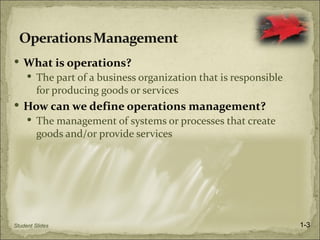
 What is operations?
      The part of a business organization that is responsible
         for producing goods or services
 How can we define operations management?
      The management of systems or processes that create
         goods and/or provide services


Student Slides                                                   1-3
Goods are physical items that include raw materials, parts,
   subassemblies, and final products.
       •Automobile
       •Computer
       •Oven
       •Shampoo

Services are activities that provide some combination of time, location,
form or psychological value.
    •Air travel
    •Education
    •Haircut
    •Legal counsel


Student Slides                                                             1-4
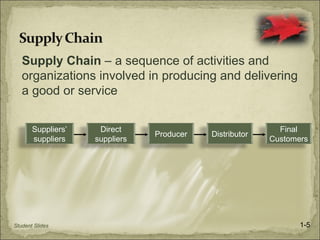
Supply Chain – a sequence of activities and
   organizations involved in producing and delivering
   a good or service


       Suppliers’    Direct                                Final
                                Producer   Distributor
       suppliers    suppliers                            Customers


Student Slides                                                  1-5
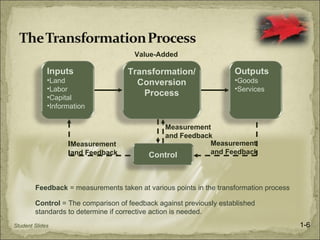
Value-Added

             Inputs                 Transformation/                 Outputs
             •Land                    Conversion                    •Goods
             •Labor                                                 •Services
             •Capital
                                        Process
             •Information


                                             Measurement
                                             and Feedback
                    Measurement                          Measurement
                    and Feedback          Control        and Feedback


        Feedback = measurements taken at various points in the transformation process

        Control = The comparison of feedback against previously established
        standards to determine if corrective action is needed.
Student Slides                                                                          1-6
1.     Degree of customer contact
2.     Uniformity of input
3.     Labor content of jobs
4.     Uniformity of output
5.     Measurement of productivity
6.     Production and delivery
7.     Quality assurance
8.     Amount of inventory
9.     Evaluation of work
10.    Ability to patent design

Student Slides                       1-7
The scope of operations management ranges across
  the organization.
The operations function includes many interrelated
activities such as:
        Forecasting
        Capacity planning
        Facilities and layout
        Scheduling
        Managing inventories
        Assuring quality
        Motivating employees
        Deciding where to locate facilities
        And more . . .

Student Slides                                       1-8
The Operations Function consists of all activities
directly related to producing goods or providing
services.

A primary function of the operations manager is to
guide the system by decision making.
    System Design Decisions
    System Operation Decisions


Student Slides                                       1-9
 Every aspect of business affects or is affected by operations
 Many service jobs are closely related to operations
    Financial services
    Marketing services
    Accounting services
    Information services
 There is a significant amount of interaction and
  collaboration amongst the functional areas
 It provides an excellent vehicle for understanding the world
  in which we live


Student Slides                                                    1-10
 Operations manager
 Supply chain manager
 Production analyst
 Schedule coordinator
 Production manager
 Industrial engineer
 Purchasing manager
 Inventory manager
 Quality manager


Student Slides           1-11
 Most operations decisions involve many alternatives that can
  have quite different impacts on costs or profits
 Typical operations decisions include:
      What: What resources are needed, and in what amounts?
      When: When will each resource be needed? When should the work be
         scheduled? When should materials and other supplies be ordered?
      Where: Where will the work be done?
      How: How will he product or service be designed? How will the work be
         done? How will resources be allocated?
      Who: Who will do the work?


Student Slides                                                                 1-12
 Industrial Revolution
 Scientific Management
 Human Relations Movement
 Decision Models and Management Science
 Influence of Japanese Manufacturers


Student Slides                             1-13
 Economic conditions
 Innovating
 Quality problems
 Risk management
 Competing in a global economy


Student Slides                    1-14
 In the past, organizations did little to manage the
   supply chain beyond their own operations and
   immediate suppliers which led to numerous problems:
      Oscillating inventory levels
      Inventory stockouts
      Late deliveries
      Quality problems


Student Slides                                           1-15

Chap001

  • 1.
    Introduction to Operations Management McGraw-Hill/Irwin Copyright © 2012 by The McGraw-Hill Companies, Inc. All rights reserved.
  • 2.
     You shouldbe able to: l Define the term operations management e Identify the three major functional areas of organizations and describe how they interrelate l Identify similarities and differences between production and service operations i Describe the operations function and the nature of the operations manager’s job r Summarize the two major aspects of process management o Explain the key aspects of operations management decision making a Briefly describe the historical evolution of operations management Characterize current trends in business that impact operations management Student Slides 1-2
  • 3.
     What isoperations?  The part of a business organization that is responsible for producing goods or services  How can we define operations management?  The management of systems or processes that create goods and/or provide services Student Slides 1-3
  • 4.
    Goods are physicalitems that include raw materials, parts, subassemblies, and final products. •Automobile •Computer •Oven •Shampoo Services are activities that provide some combination of time, location, form or psychological value. •Air travel •Education •Haircut •Legal counsel Student Slides 1-4
  • 5.
    Supply Chain –a sequence of activities and organizations involved in producing and delivering a good or service Suppliers’ Direct Final Producer Distributor suppliers suppliers Customers Student Slides 1-5
  • 6.
    Value-Added Inputs Transformation/ Outputs •Land Conversion •Goods •Labor •Services •Capital Process •Information Measurement and Feedback Measurement Measurement and Feedback Control and Feedback Feedback = measurements taken at various points in the transformation process Control = The comparison of feedback against previously established standards to determine if corrective action is needed. Student Slides 1-6
  • 7.
    1. Degree of customer contact 2. Uniformity of input 3. Labor content of jobs 4. Uniformity of output 5. Measurement of productivity 6. Production and delivery 7. Quality assurance 8. Amount of inventory 9. Evaluation of work 10. Ability to patent design Student Slides 1-7
  • 8.
    The scope ofoperations management ranges across the organization. The operations function includes many interrelated activities such as:  Forecasting  Capacity planning  Facilities and layout  Scheduling  Managing inventories  Assuring quality  Motivating employees  Deciding where to locate facilities  And more . . . Student Slides 1-8
  • 9.
    The Operations Functionconsists of all activities directly related to producing goods or providing services. A primary function of the operations manager is to guide the system by decision making.  System Design Decisions  System Operation Decisions Student Slides 1-9
  • 10.
     Every aspectof business affects or is affected by operations  Many service jobs are closely related to operations  Financial services  Marketing services  Accounting services  Information services  There is a significant amount of interaction and collaboration amongst the functional areas  It provides an excellent vehicle for understanding the world in which we live Student Slides 1-10
  • 11.
     Operations manager Supply chain manager  Production analyst  Schedule coordinator  Production manager  Industrial engineer  Purchasing manager  Inventory manager  Quality manager Student Slides 1-11
  • 12.
     Most operationsdecisions involve many alternatives that can have quite different impacts on costs or profits  Typical operations decisions include:  What: What resources are needed, and in what amounts?  When: When will each resource be needed? When should the work be scheduled? When should materials and other supplies be ordered?  Where: Where will the work be done?  How: How will he product or service be designed? How will the work be done? How will resources be allocated?  Who: Who will do the work? Student Slides 1-12
  • 13.
     Industrial Revolution Scientific Management  Human Relations Movement  Decision Models and Management Science  Influence of Japanese Manufacturers Student Slides 1-13
  • 14.
     Economic conditions Innovating  Quality problems  Risk management  Competing in a global economy Student Slides 1-14
  • 15.
     In thepast, organizations did little to manage the supply chain beyond their own operations and immediate suppliers which led to numerous problems:  Oscillating inventory levels  Inventory stockouts  Late deliveries  Quality problems Student Slides 1-15