Chapter 9
Product Planning and
    Development
        Sommers                        Barnes
             Ninth Canadian Edition


                      Presentation by
            Karen A. Blotnicky
Mount Saint Vincent University, Halifax, NS

       Copyright © 2001 by McGraw-Hill Ryerson Limited
Chapter Goals
To gain an understanding of:
• The meaning of total “product” and “new”
  product
• Classification of business and consumer products
  and its relevance to marketing planning
• Product innovation
• The product-development process
• When to add new products to a product line
• The adoption and diffusion process for products
• Organizational structures for product planning
  and development
               Copyright © 2001 McGraw-Hill Ryerson Limited

                                                              9-2
What is a Product?
• it is more than physical products; includes
  services, places, persons, and ideas
• it is easy to visualize the products of Esso, but
  more difficult to describe those of the Toronto
  Symphony, UNICEF, or the Salvation Army
• some products are sold only to consumers,
  while others are sold to organizations
• whether a product is a consumer product or a
  business product depends on how it is used

                 Copyright © 2001 McGraw-Hill Ryerson Limited

                                                                9-3
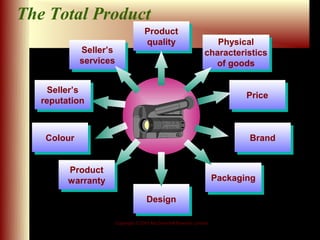
The Total Product
                                  Product
                                  Product
                                  quality
                                   quality                        Physical
                                                                   Physical
             Seller’s
              Seller’s                                         characteristics
                                                                characteristics
             services
              services                                            of goods
                                                                  of goods

     Seller’s
      Seller’s                                                            Price
                                                                          Price
   reputation
    reputation


    Colour
    Colour                                                                 Brand
                                                                           Brand


         Product
          Product
         warranty                                                   Packaging
                                                                    Packaging
         warranty
                                   Design
                                   Design

                     Copyright © 2001 McGraw-Hill Ryerson Limited

                                                                                9-4
Consumer Goods
Classes
Consumer products can be classified by the
  buying behaviour of the consumers:
• Convenience goods are bought with little time
  and effort, such as milk, bread, a chocolate bar.
• Shopping goods are those where extensive
  comparison is the norm-- cars, furniture,
  clothes.
• Specialty goods are those for which consumers
  have a strong brand preference. BMW, Armani.
• Unsought goods are those now unknown to the
  consumer or, if known, undesired.
               Copyright © 2001 McGraw-Hill Ryerson Limited

                                                              9-5
Classifying Business
Products
• raw materials: unprocessed, become part of
       materials
  other manufactured products
• manufactured parts and materials: processed
  products that become part of other products
• installations: major buildings and equipment
• accessory equipment: used in operations,
  include computers, desks, tools
• operating supplies: low value, used by most
             supplies
  firms, convenience products for businesses

               Copyright © 2001 McGraw-Hill Ryerson Limited

                                                              9-6
Innovation is
Required
• Products go through life cycles-- you need new
  ones coming on stream.
• Profits highest when products new.
• Consumers more selective: they look carefully
  at each purchase. Also a little jaded.
• High failure rates in the 75% range.
• Leads to new products:
   • Innovative= truly unique
   • Improved, with valuable new benefits
   • Imitative, another “me too” product.
               Copyright © 2001 McGraw-Hill Ryerson Limited

                                                              9-7
Ten World-Class
Product Failures
1. Ford’s Edsel automobile.
2. Dupont’s Corfam synthetic leather.
3. Polaroid’s Polavision.
4. United Artist’s Heaven’s Gate western movie.
5. RCA’s Videodisc.
6. Time’s TV-Cable Week magazine.
7. IBM’s PCjr.
8. New Coke.
9. R.J. Reynolds’ Premier cigarette.
10. Nutrasweet’s Simplesse fat substitute.
              Copyright © 2001 McGraw-Hill Ryerson Limited

                                                             9-8
New Product
Development
• companies must be constantly modifying
  existing products and developing new
  ones; the marketplace demands it
• how new is new? most new products are
  modifications of or extensions to existing
  ones
• the introduction of a new product is a
  strategic decision which should be guided
  by the company’s goals and a new product
  introduction strategy
             Copyright © 2001 McGraw-Hill Ryerson Limited

                                                            9-9
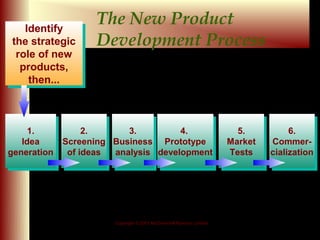
Identify
                 The New Product
    Identify
the strategic
 the strategic   Development Process
 role of new
  role of new
  products,
   products,
    then...
     then...


     1.
      1.       2.
                2.      3.
                         3.        4.
                                    4.                                5.
                                                                       5.           6.
                                                                                     6.
   Idea
    Idea   Screening Business Prototype
           Screening Business Prototype                             Market
                                                                    Market     Commer-
                                                                                Commer-
generation
generation of ideas
            of ideas analysis development
                      analysis development                          Tests
                                                                     Tests     cialization
                                                                                cialization


                     Copyright © 2001 McGraw-Hill Ryerson Limited

                                                                             9 - 10
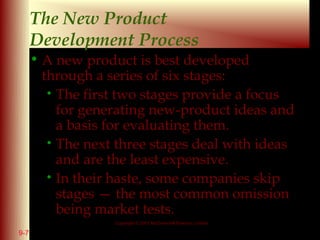
The New Product
      Development Process
      • A new product is best developed
        through a series of six stages:
         • The first two stages provide a focus
           for generating new-product ideas and
           a basis for evaluating them.
         • The next three stages deal with ideas
           and are the least expensive.
         • In their haste, some companies skip
           stages — the most common omission
           being market tests.
                   Copyright © 2001 McGraw-Hill Ryerson Limited

9-7                                                               9 - 11
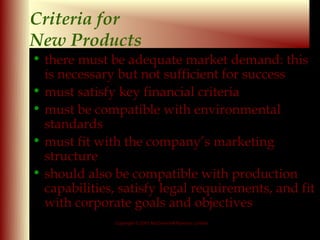
Criteria for
New Products
• there must be adequate market demand: this
  is necessary but not sufficient for success
• must satisfy key financial criteria
• must be compatible with environmental
  standards
• must fit with the company’s marketing
  structure
• should also be compatible with production
  capabilities, satisfy legal requirements, and fit
  with corporate goals and objectives
              Copyright © 2001 McGraw-Hill Ryerson Limited

                                                             9 - 12
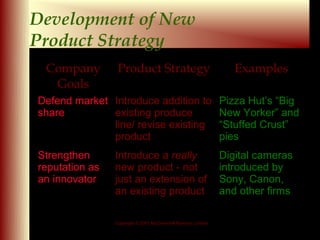
Development of New
Product Strategy
 Company         Product Strategy                                 Examples
  Goals
Defend market Introduce addition to                            Pizza Hut’s “Big
share         existing produce                                 New Yorker” and
              line/ revise existing                            “Stuffed Crust”
              product                                          pies
Strengthen      Introduce a really                             Digital cameras
reputation as   new product - not                              introduced by
an innovator    just an extension of                           Sony, Canon,
                an existing product                            and other firms

                Copyright © 2001 McGraw-Hill Ryerson Limited

                                                                       9 - 13
Adoption-Diffusion
Process
• different new products are adopted by
  consumers at different rates
• the individual consumer goes through certain
  stages before adopting a new product
• marketers must be interested in first creating
  awareness, then interest, then trial, before the
  consumer is considered an adopter
• some people are genuine innovators, while
  others wait and try later; some never adopt

               Copyright © 2001 McGraw-Hill Ryerson Limited

                                                              9 - 14
New Product Adoption
and Diffusion
 • Adoption process: The decision-
   making activity of an individual
   through which the new product is
   accepted.
 • Diffusion: The process by which
   an innovation is spread through a
   social system over time.

           Copyright © 2001 McGraw-Hill Ryerson Limited

                                                          9 - 15
Stages in the
Adoption Process
• awareness: customer is exposed to the
  product
• interest: interest and information seeking
• evaluation: assessment of the advantages and
  disadvantages of the new product
• trial: customer tries the product in low-risk
  situation; may be a sample or test drive
• adoption: customer decides to buy the
  product
• confirmation: customer decides to stay with
  the product; attempts dissonance reduction
              Copyright © 2001 McGraw-Hill Ryerson Limited

                                                             9 - 16
Adopter Categories
• Researchers have identified five categories
  of individual adopters for new products:
   • Innovators — 3% of the market.
   • Early adopters — 13% of the market.
   • Early majority — 34% of the market.
   • Late majority — 34% of the market.
   • Laggards — 16% of the market.

• In addition, some individuals —
  nonadopters — never accept the innovation.
             Copyright © 2001 McGraw-Hill Ryerson Limited

                                                            9 - 17
Five Characteristics Affecting
Adoption Rate: Example
Evaluation of new safer baseball for youngsters:
  1. Relative advantage—superior to current
    balls in terms of safety but not tradition.
  2. Compatibility—coincides with cultural
    values and experiences of parents but not of
    coaches.
  3. Complexity—no problem understanding.
  4. Trialability—ball can be easily tested.
  5. Observability—can see a youngster who’s
    hit with the new ball dust off and trot to first
    base.
                Copyright © 2001 McGraw-Hill Ryerson Limited

                                                               9 - 18
New Product
Organization
Companies take a variety of approaches
to organizing the new product function:
• product-planning committees
• new-product departments
• cross-functional new venture teams
• product managers
  • many larger firms are replacing the
    product manager with category managers

            Copyright © 2001 McGraw-Hill Ryerson Limited

                                                           9 - 19

Product Planning

  • 1.
    Chapter 9 Product Planningand Development Sommers  Barnes Ninth Canadian Edition Presentation by Karen A. Blotnicky Mount Saint Vincent University, Halifax, NS Copyright © 2001 by McGraw-Hill Ryerson Limited
  • 2.
    Chapter Goals To gainan understanding of: • The meaning of total “product” and “new” product • Classification of business and consumer products and its relevance to marketing planning • Product innovation • The product-development process • When to add new products to a product line • The adoption and diffusion process for products • Organizational structures for product planning and development Copyright © 2001 McGraw-Hill Ryerson Limited 9-2
  • 3.
    What is aProduct? • it is more than physical products; includes services, places, persons, and ideas • it is easy to visualize the products of Esso, but more difficult to describe those of the Toronto Symphony, UNICEF, or the Salvation Army • some products are sold only to consumers, while others are sold to organizations • whether a product is a consumer product or a business product depends on how it is used Copyright © 2001 McGraw-Hill Ryerson Limited 9-3
  • 4.
    The Total Product Product Product quality quality Physical Physical Seller’s Seller’s characteristics characteristics services services of goods of goods Seller’s Seller’s Price Price reputation reputation Colour Colour Brand Brand Product Product warranty Packaging Packaging warranty Design Design Copyright © 2001 McGraw-Hill Ryerson Limited 9-4
  • 5.
    Consumer Goods Classes Consumer productscan be classified by the buying behaviour of the consumers: • Convenience goods are bought with little time and effort, such as milk, bread, a chocolate bar. • Shopping goods are those where extensive comparison is the norm-- cars, furniture, clothes. • Specialty goods are those for which consumers have a strong brand preference. BMW, Armani. • Unsought goods are those now unknown to the consumer or, if known, undesired. Copyright © 2001 McGraw-Hill Ryerson Limited 9-5
  • 6.
    Classifying Business Products • rawmaterials: unprocessed, become part of materials other manufactured products • manufactured parts and materials: processed products that become part of other products • installations: major buildings and equipment • accessory equipment: used in operations, include computers, desks, tools • operating supplies: low value, used by most supplies firms, convenience products for businesses Copyright © 2001 McGraw-Hill Ryerson Limited 9-6
  • 7.
    Innovation is Required • Productsgo through life cycles-- you need new ones coming on stream. • Profits highest when products new. • Consumers more selective: they look carefully at each purchase. Also a little jaded. • High failure rates in the 75% range. • Leads to new products: • Innovative= truly unique • Improved, with valuable new benefits • Imitative, another “me too” product. Copyright © 2001 McGraw-Hill Ryerson Limited 9-7
  • 8.
    Ten World-Class Product Failures 1.Ford’s Edsel automobile. 2. Dupont’s Corfam synthetic leather. 3. Polaroid’s Polavision. 4. United Artist’s Heaven’s Gate western movie. 5. RCA’s Videodisc. 6. Time’s TV-Cable Week magazine. 7. IBM’s PCjr. 8. New Coke. 9. R.J. Reynolds’ Premier cigarette. 10. Nutrasweet’s Simplesse fat substitute. Copyright © 2001 McGraw-Hill Ryerson Limited 9-8
  • 9.
    New Product Development • companiesmust be constantly modifying existing products and developing new ones; the marketplace demands it • how new is new? most new products are modifications of or extensions to existing ones • the introduction of a new product is a strategic decision which should be guided by the company’s goals and a new product introduction strategy Copyright © 2001 McGraw-Hill Ryerson Limited 9-9
  • 10.
    Identify The New Product Identify the strategic the strategic Development Process role of new role of new products, products, then... then... 1. 1. 2. 2. 3. 3. 4. 4. 5. 5. 6. 6. Idea Idea Screening Business Prototype Screening Business Prototype Market Market Commer- Commer- generation generation of ideas of ideas analysis development analysis development Tests Tests cialization cialization Copyright © 2001 McGraw-Hill Ryerson Limited 9 - 10
  • 11.
    The New Product Development Process • A new product is best developed through a series of six stages: • The first two stages provide a focus for generating new-product ideas and a basis for evaluating them. • The next three stages deal with ideas and are the least expensive. • In their haste, some companies skip stages — the most common omission being market tests. Copyright © 2001 McGraw-Hill Ryerson Limited 9-7 9 - 11
  • 12.
    Criteria for New Products •there must be adequate market demand: this is necessary but not sufficient for success • must satisfy key financial criteria • must be compatible with environmental standards • must fit with the company’s marketing structure • should also be compatible with production capabilities, satisfy legal requirements, and fit with corporate goals and objectives Copyright © 2001 McGraw-Hill Ryerson Limited 9 - 12
  • 13.
    Development of New ProductStrategy Company Product Strategy Examples Goals Defend market Introduce addition to Pizza Hut’s “Big share existing produce New Yorker” and line/ revise existing “Stuffed Crust” product pies Strengthen Introduce a really Digital cameras reputation as new product - not introduced by an innovator just an extension of Sony, Canon, an existing product and other firms Copyright © 2001 McGraw-Hill Ryerson Limited 9 - 13
  • 14.
    Adoption-Diffusion Process • different newproducts are adopted by consumers at different rates • the individual consumer goes through certain stages before adopting a new product • marketers must be interested in first creating awareness, then interest, then trial, before the consumer is considered an adopter • some people are genuine innovators, while others wait and try later; some never adopt Copyright © 2001 McGraw-Hill Ryerson Limited 9 - 14
  • 15.
    New Product Adoption andDiffusion • Adoption process: The decision- making activity of an individual through which the new product is accepted. • Diffusion: The process by which an innovation is spread through a social system over time. Copyright © 2001 McGraw-Hill Ryerson Limited 9 - 15
  • 16.
    Stages in the AdoptionProcess • awareness: customer is exposed to the product • interest: interest and information seeking • evaluation: assessment of the advantages and disadvantages of the new product • trial: customer tries the product in low-risk situation; may be a sample or test drive • adoption: customer decides to buy the product • confirmation: customer decides to stay with the product; attempts dissonance reduction Copyright © 2001 McGraw-Hill Ryerson Limited 9 - 16
  • 17.
    Adopter Categories • Researchershave identified five categories of individual adopters for new products: • Innovators — 3% of the market. • Early adopters — 13% of the market. • Early majority — 34% of the market. • Late majority — 34% of the market. • Laggards — 16% of the market. • In addition, some individuals — nonadopters — never accept the innovation. Copyright © 2001 McGraw-Hill Ryerson Limited 9 - 17
  • 18.
    Five Characteristics Affecting AdoptionRate: Example Evaluation of new safer baseball for youngsters: 1. Relative advantage—superior to current balls in terms of safety but not tradition. 2. Compatibility—coincides with cultural values and experiences of parents but not of coaches. 3. Complexity—no problem understanding. 4. Trialability—ball can be easily tested. 5. Observability—can see a youngster who’s hit with the new ball dust off and trot to first base. Copyright © 2001 McGraw-Hill Ryerson Limited 9 - 18
  • 19.
    New Product Organization Companies takea variety of approaches to organizing the new product function: • product-planning committees • new-product departments • cross-functional new venture teams • product managers • many larger firms are replacing the product manager with category managers Copyright © 2001 McGraw-Hill Ryerson Limited 9 - 19