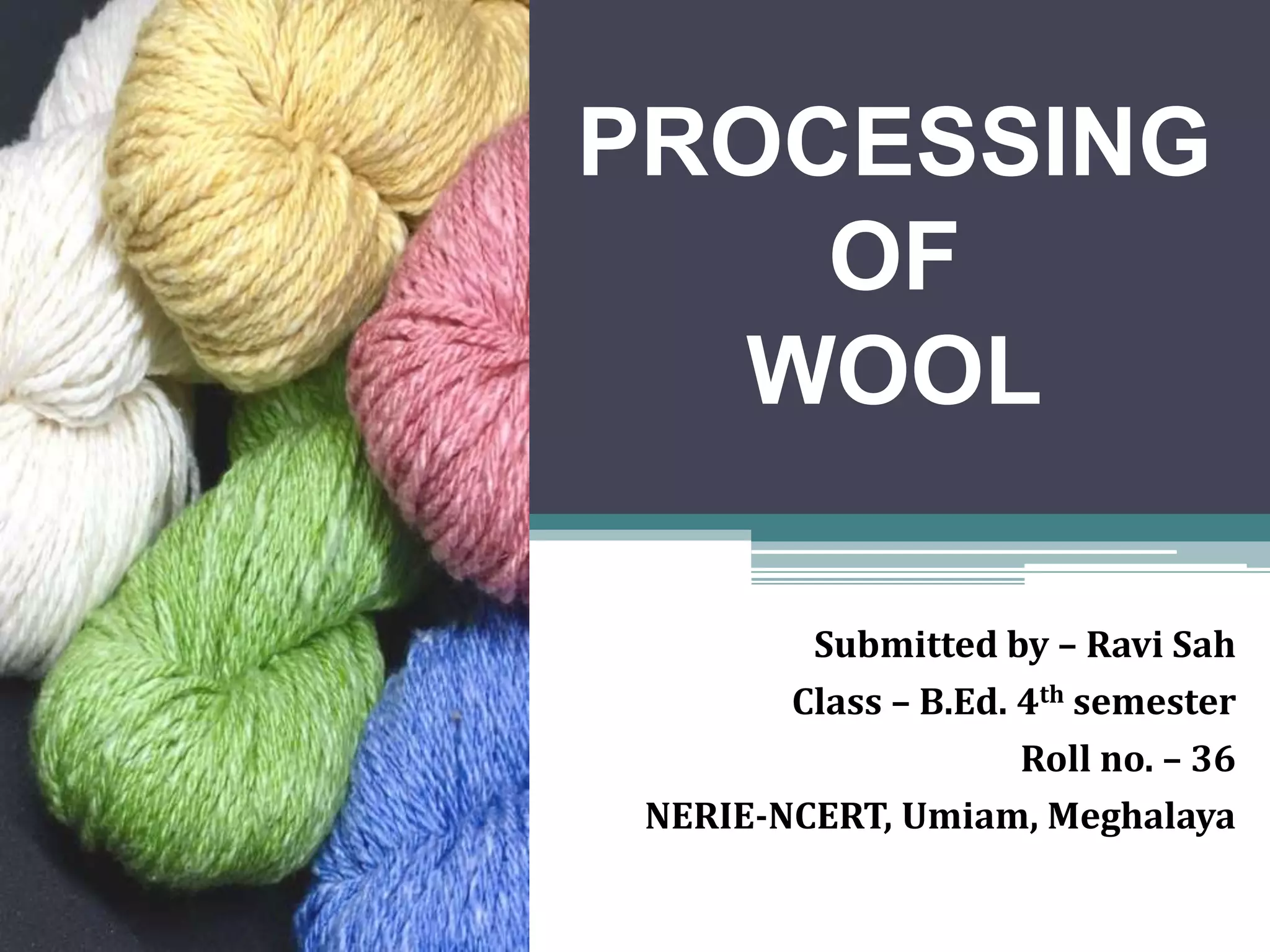
PROCESSING
OF
WOOL
Submitted by – Ravi Sah
Class – B.Ed. 4th semester
Roll no. – 36
NERIE-NCERT, Umiam, Meghalaya
WOOL
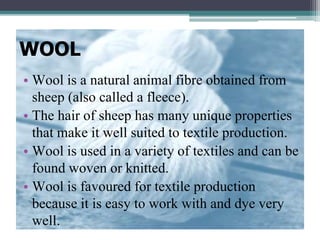
• Wool is a natural animal fibre obtained from
sheep (also called a fleece).
• The hair of sheep has many unique properties
that make it well suited to textile production.
• Wool is used in a variety of textiles and can be
found woven or knitted.
• Wool is favoured for textile production
because it is easy to work with and dye very
well.
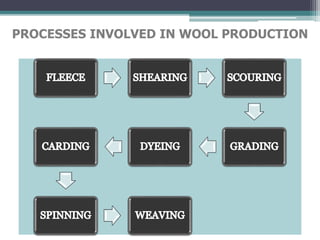
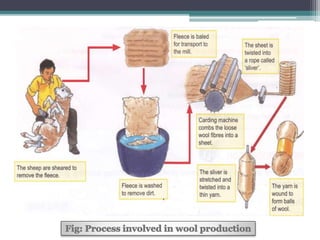
PROCESSES INVOLVED IN WOOL PRODUCTION
STEP 1: SHEARING
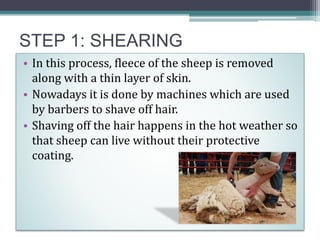
• In this process, fleece of the sheep is removed
along with a thin layer of skin.
• Nowadays it is done by machines which are used
by barbers to shave off hair.
• Shaving off the hair happens in the hot weather so
that sheep can live without their protective
coating.
STEP 2: SCOURING
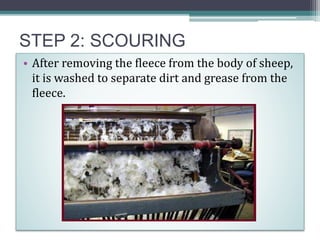
• After removing the fleece from the body of sheep,
it is washed to separate dirt and grease from the
fleece.
STEP 3: GRADING
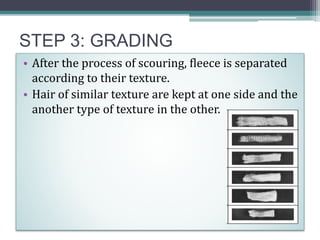
• After the process of scouring, fleece is separated
according to their texture.
• Hair of similar texture are kept at one side and the
another type of texture in the other.
STEP 4: DYEING
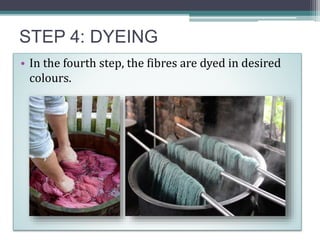
• In the fourth step, the fibres are dyed in desired
colours.
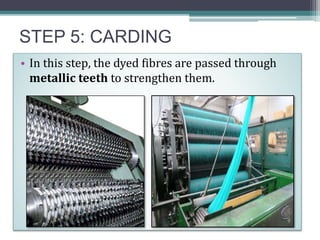
STEP 5: CARDING
• In this step, the dyed fibres are passed through
metallic teeth to strengthen them.
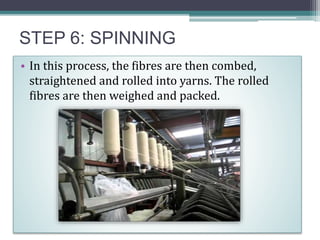
STEP 6: SPINNING
• In this process, the fibres are then combed,
straightened and rolled into yarns. The rolled
fibres are then weighed and packed.
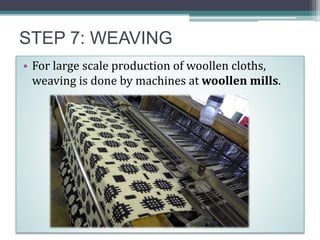
STEP 7: WEAVING
• For large scale production of woollen cloths,
weaving is done by machines at woollen mills.
PROCESSING FIBRES INTO WOOL
• https://youtu.be/U1v_h4oHVtk
BIBLIOGRAPHY
• https://www.slideshare.net/LeenaVegad1/wool-
ppt-72670887
• https://www.aplustopper.com/wool-production-
from-sheep/
Processing of wool

Processing of wool

  • 1.
    PROCESSING OF WOOL Submitted by –Ravi Sah Class – B.Ed. 4th semester Roll no. – 36 NERIE-NCERT, Umiam, Meghalaya
  • 2.
    WOOL • Wool isa natural animal fibre obtained from sheep (also called a fleece). • The hair of sheep has many unique properties that make it well suited to textile production. • Wool is used in a variety of textiles and can be found woven or knitted. • Wool is favoured for textile production because it is easy to work with and dye very well.
  • 3.
    PROCESSES INVOLVED INWOOL PRODUCTION
  • 4.
    STEP 1: SHEARING •In this process, fleece of the sheep is removed along with a thin layer of skin. • Nowadays it is done by machines which are used by barbers to shave off hair. • Shaving off the hair happens in the hot weather so that sheep can live without their protective coating.
  • 5.
    STEP 2: SCOURING •After removing the fleece from the body of sheep, it is washed to separate dirt and grease from the fleece.
  • 6.
    STEP 3: GRADING •After the process of scouring, fleece is separated according to their texture. • Hair of similar texture are kept at one side and the another type of texture in the other.
  • 7.
    STEP 4: DYEING •In the fourth step, the fibres are dyed in desired colours.
  • 8.
    STEP 5: CARDING •In this step, the dyed fibres are passed through metallic teeth to strengthen them.
  • 9.
    STEP 6: SPINNING •In this process, the fibres are then combed, straightened and rolled into yarns. The rolled fibres are then weighed and packed.
  • 10.
    STEP 7: WEAVING •For large scale production of woollen cloths, weaving is done by machines at woollen mills.
  • 12.
    PROCESSING FIBRES INTOWOOL • https://youtu.be/U1v_h4oHVtk BIBLIOGRAPHY • https://www.slideshare.net/LeenaVegad1/wool- ppt-72670887 • https://www.aplustopper.com/wool-production- from-sheep/