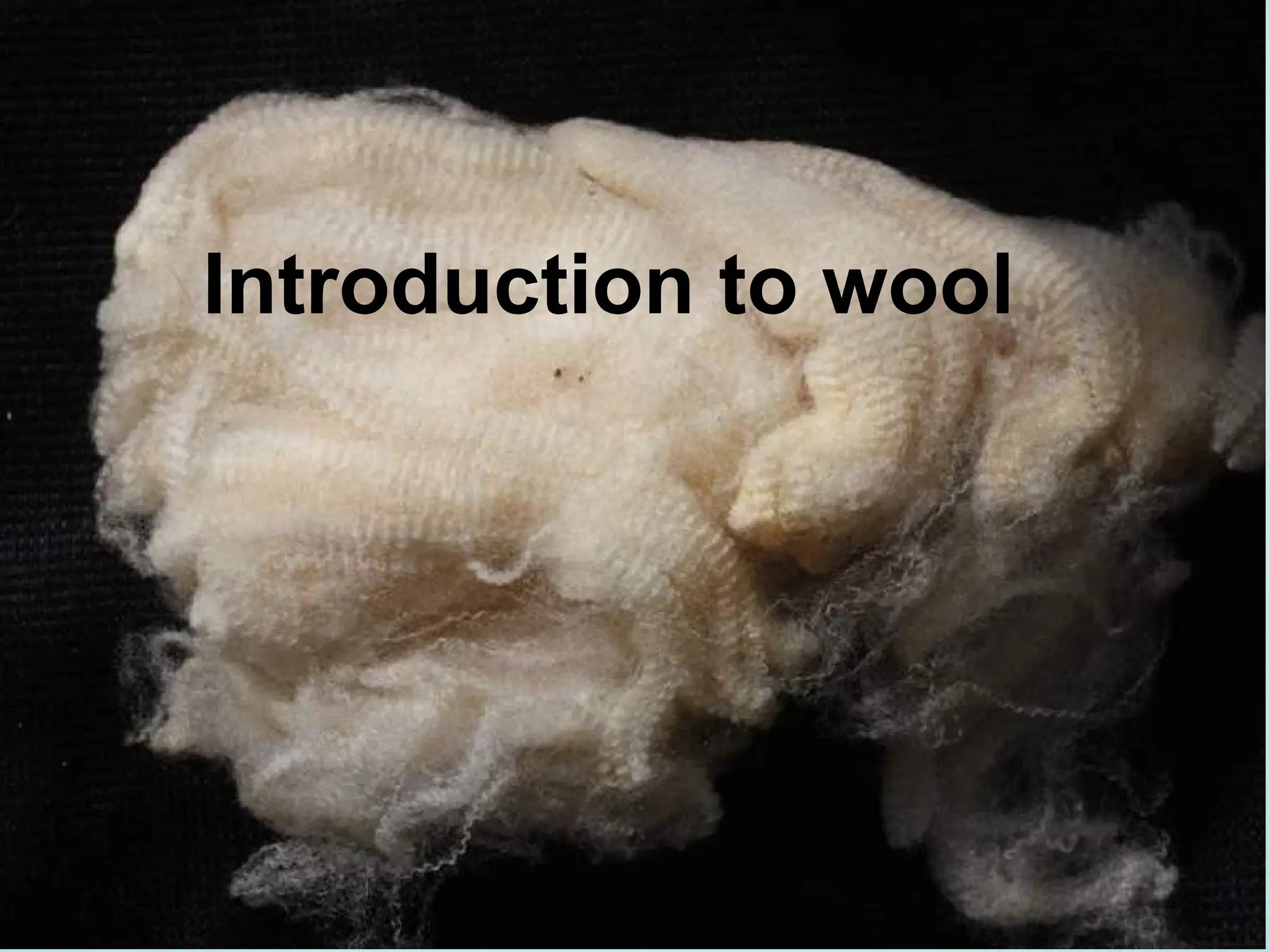
Introduction to wool
RAJ WAGH
INTRODUCTION
 Wool is one of the important products obtained from
sheep.
 Wool is the thick, wavy and fibrous protective covering of
the sheep.
 It mainly consists of insoluble protein called keratin,
containing sulphur containing amino acid, cysteine.
 In comparison to hair, it is more elastic, flexible and curly.
RAJ WAGH
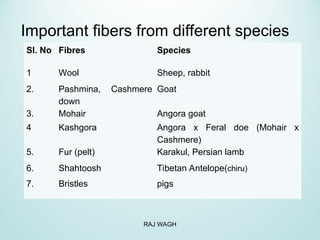
Important fibers from different species
Sl. No Fibres Species
1 Wool Sheep, rabbit
2. Pashmina, Cashmere
down
Goat
3. Mohair Angora goat
4 Kashgora Angora x Feral doe (Mohair x
Cashmere)
5. Fur (pelt) Karakul, Persian lamb
6. Shahtoosh Tibetan Antelope(chiru)
7. Bristles pigs
RAJ WAGH
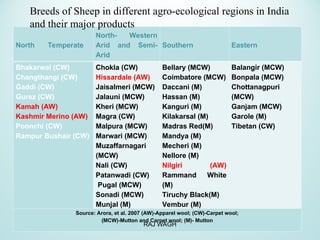
North Temperate
North- Western
Arid and Semi-
Arid
Southern Eastern
Bhakarwal (CW)
Changthangi (CW)
Gaddi (CW)
Gurez (CW)
Kamah (AW)
Kashmir Merino (AW)
Poonchi (CW)
Rampur Bushair (CW)
Chokla (CW)
Hissardale (AW)
Jaisalmeri (MCW)
Jalauni (MCW)
Kheri (MCW)
Magra (CW)
Malpura (MCW)
Marwari (MCW)
Muzaffarnagari
(MCW)
Nali (CW)
Patanwadi (CW)
Pugal (MCW)
Sonadi (MCW)
Munjal (M)
Bellary (MCW)
Coimbatore (MCW)
Daccani (M)
Hassan (M)
Kanguri (M)
Kilakarsal (M)
Madras Red(M)
Mandya (M)
Mecheri (M)
Nellore (M)
Nilgiri (AW)
Rammand White
(M)
Tiruchy Black(M)
Vembur (M)
Balangir (MCW)
Bonpala (MCW)
Chottanagpuri
(MCW)
Ganjam (MCW)
Garole (M)
Tibetan (CW)
Source: Arora, et al. 2007 (AW)-Apparel wool; (CW)-Carpet wool;
(MCW)-Mutton and Carpet wool; (M)- Mutton
Breeds of Sheep in different agro-ecological regions in India
and their major products
RAJ WAGH
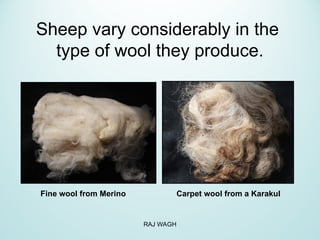
Sheep vary considerably in the
type of wool they produce.
Fine wool from Merino Carpet wool from a Karakul
RAJ WAGH
The term wool refers to the whole fleece, which
contain mainly three types of fibres.
Fleece- Fibre coat that covers the sheep
1.Fine wool fibres generally have no medulla or hollow core
and keep on growing, e.g. Merino fibre has no medulla.
2.Hairs are continuously growing long fibres with medulla in
part of their length.
3.Kemps are coarse as well as short fibres having medulla
throughout their length.
RAJ WAGH
QUALITIES OF WOOL
1. Wool is porous and will absorb moisture more readily than any
other textile fiber.
2. It can absorb as much as 18% of its own weight in moisture
without even feeling damp.
3. Wool generates heat.
4. It is a superior insulator keeping the heat of the body from
escaping and the cold air from entering.
5. Wool is light.
6. It is very elastic, the average fiber will stretch 30% of its normal
length and still spring back in shape.
7. Dye stuffs are less likely to fade.
8. It is durable.
9. It is almost non-flammable. It will stop burning almost as soon as
it is taken away from flame.
10.It can be felted or matted easily.
RAJ WAGH
Specialty fibers with respect to processing
industry
Angora wool: is from the Angora rabbit. This soft fiber is used in
sweaters, mittens and baby clothes.
Mohair: is from the Angora goat and is highly resilient and
strong. Mohair is used in home decorating fabrics as well as
garment fabrics.
Alpaca fleece: is very rich and silky with considerable luster. It
comes from the Alpaca.
RAJ WAGH
Glossary of terms of wool processing
1. Apparel wool: very fine wool suitable for manufacture into
apparel fabrics.
2. Bale: A highly compressed package of either greased or
scoured wool.
3. Blood grade: It is used to describe the proportion of Merino
(fine wool) breeding represented in a fleece.
4. Britch or breech wool: Wool from the hindquarters of
sheep, usually the coarsest wool in the fleece.
RAJ WAGH
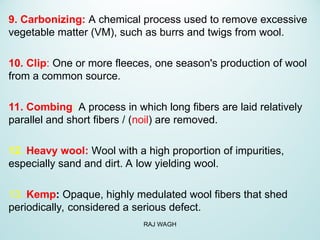
5. Staple length:-It is the total length of a fiber
in its natural condition. It is obtained by
measuring the natural staple without stretching
the crimps out of the fibre.
6. Fiber length:-It is the total length of a wool fiber after
removing the crimps or waviness by straightening it.
7. Crimpiness: - It refers to the waviness of the wool fiber. Its
number varies from 2 to 12 per cm depending upon the quality.
It is a valuable property in spinning and increases the elasticity
of the yarn and fabric. Crimps are more pronounced in fine
wool.
RAJ WAGH
9. Carbonizing: A chemical process used to remove excessive
vegetable matter (VM), such as burrs and twigs from wool.
10. Clip: One or more fleeces, one season's production of wool
from a common source.
11. Combing: A process in which long fibers are laid relatively
parallel and short fibers / (noil) are removed.
12. Heavy wool: Wool with a high proportion of impurities,
especially sand and dirt. A low yielding wool.
13. Kemp: Opaque, highly medulated wool fibers that shed
periodically, considered a serious defect.
RAJ WAGH
14: Shearing/clipping: Removal of fleece from the sheep.
15. Luster: A natural gloss or shine caused by light reflection,
typical in mohair or wool from the long wool breeds.
16. Pelt: The skin of sheep, including the wool.
17. Pulled wool: Wool pulled from the skin of slaughtered
sheep.
RAJ WAGH
Scouring: The process of removing grease, soil, and suint,
usually by washing in hot water and detergent. A mild alkali is
added in some situations.
Fellmongering: Removing wool from sheep through the use
of chemicals (sodium sulphide).
Skirting: A procedure where the less valuable parts of fleeces,
such as bellies, stained pieces, sweat locks and neck wool, are
removed from fleece.
RAJ WAGH
Sorting: Breaking a fleece into part or sorts based primarily on
fineness and length.
Wool grease: A complex mixture of esters secreted by the
sebaceous (wax) glands in the skin of sheep.
Crutchings: Wool removed from the area around the dock
and/or udder of sheep.
Felting: The property of wool fibers to interlock when agitated
in warm, moist conditions. This property results in wool fabrics
that shrink when washed in machines if not treated to resist
felting.
RAJ WAGH
Yield: The proportion of clean wool (at standard conditions)
present in a given amount of grease wool.
Yolk: A combination of sweat salts and wool grease (waxes)
deposited on wool from the sweat and wax glands in the skin
of sheep.
Raw wool or grease wool: Such wool contains not only
grease but impurities of mineral, vegetable origin and suint.
Shrinkage: The difference between clean and grease wool is
called shrinkage. This depends on the breed of sheep,
nutrition, the type of soil and so on. The buyer estimates the
shrinkage and pays for clean wool only.
RAJ WAGH
•Thanks
RAJ WAGH

The Wool Introduction along with details

  • 1.
  • 2.
    INTRODUCTION  Wool isone of the important products obtained from sheep.  Wool is the thick, wavy and fibrous protective covering of the sheep.  It mainly consists of insoluble protein called keratin, containing sulphur containing amino acid, cysteine.  In comparison to hair, it is more elastic, flexible and curly. RAJ WAGH
  • 3.
    Important fibers fromdifferent species Sl. No Fibres Species 1 Wool Sheep, rabbit 2. Pashmina, Cashmere down Goat 3. Mohair Angora goat 4 Kashgora Angora x Feral doe (Mohair x Cashmere) 5. Fur (pelt) Karakul, Persian lamb 6. Shahtoosh Tibetan Antelope(chiru) 7. Bristles pigs RAJ WAGH
  • 4.
    North Temperate North- Western Aridand Semi- Arid Southern Eastern Bhakarwal (CW) Changthangi (CW) Gaddi (CW) Gurez (CW) Kamah (AW) Kashmir Merino (AW) Poonchi (CW) Rampur Bushair (CW) Chokla (CW) Hissardale (AW) Jaisalmeri (MCW) Jalauni (MCW) Kheri (MCW) Magra (CW) Malpura (MCW) Marwari (MCW) Muzaffarnagari (MCW) Nali (CW) Patanwadi (CW) Pugal (MCW) Sonadi (MCW) Munjal (M) Bellary (MCW) Coimbatore (MCW) Daccani (M) Hassan (M) Kanguri (M) Kilakarsal (M) Madras Red(M) Mandya (M) Mecheri (M) Nellore (M) Nilgiri (AW) Rammand White (M) Tiruchy Black(M) Vembur (M) Balangir (MCW) Bonpala (MCW) Chottanagpuri (MCW) Ganjam (MCW) Garole (M) Tibetan (CW) Source: Arora, et al. 2007 (AW)-Apparel wool; (CW)-Carpet wool; (MCW)-Mutton and Carpet wool; (M)- Mutton Breeds of Sheep in different agro-ecological regions in India and their major products RAJ WAGH
  • 5.
    Sheep vary considerablyin the type of wool they produce. Fine wool from Merino Carpet wool from a Karakul RAJ WAGH
  • 6.
    The term woolrefers to the whole fleece, which contain mainly three types of fibres. Fleece- Fibre coat that covers the sheep 1.Fine wool fibres generally have no medulla or hollow core and keep on growing, e.g. Merino fibre has no medulla. 2.Hairs are continuously growing long fibres with medulla in part of their length. 3.Kemps are coarse as well as short fibres having medulla throughout their length. RAJ WAGH
  • 7.
    QUALITIES OF WOOL 1.Wool is porous and will absorb moisture more readily than any other textile fiber. 2. It can absorb as much as 18% of its own weight in moisture without even feeling damp. 3. Wool generates heat. 4. It is a superior insulator keeping the heat of the body from escaping and the cold air from entering. 5. Wool is light. 6. It is very elastic, the average fiber will stretch 30% of its normal length and still spring back in shape. 7. Dye stuffs are less likely to fade. 8. It is durable. 9. It is almost non-flammable. It will stop burning almost as soon as it is taken away from flame. 10.It can be felted or matted easily. RAJ WAGH
  • 8.
    Specialty fibers withrespect to processing industry Angora wool: is from the Angora rabbit. This soft fiber is used in sweaters, mittens and baby clothes. Mohair: is from the Angora goat and is highly resilient and strong. Mohair is used in home decorating fabrics as well as garment fabrics. Alpaca fleece: is very rich and silky with considerable luster. It comes from the Alpaca. RAJ WAGH
  • 9.
    Glossary of termsof wool processing 1. Apparel wool: very fine wool suitable for manufacture into apparel fabrics. 2. Bale: A highly compressed package of either greased or scoured wool. 3. Blood grade: It is used to describe the proportion of Merino (fine wool) breeding represented in a fleece. 4. Britch or breech wool: Wool from the hindquarters of sheep, usually the coarsest wool in the fleece. RAJ WAGH
  • 10.
    5. Staple length:-Itis the total length of a fiber in its natural condition. It is obtained by measuring the natural staple without stretching the crimps out of the fibre. 6. Fiber length:-It is the total length of a wool fiber after removing the crimps or waviness by straightening it. 7. Crimpiness: - It refers to the waviness of the wool fiber. Its number varies from 2 to 12 per cm depending upon the quality. It is a valuable property in spinning and increases the elasticity of the yarn and fabric. Crimps are more pronounced in fine wool. RAJ WAGH
  • 11.
    9. Carbonizing: Achemical process used to remove excessive vegetable matter (VM), such as burrs and twigs from wool. 10. Clip: One or more fleeces, one season's production of wool from a common source. 11. Combing: A process in which long fibers are laid relatively parallel and short fibers / (noil) are removed. 12. Heavy wool: Wool with a high proportion of impurities, especially sand and dirt. A low yielding wool. 13. Kemp: Opaque, highly medulated wool fibers that shed periodically, considered a serious defect. RAJ WAGH
  • 12.
    14: Shearing/clipping: Removalof fleece from the sheep. 15. Luster: A natural gloss or shine caused by light reflection, typical in mohair or wool from the long wool breeds. 16. Pelt: The skin of sheep, including the wool. 17. Pulled wool: Wool pulled from the skin of slaughtered sheep. RAJ WAGH
  • 13.
    Scouring: The processof removing grease, soil, and suint, usually by washing in hot water and detergent. A mild alkali is added in some situations. Fellmongering: Removing wool from sheep through the use of chemicals (sodium sulphide). Skirting: A procedure where the less valuable parts of fleeces, such as bellies, stained pieces, sweat locks and neck wool, are removed from fleece. RAJ WAGH
  • 14.
    Sorting: Breaking afleece into part or sorts based primarily on fineness and length. Wool grease: A complex mixture of esters secreted by the sebaceous (wax) glands in the skin of sheep. Crutchings: Wool removed from the area around the dock and/or udder of sheep. Felting: The property of wool fibers to interlock when agitated in warm, moist conditions. This property results in wool fabrics that shrink when washed in machines if not treated to resist felting. RAJ WAGH
  • 15.
    Yield: The proportionof clean wool (at standard conditions) present in a given amount of grease wool. Yolk: A combination of sweat salts and wool grease (waxes) deposited on wool from the sweat and wax glands in the skin of sheep. Raw wool or grease wool: Such wool contains not only grease but impurities of mineral, vegetable origin and suint. Shrinkage: The difference between clean and grease wool is called shrinkage. This depends on the breed of sheep, nutrition, the type of soil and so on. The buyer estimates the shrinkage and pays for clean wool only. RAJ WAGH
  • 16.