Process Management


   Roy Lee, 20 June 2005
   NCTU Computer Operating System Lab


                                        1
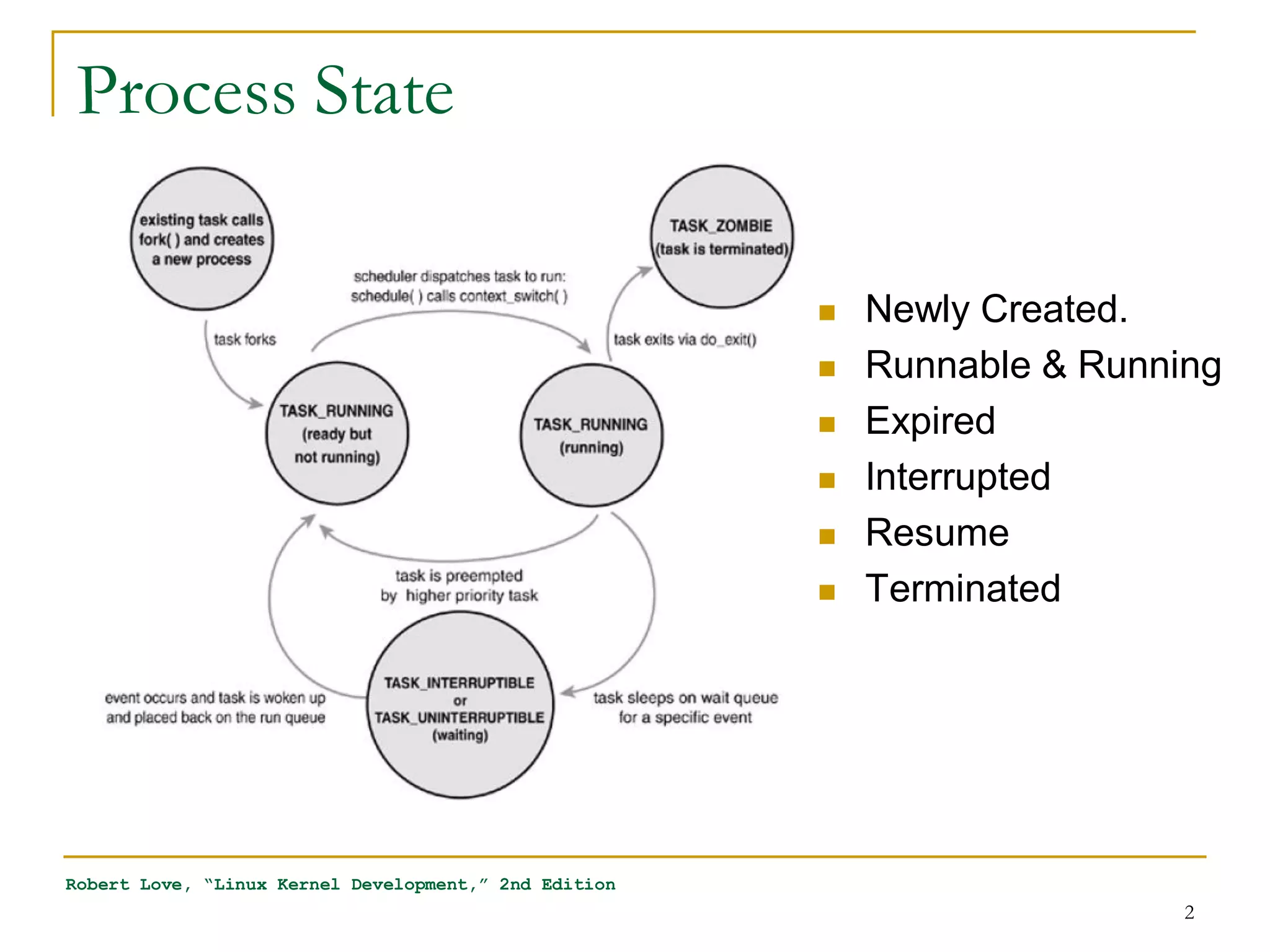
Process State

                                                          Newly Created.
                                                          Runnable & Running
                                                          Expired
                                                          Interrupted
                                                          Resume
                                                          Terminated


Robert Love, “Linux Kernel Development,” 2nd Edition
                                                                           2
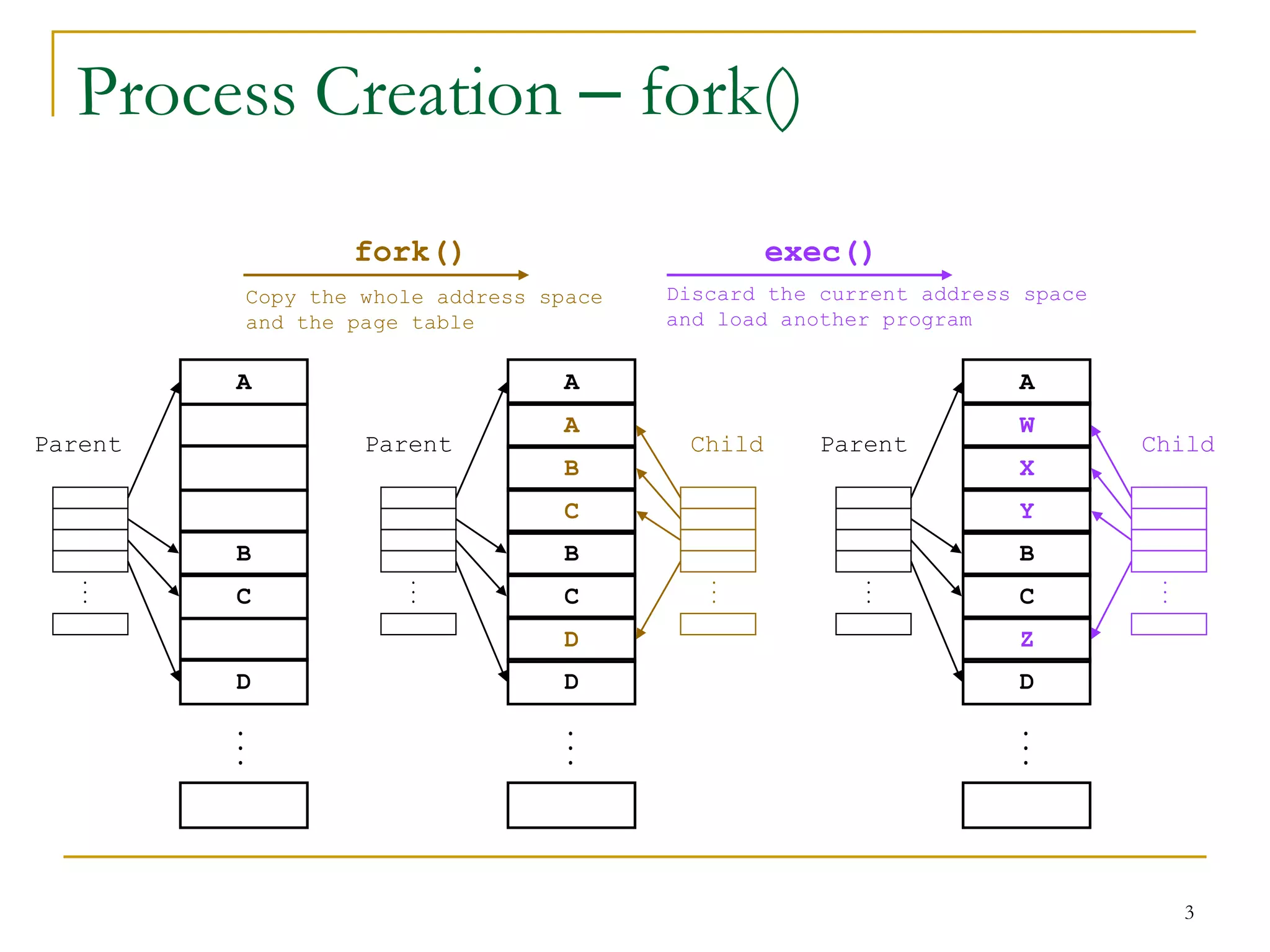
Process Creation – fork()
                  fork()                          exec()
          Copy the whole address space   Discard the current address space
          and the page table             and load another program


         A                        A                                 A
                                  A                                 W
Parent             Parent                 Child      Parent                  Child
                                  B                                 X
                                  C                                 Y
         B                        B                                 B
   ...


                      ...


                                            ...


                                                        ...


                                                                              ...
         C                        C                                 C
                                  D                                 Z
         D                        D                                 D
         ...


                                  ...


                                                                    ...
                                                                                    3
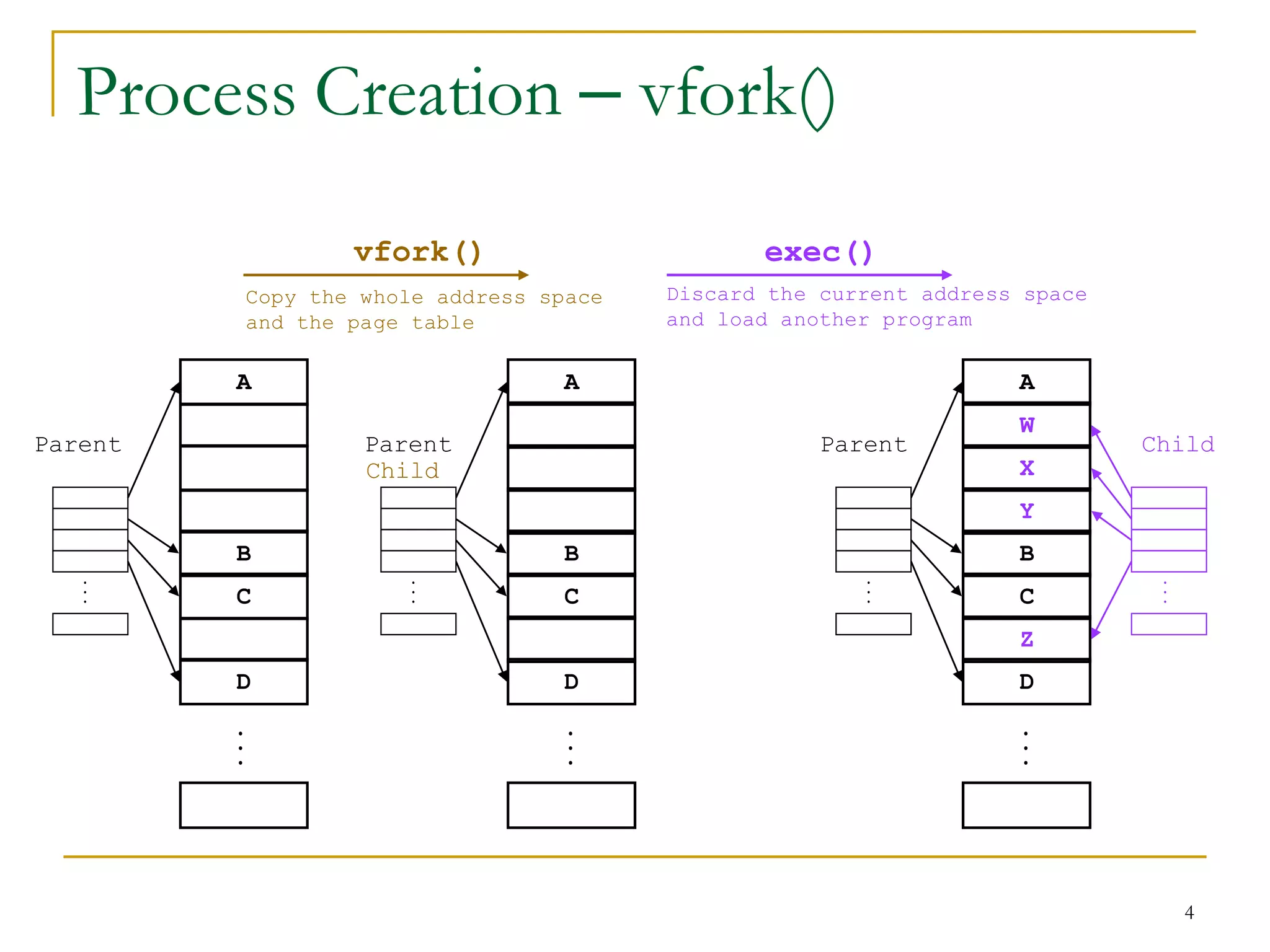
Process Creation – vfork()
                  vfork()                       exec()
          Copy the whole address space   Discard the current address space
          and the page table             and load another program


         A                        A                                 A
                                                                    W
Parent             Parent                            Parent                  Child
                   Child                                            X
                                                                    Y
         B                        B                                 B
   ...


                      ...


                                                        ...


                                                                              ...
         C                        C                                 C
                                                                    Z
         D                        D                                 D
         ...


                                  ...


                                                                    ...
                                                                                    4
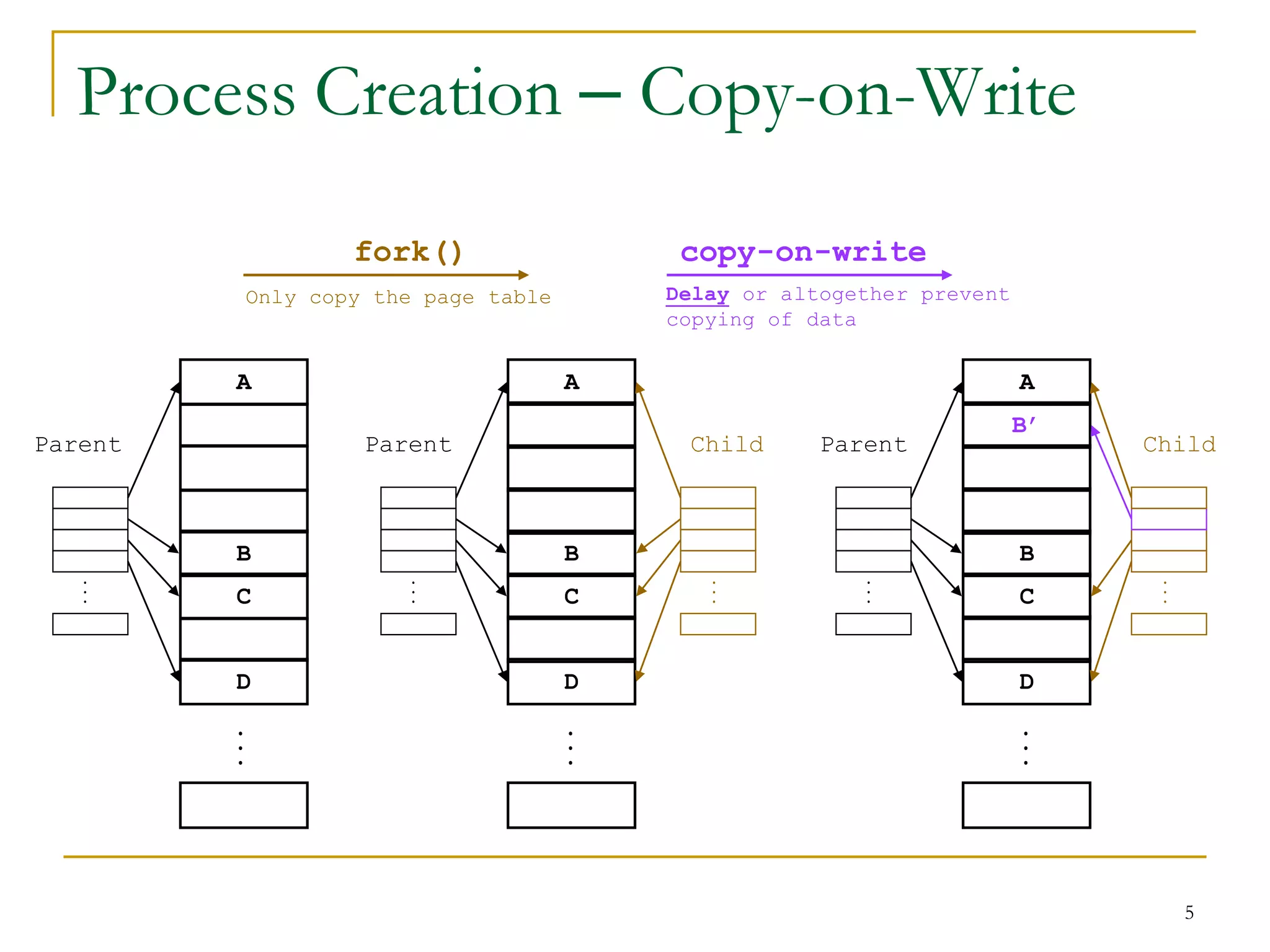
Process Creation – Copy-on-Write
                  fork()                    copy-on-write
          Only copy the page table         Delay or altogether prevent
                                           copying of data


         A                           A                                   A
                                                                         B’
Parent             Parent                   Child      Parent                  Child


         B                           B                                   B
   ...


                      ...


                                              ...


                                                          ...


                                                                                ...
         C                           C                                   C


         D                           D                                   D
         ...


                                     ...


                                                                         ...
                                                                                      5
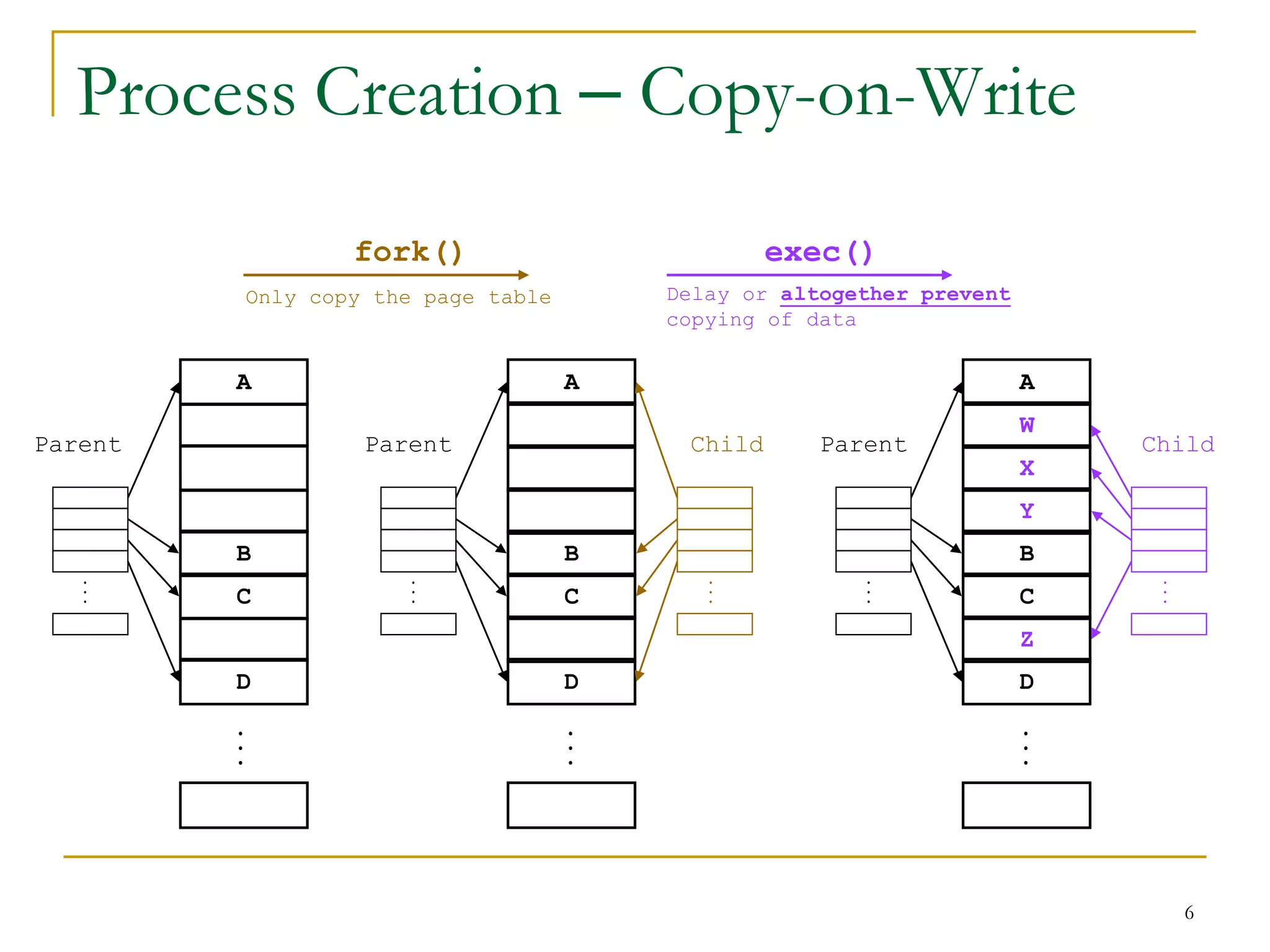
Process Creation – Copy-on-Write
                  fork()                            exec()
          Only copy the page table         Delay or altogether prevent
                                           copying of data


         A                           A                                   A
                                                                         W
Parent             Parent                   Child      Parent                  Child
                                                                         X
                                                                         Y
         B                           B                                   B
   ...


                      ...


                                              ...


                                                          ...


                                                                                ...
         C                           C                                   C
                                                                         Z
         D                           D                                   D
         ...


                                     ...


                                                                         ...
                                                                                      6
task_struct
  [include/linux/sched.h]


Robert Love, “Linux Kernel Development,” 2nd Edition
Daniel P. Bovet, Marco Cesati, “Understanding the Linux Kernel,” 3rd Edition   7
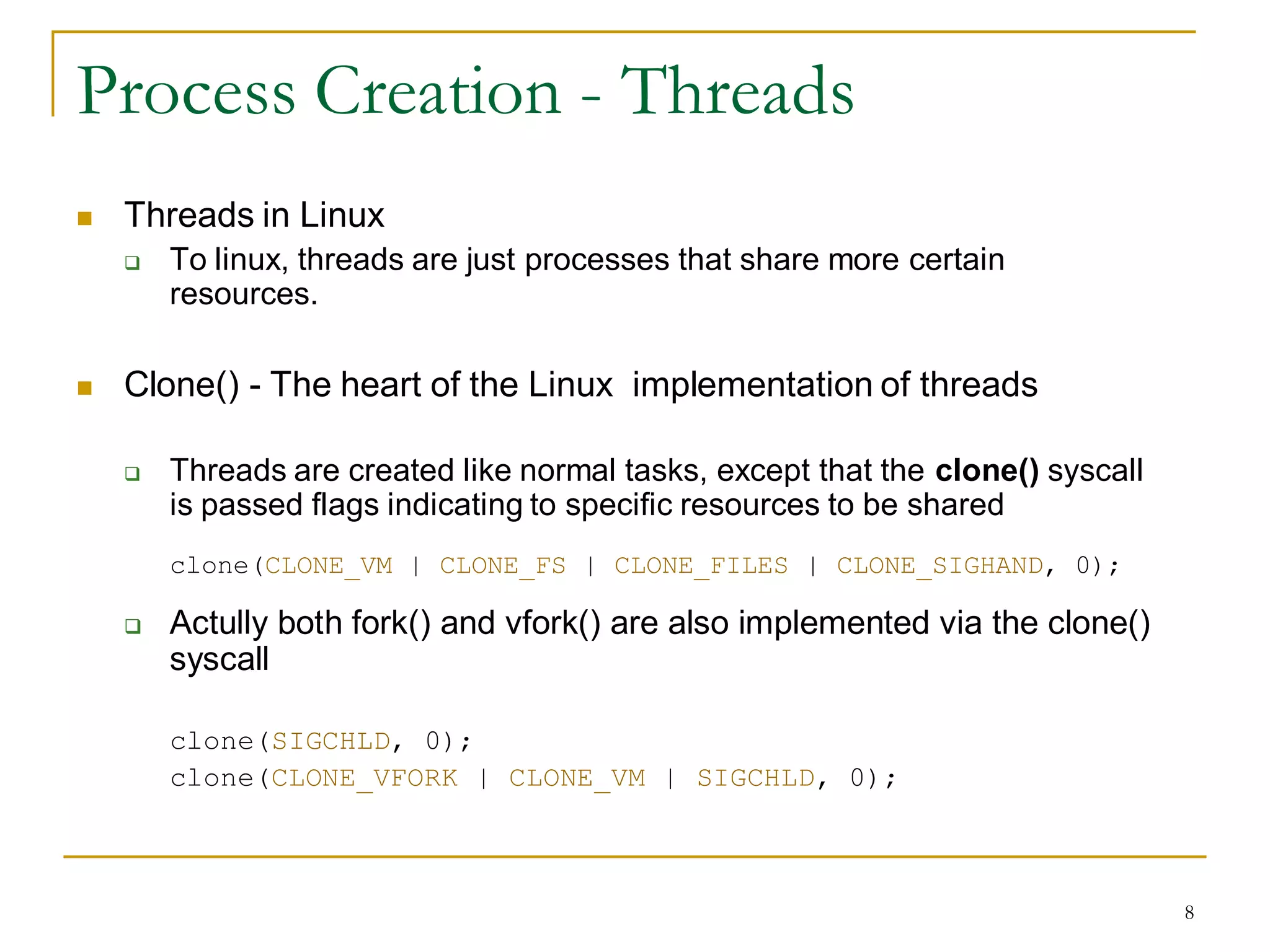
Process Creation - Threads
   Threads in Linux
       To linux, threads are just processes that share more certain
        resources.

   Clone() - The heart of the Linux implementation of threads

       Threads are created like normal tasks, except that the clone() syscall
        is passed flags indicating to specific resources to be shared
        clone(CLONE_VM | CLONE_FS | CLONE_FILES | CLONE_SIGHAND, 0);

       Actully both fork() and vfork() are also implemented via the clone()
        syscall

        clone(SIGCHLD, 0);
        clone(CLONE_VFORK | CLONE_VM | SIGCHLD, 0);


                                                                                 8
Process Creation Flow
                                                                                         User space

sys_fork()      sys_vfork()      sys_clone()
                                                                                         Kernel space
                                                             [kernel/process.c]
                                                             [kernel/fork.c]
             do_fork()                                       [kernel/sched.c]

                   alloc_pidmap()

                                             duplicate the task_struct, initialize it
                   copy_process()
                                             and setup according to the specified clone_flags

                            success?
                                 yes
                     wake_up_new_task()          put the child into runqueue
       no

  free_pidmap()              vfork?            wait_for_completion()
                                       yes
                                               when the child terminates,
                            no                 it wakes up the parent sleeping in the wait queue

               return pid


                                                                                                        9
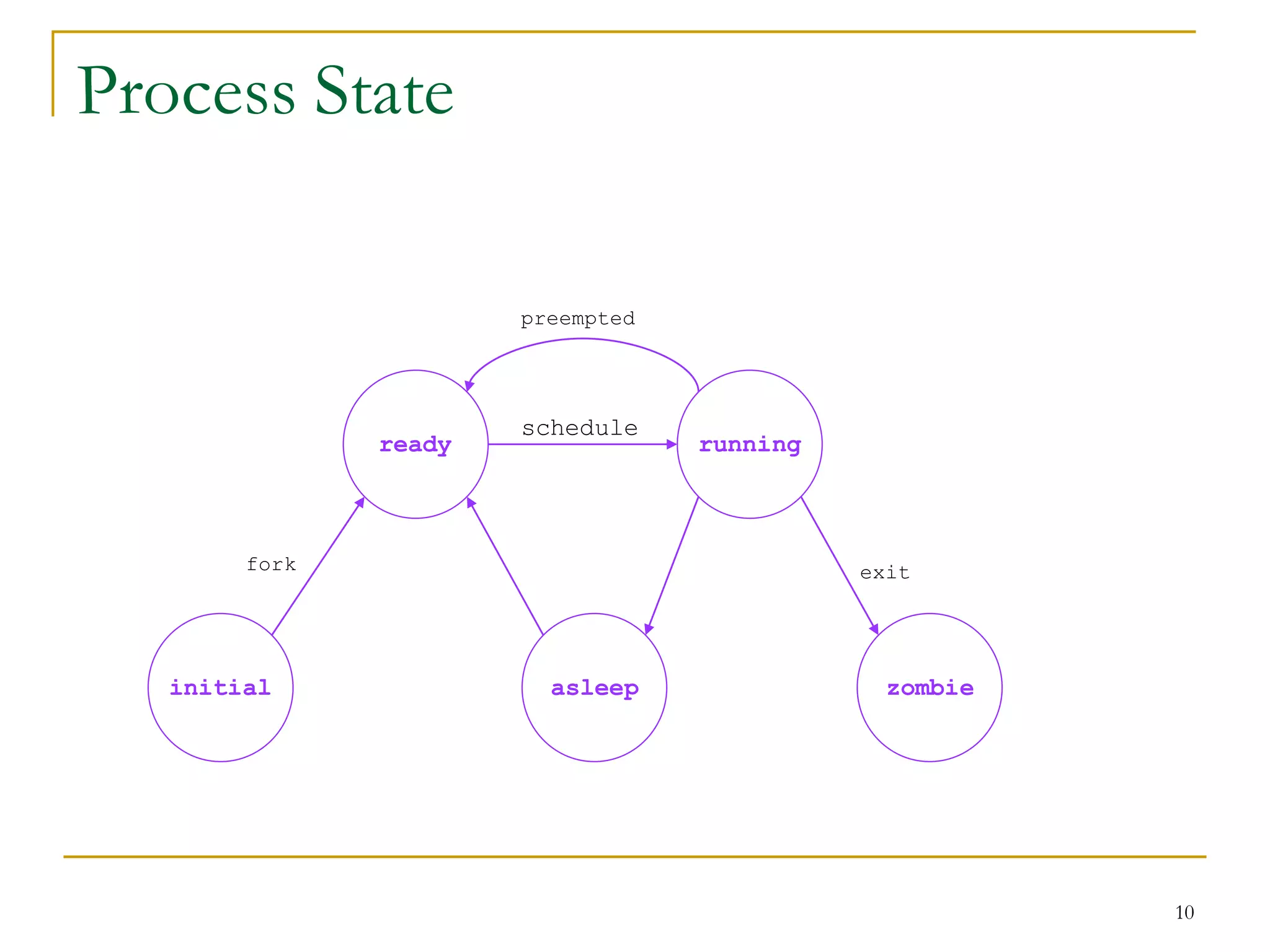
Process State

                       preempted


                       schedule
               ready               running


        fork                                 exit


   initial               asleep                zombie


                                                        10
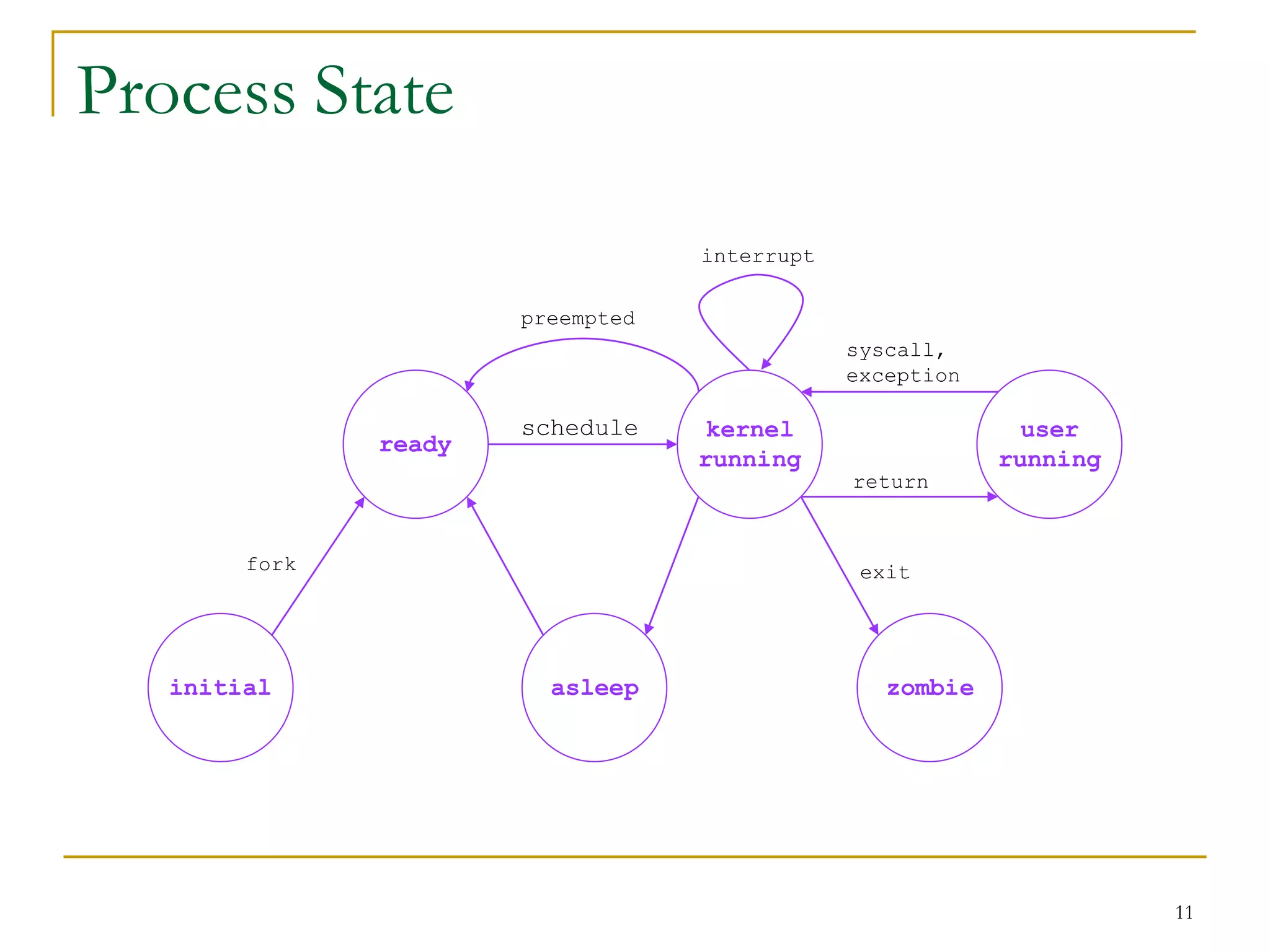
Process State

                                   interrupt

                       preempted
                                               syscall,
                                               exception

                       schedule     kernel                   user
               ready
                                   running                 running
                                               return


        fork                                    exit


   initial               asleep                   zombie


                                                                     11
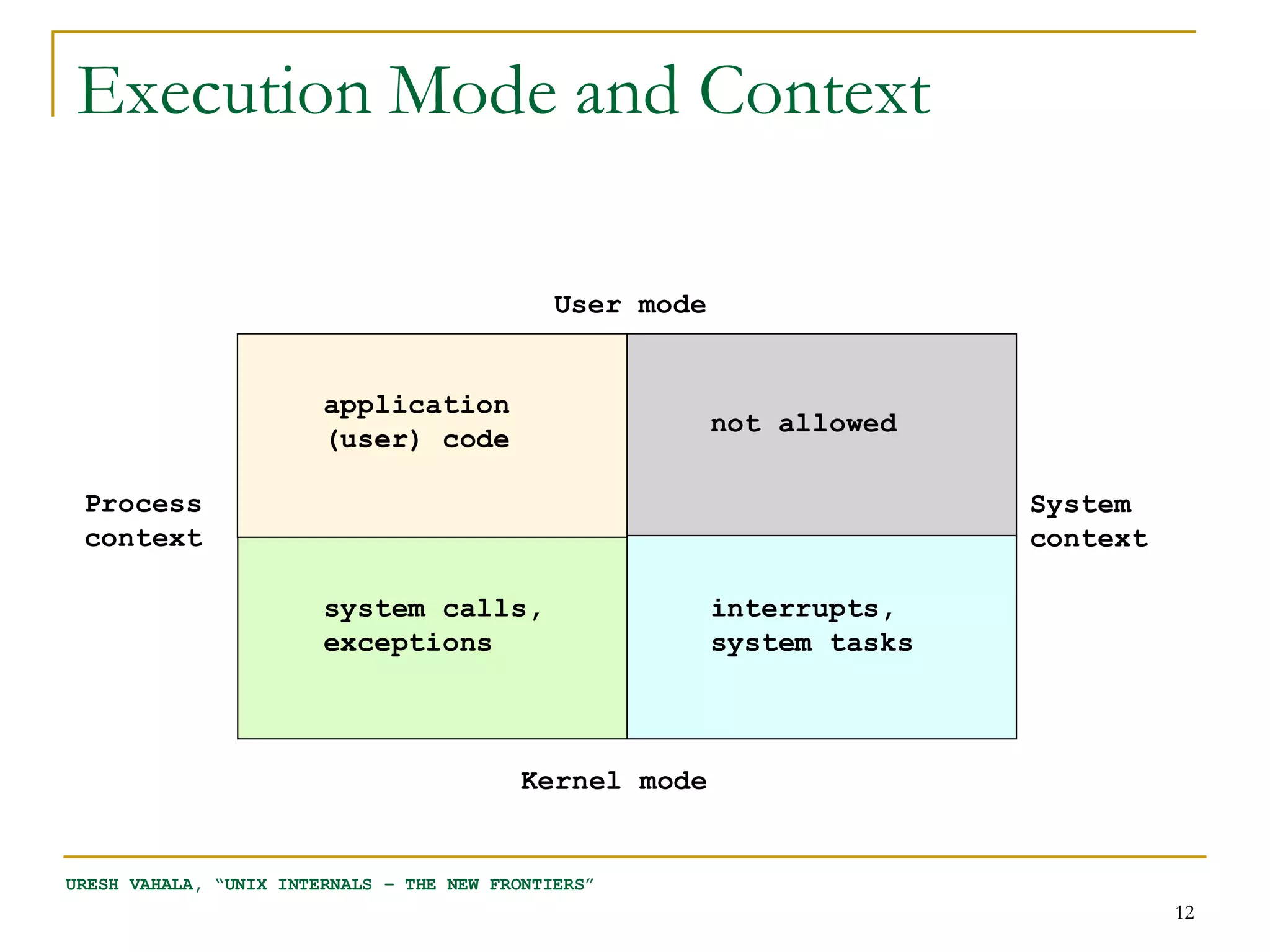
Execution Mode and Context

                                              User mode


                        application
                                                          not allowed
                        (user) code

 Process                                                                 System
 context                                                                 context

                        system calls,                     interrupts,
                        exceptions                        system tasks


                                           Kernel mode


URESH VAHALA, “UNIX INTERNALS – THE NEW FRONTIERS”
                                                                                   12
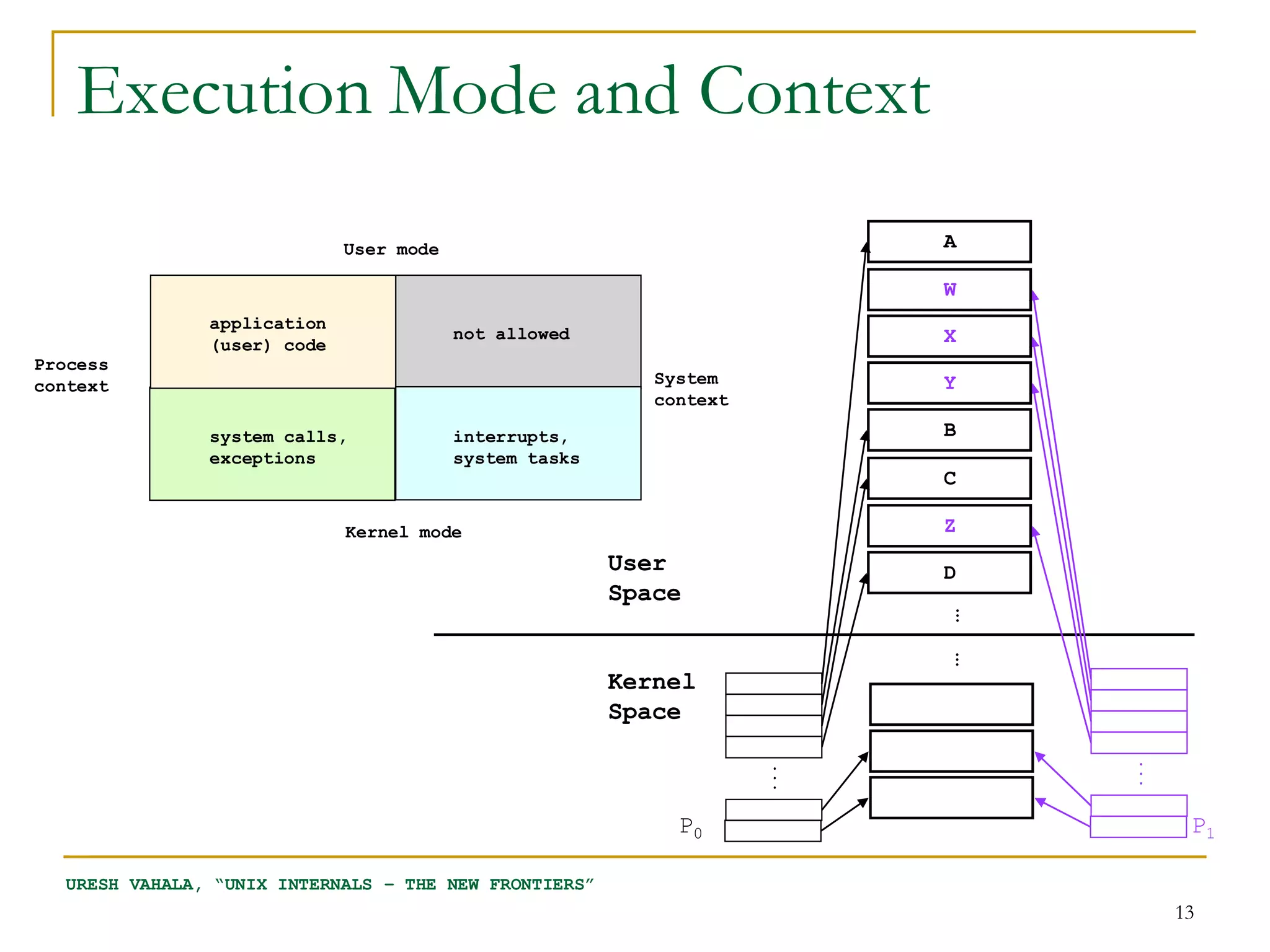
Execution Mode and Context
                             User mode                                     A

                                                                           W
               application
                                         not allowed                       X
               (user) code
Process
context                                                    System          Y
                                                           context

               system calls,             interrupts,                       B
               exceptions                system tasks
                                                                           C

                             Kernel mode                                   Z
                                                        User               D
                                                        Space


                                                                           …
                                                                           …
                                                        Kernel
                                                        Space


                                                                               ...
                                                                     ...


                                                             P0                       P1

  URESH VAHALA, “UNIX INTERNALS – THE NEW FRONTIERS”
                                                                                     13
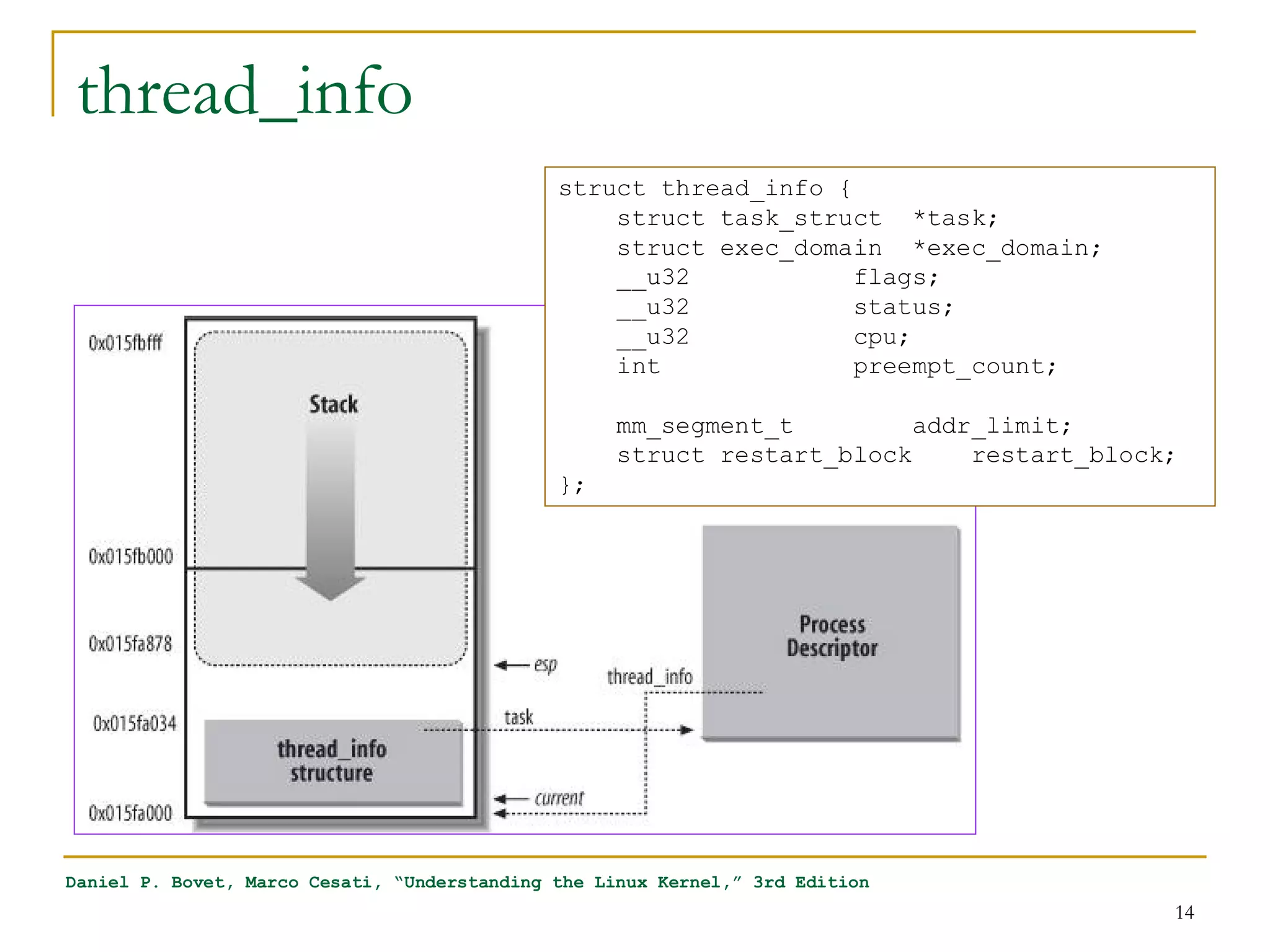
thread_info
                                              struct thread_info {
                                                  struct task_struct *task;
                                                  struct exec_domain *exec_domain;
                                                  __u32            flags;
                                                  __u32            status;
                                                  __u32            cpu;
                                                  int              preempt_count;

                                                    mm_segment_t         addr_limit;
                                                    struct restart_block     restart_block;
                                              };


Daniel P. Bovet, Marco Cesati, “Understanding the Linux Kernel,” 3rd Edition
                                                                                          14
do_fork()                          (1/4)
                                                                                 [kernel/fork.c]


1.    long pid = alloc_pidmap();

2.    if (pid < 0)
3.        return -EAGAIN;
4.    …
5.    p = copy_process(clone_flags, stack_start, regs, stack_size, parent_tidptr, child_tidptr, pid);
6.    if (!IS_ERR(p)) {
7.        struct completion vfork;

8.        if (clone_flags & CLONE_VFORK) {
9.             p->vfork_done = &vfork;
10.            init_completion(&vfork);
11.       }
12.       …
13.       if (!(clone_flags & CLONE_STOPPED))
14.            wake_up_new_task(p, clone_flags);
15.       else
16.            p->state = TASK_STOPPED;
17.       …
18.       if (clone_flags & CLONE_VFORK) {
19.            wait_for_completion(&vfork);
20.            if (unlikely (current->ptrace & PT_TRACE_VFORK_DONE))
21.                ptrace_notify ((PTRACE_EVENT_VFORK_DONE << 8) | SIGTRAP);
22.       }
23.   } else {
24.       free_pidmap(pid);
25.       pid = PTR_ERR(p);
26.   }
27.   return pid;


                                                                                                        15
do_fork()                          (2/4)
                                                                                 [kernel/fork.c]


1.    long pid = alloc_pidmap();

2.    if (pid < 0)
3.        return -EAGAIN;
4.    …
5.    p = copy_process(clone_flags, stack_start, regs, stack_size, parent_tidptr, child_tidptr, pid);
6.    if (!IS_ERR(p)) {
7.        struct completion vfork;

8.        if (clone_flags & CLONE_VFORK) {
9.             p->vfork_done = &vfork;
10.            init_completion(&vfork);
11.       }
12.       …
13.       if (!(clone_flags & CLONE_STOPPED))
14.            wake_up_new_task(p, clone_flags);
15.       else
16.            p->state = TASK_STOPPED;
17.       …
18.       if (clone_flags & CLONE_VFORK) {
19.            wait_for_completion(&vfork);
20.            if (unlikely (current->ptrace & PT_TRACE_VFORK_DONE))
21.                ptrace_notify ((PTRACE_EVENT_VFORK_DONE << 8) | SIGTRAP);
22.       }
23.   } else {
24.       free_pidmap(pid);
25.       pid = PTR_ERR(p);
26.   }
27.   return pid;


                                                                                                        16
do_fork()                          (3/4)
                                                                                 [kernel/fork.c]


1.    long pid = alloc_pidmap();

2.    if (pid < 0)
3.        return -EAGAIN;
4.    …
5.    p = copy_process(clone_flags, stack_start, regs, stack_size, parent_tidptr, child_tidptr, pid);
6.    if (!IS_ERR(p)) {
7.        struct completion vfork;

8.        if (clone_flags & CLONE_VFORK) {
9.             p->vfork_done = &vfork;
10.            init_completion(&vfork);
11.       }
12.       …
13.       if (!(clone_flags & CLONE_STOPPED))
14.            wake_up_new_task(p, clone_flags);
15.       else
16.            p->state = TASK_STOPPED;
17.       …
18.       if (clone_flags & CLONE_VFORK) {
19.            wait_for_completion(&vfork);
20.            if (unlikely (current->ptrace & PT_TRACE_VFORK_DONE))
21.                ptrace_notify ((PTRACE_EVENT_VFORK_DONE << 8) | SIGTRAP);
22.       }
23.   } else {
24.       free_pidmap(pid);
25.       pid = PTR_ERR(p);
26.   }
27.   return pid;


                                                                                                        17
do_fork()                          (4/4)
                                                                                 [kernel/fork.c]


1.    long pid = alloc_pidmap();

2.    if (pid < 0)
3.        return -EAGAIN;
4.    …
5.    p = copy_process(clone_flags, stack_start, regs, stack_size, parent_tidptr, child_tidptr, pid);
6.    if (!IS_ERR(p)) {
7.        struct completion vfork;

8.        if (clone_flags & CLONE_VFORK) {
9.             p->vfork_done = &vfork;
10.            init_completion(&vfork);
11.       }
12.       …
13.       if (!(clone_flags & CLONE_STOPPED))
14.            wake_up_new_task(p, clone_flags);
15.       else
16.            p->state = TASK_STOPPED;
17.       …
18.       if (clone_flags & CLONE_VFORK) {
19.            wait_for_completion(&vfork);
20.            if (unlikely (current->ptrace & PT_TRACE_VFORK_DONE))
21.                ptrace_notify ((PTRACE_EVENT_VFORK_DONE << 8) | SIGTRAP);
22.       }
23.   } else {
24.       free_pidmap(pid);
25.       pid = PTR_ERR(p);
26.   }
27.   return pid;


                                                                                                        18
copy_process()                                           [kernel/fork.c]

  int retval;
  struct task_struct *p = NULL;

  if ((clone_flags & (CLONE_NEWNS|CLONE_FS)) == (CLONE_NEWNS|CLONE_FS))
      return ERR_PTR(-EINVAL);

  /*
   * Thread groups must share signals as well, and detached threads
   * can only be started up within the thread group.
   */
  if ((clone_flags & CLONE_THREAD) && !(clone_flags & CLONE_SIGHAND))
      return ERR_PTR(-EINVAL);

  /*
   * Shared signal handlers imply shared VM. By way of the above,
   * thread groups also imply shared VM. Blocking this case allows
   * for various simplifications in other code.
   */
  if ((clone_flags & CLONE_SIGHAND) && !(clone_flags & CLONE_VM))
      return ERR_PTR(-EINVAL);


                                                                          19
copy_process()
  retval = security_task_create(clone_flags);
  if (retval)
      goto fork_out;

  retval = -ENOMEM;
  p = dup_task_struct(current);
  if (!p)
      goto fork_out;

  retval = -EAGAIN;
  if (atomic_read(&p->user->processes) >=
          p->signal->rlim[RLIMIT_NPROC].rlim_cur) {
      if (!capable(CAP_SYS_ADMIN) && !capable(CAP_SYS_RESOURCE) &&
              p->user != &root_user)
          goto bad_fork_free;
  }

  atomic_inc(&p->user->__count);
  atomic_inc(&p->user->processes);
  get_group_info(p->group_info);


                                                                     20
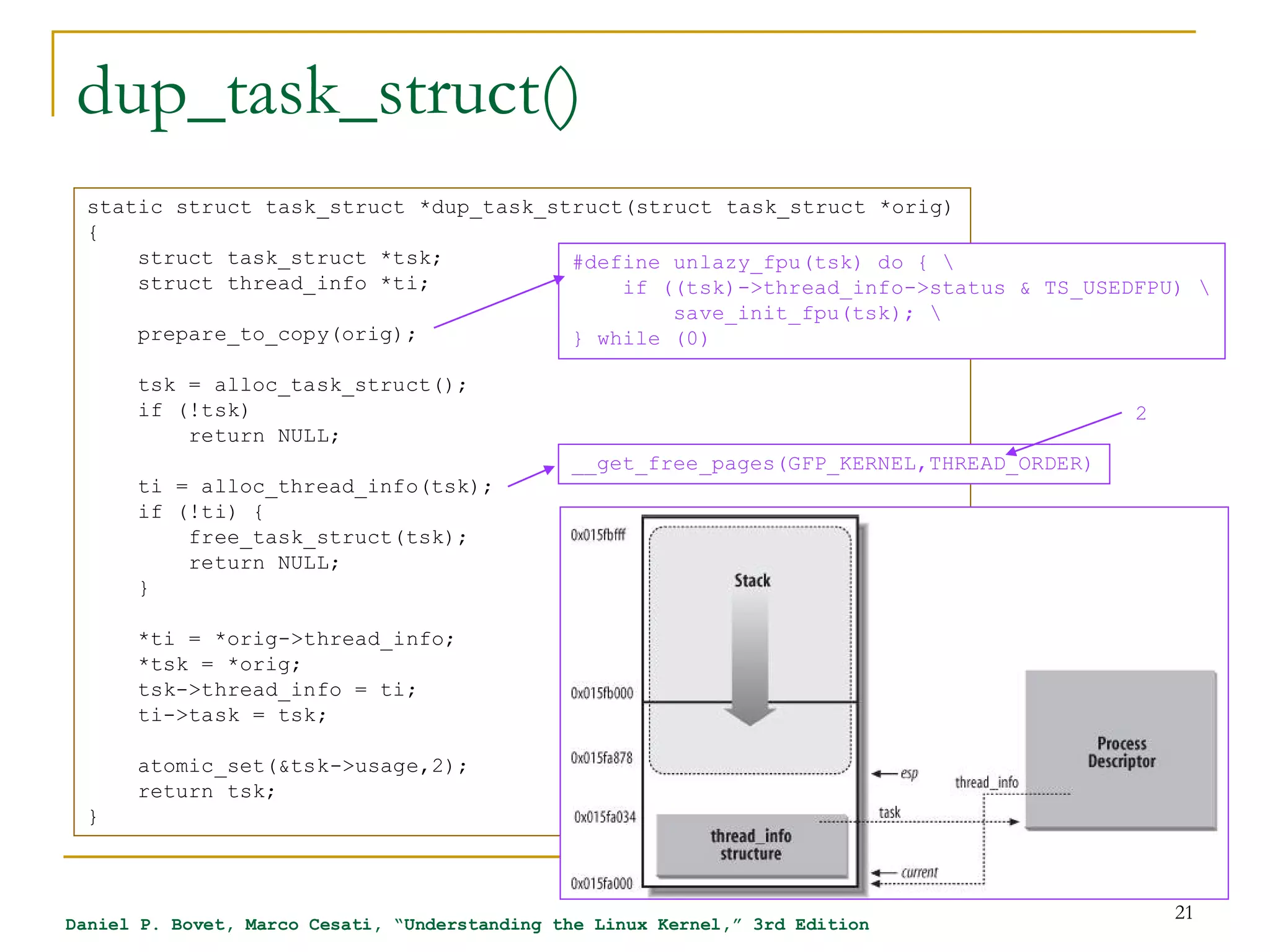
dup_task_struct()
  static struct task_struct *dup_task_struct(struct task_struct *orig)
  {
      struct task_struct *tsk;          #define unlazy_fpu(tsk) do { 
      struct thread_info *ti;               if ((tsk)->thread_info->status & TS_USEDFPU) 
                                                save_init_fpu(tsk); 
      prepare_to_copy(orig);            } while (0)

      tsk = alloc_task_struct();
      if (!tsk)                                                                            2
          return NULL;
                                               __get_free_pages(GFP_KERNEL,THREAD_ORDER)
      ti = alloc_thread_info(tsk);
      if (!ti) {
          free_task_struct(tsk);
          return NULL;
      }

      *ti = *orig->thread_info;
      *tsk = *orig;
      tsk->thread_info = ti;
      ti->task = tsk;

      atomic_set(&tsk->usage,2);
      return tsk;
  }


                                                                                               21
Daniel P. Bovet, Marco Cesati, “Understanding the Linux Kernel,” 3rd Edition
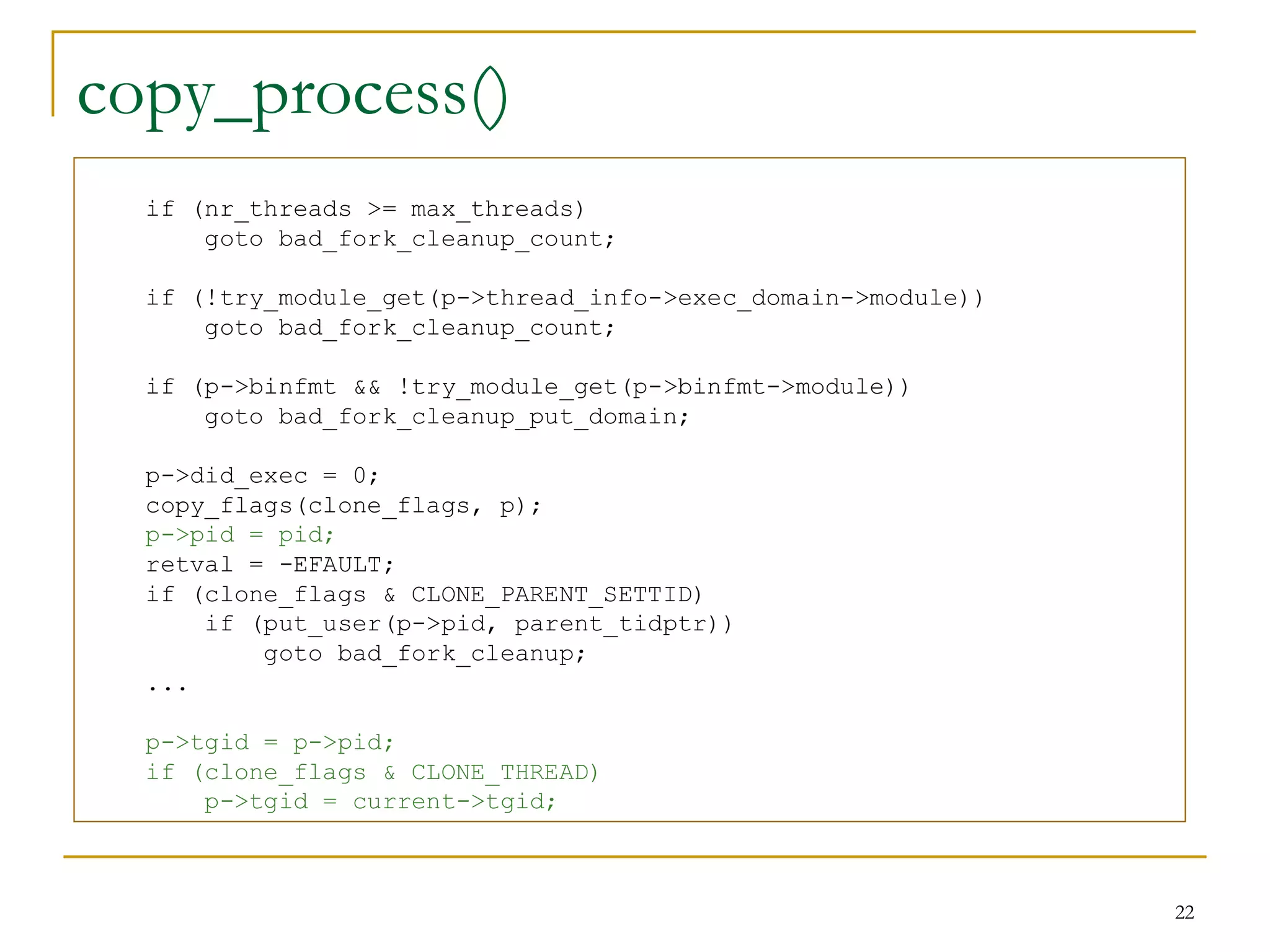
copy_process()
  if (nr_threads >= max_threads)
      goto bad_fork_cleanup_count;

  if (!try_module_get(p->thread_info->exec_domain->module))
      goto bad_fork_cleanup_count;

  if (p->binfmt && !try_module_get(p->binfmt->module))
      goto bad_fork_cleanup_put_domain;

  p->did_exec = 0;
  copy_flags(clone_flags, p);
  p->pid = pid;
  retval = -EFAULT;
  if (clone_flags & CLONE_PARENT_SETTID)
      if (put_user(p->pid, parent_tidptr))
          goto bad_fork_cleanup;
  ...

  p->tgid = p->pid;
  if (clone_flags & CLONE_THREAD)
      p->tgid = current->tgid;


                                                              22
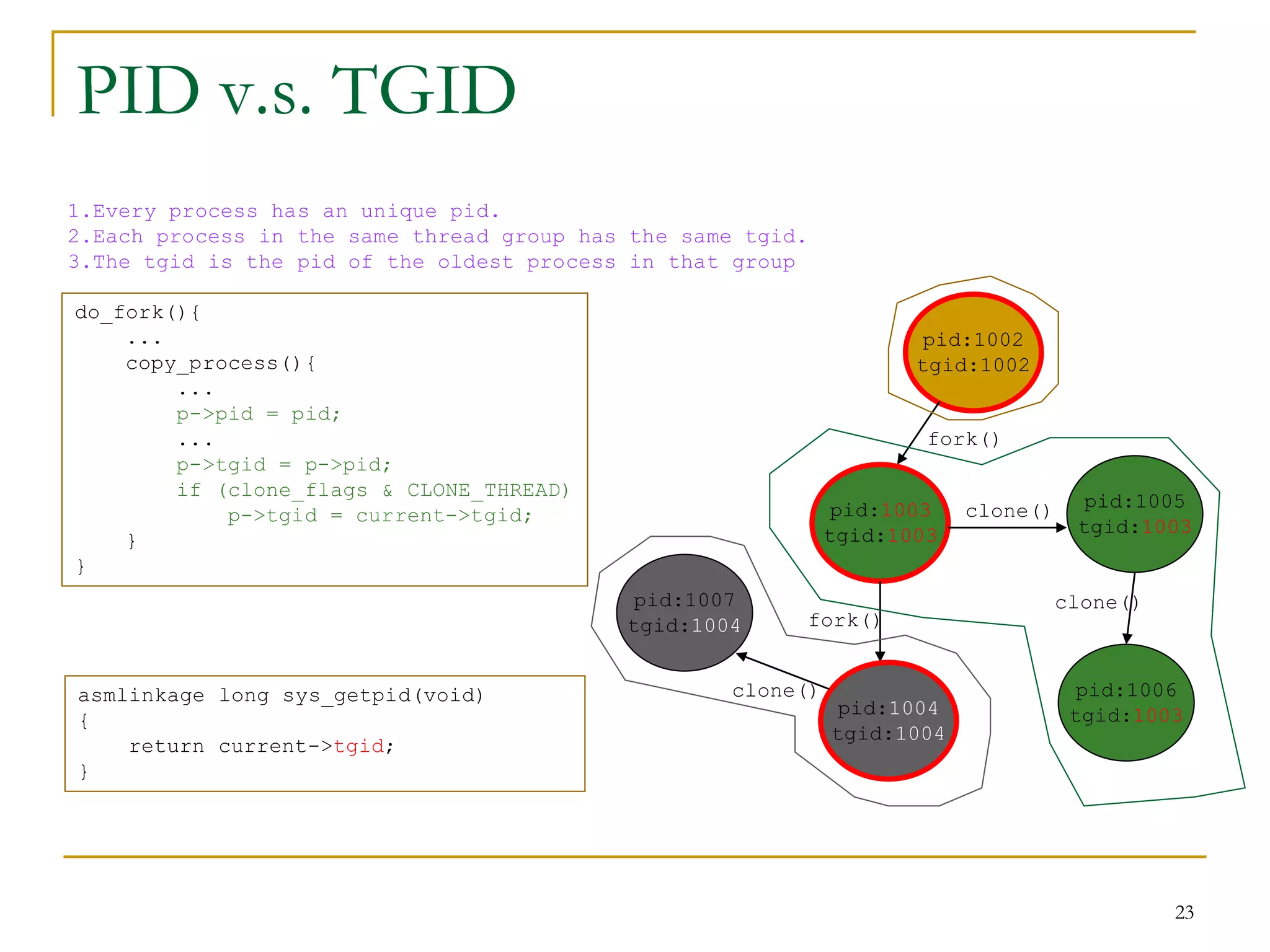
PID v.s. TGID
1.Every process has an unique pid.
2.Each process in the same thread group has the same tgid.
3.The tgid is the pid of the oldest process in that group

do_fork(){
    ...                                                               pid:1002
    copy_process(){                                                  tgid:1002
        ...
        p->pid = pid;
        ...                                                           fork()
        p->tgid = p->pid;
        if (clone_flags & CLONE_THREAD)
                                                              pid:1003    clone()     pid:1005
            p->tgid = current->tgid;
                                                              tgid:1003              tgid:1003
    }
}
                                           pid:1007                                 clone()
                                           tgid:1004     fork()


asmlinkage long sys_getpid(void)                    clone()                          pid:1006
                                                              pid:1004               tgid:1003
{
                                                              tgid:1004
    return current->tgid;
}


                                                                                              23
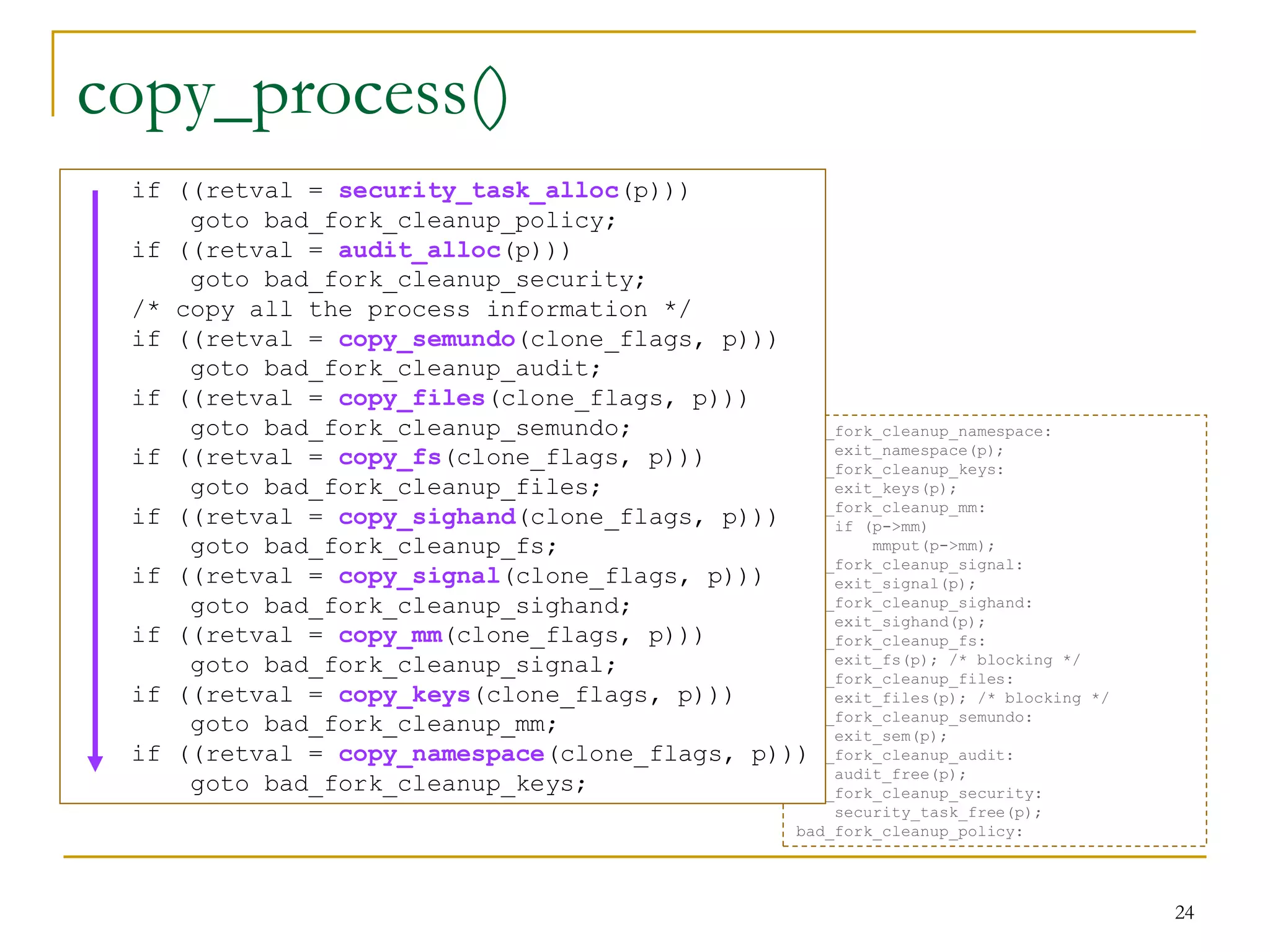
copy_process()
 if ((retval = security_task_alloc(p)))
     goto bad_fork_cleanup_policy;
 if ((retval = audit_alloc(p)))
     goto bad_fork_cleanup_security;
 /* copy all the process information */
 if ((retval = copy_semundo(clone_flags, p)))
     goto bad_fork_cleanup_audit;
 if ((retval = copy_files(clone_flags, p)))
     goto bad_fork_cleanup_semundo;           bad_fork_cleanup_namespace:
                                                  exit_namespace(p);
 if ((retval = copy_fs(clone_flags, p)))      bad_fork_cleanup_keys:
     goto bad_fork_cleanup_files;                 exit_keys(p);
                                              bad_fork_cleanup_mm:
 if ((retval = copy_sighand(clone_flags, p)))     if (p->mm)
     goto bad_fork_cleanup_fs;                        mmput(p->mm);
                                              bad_fork_cleanup_signal:
 if ((retval = copy_signal(clone_flags, p)))      exit_signal(p);
     goto bad_fork_cleanup_sighand;           bad_fork_cleanup_sighand:
                                                  exit_sighand(p);
 if ((retval = copy_mm(clone_flags, p)))      bad_fork_cleanup_fs:
     goto bad_fork_cleanup_signal;                exit_fs(p); /* blocking */
                                              bad_fork_cleanup_files:
 if ((retval = copy_keys(clone_flags, p)))        exit_files(p); /* blocking      */
                                              bad_fork_cleanup_semundo:
     goto bad_fork_cleanup_mm;                    exit_sem(p);
 if ((retval = copy_namespace(clone_flags, p)))
                                              bad_fork_cleanup_audit:
                                                  audit_free(p);
     goto bad_fork_cleanup_keys;              bad_fork_cleanup_security:
                                                         security_task_free(p);
                                                     bad_fork_cleanup_policy:


                                                                                       24
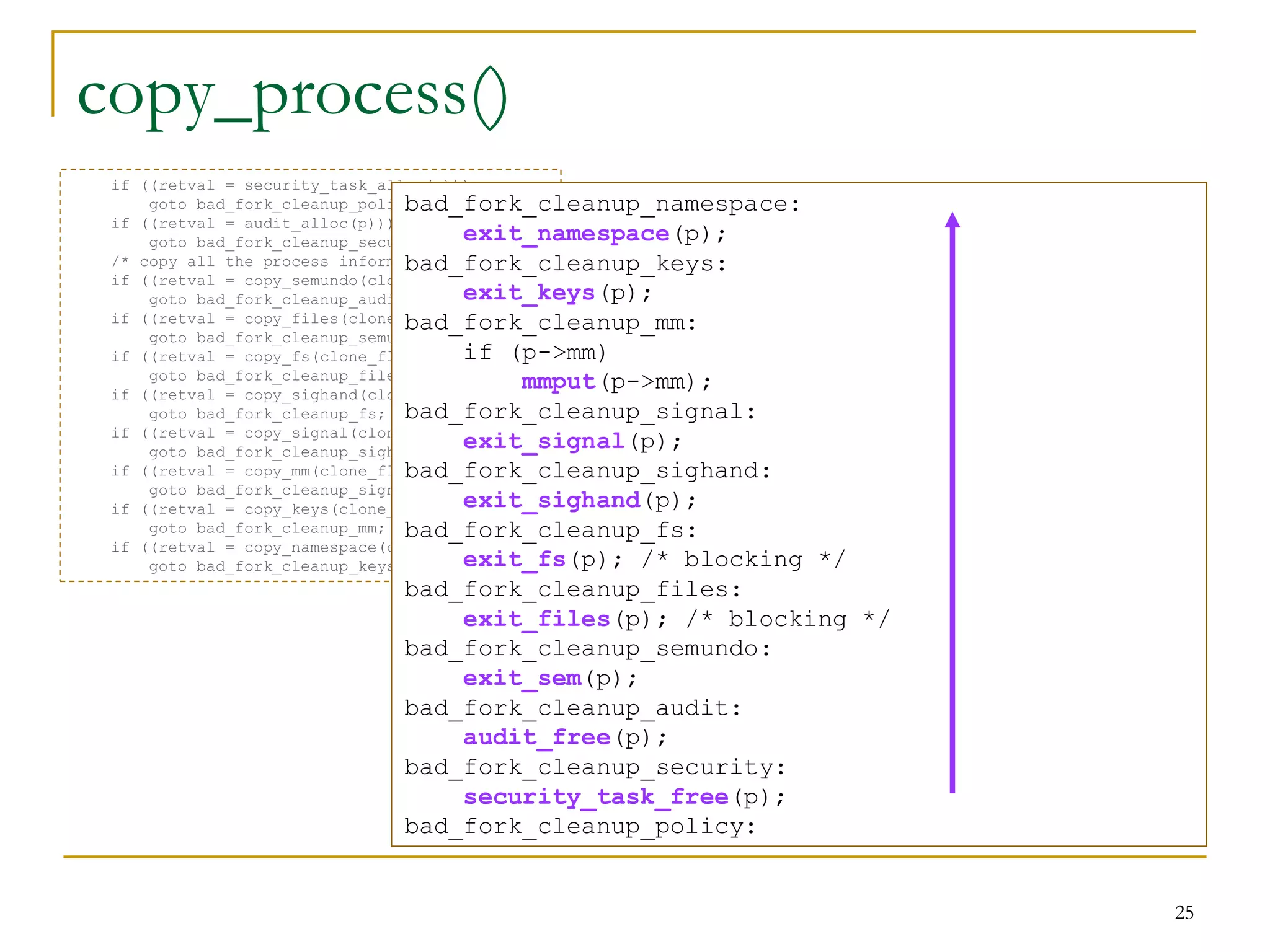
copy_process()
 if ((retval = security_task_alloc(p)))
                                bad_fork_cleanup_namespace:
     goto bad_fork_cleanup_policy;
 if ((retval = audit_alloc(p)))
     goto bad_fork_cleanup_security; exit_namespace(p);
                                bad_fork_cleanup_keys:
 /* copy all the process information */
 if ((retval = copy_semundo(clone_flags, p)))
     goto bad_fork_cleanup_audit;     exit_keys(p);
                                bad_fork_cleanup_mm:
 if ((retval = copy_files(clone_flags, p)))
     goto bad_fork_cleanup_semundo;
                                      if (p->mm)
 if ((retval = copy_fs(clone_flags, p)))
     goto bad_fork_cleanup_files;
 if ((retval = copy_sighand(clone_flags, p)))
                                             mmput(p->mm);
     goto bad_fork_cleanup_fs; bad_fork_cleanup_signal:
 if ((retval = copy_signal(clone_flags, p)))
     goto bad_fork_cleanup_sighand;
                                      exit_signal(p);
                                bad_fork_cleanup_sighand:
 if ((retval = copy_mm(clone_flags, p)))
     goto bad_fork_cleanup_signal;
                                      exit_sighand(p);
 if ((retval = copy_keys(clone_flags, p)))
     goto bad_fork_cleanup_mm; bad_fork_cleanup_fs:
 if ((retval = copy_namespace(clone_flags, p)))
     goto bad_fork_cleanup_keys;      exit_fs(p); /* blocking   */
                          bad_fork_cleanup_files:
                              exit_files(p); /* blocking */
                          bad_fork_cleanup_semundo:
                              exit_sem(p);
                          bad_fork_cleanup_audit:
                              audit_free(p);
                          bad_fork_cleanup_security:
                              security_task_free(p);
                          bad_fork_cleanup_policy:


                                                                     25
context_swtich()
                                                               [kernel/sched.c]
1.    static inline
2.    task_t * context_switch(runqueue_t *rq, task_t *prev, task_t *next)
3.    {
4.        struct mm_struct *mm = next->mm;
5.        struct mm_struct *oldmm = prev->active_mm;

6.       if (unlikely(!mm)) {
7.           next->active_mm = oldmm;
8.           atomic_inc(&oldmm->mm_count);
9.           enter_lazy_tlb(oldmm, next);
10.      } else
11.          switch_mm(oldmm, mm, next);

12.      if (unlikely(!prev->mm)) {
13.          prev->active_mm = NULL;
14.          WARN_ON(rq->prev_mm);
15.          rq->prev_mm = oldmm;
16.      }

17.      /* Here we just switch the register state and the stack. */
18.      switch_to(prev, next, prev);

19.      return prev;
20. }


                                                                                  26

Process Management

  • 1.
    Process Management Roy Lee, 20 June 2005 NCTU Computer Operating System Lab 1
  • 2.
    Process State  Newly Created.  Runnable & Running  Expired  Interrupted  Resume  Terminated Robert Love, “Linux Kernel Development,” 2nd Edition 2
  • 3.
    Process Creation –fork() fork() exec() Copy the whole address space Discard the current address space and the page table and load another program A A A A W Parent Parent Child Parent Child B X C Y B B B ... ... ... ... ... C C C D Z D D D ... ... ... 3
  • 4.
    Process Creation –vfork() vfork() exec() Copy the whole address space Discard the current address space and the page table and load another program A A A W Parent Parent Parent Child Child X Y B B B ... ... ... ... C C C Z D D D ... ... ... 4
  • 5.
    Process Creation –Copy-on-Write fork() copy-on-write Only copy the page table Delay or altogether prevent copying of data A A A B’ Parent Parent Child Parent Child B B B ... ... ... ... ... C C C D D D ... ... ... 5
  • 6.
    Process Creation –Copy-on-Write fork() exec() Only copy the page table Delay or altogether prevent copying of data A A A W Parent Parent Child Parent Child X Y B B B ... ... ... ... ... C C C Z D D D ... ... ... 6
  • 7.
    task_struct [include/linux/sched.h] RobertLove, “Linux Kernel Development,” 2nd Edition Daniel P. Bovet, Marco Cesati, “Understanding the Linux Kernel,” 3rd Edition 7
  • 8.
    Process Creation -Threads  Threads in Linux  To linux, threads are just processes that share more certain resources.  Clone() - The heart of the Linux implementation of threads  Threads are created like normal tasks, except that the clone() syscall is passed flags indicating to specific resources to be shared clone(CLONE_VM | CLONE_FS | CLONE_FILES | CLONE_SIGHAND, 0);  Actully both fork() and vfork() are also implemented via the clone() syscall clone(SIGCHLD, 0); clone(CLONE_VFORK | CLONE_VM | SIGCHLD, 0); 8
  • 9.
    Process Creation Flow User space sys_fork() sys_vfork() sys_clone() Kernel space [kernel/process.c] [kernel/fork.c] do_fork() [kernel/sched.c] alloc_pidmap() duplicate the task_struct, initialize it copy_process() and setup according to the specified clone_flags success? yes wake_up_new_task() put the child into runqueue no free_pidmap() vfork? wait_for_completion() yes when the child terminates, no it wakes up the parent sleeping in the wait queue return pid 9
  • 10.
    Process State preempted schedule ready running fork exit initial asleep zombie 10
  • 11.
    Process State interrupt preempted syscall, exception schedule kernel user ready running running return fork exit initial asleep zombie 11
  • 12.
    Execution Mode andContext User mode application not allowed (user) code Process System context context system calls, interrupts, exceptions system tasks Kernel mode URESH VAHALA, “UNIX INTERNALS – THE NEW FRONTIERS” 12
  • 13.
    Execution Mode andContext User mode A W application not allowed X (user) code Process context System Y context system calls, interrupts, B exceptions system tasks C Kernel mode Z User D Space … … Kernel Space ... ... P0 P1 URESH VAHALA, “UNIX INTERNALS – THE NEW FRONTIERS” 13
  • 14.
    thread_info struct thread_info { struct task_struct *task; struct exec_domain *exec_domain; __u32 flags; __u32 status; __u32 cpu; int preempt_count; mm_segment_t addr_limit; struct restart_block restart_block; }; Daniel P. Bovet, Marco Cesati, “Understanding the Linux Kernel,” 3rd Edition 14
  • 15.
    do_fork() (1/4) [kernel/fork.c] 1. long pid = alloc_pidmap(); 2. if (pid < 0) 3. return -EAGAIN; 4. … 5. p = copy_process(clone_flags, stack_start, regs, stack_size, parent_tidptr, child_tidptr, pid); 6. if (!IS_ERR(p)) { 7. struct completion vfork; 8. if (clone_flags & CLONE_VFORK) { 9. p->vfork_done = &vfork; 10. init_completion(&vfork); 11. } 12. … 13. if (!(clone_flags & CLONE_STOPPED)) 14. wake_up_new_task(p, clone_flags); 15. else 16. p->state = TASK_STOPPED; 17. … 18. if (clone_flags & CLONE_VFORK) { 19. wait_for_completion(&vfork); 20. if (unlikely (current->ptrace & PT_TRACE_VFORK_DONE)) 21. ptrace_notify ((PTRACE_EVENT_VFORK_DONE << 8) | SIGTRAP); 22. } 23. } else { 24. free_pidmap(pid); 25. pid = PTR_ERR(p); 26. } 27. return pid; 15
  • 16.
    do_fork() (2/4) [kernel/fork.c] 1. long pid = alloc_pidmap(); 2. if (pid < 0) 3. return -EAGAIN; 4. … 5. p = copy_process(clone_flags, stack_start, regs, stack_size, parent_tidptr, child_tidptr, pid); 6. if (!IS_ERR(p)) { 7. struct completion vfork; 8. if (clone_flags & CLONE_VFORK) { 9. p->vfork_done = &vfork; 10. init_completion(&vfork); 11. } 12. … 13. if (!(clone_flags & CLONE_STOPPED)) 14. wake_up_new_task(p, clone_flags); 15. else 16. p->state = TASK_STOPPED; 17. … 18. if (clone_flags & CLONE_VFORK) { 19. wait_for_completion(&vfork); 20. if (unlikely (current->ptrace & PT_TRACE_VFORK_DONE)) 21. ptrace_notify ((PTRACE_EVENT_VFORK_DONE << 8) | SIGTRAP); 22. } 23. } else { 24. free_pidmap(pid); 25. pid = PTR_ERR(p); 26. } 27. return pid; 16
  • 17.
    do_fork() (3/4) [kernel/fork.c] 1. long pid = alloc_pidmap(); 2. if (pid < 0) 3. return -EAGAIN; 4. … 5. p = copy_process(clone_flags, stack_start, regs, stack_size, parent_tidptr, child_tidptr, pid); 6. if (!IS_ERR(p)) { 7. struct completion vfork; 8. if (clone_flags & CLONE_VFORK) { 9. p->vfork_done = &vfork; 10. init_completion(&vfork); 11. } 12. … 13. if (!(clone_flags & CLONE_STOPPED)) 14. wake_up_new_task(p, clone_flags); 15. else 16. p->state = TASK_STOPPED; 17. … 18. if (clone_flags & CLONE_VFORK) { 19. wait_for_completion(&vfork); 20. if (unlikely (current->ptrace & PT_TRACE_VFORK_DONE)) 21. ptrace_notify ((PTRACE_EVENT_VFORK_DONE << 8) | SIGTRAP); 22. } 23. } else { 24. free_pidmap(pid); 25. pid = PTR_ERR(p); 26. } 27. return pid; 17
  • 18.
    do_fork() (4/4) [kernel/fork.c] 1. long pid = alloc_pidmap(); 2. if (pid < 0) 3. return -EAGAIN; 4. … 5. p = copy_process(clone_flags, stack_start, regs, stack_size, parent_tidptr, child_tidptr, pid); 6. if (!IS_ERR(p)) { 7. struct completion vfork; 8. if (clone_flags & CLONE_VFORK) { 9. p->vfork_done = &vfork; 10. init_completion(&vfork); 11. } 12. … 13. if (!(clone_flags & CLONE_STOPPED)) 14. wake_up_new_task(p, clone_flags); 15. else 16. p->state = TASK_STOPPED; 17. … 18. if (clone_flags & CLONE_VFORK) { 19. wait_for_completion(&vfork); 20. if (unlikely (current->ptrace & PT_TRACE_VFORK_DONE)) 21. ptrace_notify ((PTRACE_EVENT_VFORK_DONE << 8) | SIGTRAP); 22. } 23. } else { 24. free_pidmap(pid); 25. pid = PTR_ERR(p); 26. } 27. return pid; 18
  • 19.
    copy_process() [kernel/fork.c] int retval; struct task_struct *p = NULL; if ((clone_flags & (CLONE_NEWNS|CLONE_FS)) == (CLONE_NEWNS|CLONE_FS)) return ERR_PTR(-EINVAL); /* * Thread groups must share signals as well, and detached threads * can only be started up within the thread group. */ if ((clone_flags & CLONE_THREAD) && !(clone_flags & CLONE_SIGHAND)) return ERR_PTR(-EINVAL); /* * Shared signal handlers imply shared VM. By way of the above, * thread groups also imply shared VM. Blocking this case allows * for various simplifications in other code. */ if ((clone_flags & CLONE_SIGHAND) && !(clone_flags & CLONE_VM)) return ERR_PTR(-EINVAL); 19
  • 20.
    copy_process() retval= security_task_create(clone_flags); if (retval) goto fork_out; retval = -ENOMEM; p = dup_task_struct(current); if (!p) goto fork_out; retval = -EAGAIN; if (atomic_read(&p->user->processes) >= p->signal->rlim[RLIMIT_NPROC].rlim_cur) { if (!capable(CAP_SYS_ADMIN) && !capable(CAP_SYS_RESOURCE) && p->user != &root_user) goto bad_fork_free; } atomic_inc(&p->user->__count); atomic_inc(&p->user->processes); get_group_info(p->group_info); 20
  • 21.
    dup_task_struct() staticstruct task_struct *dup_task_struct(struct task_struct *orig) { struct task_struct *tsk; #define unlazy_fpu(tsk) do { struct thread_info *ti; if ((tsk)->thread_info->status & TS_USEDFPU) save_init_fpu(tsk); prepare_to_copy(orig); } while (0) tsk = alloc_task_struct(); if (!tsk) 2 return NULL; __get_free_pages(GFP_KERNEL,THREAD_ORDER) ti = alloc_thread_info(tsk); if (!ti) { free_task_struct(tsk); return NULL; } *ti = *orig->thread_info; *tsk = *orig; tsk->thread_info = ti; ti->task = tsk; atomic_set(&tsk->usage,2); return tsk; } 21 Daniel P. Bovet, Marco Cesati, “Understanding the Linux Kernel,” 3rd Edition
  • 22.
    copy_process() if(nr_threads >= max_threads) goto bad_fork_cleanup_count; if (!try_module_get(p->thread_info->exec_domain->module)) goto bad_fork_cleanup_count; if (p->binfmt && !try_module_get(p->binfmt->module)) goto bad_fork_cleanup_put_domain; p->did_exec = 0; copy_flags(clone_flags, p); p->pid = pid; retval = -EFAULT; if (clone_flags & CLONE_PARENT_SETTID) if (put_user(p->pid, parent_tidptr)) goto bad_fork_cleanup; ... p->tgid = p->pid; if (clone_flags & CLONE_THREAD) p->tgid = current->tgid; 22
  • 23.
    PID v.s. TGID 1.Everyprocess has an unique pid. 2.Each process in the same thread group has the same tgid. 3.The tgid is the pid of the oldest process in that group do_fork(){ ... pid:1002 copy_process(){ tgid:1002 ... p->pid = pid; ... fork() p->tgid = p->pid; if (clone_flags & CLONE_THREAD) pid:1003 clone() pid:1005 p->tgid = current->tgid; tgid:1003 tgid:1003 } } pid:1007 clone() tgid:1004 fork() asmlinkage long sys_getpid(void) clone() pid:1006 pid:1004 tgid:1003 { tgid:1004 return current->tgid; } 23
  • 24.
    copy_process() if ((retval= security_task_alloc(p))) goto bad_fork_cleanup_policy; if ((retval = audit_alloc(p))) goto bad_fork_cleanup_security; /* copy all the process information */ if ((retval = copy_semundo(clone_flags, p))) goto bad_fork_cleanup_audit; if ((retval = copy_files(clone_flags, p))) goto bad_fork_cleanup_semundo; bad_fork_cleanup_namespace: exit_namespace(p); if ((retval = copy_fs(clone_flags, p))) bad_fork_cleanup_keys: goto bad_fork_cleanup_files; exit_keys(p); bad_fork_cleanup_mm: if ((retval = copy_sighand(clone_flags, p))) if (p->mm) goto bad_fork_cleanup_fs; mmput(p->mm); bad_fork_cleanup_signal: if ((retval = copy_signal(clone_flags, p))) exit_signal(p); goto bad_fork_cleanup_sighand; bad_fork_cleanup_sighand: exit_sighand(p); if ((retval = copy_mm(clone_flags, p))) bad_fork_cleanup_fs: goto bad_fork_cleanup_signal; exit_fs(p); /* blocking */ bad_fork_cleanup_files: if ((retval = copy_keys(clone_flags, p))) exit_files(p); /* blocking */ bad_fork_cleanup_semundo: goto bad_fork_cleanup_mm; exit_sem(p); if ((retval = copy_namespace(clone_flags, p))) bad_fork_cleanup_audit: audit_free(p); goto bad_fork_cleanup_keys; bad_fork_cleanup_security: security_task_free(p); bad_fork_cleanup_policy: 24
  • 25.
    copy_process() if ((retval= security_task_alloc(p))) bad_fork_cleanup_namespace: goto bad_fork_cleanup_policy; if ((retval = audit_alloc(p))) goto bad_fork_cleanup_security; exit_namespace(p); bad_fork_cleanup_keys: /* copy all the process information */ if ((retval = copy_semundo(clone_flags, p))) goto bad_fork_cleanup_audit; exit_keys(p); bad_fork_cleanup_mm: if ((retval = copy_files(clone_flags, p))) goto bad_fork_cleanup_semundo; if (p->mm) if ((retval = copy_fs(clone_flags, p))) goto bad_fork_cleanup_files; if ((retval = copy_sighand(clone_flags, p))) mmput(p->mm); goto bad_fork_cleanup_fs; bad_fork_cleanup_signal: if ((retval = copy_signal(clone_flags, p))) goto bad_fork_cleanup_sighand; exit_signal(p); bad_fork_cleanup_sighand: if ((retval = copy_mm(clone_flags, p))) goto bad_fork_cleanup_signal; exit_sighand(p); if ((retval = copy_keys(clone_flags, p))) goto bad_fork_cleanup_mm; bad_fork_cleanup_fs: if ((retval = copy_namespace(clone_flags, p))) goto bad_fork_cleanup_keys; exit_fs(p); /* blocking */ bad_fork_cleanup_files: exit_files(p); /* blocking */ bad_fork_cleanup_semundo: exit_sem(p); bad_fork_cleanup_audit: audit_free(p); bad_fork_cleanup_security: security_task_free(p); bad_fork_cleanup_policy: 25
  • 26.
    context_swtich() [kernel/sched.c] 1. static inline 2. task_t * context_switch(runqueue_t *rq, task_t *prev, task_t *next) 3. { 4. struct mm_struct *mm = next->mm; 5. struct mm_struct *oldmm = prev->active_mm; 6. if (unlikely(!mm)) { 7. next->active_mm = oldmm; 8. atomic_inc(&oldmm->mm_count); 9. enter_lazy_tlb(oldmm, next); 10. } else 11. switch_mm(oldmm, mm, next); 12. if (unlikely(!prev->mm)) { 13. prev->active_mm = NULL; 14. WARN_ON(rq->prev_mm); 15. rq->prev_mm = oldmm; 16. } 17. /* Here we just switch the register state and the stack. */ 18. switch_to(prev, next, prev); 19. return prev; 20. } 26