C.K. PITHAWALA COLLAGE OF
ENGINEERING AND TECHNOLOGY
DEPARTMENT
OF
MECHANICAL ENGINEERING
A Presentation of Winter Internship
At
J.P.C ENTERPRISES Under SIEMENS
Submitted by
ASHWIN ANIL
Enrolment No. 190093119001
in partial fulfilment for the award of the degree of
BACHELOR OF ENGINEERING
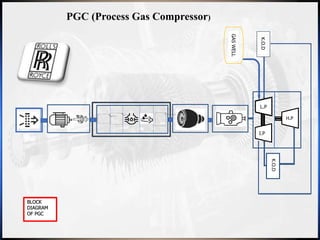
L.P
I.P
H.P
K.O.D
K.O.D
GAS
WELL
BLOCK
DIAGRAM
OF PGC
PGC (Process Gas Compressor)
OVERHAULING OF PT (POWER TURBINE)
What is the purpose of overhauling?
Overhauling of a machine is defined as a process of general maintenance performed on a machine or other industrial equipment.
The goal of overhauling is to keep the system in serviceable condition. Regular checks can prevent all kinds of critical damage.
PROCEDURE OF RT56 PT OVERHAULING
• The overhauling of PT starts with pre-shutdown activities.
• Pre- shutdown parameters like vibration and temperature valves are noted down before
shutting down the system.
• Shutdown by isolation of electrical and instrument systems and also positive isolation of
fuel gas system.
• Draining of fuel gas to the pipelines and positive isolation of fuel gas system.
• Isolation of all the compressor inlet and outlet pipelines.
• Removal of starter shaft along with inlet bullet.
• Removal of all bleed pipelines lube oil supply and drain lines
• Removal of guide vane control system of Gas Generator
• Removal of rim cooling piping’s connected between g,g and p,t
• Removal of g,g inlet bell mouth
• Removal of transiton duct between diffuser and g,g exhaust
• Positioning of g.g lifting tool on g.g
• Removal of g.g and placing it on g.g engine cradle.
• Removal p.t inlet diffuser assembly along with 1st satge stator vanes
• Removal of rim cooling manifold from 1st stage nozzle casing along with honeycomb
retaining ring
• Removal of 1st stage honeycomb seal.
• Removal of 2nd stage stator vanes from 2nd stage nozzle casing.
• Removal of 2nd stage nozzle casing along with2nd stage honeycomb seal.
• Removal of top and bottom coupling guard between gearbox and P.T
• Removal of coupling guard adaptor rings.
• Removal of coupling spacer or torque meter.
• Removal of conduits of vibration probes and speed pickup probes from middle and inner
bearing cover.
• Removal of middle and inner bearing covers.
• Installation of dummy shipping bracket for safety before removing the thrust and
journal bearing.
• Removing all the RTD cables from the bearings.
• Removal of top and bottom thrust bearing housing.
• Removal of thrust bearing which is pad type.
• Removal of coupling end and disc end journal bearing caps.
• Removal of pt hub by hydraulic pump method.
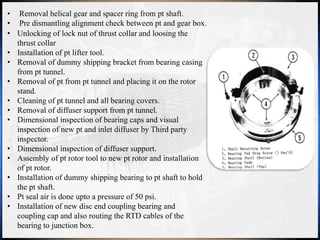
• Removal helical gear and spacer ring from pt shaft.
• Pre dismantling alignment check between pt and gear box.
• Unlocking of lock nut of thrust collar and loosing the
thrust collar
• Installation of pt lifter tool.
• Removal of dummy shipping bracket from bearing casing
from pt tunnel.
• Removal of pt from pt tunnel and placing it on the rotor
stand.
• Cleaning of pt tunnel and all bearing covers.
• Removal of diffuser support from pt tunnel.
• Dimensional inspection of bearing caps and visual
inspection of new pt and inlet diffuser by Third party
inspector.
• Dimensional inspection of diffuser support.
• Assembly of pt rotor tool to new pt rotor and installation
of pt rotor.
• Installation of dummy shipping bearing to pt shaft to hold
the pt shaft.
• Pt seal air is done upto a pressure of 50 psi.
• Installation of new disc end coupling bearing and
coupling cap and also routing the RTD cables of the
bearing to junction box.
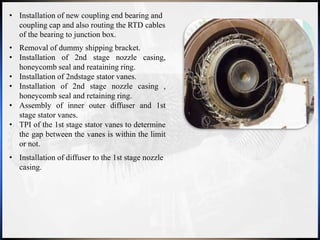
• Removal of dummy shipping bracket.
• Installation of 2nd stage nozzle casing,
honeycomb seal and reataining ring.
• Installation of 2ndstage stator vanes.
• Installation of 2nd stage nozzle casing ,
honeycomb seal and retaining ring.
• Assembly of inner outer diffuser and 1st
stage stator vanes.
• TPI of the 1st stage stator vanes to determine
the gap between the vanes is within the limit
or not.
• Installation of new coupling end bearing and
coupling cap and also routing the RTD cables
of the bearing to junction box.
• Installation of diffuser to the 1st stage nozzle
casing.
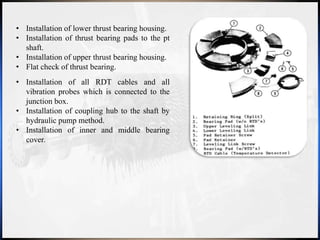
• Installation of lower thrust bearing housing.
• Installation of thrust bearing pads to the pt
shaft.
• Installation of upper thrust bearing housing.
• Flat check of thrust bearing.
• Installation of all RDT cables and all
vibration probes which is connected to the
junction box.
• Installation of coupling hub to the shaft by
hydraulic pump method.
• Installation of inner and middle bearing
cover.
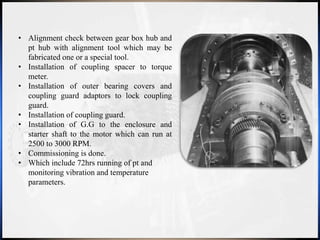
• Alignment check between gear box hub and
pt hub with alignment tool which may be
fabricated one or a special tool.
• Installation of coupling spacer to torque
meter.
• Installation of outer bearing covers and
coupling guard adaptors to lock coupling
guard.
• Installation of coupling guard.
• Installation of G.G to the enclosure and
starter shaft to the motor which can run at
2500 to 3000 RPM.
• Commissioning is done.
• Which include 72hrs running of pt and
monitoring vibration and temperature
parameters.
INSTRUMENTS USED
 Vibration probes
 Speed pickup probes
 RTD
 Pressure sensors
 Thermocouples
MEASURING INSTRUMENTS
 Vernier caliper
 Depth gauge
 Outside micrometer
 Inside micrometer
 Feller gauge
 Spirit level
PROBLEM FACED
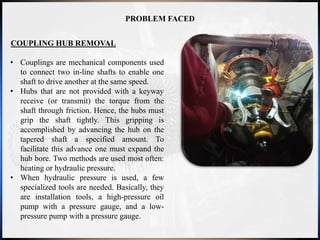
COUPLING HUB REMOVAL
• Couplings are mechanical components used
to connect two in-line shafts to enable one
shaft to drive another at the same speed.
• Hubs that are not provided with a keyway
receive (or transmit) the torque from the
shaft through friction. Hence, the hubs must
grip the shaft tightly. This gripping is
accomplished by advancing the hub on the
tapered shaft a specified amount. To
facilitate this advance one must expand the
hub bore. Two methods are used most often:
heating or hydraulic pressure.
• When hydraulic pressure is used, a few
specialized tools are needed. Basically, they
are installation tools, a high-pressure oil
pump with a pressure gauge, and a low-
pressure pump with a pressure gauge.
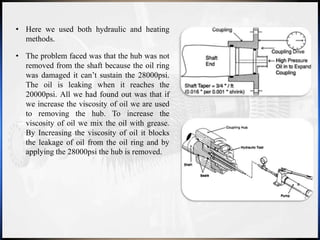
• Here we used both hydraulic and heating
methods.
• The problem faced was that the hub was not
removed from the shaft because the oil ring
was damaged it can’t sustain the 28000psi.
The oil is leaking when it reaches the
20000psi. All we had found out was that if
we increase the viscosity of oil we are used
to removing the hub. To increase the
viscosity of oil we mix the oil with grease.
By Increasing the viscosity of oil it blocks
the leakage of oil from the oil ring and by
applying the 28000psi the hub is removed.
CONCLUSION
The internship of duration 12 weeks at NQO ONGC Offshore Mumbai high (India) has helped
me to develop a better understanding about the process gas compressor Machine (PGC) and P.T
overhauling. I have gained technical knowledge regarding PGC machine how it transfer the oil
to MUT line and the Overhauling of P.T. This internship connects the knowledge I learned in the
classroom with real life applications which gives me ultimate experience. My concept regarding
Gas turbine, PGC and PT was not that clear but when I joined the internship then I got to know
what actual scenario is going on in this field with detailed description. This internship has taught
me the importance of managerial and supervisors’ skill and team work in the offshore plant
impossible. This internship has truly been outstanding and benefitted me for the future.

PROCESS GAS COMPRESSOR AND PT OVERHAULING

  • 1.
    C.K. PITHAWALA COLLAGEOF ENGINEERING AND TECHNOLOGY DEPARTMENT OF MECHANICAL ENGINEERING A Presentation of Winter Internship At J.P.C ENTERPRISES Under SIEMENS Submitted by ASHWIN ANIL Enrolment No. 190093119001 in partial fulfilment for the award of the degree of BACHELOR OF ENGINEERING
  • 2.
  • 3.
    OVERHAULING OF PT(POWER TURBINE) What is the purpose of overhauling? Overhauling of a machine is defined as a process of general maintenance performed on a machine or other industrial equipment. The goal of overhauling is to keep the system in serviceable condition. Regular checks can prevent all kinds of critical damage. PROCEDURE OF RT56 PT OVERHAULING • The overhauling of PT starts with pre-shutdown activities. • Pre- shutdown parameters like vibration and temperature valves are noted down before shutting down the system. • Shutdown by isolation of electrical and instrument systems and also positive isolation of fuel gas system. • Draining of fuel gas to the pipelines and positive isolation of fuel gas system. • Isolation of all the compressor inlet and outlet pipelines.
  • 4.
    • Removal ofstarter shaft along with inlet bullet. • Removal of all bleed pipelines lube oil supply and drain lines • Removal of guide vane control system of Gas Generator • Removal of rim cooling piping’s connected between g,g and p,t • Removal of g,g inlet bell mouth • Removal of transiton duct between diffuser and g,g exhaust • Positioning of g.g lifting tool on g.g • Removal of g.g and placing it on g.g engine cradle. • Removal p.t inlet diffuser assembly along with 1st satge stator vanes • Removal of rim cooling manifold from 1st stage nozzle casing along with honeycomb retaining ring • Removal of 1st stage honeycomb seal. • Removal of 2nd stage stator vanes from 2nd stage nozzle casing. • Removal of 2nd stage nozzle casing along with2nd stage honeycomb seal.
  • 5.
    • Removal oftop and bottom coupling guard between gearbox and P.T • Removal of coupling guard adaptor rings. • Removal of coupling spacer or torque meter. • Removal of conduits of vibration probes and speed pickup probes from middle and inner bearing cover. • Removal of middle and inner bearing covers. • Installation of dummy shipping bracket for safety before removing the thrust and journal bearing. • Removing all the RTD cables from the bearings. • Removal of top and bottom thrust bearing housing. • Removal of thrust bearing which is pad type. • Removal of coupling end and disc end journal bearing caps. • Removal of pt hub by hydraulic pump method.
  • 6.
    • Removal helicalgear and spacer ring from pt shaft. • Pre dismantling alignment check between pt and gear box. • Unlocking of lock nut of thrust collar and loosing the thrust collar • Installation of pt lifter tool. • Removal of dummy shipping bracket from bearing casing from pt tunnel. • Removal of pt from pt tunnel and placing it on the rotor stand. • Cleaning of pt tunnel and all bearing covers. • Removal of diffuser support from pt tunnel. • Dimensional inspection of bearing caps and visual inspection of new pt and inlet diffuser by Third party inspector. • Dimensional inspection of diffuser support. • Assembly of pt rotor tool to new pt rotor and installation of pt rotor. • Installation of dummy shipping bearing to pt shaft to hold the pt shaft. • Pt seal air is done upto a pressure of 50 psi. • Installation of new disc end coupling bearing and coupling cap and also routing the RTD cables of the bearing to junction box.
  • 7.
    • Removal ofdummy shipping bracket. • Installation of 2nd stage nozzle casing, honeycomb seal and reataining ring. • Installation of 2ndstage stator vanes. • Installation of 2nd stage nozzle casing , honeycomb seal and retaining ring. • Assembly of inner outer diffuser and 1st stage stator vanes. • TPI of the 1st stage stator vanes to determine the gap between the vanes is within the limit or not. • Installation of new coupling end bearing and coupling cap and also routing the RTD cables of the bearing to junction box. • Installation of diffuser to the 1st stage nozzle casing.
  • 8.
    • Installation oflower thrust bearing housing. • Installation of thrust bearing pads to the pt shaft. • Installation of upper thrust bearing housing. • Flat check of thrust bearing. • Installation of all RDT cables and all vibration probes which is connected to the junction box. • Installation of coupling hub to the shaft by hydraulic pump method. • Installation of inner and middle bearing cover.
  • 9.
    • Alignment checkbetween gear box hub and pt hub with alignment tool which may be fabricated one or a special tool. • Installation of coupling spacer to torque meter. • Installation of outer bearing covers and coupling guard adaptors to lock coupling guard. • Installation of coupling guard. • Installation of G.G to the enclosure and starter shaft to the motor which can run at 2500 to 3000 RPM. • Commissioning is done. • Which include 72hrs running of pt and monitoring vibration and temperature parameters.
  • 10.
    INSTRUMENTS USED  Vibrationprobes  Speed pickup probes  RTD  Pressure sensors  Thermocouples MEASURING INSTRUMENTS  Vernier caliper  Depth gauge  Outside micrometer  Inside micrometer  Feller gauge  Spirit level
  • 11.
    PROBLEM FACED COUPLING HUBREMOVAL • Couplings are mechanical components used to connect two in-line shafts to enable one shaft to drive another at the same speed. • Hubs that are not provided with a keyway receive (or transmit) the torque from the shaft through friction. Hence, the hubs must grip the shaft tightly. This gripping is accomplished by advancing the hub on the tapered shaft a specified amount. To facilitate this advance one must expand the hub bore. Two methods are used most often: heating or hydraulic pressure. • When hydraulic pressure is used, a few specialized tools are needed. Basically, they are installation tools, a high-pressure oil pump with a pressure gauge, and a low- pressure pump with a pressure gauge.
  • 12.
    • Here weused both hydraulic and heating methods. • The problem faced was that the hub was not removed from the shaft because the oil ring was damaged it can’t sustain the 28000psi. The oil is leaking when it reaches the 20000psi. All we had found out was that if we increase the viscosity of oil we are used to removing the hub. To increase the viscosity of oil we mix the oil with grease. By Increasing the viscosity of oil it blocks the leakage of oil from the oil ring and by applying the 28000psi the hub is removed.
  • 13.
    CONCLUSION The internship ofduration 12 weeks at NQO ONGC Offshore Mumbai high (India) has helped me to develop a better understanding about the process gas compressor Machine (PGC) and P.T overhauling. I have gained technical knowledge regarding PGC machine how it transfer the oil to MUT line and the Overhauling of P.T. This internship connects the knowledge I learned in the classroom with real life applications which gives me ultimate experience. My concept regarding Gas turbine, PGC and PT was not that clear but when I joined the internship then I got to know what actual scenario is going on in this field with detailed description. This internship has taught me the importance of managerial and supervisors’ skill and team work in the offshore plant impossible. This internship has truly been outstanding and benefitted me for the future.