ORGANIZATIONAL
BEHAVIOUR
ORGANIZATIONAL STRUCTURES
&
GROUP DYNAMICS
PREPARED BY
Organization Structure
Definition-:
An organizational structure is a system that outlines how
certain activities are directed in order to achieve the goals of
an organization. These activities can include rules, roles, and
responsibilities. The organizational structure also determines
how information flows between levels within the company.
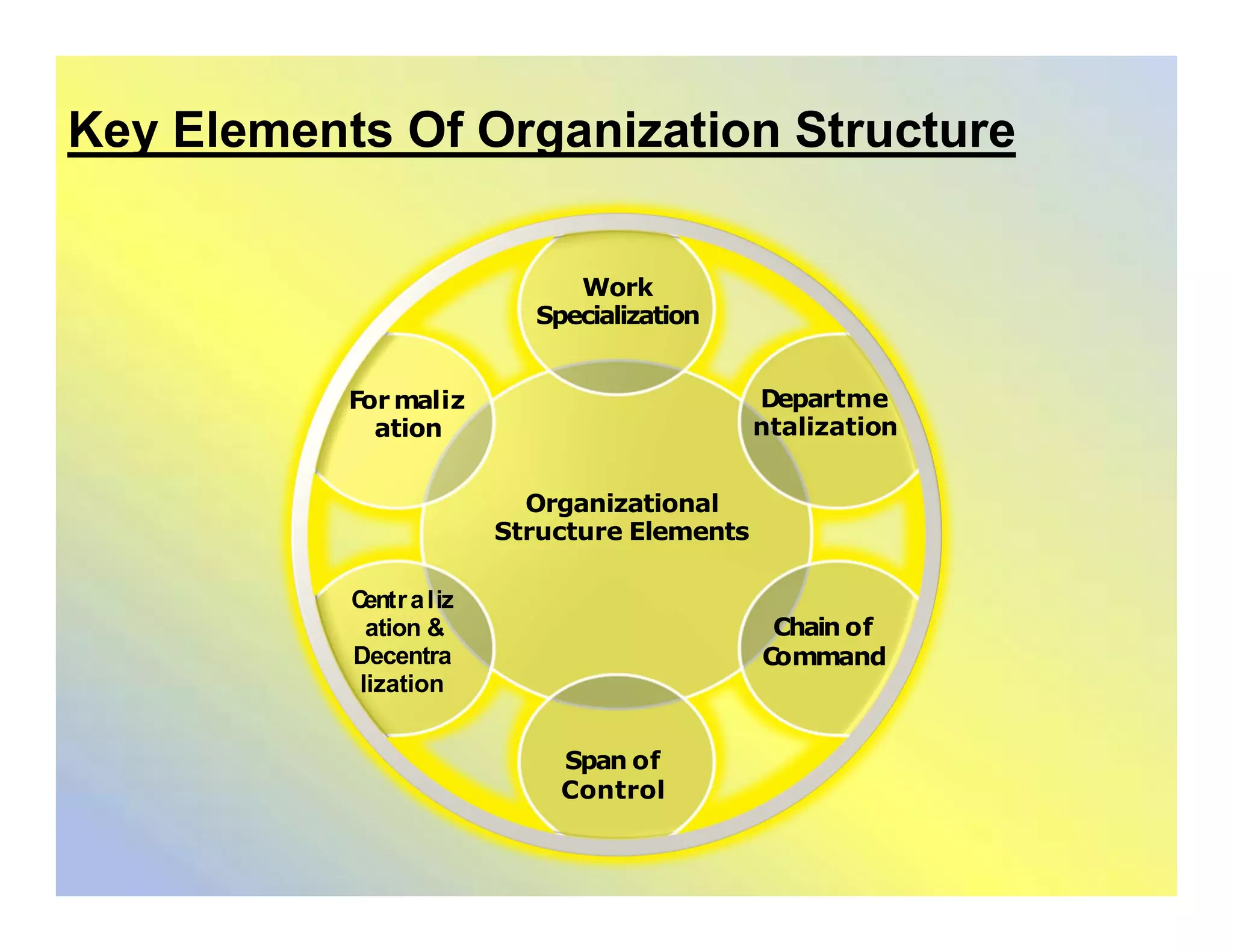
Key Elements Of Organization Structure
Work
Specialization
Departme
ntalization
Chain of
Command
Span of
Control
Centraliz
ation &
Decentra
lization
For maliz
ation
Organizational
Structure Elements
Work Specialization
 Assign wok according to Work
specialization
 Division of labor
 Activities subdivided into separatejobs
 Consume less time to understand tools and equipments
 Increase efficiency of work
Departmentalization
 The basis by which jobs are grouped.
 Clustering individuals into units and units into
departmentsand departments into larger units.
 Encourages informal Communicationamong people and
subunits.
Chain of Command
 Unbroken line of authority ,extends from top of the
organization to the lowest
 Clarifies who report to whom
 Responsibility, legal duty to perform a task which is
assigned
 Authority, right inherent in a managerial position to give
order and expects them to be obeyed
 Unity of command, Aperson should have one and only one
superior to whom he is directly responsible
 Organization more productive by enforcing chain of
command
Span of Control
 The number of subordinates a manager can efficiently
and effectivelydirect
 It determine the number of level and manager an
organization has
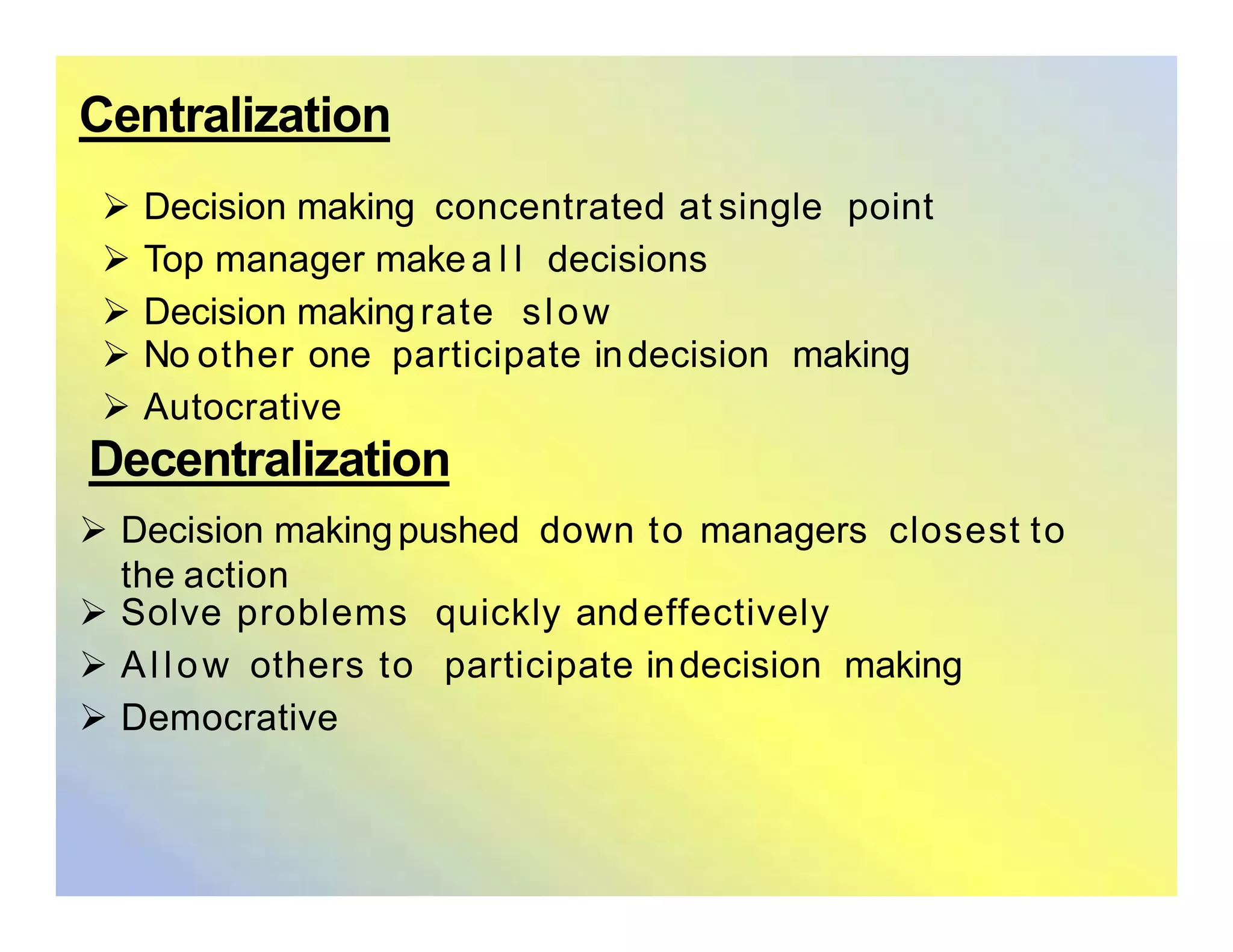
Centralization
 Decision making concentrated at single point
 Top manager makea l l decisions
 Decision makingrate slow
 No other one participate indecision making
 Autocrative
 Decision makingpushed down to managers closest to
the action
 Solve problems quickly andeffectively
 Allow others to participate indecision making
 Democrative
Decentralization
Formalization
 The degree to which jobs within an organization
are standardized
 Describe what, when and how to do work
 Describe lots of organizational rules and clearly defined
procedures covering work process
 Reduce ambiguity
 Increase consistency and uniformoutput
Based on relationship (formal and informal)
Formal
An organization having well defined structure where the
authority and responsibility of each one is defined.
 Informal
A network developed by employees having common
interval where there is no hierarchy.
Based on hierarchy structure (line, staff and
matrix)
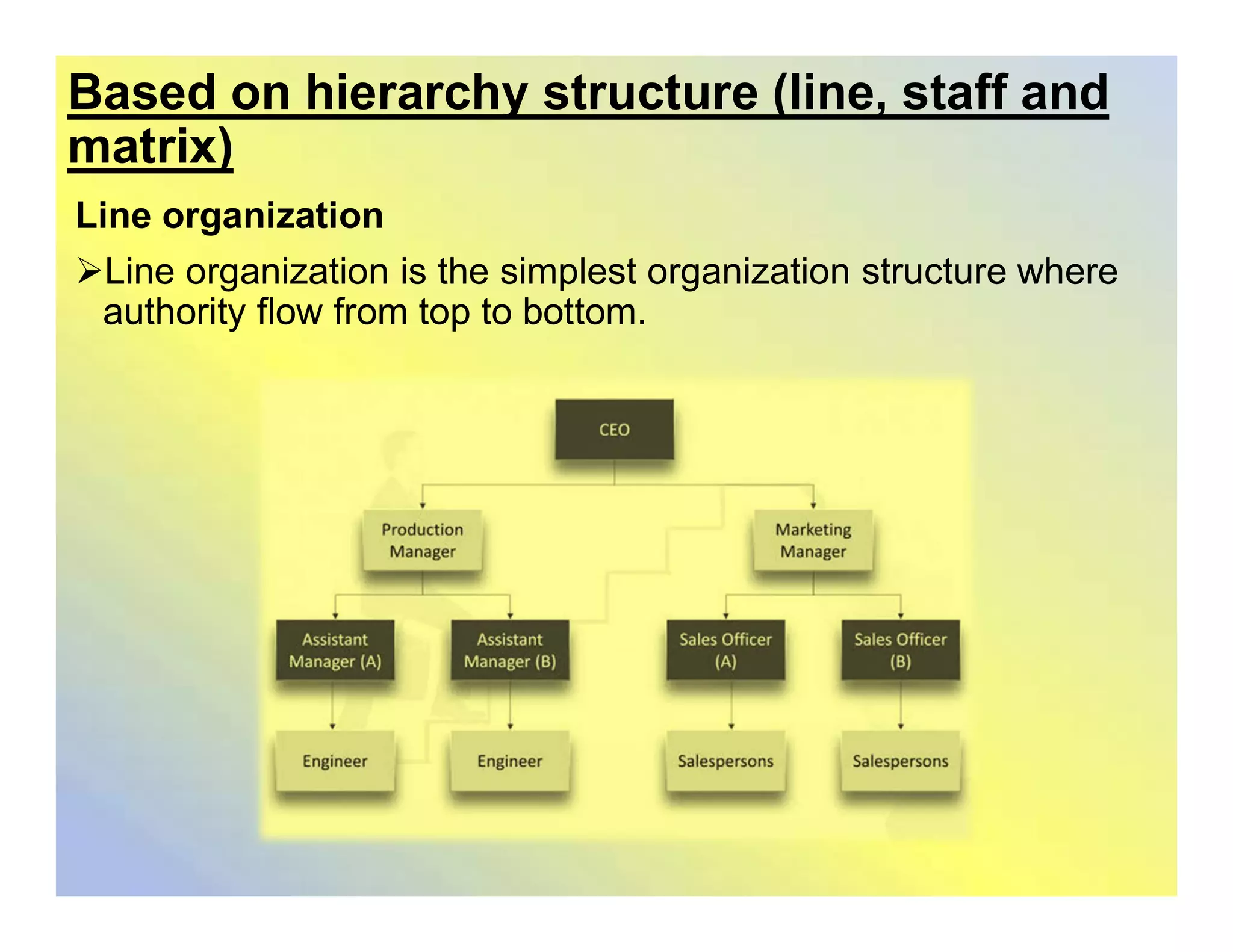
Line organization
Line organization is the simplest organization structure where
authority flow from top to bottom.
Based on hierarchy structure (line, staff and
matrix)
Staff organization
Staff organization is the structure where specialized person
looks after the whole function having predefined staff
Based on hierarchy structure (line, staff and
matrix)
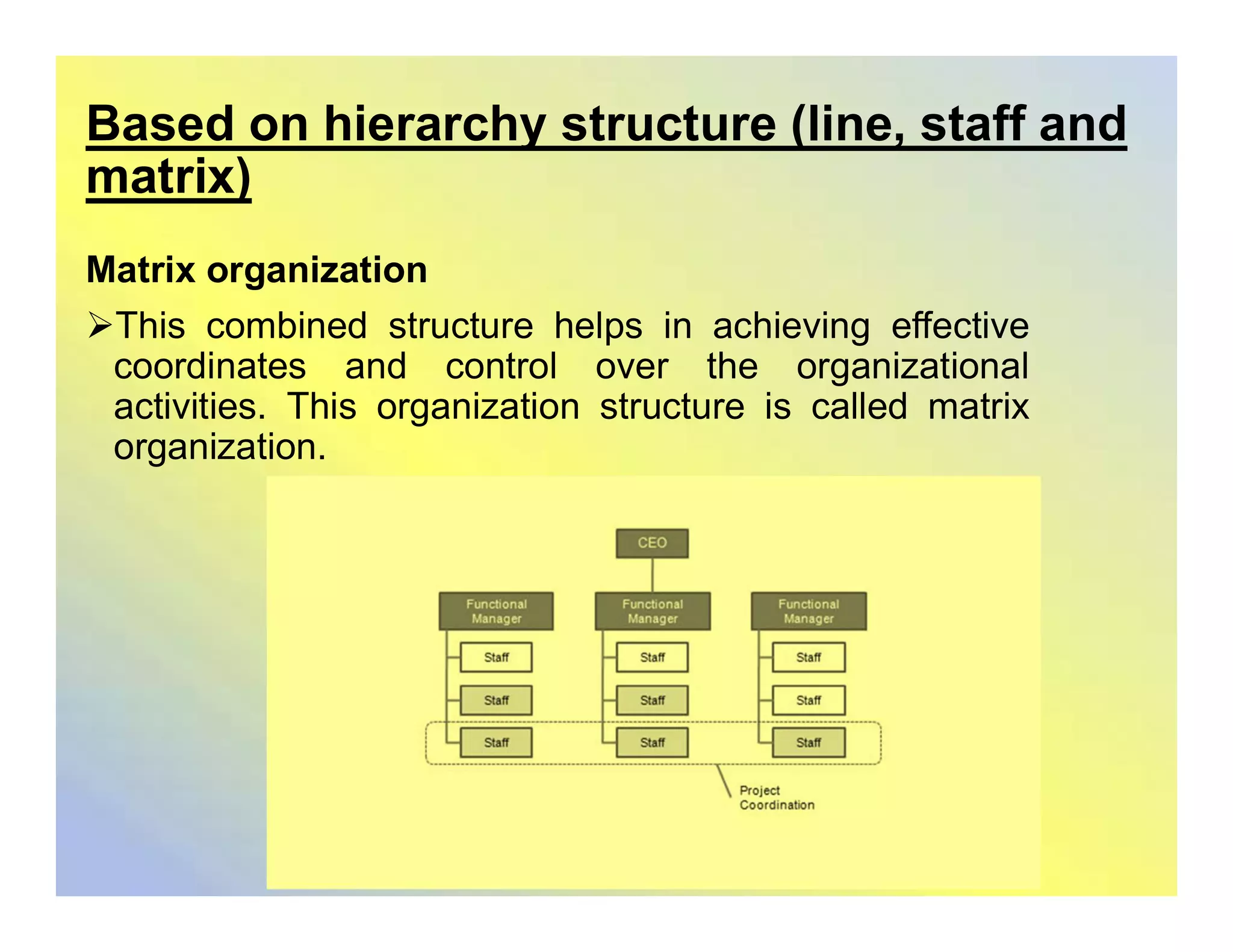
Matrix organization
This combined structure helps in achieving effective
coordinates and control over the organizational
activities. This organization structure is called matrix
organization.
Group Dynamics
 Group-Basic fundamental unit of an organization.
 Two or more persons who interact & work with each
other to achieve a common purpose.
 Group Dynamics:The interactions that take place
among the members of a group.
 The term group dynamics was popularised by Kurt Lewin
in 1930s.
Theory of Group Formation:
1.Propinquity Theory: people associate with one
another due to geographical proximity.
2.Balance Theory:People who have similar attitudes
toward certain objects & goals tend to be attracted to
each other & form a group.
3.Exchange Theory: Reward-cost outcome serve as the
basis of group formation.It states that
affiliation/association takes place when the reward-cost
equation has a positive outcome- rewards are greater
than the costs incurred.
Types of Groups
1.Formal groups are formed by the organization to
carry out certain activities.It includes
a) Command group-permanent in
nature.eg:functional groups.
b) Task group-to carry out specific tasks:temporary
in nature.
2.Informal groups are formed by the employees
themselves.
Types of Informal Groups
1.Friendship groups;permanent in nature
2.Interest groups;-relativly temporary & are organized around
a common activity or interest.
Fred Luthans-In addition to formal & informal; Groups can also
be classified into small & large groups;Primary & secondary
groups
Coalitions,memberships & reference groups
Ingroups & outgroups.
The Punctuated Equilibrium Model:
 According to this model, the process of group
formation is characterized by long periods of
inertia,punctuated or interspersed with brief periods
of activity.
 These periods of activity primarily take place when
the members become aware of the time & the
approaching project deadline.
Dynamics of formal work groups:
 It includes- committees,commissions,boards,teams & task
forces.
 Committees can perform various functions-a
service, advisory or administrative functions
 Positive & Negative attributes of committees.
OB STRUCTURE & GROUP DYNAMICS

OB STRUCTURE & GROUP DYNAMICS

  • 1.
  • 2.
    Organization Structure Definition-: An organizationalstructure is a system that outlines how certain activities are directed in order to achieve the goals of an organization. These activities can include rules, roles, and responsibilities. The organizational structure also determines how information flows between levels within the company.
  • 3.
    Key Elements OfOrganization Structure Work Specialization Departme ntalization Chain of Command Span of Control Centraliz ation & Decentra lization For maliz ation Organizational Structure Elements
  • 4.
    Work Specialization  Assignwok according to Work specialization  Division of labor  Activities subdivided into separatejobs  Consume less time to understand tools and equipments  Increase efficiency of work Departmentalization  The basis by which jobs are grouped.  Clustering individuals into units and units into departmentsand departments into larger units.  Encourages informal Communicationamong people and subunits.
  • 5.
    Chain of Command Unbroken line of authority ,extends from top of the organization to the lowest  Clarifies who report to whom  Responsibility, legal duty to perform a task which is assigned  Authority, right inherent in a managerial position to give order and expects them to be obeyed  Unity of command, Aperson should have one and only one superior to whom he is directly responsible  Organization more productive by enforcing chain of command Span of Control  The number of subordinates a manager can efficiently and effectivelydirect  It determine the number of level and manager an organization has
  • 6.
    Centralization  Decision makingconcentrated at single point  Top manager makea l l decisions  Decision makingrate slow  No other one participate indecision making  Autocrative  Decision makingpushed down to managers closest to the action  Solve problems quickly andeffectively  Allow others to participate indecision making  Democrative Decentralization
  • 7.
    Formalization  The degreeto which jobs within an organization are standardized  Describe what, when and how to do work  Describe lots of organizational rules and clearly defined procedures covering work process  Reduce ambiguity  Increase consistency and uniformoutput
  • 8.
    Based on relationship(formal and informal) Formal An organization having well defined structure where the authority and responsibility of each one is defined.  Informal A network developed by employees having common interval where there is no hierarchy.
  • 9.
    Based on hierarchystructure (line, staff and matrix) Line organization Line organization is the simplest organization structure where authority flow from top to bottom.
  • 10.
    Based on hierarchystructure (line, staff and matrix) Staff organization Staff organization is the structure where specialized person looks after the whole function having predefined staff
  • 11.
    Based on hierarchystructure (line, staff and matrix) Matrix organization This combined structure helps in achieving effective coordinates and control over the organizational activities. This organization structure is called matrix organization.
  • 12.
    Group Dynamics  Group-Basicfundamental unit of an organization.  Two or more persons who interact & work with each other to achieve a common purpose.  Group Dynamics:The interactions that take place among the members of a group.  The term group dynamics was popularised by Kurt Lewin in 1930s.
  • 13.
    Theory of GroupFormation: 1.Propinquity Theory: people associate with one another due to geographical proximity. 2.Balance Theory:People who have similar attitudes toward certain objects & goals tend to be attracted to each other & form a group. 3.Exchange Theory: Reward-cost outcome serve as the basis of group formation.It states that affiliation/association takes place when the reward-cost equation has a positive outcome- rewards are greater than the costs incurred.
  • 14.
    Types of Groups 1.Formalgroups are formed by the organization to carry out certain activities.It includes a) Command group-permanent in nature.eg:functional groups. b) Task group-to carry out specific tasks:temporary in nature. 2.Informal groups are formed by the employees themselves.
  • 15.
    Types of InformalGroups 1.Friendship groups;permanent in nature 2.Interest groups;-relativly temporary & are organized around a common activity or interest. Fred Luthans-In addition to formal & informal; Groups can also be classified into small & large groups;Primary & secondary groups Coalitions,memberships & reference groups Ingroups & outgroups.
  • 16.
    The Punctuated EquilibriumModel:  According to this model, the process of group formation is characterized by long periods of inertia,punctuated or interspersed with brief periods of activity.  These periods of activity primarily take place when the members become aware of the time & the approaching project deadline.
  • 17.
    Dynamics of formalwork groups:  It includes- committees,commissions,boards,teams & task forces.  Committees can perform various functions-a service, advisory or administrative functions  Positive & Negative attributes of committees.