Chapter
14
1
Closed-Loop Frequency Response and
Sensitivity Functions
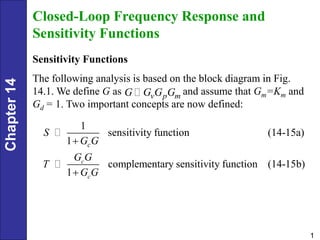
The following analysis is based on the block diagram in Fig.
14.1. We define G as and assume that Gm=Km and
Gd = 1. Two important concepts are now defined:
v p m
G G G G
1
sensitivity function (14-15a)
1
complementary sensitivity function (14-15b)
1
c
c
c
S
G G
G G
T
G G


Chapter
14
2
Comparing Fig. 14.1 and Eq. 14-15 indicates that S is the
closed-loop transfer function for disturbances (Y/D), while T is
the closed-loop transfer function for set-point changes (Y/Ysp). It
is easy to show that:
1 (14-16)
S T
 
As will be shown in Section 14.6, S and T provide measures of
how sensitive the closed-loop system is to changes in the
process.
• Let |S(j )| and |T(j )| denote the amplitude ratios of S and T,
respectively.
• The maximum values of the amplitude ratios provide useful
measures of robustness.
• They also serve as control system design criteria, as discussed
below.
ω ω
Chapter
14
3
• Define MS to be the maximum value of |S(j )| for all
frequencies:
ω
ω
max | ( ω) | (14-17)
S
M S j
The second robustness measure is MT, the maximum value of
|T(j )|:
ω
ω
max | ( ω) | (14-18)
T
M T j
MT is also referred to as the resonant peak. Typical amplitude
ratio plots for S and T are shown in Fig. 14.13.
It is easy to prove that MS and MT are related to the gain and
phase margins of Section 14.4 (Morari and Zafiriou, 1989):
1 1
GM , PM 2sin (14-19)
1 2
S
S S
M
M M
  
   
  
Chapter
14
4
Figure 14.13 Typical S and T magnitude plots. (Modified from
Maciejowski (1998)).
Guideline. For a satisfactory control system, MT should be in the
range 1.0 – 1.5 and MS should be in the range of 1.2 – 2.0.
Chapter
14
5
It is easy to prove that MS and MT are related to the gain and
phase margins of Section 14.4 (Morari and Zafiriou, 1989):
1 1
GM , PM 2sin (14-19)
1 2
S
S S
M
M M
  
   
  
1
1 1
GM 1 , PM 2sin (14-20)
2
T T
M M
  
    
 
Chapter
14
6
Bandwidth
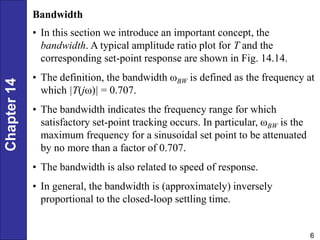
• In this section we introduce an important concept, the
bandwidth. A typical amplitude ratio plot for T and the
corresponding set-point response are shown in Fig. 14.14.
• The definition, the bandwidth ωBW is defined as the frequency at
which |T(jω)| = 0.707.
• The bandwidth indicates the frequency range for which
satisfactory set-point tracking occurs. In particular, ωBW is the
maximum frequency for a sinusoidal set point to be attenuated
by no more than a factor of 0.707.
• The bandwidth is also related to speed of response.
• In general, the bandwidth is (approximately) inversely
proportional to the closed-loop settling time.
Chapter
14
7
Figure 14.14 Typical closed-loop amplitude ratio |T(jω)| and
set-point response.
Chapter
14
8
Closed-loop Performance Criteria
Ideally, a feedback controller should satisfy the following
criteria.
1. In order to eliminate offset, |T(jω)| 1 as ω  0.
2. |T(jω)| should be maintained at unity up to as high as
frequency as possible. This condition ensures a rapid
approach to the new steady state during a set-point change.
3. As indicated in the Guideline, MT should be selected so that
1.0 < MT < 1.5.
4. The bandwidth ωBW and the frequency ωT at which MT
occurs, should be as large as possible. Large values result in
the fast closed-loop responses.
Nichols Chart
The closed-loop frequency response can be calculated analytically
from the open-loop frequency response.
Chapter
14
9
Figure 14.15 A Nichols chart. [The closed-loop amplitude ratio
ARCL ( ) and phase angle are shown in families
of curves.]
 
φCL   
Chapter
14
10
Example 14.8
Consider a fourth-order process with a wide range of time
constants that have units of minutes (Åström et al., 1998):
1
(14-22)
( 1)(0.2 1)(0.04 1)(0.008 1)
v p m
G G G G
s s s s
 
   
Calculate PID controller settings based on following tuning
relations in Chapter 12
a. Ziegler-Nichols tuning (Table 12.6)
b. Tyreus-Luyben tuning (Table 12.6)
c. IMC Tuning with (Table 12.1)
d. Simplified IMC (SIMC) tuning (Table 12.5) and a second-
order plus time-delay model derived using Skogestad’s model
approximation method (Section 6.3).
τ 0.25 min
c 
Chapter
14
11
Determine sensitivity peaks MS and MT for each controller.
Compare the closed-loop responses to step changes in the set-
point and the disturbance using the parallel form of the PID
controller without a derivative filter:
( ) 1
1 τ (14-23)
( ) τ
c D
I
P s
K s
E s s
 

  
 
 
Assume that Gd(s) = G(s).
Chapter
14
12
Controller Kc MS MT
Ziegler-
Nichols
18.1 0.28 0.070 2.38 2.41
Tyreus-
Luyben
13.6 1.25 0.089 1.45 1.23
IMC 4.3 1.20 0.167 1.12 1.00
Simplified
IMC
21.8 1.22 0.180 1.58 1.16
τ (min)
I τ (min)
D
Controller Settings for Example 14.8
Chapter
14
13
Figure 14.16 Closed-loop responses for Example 14.8. (A set-
point change occurs at t = 0 and a step disturbance at t = 4 min.)

process control

  • 1.
    Chapter 14 1 Closed-Loop Frequency Responseand Sensitivity Functions Sensitivity Functions The following analysis is based on the block diagram in Fig. 14.1. We define G as and assume that Gm=Km and Gd = 1. Two important concepts are now defined: v p m G G G G 1 sensitivity function (14-15a) 1 complementary sensitivity function (14-15b) 1 c c c S G G G G T G G  
  • 2.
    Chapter 14 2 Comparing Fig. 14.1and Eq. 14-15 indicates that S is the closed-loop transfer function for disturbances (Y/D), while T is the closed-loop transfer function for set-point changes (Y/Ysp). It is easy to show that: 1 (14-16) S T   As will be shown in Section 14.6, S and T provide measures of how sensitive the closed-loop system is to changes in the process. • Let |S(j )| and |T(j )| denote the amplitude ratios of S and T, respectively. • The maximum values of the amplitude ratios provide useful measures of robustness. • They also serve as control system design criteria, as discussed below. ω ω
  • 3.
    Chapter 14 3 • Define MSto be the maximum value of |S(j )| for all frequencies: ω ω max | ( ω) | (14-17) S M S j The second robustness measure is MT, the maximum value of |T(j )|: ω ω max | ( ω) | (14-18) T M T j MT is also referred to as the resonant peak. Typical amplitude ratio plots for S and T are shown in Fig. 14.13. It is easy to prove that MS and MT are related to the gain and phase margins of Section 14.4 (Morari and Zafiriou, 1989): 1 1 GM , PM 2sin (14-19) 1 2 S S S M M M          
  • 4.
    Chapter 14 4 Figure 14.13 TypicalS and T magnitude plots. (Modified from Maciejowski (1998)). Guideline. For a satisfactory control system, MT should be in the range 1.0 – 1.5 and MS should be in the range of 1.2 – 2.0.
  • 5.
    Chapter 14 5 It is easyto prove that MS and MT are related to the gain and phase margins of Section 14.4 (Morari and Zafiriou, 1989): 1 1 GM , PM 2sin (14-19) 1 2 S S S M M M           1 1 1 GM 1 , PM 2sin (14-20) 2 T T M M          
  • 6.
    Chapter 14 6 Bandwidth • In thissection we introduce an important concept, the bandwidth. A typical amplitude ratio plot for T and the corresponding set-point response are shown in Fig. 14.14. • The definition, the bandwidth ωBW is defined as the frequency at which |T(jω)| = 0.707. • The bandwidth indicates the frequency range for which satisfactory set-point tracking occurs. In particular, ωBW is the maximum frequency for a sinusoidal set point to be attenuated by no more than a factor of 0.707. • The bandwidth is also related to speed of response. • In general, the bandwidth is (approximately) inversely proportional to the closed-loop settling time.
  • 7.
    Chapter 14 7 Figure 14.14 Typicalclosed-loop amplitude ratio |T(jω)| and set-point response.
  • 8.
    Chapter 14 8 Closed-loop Performance Criteria Ideally,a feedback controller should satisfy the following criteria. 1. In order to eliminate offset, |T(jω)| 1 as ω  0. 2. |T(jω)| should be maintained at unity up to as high as frequency as possible. This condition ensures a rapid approach to the new steady state during a set-point change. 3. As indicated in the Guideline, MT should be selected so that 1.0 < MT < 1.5. 4. The bandwidth ωBW and the frequency ωT at which MT occurs, should be as large as possible. Large values result in the fast closed-loop responses. Nichols Chart The closed-loop frequency response can be calculated analytically from the open-loop frequency response.
  • 9.
    Chapter 14 9 Figure 14.15 ANichols chart. [The closed-loop amplitude ratio ARCL ( ) and phase angle are shown in families of curves.]   φCL   
  • 10.
    Chapter 14 10 Example 14.8 Consider afourth-order process with a wide range of time constants that have units of minutes (Åström et al., 1998): 1 (14-22) ( 1)(0.2 1)(0.04 1)(0.008 1) v p m G G G G s s s s       Calculate PID controller settings based on following tuning relations in Chapter 12 a. Ziegler-Nichols tuning (Table 12.6) b. Tyreus-Luyben tuning (Table 12.6) c. IMC Tuning with (Table 12.1) d. Simplified IMC (SIMC) tuning (Table 12.5) and a second- order plus time-delay model derived using Skogestad’s model approximation method (Section 6.3). τ 0.25 min c 
  • 11.
    Chapter 14 11 Determine sensitivity peaksMS and MT for each controller. Compare the closed-loop responses to step changes in the set- point and the disturbance using the parallel form of the PID controller without a derivative filter: ( ) 1 1 τ (14-23) ( ) τ c D I P s K s E s s           Assume that Gd(s) = G(s).
  • 12.
    Chapter 14 12 Controller Kc MSMT Ziegler- Nichols 18.1 0.28 0.070 2.38 2.41 Tyreus- Luyben 13.6 1.25 0.089 1.45 1.23 IMC 4.3 1.20 0.167 1.12 1.00 Simplified IMC 21.8 1.22 0.180 1.58 1.16 τ (min) I τ (min) D Controller Settings for Example 14.8
  • 13.
    Chapter 14 13 Figure 14.16 Closed-loopresponses for Example 14.8. (A set- point change occurs at t = 0 and a step disturbance at t = 4 min.)