Project Risk Management November 2007
Presented by Keith Farndale. © Procept Associates Ltd., v2007-1
Project Risk Management v2006-1
Keith Farndale, MBA, P.Eng., PMP
farndale@procept.com
President
Procept Associates Ltd
www.procept.com
416-693-5559
Project Management Training
Canada’s leader in PM training and
consulting
Emphasis on A/E/C
Registered Education Provider with
PMI
A full portfolio of courses, beginner to
advanced
“PMP” preparation
Public courses available through
University of Toronto
Project Risk Management November 2007
Presented by Keith Farndale. © Procept Associates Ltd., v2007-1
Project Management Consulting
Develop PM processes
Project planning support
Project Management
Offices (PMO)
Microsoft Project
including Enterprise PM
One-on-one coaching
Portfolio Management
processes
ISO 9001 registered
4
Project Risk Management
Workshopv2007-1
Project Risk Management November 2007
Presented by Keith Farndale. © Procept Associates Ltd., v2007-1
5
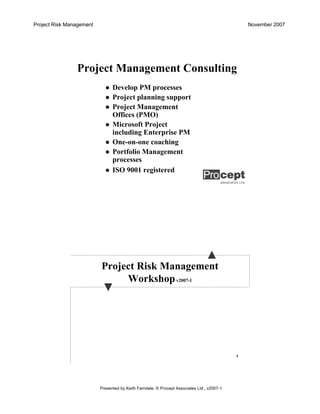
Project Risk:
An uncertain event or condition
that, if it occurs, has a positive or
negative effect on the project’s
objective
PMBOK® Guide 2004, glossary
6
Project Risk Management:
Systematic process of…
Identifying,
Analyzing, &
Responding to,
Risks throughout the life of the
project
Project Risk Management November 2007
Presented by Keith Farndale. © Procept Associates Ltd., v2007-1
7
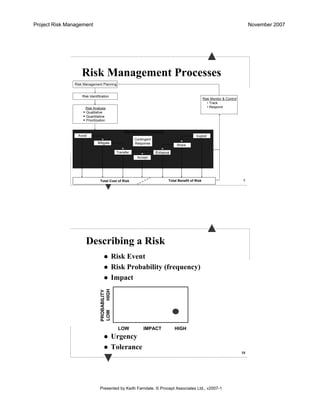
Risk Management Processes
Risk Identification
Risk Analysis
• Qualitative
• Quantitative
• Prioritization
Risk Monitor & Control
• Track
• Respond
Risk Management Planning
Total Cost of Risk
Risk Response Planning
Avoid
Mitigate
Transfer
Accept
Exploit
Share
Enhance
Total Benefit of Risk
Contingent
Response
10
Risk Event
Risk Probability (frequency)
Impact
LOW IMPACT HIGH
PROBABILITY
LOWHIGH
Urgency
Tolerance
Describing a Risk
Project Risk Management November 2007
Presented by Keith Farndale. © Procept Associates Ltd., v2007-1
11
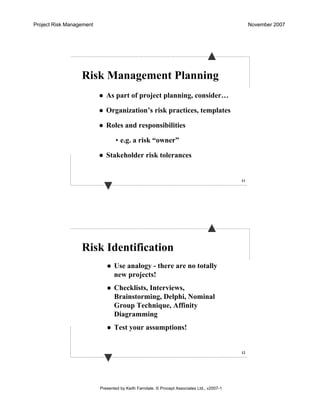
Risk Management Planning
As part of project planning, consider…
Organization’s risk practices, templates
Roles and responsibilities
• e.g. a risk “owner”
Stakeholder risk tolerances
12
Risk Identification
Use analogy - there are no totally
new projects!
Checklists, Interviews,
Brainstorming, Delphi, Nominal
Group Technique, Affinity
Diagramming
Test your assumptions!
Project Risk Management November 2007
Presented by Keith Farndale. © Procept Associates Ltd., v2007-1
13
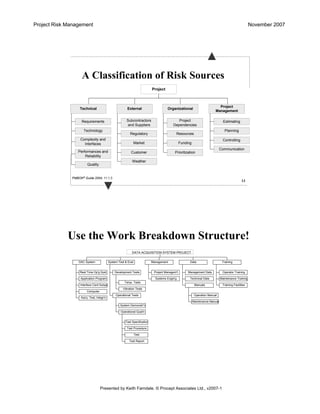
A Classification of Risk Sources
Project
Technical
Project
Management
OrganizationalExternal
Requirements
Complexity and
Interfaces
Technology
Performances and
Reliability
Quality
Subcontractors
and Suppliers
Regulatory
Market
Customer
Weather
Project
Dependencies
Resources
Funding
Prioritization
Estimating
Planning
Controlling
Communication
PMBOK® Guide 2004, 11.1.3
Real Time Op'g Syst.
Application Program
Interface Card Subprj
Computer
Ass'y, Test, Integr'n
DAC System
Temp. Tests
Vibration Tests
Development Tests
System Demonstr'n
Test Specification
Test Procedure
Test
Test Report
Operational Qual'n
Operational Tests
System Test & Eval.
Project Managem't
Systems Engin'g
Management
Management Data
Technical Data
Operation Manual
Maintenance Manual
Manuals
Data
Operator Training
Maintenance Training
Training Facilities
Training
DATA ACQUISITION SYSTEM PROJECT
Use the Work Breakdown Structure!
Project Risk Management November 2007
Presented by Keith Farndale. © Procept Associates Ltd., v2007-1
15
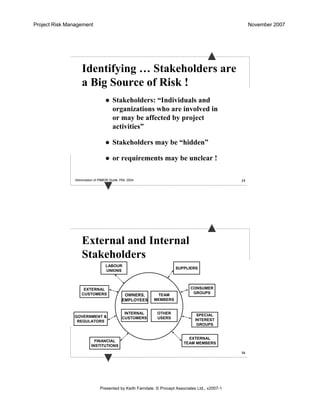
Identifying … Stakeholders are
a Big Source of Risk !
Stakeholders: “Individuals and
organizations who are involved in
or may be affected by project
activities”
Stakeholders may be “hidden”
or requirements may be unclear !
Abbreviation of PMBOK Guide, PMI, 2004
16
External and Internal
Stakeholders
OWNERS,
EMPLOYEES
TEAM
MEMBERS
INTERNAL
CUSTOMERS
OTHER
USERS
CONSUMER
GROUPS
FINANCIAL
INSTITUTIONS
EXTERNAL
CUSTOMERS
SUPPLIERS
LABOUR
UNIONS
GOVERNMENT &
REGULATORS
SPECIAL
INTEREST
GROUPS
EXTERNAL
TEAM MEMBERS
Project Risk Management November 2007
Presented by Keith Farndale. © Procept Associates Ltd., v2007-1
17
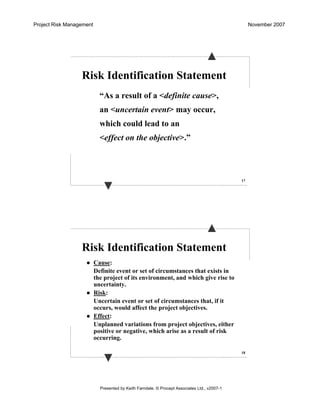
Risk Identification Statement
“As a result of a <definite cause>,
an <uncertain event> may occur,
which could lead to an
<effect on the objective>.”
18
Risk Identification Statement
Cause:
Definite event or set of circumstances that exists in
the project of its environment, and which give rise to
uncertainty.
Risk:
Uncertain event or set of circumstances that, if it
occurs, would affect the project objectives.
Effect:
Unplanned variations from project objectives, either
positive or negative, which arise as a result of risk
occurring.
Project Risk Management November 2007
Presented by Keith Farndale. © Procept Associates Ltd., v2007-1
19
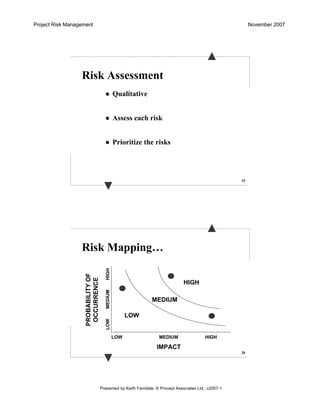
Risk Assessment
Qualitative
Assess each risk
Prioritize the risks
20
Risk Mapping…
PROBABILITYOF
OCCURRENCE
IMPACT
LOW
LOWMEDIUM
MEDIUM
HIGH
HIGH
LOW
HIGH
MEDIUM
Project Risk Management November 2007
Presented by Keith Farndale. © Procept Associates Ltd., v2007-1
21
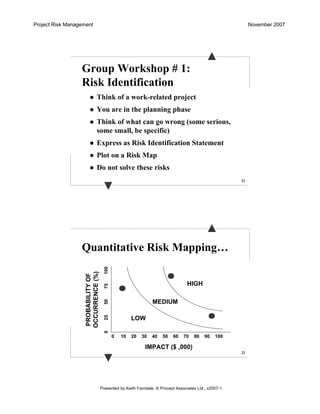
Group Workshop # 1:
Risk Identification
Think of a work-related project
You are in the planning phase
Think of what can go wrong (some serious,
some small, be specific)
Express as Risk Identification Statement
Plot on a Risk Map
Do not solve these risks
22
Quantitative Risk Mapping…
PROBABILITYOF
OCCURRENCE(%)
IMPACT ($ ,000)
LOW
HIGH
MEDIUM
0 10 20 30 40 50 60 70 80 90 100
0255075100
Project Risk Management November 2007
Presented by Keith Farndale. © Procept Associates Ltd., v2007-1
23
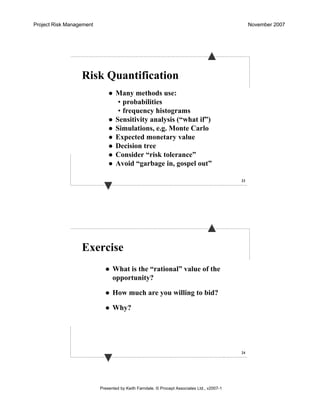
Risk Quantification
Many methods use:
• probabilities
• frequency histograms
Sensitivity analysis (“what if”)
Simulations, e.g. Monte Carlo
Expected monetary value
Decision tree
Consider “risk tolerance”
Avoid “garbage in, gospel out”
24
Exercise
What is the “rational” value of the
opportunity?
How much are you willing to bid?
Why?
Project Risk Management November 2007
Presented by Keith Farndale. © Procept Associates Ltd., v2007-1
25
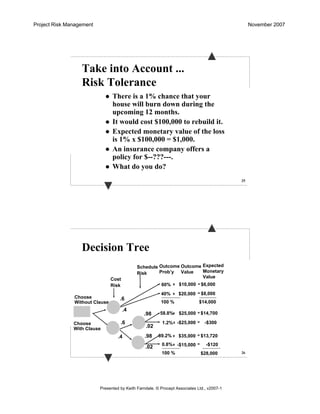
There is a 1% chance that your
house will burn down during the
upcoming 12 months.
It would cost $100,000 to rebuild it.
Expected monetary value of the loss
is 1% x $100,000 = $1,000.
An insurance company offers a
policy for $--???---.
What do you do?
Take into Account ...
Risk Tolerance
26
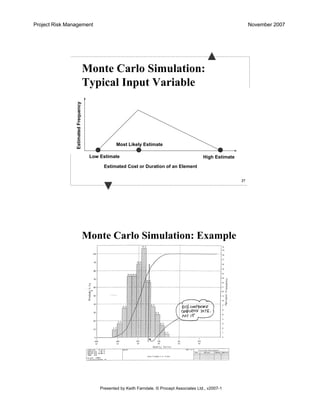
Decision Tree
Choose
Without Clause
Choose
With Clause
CostCost
RiskRisk
ScheduleSchedule
RiskRisk
100 %100 %
Outcome
Prob’y
100 %100 %
60%60%
40%40%
58.8%58.8%
1.2%1.2%
39.2%39.2%
0.8%0.8%
xx
xx
xx
xx
xx
xx
Outcome
Value
$20,000$20,000
$10,000$10,000
$25,000$25,000
$35,000$35,000
--$15,000$15,000
--$25,000$25,000
==
==
==
==
==
==
Expected
Monetary
Value
$6,000$6,000
--$300$300
$14,000$14,000
$13,720$13,720
$14,700$14,700
$8,000$8,000
--$120$120
$28,000$28,000
.4.4
.6.6
.02.02
.98.98
.02.02
.98.98
.4.4
.6.6
Project Risk Management November 2007
Presented by Keith Farndale. © Procept Associates Ltd., v2007-1
27
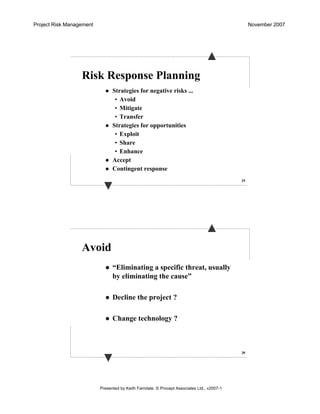
Monte Carlo Simulation:
Typical Input Variable
Estimated Cost or Duration of an ElementEstimated Cost or Duration of an Element
EstimatedFrequencyEstimatedFrequency
High EstimateHigh EstimateLow EstimateLow Estimate
Most Likely EstimateMost Likely Estimate
Monte Carlo Simulation: Example
Project Risk Management November 2007
Presented by Keith Farndale. © Procept Associates Ltd., v2007-1
29
Risk Response Planning
Strategies for negative risks ...
• Avoid
• Mitigate
• Transfer
Strategies for opportunities
• Exploit
• Share
• Enhance
Accept
Contingent response
30
Avoid
“Eliminating a specific threat, usually
by eliminating the cause”
Decline the project ?
Change technology ?
Project Risk Management November 2007
Presented by Keith Farndale. © Procept Associates Ltd., v2007-1
31
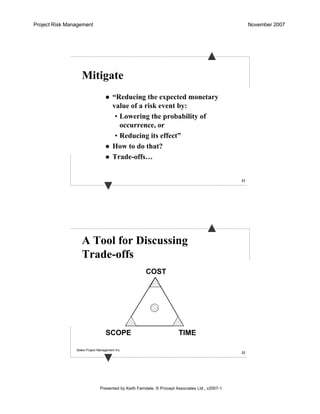
Mitigate
“Reducing the expected monetary
value of a risk event by:
• Lowering the probability of
occurrence, or
• Reducing its effect”
How to do that?
Trade-offs…
32
A Tool for Discussing
Trade-offs
TIME
COST
SCOPE
Bates Project Management Inc.
Project Risk Management November 2007
Presented by Keith Farndale. © Procept Associates Ltd., v2007-1
33
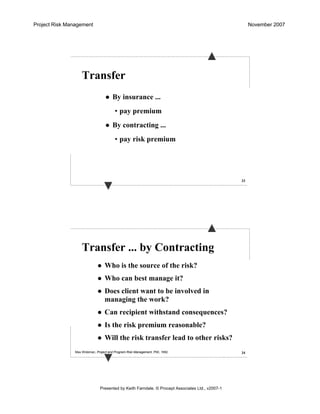
Transfer
By insurance ...
• pay premium
By contracting ...
• pay risk premium
34
Transfer ... by Contracting
Who is the source of the risk?
Who can best manage it?
Does client want to be involved in
managing the work?
Can recipient withstand consequences?
Is the risk premium reasonable?
Will the risk transfer lead to other risks?
Max Wideman, Project and Program Risk Management, PMI, 1992.
Project Risk Management November 2007
Presented by Keith Farndale. © Procept Associates Ltd., v2007-1
35
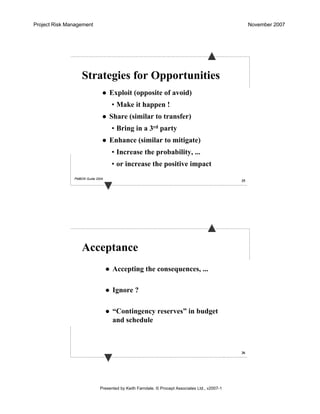
Strategies for Opportunities
Exploit (opposite of avoid)
• Make it happen !
Share (similar to transfer)
• Bring in a 3rd party
Enhance (similar to mitigate)
• Increase the probability, ...
• or increase the positive impact
PMBOK Guide 2004
36
Acceptance
Accepting the consequences, ...
Ignore ?
“Contingency reserves” in budget
and schedule
Project Risk Management November 2007
Presented by Keith Farndale. © Procept Associates Ltd., v2007-1
37
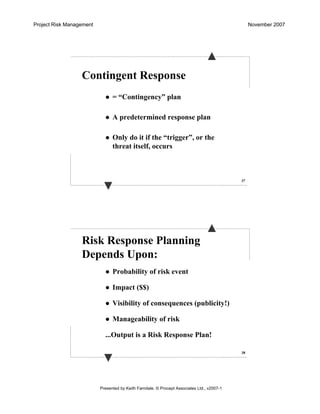
Contingent Response
= “Contingency” plan
A predetermined response plan
Only do it if the “trigger”, or the
threat itself, occurs
38
Risk Response Planning
Depends Upon:
Probability of risk event
Impact ($$)
Visibility of consequences (publicity!)
Manageability of risk
...Output is a Risk Response Plan!
Project Risk Management November 2007
Presented by Keith Farndale. © Procept Associates Ltd., v2007-1
39
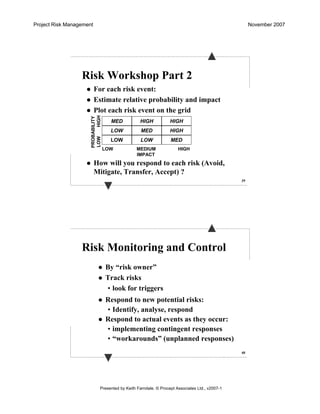
Risk Workshop Part 2
For each risk event:
Estimate relative probability and impact
Plot each risk event on the grid
How will you respond to each risk (Avoid,
Mitigate, Transfer, Accept) ?
MED
LOW
LOWLOW
MED
HIGH
HIGH
HIGH
MED
LOW MEDIUM HIGH
IMPACT
PROBABILITY
LOWHIGH
40
Risk Monitoring and Control
By “risk owner”
Track risks
• look for triggers
Respond to new potential risks:
• Identify, analyse, respond
Respond to actual events as they occur:
• implementing contingent responses
• “workarounds” (unplanned responses)
Project Risk Management November 2007
Presented by Keith Farndale. © Procept Associates Ltd., v2007-1
Thank You
Keith Farndale, MBA, P.Eng., PMP
farndale@procept.com
President
Procept Associates Ltd
Professional Services Ltd
www.procept.com
farndale@procept.com

Procept Risk Workshop 2007

  • 1.
    Project Risk ManagementNovember 2007 Presented by Keith Farndale. © Procept Associates Ltd., v2007-1 Project Risk Management v2006-1 Keith Farndale, MBA, P.Eng., PMP farndale@procept.com President Procept Associates Ltd www.procept.com 416-693-5559 Project Management Training Canada’s leader in PM training and consulting Emphasis on A/E/C Registered Education Provider with PMI A full portfolio of courses, beginner to advanced “PMP” preparation Public courses available through University of Toronto
  • 2.
    Project Risk ManagementNovember 2007 Presented by Keith Farndale. © Procept Associates Ltd., v2007-1 Project Management Consulting Develop PM processes Project planning support Project Management Offices (PMO) Microsoft Project including Enterprise PM One-on-one coaching Portfolio Management processes ISO 9001 registered 4 Project Risk Management Workshopv2007-1
  • 3.
    Project Risk ManagementNovember 2007 Presented by Keith Farndale. © Procept Associates Ltd., v2007-1 5 Project Risk: An uncertain event or condition that, if it occurs, has a positive or negative effect on the project’s objective PMBOK® Guide 2004, glossary 6 Project Risk Management: Systematic process of… Identifying, Analyzing, & Responding to, Risks throughout the life of the project
  • 4.
    Project Risk ManagementNovember 2007 Presented by Keith Farndale. © Procept Associates Ltd., v2007-1 7 Risk Management Processes Risk Identification Risk Analysis • Qualitative • Quantitative • Prioritization Risk Monitor & Control • Track • Respond Risk Management Planning Total Cost of Risk Risk Response Planning Avoid Mitigate Transfer Accept Exploit Share Enhance Total Benefit of Risk Contingent Response 10 Risk Event Risk Probability (frequency) Impact LOW IMPACT HIGH PROBABILITY LOWHIGH Urgency Tolerance Describing a Risk
  • 5.
    Project Risk ManagementNovember 2007 Presented by Keith Farndale. © Procept Associates Ltd., v2007-1 11 Risk Management Planning As part of project planning, consider… Organization’s risk practices, templates Roles and responsibilities • e.g. a risk “owner” Stakeholder risk tolerances 12 Risk Identification Use analogy - there are no totally new projects! Checklists, Interviews, Brainstorming, Delphi, Nominal Group Technique, Affinity Diagramming Test your assumptions!
  • 6.
    Project Risk ManagementNovember 2007 Presented by Keith Farndale. © Procept Associates Ltd., v2007-1 13 A Classification of Risk Sources Project Technical Project Management OrganizationalExternal Requirements Complexity and Interfaces Technology Performances and Reliability Quality Subcontractors and Suppliers Regulatory Market Customer Weather Project Dependencies Resources Funding Prioritization Estimating Planning Controlling Communication PMBOK® Guide 2004, 11.1.3 Real Time Op'g Syst. Application Program Interface Card Subprj Computer Ass'y, Test, Integr'n DAC System Temp. Tests Vibration Tests Development Tests System Demonstr'n Test Specification Test Procedure Test Test Report Operational Qual'n Operational Tests System Test & Eval. Project Managem't Systems Engin'g Management Management Data Technical Data Operation Manual Maintenance Manual Manuals Data Operator Training Maintenance Training Training Facilities Training DATA ACQUISITION SYSTEM PROJECT Use the Work Breakdown Structure!
  • 7.
    Project Risk ManagementNovember 2007 Presented by Keith Farndale. © Procept Associates Ltd., v2007-1 15 Identifying … Stakeholders are a Big Source of Risk ! Stakeholders: “Individuals and organizations who are involved in or may be affected by project activities” Stakeholders may be “hidden” or requirements may be unclear ! Abbreviation of PMBOK Guide, PMI, 2004 16 External and Internal Stakeholders OWNERS, EMPLOYEES TEAM MEMBERS INTERNAL CUSTOMERS OTHER USERS CONSUMER GROUPS FINANCIAL INSTITUTIONS EXTERNAL CUSTOMERS SUPPLIERS LABOUR UNIONS GOVERNMENT & REGULATORS SPECIAL INTEREST GROUPS EXTERNAL TEAM MEMBERS
  • 8.
    Project Risk ManagementNovember 2007 Presented by Keith Farndale. © Procept Associates Ltd., v2007-1 17 Risk Identification Statement “As a result of a <definite cause>, an <uncertain event> may occur, which could lead to an <effect on the objective>.” 18 Risk Identification Statement Cause: Definite event or set of circumstances that exists in the project of its environment, and which give rise to uncertainty. Risk: Uncertain event or set of circumstances that, if it occurs, would affect the project objectives. Effect: Unplanned variations from project objectives, either positive or negative, which arise as a result of risk occurring.
  • 9.
    Project Risk ManagementNovember 2007 Presented by Keith Farndale. © Procept Associates Ltd., v2007-1 19 Risk Assessment Qualitative Assess each risk Prioritize the risks 20 Risk Mapping… PROBABILITYOF OCCURRENCE IMPACT LOW LOWMEDIUM MEDIUM HIGH HIGH LOW HIGH MEDIUM
  • 10.
    Project Risk ManagementNovember 2007 Presented by Keith Farndale. © Procept Associates Ltd., v2007-1 21 Group Workshop # 1: Risk Identification Think of a work-related project You are in the planning phase Think of what can go wrong (some serious, some small, be specific) Express as Risk Identification Statement Plot on a Risk Map Do not solve these risks 22 Quantitative Risk Mapping… PROBABILITYOF OCCURRENCE(%) IMPACT ($ ,000) LOW HIGH MEDIUM 0 10 20 30 40 50 60 70 80 90 100 0255075100
  • 11.
    Project Risk ManagementNovember 2007 Presented by Keith Farndale. © Procept Associates Ltd., v2007-1 23 Risk Quantification Many methods use: • probabilities • frequency histograms Sensitivity analysis (“what if”) Simulations, e.g. Monte Carlo Expected monetary value Decision tree Consider “risk tolerance” Avoid “garbage in, gospel out” 24 Exercise What is the “rational” value of the opportunity? How much are you willing to bid? Why?
  • 12.
    Project Risk ManagementNovember 2007 Presented by Keith Farndale. © Procept Associates Ltd., v2007-1 25 There is a 1% chance that your house will burn down during the upcoming 12 months. It would cost $100,000 to rebuild it. Expected monetary value of the loss is 1% x $100,000 = $1,000. An insurance company offers a policy for $--???---. What do you do? Take into Account ... Risk Tolerance 26 Decision Tree Choose Without Clause Choose With Clause CostCost RiskRisk ScheduleSchedule RiskRisk 100 %100 % Outcome Prob’y 100 %100 % 60%60% 40%40% 58.8%58.8% 1.2%1.2% 39.2%39.2% 0.8%0.8% xx xx xx xx xx xx Outcome Value $20,000$20,000 $10,000$10,000 $25,000$25,000 $35,000$35,000 --$15,000$15,000 --$25,000$25,000 == == == == == == Expected Monetary Value $6,000$6,000 --$300$300 $14,000$14,000 $13,720$13,720 $14,700$14,700 $8,000$8,000 --$120$120 $28,000$28,000 .4.4 .6.6 .02.02 .98.98 .02.02 .98.98 .4.4 .6.6
  • 13.
    Project Risk ManagementNovember 2007 Presented by Keith Farndale. © Procept Associates Ltd., v2007-1 27 Monte Carlo Simulation: Typical Input Variable Estimated Cost or Duration of an ElementEstimated Cost or Duration of an Element EstimatedFrequencyEstimatedFrequency High EstimateHigh EstimateLow EstimateLow Estimate Most Likely EstimateMost Likely Estimate Monte Carlo Simulation: Example
  • 14.
    Project Risk ManagementNovember 2007 Presented by Keith Farndale. © Procept Associates Ltd., v2007-1 29 Risk Response Planning Strategies for negative risks ... • Avoid • Mitigate • Transfer Strategies for opportunities • Exploit • Share • Enhance Accept Contingent response 30 Avoid “Eliminating a specific threat, usually by eliminating the cause” Decline the project ? Change technology ?
  • 15.
    Project Risk ManagementNovember 2007 Presented by Keith Farndale. © Procept Associates Ltd., v2007-1 31 Mitigate “Reducing the expected monetary value of a risk event by: • Lowering the probability of occurrence, or • Reducing its effect” How to do that? Trade-offs… 32 A Tool for Discussing Trade-offs TIME COST SCOPE Bates Project Management Inc.
  • 16.
    Project Risk ManagementNovember 2007 Presented by Keith Farndale. © Procept Associates Ltd., v2007-1 33 Transfer By insurance ... • pay premium By contracting ... • pay risk premium 34 Transfer ... by Contracting Who is the source of the risk? Who can best manage it? Does client want to be involved in managing the work? Can recipient withstand consequences? Is the risk premium reasonable? Will the risk transfer lead to other risks? Max Wideman, Project and Program Risk Management, PMI, 1992.
  • 17.
    Project Risk ManagementNovember 2007 Presented by Keith Farndale. © Procept Associates Ltd., v2007-1 35 Strategies for Opportunities Exploit (opposite of avoid) • Make it happen ! Share (similar to transfer) • Bring in a 3rd party Enhance (similar to mitigate) • Increase the probability, ... • or increase the positive impact PMBOK Guide 2004 36 Acceptance Accepting the consequences, ... Ignore ? “Contingency reserves” in budget and schedule
  • 18.
    Project Risk ManagementNovember 2007 Presented by Keith Farndale. © Procept Associates Ltd., v2007-1 37 Contingent Response = “Contingency” plan A predetermined response plan Only do it if the “trigger”, or the threat itself, occurs 38 Risk Response Planning Depends Upon: Probability of risk event Impact ($$) Visibility of consequences (publicity!) Manageability of risk ...Output is a Risk Response Plan!
  • 19.
    Project Risk ManagementNovember 2007 Presented by Keith Farndale. © Procept Associates Ltd., v2007-1 39 Risk Workshop Part 2 For each risk event: Estimate relative probability and impact Plot each risk event on the grid How will you respond to each risk (Avoid, Mitigate, Transfer, Accept) ? MED LOW LOWLOW MED HIGH HIGH HIGH MED LOW MEDIUM HIGH IMPACT PROBABILITY LOWHIGH 40 Risk Monitoring and Control By “risk owner” Track risks • look for triggers Respond to new potential risks: • Identify, analyse, respond Respond to actual events as they occur: • implementing contingent responses • “workarounds” (unplanned responses)
  • 20.
    Project Risk ManagementNovember 2007 Presented by Keith Farndale. © Procept Associates Ltd., v2007-1 Thank You Keith Farndale, MBA, P.Eng., PMP farndale@procept.com President Procept Associates Ltd Professional Services Ltd www.procept.com farndale@procept.com