
ADVANCED
AGILE RISK
MANAGEMENT
3 Points of Risk Management
in Agile work
What is RISK?
 Risk
 Noun 1. a situation
involving exposure to
danger.
 Biggest Project Risks
 Deliver the Wrong
Thing
 Deliver the Right Thing
Too Late
 Deliver something that
does not work.
Being Agile
Reduces Risk
Incremental Delivery
of Working Products
Customer Demos
Fail Fast
Value Prioritized
Loosely Coupled
Modules
Distributed Decision
Making
 Deliver the
Wrong Thing
 Deliver the Right
Thing Too Late
 Deliver
something that
does not work.
Identify
Evaluate
PrioritizeRespond
Track
Risk
Management
 Probability/Impact
 Risk Statement
 Some event may occur which may result in some
consequence.
 It is only a risk if you cannot PROVE it.
 Difference between a risk and assumption
 An assumption you believe has a 100% probably
 Positive Risk
Risk Language
 Focus on the important
 Make Risk Visible
 Involve Everyone
 Make It Living
 Make it FAST
Principles
Find the
risks
Identification
 Chartering
 Story mapping
 Planning
 Retrospectives

When to do
Identification
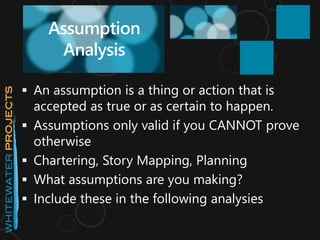
 An assumption is a thing or action that is
accepted as true or as certain to happen.
 Assumptions only valid if you CANNOT prove
otherwise
 Chartering, Story Mapping, Planning
 What assumptions are you making?
 Include these in the following analysies
Assumption
Analysis
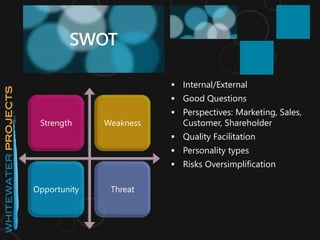
SWOT
Strength Weakness
Opportunity Threat
 Internal/External
 Good Questions
 Perspectives: Marketing, Sales,
Customer, Shareholder
 Quality Facilitation
 Personality types
 Risks Oversimplification
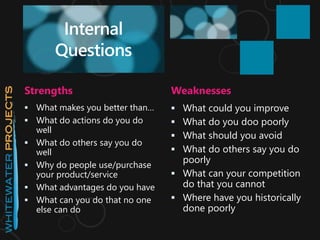
Internal
Questions
Strengths Weaknesses
 What makes you better than…
 What do actions do you do
well
 What do others say you do
well
 Why do people use/purchase
your product/service
 What advantages do you have
 What can you do that no one
else can do
 What could you improve
 What do you doo poorly
 What should you avoid
 What do others say you do
poorly
 What can your competition
do that you cannot
 Where have you historically
done poorly
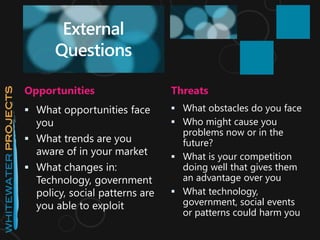
External
Questions
Opportunities Threats
 What opportunities face
you
 What trends are you
aware of in your market
 What changes in:
Technology, government
policy, social patterns are
you able to exploit
 What obstacles do you face
 Who might cause you
problems now or in the
future?
 What is your competition
doing well that gives them
an advantage over you
 What technology,
government, social events
or patterns could harm you
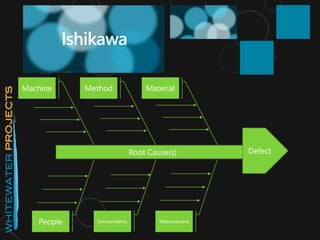
Ishikawa
Root Cause(s) Defect
Machine Method Material
People Environments Measurement
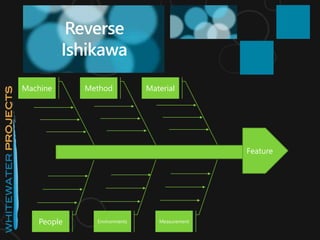
Reverse
Ishikawa
Feature
Machine Method Material
People Environments Measurement
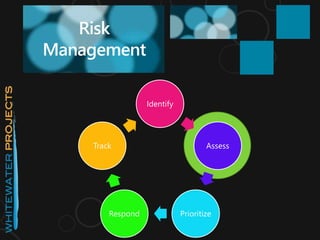
Identify
Assess
PrioritizeRespond
Track
Risk
Management
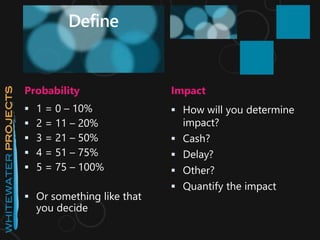
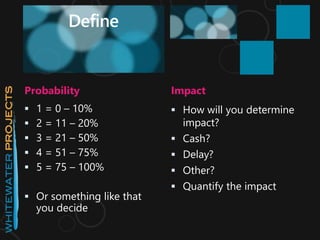
Define
Probability Impact
 1 = 0 – 10%
 2 = 11 – 20%
 3 = 21 – 50%
 4 = 51 – 75%
 5 = 75 – 100%
 Or something like that
you decide
 How will you determine
impact?
 Cash?
 Delay?
 Other?
 Quantify the impact
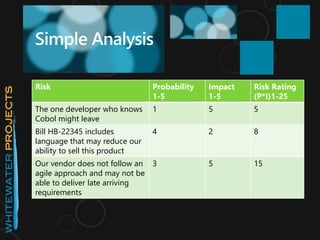
Risk Probability
1-5
Impact
1-5
Risk Rating
(P*I)1-25
The one developer who knows
Cobol might leave
1 5 5
Bill HB-22345 includes
language that may reduce our
ability to sell this product
4 2 8
Our vendor does not follow an
agile approach and may not be
able to deliver late arriving
requirements
3 5 15
Simple Analysis
Define
Probability Impact
 1 = 0 – 10%
 2 = 11 – 20%
 3 = 21 – 50%
 4 = 51 – 75%
 5 = 75 – 100%
 Or something like that
you decide
 How will you determine
impact?
 Cash?
 Delay?
 Other?
 Quantify the impact
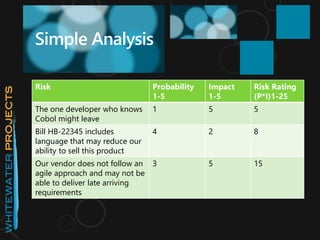
Risk Probability
1-5
Impact
1-5
Risk Rating
(P*I)1-25
The one developer who knows
Cobol might leave
1 5 5
Bill HB-22345 includes
language that may reduce our
ability to sell this product
4 2 8
Our vendor does not follow an
agile approach and may not be
able to deliver late arriving
requirements
3 5 15
Simple Analysis
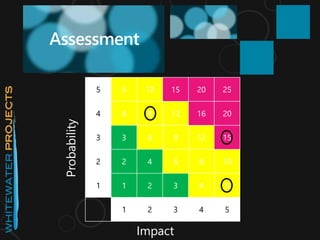
Assessment
5 5 10 15 20 25
4 4 8 12 16 20
3 3 6 9 12 15
2 2 4 6 8 10
1 1 2 3 4 5
1 2 3 4 5
Probability
Impact
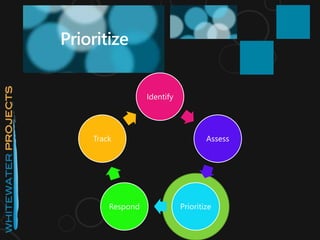
Identify
Assess
PrioritizeRespond
Track
Prioritize
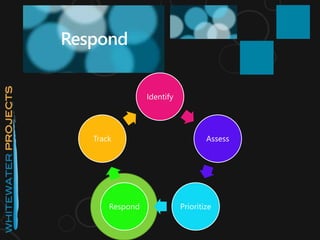
Identify
Assess
PrioritizeRespond
Track
Respond
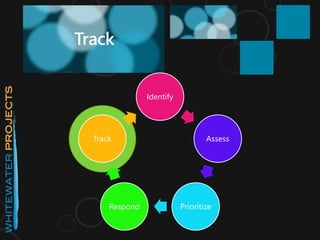
Identify
Assess
PrioritizeRespond
Track
Track
Summary

Agile risk management - Enterprise agility