Procept Associates Ltd.
Certificate in Business Analysis

                             Terry Aldebert, CBAP


Precision meets Expertise.
Agenda

• Introduction to Procept Associates Ltd.
• International Institute of Business Analysis (IIBA®)
  and Certified Business Analyst Professional™
  (CBAP®) designation
• Career as a business analyst
• Knowledge areas of BABOK®
• Introduction to Certificate in Business Analysis


                                                         2
Introduction to Procept


Precision meets Expertise.
Introduction to Procept Associates

• Premier provider of professional training programs
  specializing in:
   – Project Management
   – Business Analysis
   – IT Service Management
   – Business Continuity Management
• Strategic consulting
• More than 14,000 training days each year
• Charter Global PMI Registered Education Provider; IIBA
  Endorsed Education Provider; ISEB Accredited Education
  Provider


                                                           4
Introduction to Procept Associates

• Training programs
   • Partnership with four universities across
      Canada
   • Direct public offerings
   • In-house and customized training
• Leader in customized training solutions since
  1994
   • Learning assessments and needs analysis
   • Pre course and post course assessments
   • Development of corporate career paths
   • Coaching
   • Refresher sessions
                                                  5
Private and Public Sector Clients


6
IIBA® and CBAP®


Precision meets Expertise.
International Institute of Business
Analysis (IIBA®)

• Formed in 2003 with 28 founding members
• IIBA® has over 7,600 members from more than 40
  countries worldwide, with over 80 chapters
  globally.
• Business Analysis Body of Knowledge™ (BABOK®)
  – current generally accepted practices in business
  analysis
• More information: www.theiiba.org


                                                   8
Certified Business Analysis Professional
(CBAP®)
•   Certified Business Analysis Professionals   Quick Facts:
    are experts in identifying the business         ―   Certification candidates are not
    needs of an organization in order to                required to be IIBA® members in
    determine the best solutions, a role that           order to take the certification
    is increasingly seen as a vital component           examination.
    of any successful project. More and
                                                    ―   Currently, the certification
    more companies are recognizing the
                                                        examination is offered in English,
    CBAP® designation and the value and
                                                        but other languages will be
    expertise that these professionals bring
                                                        included in the future.
    to their organizations.
                                                    ―   This program has been carefully
                                                        designed to be in compliance with
                                                        the International Standards
                                                        Organization (ISO) 17204 standard
                                                        for certifying the competence of
                                                        personnel. IIBA® will be seeking ISO
                                                        17204 approval.


                                                                                         9
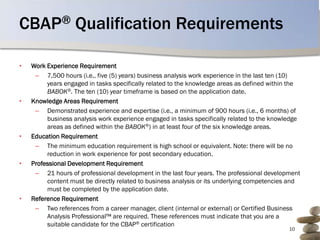
CBAP® Qualification Requirements

•   Work Experience Requirement
     – 7,500 hours (i.e., five (5) years) business analysis work experience in the last ten (10)
         years engaged in tasks specifically related to the knowledge areas as defined within the
         BABOK®. The ten (10) year timeframe is based on the application date.
•   Knowledge Areas Requirement
     – Demonstrated experience and expertise (i.e., a minimum of 900 hours (i.e., 6 months) of
         business analysis work experience engaged in tasks specifically related to the knowledge
         areas as defined within the BABOK®) in at least four of the six knowledge areas.
•   Education Requirement
     – The minimum education requirement is high school or equivalent. Note: there will be no
         reduction in work experience for post secondary education.
•   Professional Development Requirement
     – 21 hours of professional development in the last four years. The professional development
         content must be directly related to business analysis or its underlying competencies and
         must be completed by the application date.
•   Reference Requirement
     – Two references from a career manager, client (internal or external) or Certified Business
         Analysis Professional™ are required. These references must indicate that you are a
         suitable candidate for the CBAP® certification
                                                                                             10
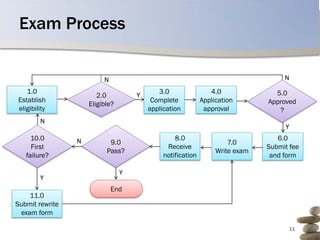
Exam Process

                          N                                                         N
   1.0                                      3.0                 4.0              5.0
                        2.0          Y
Establish                                 Complete           Application       Approved
                     Eligible?
eligibility                              application          approval            ?
        N
                                                                                    Y
     10.0        N                                8.0                             6.0
                            9.0                                       7.0
     First                                     Receive                         Submit fee
                           Pass?                                  Write exam
   failure?                                   notification                      and form

                                 Y
        Y
                              End
    11.0
Submit rewrite
 exam form

                                                                                        11
Business Analysis as a Career

•   Business Analysis is among the top 20
    most recession-proof professions,
    according to a special report published on
    Jobfox.com
•   Research shows the IT Analyst job to be the
    7th best job in America, with a 10-year
    growth outlook of 36%
•   Certified professionals earn 10 to 15%
    more than their non-certified counterparts
    in comparable roles
•   Business Analyst is one of the most in-
    demand and hottest jobs that employers
    are looking for, according to CIO Magazine
•   According to the U.S. Department of Labor
    and an IIBA Salary Survey, Business
    Analysts can earn over $100,000 per year

                                                  12
What is Business Analysis?

• Business Analysis is about identifying the business
  needs of your clients and stakeholders to help
  determine solutions to business problems
• Usually defines the ‘what’ needs to be done, not
  the ‘how’
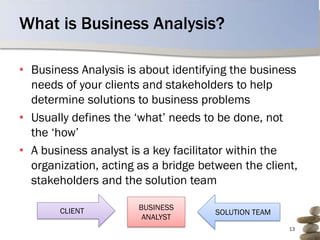
• A business analyst is a key facilitator within the
  organization, acting as a bridge between the client,
  stakeholders and the solution team

       CLIENT          BUSINESS
                                      SOLUTION TEAM
                        ANALYST
                                                      13
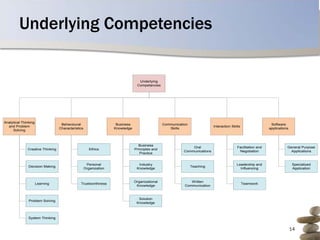
Underlying Competencies


                                                                                 Underlying
                                                                                Competancies


Analytical Thinking
                                   Behavioural                      Business                    Communication                                                   Software
  and Problem                                                                                                               Interaction Skills
                                  Characteristics                  Knowledge                       Skills                                                      applications
     Solving


                                                                                  Business
                                                                                                               Oral                         Facilitation and              General Purpose
              Creative Thinking                        Ethics                  Principles and
                                                                                                           Communications                    Negotiation                    Applications
                                                                                  Practice


                                                     Personal                    Industry                                                  Leadership and                     Specialized
               Decision Making                                                                                  Teaching
                                                    Organization                Knowledge                                                    Influencing                      Application


                                                                               Organizational                 Written
                      Learning                 Trustworthiness                                                                                   Teamwork
                                                                                Knowledge                  Communication


                                                                                 Solution
               Problem Solving
                                                                                Knowledge


               System Thinking


                                                                                                                                                                              14
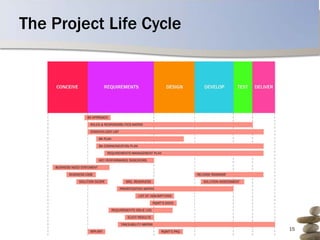
The Project Life Cycle


                         15
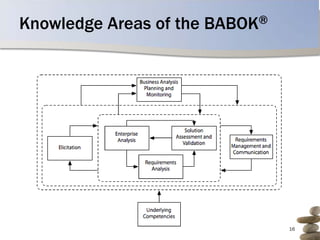
Knowledge Areas of the BABOK®


                                16
Planning and Monitoring

• Description
   –   Processes, activities and techniques needed
   –   Identification of stakeholders
   –   Monitoring the progress of work
   –   Inputs to project plan
• Will be used:
   – By Project managers as input to project plan
   – To coordinate BA activities with other work required
     by other resources

                                                       17
Elicitation

• Description
   – Outlines stakeholder engagement
   – How needs will be captured and assessed
   – Execution of the plan from BA Planning and
     Monitoring
• The Business Analyst will:
   – Document requirements in appropriate format
   – Confirm information that was elicited


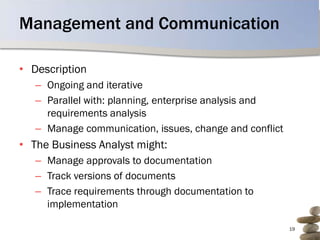
                                                   18
Management and Communication

• Description
   – Ongoing and iterative
   – Parallel with: planning, enterprise analysis and
     requirements analysis
   – Manage communication, issues, change and conflict
• The Business Analyst might:
   – Manage approvals to documentation
   – Track versions of documents
   – Trace requirements through documentation to
     implementation

                                                         19
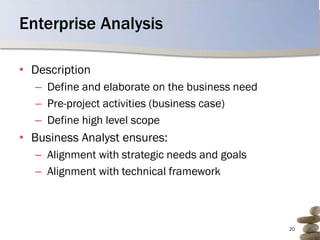
Enterprise Analysis

• Description
  – Define and elaborate on the business need
  – Pre-project activities (business case)
  – Define high level scope
• Business Analyst ensures:
  – Alignment with strategic needs and goals
  – Alignment with technical framework


                                                20
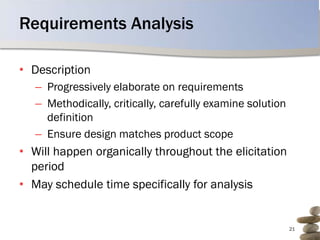
Requirements Analysis

• Description
   – Progressively elaborate on requirements
   – Methodically, critically, carefully examine solution
     definition
   – Ensure design matches product scope
• Will happen organically throughout the elicitation
  period
• May schedule time specifically for analysis


                                                            21
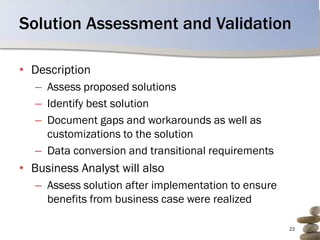
Solution Assessment and Validation

• Description
   – Assess proposed solutions
   – Identify best solution
   – Document gaps and workarounds as well as
     customizations to the solution
   – Data conversion and transitional requirements
• Business Analyst will also
   – Assess solution after implementation to ensure
     benefits from business case were realized

                                                      22
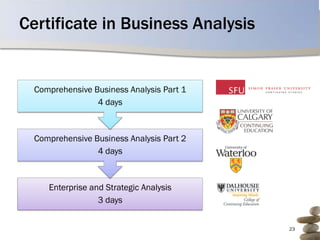
Certificate in Business Analysis


  Comprehensive Business Analysis Part 1
                 4 days


  Comprehensive Business Analysis Part 2
                 4 days


     Enterprise and Strategic Analysis
                  3 days


                                           23
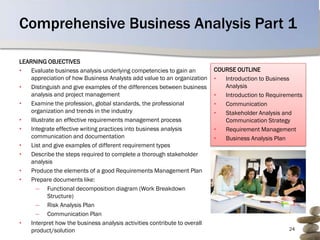
Comprehensive Business Analysis Part 1

LEARNING OBJECTIVES
•   Evaluate business analysis underlying competencies to gain an          COURSE OUTLINE
    appreciation of how Business Analysts add value to an organization     •  Introduction to Business
•   Distinguish and give examples of the differences between business         Analysis
    analysis and project management                                        •  Introduction to Requirements
•   Examine the profession, global standards, the professional             •  Communication
    organization and trends in the industry                                •  Stakeholder Analysis and
•   Illustrate an effective requirements management process                   Communication Strategy
•   Integrate effective writing practices into business analysis           •  Requirement Management
    communication and documentation                                        •  Business Analysis Plan
•   List and give examples of different requirement types
•   Describe the steps required to complete a thorough stakeholder
    analysis
•   Produce the elements of a good Requirements Management Plan
•   Prepare documents like:
       ― Functional decomposition diagram (Work Breakdown
           Structure)
       ― Risk Analysis Plan
       ― Communication Plan
•   Interpret how the business analysis activities contribute to overall
    product/solution                                                                                 24
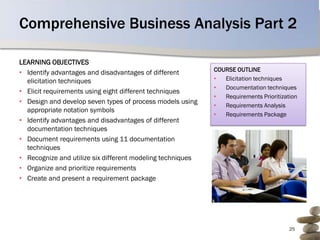
Comprehensive Business Analysis Part 2

LEARNING OBJECTIVES
• Identify advantages and disadvantages of different        COURSE OUTLINE
  elicitation techniques                                    •  Elicitation techniques
                                                            •  Documentation techniques
• Elicit requirements using eight different techniques
                                                            •  Requirements Prioritization
• Design and develop seven types of process models using
                                                            •  Requirements Analysis
  appropriate notation symbols
                                                            •  Requirements Package
• Identify advantages and disadvantages of different
  documentation techniques
• Document requirements using 11 documentation
  techniques
• Recognize and utilize six different modeling techniques
• Organize and prioritize requirements
• Create and present a requirement package


                                                                                       25
Enterprise and Strategic Analysis
LEARNING OBJECTIVES
•   Discuss enterprise analysis tasks and techniques                 COURSE OUTLINE
•   Describe the steps involved in modelling the organizational      •  Understanding the business
    structure and its effect on the project                          •  Confirming Business Problem
•   Analyze and document a business problem                          •  Identifying Scope
•   Devise a business case                                           •  Identifying Viable Options
•   Contrast viable solutions against developed decision criteria    •  Writing and presenting a
•   List possible solutions approaches                                  Business Case
•   Evaluate causes through the application of problem analysis      •  Benchmarking / Competitive
    techniques                                                          Analysis
•   Isolate major causes of business problem and where to focus      •  Gap Analysis
    resources                                                        •  SWOT
•   List types of gap analyses
•   Assess limitations through the creation of a gap analysis
•   Conduct a Strength Weakness Opportunity Threat (SWOT) analysis
•   Appraise competitive intelligence through a benchmarking study
•   Build on previously learned techniques to develop high level
    requirements for the business case
•   Defend business case recommendations
                                                                                              26
Certificate Information

Toronto:
• Comprehensive Business Analysis Part 1: Oct 26−29
• Comprehensive Business Analysis Part 2: Dec 8−11
• Enterprise and Strategic Analysis: Jan 25−27, 2010

Price: $4,197

Vancouver:


Calgary:
                                                           To register or bring this
                                                       certificate to your organization:
Waterloo:                                                      1-800-261-6861
                                                               www.procept.com
                                                              sales@procept.com
Halifax:
                                                                                     27
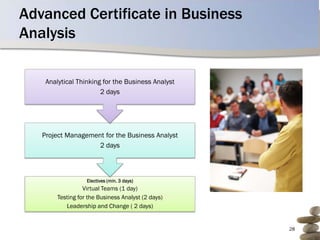
Advanced Certificate in Business
Analysis

    Analytical Thinking for the Business Analyst
                       2 days


   Project Management for the Business Analyst
                    2 days


                   Electives (min. 3 days)
                  Virtual Teams (1 day)
        Testing for the Business Analyst (2 days)
           Leadership and Change ( 2 days)


                                                    28
CBAP® Preparation Course

•   The Certified Business Analysis Professional™ (CBAP®)
    designation is increasingly recognized as the benchmark for       COURSE OUTLINE
    personnel in a business analysis role. If you are preparing for   •  Introduction
    the examination you should attend our intense preparation         •  Underlying Competencies
    course.                                                           •  Techniques
•   This course is an intense, in-depth “crash” review of the         •  Planning & Monitoring
    Business Analysis Body of Knowledge (BABOK®) v2 meant to             Knowledge
    augment your practical knowledge and experience and ready
    you for the CBAP® exam. This 4-day course covers the tasks and    •  Management & Communication
    techniques from each knowledge area of the BABOK® but also        •  Enterprise Analysis Knowledge
    provides practical experience writing the exam with almost 300    •  Requirements Elicitation
    questions completed during the 4 days. In addition, you will         Knowledge
    receive supplemental exam questions with references to the        •  Requirements Analysis
    BABOK®.                                                              Knowledge
                                                                      •  Solution Selection & Validation


                                                                      Toronto: Oct 5 −8
                                                                      Price: $2,199


                                                                                                29
Question and Answer

Speaker:


                       For more information:
                       1-800-261-6861
Terry Aldebert, CBAP   www.procept.com
aldebert@procept.com   sales@procept.com

                                               30

Ba Certificate Info 2009-09-28

  • 1.
    Procept Associates Ltd. Certificatein Business Analysis Terry Aldebert, CBAP Precision meets Expertise.
  • 2.
    Agenda • Introduction toProcept Associates Ltd. • International Institute of Business Analysis (IIBA®) and Certified Business Analyst Professional™ (CBAP®) designation • Career as a business analyst • Knowledge areas of BABOK® • Introduction to Certificate in Business Analysis 2
  • 3.
  • 4.
    Introduction to ProceptAssociates • Premier provider of professional training programs specializing in: – Project Management – Business Analysis – IT Service Management – Business Continuity Management • Strategic consulting • More than 14,000 training days each year • Charter Global PMI Registered Education Provider; IIBA Endorsed Education Provider; ISEB Accredited Education Provider 4
  • 5.
    Introduction to ProceptAssociates • Training programs • Partnership with four universities across Canada • Direct public offerings • In-house and customized training • Leader in customized training solutions since 1994 • Learning assessments and needs analysis • Pre course and post course assessments • Development of corporate career paths • Coaching • Refresher sessions 5
  • 6.
    Private and PublicSector Clients 6
  • 7.
  • 8.
    International Institute ofBusiness Analysis (IIBA®) • Formed in 2003 with 28 founding members • IIBA® has over 7,600 members from more than 40 countries worldwide, with over 80 chapters globally. • Business Analysis Body of Knowledge™ (BABOK®) – current generally accepted practices in business analysis • More information: www.theiiba.org 8
  • 9.
    Certified Business AnalysisProfessional (CBAP®) • Certified Business Analysis Professionals Quick Facts: are experts in identifying the business ― Certification candidates are not needs of an organization in order to required to be IIBA® members in determine the best solutions, a role that order to take the certification is increasingly seen as a vital component examination. of any successful project. More and ― Currently, the certification more companies are recognizing the examination is offered in English, CBAP® designation and the value and but other languages will be expertise that these professionals bring included in the future. to their organizations. ― This program has been carefully designed to be in compliance with the International Standards Organization (ISO) 17204 standard for certifying the competence of personnel. IIBA® will be seeking ISO 17204 approval. 9
  • 10.
    CBAP® Qualification Requirements • Work Experience Requirement – 7,500 hours (i.e., five (5) years) business analysis work experience in the last ten (10) years engaged in tasks specifically related to the knowledge areas as defined within the BABOK®. The ten (10) year timeframe is based on the application date. • Knowledge Areas Requirement – Demonstrated experience and expertise (i.e., a minimum of 900 hours (i.e., 6 months) of business analysis work experience engaged in tasks specifically related to the knowledge areas as defined within the BABOK®) in at least four of the six knowledge areas. • Education Requirement – The minimum education requirement is high school or equivalent. Note: there will be no reduction in work experience for post secondary education. • Professional Development Requirement – 21 hours of professional development in the last four years. The professional development content must be directly related to business analysis or its underlying competencies and must be completed by the application date. • Reference Requirement – Two references from a career manager, client (internal or external) or Certified Business Analysis Professional™ are required. These references must indicate that you are a suitable candidate for the CBAP® certification 10
  • 11.
    Exam Process N N 1.0 3.0 4.0 5.0 2.0 Y Establish Complete Application Approved Eligible? eligibility application approval ? N Y 10.0 N 8.0 6.0 9.0 7.0 First Receive Submit fee Pass? Write exam failure? notification and form Y Y End 11.0 Submit rewrite exam form 11
  • 12.
    Business Analysis asa Career • Business Analysis is among the top 20 most recession-proof professions, according to a special report published on Jobfox.com • Research shows the IT Analyst job to be the 7th best job in America, with a 10-year growth outlook of 36% • Certified professionals earn 10 to 15% more than their non-certified counterparts in comparable roles • Business Analyst is one of the most in- demand and hottest jobs that employers are looking for, according to CIO Magazine • According to the U.S. Department of Labor and an IIBA Salary Survey, Business Analysts can earn over $100,000 per year 12
  • 13.
    What is BusinessAnalysis? • Business Analysis is about identifying the business needs of your clients and stakeholders to help determine solutions to business problems • Usually defines the ‘what’ needs to be done, not the ‘how’ • A business analyst is a key facilitator within the organization, acting as a bridge between the client, stakeholders and the solution team CLIENT BUSINESS SOLUTION TEAM ANALYST 13
  • 14.
    Underlying Competencies Underlying Competancies Analytical Thinking Behavioural Business Communication Software and Problem Interaction Skills Characteristics Knowledge Skills applications Solving Business Oral Facilitation and General Purpose Creative Thinking Ethics Principles and Communications Negotiation Applications Practice Personal Industry Leadership and Specialized Decision Making Teaching Organization Knowledge Influencing Application Organizational Written Learning Trustworthiness Teamwork Knowledge Communication Solution Problem Solving Knowledge System Thinking 14
  • 15.
  • 16.
    Knowledge Areas ofthe BABOK® 16
  • 17.
    Planning and Monitoring •Description – Processes, activities and techniques needed – Identification of stakeholders – Monitoring the progress of work – Inputs to project plan • Will be used: – By Project managers as input to project plan – To coordinate BA activities with other work required by other resources 17
  • 18.
    Elicitation • Description – Outlines stakeholder engagement – How needs will be captured and assessed – Execution of the plan from BA Planning and Monitoring • The Business Analyst will: – Document requirements in appropriate format – Confirm information that was elicited 18
  • 19.
    Management and Communication •Description – Ongoing and iterative – Parallel with: planning, enterprise analysis and requirements analysis – Manage communication, issues, change and conflict • The Business Analyst might: – Manage approvals to documentation – Track versions of documents – Trace requirements through documentation to implementation 19
  • 20.
    Enterprise Analysis • Description – Define and elaborate on the business need – Pre-project activities (business case) – Define high level scope • Business Analyst ensures: – Alignment with strategic needs and goals – Alignment with technical framework 20
  • 21.
    Requirements Analysis • Description – Progressively elaborate on requirements – Methodically, critically, carefully examine solution definition – Ensure design matches product scope • Will happen organically throughout the elicitation period • May schedule time specifically for analysis 21
  • 22.
    Solution Assessment andValidation • Description – Assess proposed solutions – Identify best solution – Document gaps and workarounds as well as customizations to the solution – Data conversion and transitional requirements • Business Analyst will also – Assess solution after implementation to ensure benefits from business case were realized 22
  • 23.
    Certificate in BusinessAnalysis Comprehensive Business Analysis Part 1 4 days Comprehensive Business Analysis Part 2 4 days Enterprise and Strategic Analysis 3 days 23
  • 24.
    Comprehensive Business AnalysisPart 1 LEARNING OBJECTIVES • Evaluate business analysis underlying competencies to gain an COURSE OUTLINE appreciation of how Business Analysts add value to an organization • Introduction to Business • Distinguish and give examples of the differences between business Analysis analysis and project management • Introduction to Requirements • Examine the profession, global standards, the professional • Communication organization and trends in the industry • Stakeholder Analysis and • Illustrate an effective requirements management process Communication Strategy • Integrate effective writing practices into business analysis • Requirement Management communication and documentation • Business Analysis Plan • List and give examples of different requirement types • Describe the steps required to complete a thorough stakeholder analysis • Produce the elements of a good Requirements Management Plan • Prepare documents like: ― Functional decomposition diagram (Work Breakdown Structure) ― Risk Analysis Plan ― Communication Plan • Interpret how the business analysis activities contribute to overall product/solution 24
  • 25.
    Comprehensive Business AnalysisPart 2 LEARNING OBJECTIVES • Identify advantages and disadvantages of different COURSE OUTLINE elicitation techniques • Elicitation techniques • Documentation techniques • Elicit requirements using eight different techniques • Requirements Prioritization • Design and develop seven types of process models using • Requirements Analysis appropriate notation symbols • Requirements Package • Identify advantages and disadvantages of different documentation techniques • Document requirements using 11 documentation techniques • Recognize and utilize six different modeling techniques • Organize and prioritize requirements • Create and present a requirement package 25
  • 26.
    Enterprise and StrategicAnalysis LEARNING OBJECTIVES • Discuss enterprise analysis tasks and techniques COURSE OUTLINE • Describe the steps involved in modelling the organizational • Understanding the business structure and its effect on the project • Confirming Business Problem • Analyze and document a business problem • Identifying Scope • Devise a business case • Identifying Viable Options • Contrast viable solutions against developed decision criteria • Writing and presenting a • List possible solutions approaches Business Case • Evaluate causes through the application of problem analysis • Benchmarking / Competitive techniques Analysis • Isolate major causes of business problem and where to focus • Gap Analysis resources • SWOT • List types of gap analyses • Assess limitations through the creation of a gap analysis • Conduct a Strength Weakness Opportunity Threat (SWOT) analysis • Appraise competitive intelligence through a benchmarking study • Build on previously learned techniques to develop high level requirements for the business case • Defend business case recommendations 26
  • 27.
    Certificate Information Toronto: • ComprehensiveBusiness Analysis Part 1: Oct 26−29 • Comprehensive Business Analysis Part 2: Dec 8−11 • Enterprise and Strategic Analysis: Jan 25−27, 2010 Price: $4,197 Vancouver: Calgary: To register or bring this certificate to your organization: Waterloo: 1-800-261-6861 www.procept.com sales@procept.com Halifax: 27
  • 28.
    Advanced Certificate inBusiness Analysis Analytical Thinking for the Business Analyst 2 days Project Management for the Business Analyst 2 days Electives (min. 3 days) Virtual Teams (1 day) Testing for the Business Analyst (2 days) Leadership and Change ( 2 days) 28
  • 29.
    CBAP® Preparation Course • The Certified Business Analysis Professional™ (CBAP®) designation is increasingly recognized as the benchmark for COURSE OUTLINE personnel in a business analysis role. If you are preparing for • Introduction the examination you should attend our intense preparation • Underlying Competencies course. • Techniques • This course is an intense, in-depth “crash” review of the • Planning & Monitoring Business Analysis Body of Knowledge (BABOK®) v2 meant to Knowledge augment your practical knowledge and experience and ready you for the CBAP® exam. This 4-day course covers the tasks and • Management & Communication techniques from each knowledge area of the BABOK® but also • Enterprise Analysis Knowledge provides practical experience writing the exam with almost 300 • Requirements Elicitation questions completed during the 4 days. In addition, you will Knowledge receive supplemental exam questions with references to the • Requirements Analysis BABOK®. Knowledge • Solution Selection & Validation Toronto: Oct 5 −8 Price: $2,199 29
  • 30.
    Question and Answer Speaker: For more information: 1-800-261-6861 Terry Aldebert, CBAP www.procept.com aldebert@procept.com sales@procept.com 30