Problems with pronoun use
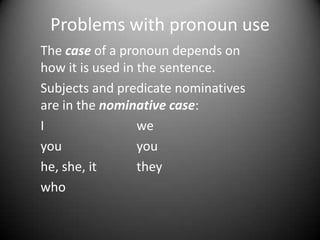
The case of a pronoun depends on
how it is used in the sentence.
Subjects and predicate nominatives
are in the nominative case:
I
we
you
you
he, she, it
they
who
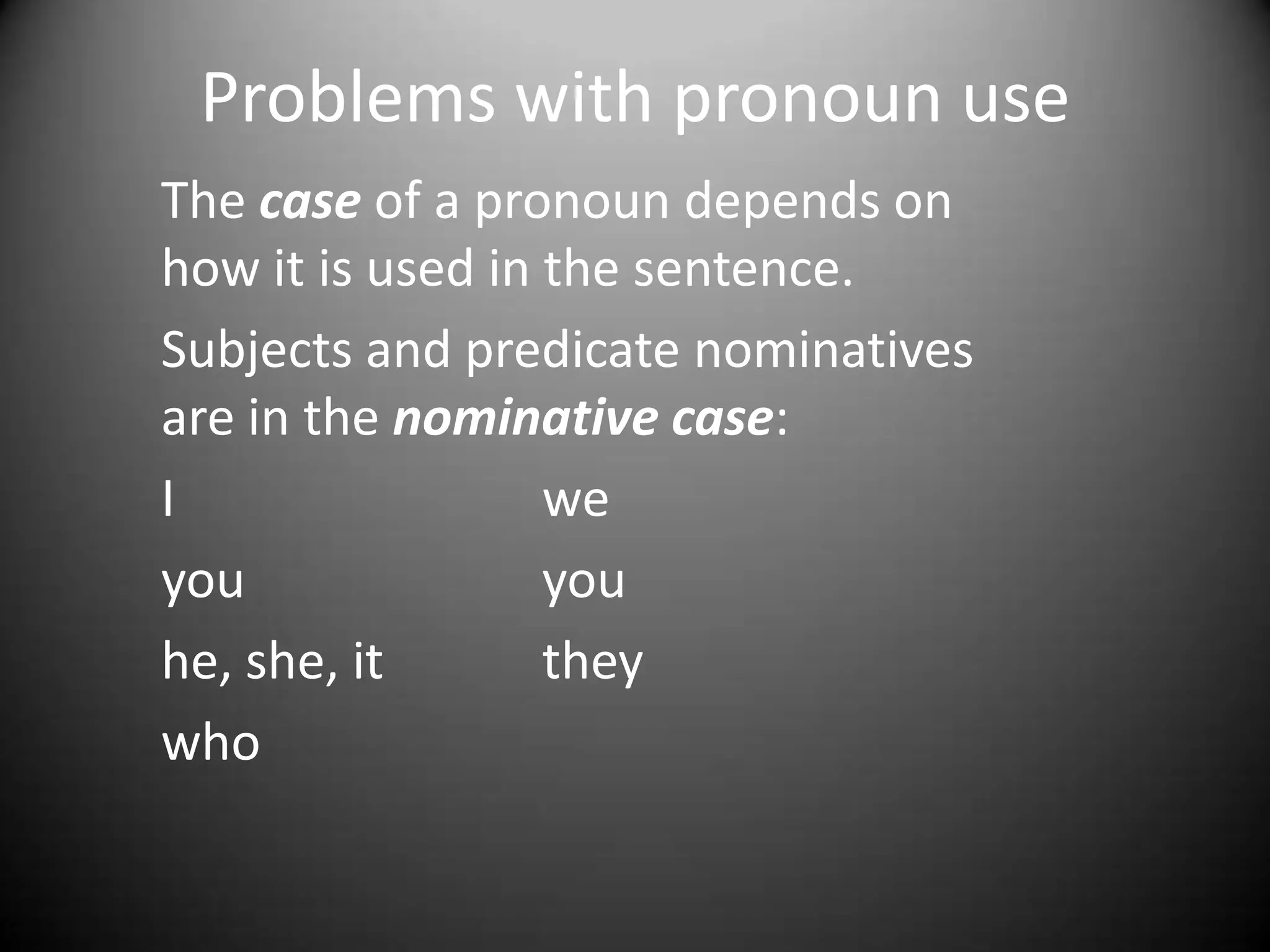
Pronouns used as objects (direct object, indirect
object, object of the preposition) are in the
objective case.
me
you
him, her, it
whom

us
you
them
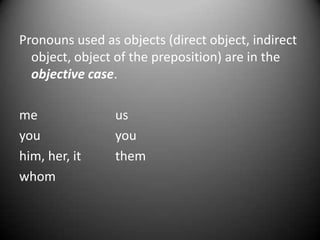
Pronoun pairs
• Use the nominative case when two pronouns
(or pronoun and noun) act as subject or
predicate nominative.
He and I are different ages. (not me and him)
She and the new students were in the same
class. (not her and the new students)
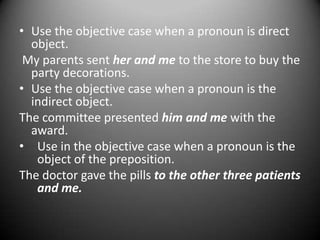
• Use the objective case when a pronoun is direct
object.
My parents sent her and me to the store to buy the
party decorations.
• Use the objective case when a pronoun is the
indirect object.
The committee presented him and me with the
award.
• Use in the objective case when a pronoun is the
object of the preposition.
The doctor gave the pills to the other three patients
and me.
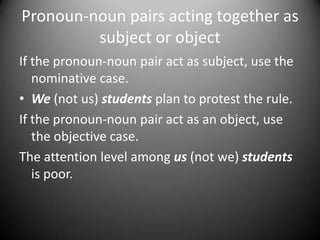
Pronoun-noun pairs acting together as
subject or object
If the pronoun-noun pair act as subject, use the
nominative case.
• We (not us) students plan to protest the rule.
If the pronoun-noun pair act as an object, use
the objective case.
The attention level among us (not we) students
is poor.
Pronouns following the comparative
than
• To determine the appropriate case for the
pronoun in a sentence with than, simply add
the implied word.
The other employees are more willing to
negotiate than we [are].
The boss seems to like them better than [he
likes] us.
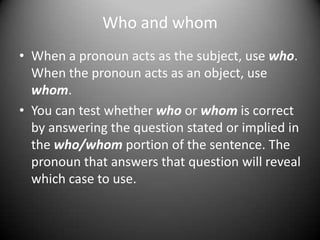
Who and whom
• When a pronoun acts as the subject, use who.
When the pronoun acts as an object, use
whom.
• You can test whether who or whom is correct
by answering the question stated or implied in
the who/whom portion of the sentence. The
pronoun that answers that question will reveal
which case to use.
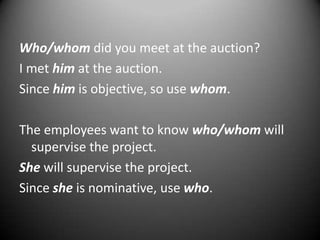
Who/whom did you meet at the auction?
I met him at the auction.
Since him is objective, so use whom.
The employees want to know who/whom will
supervise the project.
She will supervise the project.
Since she is nominative, use who.

Problems with pronoun use

  • 1.
    Problems with pronounuse The case of a pronoun depends on how it is used in the sentence. Subjects and predicate nominatives are in the nominative case: I we you you he, she, it they who
  • 2.
    Pronouns used asobjects (direct object, indirect object, object of the preposition) are in the objective case. me you him, her, it whom us you them
  • 3.
    Pronoun pairs • Usethe nominative case when two pronouns (or pronoun and noun) act as subject or predicate nominative. He and I are different ages. (not me and him) She and the new students were in the same class. (not her and the new students)
  • 4.
    • Use theobjective case when a pronoun is direct object. My parents sent her and me to the store to buy the party decorations. • Use the objective case when a pronoun is the indirect object. The committee presented him and me with the award. • Use in the objective case when a pronoun is the object of the preposition. The doctor gave the pills to the other three patients and me.
  • 5.
    Pronoun-noun pairs actingtogether as subject or object If the pronoun-noun pair act as subject, use the nominative case. • We (not us) students plan to protest the rule. If the pronoun-noun pair act as an object, use the objective case. The attention level among us (not we) students is poor.
  • 6.
    Pronouns following thecomparative than • To determine the appropriate case for the pronoun in a sentence with than, simply add the implied word. The other employees are more willing to negotiate than we [are]. The boss seems to like them better than [he likes] us.
  • 7.
    Who and whom •When a pronoun acts as the subject, use who. When the pronoun acts as an object, use whom. • You can test whether who or whom is correct by answering the question stated or implied in the who/whom portion of the sentence. The pronoun that answers that question will reveal which case to use.
  • 8.
    Who/whom did youmeet at the auction? I met him at the auction. Since him is objective, so use whom. The employees want to know who/whom will supervise the project. She will supervise the project. Since she is nominative, use who.