A Plan for Problem Solving You will learn to solve problems that involve the perimeters and areas of rectangles and parallelograms. What You'll Learn
A Plan for Problem Solving You will learn to solve problems that involve the perimeters and areas of rectangles and parallelograms. What You'll Learn Perimeter is the _____________________. Perimeter is similar to ____________.
A Plan for Problem Solving You will learn to solve problems that involve the perimeters and areas of rectangles and parallelograms. What You'll Learn Perimeter is the _____________________. distance around an object Perimeter is similar to ____________. a line segment
A Plan for Problem Solving You will learn to solve problems that involve the perimeters and areas of rectangles and parallelograms. What You'll Learn Perimeter is the _____________________. distance around an object Perimeter is similar to ____________. a line segment Area is the _______________________________________________. Area is similar to ______.
A Plan for Problem Solving You will learn to solve problems that involve the perimeters and areas of rectangles and parallelograms. What You'll Learn Perimeter is the _____________________. distance around an object Perimeter is similar to ____________. a line segment Area is the _______________________________________________. number of square units needed to cover an object’s surface Area is similar to ______. a plane
A Plan for Problem Solving In this section you will learn to solve problems that involve the perimeters and areas of rectangles and parallelograms. Perimeter is the ____________________.
A Plan for Problem Solving In this section you will learn to solve problems that involve the perimeters and areas of rectangles and parallelograms. Perimeter is the ____________________. distance around a figure
A Plan for Problem Solving In this section you will learn to solve problems that involve the perimeters and areas of rectangles and parallelograms. Perimeter is the ____________________. distance around a figure The perimeter is the ____ of the lengths of the sides of the figure.
A Plan for Problem Solving In this section you will learn to solve problems that involve the perimeters and areas of rectangles and parallelograms. Perimeter is the ____________________. distance around a figure The perimeter is the ____ of the lengths of the sides of the figure. sum
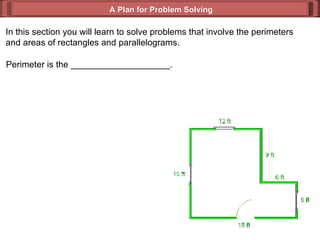
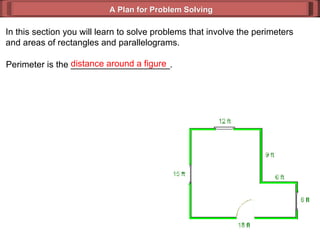
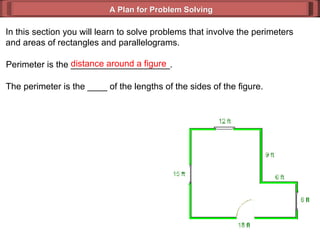
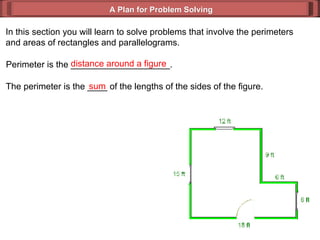
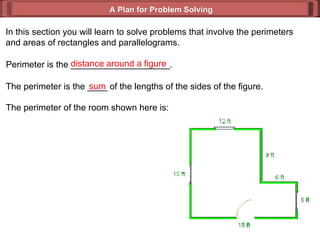
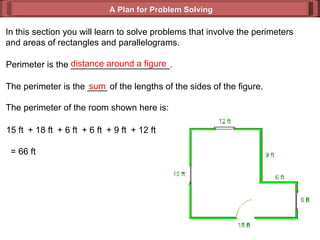
A Plan for Problem Solving In this section you will learn to solve problems that involve the perimeters and areas of rectangles and parallelograms. Perimeter is the ____________________. distance around a figure The perimeter is the ____ of the lengths of the sides of the figure. sum The perimeter of the room shown here is:
A Plan for Problem Solving In this section you will learn to solve problems that involve the perimeters and areas of rectangles and parallelograms. Perimeter is the ____________________. distance around a figure The perimeter is the ____ of the lengths of the sides of the figure. sum The perimeter of the room shown here is: 15 ft + 12 ft + 18 ft + 6 ft + 6 ft + 9 ft = 66 ft
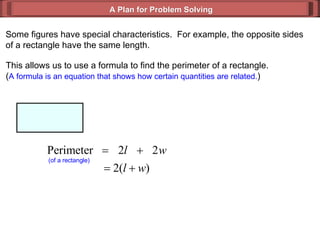
A Plan for Problem Solving Some figures have special characteristics.  For example, the opposite sides of a rectangle have the same length. This allows us to use a formula to find the perimeter of a rectangle. ( A formula is an equation that shows how certain quantities are related. )
A Plan for Problem Solving Some figures have special characteristics.  For example, the opposite sides of a rectangle have the same length. This allows us to use a formula to find the perimeter of a rectangle. ( A formula is an equation that shows how certain quantities are related. ) (of a rectangle)
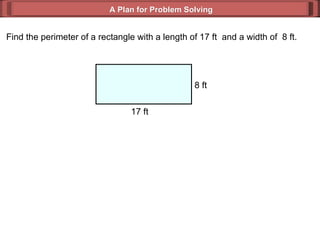
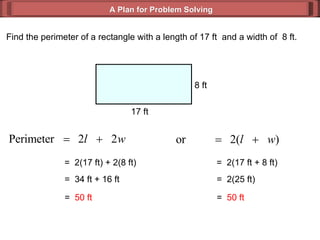
A Plan for Problem Solving Find the perimeter of a rectangle with a length of 17 ft  and a width of  8 ft. 17 ft 8 ft
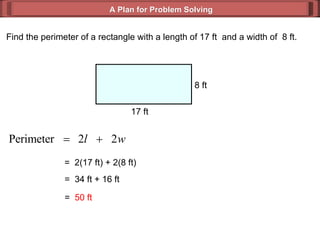
A Plan for Problem Solving Find the perimeter of a rectangle with a length of 17 ft  and a width of  8 ft. =  2(17 ft) + 2(8 ft) =  34 ft + 16 ft =  50 ft 17 ft 8 ft
A Plan for Problem Solving Find the perimeter of a rectangle with a length of 17 ft  and a width of  8 ft. =  2(17 ft) + 2(8 ft) =  2(17 ft + 8 ft) =  34 ft + 16 ft =  50 ft =  2(25 ft) =  50 ft 17 ft 8 ft
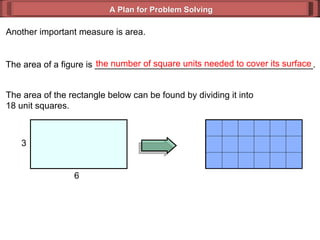
A Plan for Problem Solving Another important measure is area. The area of a figure is ____________________________________________.
A Plan for Problem Solving Another important measure is area. The area of a figure is ____________________________________________. the number of square units needed to cover its surface
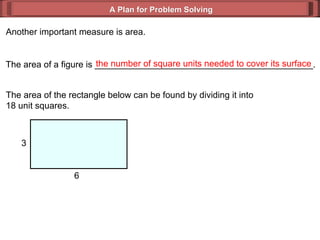
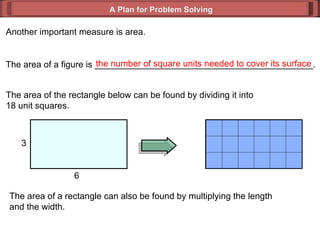
A Plan for Problem Solving Another important measure is area. The area of a figure is ____________________________________________. the number of square units needed to cover its surface The area of the rectangle below can be found by dividing it into  18 unit squares. 3 6
A Plan for Problem Solving Another important measure is area. The area of a figure is ____________________________________________. the number of square units needed to cover its surface The area of the rectangle below can be found by dividing it into  18 unit squares. The area of a rectangle can also be found by multiplying the length  and the width. 3 6
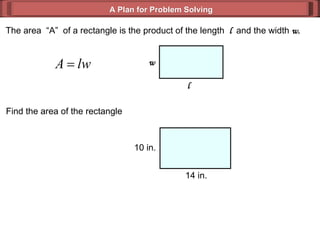
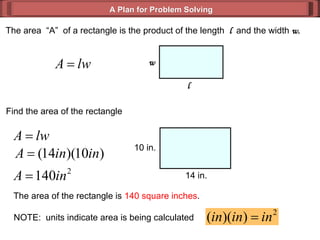
A Plan for Problem Solving The area  “A”  of a rectangle is the product of the length  l   and the width  w.   Find the area of the rectangle l   w   14 in. 10 in.
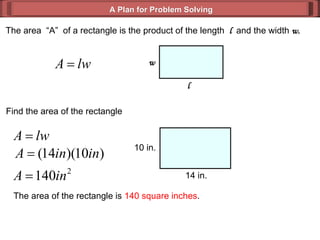
A Plan for Problem Solving The area  “A”  of a rectangle is the product of the length  l   and the width  w.   Find the area of the rectangle The area of the rectangle is  140 square inches . l   w   14 in. 10 in.
A Plan for Problem Solving The area  “A”  of a rectangle is the product of the length  l   and the width  w.   Find the area of the rectangle The area of the rectangle is  140 square inches . l   w   14 in. 10 in. NOTE:  units indicate area is being calculated
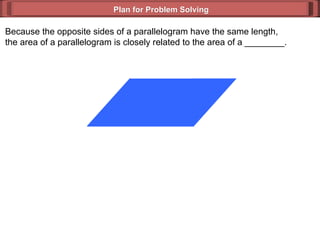
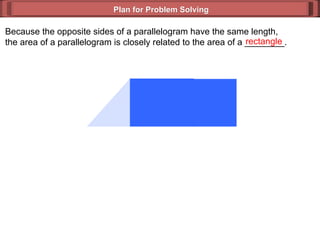
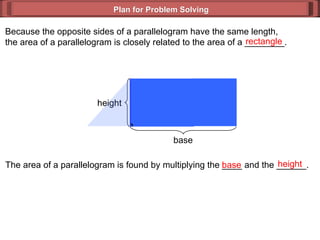
Plan for Problem Solving Because the opposite sides of a parallelogram have the same length, the area of a parallelogram is closely related to the area of a ________.
Plan for Problem Solving Because the opposite sides of a parallelogram have the same length, the area of a parallelogram is closely related to the area of a ________. rectangle
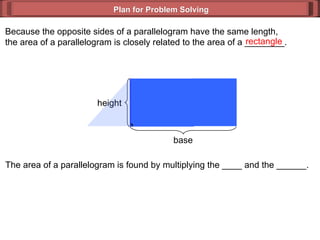
Plan for Problem Solving Because the opposite sides of a parallelogram have the same length, the area of a parallelogram is closely related to the area of a ________. rectangle The area of a parallelogram is found by multiplying the ____ and the ______. base height
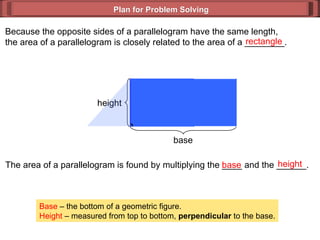
Plan for Problem Solving Because the opposite sides of a parallelogram have the same length, the area of a parallelogram is closely related to the area of a ________. rectangle The area of a parallelogram is found by multiplying the ____ and the ______. base height base height
Plan for Problem Solving Because the opposite sides of a parallelogram have the same length, the area of a parallelogram is closely related to the area of a ________. rectangle The area of a parallelogram is found by multiplying the ____ and the ______. base height Base  – the bottom of a geometric figure. Height  – measured from top to bottom,  perpendicular  to the base. base height
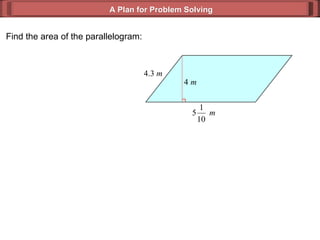
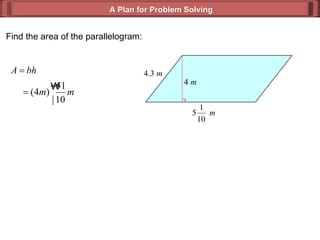
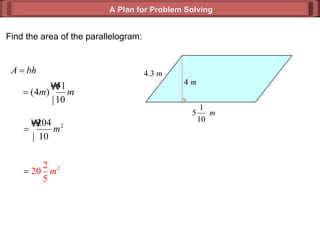
A Plan for Problem Solving Find the area of the parallelogram:
§1.6  A Plan for Problem Solving End of Lesson

Problem Solving (Geometry 1_6)

  • 1.
    A Plan forProblem Solving You will learn to solve problems that involve the perimeters and areas of rectangles and parallelograms. What You'll Learn
  • 2.
    A Plan forProblem Solving You will learn to solve problems that involve the perimeters and areas of rectangles and parallelograms. What You'll Learn Perimeter is the _____________________. Perimeter is similar to ____________.
  • 3.
    A Plan forProblem Solving You will learn to solve problems that involve the perimeters and areas of rectangles and parallelograms. What You'll Learn Perimeter is the _____________________. distance around an object Perimeter is similar to ____________. a line segment
  • 4.
    A Plan forProblem Solving You will learn to solve problems that involve the perimeters and areas of rectangles and parallelograms. What You'll Learn Perimeter is the _____________________. distance around an object Perimeter is similar to ____________. a line segment Area is the _______________________________________________. Area is similar to ______.
  • 5.
    A Plan forProblem Solving You will learn to solve problems that involve the perimeters and areas of rectangles and parallelograms. What You'll Learn Perimeter is the _____________________. distance around an object Perimeter is similar to ____________. a line segment Area is the _______________________________________________. number of square units needed to cover an object’s surface Area is similar to ______. a plane
  • 6.
    A Plan forProblem Solving In this section you will learn to solve problems that involve the perimeters and areas of rectangles and parallelograms. Perimeter is the ____________________.
  • 7.
    A Plan forProblem Solving In this section you will learn to solve problems that involve the perimeters and areas of rectangles and parallelograms. Perimeter is the ____________________. distance around a figure
  • 8.
    A Plan forProblem Solving In this section you will learn to solve problems that involve the perimeters and areas of rectangles and parallelograms. Perimeter is the ____________________. distance around a figure The perimeter is the ____ of the lengths of the sides of the figure.
  • 9.
    A Plan forProblem Solving In this section you will learn to solve problems that involve the perimeters and areas of rectangles and parallelograms. Perimeter is the ____________________. distance around a figure The perimeter is the ____ of the lengths of the sides of the figure. sum
  • 10.
    A Plan forProblem Solving In this section you will learn to solve problems that involve the perimeters and areas of rectangles and parallelograms. Perimeter is the ____________________. distance around a figure The perimeter is the ____ of the lengths of the sides of the figure. sum The perimeter of the room shown here is:
  • 11.
    A Plan forProblem Solving In this section you will learn to solve problems that involve the perimeters and areas of rectangles and parallelograms. Perimeter is the ____________________. distance around a figure The perimeter is the ____ of the lengths of the sides of the figure. sum The perimeter of the room shown here is: 15 ft + 12 ft + 18 ft + 6 ft + 6 ft + 9 ft = 66 ft
  • 12.
    A Plan forProblem Solving Some figures have special characteristics. For example, the opposite sides of a rectangle have the same length. This allows us to use a formula to find the perimeter of a rectangle. ( A formula is an equation that shows how certain quantities are related. )
  • 13.
    A Plan forProblem Solving Some figures have special characteristics. For example, the opposite sides of a rectangle have the same length. This allows us to use a formula to find the perimeter of a rectangle. ( A formula is an equation that shows how certain quantities are related. ) (of a rectangle)
  • 14.
    A Plan forProblem Solving Find the perimeter of a rectangle with a length of 17 ft and a width of 8 ft. 17 ft 8 ft
  • 15.
    A Plan forProblem Solving Find the perimeter of a rectangle with a length of 17 ft and a width of 8 ft. = 2(17 ft) + 2(8 ft) = 34 ft + 16 ft = 50 ft 17 ft 8 ft
  • 16.
    A Plan forProblem Solving Find the perimeter of a rectangle with a length of 17 ft and a width of 8 ft. = 2(17 ft) + 2(8 ft) = 2(17 ft + 8 ft) = 34 ft + 16 ft = 50 ft = 2(25 ft) = 50 ft 17 ft 8 ft
  • 17.
    A Plan forProblem Solving Another important measure is area. The area of a figure is ____________________________________________.
  • 18.
    A Plan forProblem Solving Another important measure is area. The area of a figure is ____________________________________________. the number of square units needed to cover its surface
  • 19.
    A Plan forProblem Solving Another important measure is area. The area of a figure is ____________________________________________. the number of square units needed to cover its surface The area of the rectangle below can be found by dividing it into 18 unit squares. 3 6
  • 20.
    A Plan forProblem Solving Another important measure is area. The area of a figure is ____________________________________________. the number of square units needed to cover its surface The area of the rectangle below can be found by dividing it into 18 unit squares. 3 6
  • 21.
    A Plan forProblem Solving Another important measure is area. The area of a figure is ____________________________________________. the number of square units needed to cover its surface The area of the rectangle below can be found by dividing it into 18 unit squares. The area of a rectangle can also be found by multiplying the length and the width. 3 6
  • 22.
    A Plan forProblem Solving The area “A” of a rectangle is the product of the length l and the width w. Find the area of the rectangle l w 14 in. 10 in.
  • 23.
    A Plan forProblem Solving The area “A” of a rectangle is the product of the length l and the width w. Find the area of the rectangle The area of the rectangle is 140 square inches . l w 14 in. 10 in.
  • 24.
    A Plan forProblem Solving The area “A” of a rectangle is the product of the length l and the width w. Find the area of the rectangle The area of the rectangle is 140 square inches . l w 14 in. 10 in. NOTE: units indicate area is being calculated
  • 25.
    Plan for ProblemSolving Because the opposite sides of a parallelogram have the same length, the area of a parallelogram is closely related to the area of a ________.
  • 26.
    Plan for ProblemSolving Because the opposite sides of a parallelogram have the same length, the area of a parallelogram is closely related to the area of a ________. rectangle
  • 27.
    Plan for ProblemSolving Because the opposite sides of a parallelogram have the same length, the area of a parallelogram is closely related to the area of a ________. rectangle The area of a parallelogram is found by multiplying the ____ and the ______. base height
  • 28.
    Plan for ProblemSolving Because the opposite sides of a parallelogram have the same length, the area of a parallelogram is closely related to the area of a ________. rectangle The area of a parallelogram is found by multiplying the ____ and the ______. base height base height
  • 29.
    Plan for ProblemSolving Because the opposite sides of a parallelogram have the same length, the area of a parallelogram is closely related to the area of a ________. rectangle The area of a parallelogram is found by multiplying the ____ and the ______. base height Base – the bottom of a geometric figure. Height – measured from top to bottom, perpendicular to the base. base height
  • 30.
    A Plan forProblem Solving Find the area of the parallelogram:
  • 31.
    A Plan forProblem Solving Find the area of the parallelogram:
  • 32.
    A Plan forProblem Solving Find the area of the parallelogram:
  • 33.
    §1.6 APlan for Problem Solving End of Lesson