Privacy in Mobile Apps
ď‚— Mobile Apps are software programs designed to run
on mobile devices operating system such as phone,
tablet or watch.
ď‚— Mobile Apps have become more embedded in
consumer’s daily life which collect, use and share of
users’ personal data.
ď‚— More than half of app users have uninstalled or
decided to not install an app due to concerns about
personal information.
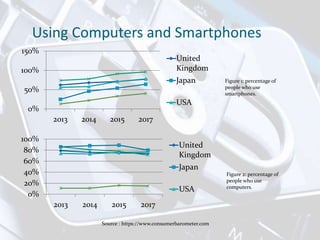
Using Computers and Smartphones
0%
50%
100%
150%
2013 2014 2015 2017
United
Kingdom
Japan
USA
0%
20%
40%
60%
80%
100%
2013 2014 2015 2017
United
Kingdom
Japan
USA
Figure 1: percentage of
people who use
smartphones.
Figure 2: percentage of
people who use
computers.
Source : https://www.consumerbarometer.com
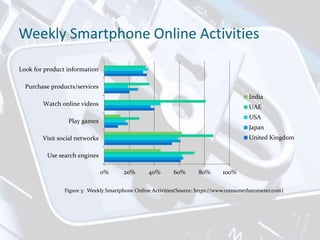
Weekly Smartphone Online Activities
0% 20% 40% 60% 80% 100%
Use search engines
Visit social networks
Play games
Watch online videos
Purchase products/services
Look for product information
India
UAE
USA
Japan
United Kingdom
Figure 3: Weekly Smartphone Online Activities(Source: https://www.consumerbarometer.com)
Privacy Policy in Mobile Apps
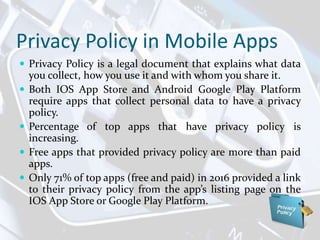
ď‚— Privacy Policy is a legal document that explains what data
you collect, how you use it and with whom you share it.
ď‚— Both IOS App Store and Android Google Play Platform
require apps that collect personal data to have a privacy
policy.
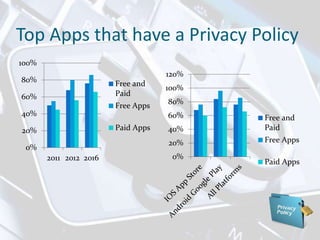
ď‚— Percentage of top apps that have privacy policy is
increasing.
ď‚— Free apps that provided privacy policy are more than paid
apps.
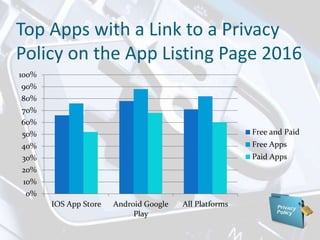
ď‚— Only 71% of top apps (free and paid) in 2016 provided a link
to their privacy policy from the app’s listing page on the
IOS App Store or Google Play Platform.
Top Apps that have a Privacy Policy
0%
20%
40%
60%
80%
100%
2011 2012 2016
Free and
Paid
Free Apps
Paid Apps
0%
20%
40%
60%
80%
100%
120%
Free and
Paid
Free Apps
Paid Apps
Top Apps with a Link to a Privacy
Policy on the App Listing Page 2016
0%
10%
20%
30%
40%
50%
60%
70%
80%
90%
100%
IOS App Store Android Google
Play
All Platforms
Free and Paid
Free Apps
Paid Apps
Best Practices for Privacy Policy
ď‚— Make your privacy policy clear and specific.
ď‚— Make you privacy policy accessible by providing a hyperlink to it
prior download from the app store linking or in the sign up page
and place your privacy policy in a prominent location.
ď‚— Make your privacy policy up-to-date as your data usage practices
changes and tell users what has changed.
ď‚— Post updated privacy policies prior to implementing the new
data use practices to give users time to notice and understand
the change.
ď‚— Obtain new permission if you make material changes to your
data policies and practices that will apply to previously-
collected data.
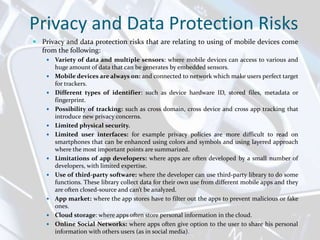
Privacy and Data Protection Risks
ď‚— Privacy and data protection risks that are relating to using of mobile devices come
from the following:
ď‚— Variety of data and multiple sensors: where mobile devices can access to various and
huge amount of data that can be generates by embedded sensors.
ď‚— Mobile devices are always on: and connected to network which make users perfect target
for trackers.
ď‚— Different types of identifier: such as device hardware ID, stored files, metadata or
fingerprint.
ď‚— Possibility of tracking: such as cross domain, cross device and cross app tracking that
introduce new privacy concerns.
ď‚— Limited physical security.
ď‚— Limited user interfaces: for example privacy policies are more difficult to read on
smartphones that can be enhanced using colors and symbols and using layered approach
where the most important points are summarized.
ď‚— Limitations of app developers: where apps are often developed by a small number of
developers, with limited expertise.
ď‚— Use of third-party software: where the developer can use third-party library to do some
functions. These library collect data for their own use from different mobile apps and they
are often closed-source and can’t be analyzed.
ď‚— App market: where the app stores have to filter out the apps to prevent malicious or fake
ones.
ď‚— Cloud storage: where apps often store personal information in the cloud.
ď‚— Online Social Networks: where apps often give option to the user to share his personal
information with others users (as in social media).
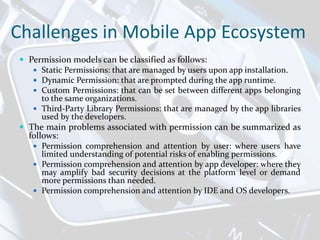
Challenges in Mobile App Ecosystem
ď‚— Permission models can be classified as follows:
ď‚— Static Permissions: that are managed by users upon app installation.
ď‚— Dynamic Permission: that are prompted during the app runtime.
ď‚— Custom Permissions: that can be set between different apps belonging
to the same organizations.
ď‚— Third-Party Library Permissions: that are managed by the app libraries
used by the developers.
ď‚— The main problems associated with permission can be summarized as
follows:
ď‚— Permission comprehension and attention by user: where users have
limited understanding of potential risks of enabling permissions.
ď‚— Permission comprehension and attention by app developer: where they
may amplify bad security decisions at the platform level or demand
more permissions than needed.
ď‚— Permission comprehension and attention by IDE and OS developers.
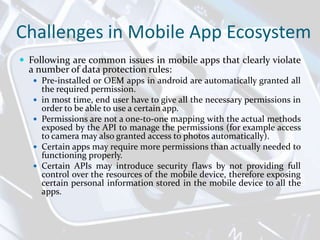
Challenges in Mobile App Ecosystem
ď‚— Following are common issues in mobile apps that clearly violate
a number of data protection rules:
ď‚— Pre-installed or OEM apps in android are automatically granted all
the required permission.
ď‚— in most time, end user have to give all the necessary permissions in
order to be able to use a certain app.
ď‚— Permissions are not a one-to-one mapping with the actual methods
exposed by the API to manage the permissions (for example access
to camera may also granted access to photos automatically).
ď‚— Certain apps may require more permissions than actually needed to
functioning properly.
ď‚— Certain APIs may introduce security flaws by not providing full
control over the resources of the mobile device, therefore exposing
certain personal information stored in the mobile device to all the
apps.
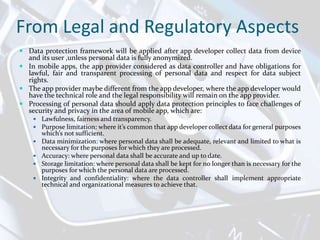
From Legal and Regulatory Aspects
ď‚— Data protection framework will be applied after app developer collect data from device
and its user ,unless personal data is fully anonymized.
ď‚— In mobile apps, the app provider considered as data controller and have obligations for
lawful, fair and transparent processing of personal data and respect for data subject
rights.
ď‚— The app provider maybe different from the app developer, where the app developer would
have the technical role and the legal responsibility will remain on the app provider.
ď‚— Processing of personal data should apply data protection principles to face challenges of
security and privacy in the area of mobile app, which are:
ď‚— Lawfulness, fairness and transparency.
 Purpose limitation: where it’s common that app developer collect data for general purposes
which’s not sufficient.
ď‚— Data minimization: where personal data shall be adequate, relevant and limited to what is
necessary for the purposes for which they are processed.
ď‚— Accuracy: where personal data shall be accurate and up to date.
ď‚— Storage limitation: where personal data shall be kept for no longer than is necessary for the
purposes for which the personal data are processed.
ď‚— Integrity and confidentiality: where the data controller shall implement appropriate
technical and organizational measures to achieve that.
References
ď‚— https://s3.amazonaws.com/academia.edu.documents/42723605/Report_No_P
RIVACY_MOBILE_SISTE_FEB.pdf?AWSAccessKeyId=AKIAIWOWYYGZ2Y53U
L3A&Expires=1527412469&Signature=UGJwXurvF%2Ba9FTjXKwKLOqZ4Pvo%
3D&response-content-
disposition=inline%3B%20filename%3DPrivacy_in_Mobile_Apps_Measuring_
Privacy.pdf
ď‚— https://www.consumerbarometer.com
ď‚— https://developer.apple.com/app-store/review/guidelines/#privacy
ď‚— https://play.google.com/about/privacy-security-deception/personal-sensitive/
ď‚— https://fpf.org/wp-content/uploads/2016/08/2016-FPF-Mobile-Apps-
Study_final.pdf
ď‚— http://www.pewinternet.org/files/old-
media/Files/Reports/2012/PIP_MobilePrivacyManagement.pdf
ď‚— https://www.enisa.europa.eu/publications/privacy-and-data-protection-in-
mobile-applications
ď‚— https://www.cdt.org/files/pdfs/Best-Practices-Mobile-App-Developers.pdf

Privacy on Mobile Apps

  • 1.
    Privacy in MobileApps  Mobile Apps are software programs designed to run on mobile devices operating system such as phone, tablet or watch.  Mobile Apps have become more embedded in consumer’s daily life which collect, use and share of users’ personal data.  More than half of app users have uninstalled or decided to not install an app due to concerns about personal information.
  • 2.
    Using Computers andSmartphones 0% 50% 100% 150% 2013 2014 2015 2017 United Kingdom Japan USA 0% 20% 40% 60% 80% 100% 2013 2014 2015 2017 United Kingdom Japan USA Figure 1: percentage of people who use smartphones. Figure 2: percentage of people who use computers. Source : https://www.consumerbarometer.com
  • 3.
    Weekly Smartphone OnlineActivities 0% 20% 40% 60% 80% 100% Use search engines Visit social networks Play games Watch online videos Purchase products/services Look for product information India UAE USA Japan United Kingdom Figure 3: Weekly Smartphone Online Activities(Source: https://www.consumerbarometer.com)
  • 4.
    Privacy Policy inMobile Apps  Privacy Policy is a legal document that explains what data you collect, how you use it and with whom you share it.  Both IOS App Store and Android Google Play Platform require apps that collect personal data to have a privacy policy.  Percentage of top apps that have privacy policy is increasing.  Free apps that provided privacy policy are more than paid apps.  Only 71% of top apps (free and paid) in 2016 provided a link to their privacy policy from the app’s listing page on the IOS App Store or Google Play Platform.
  • 5.
    Top Apps thathave a Privacy Policy 0% 20% 40% 60% 80% 100% 2011 2012 2016 Free and Paid Free Apps Paid Apps 0% 20% 40% 60% 80% 100% 120% Free and Paid Free Apps Paid Apps
  • 6.
    Top Apps witha Link to a Privacy Policy on the App Listing Page 2016 0% 10% 20% 30% 40% 50% 60% 70% 80% 90% 100% IOS App Store Android Google Play All Platforms Free and Paid Free Apps Paid Apps
  • 7.
    Best Practices forPrivacy Policy ď‚— Make your privacy policy clear and specific. ď‚— Make you privacy policy accessible by providing a hyperlink to it prior download from the app store linking or in the sign up page and place your privacy policy in a prominent location. ď‚— Make your privacy policy up-to-date as your data usage practices changes and tell users what has changed. ď‚— Post updated privacy policies prior to implementing the new data use practices to give users time to notice and understand the change. ď‚— Obtain new permission if you make material changes to your data policies and practices that will apply to previously- collected data.
  • 8.
    Privacy and DataProtection Risks  Privacy and data protection risks that are relating to using of mobile devices come from the following:  Variety of data and multiple sensors: where mobile devices can access to various and huge amount of data that can be generates by embedded sensors.  Mobile devices are always on: and connected to network which make users perfect target for trackers.  Different types of identifier: such as device hardware ID, stored files, metadata or fingerprint.  Possibility of tracking: such as cross domain, cross device and cross app tracking that introduce new privacy concerns.  Limited physical security.  Limited user interfaces: for example privacy policies are more difficult to read on smartphones that can be enhanced using colors and symbols and using layered approach where the most important points are summarized.  Limitations of app developers: where apps are often developed by a small number of developers, with limited expertise.  Use of third-party software: where the developer can use third-party library to do some functions. These library collect data for their own use from different mobile apps and they are often closed-source and can’t be analyzed.  App market: where the app stores have to filter out the apps to prevent malicious or fake ones.  Cloud storage: where apps often store personal information in the cloud.  Online Social Networks: where apps often give option to the user to share his personal information with others users (as in social media).
  • 9.
    Challenges in MobileApp Ecosystem ď‚— Permission models can be classified as follows: ď‚— Static Permissions: that are managed by users upon app installation. ď‚— Dynamic Permission: that are prompted during the app runtime. ď‚— Custom Permissions: that can be set between different apps belonging to the same organizations. ď‚— Third-Party Library Permissions: that are managed by the app libraries used by the developers. ď‚— The main problems associated with permission can be summarized as follows: ď‚— Permission comprehension and attention by user: where users have limited understanding of potential risks of enabling permissions. ď‚— Permission comprehension and attention by app developer: where they may amplify bad security decisions at the platform level or demand more permissions than needed. ď‚— Permission comprehension and attention by IDE and OS developers.
  • 10.
    Challenges in MobileApp Ecosystem ď‚— Following are common issues in mobile apps that clearly violate a number of data protection rules: ď‚— Pre-installed or OEM apps in android are automatically granted all the required permission. ď‚— in most time, end user have to give all the necessary permissions in order to be able to use a certain app. ď‚— Permissions are not a one-to-one mapping with the actual methods exposed by the API to manage the permissions (for example access to camera may also granted access to photos automatically). ď‚— Certain apps may require more permissions than actually needed to functioning properly. ď‚— Certain APIs may introduce security flaws by not providing full control over the resources of the mobile device, therefore exposing certain personal information stored in the mobile device to all the apps.
  • 11.
    From Legal andRegulatory Aspects  Data protection framework will be applied after app developer collect data from device and its user ,unless personal data is fully anonymized.  In mobile apps, the app provider considered as data controller and have obligations for lawful, fair and transparent processing of personal data and respect for data subject rights.  The app provider maybe different from the app developer, where the app developer would have the technical role and the legal responsibility will remain on the app provider.  Processing of personal data should apply data protection principles to face challenges of security and privacy in the area of mobile app, which are:  Lawfulness, fairness and transparency.  Purpose limitation: where it’s common that app developer collect data for general purposes which’s not sufficient.  Data minimization: where personal data shall be adequate, relevant and limited to what is necessary for the purposes for which they are processed.  Accuracy: where personal data shall be accurate and up to date.  Storage limitation: where personal data shall be kept for no longer than is necessary for the purposes for which the personal data are processed.  Integrity and confidentiality: where the data controller shall implement appropriate technical and organizational measures to achieve that.
  • 12.
    References ď‚— https://s3.amazonaws.com/academia.edu.documents/42723605/Report_No_P RIVACY_MOBILE_SISTE_FEB.pdf?AWSAccessKeyId=AKIAIWOWYYGZ2Y53U L3A&Expires=1527412469&Signature=UGJwXurvF%2Ba9FTjXKwKLOqZ4Pvo% 3D&response-content- disposition=inline%3B%20filename%3DPrivacy_in_Mobile_Apps_Measuring_ Privacy.pdf ď‚— https://www.consumerbarometer.com ď‚—https://developer.apple.com/app-store/review/guidelines/#privacy ď‚— https://play.google.com/about/privacy-security-deception/personal-sensitive/ ď‚— https://fpf.org/wp-content/uploads/2016/08/2016-FPF-Mobile-Apps- Study_final.pdf ď‚— http://www.pewinternet.org/files/old- media/Files/Reports/2012/PIP_MobilePrivacyManagement.pdf ď‚— https://www.enisa.europa.eu/publications/privacy-and-data-protection-in- mobile-applications ď‚— https://www.cdt.org/files/pdfs/Best-Practices-Mobile-App-Developers.pdf