Building Faster Horses
Taking over an existing software product
About Me
 Technical Product Manager for Prime Occupational Medicine
 10 years in software development and design
 Six of those years in software development consulting
 Certifications:
 Professional Scrum Master (PSM-I)
 Distinguished Toastmaster (DTM)
 Numerous Microsoft certifications in .NET development and ALM
 Volunteer for SCORE and SQL Saturday Baton Rouge
About SCORE and SCORE BR
 Nation’s largest network of free expert business mentors
 Free mentoring sessions with SCORE volunteer mentors
 Free and paid seminars and workshops
 Simple Steps to Starting Your Business
 Held monthly and free to attend
 Simple Steps for Growing Your Business
 Currently being held at the Central Library every other Wednesday
http://scorebr.org
About SQL Saturday Baton Rouge
 August 6th, 2016 at the LSU Business Education Complex
 Annual free to attend all day technology conference, lunch provided
 Includes tracks on IT Management and Career Growth
 This year trying to form a Project Management track!
 If you have a topic to present, please submit it by the end of the month!
 If you don’t, make one up!
 If you still don’t, register to attend and see you there!
http://www.sqlsaturday.com/515
Agenda
 What is Product Management?
 A Case Study: EME
 The Backstory
 The Approach
 Lessons Learned
 Planning for the Future
 Resources and References
“If I had asked people what they
wanted, they would have said faster
horses.”
Henry Ford (supposedly.)
https://hbr.org/2011/08/henry-ford-never-said-the-fast
What is Product
Management?
What is Product Management?
 Product management is an organizational lifecycle function within a company
dealing with the planning, forecasting, and production, or marketing of a
product or products at all stages of the product lifecycle.
(“Product Management”, 2016, para. 1)
 The product manager is often called the product "CEO." The product
manager investigates, selects, and drives the development of products for an
organization, performing the activities of product management.
(“Product Manager”, 2016, para. 1)
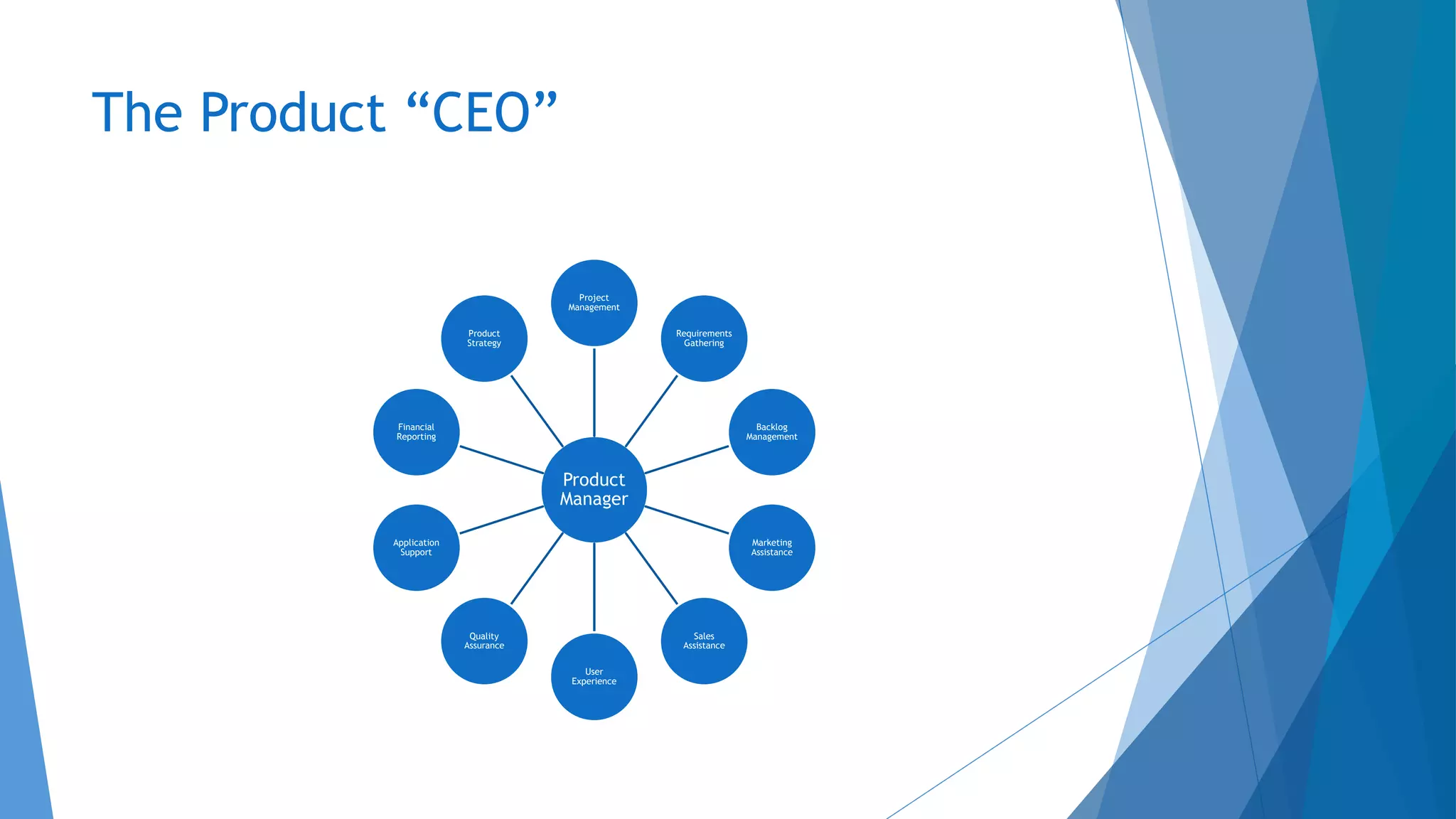
The Product “CEO”
Product
Manager
Project
Management
Requirements
Gathering
Backlog
Management
Marketing
Assistance
Sales
Assistance
User
Experience
Quality
Assurance
Application
Support
Financial
Reporting
Product
Strategy
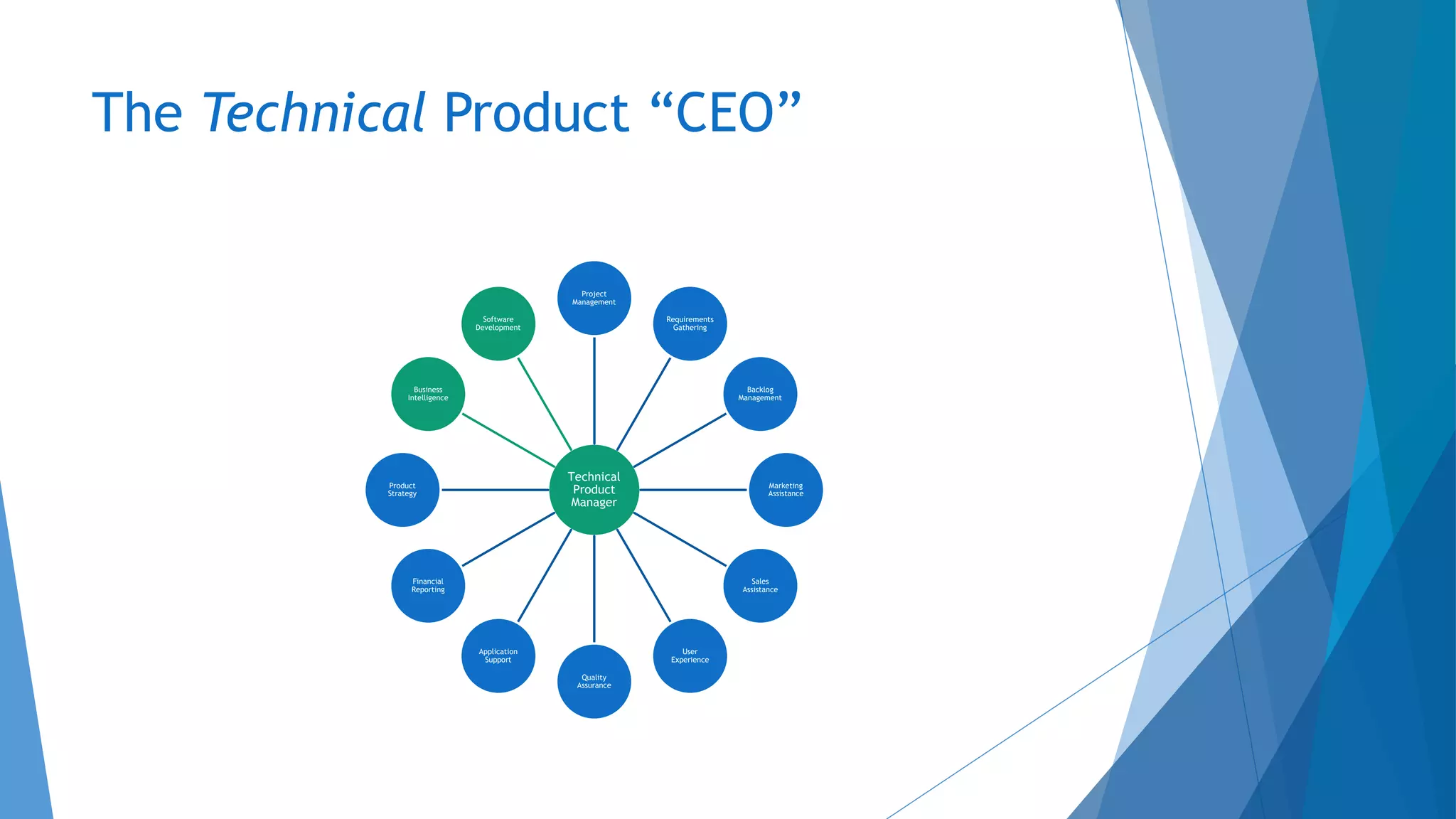
The Technical Product “CEO”
Technical
Product
Manager
Project
Management
Requirements
Gathering
Backlog
Management
Marketing
Assistance
Sales
Assistance
User
Experience
Quality
Assurance
Application
Support
Financial
Reporting
Product
Strategy
Business
Intelligence
Software
Development
A Case Study: EME
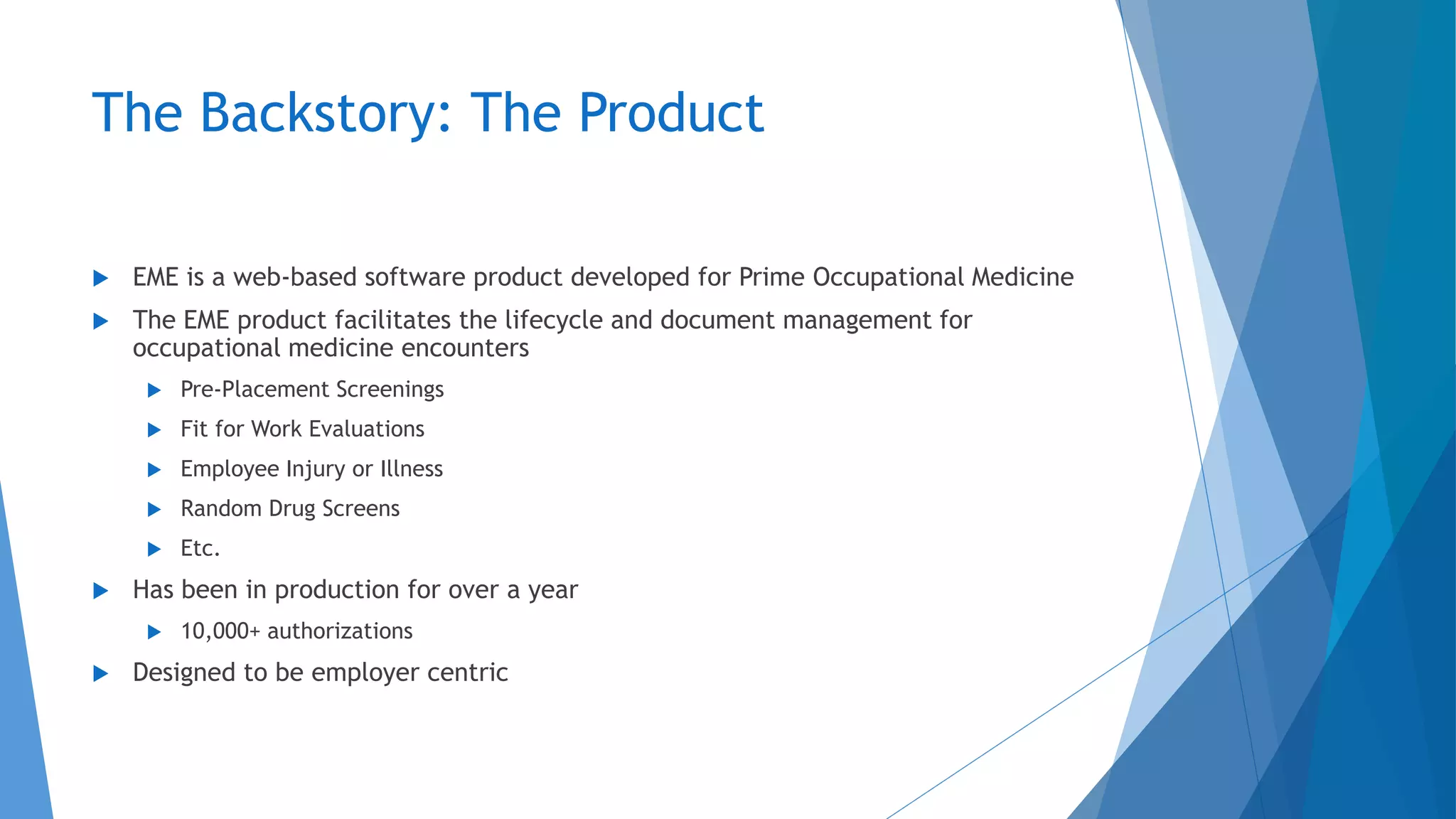
The Backstory: The Product
 EME is a web-based software product developed for Prime Occupational Medicine
 The EME product facilitates the lifecycle and document management for
occupational medicine encounters
 Pre-Placement Screenings
 Fit for Work Evaluations
 Employee Injury or Illness
 Random Drug Screens
 Etc.
 Has been in production for over a year
 10,000+ authorizations
 Designed to be employer centric
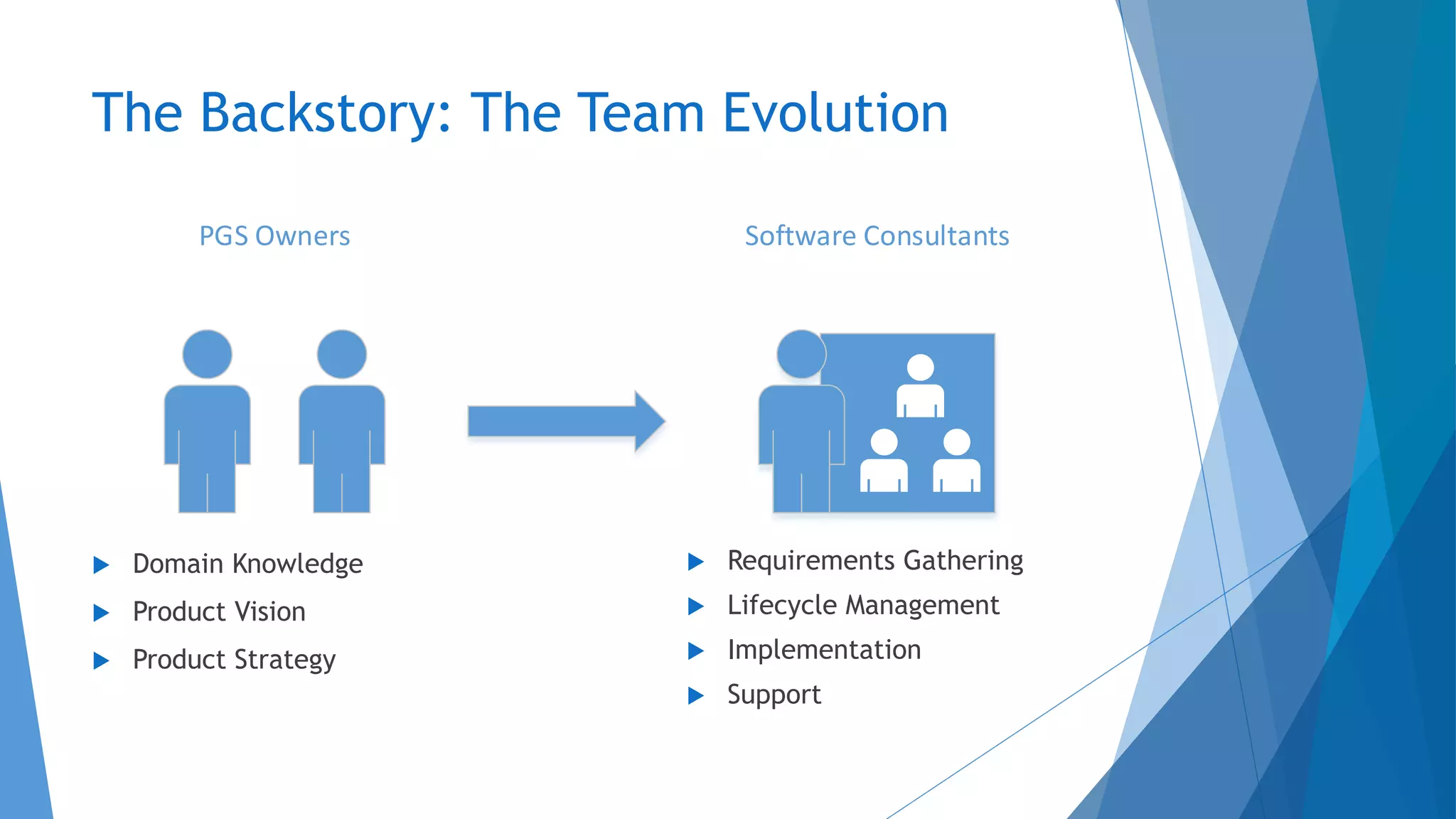
The Backstory: The Team Evolution
PGS Owners Software Consultants
 Domain Knowledge
 Product Vision
 Product Strategy
 Requirements Gathering
 Lifecycle Management
 Implementation
 Support
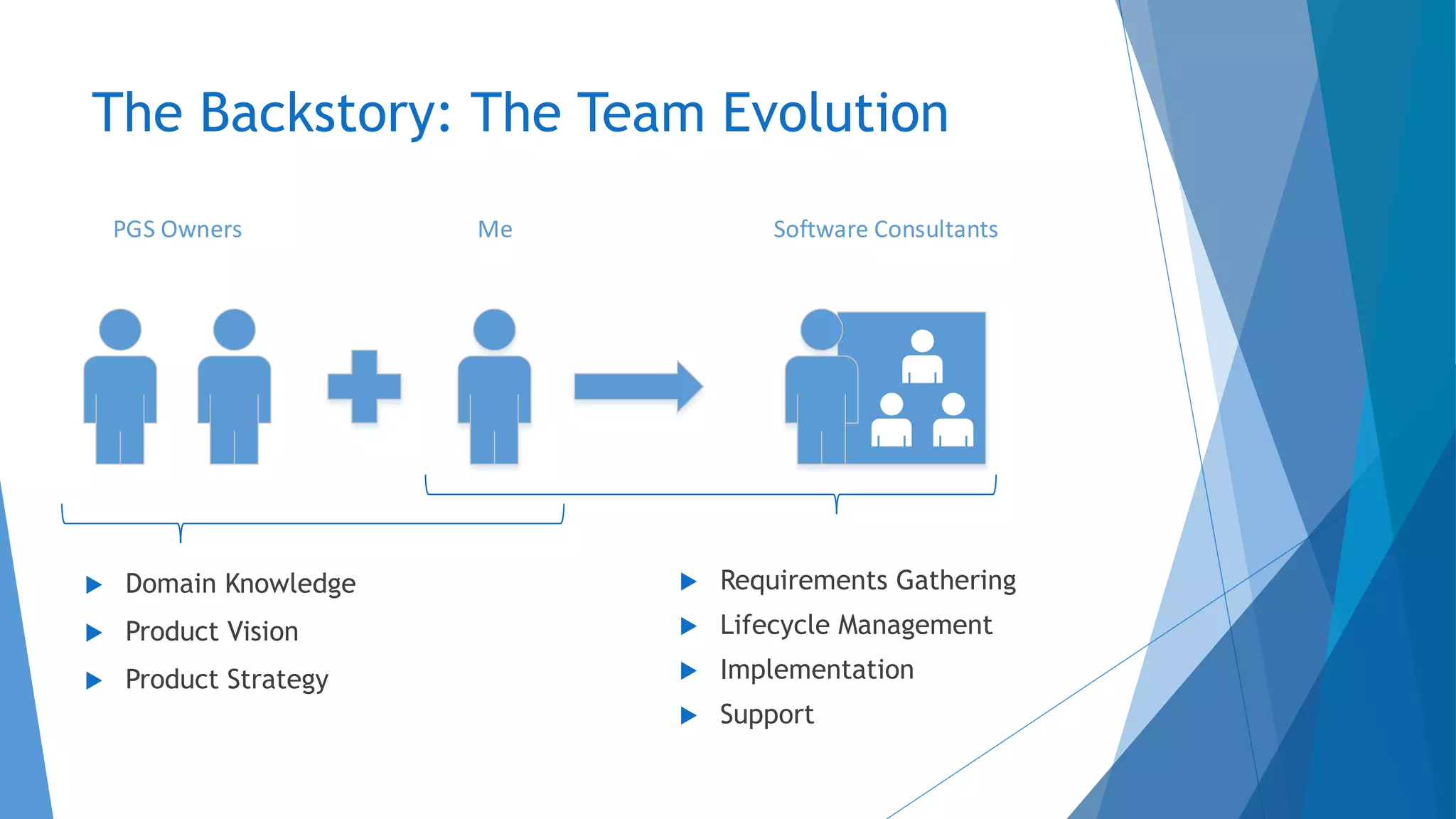
The Backstory: The Team Evolution
 Domain Knowledge
 Product Vision
 Product Strategy
 Requirements Gathering
 Lifecycle Management
 Implementation
 Support
PGS Owners Software ConsultantsMe
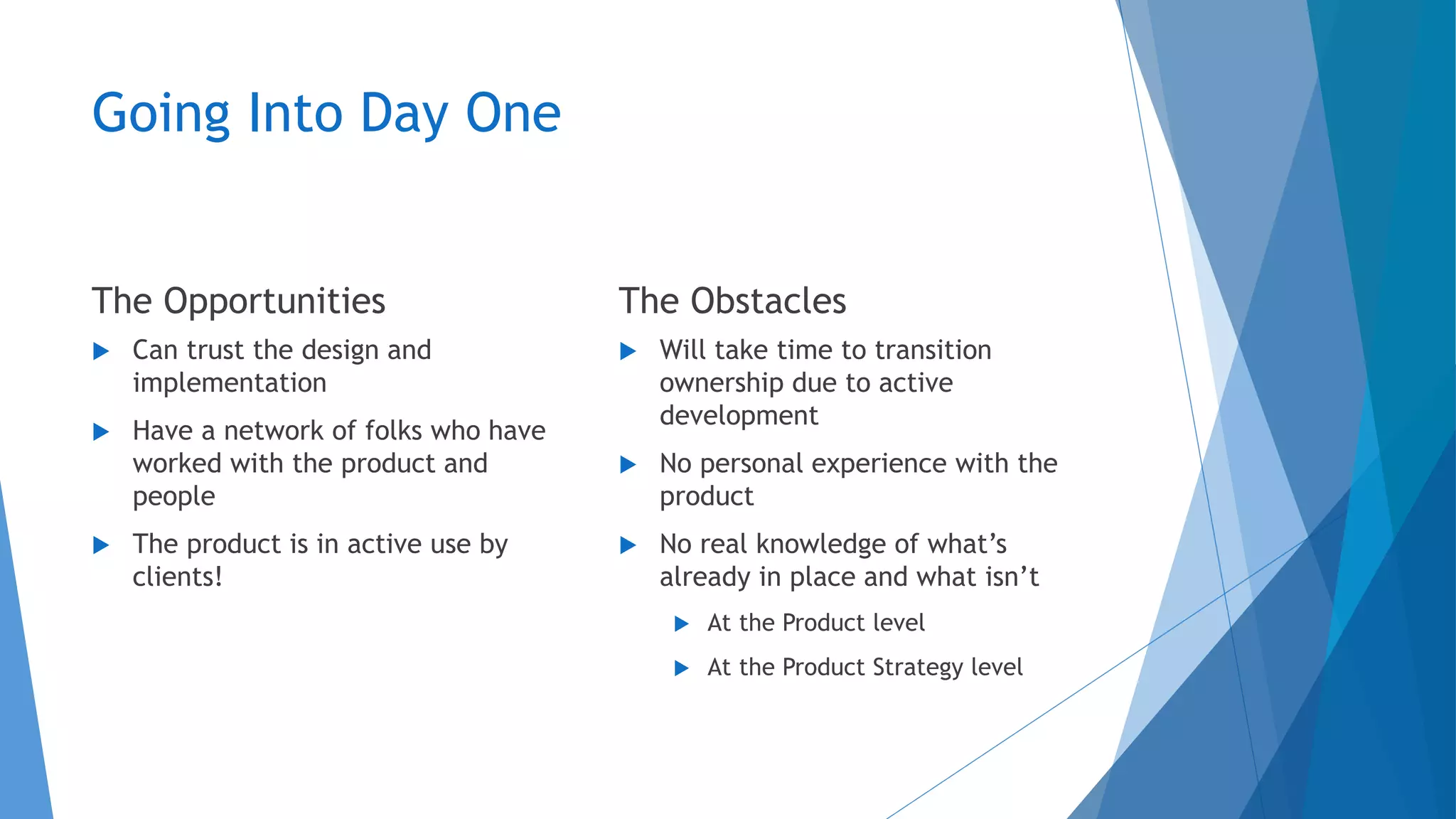
Going Into Day One
The Opportunities
 Can trust the design and
implementation
 Have a network of folks who have
worked with the product and
people
 The product is in active use by
clients!
The Obstacles
 Will take time to transition
ownership due to active
development
 No personal experience with the
product
 No real knowledge of what’s
already in place and what isn’t
 At the Product level
 At the Product Strategy level
The Approach
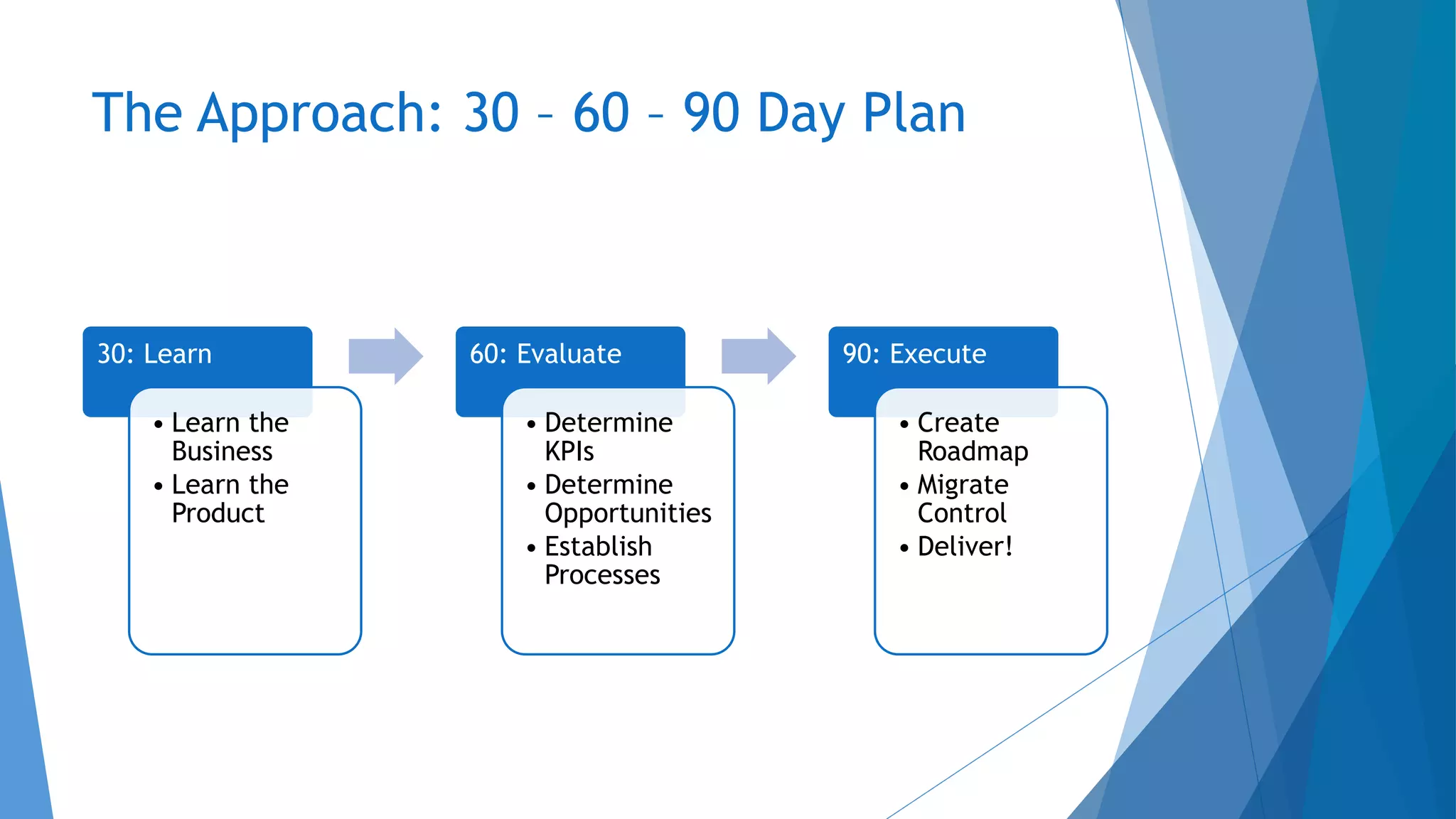
The Approach: 30 – 60 – 90 Day Plan
30: Learn
• Learn the
Business
• Learn the
Product
60: Evaluate
• Determine
KPIs
• Determine
Opportunities
• Establish
Processes
90: Execute
• Create
Roadmap
• Migrate
Control
• Deliver!
The First 30 Days: Learn
 Learn the business and how it operates
 Services
 Locations
 Org Chart
 Learn the product
 Key stakeholders and users
 What does it do?
 What doesn’t it do?
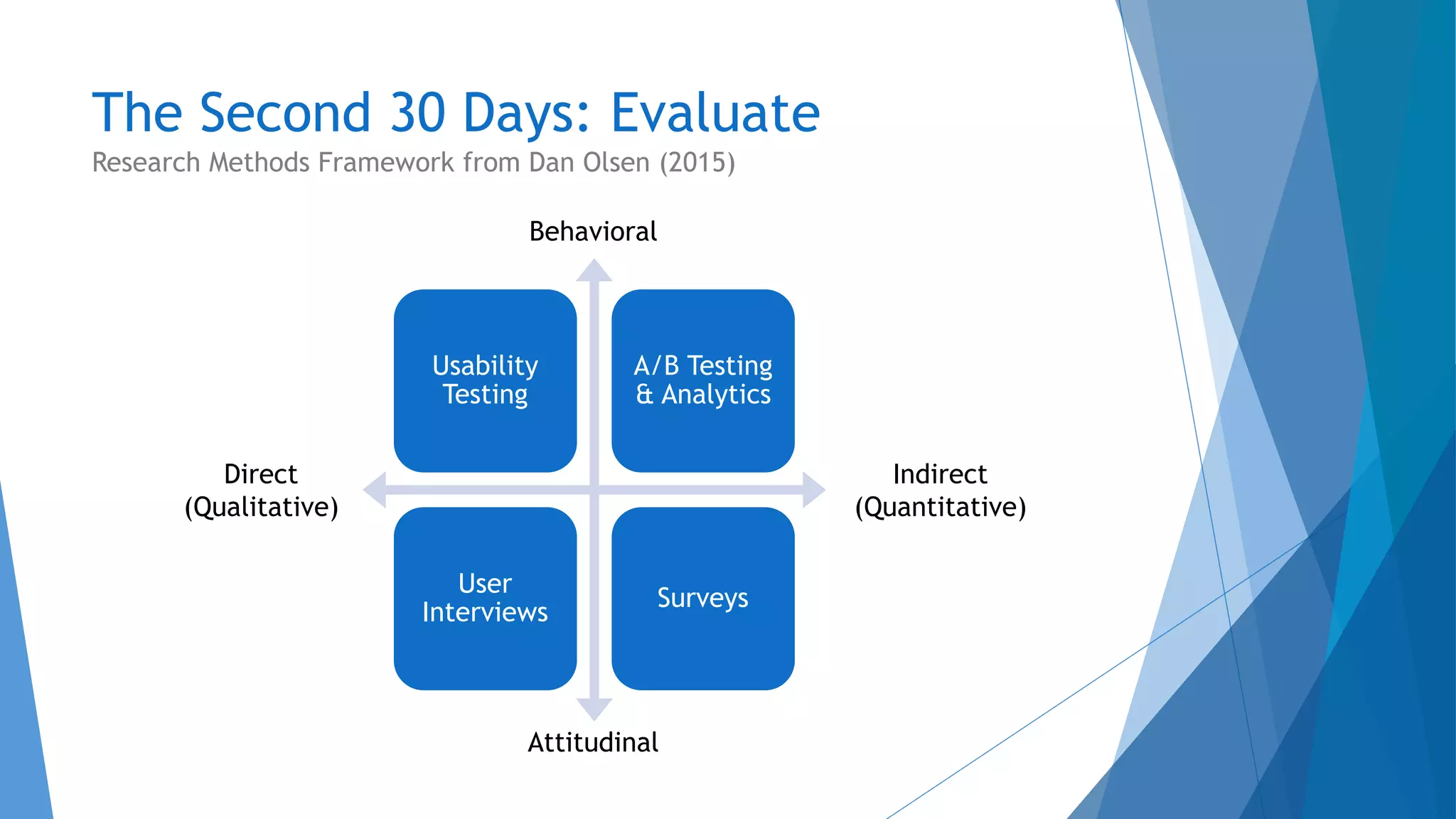
The Second 30 Days: Evaluate
Usability
Testing
A/B Testing
& Analytics
User
Interviews
Surveys
Behavioral
Attitudinal
Direct
(Qualitative)
Indirect
(Quantitative)
Research Methods Framework from Dan Olsen (2015)
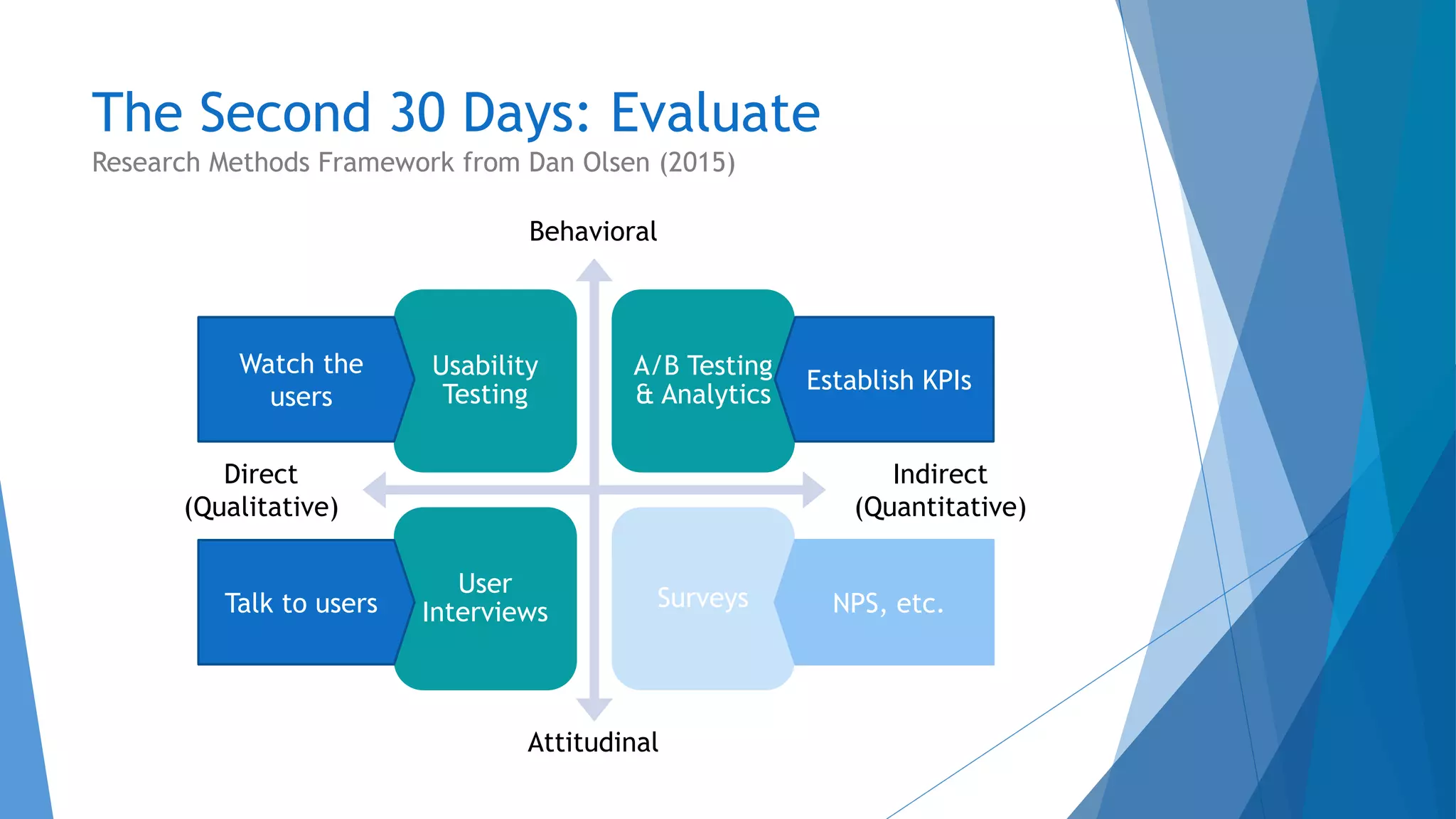
The Second 30 Days: Evaluate
Usability
Testing
A/B Testing
& Analytics
User
Interviews
Surveys
Behavioral
Attitudinal
Direct
(Qualitative)
Indirect
(Quantitative)
Watch the
users
Talk to users
Establish KPIs
NPS, etc.
Research Methods Framework from Dan Olsen (2015)
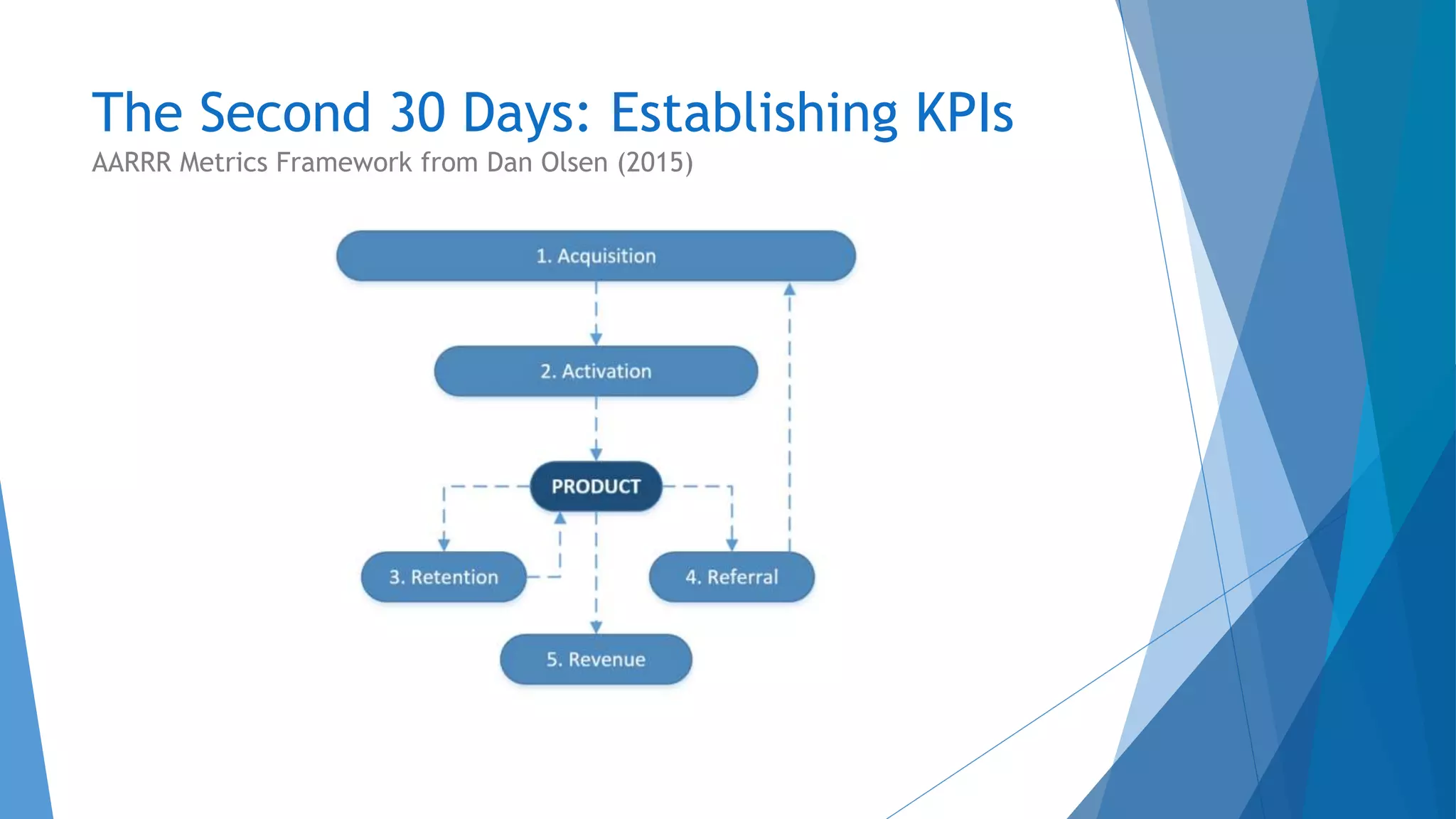
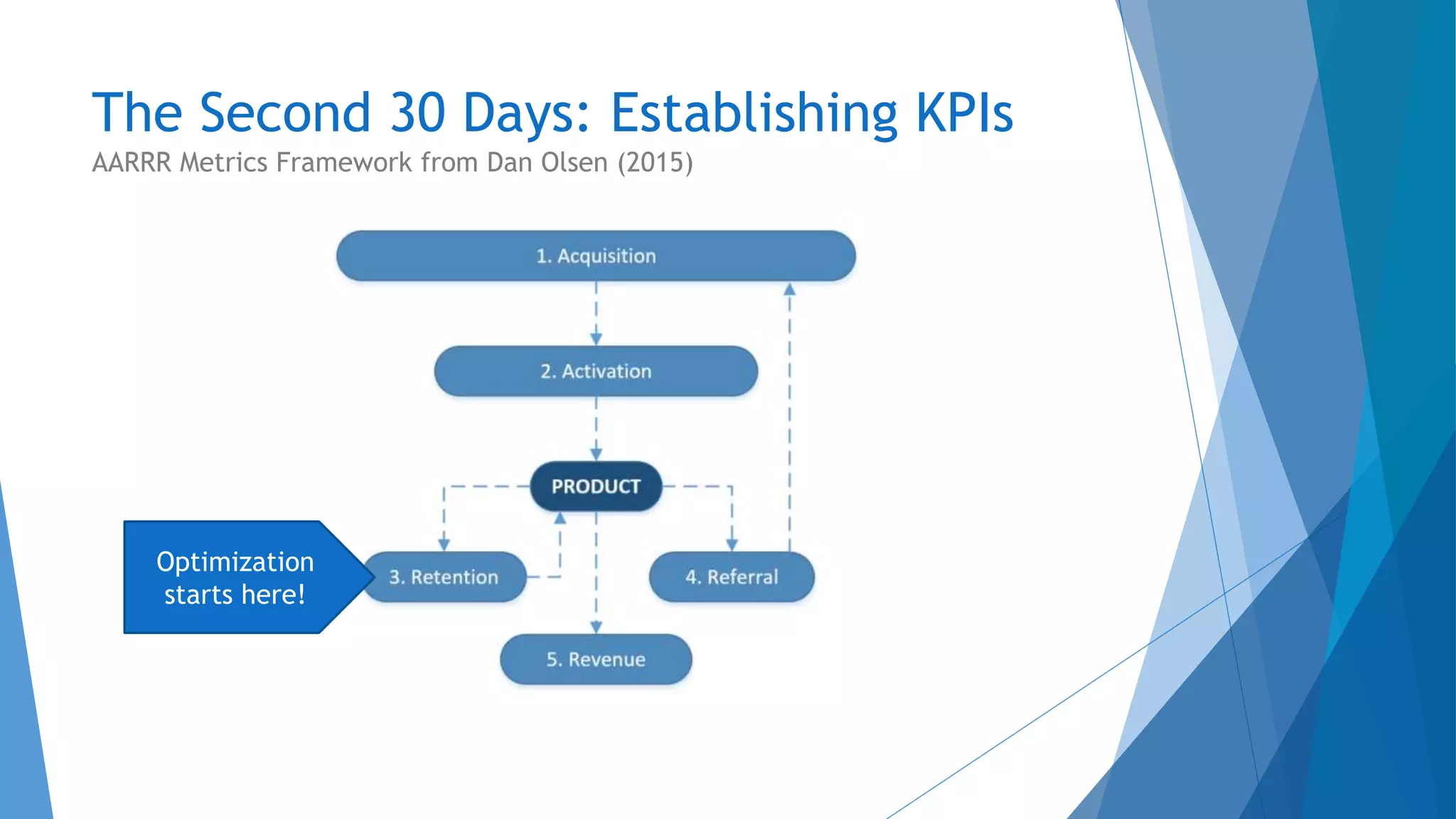
The Second 30 Days: Establishing KPIs
AARRR Metrics Framework from Dan Olsen (2015)
The Second 30 Days: Establishing KPIs
AARRR Metrics Framework from Dan Olsen (2015)
Optimization
starts here!
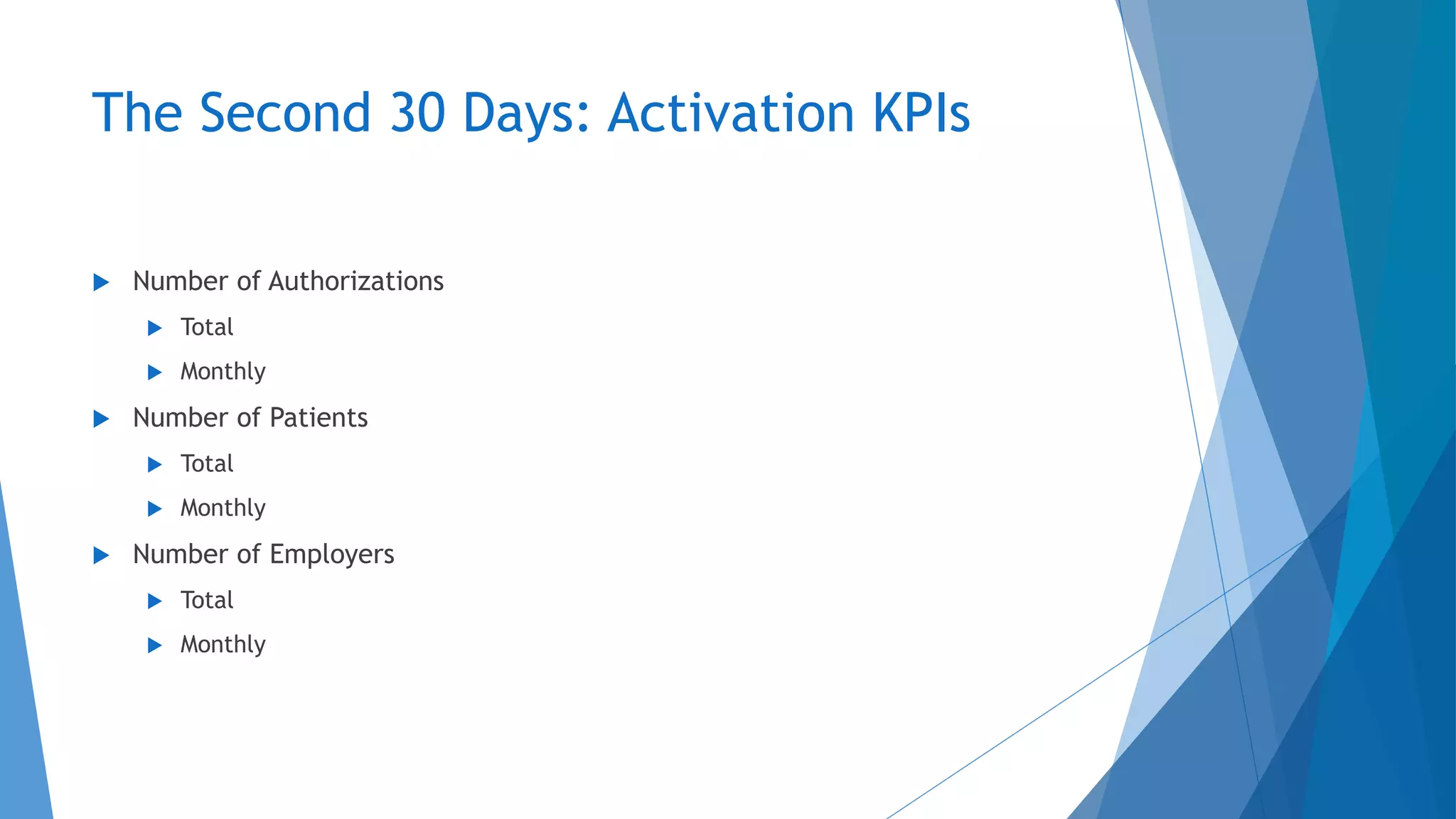
The Second 30 Days: Activation KPIs
 Number of Authorizations
 Total
 Monthly
 Number of Patients
 Total
 Monthly
 Number of Employers
 Total
 Monthly
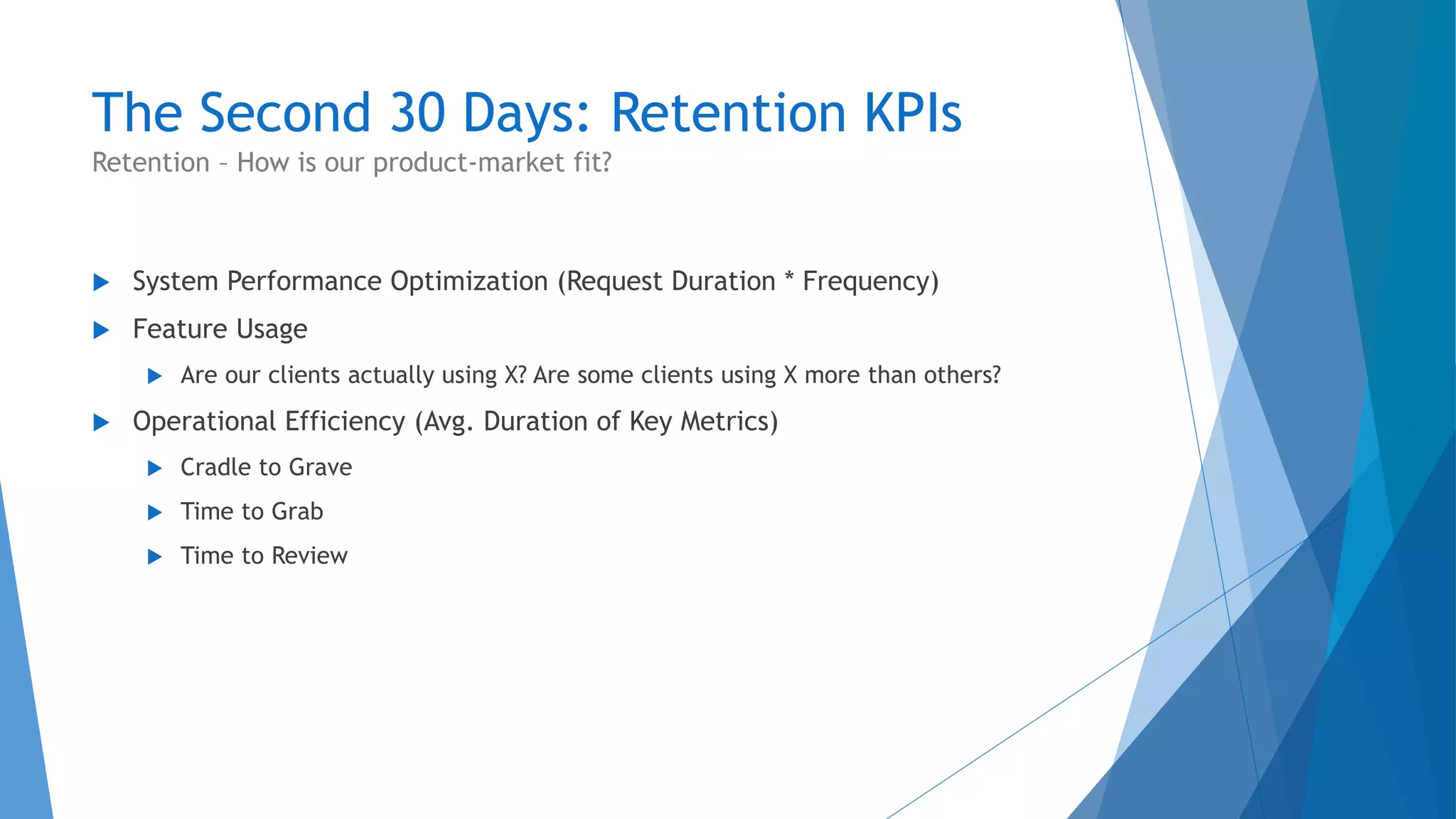
The Second 30 Days: Retention KPIs
 System Performance Optimization (Request Duration * Frequency)
 Feature Usage
 Are our clients actually using X? Are some clients using X more than others?
 Operational Efficiency (Avg. Duration of Key Metrics)
 Cradle to Grave
 Time to Grab
 Time to Review
Retention – How is our product-market fit?
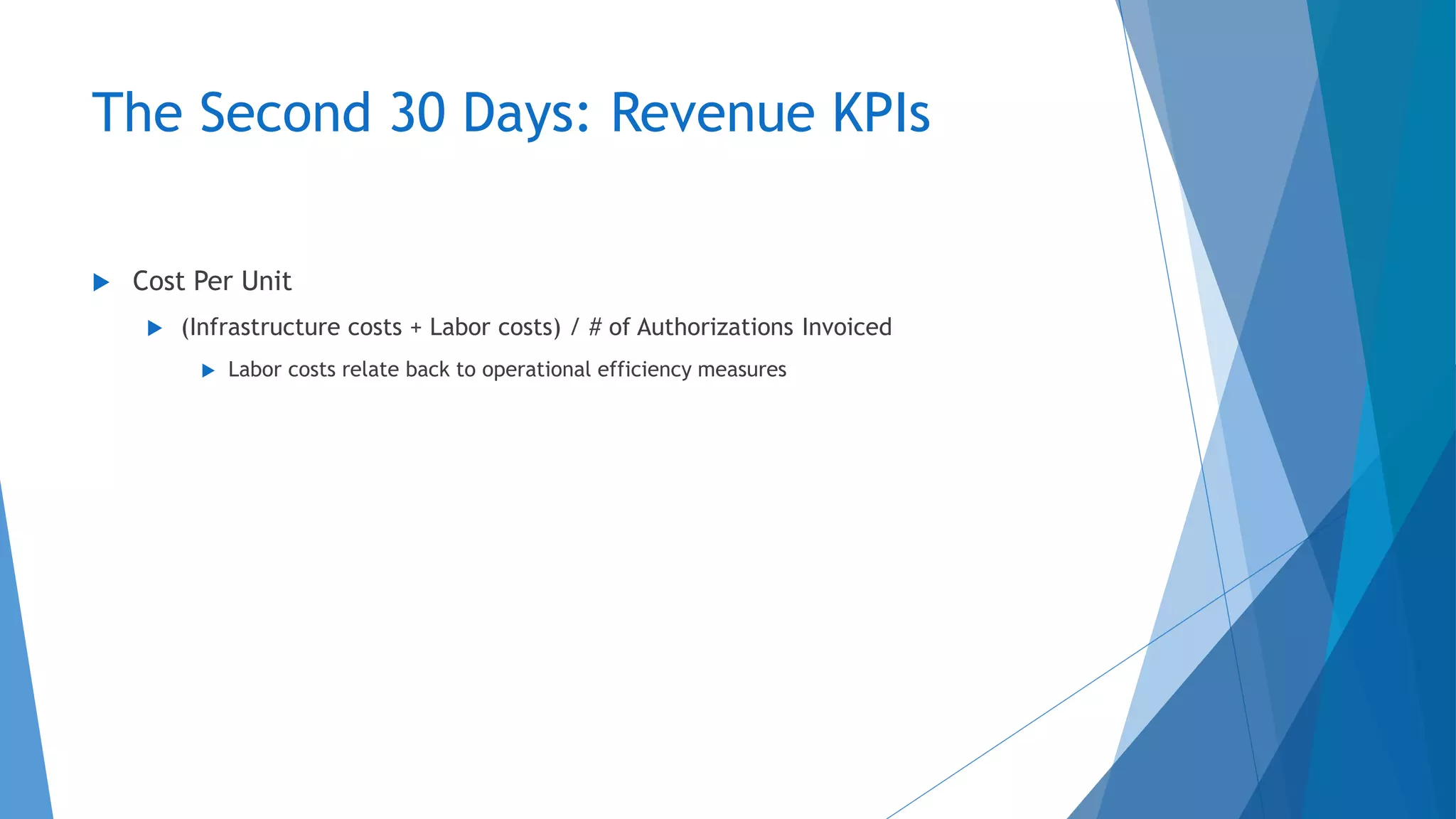
The Second 30 Days: Revenue KPIs
 Cost Per Unit
 (Infrastructure costs + Labor costs) / # of Authorizations Invoiced
 Labor costs relate back to operational efficiency measures
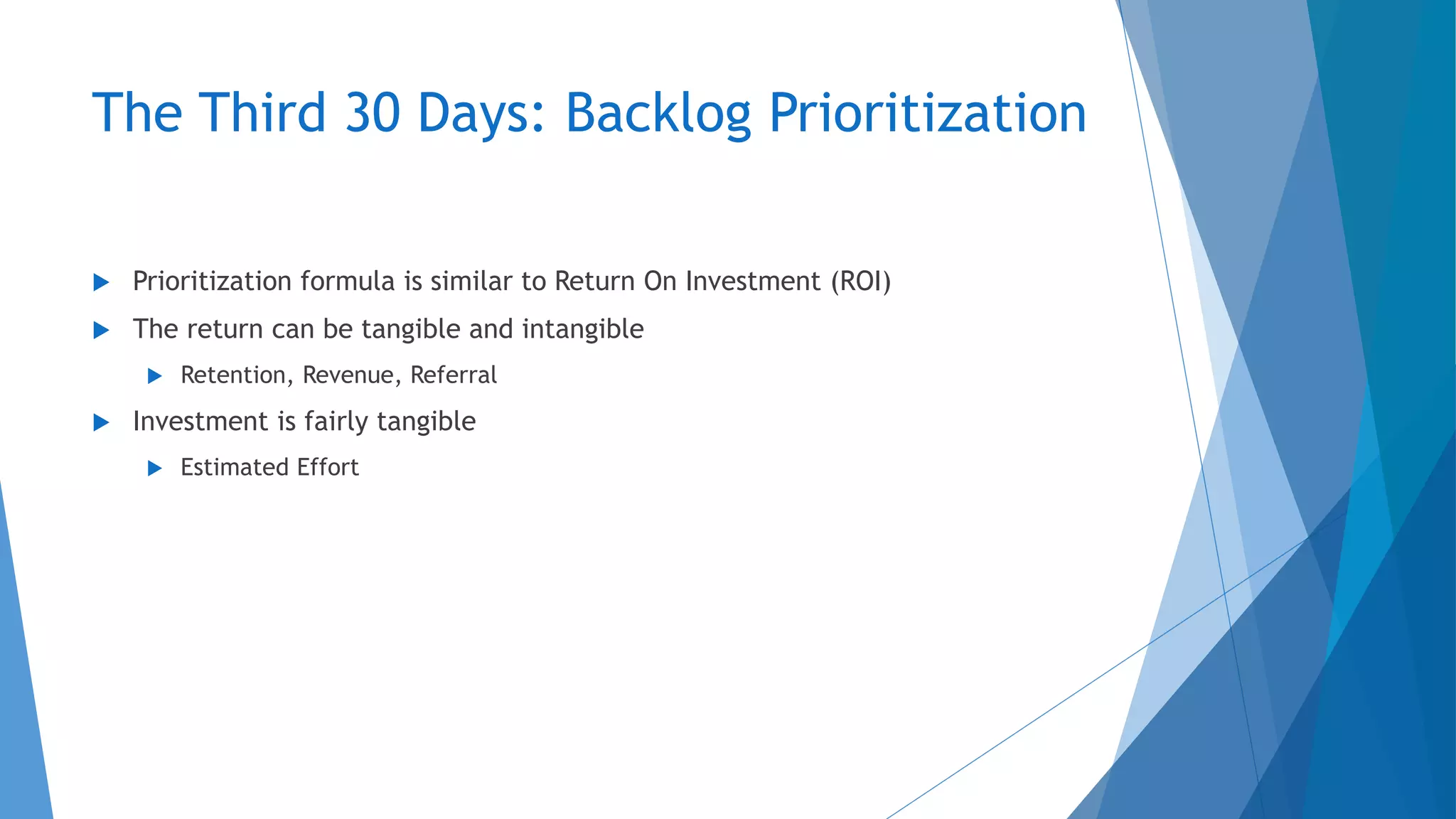
The Third 30 Days: Backlog Prioritization
 Prioritization formula is similar to Return On Investment (ROI)
 The return can be tangible and intangible
 Retention, Revenue, Referral
 Investment is fairly tangible
 Estimated Effort
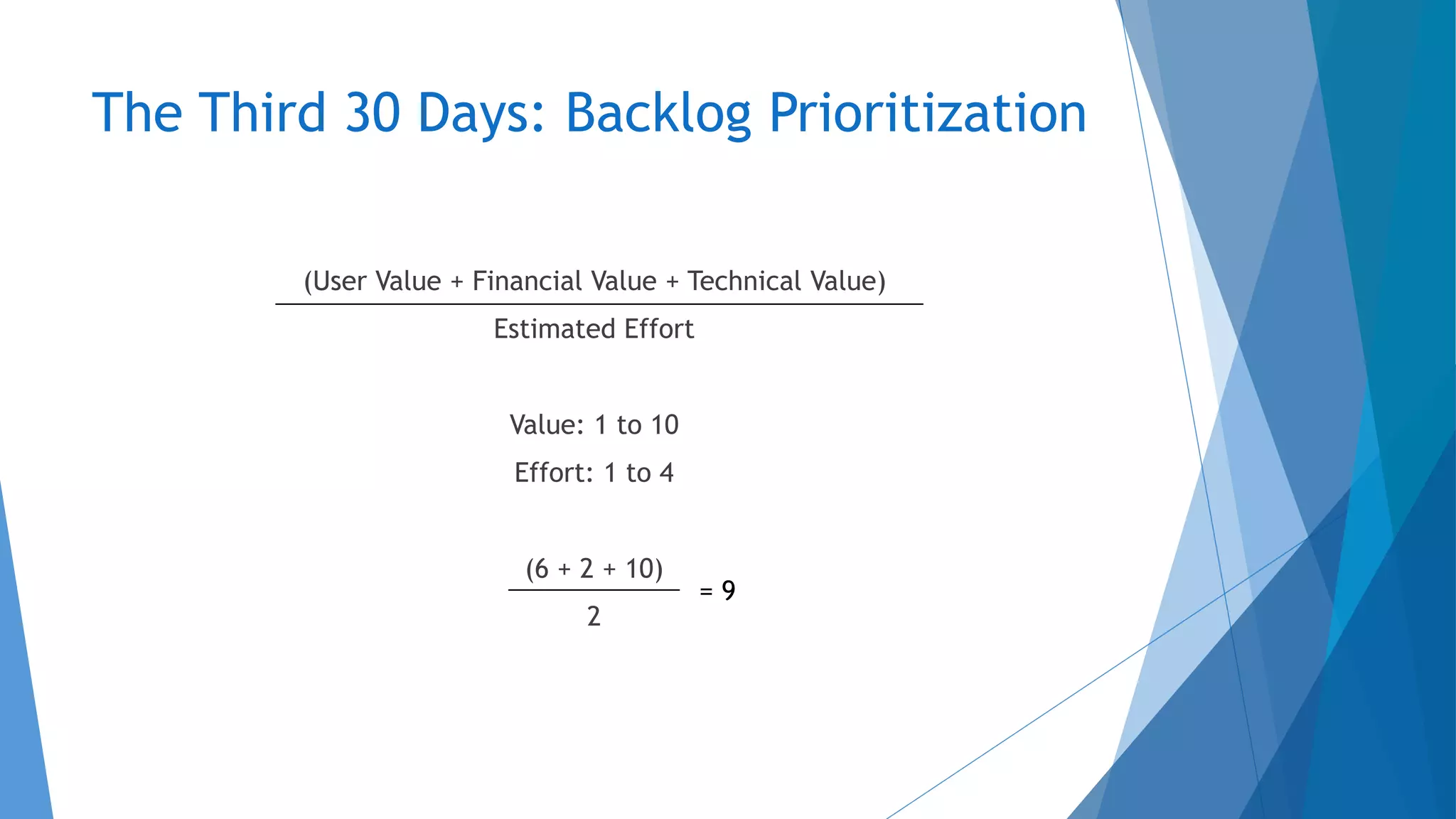
The Third 30 Days: Backlog Prioritization
(User Value + Financial Value + Technical Value)
Estimated Effort
Value: 1 to 10
Effort: 1 to 4
(6 + 2 + 10)
2
= 9
Also… the first internal push to
production!
No pressure…
Some Lessons Learned
Don’t Make Faster Horses When a
Car Will Do.
Look for the goal beyond the request.
Translators shouldn’t need
translators.
Foster an environment open to communicating the fact that we aren’t
actually communicating.
Trade Sandbags for Idols.
Work is “instead of” not “in addition to”. Do the 20% that yields 80%.
Planning for the Future
Let’s play a game…
Speed ABC’s
 Timed 20 seconds
 Write upper case block letters
 No cursive!
 Write the alphabet starting at A and ending at Z
 If you reach the end, start over and keep going!
Speed abc’s
 Timed 20 seconds
 Write lower case block letters
 No cursive!
 Write the alphabet starting at A and ending at Z
 If you reach the end, start over and keep going!
Speed AbC’s
 Timed 20 seconds
 Alternate upper and lower case block letters
 Start with upper case
 No cursive!
 Write the alphabet starting at A and ending at Z
 If you reach the end, start over and keep going!
Planning for the Future: Scaling
Technical
Product
Manager
Project
Managem
ent Requirem
ents
Gathering
Backlog
Managem
ent
Marketing
Assistanc
e
Sales
Assistanc
e
User
Experienc
e
Quality
Assurance
Applicatio
n Support
Financial
Reporting
Product
Strategy
Business
Intelligen
ce
Software
Developm
ent
Ab1@Cd2#Ef3$Gh4%... ABCDEFGHIJKLMNOP…
abcdefghijklmnop…
123456789012345…
@#$%^&*()!@#$%^&…
Planning for the Future: Scaling
 Build a Future Org Chart
 Fill in the areas with your name for now
 Actively build job descriptions from your responsibilities
 Prioritize the growth based on biggest impact
References
References
 Olsen, D. (2015) The Lean Product Playbook. Hoboken, New Jersey: John
Wiley & Sons, Inc.
 Product Management. (n.d.). In Wikipedia. Retrieved May 16, 2016, from
https://en.wikipedia.org/wiki/Product_management
 Product Manager. (n.d.). In Wikipedia. Retrieved May 16, 2016, from
https://en.wikipedia.org/wiki/Product_manager
Additional Resources
 https://www.score.org/resources/simple-steps-workbooks
 http://www.slideshare.net/dan_o

Building Faster Horses: Taking Over An Existing Software Product

  • 1.
    Building Faster Horses Takingover an existing software product
  • 2.
    About Me  TechnicalProduct Manager for Prime Occupational Medicine  10 years in software development and design  Six of those years in software development consulting  Certifications:  Professional Scrum Master (PSM-I)  Distinguished Toastmaster (DTM)  Numerous Microsoft certifications in .NET development and ALM  Volunteer for SCORE and SQL Saturday Baton Rouge
  • 3.
    About SCORE andSCORE BR  Nation’s largest network of free expert business mentors  Free mentoring sessions with SCORE volunteer mentors  Free and paid seminars and workshops  Simple Steps to Starting Your Business  Held monthly and free to attend  Simple Steps for Growing Your Business  Currently being held at the Central Library every other Wednesday http://scorebr.org
  • 4.
    About SQL SaturdayBaton Rouge  August 6th, 2016 at the LSU Business Education Complex  Annual free to attend all day technology conference, lunch provided  Includes tracks on IT Management and Career Growth  This year trying to form a Project Management track!  If you have a topic to present, please submit it by the end of the month!  If you don’t, make one up!  If you still don’t, register to attend and see you there! http://www.sqlsaturday.com/515
  • 5.
    Agenda  What isProduct Management?  A Case Study: EME  The Backstory  The Approach  Lessons Learned  Planning for the Future  Resources and References
  • 6.
    “If I hadasked people what they wanted, they would have said faster horses.” Henry Ford (supposedly.) https://hbr.org/2011/08/henry-ford-never-said-the-fast
  • 7.
  • 8.
    What is ProductManagement?  Product management is an organizational lifecycle function within a company dealing with the planning, forecasting, and production, or marketing of a product or products at all stages of the product lifecycle. (“Product Management”, 2016, para. 1)  The product manager is often called the product "CEO." The product manager investigates, selects, and drives the development of products for an organization, performing the activities of product management. (“Product Manager”, 2016, para. 1)
  • 9.
  • 10.
    The Technical Product“CEO” Technical Product Manager Project Management Requirements Gathering Backlog Management Marketing Assistance Sales Assistance User Experience Quality Assurance Application Support Financial Reporting Product Strategy Business Intelligence Software Development
  • 11.
  • 12.
    The Backstory: TheProduct  EME is a web-based software product developed for Prime Occupational Medicine  The EME product facilitates the lifecycle and document management for occupational medicine encounters  Pre-Placement Screenings  Fit for Work Evaluations  Employee Injury or Illness  Random Drug Screens  Etc.  Has been in production for over a year  10,000+ authorizations  Designed to be employer centric
  • 13.
    The Backstory: TheTeam Evolution PGS Owners Software Consultants  Domain Knowledge  Product Vision  Product Strategy  Requirements Gathering  Lifecycle Management  Implementation  Support
  • 14.
    The Backstory: TheTeam Evolution  Domain Knowledge  Product Vision  Product Strategy  Requirements Gathering  Lifecycle Management  Implementation  Support PGS Owners Software ConsultantsMe
  • 15.
    Going Into DayOne The Opportunities  Can trust the design and implementation  Have a network of folks who have worked with the product and people  The product is in active use by clients! The Obstacles  Will take time to transition ownership due to active development  No personal experience with the product  No real knowledge of what’s already in place and what isn’t  At the Product level  At the Product Strategy level
  • 16.
  • 17.
    The Approach: 30– 60 – 90 Day Plan 30: Learn • Learn the Business • Learn the Product 60: Evaluate • Determine KPIs • Determine Opportunities • Establish Processes 90: Execute • Create Roadmap • Migrate Control • Deliver!
  • 18.
    The First 30Days: Learn  Learn the business and how it operates  Services  Locations  Org Chart  Learn the product  Key stakeholders and users  What does it do?  What doesn’t it do?
  • 19.
    The Second 30Days: Evaluate Usability Testing A/B Testing & Analytics User Interviews Surveys Behavioral Attitudinal Direct (Qualitative) Indirect (Quantitative) Research Methods Framework from Dan Olsen (2015)
  • 20.
    The Second 30Days: Evaluate Usability Testing A/B Testing & Analytics User Interviews Surveys Behavioral Attitudinal Direct (Qualitative) Indirect (Quantitative) Watch the users Talk to users Establish KPIs NPS, etc. Research Methods Framework from Dan Olsen (2015)
  • 21.
    The Second 30Days: Establishing KPIs AARRR Metrics Framework from Dan Olsen (2015)
  • 22.
    The Second 30Days: Establishing KPIs AARRR Metrics Framework from Dan Olsen (2015) Optimization starts here!
  • 23.
    The Second 30Days: Activation KPIs  Number of Authorizations  Total  Monthly  Number of Patients  Total  Monthly  Number of Employers  Total  Monthly
  • 24.
    The Second 30Days: Retention KPIs  System Performance Optimization (Request Duration * Frequency)  Feature Usage  Are our clients actually using X? Are some clients using X more than others?  Operational Efficiency (Avg. Duration of Key Metrics)  Cradle to Grave  Time to Grab  Time to Review Retention – How is our product-market fit?
  • 25.
    The Second 30Days: Revenue KPIs  Cost Per Unit  (Infrastructure costs + Labor costs) / # of Authorizations Invoiced  Labor costs relate back to operational efficiency measures
  • 26.
    The Third 30Days: Backlog Prioritization  Prioritization formula is similar to Return On Investment (ROI)  The return can be tangible and intangible  Retention, Revenue, Referral  Investment is fairly tangible  Estimated Effort
  • 27.
    The Third 30Days: Backlog Prioritization (User Value + Financial Value + Technical Value) Estimated Effort Value: 1 to 10 Effort: 1 to 4 (6 + 2 + 10) 2 = 9
  • 28.
    Also… the firstinternal push to production! No pressure…
  • 29.
  • 30.
    Don’t Make FasterHorses When a Car Will Do. Look for the goal beyond the request.
  • 31.
    Translators shouldn’t need translators. Fosteran environment open to communicating the fact that we aren’t actually communicating.
  • 32.
    Trade Sandbags forIdols. Work is “instead of” not “in addition to”. Do the 20% that yields 80%.
  • 33.
  • 34.
  • 35.
    Speed ABC’s  Timed20 seconds  Write upper case block letters  No cursive!  Write the alphabet starting at A and ending at Z  If you reach the end, start over and keep going!
  • 36.
    Speed abc’s  Timed20 seconds  Write lower case block letters  No cursive!  Write the alphabet starting at A and ending at Z  If you reach the end, start over and keep going!
  • 37.
    Speed AbC’s  Timed20 seconds  Alternate upper and lower case block letters  Start with upper case  No cursive!  Write the alphabet starting at A and ending at Z  If you reach the end, start over and keep going!
  • 38.
    Planning for theFuture: Scaling Technical Product Manager Project Managem ent Requirem ents Gathering Backlog Managem ent Marketing Assistanc e Sales Assistanc e User Experienc e Quality Assurance Applicatio n Support Financial Reporting Product Strategy Business Intelligen ce Software Developm ent Ab1@Cd2#Ef3$Gh4%... ABCDEFGHIJKLMNOP… abcdefghijklmnop… 123456789012345… @#$%^&*()!@#$%^&…
  • 39.
    Planning for theFuture: Scaling  Build a Future Org Chart  Fill in the areas with your name for now  Actively build job descriptions from your responsibilities  Prioritize the growth based on biggest impact
  • 40.
    References References  Olsen, D.(2015) The Lean Product Playbook. Hoboken, New Jersey: John Wiley & Sons, Inc.  Product Management. (n.d.). In Wikipedia. Retrieved May 16, 2016, from https://en.wikipedia.org/wiki/Product_management  Product Manager. (n.d.). In Wikipedia. Retrieved May 16, 2016, from https://en.wikipedia.org/wiki/Product_manager Additional Resources  https://www.score.org/resources/simple-steps-workbooks  http://www.slideshare.net/dan_o