Introduction to mass communication
                            Section 5

MEDIA HISTORY AND DEVELOPMENTS: A STUDY ON INDIAN MASS
                       MEDIA


            SUHAILAH BINTI ZULKIFLY ( 1019100)
           FARAH WAHIDA BINTI ARIFFIN (1013546)
NUR FASIHATUL HAFIZAH BINTI MOHD KAMAROLZAMAN (1011400)
            NURUL ATIKAH BINTI AZMI (1018156)
MASS MEDIA IN INDIA


The variety ethnic in india is one of factors the increasing of mass
media in a various language


    The contribution of print media in providing information and
    transfer of knowledge is remarkable and has the advantage of
    making a longer impact on the minds of the reader, with more in-
    depth reporting and analysis.


The emergence of online media does not effect the requirement of
print media, otherwise it generates the development of the country.
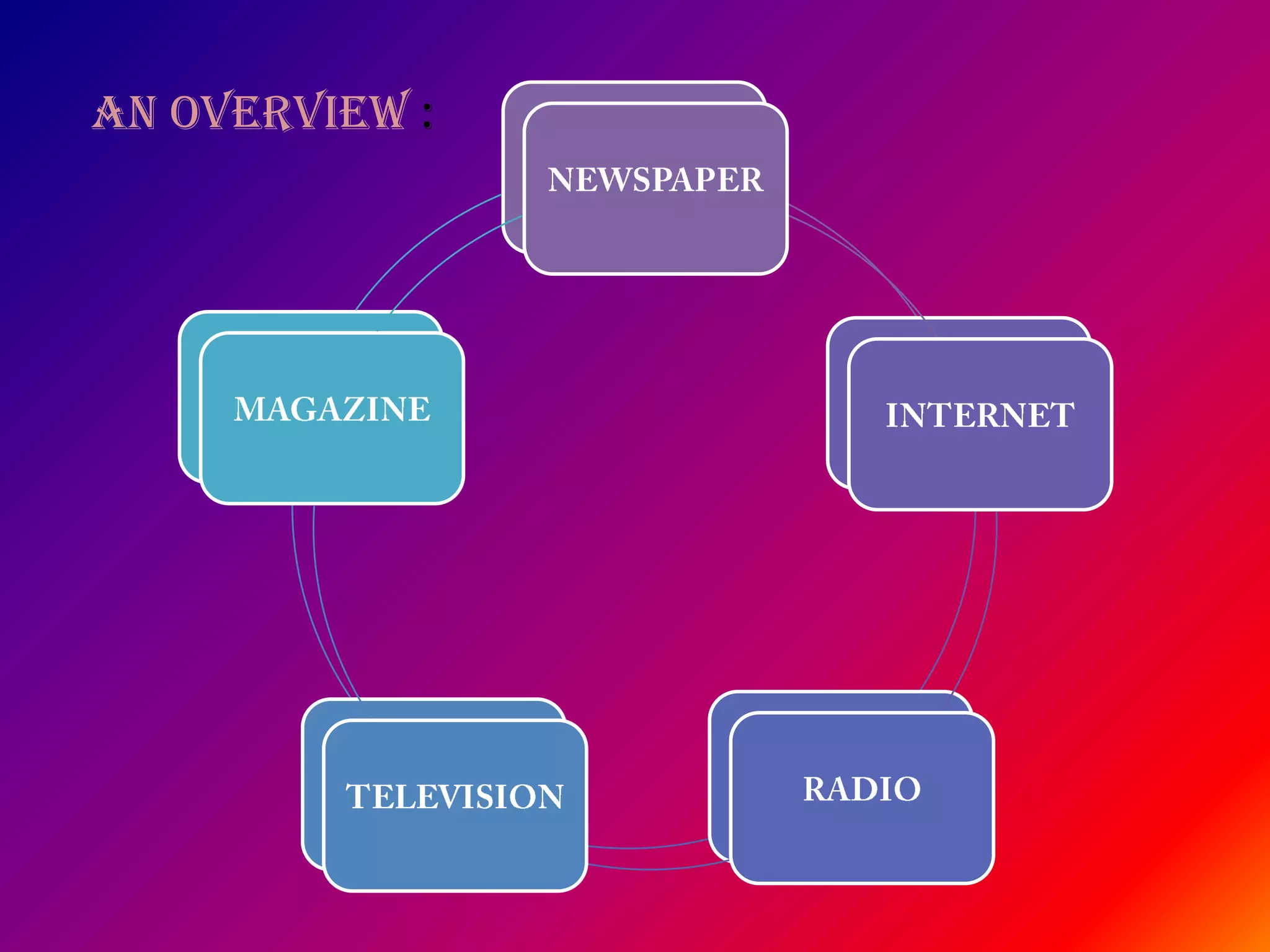
AN OVERVIEW :
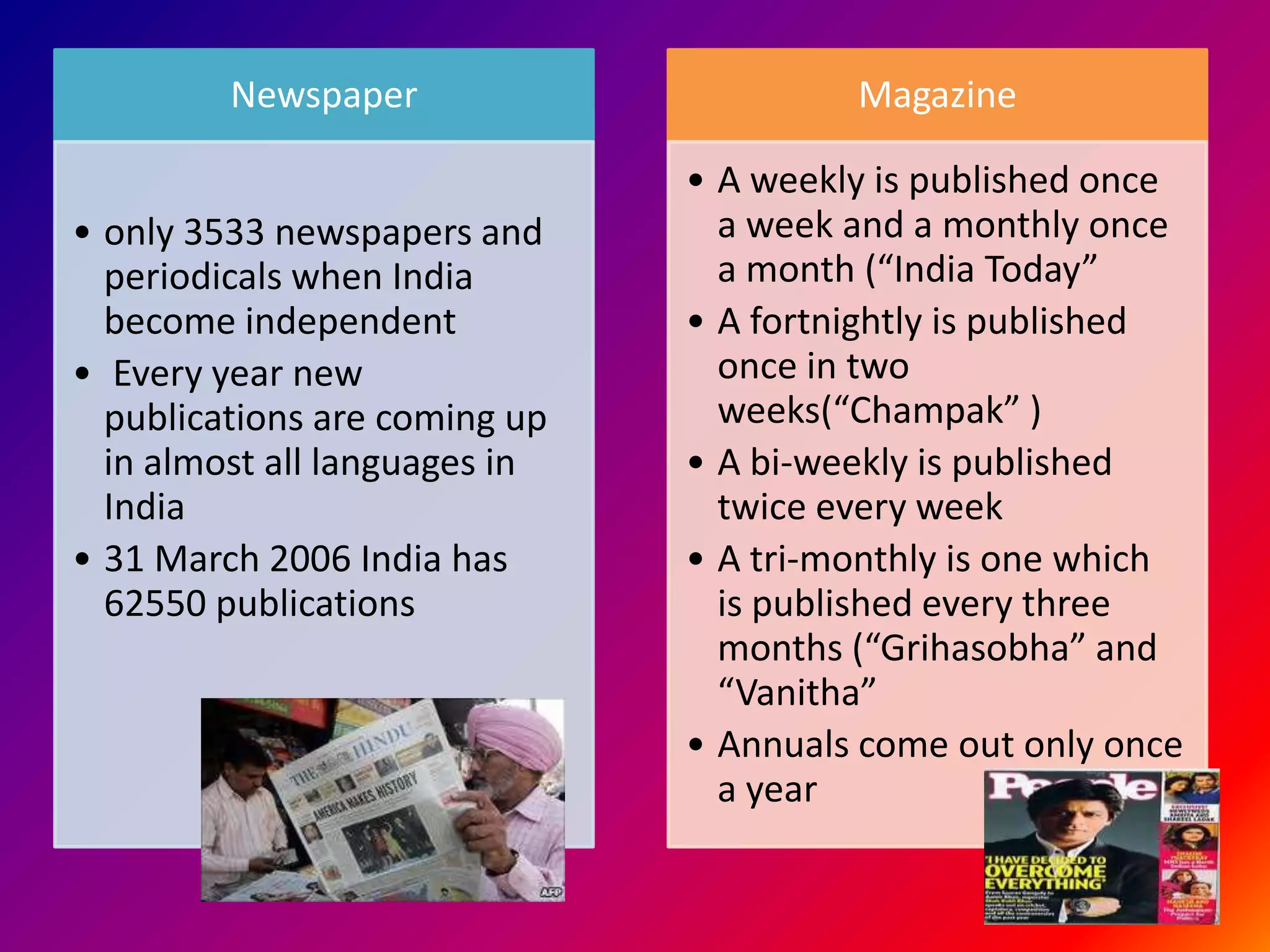
Newspaper                      Magazine

                               • A weekly is published once
• only 3533 newspapers and       a week and a monthly once
  periodicals when India         a month (“India Today”
  become independent           • A fortnightly is published
• Every year new                 once in two
  publications are coming up     weeks(“Champak” )
  in almost all languages in   • A bi-weekly is published
  India                          twice every week
• 31 March 2006 India has      • A tri-monthly is one which
  62550 publications             is published every three
                                 months (“Grihasobha” and
                                 “Vanitha”
                               • Annuals come out only once
                                 a year
• started in India under     • was pioneered in India    • 'Software Development
  All India Radio (AIR) on     by the Madras               and IT Enabled
  15th September 1959          Presidency Club Radio       Services' have emerged
  as an experiment             in 1924                     as a niche opportunity
• educational                • in 1932 the                 for India in the global
  programmes for school        Government of India         context
  children and farmers         took over broadcasting.   • The Government has
• the Indian government        A separate                  announced promotion
  used the American            depart-ment known as        of Information
  satellite ATS-6 to           Indian Broadcasting         Technology as one of
  broadcast educational        Service was opened.         the top five priorities
  programmes to Indian       • The Service was later       of the country and has
  villages                     designated 'All India       constituted a National
• Total number of              Radio' (AIR)The             Task Force on
  channels registered          number of private FM        Information
  with Ministry of             Radio stations in           Technology and
  Information and              operation stood at 248      Software Development.
  Broadcasting has             at the end of June
  increased from 503 in        2010.
  March 2010 to 515 in
  June 2010.
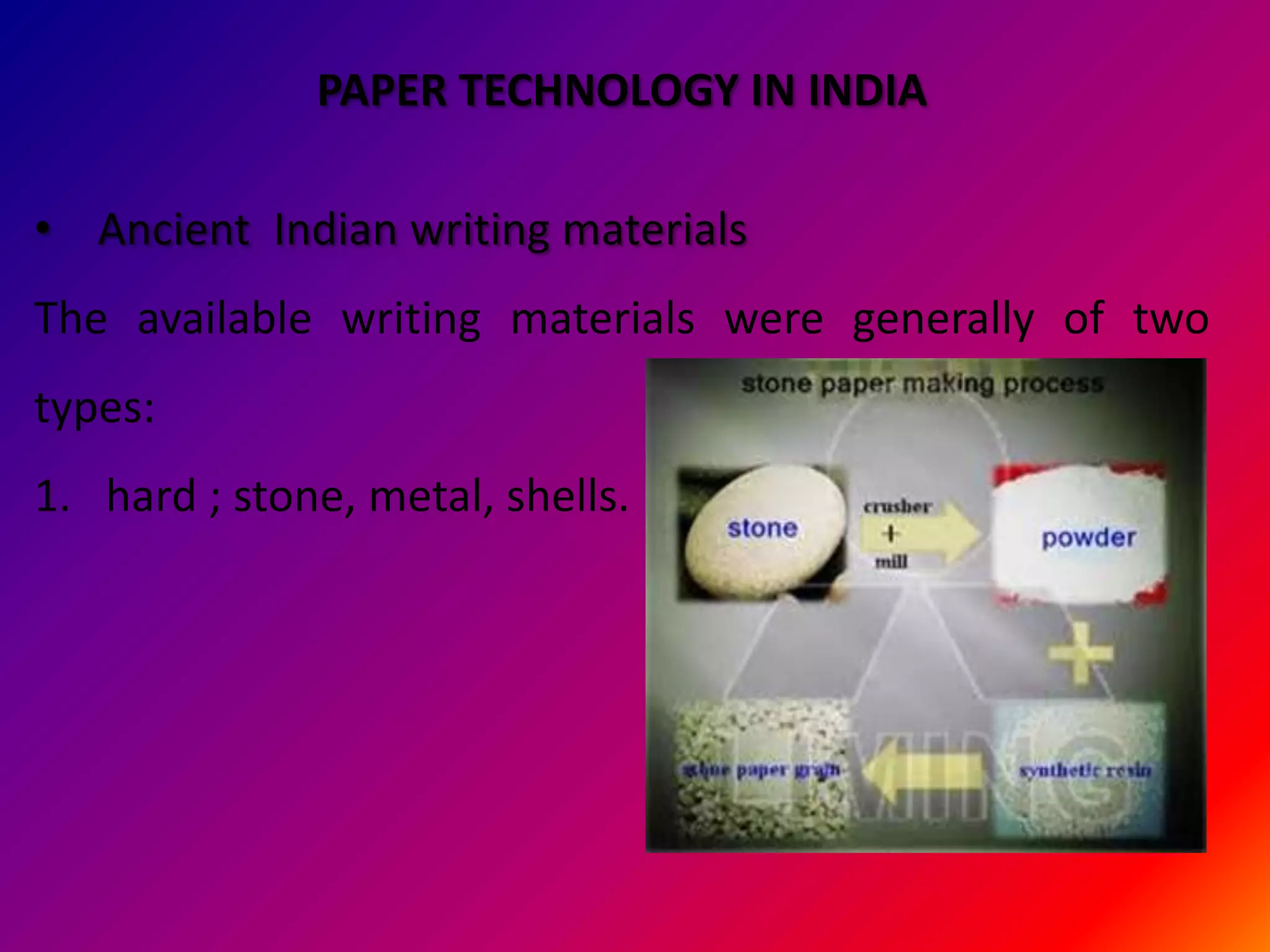
PAPER TECHNOLOGY IN INDIA

• Ancient Indian writing materials
The available writing materials were generally of two
types:
1. hard ; stone, metal, shells.
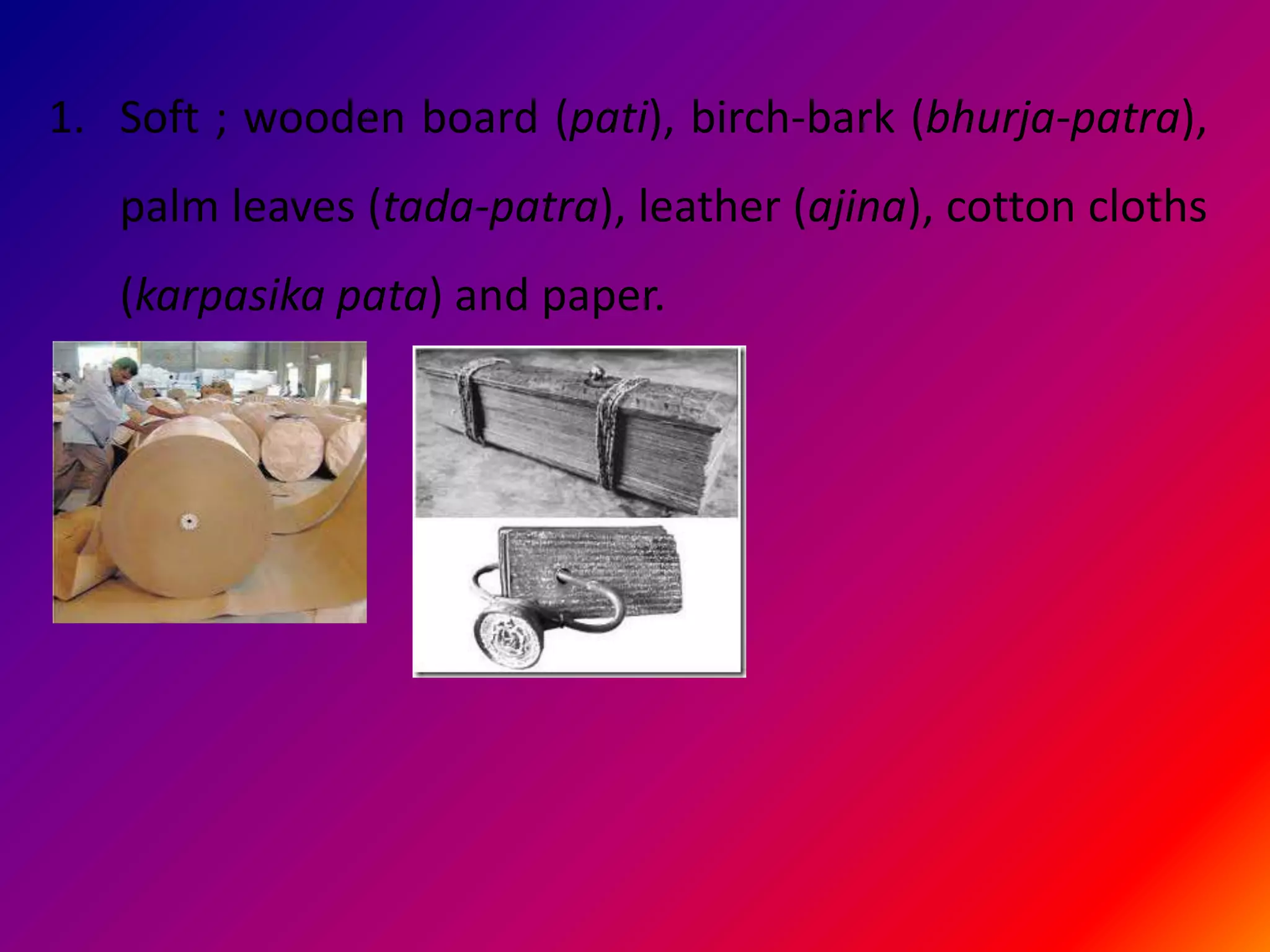
1. Soft ; wooden board (pati), birch-bark (bhurja-patra),
   palm leaves (tada-patra), leather (ajina), cotton cloths
   (karpasika pata) and paper.
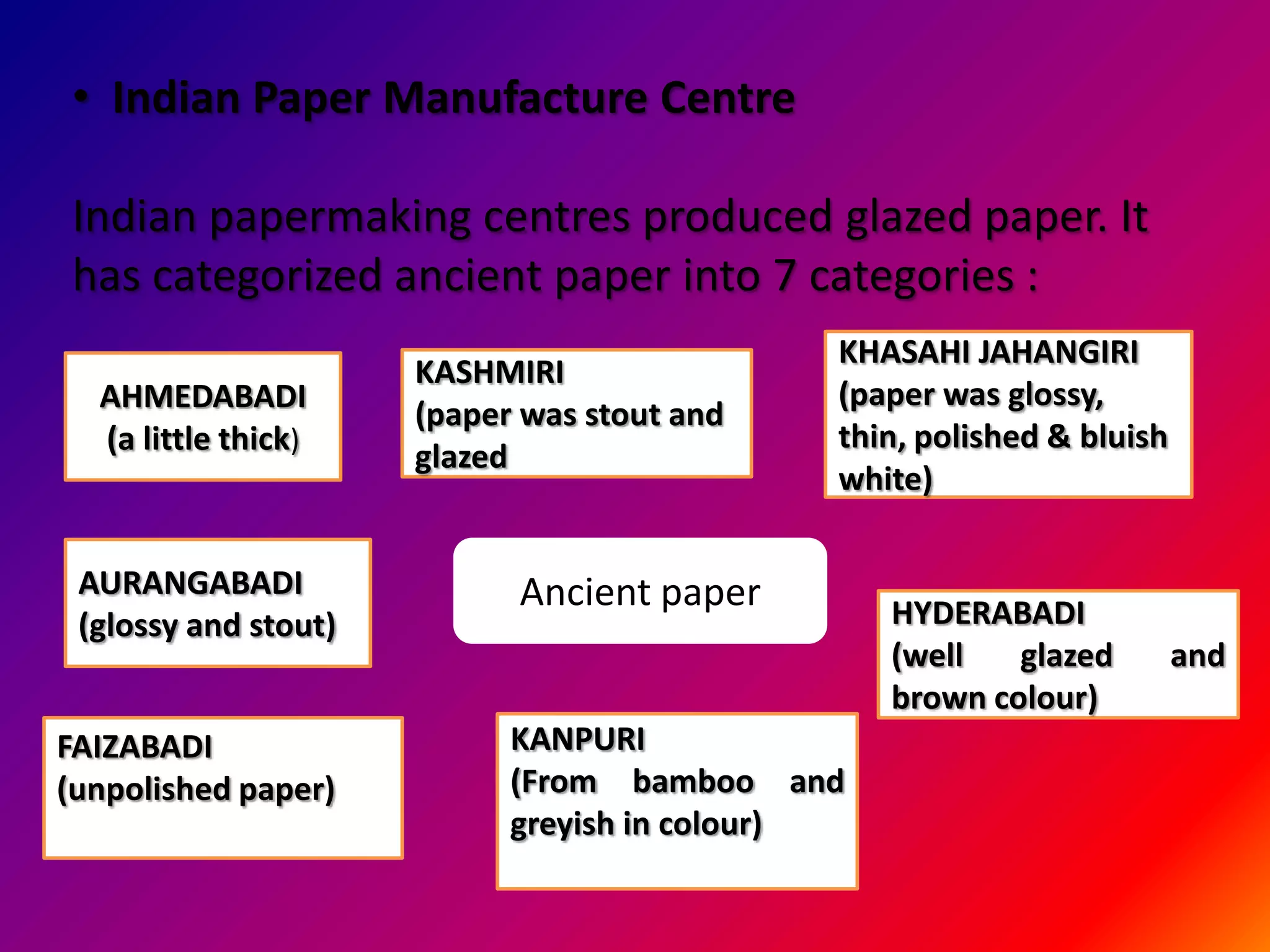
• Indian Paper Manufacture Centre

Indian papermaking centres produced glazed paper. It
has categorized ancient paper into 7 categories :
                                             KHASAHI JAHANGIRI
                      KASHMIRI
  AHMEDABADI                                 (paper was glossy,
                      (paper was stout and
  (a little thick)                           thin, polished & bluish
                      glazed
                                             white)

 AURANGABADI                Ancient paper
 (glossy and stout)                              HYDERABADI
                                                 (well   glazed        and
                                                 brown colour)
FAIZABADI                   KANPURI
(unpolished paper)          (From bamboo and
                            greyish in colour)
PRINT MEDIA DEVELOPMENT

•  Indian print media industry –biggest industries on global scale
   more than 230 years
• Printing media –originated in 1556- Jesuit Priests
• Francis Xavier-Doctrina Crista (1st book was printed in Old Goa)-
   Portuguese language
• Raja Ram Mohan Ray and British Journalists in India made an
   early demand for free press during British periods
• 19th century, 2 categories of newspaper :
1. Began by Serampor Missionaries as the cultural arms of British
   imperialism
2. Consisted of newspapers started by Indians
• Today, newspaper were a role of the freedom struggle
Newspaper
• History-began in 1780 with publication of the Bengal Gazette from
  Calcutta
• The 1st printed newspaper was a weekly publication- but, British not
  consider freedom of the press as good for society and they tried to
  defeat publication of newspaper
• In 1789, 1st newspaper from Bombay- The Bombay Herald, followed
  by „ Bombay Courier‟ (English language)
• Later, this newspaper merged with the Times of India in 1861-
  carried news about areas under the British rule
• Raja Ram Mohan Roy, fought for the freedom of the press edited a
  Persian weekly called „Mirat-ul- Akhbar‟ .
• Then, Samachar Darpan in Bengali was the 1st newspaper in Indian
  language.
•   Now, the total number of newspaper and periodicals produced
    in India around 41,704 in 1997
•   the newspaper collected their news from agencies.
•   Have 4 agencies, Press Trust of India( PTOI), United News of
    India (UNI), Samchar Bharti and Hindustan Smanchar.
•   India consumed 99 million newspaper copies as of 2007,
    making it second largest market in the world for newspaper.
•   Nowadays, there are many newspaper in India such as MP
    Chronicle, Navaabharat , Kannanda Praba and etc.
BOOK
• 1st book, “Doctrina Crista‟ wrote by Francis Xavier printed in
  Kollam using machine imported from Portugal in 1556
• The same book „Thambiraan Vanakkam” published by
  Portuguese missionary Henrique Henriques with paper imported
  from China
• Other book – other language, Bengali, Hindi, Oriya,
  Malayalam, Assamese and Telugu
• In 1897, F.M Colemam was earliest book with color photograph
  publish in India.
• Now,one of the Companies of book manufacturing in India,
  located in Navi Mumbai, Repro India reported stand alone
  earnings results for the third quarter ended December 2010.
• The total income rose 25.65% to Rs 651.35 million, And they
  bocame best of the world for book manufacturing companies
MAGAZINE
• 1st magazine- The Calcutta Monthly Register was published
  In 1790
• In Bombay,, the Bombay magazine was started in 1811 and
  lasted but a short time .
• The Bombay Quarterly Magazine in 1853 gave place to the
  Bombay Quarterly Review , issued in 1855.
• In Madras, - Journal of Literature and Science and the
  Oriental Magazine and Indian Hurkuru(1819)
• Nowadays, the Indian magazine segment has been increased
  rapidly- reach INR 14.9 billion in 2009.
• Over the next three years, it is expected to record an annual
  growth rate of 6-10 % .
• The examples of the magazine in India now in Forbes, Seed
  Today. Cosmopolitan and etc.
MASS MEDIA CONTRIBUTION TOWARD NATION BUILDING


•Politic


    1. One of the modes in revealing the aspect of democracy -
           bring about the downfall of the despot rulers.
    2. Exposes the injustice, oppression, partially and misdeeds
           of society.
    3. Creates awareness among the public - make them
           against the negative ailment in the administrative level.
    4. Act as the supervisor of citizen’s right and privileges.
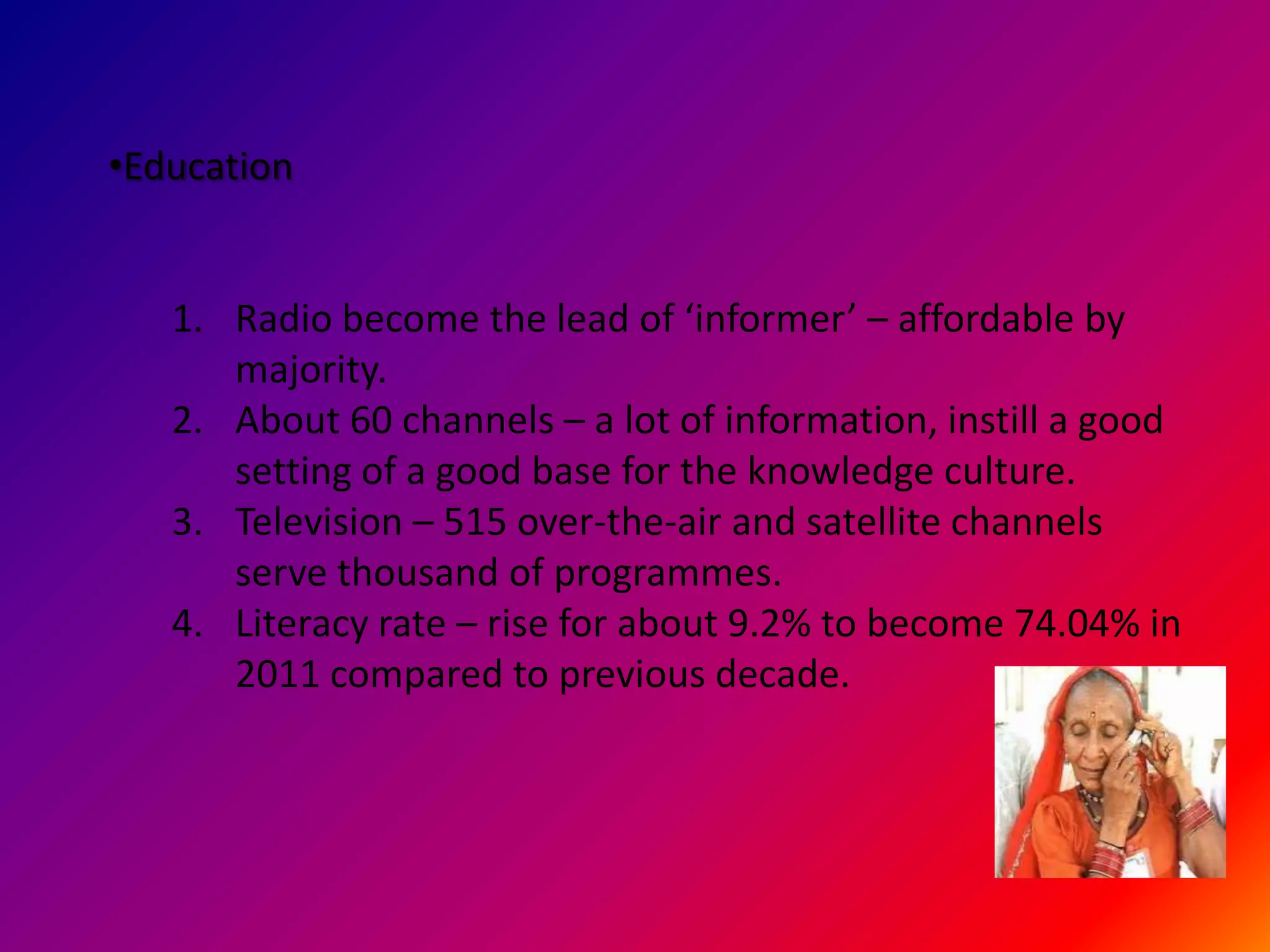
•Education


   1. Radio become the lead of ‘informer’ – affordable by
      majority.
   2. About 60 channels – a lot of information, instill a good
      setting of a good base for the knowledge culture.
   3. Television – 515 over-the-air and satellite channels
      serve thousand of programmes.
   4. Literacy rate – rise for about 9.2% to become 74.04% in
      2011 compared to previous decade.
• Economy
   1. various types of communication media (tv, radio,
      newspaper, magazine and internet) – government
      gain profit through corporation by reap revenue
      from the operation, advertising, subscription and
      sale of copyrighted materials.
   2. has more than 40 000 newspaper ( over 100
      million copies sold each day) and over 500
      satellite channels.
   3. has strong music and film industry.
CONCLUSION

• Each country has its own way in developing mass media in
line with the evolving of technology and the other aspects
such as economy, politics and culture

•The social media widely used by the people in India. There
are over 184 million bloggers generating content, mostly for
free. There are millions of video clippings uploaded daily

•Even after the advent of electronic media, the print media
has not lost its charm or relevance because its has the
advantage of making a longer impact on the minds of the
reader, with more in-depth reporting and analysis.
THANK YOU

print media in India

  • 1.
    Introduction to masscommunication Section 5 MEDIA HISTORY AND DEVELOPMENTS: A STUDY ON INDIAN MASS MEDIA SUHAILAH BINTI ZULKIFLY ( 1019100) FARAH WAHIDA BINTI ARIFFIN (1013546) NUR FASIHATUL HAFIZAH BINTI MOHD KAMAROLZAMAN (1011400) NURUL ATIKAH BINTI AZMI (1018156)
  • 2.
    MASS MEDIA ININDIA The variety ethnic in india is one of factors the increasing of mass media in a various language The contribution of print media in providing information and transfer of knowledge is remarkable and has the advantage of making a longer impact on the minds of the reader, with more in- depth reporting and analysis. The emergence of online media does not effect the requirement of print media, otherwise it generates the development of the country.
  • 3.
  • 4.
    Newspaper Magazine • A weekly is published once • only 3533 newspapers and a week and a monthly once periodicals when India a month (“India Today” become independent • A fortnightly is published • Every year new once in two publications are coming up weeks(“Champak” ) in almost all languages in • A bi-weekly is published India twice every week • 31 March 2006 India has • A tri-monthly is one which 62550 publications is published every three months (“Grihasobha” and “Vanitha” • Annuals come out only once a year
  • 5.
    • started inIndia under • was pioneered in India • 'Software Development All India Radio (AIR) on by the Madras and IT Enabled 15th September 1959 Presidency Club Radio Services' have emerged as an experiment in 1924 as a niche opportunity • educational • in 1932 the for India in the global programmes for school Government of India context children and farmers took over broadcasting. • The Government has • the Indian government A separate announced promotion used the American depart-ment known as of Information satellite ATS-6 to Indian Broadcasting Technology as one of broadcast educational Service was opened. the top five priorities programmes to Indian • The Service was later of the country and has villages designated 'All India constituted a National • Total number of Radio' (AIR)The Task Force on channels registered number of private FM Information with Ministry of Radio stations in Technology and Information and operation stood at 248 Software Development. Broadcasting has at the end of June increased from 503 in 2010. March 2010 to 515 in June 2010.
  • 6.
    PAPER TECHNOLOGY ININDIA • Ancient Indian writing materials The available writing materials were generally of two types: 1. hard ; stone, metal, shells.
  • 7.
    1. Soft ;wooden board (pati), birch-bark (bhurja-patra), palm leaves (tada-patra), leather (ajina), cotton cloths (karpasika pata) and paper.
  • 8.
    • Indian PaperManufacture Centre Indian papermaking centres produced glazed paper. It has categorized ancient paper into 7 categories : KHASAHI JAHANGIRI KASHMIRI AHMEDABADI (paper was glossy, (paper was stout and (a little thick) thin, polished & bluish glazed white) AURANGABADI Ancient paper (glossy and stout) HYDERABADI (well glazed and brown colour) FAIZABADI KANPURI (unpolished paper) (From bamboo and greyish in colour)
  • 9.
    PRINT MEDIA DEVELOPMENT • Indian print media industry –biggest industries on global scale more than 230 years • Printing media –originated in 1556- Jesuit Priests • Francis Xavier-Doctrina Crista (1st book was printed in Old Goa)- Portuguese language • Raja Ram Mohan Ray and British Journalists in India made an early demand for free press during British periods • 19th century, 2 categories of newspaper : 1. Began by Serampor Missionaries as the cultural arms of British imperialism 2. Consisted of newspapers started by Indians • Today, newspaper were a role of the freedom struggle
  • 10.
    Newspaper • History-began in1780 with publication of the Bengal Gazette from Calcutta • The 1st printed newspaper was a weekly publication- but, British not consider freedom of the press as good for society and they tried to defeat publication of newspaper • In 1789, 1st newspaper from Bombay- The Bombay Herald, followed by „ Bombay Courier‟ (English language) • Later, this newspaper merged with the Times of India in 1861- carried news about areas under the British rule • Raja Ram Mohan Roy, fought for the freedom of the press edited a Persian weekly called „Mirat-ul- Akhbar‟ . • Then, Samachar Darpan in Bengali was the 1st newspaper in Indian language.
  • 11.
    Now, the total number of newspaper and periodicals produced in India around 41,704 in 1997 • the newspaper collected their news from agencies. • Have 4 agencies, Press Trust of India( PTOI), United News of India (UNI), Samchar Bharti and Hindustan Smanchar. • India consumed 99 million newspaper copies as of 2007, making it second largest market in the world for newspaper. • Nowadays, there are many newspaper in India such as MP Chronicle, Navaabharat , Kannanda Praba and etc.
  • 12.
    BOOK • 1st book,“Doctrina Crista‟ wrote by Francis Xavier printed in Kollam using machine imported from Portugal in 1556 • The same book „Thambiraan Vanakkam” published by Portuguese missionary Henrique Henriques with paper imported from China • Other book – other language, Bengali, Hindi, Oriya, Malayalam, Assamese and Telugu • In 1897, F.M Colemam was earliest book with color photograph publish in India. • Now,one of the Companies of book manufacturing in India, located in Navi Mumbai, Repro India reported stand alone earnings results for the third quarter ended December 2010. • The total income rose 25.65% to Rs 651.35 million, And they bocame best of the world for book manufacturing companies
  • 13.
    MAGAZINE • 1st magazine-The Calcutta Monthly Register was published In 1790 • In Bombay,, the Bombay magazine was started in 1811 and lasted but a short time . • The Bombay Quarterly Magazine in 1853 gave place to the Bombay Quarterly Review , issued in 1855. • In Madras, - Journal of Literature and Science and the Oriental Magazine and Indian Hurkuru(1819) • Nowadays, the Indian magazine segment has been increased rapidly- reach INR 14.9 billion in 2009. • Over the next three years, it is expected to record an annual growth rate of 6-10 % . • The examples of the magazine in India now in Forbes, Seed Today. Cosmopolitan and etc.
  • 14.
    MASS MEDIA CONTRIBUTIONTOWARD NATION BUILDING •Politic 1. One of the modes in revealing the aspect of democracy - bring about the downfall of the despot rulers. 2. Exposes the injustice, oppression, partially and misdeeds of society. 3. Creates awareness among the public - make them against the negative ailment in the administrative level. 4. Act as the supervisor of citizen’s right and privileges.
  • 15.
    •Education 1. Radio become the lead of ‘informer’ – affordable by majority. 2. About 60 channels – a lot of information, instill a good setting of a good base for the knowledge culture. 3. Television – 515 over-the-air and satellite channels serve thousand of programmes. 4. Literacy rate – rise for about 9.2% to become 74.04% in 2011 compared to previous decade.
  • 16.
    • Economy 1. various types of communication media (tv, radio, newspaper, magazine and internet) – government gain profit through corporation by reap revenue from the operation, advertising, subscription and sale of copyrighted materials. 2. has more than 40 000 newspaper ( over 100 million copies sold each day) and over 500 satellite channels. 3. has strong music and film industry.
  • 17.
    CONCLUSION • Each countryhas its own way in developing mass media in line with the evolving of technology and the other aspects such as economy, politics and culture •The social media widely used by the people in India. There are over 184 million bloggers generating content, mostly for free. There are millions of video clippings uploaded daily •Even after the advent of electronic media, the print media has not lost its charm or relevance because its has the advantage of making a longer impact on the minds of the reader, with more in-depth reporting and analysis.
  • 18.